The New York Times reports: Nations have dragged their feet in battling climate change so much that the situation has grown critical and the risk of severe economic disruption is rising, according to a UN draft report. Another 15 years of failure to limit carbon emissions could make the problem virtually impossible to solve with current technologies, the experts found.
Delay would probably force future generations to develop the capability to suck greenhouse gases out of the atmosphere and store them underground to preserve the livability of the planet, the report found. But it is not clear whether such technologies will ever exist at the necessary scale, and even if they do, the approach would probably be wildly expensive compared with taking steps now to slow emissions.
The report said that governments of the world were still spending far more money to subsidize fossil fuels than to accelerate the shift to cleaner energy, thus encouraging continued investment in projects like coal-burning power plants that pose a long-term climate risk.
While the spread of technologies like solar power and wind farms might give the impression of progress, the report said, such developments are being overtaken by rising emissions from fossil fuels over the past decade, especially in fast-growing countries like China. And one of the most important sources of low-carbon energy, nuclear power, is actually declining over time as a percentage of the global energy mix, the report said.
“The fundamental drivers of emissions growth are expected to persist despite major improvements in energy supply” and in the efficiency with which energy is used, the report declared.
The new warnings come in a draft report from the Intergovernmental Panel on Climate Change, a panel of climate experts that won the Nobel Peace Prize in 2007 for its efforts to analyze and communicate the risks of climate change. The report is not final, but a draft dated Dec. 17 leaked this week and was first reported by Reuters. The New York Times obtained a copy independently. [Continue reading…]
Category Archives: United Nations
EU must open doors to avoid Syrian refugee catastrophe, says UN
The Guardian reports: The crisis posed by millions of refugees from Syria’s civil war flooding into neighbouring countries is becoming a humanitarian and political catastrophe that can only be eased if Europe opens its doors, the UN and European commission have warned.
More than 2.1 million refugees have been registered by the UN high commissioner for refugees (UNHCR) in Syria’s four neighbouring states; hundreds of thousands more are known to be living outside Syria’s borders without access to aid.
The scale of the crisis is perhaps the most acute since the end of the second world war. David Miliband, president of the International Rescue Committee (IRC), described the ever-deteriorating situation in Syria as “the defining humanitarian crisis of our time”.
The UNHCR, European commission and British Refugee Council have urged EU leaders to acknowledge the exceptional crisis posed by the Syrian civil war and accept the temporary settlement of Syrian refugees inside their borders – relaxing “fortress” policies designed to keep migrants out of Europe.
The UN has issued an urgent call to resettle 30,000 of the most vulnerable Syrians worldwide – a call that remains unmet as the exodus from Syria into Turkey, Lebanon, Jordan and Iraq fast outpaces the capacity to provide for them. The UK government has refused to take part in the resettlement scheme, calling the idea tokenistic and stressing the importance of the £500m of aid it has sent to the region. [Continue reading…]
Kerry opens door to Iran’s participation in Syrian peace talks
The New York Times reports: Secretary of State John Kerry suggested on Sunday that Iran might play a role at the peace talks on Syria that are scheduled to take place this month.
It was the first time that a senior American official had indicated that Iranian diplomats might participate in the session, which is to convene in Switzerland on Jan. 22.
But Mr. Kerry also made clear that there would be limits on Iran’s role if Tehran did not formally accept that the goal of the conference would be to work out arrangements for a transitional authority that would govern Syria if President Bashar al-Assad could be persuaded to give up power.
“Now, could they contribute from the sidelines? Are there ways for them conceivably to weigh in?” Mr. Kerry said, referring to the Iranians. “Can their mission that is already in Geneva be there in order to help the process?”
“It may be that that could happen, but that has to be determined by the secretary general,” he added, referring to Ban Ki-moon of the United Nations. “It has to be determined by Iranian intentions themselves.” [Continue reading…]
Al Nusra leader targeting UN workers in Syria
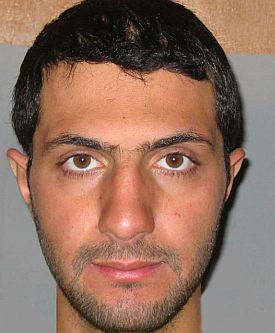
The Associated Press reports: The shadowy leader of a powerful al-Qaida group fighting in Syria sought to kidnap United Nations workers and scrawled out plans for his aides to take over in the event of his death, according to excerpts of letters obtained Wednesday by The Associated Press.If this is indeed the leader of Jabhat al-Nusra, presumably it is not a recent photograph.
Iraqi intelligence officials offered the AP the letters, as well as the first known photograph of the Nusra Front leader, Abu Mohammed al-Golani, the head of one of the most powerful bands of radicals fighting the Syrian government in the country’s civil war.
The officials said they obtained the information about al-Golani after they captured members of another al-Qaida group in September. They spoke on condition of anonymity because they weren’t authorized to speak to journalists.
“I was told by a soldier that he observed some of the workers of the U.N. and he will kidnap them. I ask God for his success,” read an excerpt of a letter given by officials from Iraq’s Falcon Intelligence Cell, an anti-terrorism unit that works under Prime Minister Nouri al-Maliki.
The officials said other letters planned the kidnapping and killing of other foreigners, and Syrian and Iraqi civilians.
One U.N. worker was kidnapped for eight months in Syria and was released in October. Another two dozen U.N. peacekeepers were briefly held this year. It’s not clear if those abductions had any relation to al-Golani’s letters. [Continue reading…]
UN envoy says Iran could attend Syria talks
Al Jazeera reports: Whether or not Iran will be among the nations invited to attend Syrian peace talks in Switzerland is still a source of disagreement between the UN and the United States, peace envoy Lakhdar Brahimi has said.
Speaking at a news conference in Geneva on Friday, Brahimi underlined that Tehran was not completely off the list of those who would attend Geneva 2, despite US objections.
“On Iran, we haven’t agreed yet. It’s no secret that we in the United Nations welcome the participation of Iran, but our partners in the United States are still not convinced that Iran’s participation would be the right thing,” Brahimi told reporters after talks with US and Russian officials.
GCHQ and NSA targeted charities, Germans, Israeli PM and EU chief
The Guardian reports: British and American intelligence agencies had a comprehensive list of surveillance targets that included the EU’s competition commissioner, German government buildings in Berlin and overseas, and the heads of institutions that provide humanitarian and financial help to Africa, top-secret documents reveal.
The papers show GCHQ, in collaboration with America’s National Security Agency (NSA), was targeting organisations such as the United Nations development programme, the UN’s children’s charity Unicef and Médecins du Monde, a French organisation that provides doctors and medical volunteers to conflict zones. The head of the Economic Community of West African States (Ecowas) also appears in the documents, along with text messages he sent to colleagues.
The latest disclosures will add to Washington’s embarrassment after the heavy criticism of the NSA when it emerged that it had been tapping the mobile phone of the German chancellor, Angela Merkel.
One GCHQ document, drafted in January 2009, makes clear that the agencies were targeting an email address listed as belonging to another important American ally – the “Israeli prime minister”. Ehud Olmert was in office at the time.
Three further Israeli targets appeared on GCHQ documents, including another email address understood to have been used to send messages between the then Israeli defence minister, Ehud Barak, and his chief of staff, Yoni Koren.
Prominent names that appear in the GCHQ documents include Joaquín Almunia, a Spaniard who is vice-president of the European commission with responsibility for competition policy.
Britain’s targeting of Germany may also prove awkward for the prime minister, David Cameron: in October, he endorsed an EU statement condemning NSA spying on world leaders, including Merkel.
They have both been in Brussels, attending an EU summit that concludes on Friday.
The names and details are the latest revelations to come from documents leaked by the whistleblower Edward Snowden. They provoked a furious reaction from the European commission, Almunia and others on the target lists.
• The commission said the disclosures “are unacceptable and deserve our strongest condemnation. This is not the type of behaviour that we expect from strategic partners, let alone from our own member states.” Almunia said he was “very upset” to discover his name was on GCHQ documents.
• Leigh Daynes, UK executive director of Médecins du Monde, said he was “bewildered by these extraordinary allegations of secret surveillance. Our doctors, nurses and midwives are not a threat to national security. There is absolutely no reason for our operations to be secretly monitored.”
• Another target, Nicolas Imboden, the head of an NGO that provides help to African countries, said the spying on him was “clearly economic espionage and politically motivated”.
• Human Rights Watch, Privacy International and Big Brother Watch condemned the targeting.
• Labour said the committee that oversees GCHQ should be given extra powers.
The disclosures reflect the breadth of targets sought by the agencies, which goes far beyond the desire to intercept the communications of potential terrorists and criminals, or diplomats and officials from hostile countries. [Continue reading…]
Pro forma denials from GCHQ and the NSA that they are engaged in economic espionage are to be expected. But agencies that don’t provide clear explanations about what they are doing, can hardly be expected to have such denials accepted without question.
The targeting of NGOs will probably heighten suspicions that these organizations are being used to provide cover for intelligence agencies and that in turn will undermine relief and development work in countries where populations are in need but their governments feel easily threatened.
The New York Times reports: The reports show that spies monitored the email traffic of several Israeli officials, including one target identified as “Israeli prime minister,” followed by an email address. The prime minister at the time of the interception, in January 2009, was Ehud Olmert. The following month, spies intercepted the email traffic of the Israeli defense minister, Ehud Barak, according to another report. Two Israeli embassies also appear on the target lists.
Mr. Olmert said in a telephone interview Friday that the email address was used for correspondence with his office, which he said staff members often handled. He added that it was unlikely that any secrets could have been compromised.
“This was an unimpressive target,” Mr. Olmert said. He noted, for example, that his most sensitive discussions with President George W. Bush took place in private. “I would be surprised if there was any attempt by American intelligence in Israel to listen to the prime minister’s lines,” he said.
Mr. Barak, who declined to comment, has said publicly that he used to take it for granted that he was under surveillance.
Despite the close ties between the United States and Israel, the record of mutual spying is long: Israeli spies, including Jonathan Jay Pollard, who was sentenced in 1987 to life in prison for passing intelligence information to Israel, have often operated in the United States, and the United States has often turned the capabilities of the N.S.A. against Israel.
The interception of Mr. Olmert’s office email occurred while he was dealing with fallout from Israel’s military response to rocket attacks from Gaza, but also at a particularly tense time in relations with the United States. The two countries were simultaneously at odds on Israeli preparations to attack Iran’s nuclear program and cooperating on a wave of cyberattacks on Iran’s major nuclear enrichment facility.
A year before the interception of Mr. Olmert’s office email, the documents listed another target, the Institute of Physics at the Hebrew University of Jerusalem, an internationally recognized center for research in atomic and nuclear physics. [Continue reading…]
Syria’s chemical weapons to travel by guarded convoy before destruction
The Guardian reports: Syria’s chemical weapon arsenal is to be taken cross-country in Russian armoured trucks guarded by Syrian government troops and tracked by American satellite navigation equipment on its way to the Mediterranean coast.
The unprecedented and precarious two-week operation will take the cargo – 500 tonnes of chemical components of sarin and VX nerve agents and canisters of mustard gas – from 12 sites around the country to the port of Latakia, where they will be loaded onto Danish and Norwegian cargo ships.
China will provide surveillance cameras and ambulances on stand-by in case of any accidents, while Finland has offered to provide its own emergency response teams.
The ships will sail under Danish and Norwegian naval escort to an unnamed Italian port to be transferred to a US vessel, the Cape Ray, which will be carrying two chemical reactor chambers to neutralise the chemical weapons while at sea. On-board tankerswill store the by-products for later incineration. [Continue reading…]
UN falls short of feeding Syria’s hungry as winter bites
Reuters reports: The United Nations said on Tuesday it had delivered food to 3.4 million people in Syria in November, falling short again of its monthly target of 4 million as heavy fighting kept it from reaching hungry people in contested areas.
As winter bites, the number of children in Syria deemed vulnerable and in need of assistance has nearly quadrupled from a year ago to 4.3 million, the U.N. Children’s Fund (UNICEF) said.
“The scale of the humanitarian response needed for the looming winter is unprecedented,” it said in a statement.
U.N. aid chief Valerie Amos was to brief the Security Council on the humanitarian situation in Syria later on Tuesday amid deep concerns about lack of access to besieged civilians.
A U.N. document obtained by Reuters last week said around 250,000 people were beyond the reach of its aid convoys, in areas besieged by Syrian government forces or rebels. [Continue reading…]
Syria’s chemical weapon transport issues
Brown Moses Blog: Syria’s Deputy Foreign Minister Faisal Mekdad has told the BBC his government needs the international community to provide military equipment, to help transport their chemical weapons out of the country. Mr Mekdad was attending an Organisation for the Prohibition of Chemical Weapons meeting in The Hague.
The Assad Regime is required under the auspices of the UN Security Council to remove all chemical agent and the most toxic precursors about 630 tonnes in total from Syria by 31 Dec 13 and the less toxic precursors, around 700 tonnes by Feb 14. There appear to be 3 phases to the plan, firstly, to move the 1330 tonnes to the Port of Latakia, secondly to transport these chemicals to the MV Cape Ray presumably in the Mediterranean somewhere, and to commercial toxic waste destruction facilities and finally to destroy the most toxic by hydrolysis on the MV Cape Ray and the rest by normal convention toxic waste destruction at civilian facilities, by mid 2014 – all possible, well apparently, until yesterday’s 11th hour request by Minister Mekdad.
It is understood that most of the CW is North of Damascus and will have to move through a number of contested areas before it reaches Latakia. Sigrid Kaag head of the UN/OPCW in Damascus admitted on Sat 30 Nov 13 on BBC World Service that the route to the Port is currently blocked. It is the Regimes responsibility to deliver the CW, as per the CWC, to the Port whence it will be loaded onto ships to become the responsibility of the International Community under supervision of, and verification by the OPCW.
Phase 1 planning for the movement to the Port is an extremely complex military operation with many factors which must be worked through in finite detail, from force protection, to logistics, communications, capabilities required and many alternative options if things go wrong. Ideally, it would take a sophisticated military like the US or UK many days and weeks with great expertise to plan such an operation. One of the initial stages of military planning is working out whether you have enough ‘Troops to Task’ or forces available, to achieve the mission. It would appear at the 11th hour, rather than the First or Second, that the Regime planners have decided they do not have the ‘Troops for the Task’ and now require the International Community to supply, presumably Tanks, armoured personnel carriers etc in order to be able to achieve the mission. Even if the International community was minded to supply this hardware there is no way it could be handed over the Regime and trained on in order to deliver the CW to the Port by 31 Dec 13. But surely the UN and OPCW have been intermittently involved in this planning and this would be apparent at the outset, or are the Regime only involving them [UN/OPCW] when it is convenient? [Continue reading…]
Edward Snowden revelations prompt UN investigation into surveillance
The Guardian reports: The UN’s senior counter-terrorism official is to launch an investigation into the surveillance powers of American and British intelligence agencies following Edward Snowden’s revelations that they are using secret programmes to store and analyse billions of emails, phone calls and text messages.
The UN special rapporteur Ben Emmerson QC said his inquiry would also seek to establish whether the British parliament had been misled about the capabilities of Britain’s eavesdropping headquarters, GCHQ, and whether the current system of oversight and scrutiny was strong enough to meet United Nations standards.
The inquiry will make a series of recommendations to the UN general assembly next year. [Continue reading…]
Syrian war is making casualties of ‘a generation of innocents,’ warns UN
Al Jazeera America reports: School-age refugees who have fled Syria’s civil war to neighboring countries are cut off from education and are increasingly becoming primary providers for families who lack resources for basic survival, the United Nations said Friday.
A report published by the U.N.’s refugee agency (UNHCR) says children represent 52 percent of the total Syrian refugee population, which now exceeds 2.2 million. Seventy-five percent of those children are under the age of 12.
“If we do not act quickly, a generation of innocents will become lasting casualties of an appalling war,” Antonio Guterres, the U.N. High Commissioner for Refugees, said in launching the report.
The UNHCR report found a majority of the refugee children live in Syria’s neighboring countries, with Jordan and Lebanon combined hosting more than 60 percent. As of the end of October, 291,238 Syrian refugee children were living in Jordan and 385,007 in Lebanon.
“This is the moment for the international community to fully understand that the support provided to the countries of the region needs to be strongly enhanced, needs to be really massive, because there is a risk for the asylum space if that doesn’t happen,” Guterres added. [Continue reading…]
Destruction of Syria’s chemical weapons may be outsourced to private contractors
The Associated Press reports: The global chemical weapons watchdog is inviting private companies to bid to get involved in destroying Syria’s stockpile of toxic agents and precursor chemicals.
The Organization for the Prohibition of Chemical Weapons is posting a request for “expressions of interest” from companies who want a role in “the treatment and disposal of hazardous and non-hazardous organic and inorganic chemicals.”
Video: Leaked memo reveals U.S. plan to oppose helping poor nations adapt to climate change
Why has the UN given Assad a free pass on mass murder?
Colum Lynch reports: During the past year, the United Nations’ chief relief agency has routinely withheld from the public vital details of the Bashar al-Assad regime’s systematic campaign to block humanitarian assistance to Syrian civilians. This silence has infuriated human rights advocates, who believe that greater public exposure of Assad’s actions would increase political pressure on the Syrian government to allow the international community to help hundreds of thousands of ordinary Syrians who are trapped in the line of fire.
Instead, the U.N. Office for the Coordination of Humanitarian Affairs (OCHA) — which oversees international relief efforts in Syria — has relied on low-key, behind-the-scenes diplomacy to quietly persuade the Syrian regime to open the aid floodgates. So far, critics say, the strategy has been ineffective. Worse, it provides a measure of political cover to the Assad regime as it carries out mass starvation and slaughter, these critics contend.
The U.N. “should be much more willing to point the finger at the Syrian government when they are responsible for vast blockages of aid. They haven’t said enough about who is responsible for violations and the character of those violations,” said Peggy Hicks, the head of advocacy for Human Rights Watch. “There is always a balancing act, but we have been concerned that the U.N. has been reluctant to recognize the limits of working behind the scenes.” [Continue reading…]
The fight against climate injustice
The New York Times reports: Following a devastating typhoon that killed thousands in the Philippines, a routine international climate change conference here turned into an emotional forum, with developing countries demanding compensation from the worst polluting countries for damage they say they are already suffering.
Calling the climate crisis “madness,” the Philippines representative vowed to fast for the duration of the talks. Malia Talakai, a negotiator for the Alliance of Small Island States, a group that includes her tiny South Pacific homeland, Nauru, said that without urgent action to stem rising sea levels, “some of our members won’t be around.”
From the time a scientific consensus emerged that human activity was changing the climate, it has been understood that the nations that contributed least to the problem would be hurt the most. Now, even as the possible consequences of climate change have surged — from the typhoons that have raked the Philippines and India this year to the droughts in Africa, to rising sea levels that threaten to submerge entire island nations — no consensus has emerged over how to rectify what many call “climate injustice.”
Growing demands to address the issue have become an emotionally charged flash point at negotiations here at the 19th conference of the United Nations Framework Convention on Climate Change, which continues this week.
“We are in a piece of land which is smaller than Denmark, with a population of 160 million, trying to cope with this extreme weather, trying to cope with the effect of emissions for which we are not responsible,” Farah Kabir, the director in Bangladesh for the anti-poverty organization ActionAid International, said at a news briefing here. [Continue reading…]
Yassin Kadi’s ordeal at the hands of the U.S. security services is Kafka incarnate
Giles Fraser writes: As I am walking out of Temple tube station, past a row of young men in uniform selling poppies – men who look as if they have seen too much bloodshed in places like Afghanistan – I can’t help but speculate to myself about the identity of the person I am about to meet.
Will he really be what he claims to be – an innocent victim of post 9/11 panic? Or is he a “specially designated global terrorist”, previously connected to Osama Bin Laden and a financier of international terrorism, as US law continues to maintain? It feels odd to be meeting him in central London.
And yet, except in the very vaguest of terms, no one has ever told Sheikh Yassin Abdullah Kadi what he is supposed to have done. The US evidence against the Saudi Arabian former architect is classified. His lawyers cannot see it. He cannot see it. And so, for 11 years, Sheikh Kadi has been fighting an invisible charge.
When Franz Kafka wrote The Trial back in 1914/5, he thought his story far-fetched, more an existentialist dystopia than a prophecy of future events. Joseph K is arrested on an unknown charge and brought before a secret court where the charge is never explained. But a century later, this doesn’t feel at all far-fetched. [Continue reading…]
U.S., Israel lose voting rights at UNESCO over Palestine row
Reuters reports: UNESCO has suspended the voting rights of the United States and Israel, two years after both countries stopped paying dues to the U.N.’s cultural arm in protest over its granting full membership to the Palestinians.
The U.S. decision to cancel its funding in October 2011 was blamed on U.S. laws that prohibit funding to any U.N. agency that implies recognition of the Palestinians’ demands for their own state.
Israel also pulled its funding, objecting to what it called unilateral attempts by the Palestinians to gain recognition of statehood.
Both countries missed a 1100 GMT Friday deadline to provide an official justification for non-payment and a plan to pay back missed dues, a UNESCO source told Reuters. That automatically triggered suspension of their voting rights. [Continue reading…]
40 percent of Syrian population need humanitarian assistance, says UN
Reuters reports: The United Nations estimates that around 9.3 million people in Syria or about 40 percent of the population need humanitarian assistance due to the country’s 2-1/2-year, the U.N. humanitarian office said on Monday.
“The humanitarian situation in Syria continues to deteriorate rapidly and inexorably,” U.N. humanitarian chief Valerie Amos told the U.N. Security Council behind closed doors, according to her spokeswoman Amanda Pitt.
“The number of people we estimate to be in need of humanitarian assistance in Syria has now risen to some 9.3 million,” Pitt said, summarizing Amos’ remarks to the 15-nation council. “Of them, 6.5 million people are displaced from their homes, within the country.” [Continue reading…]