Category Archives: US government

CIA drones quit one Pakistan site — but U.S. keeps access to other airbases

The Bureau of Investigative Journalism reports: Despite its very public withdrawal from Shamsi airfield at the weekend, the United States continues to have access to a number of military airfields inside Pakistan – including at least one from which armed drones are able to operate, the Bureau understands.

The first concrete indications have also emerged that the US has now effectively suspended its drone strikes in Pakistan. The Bureau’s own data registers no CIA strikes since November 17.

Islamabad is furious in the wake of a NATO attack which recently killed 24 Pakistani soldiers on its Afghan borders. As well as suspending NATO supply convoys through Pakistan, anti-aircraft missiles have also reportedly been moved to the border with Afghanistan. Pakistan also demanded that the US withdraw from Shamsi, a major airfield in Balochistan controlled and run by the Americans since late 2001.

US Predator and Reaper drones have operated from the isolated airbase for many years. Technically the base is leased to Abu Dhabi in the United Arab Emirates, which allowed Pakistan to deny a US presence for many years. Now the US has quit Shamsi, with large US transporter planes stripping military hardware from the base.

But the US will continue to have access to at least five other Pakistani military facilities, according to a Pakistani source with extensive knowledge of US-Pakistani military and intelligence co-operation.

Facebooktwittermail

For U.S. marines, killing civilians was ‘a cost of doing business’ in Iraq

The New York Times reports: One by one, the Marines sat down, swore to tell the truth and began to give secret interviews discussing one of the most horrific episodes of America’s time in Iraq: the 2005 massacre by Marines of Iraqi civilians in the town of Haditha.

“I mean, whether it’s a result of our action or other action, you know, discovering 20 bodies, throats slit, 20 bodies, you know, beheaded, 20 bodies here, 20 bodies there,” Col. Thomas Cariker, a commander in Anbar Province at the time, said to investigators as he described the chaos of Iraq. At times, he said, deaths were caused by “grenade attacks on a checkpoint and, you know, collateral with civilians.”

The 400 pages of interrogations, once closely guarded as secrets of war, were supposed to have been destroyed as the last American troops prepare to leave Iraq. Instead, they were discovered along with reams of other classified documents, including military maps showing helicopter routes and radar capabilities, by a reporter for The New York Times at a junkyard outside Baghdad. An attendant was burning them as fuel to cook a dinner of smoked carp.

The documents — many marked secret — form part of the military’s own internal investigation, and confirm much of what happened at Haditha, a Euphrates River town where Marines killed 24 Iraqis, including a 76-year-old man in a wheelchair, women and children, some just toddlers.

Haditha became a defining moment of the war, helping cement an enduring Iraqi distrust of the United States and a resentment that not a single Marine was ever prosecuted. That is one of the main reasons that all American combat troops are leaving by the weekend.

But the accounts are just as striking for what they reveal about the extraordinary strains on the soldiers who were assigned here, their frustrations and their frequently painful encounters with a population they did not understand. In their own words, the report documents the dehumanizing nature of this war, where Marines came to view 20 dead civilians as not “remarkable,” but as routine.

Iraqi civilians were being killed all the time. Maj. Gen. Steve Johnson, the commander of American forces in Anbar Province, in his own testimony, described it as “a cost of doing business.”

Facebooktwittermail

Hezbollah and the U.S. government — tangled ties to drug cartels

Make of this tangled web, what you will. All I can say is that the key words — ties and links — don’t have a lot of substance.

Lebanon is a small country inside which Hezbollah is the most powerful political organization. To identify a person or a business in Lebanon as having ties to Hezbollah doesn’t say a great deal.

A New York Times report alleges that an investigation of the books of the Lebanese Canadian Bank (LCB) “offer evidence of an intricate global money-laundering apparatus that, with the bank as its hub, appeared to let Hezbollah move huge sums of money into the legitimate financial system, despite sanctions aimed at cutting off its economic lifeblood.”

(The LCB was recently acquired by the Lebanese subsidiary of the major European bank, Societe Generale, which itself happens to have been the largest beneficiary of the U.S. government’s bailout of AIG, receiving $16.5 billion — but that’s a whole other banking story!)

The report says:

While law enforcement agencies around the world have long believed that Hezbollah is a passive beneficiary of contributions from loyalists abroad involved in drug trafficking and a grab bag of other criminal enterprises, intelligence from several countries points to the direct involvement of high-level Hezbollah officials in the South American cocaine trade.

One agent involved in the investigation compared Hezbollah to the Mafia, saying, “They operate like the Gambinos on steroids.”

But once the report goes into details, the substance of the ties to Hezbollah amounts to facts like these: one individual involved turns out to be “a relative of a former Hezbollah commander”; Shiite businessmen, “many of them known Hezbollah supporters,” are involved; and Ayman Joumaa, a Sunni Lebanese hotel owner at the center of the scheme possessed cell phones that “linked him to Shiites in Hezbollah strongholds in southern Lebanon.”

The evidence of the laundering scheme may be strong but the ties to Hezbollah seem a bit sketchy. Moreover, the desire of U.S. officials to tar the Shiite movement is quite explicit.

As the case traveled up the administration’s chain of command beginning in the fall of 2010, some officials proposed leaving the Hezbollah link unsaid. They argued that simply blacklisting the bank would disrupt the network while insulating the United States from suspicions of playing politics, especially amid American alarm about ebbing influence in the Middle East. But the prevailing view was that the case offered what one official called “a great opportunity to dirty up Hezbollah” by pointing out the hypocrisy of the “Party of God” profiting from criminal activity.

If Hezbollah is worried about protecting its reputation, it probably has less to fear from the U.S. government than it does from reactions to its response to the uprising in Syria.

Larbi Sadiki writes:

Faced with the Syrian people’s uprising against President Bashar al-Assad and a democratic tsunami sweeping the Middle East, Hezbollah’s alignment with Mr. Assad is destroying its reputation across the Arab world.

The Syrian masses who once worshiped the Hezbollah leader Hassan Nasrallah today curse him when they parade in public squares. The posters of Mr. Assad and Mr. Nasrallah that once adorned car windows and walls throughout Syria are now regularly torched.

Until recently, Mr. Nasrallah, a Shiite, was a pan-Arab icon. His standing as Hezbollah’s chairman and commander of the 2006 war against Israel elevated him to new heights of popularity among Shiites and Sunnis alike, reminiscent of the former Egyptian president Gamal Abdel Nasser’s political stardom following the nationalization of the Suez Canal in 1956.

Not only did Mr. Nasrallah fight Israel next door; he defied pro-American Arab states, trained and protected Hamas in Lebanon, backed Moktada al-Sadr’s Shiite militia as it killed Americans in Iraq, and showed absolute loyalty to Iran. His fans were in the millions. The Arab multitude from Casablanca to Mecca saw him as a genuine hero who talked the talk and fought the good fight.

But when such a wildly popular resistance movement abandons the ideal, much less the practice, of liberation in support of tyranny, it loses credibility with the public.

Fighting Israel as a Syrian proxy is one thing, but opposing the Syrian people’s desire for democratic change is something else entirely.

The Assads are mortals who are today burdened by a moribund political system. Mr. Assad, his brother Maher and their henchmen have managed to trap themselves in a macabre machine of oppression that has left the stench of death in its wake, from Homs to Hama.

Now, Mr. Nasrallah has reason to worry. In one speech, he defensively denied that his troops partake in repressing Syrian protesters. In another, he ignored the Syrian uprising altogether.

Syrians, in Mr. Nasrallah’s eyes, apparently, do not deserve democracy because that would mean the downfall of Hezbollah’s patron in Damascus, not to mention the destruction of the “axis of resistance” that reaches from southern Beirut to Syria and Iran.

Hezbollah’s fellow “resistance” movement, Hamas, has been more politically savvy. It has adapted to the new political landscape, navigating the uncharted territory of the Syrian uprising by impressing onlookers by what it didn’t do and say rather than what it did or said.

Thanassis Cambanis points out that in spite of the criticisms it currently faces, Hezbollah remains a strong force.

[It] boasts the most formidable militia in the Arab world and commands the undivided loyalty of its core supporters, even if the casual fans are drifting away. For the time being, the movement also can count on Iran’s funding, which is critical for them. Even in the year of the Arab uprisings, Nasrallah scored as the most popular Arab leader on the Annual Arab Public Opinion Survey [PDF] (although some non-Arabs did better; Nasrallah was tied with Iranian President Mahmoud Ahmedinejad and behind Turkey’s leader Recep Tayyip Erdogan).

So Hezbollah is unlikely in the short term to diminish as a player.

And Hezbollah’s unmasking of CIA agents in Lebanon serves as a stark reminder that the Party of God is a force with real tools in its arsenal, not just a rhetorically gifted leader who plays well on television. This week, Al Manar aired the name of a man it claims is the current CIA station chief in Beirut; the agency has replaced top officers in Pakistan twice in the last two years when their names were published.

However dim Hezbollah’s long-term prospects, it will remain a critical player in the short term. And if history is any indicator, it might just find a way to emerge from a self-induced crisis that threatens to consign it to irrelevance — once again — even stronger.

Meanwhile, when it comes to investigating ties to the Mexican drug cartels, the operations of the investigators themselves seem to warrant as much scrutiny as the subjects of their investigations.

Earlier this month, the New York Times reported:

Undercover American narcotics agents have laundered or smuggled millions of dollars in drug proceeds as part of Washington’s expanding role in Mexico’s fight against drug cartels, according to current and former federal law enforcement officials.

The agents, primarily with the Drug Enforcement Administration, have handled shipments of hundreds of thousands of dollars in illegal cash across borders, those officials said, to identify how criminal organizations move their money, where they keep their assets and, most important, who their leaders are.

They said agents had deposited the drug proceeds in accounts designated by traffickers, or in shell accounts set up by agents.

The officials said that while the D.E.A. conducted such operations in other countries, it began doing so in Mexico only in the past few years. The high-risk activities raise delicate questions about the agency’s effectiveness in bringing down drug kingpins, underscore diplomatic concerns about Mexican sovereignty, and blur the line between surveillance and facilitating crime. As it launders drug money, the agency often allows cartels to continue their operations over months or even years before making seizures or arrests.

Agency officials declined to publicly discuss details of their work, citing concerns about compromising their investigations. But Michael S. Vigil, a former senior agency official who is currently working for a private contracting company called Mission Essential Personnel, said, “We tried to make sure there was always close supervision of these operations so that we were accomplishing our objectives, and agents weren’t laundering money for the sake of laundering money.”

Another former agency official, who asked not to be identified speaking publicly about delicate operations, said, “My rule was that if we are going to launder money, we better show results. Otherwise, the D.E.A. could wind up being the largest money launderer in the business, and that money results in violence and deaths.”

Those are precisely the kinds of concerns members of Congress have raised about a gun-smuggling operation known as Fast and Furious, in which agents of the Bureau of Alcohol, Tobacco, Firearms and Explosives allowed people suspected of being low-level smugglers to buy and transport guns across the border in the hope that they would lead to higher-level operatives working for Mexican cartels. After the agency lost track of hundreds of weapons, some later turned up in Mexico; two were found on the United States side of the border where an American Border Patrol agent had been shot to death.

So, the DEA is laundering cartel money and the ATF is providing them with guns. What next? Drug kingpins on the CIA payroll? Oh, I guess that’s just old news.

The CIA — which seems to have been down on its luck recently with officers exposed in Beirut, operatives arrested in Iran and a stealth drone captured by Iran’s Revolutionary Guard — does indeed show up in the Times Lebanon story.

The trail began with a man known as Taliban, overheard on Colombian wiretaps of a Medellín cartel, La Oficina de Envigado. Actually, he was a Lebanese transplant, Chekri Mahmoud Harb, and in June 2007, he met in Bogotá with an undercover agent for the Drug Enforcement Administration and sketched out his route.

Cocaine was shipped by sea to Port Aqaba, Jordan, then smuggled into Syria. After Mr. Harb bragged that he could deliver 950 kilos into Lebanon within hours, the undercover agent casually remarked that he must have Hezbollah connections. Mr. Harb smiled and nodded, the agent reported.

A nod and a smile? This is the kind of detail that’s good for a new report, but it would hardly have any value in a trial. But then again, since this is a case that probably won’t ever reach trial, the political value of the indictment seems to figure more prominently than any likely legal outcome.

(Jordanian officials, after extensive surveillance, later told the D.E.A. that the Syrian leg of the shipment was coordinated by a Syrian intelligence officer assigned as a liaison to Hezbollah. From there, multiple sources reported, Hezbollah operatives charged a tax to guarantee shipments into Lebanon.)

Soon the cartel was giving the agent money to launder: $20 million in all. But before Mr. Harb could reveal the entire scheme and identify his Hezbollah contacts, the operation broke down: The C.I.A., initially skeptical of a Hezbollah link, now wanted in on the case. On the eve of a planned meeting in Jordan, it forced the undercover agent to postpone. His quarry spooked. In the end, Mr. Harb was convicted on federal drug trafficking and money-laundering charges, but the window into the organization’s heart had slammed shut.

Lastly, for a story in which Hezbollah figures so prominently, here’s perhaps the most curious detail about the legal case around which the story revolves: the indictment unveiled by the U.S. Attorney in the Eastern District of Virginia on Tuesday does not mention Hezbollah.

Facebooktwittermail

Hezbollah claims to reveal 10 CIA spies in Lebanon

CNN reports: The militant group Hezbollah claims it has blown the cover of 10 alleged CIA officers working in Lebanon.

In the latest round of an escalating spy war, Hezbollah’s media arm, al Manar, posted a video Friday accusing the CIA of running espionage operations from the diplomatic cover of the U.S. Embassy in Beirut. It discloses the alleged names of the current CIA station chief (including his birthdate), the former station chief, and three other officers, as well as code names for five others.

If those are indeed the names of CIA officers, their covert abilities have been compromised, and they will likely leave the country, according to two former CIA agents.

“The truth is, almost everybody probably knows who the station chief in Beirut is – at least if you’re the bad guy,” said former CIA officer Reuel Marc Gerecht. But if the identities of officers have been publicly revealed, he said, “they (agency officials) most definitely yank you.”

Former CIA officer Robert Baer, who once served in the agency’s Beirut station, said, “If I were there, I’d close the place down. You just have to assume that all your sources are compromised. Your tradecraft is compromised. It could be a year, doing a damage assessment, then you have to send in new people – who haven’t been exposed, and operate in a completely different way.”

The Hezbollah video says the CIA tries to recruit Lebanese officials, politicians, religious and social leaders, and opponents of Israel. When an informant is recruited, “a detailed personal file is prepared, about him” and the “network of persons acquainted with him,” the report alleges. The CIA meets with its assets in restaurants like McDonalds and Pizza Hut and Starbucks, or in a car being driven around the city, and “every bit of information is extracted from him,” the Hezbollah video claims. The video is illustrated with animated re-enactments of such meetings.

Facebooktwittermail

Does the U.S. military want Afghanistan to get even nastier?

The Guardian reports: Even by Afghanistan‘s high standards, the massacre of Shia worshippers in Kabul on Tuesday 6 December was an act of stomach-churning brutality. A suicide bomber posing as a pilgrim on Ashura, one of the holiest days of the calendar of Shia Islam, had inveigled his way into the middle of a packed crowd of men, women and children. Witnesses watching from the rooftop of the nearby Abu Fazal shrine said body parts flew up into the air near the epicentre of the blast when the unknown bomber detonated himself.

The clearing smoke revealed a scene strewn with lifeless and often mangled bodies, lying in circles around the blackened area of tarmac where the bomber had stood. A young girl who had somehow miraculously survived was snapped by a photographer wailing into the air. Among the 55 killed there were no police officers or soldiers or anyone who might remotely be considered a “legitimate” target of the Taliban-led war against the Afghan government.

The Taliban itself was quick to condemn the attack in strong terms, while an extremist Pakistan-based movement called Lashkar- e-Jhangvi al Almiv has been fingered. If it really was a unilateral operation launched without the consent of the Taliban’s leadership it is another worrying sign of how the insurgency in Afghanistan is spinning out of control, becoming crueller and ever more willing to inflict horrendous damage on ordinary civilians.

But not everyone thinks such horrors are an entirely bad thing. Indeed, some within the US war machine have long argued the emergence of a nastier insurgency could be really quite useful for Nato‘s war aims. So useful, in fact, that foreign forces should try to encourage such behaviour.

One of them was Peter Lavoy, a former chairman of the US National Intelligence Council, the body that examines data from across the US government’s intelligence gathering machine and turns it into high-grade analysis that is rarely discussed publicly. At a closed-door meeting with ambassadors at Nato headquarters in Brussels in December 2008, Lavoy spelled out a strategy for winning the war in Afghanistan that has never been uttered publicly: “The international community should put intense pressure on the Taliban in 2009 in order to bring out their more violent and ideologically radical tendencies,” he said, according to a State Department note-taker in the room. “This will alienate the population and give us an opportunity to separate the Taliban from the population.”

His words, which we only know courtesy of WikiLeaks, are extraordinary because they have been proven at least partially right. They also differ fundamentally from the publicly stated strategy in Afghanistan. Known as population-centric counterinsurgency, or Coin, the fundamental principle is that foreign forces should try to keep ordinary Afghans safe from insurgents and thereby win their support.

The idea that Nato may actually be trying to make the population less secure appalls observers. “It just goes completely against the ethos of the American military not to take more risks in order to protect civilians,” says John Nagl, a retired lieutenant-colonel who co-wrote the US army’s field manual on countering guerrilla warfare. “I find it hard to believe elements of the US military would want to deliberately put more risk on to civilians.”

But behind the scenes, powerful voices continue to argue for a harder-edged strategy that makes the lives of ordinary Afghans more miserable, not less. Michael Semple, a regional expert on the Taliban, says it is an outlook he runs across in discussions with Nato officials: “I have heard serious, thinking officers articulate the idea that provoking Taliban fighters into acts of extreme violence against the population could be taken as a sign of Coin progress, prior to the final victory when the people turn against them.”

Facebooktwittermail

Hezbollah identifies undercover CIA officers in Lebanon in dangerous spy war

The Associated Press reports: The militant group Hezbollah has revealed the identities of CIA officers working undercover in Lebanon, a blow to agency operations in the region and the latest salvo in an escalating spy war.

Hezbollah made the names public in a broadcast Friday night on a Lebanese television station, al-Manar. Using animated videos, the station recreated meetings purported to take place between CIA officers and paid informants at Starbucks and Pizza Hut.

The disclosure comes after Hezbollah managed to partially unravel the agency’s spy network in Lebanon after running a double agent against the CIA, former and current U.S. intelligence officials said. They requested anonymity to discuss matters of intelligence.

In June, Hezbollah chief Hassan Nasrallah bragged that his group had identified at least two spies working for the CIA. It is not clear whether one of those spies was, in fact, the same double agent working for Hezbollah, which is considered a terrorist group by the U.S. Nasrallah has called the U.S. Embassy in Beirut a “den of spies.”

The fiasco happened despite top CIA officials being warned to be extra careful when handling informants after Hezbollah and Lebanese officials arrested scores of Israeli spies in 2009.

The outing of the officers is particularly damaging because it will hinder the ability of these CIA employees to work overseas again — especially in the Internet age where references to their names will be widely available to other foreign intelligence agencies.

Facebooktwittermail

New evidence that Iran hijacked U.S. stealth drone — updated

Updated: I guess the egg’s on my face this time. Turns out the video the Iranians broadcast (see below) is not an RQ-170 — it’s a Lockheed Polecat on a test flight. (Thanks goes to reader “blowback” for pointing this out.)

As the story about Iran’s capture of an RQ-170 stealth drone continues to unfold, it is the credibility of American officials that keeps on getting shredded.

Here’s the latest from the Associated Press:

Officers in the Revolutionary Guard, Iran’s most powerful military force, have claimed the country’s armed forces brought down the surveillance aircraft with an electronic ambush, causing minimum damage to the drone.

American officials have said that U.S. intelligence assessments indicate that Iran neither shot the drone down, nor used electronic or cybertechnology to force it from the sky. They contend the drone malfunctioned.

Is this how a malfunctioning drone makes a perfect landing on an Iranian airstrip?

President Obama says the U.S. has asked for its drone back. But Iran has no intention of returning it and claims to be in the final stages of extracting data from it according to one lawmaker.

The Washington Post reports:

Parviz Sorouri, a key member of the parliament’s national security and foreign policy committee, told Iranian state television that the extracted information would be used to file a lawsuit against the United States over the “invasion” by the unmanned aircraft.

He asserted that Iran would “soon” start to reproduce the drone after a nearly finished process of reverse engineering was completed. “In the near future, we will be able to mass produce it. . . . Iranian engineers will soon build an aircraft superior to the American [drone] using reverse engineering,” he was quoted as saying.

Sorouri also said the country’s armed forces would soon conduct an exercise on closing the Strait of Hormuz, the narrow waterway between the Gulf of Oman and the oil-rich Persian Gulf.

Noting the strategic importance of the strait, Sorouri said, “We will hold a military maneuver on how to close the Strait of Hormuz soon,” the Iranian Students’ News Agency reported. “If the world wants to make the region insecure, we will make the world insecure.”

Facebooktwittermail

U.S.-Pakistan relations deteriorate

Al Jazeera reports: The US has vacated the Shamsi air base in Pakistan’s Balochistan province after a 15-day ultimatum given by Islamabad, prompted by the deaths of at least 24 of its soldiers in a NATO air raid last month.

Sunday’s withdrawal was completed when the final flight carrying US personnel and equiptment flew out.

Nine planes carrying personnel and 20 carrying equiptment – including drone aircraft and weapons – left for neighbouring Afghanistan, officials said.

Shamsi was believed to be the staging post for US drones operating in northwest Pakistan and neighbouring Afghanistan.

Meanwhile, a senior Pakistani military official told a US television network on Sunday that his country “will shoot down any US drone that enters its territory”.

Al Jazeera’s Kamal Hyder, reporting from Islamabad, said that Pakistani parliamentarians had “asked their air chief whether they had the capability to shoot down the drones if they were to violate their frontiers”.

“The air chief told them point blank that the decision to shoot down the drones was a political one and if they were ordered to do so they would comply,” he said.

Facebooktwittermail

The real definition of terrorism

Glenn Greenwald writes: The FBI yesterday announced it has secured an indictment against Faruq Khalil Muhammad ‘Isa, a 38-year-old citizen of Iraq currently in Canada, from which the U.S. is seeking his extradition. The headline on the FBI’s Press Release tells the basic story: “Alleged Terrorist Indicted in New York for the Murder of Five American Soldiers.” The criminal complaint previously filed under seal provides the details: ‘Isa is charged with “providing material support to a terrorist conspiracy” because he allegedly supported a 2008 attack on a U.S. military base in Mosul that killed 5 American soldiers. In other words, if the U.S. invades and occupies your country, and you respond by fighting back against the invading army — the ultimate definition of a “military, not civilian target” — then you are a . . . Terrorist.

Here is how the complaint, in the first paragraph, summarizes the Terrorism charge against ‘Isa:

Facebooktwittermail

America’s secret terrorist prison system

The New York Times reports: It is the other Guantánamo, an archipelago of federal prisons that stretches across the country, hidden away on back roads. Today, it houses far more men convicted in terrorism cases than the shrunken population of the prison in Cuba that has generated so much debate.

An aggressive prosecution strategy, aimed at prevention as much as punishment, has sent away scores of people. They serve long sentences, often in restrictive, Muslim-majority units, under intensive monitoring by prison officers. Their world is spare.

Among them is Ismail Royer, serving 20 years for helping friends go to an extremist training camp in Pakistan. In a letter from the highest-security prison in the United States, Mr. Royer describes his remarkable neighbors at twice-a-week outdoor exercise sessions, each prisoner alone in his own wire cage under the Colorado sky. “That’s really the only interaction I have with other inmates,” he wrote from the federal Supermax, 100 miles south of Denver.

There is Richard Reid, the shoe bomber, Mr. Royer wrote. Terry Nichols, who conspired to blow up the Oklahoma City federal building. Ahmed Ressam, the would-be “millennium bomber,” who plotted to attack Los Angeles International Airport. And Eric Rudolph, who bombed abortion clinics and the 1996 Summer Olympics in Atlanta.

In recent weeks, Congress has reignited an old debate, with some arguing that only military justice is appropriate for terrorist suspects. But military tribunals have proved excruciatingly slow and imprisonment at Guantánamo hugely costly — $800,000 per inmate a year, compared with $25,000 in federal prison.

The criminal justice system, meanwhile, has absorbed the surge of terrorism cases since 2001 without calamity, and without the international criticism that Guantánamo has attracted for holding prisoners without trial.

Facebooktwittermail

Who are they kidding? When Americans struggle to close the plausibility gap with Iran

After Iranian television broadcast film of a captured CIA RQ-170 stealth drone that landed in Iran a few days ago, the BBC’s security correspondent, Frank Gardner, wrote:

If, as was originally thought, the Sentinel had been shot down then there would have been little to put on display but a pile of twisted wreckage.

Instead, what was on show on Iranian TV was an immaculate gleaming white drone that looked straight off the production line.

Which tends to back up the claim by Iran that its forces brought down the drone through electronic warfare, in other words that it electronically hijacked the plane and steered it to the ground.

On Thursday, the Commander of Iran’s Islamic Revolutionary Guards Corps (IRGC) Aerospace Force Brig-Gen Amir Ali Hajizadeh said “through precise electronic monitoring it was known that this plane had the objective of penetrating the country’s skies for espionage purposes.

“After entering the country’s eastern space the plane was caught in an electronic ambush by the armed forces and it was brought down on the land with minimum damage.”

U.S. officials are now willing to concede what they must have known from day one: that the aircraft Iran captured is indeed an RQ-170.

But even after the release of close-up footage showing the drone in greater detail than it has ever been publicly viewed before, some U.S. officials remained skeptical.

ABC News’ Martha Raddatz reported:

Early Thursday, U.S. officials said, and ABC News reported, that the craft displayed did not appear to be the highly sensitive RQ-170 Sentinel and might be a model, in part because U.S. imagery indicated the Sentinel had not landed intact. Later, however, officials said it was possible that the Iranians had reconstructed the drone for display on television, but that the evidence was “inconclusive.”

An unnamed former senior Pentagon official “with extensive knowledge of unmanned aerial vehicles” also voiced skepticism to an AOL defense blogger:

Here’s what he said in an email after I sent a link to the Iranian footage. “Looks like a fake,” he wrote. “Does not look like the condition of an aircraft that lost control. Also wrong color, and they are not showing the landing gear or bottom of the aircraft… and the welds on the wing joints are hardly stealthy…” In order to avoid setting off radar, welds on stealthy aircraft must be very close to the surface of the structure and extremely smooth.

In both instances we get the same line of reasoning: those images of a captured RQ-170 can’t depict the real aircraft because we know the real one crashed and what we are being shown is intact.

That might sound plausible to a few people — especially those willing to believe anything a US government official says. But for the rest of us (and I’m inclined to think we’re in the majority), the reasoning is more likely to run like this: that thing doesn’t look like a model and it clearly didn’t crash, so any U.S. official who says that the lost RQ-170 crashed, either doesn’t know what he’s talking about, or he’s lying.

Most people will remain appropriately agnostic about the technical question of whether it would be feasible for an adversary to intercept and take control of such an aircraft.

As far as the issue of the weld joints on the wings go, it’s reasonable to make a couple of inferences.

Firstly, having recovered the aircraft, the first priority of the Iranians would have been to examine it thoroughly enough to make sure it wouldn’t self-destruct. The wings may well have been removed for that purpose and then later re-attached for public display.

Secondly, the Iranians clearly had an interest in giving U.S. officials and analysts plenty of time to make statements that could later be shown to be false. Given the difficulty that officials and experts have in uttering these simple words — I don’t know — it was predictable that the longer the Iranians kept quiet, the more often an American would say something stupid.

Loren Thompson at the Lexington Institute initially argued that the drone could be of no value to Iran because it was a “pile of wreckage.” He still insists, “whatever the insights that Iranians may glean from the RQ-170 Sentinel, the value of applying that knowledge in their ongoing war with America is likely to be modest.”

Others are less sanguine in their assessment.

Peter Singer of the Brookings Institution, author of “Wired for War: The Robotics Revolution and Conflict in the 21st Century,” said that while some of the mechanics of the aircraft are well known, some aspects — especially its sensors — would be important to countries like China.

“This is the jewel for them now,” Singer said. “It depends on what was on the plane on this mission, but one sensor it has carried in the past is an AESA radar. This is a very advanced radar that really is a difference maker for our next generation of planes, not just drones, but also manned ones like F-22s and F-35s.”

Maybe Iran won’t learn enough to clone drones for spying on America. But that’s irrelevant, firstly because the primary interest they have is in learning how to defend themselves from the U.S., and secondly, at a time when the U.S. is known to have been operating a fleet of RQ-170s over Iran for years and is suspected of involvement in a series of bombings, assassinations and acts of sabotage targeting Iran’s nuclear program, the evidence of an ongoing war is one being conducted by the United States (and Israel) against Iran — not the other way around.

What surprisingly few Americans still seem able to grasp is that countries like Iran, however malevolent their leadership might be, are much more preoccupied about defending themselves from the most heavily armed and aggressive nation on the planet, than they are in hatching plans to take over the world.

The more often Iran gets called the enemy of America, the more stupid we become.

Facebooktwittermail

AIPAC posterizes Obama in Senate, 100-0

Philip Weiss writes: If you want to understand the pressure that Obama is under from the Israel lobby, consider this greasy story: Last week three high Obama officials urged Senators not to pass an amendment to the huge Defense Authorization Act that would apply far stiffer sanctions to Iran’s central bank than the Obama administration wanted. Two of the officials went to the Hill, and said the amendment would send oil prices higher, among other damaging effects.

But the Senate rebuffed the administration and voted  unanimously, 100-0, for the sanctions.

Why did the Senate put aside appeals from Treasury secretary Tim Geithner, under secretary of the Treasury David Cohen, and Wendy Sherman, #3 at the State Department, all saying that the bill would be bad for business and bad for the U.S.’s efforts to build a coalition on Iran? Why did John Kerry, chairman of Senate Foreign Relations, acknowledge Tim Geithner’s letter against the legislation, and then vote against his president? 

The clear evidence is: because the lobby wanted this amendment and these guys feared for their political lives. AIPAC led the charge. AIPAC rolled the amendment out 3 weeks ago, and then led a letter-writing campaign to US Senators on the amendment, known as Kirk-Menendez (in part for the Senator from AIPAC, Mark Kirk of Illinois). Here’s the AIPAC memo from last month:

Time is running out to prevent Iran from obtaining sufficient quantities of higher enriched uranium to facilitate a quick breakout to produce a nuclear weapon. Together with like-minded nations, the United States must act quickly and with the full force of our remaining economic tools to prevent such a nightmare scenario. 

The president should immediately designate the CBI [Central Bank of Iran] as a weapons proliferator or terror supporter under Executive Order 13224 or 13338. This designation would prohibit foreign banks with operations in the United States from conducting business with the CBI.

The Jewish Institute for National Security Affairs also applauded the amendment. And the Israeli government tweeted a celebration of the “UNANIMOUS” vote last Thursday.

And AIPAC took its scalp: It promptly organized a campaign to thank the Senators for voting for the sanctions.

Facebooktwittermail

Iran shows off captured RQ-170 Sentinel drone

After it became known a few days ago that Iran had captured a CIA RQ-170 surveillance drone, this was the assessment of one of Washington’s most frequently quoted defense technology experts:

Loren Thompson

“[W]hat the Iranians have is a pile of wreckage — many small and damaged pieces from which they could glean little in the way of technological insights,” said Loren Thompson, defense policy analyst for the Lexington Institute in Arlington, Virginia, earlier this week.

Even now that Iran has released video of the captured drone, the Los Angeles Times isn’t ready to assert that it’s the real thing. “Iran shows off alleged captured U.S. drone,” (my emphasis) says their headline.

Alleged? I think it’s already fair to assume that this is the real thing — and we’re getting a much closer view of it than the CIA ever wished.

U.S. officials (and journalists dutifully repeating what they have been told) have insisted that this unmanned aircraft “crashed”.

All I can say is this: however this thing came down it had a pretty soft landing. It doesn’t look like it was shot down — as Iran originally claimed. But neither does it look like it completely lost control.

Did it gently glide down onto the perfectly smooth surface of a conveniently located dry salt lake? Maybe. Or — even though all the experts insist this is highly improbable — did the Iranians somehow manage to conduct a remote hijacking?

Facebooktwittermail

Inside Romania’s secret CIA prison

The Associated Press reports: In northern Bucharest, in a busy residential neighborhood minutes from the center of Romania’s capital city, is a secret that the Romanian government has tried for years to protect.

For years, the CIA used a government building — codenamed Bright Light — as a makeshift prison for its most valuable detainees. There, it held al-Qaida operatives Khalid Sheik Mohammad, the mastermind of 9/11, and others in a basement prison before they were ultimately transferred to Guantanamo Bay in 2006, according to former U.S. intelligence officials familiar with the location and inner workings of the prison.

The existence of a CIA prison in Romania has been widely reported but its location has never been made public until a joint investigation by The Associated Press and German public television, ARD Panorama. The news organizations located the former prison and learned details of the facility where harsh interrogation tactics were used. ARD’s program on the CIA prison will air Dec 8.

The Romanian prison was part of a network of so-called black sites that the CIA operated and controlled overseas in Thailand, Lithuania and Poland. All the prisons were closed by May 2006, and the CIA’s detention and interrogation program ended in 2009.

Unlike the CIA’s facility in Lithuania’s countryside or the one hidden in a Polish military installation, the CIA’s prison in Romania was not in a remote location. It was hidden in plain sight, a couple blocks off a major boulevard on a street lined with trees and homes, along busy train tracks.

Facebooktwittermail

Satellite images reveal secret Nevada drone site

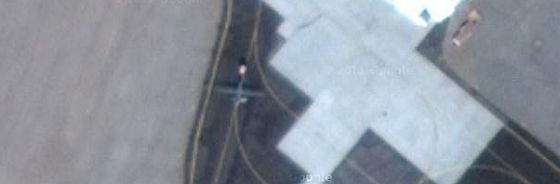
What appears to be a General Atomics MQ-1 Predator or MQ-9 Reaper UAV being towed on the parking ramp, Yucca Lake, Nevada.

Flightglobal reports: A new satellite image of an isolated airstrip in Nevada shows a secret but operational unmanned air vehicle (UAV) test facility. The Yucca Lake airfield, deep inside the heavily restricted Tonopah Test Range, is on land owned by the National Nuclear Security Administration (NNSA), a division of the Department of Energy (DoE), but was constructed and operated by an undisclosed government customer.

The satellite image, taken in early 2011 and available on Google Maps, appears to show a roughly 5,200 ft (1,580m) asphalt runway and what appears to be a General Atomics MQ-1 Predator or MQ-9 Reaper UAV being towed on the parking ramp. The airfield has four hangers of varying sizes, including a hanger with clamshell doors that is characteristic of US UAV operations. Details of the airfield, including a parking lot, security perimeter and ongoing construction are clearly visible.

The hangers could accommodate a total of between 10-15 MQ-9 Reaper aircraft, according to Tim Brown, an imagery analyst with Globalsecurity.org.

Facebooktwittermail