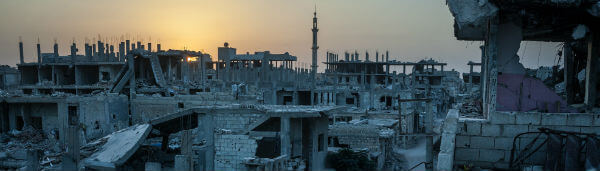
Syria Deeply reports: World powers agreed Friday to the “cessation of hostilities” in Syria in one week and to redouble efforts to deliver humanitarian aid to civilians across the country, but failed to secure a nationwide ceasefire or an end to Russian bombing.
U.S. Secretary of State John Kerry announced the deal in Munich shortly after a marathon meeting with top diplomats from more than a dozen countries, including Russia, to push forward a ceasefire deal and to resurrect peace talks that collapsed last week.
“First, we have agreed to accelerate and expand the delivery of humanitarian aid beginning immediately,” Kerry told reporters.
“Second, we have agreed to implement a nationwide cessation of hostilities to begin in a target of one week’s time. That’s ambitious, but everybody is determined to move as rapidly as possible to try to achieve this.”
Kerry was quick to acknowledge that the meeting produced commitments on paper only.
“What we need to see in the next few days are actions on the ground, in the field,” he said, adding that “without a political transition, it is not possible to achieve peace.”
Russian foreign minister Sergei Lavrov said that Moscow would not halt its air raids in Syria, saying the cessation of hostilities did not apply to the Islamic State group (ISIS) and the al-Nusra Front, the al-Qaida affiliate in Syria.
Diplomats from the U.S. and the E.U. have said very few of Russia’s air raids have targeted Islamic extremist groups; instead, they have primarily targeted western-backed rebel groups seeking to oust President Bashar al-Assad. [Continue reading…]
The Washington Post reports: Russian warplanes resumed their bombardment of rebel positions across Syria within hours of the deal, striking areas in the countryside around the northern city of Aleppo in support of a 10-day-old government offensive to lay siege to the city.
In Brussels, Russian Foreign Minister Sergei Lavrov told reporters that Moscow would continue its attacks against groups including the Islamic State.
The Russians have repeatedly said that they consider a number of Islamist groups fighting within the opposition to be “terrorist,” and have used this formulation to justify air attacks that have largely targeted the anti-Assad opposition.
Under the agreement, the United States and Russia will chair a task force to adjudicate questions about where and when bombing is permitted. But it remains unclear how those decisions will be made. [Continue reading…]
U.S. State Department: Statement of the International Syria Support Group
Meeting in Munich on February 11 & 12, 2016, as the International Syria Support Group (ISSG), the Arab League, China, Egypt, the EU, France, Germany, Iran, Iraq, Italy, Jordan, Lebanon, the Organization of Islamic Cooperation, Oman, Qatar, Russia, Saudi Arabia, Turkey, United Arab Emirates, the United Kingdom, the United Nations, and the United States decided that humanitarian access will commence this week to besieged areas, and an ISSG task force will within one week elaborate modalities for a nationwide cessation of hostilities. [Continue reading…]