Category Archives: US government

Warnings about risks posed by encryption have been wildly overblown by intelligence agencies, says report

encryption

The New York Times reports: For more than two years the F.B.I. and intelligence agencies have warned that encrypted communications are creating a “going dark” crisis that will keep them from tracking terrorists and kidnappers.

Now, a study in which current and former intelligence officials participated concludes that the warning is wildly overblown, and that a raft of new technologies — like television sets with microphones and web-connected cars — are creating ample opportunities for the government to track suspects, many of them worrying.

“ ‘Going dark’ does not aptly describe the long-term landscape for government surveillance,” concludes the study, to be published Monday by the Berkman Center for Internet and Society at Harvard.

The study argues that the phrase ignores the flood of new technologies “being packed with sensors and wireless connectivity” that are expected to become the subject of court orders and subpoenas, and are already the target of the National Security Agency as it places “implants” into networks around the world to monitor communications abroad. [Continue reading…]

Facebooktwittermail

How the FBI is pressuring Muslim immigrants to become informants

shadow16

BuzzFeed reports: When he got the last call to come meet with the FBI agents, A.M. allowed himself an uncharacteristic bit of optimism. An immigrant from Pakistan, he had spent the last seven years trying to get a green card, a process that had so far included a series of interviews, three encounters with the FBI, and unexplained bureaucratic delays. Maybe this meeting would bring some resolution?
But when the 37-year-old software programmer arrived at the Homeland Security offices in Dallas that day in August 2014, the conversation quickly swerved. One of the two agents placed a piece of paper on the table and told him to write down the names of all the people he knew who he thought were terrorists.

Bewildered, he said he didn’t know any terrorists. He said he didn’t know about any suspicious activity at all. “We think you do,” the agents replied.

A.M. was quickly becoming alarmed. (Like almost all other immigrants interviewed for this story, he said he did not feel safe allowing his name to be published. A.M. are his initials.) He was a family man, with a highly skilled 9-to-5 job. He had lived in America for nearly two decades. He went to college in America. Why would the FBI see him as a link to terrorism? And weren’t they supposed to be discussing his green card application?
As it turned out, that’s precisely what they were discussing. “We know about your immigration problems,” he recalls one of the agents telling him. “And we can help you with that.” If, they said, he agreed to start making secret reports on his community, his friends, even his family.

Pressuring people to become informants by dangling the promise of citizenship — or, if they do not comply, deportation — is expressly against the rules that govern FBI agents’ activities.

Attorney General Alberto Gonzales forbade the practice nine years ago: “No promises or commitments can be made, except by the United States Department of Homeland Security, regarding the alien status of any person or the right of any person to enter or remain in the United States,” according to the Attorney General’s Guidelines Regarding the Use of FBI Confidential Human Sources.

In fact, Gonzales’s guidelines, which are still in force today, require agents to go further: They must explicitly warn potential informants that the FBI cannot help with their immigration status in any way.

But a BuzzFeed News investigation — based on government and court documents, official complaints, and interviews with immigrants, immigration and civil rights lawyers, and former special agents — shows that the FBI violates these rules. Mandated to enforce the law, the bureau has assumed a powerful but unacknowledged role in a very different realm: decisions about the legal status of immigrants — in particular, Muslim immigrants. First the immigration agency ties up their green card applications for years, even a decade, without explanation, then FBI agents approach the applicants with a loaded offer: Want to get your papers? Start reporting to us about people you know. [Continue reading…]

Facebooktwittermail

Senator calls on Obama administration to stop UN from letting Assad regime censor aid plans

BuzzFeed reports: Sen. Bob Casey has told the Obama administration he is “appalled” that the United Nations allowed the regime of Syrian President Bashar al-Assad to censor parts of a humanitarian aid plan, in a letter being sent to the State Department on Thursday and obtained in advance by BuzzFeed News.

The letter follows reporting by BuzzFeed News last week that the U.N. had changed parts of a humanitarian aid plan for Syria after consulting with the Assad regime, removing the words “besieged” and “sieged,” references to a de-mining program, and references to violations of international law.

The censorship came to light after revelations of extreme starvation in the Syrian town of Madaya, which has been besieged by regime forces.

Casey, a Democrat from Pennsylvania, is urging the State Department to “insist that UN-produced assessments and humanitarian aid plans accurately reflect conditions on the ground, not the political concerns of the Assad regime.” Casey’s letter, addressed to Secretary of State John Kerry and U.S. Ambassador to the U.N. Samantha Power, states that he is “appalled” by the reports that the Assad regime was allowed to censor parts of the document, which lays out a $3.1 billion aid plan. [Continue reading…]

Facebooktwittermail

As U.S. expands military operations in Iraq and Syria it is withholding detailed information about civilian casualties

The Washington Post reports: As the U.S. military prepares to expand its operations against the Islamic State militant group in Iraq and Syria, it has altered how and when it discloses sensitive information about when it kills civilians with airstrikes.

In recent days, U.S. Central Command, which oversees operations in the Middle East from its headquarters at MacDill Air Force Base in Tampa, Fla., announced the results of investigations into 10 airstrikes “alleged to have resulted in civilian casualties and determined to be credible.” The first five were announced Jan. 15, and the second five were disclosed a week later. In each case, military officials released just a sentence or two of information.

The recent disclosures varied from earlier cases of civilian casualties because the military did not release documents detailing what happened in the incidents. Air Force Col. Patrick Ryder, a Central Command spokesman, said that was by design. [Continue reading…]

Facebooktwittermail

Nuclear mishap withheld by Air Force from review team

The Associated Press reports: In the spring of 2014, as a team of experts was examining what ailed the U.S. nuclear force, the Air Force withheld from them the fact that it was simultaneously investigating damage to a nuclear-armed missile in its launch silo caused by three airmen.

The Air Force on Friday gave The Associated Press the first substantive description of the accident after being questioned about it by the AP for more than a year.

The accident happened May 17, 2014, at an underground launch silo containing a Minuteman 3 intercontinental ballistic missile, or ICBM. The silo, designated Juliet-07, is situated among wheat fields and wind turbines about 9 miles west of Peetz, Colorado. It is controlled by launch officers of the 320th Missile Squadron and administered by the 90th Missile Wing at F.E. Warren Air Force Base at Cheyenne, Wyoming.

The Air Force said that while three airmen were troubleshooting the missile, a “mishap” occurred, causing $1.8 million in damage to the missile. [Continue reading…]

Facebooktwittermail

Pentagon wants psychologists to end ban on interrogation role

decay14bw

The New York Times reports: The Pentagon has asked the American Psychological Association to reconsider its ban on the involvement of psychologists in national security interrogations at the Guantánamo Bay prison and other facilities.

The Defense Department reduced its use of psychologists at Guantánamo in late 2015 in response to the policy approved by the association last summer.

But in a letter and accompanying memo to association officials this month, Brad Carson, the acting principal deputy secretary of defense for personnel and readiness, asked that the group, the nation’s largest professional organization for psychologists, revisit its “blanket prohibition.” [Continue reading…]

Facebooktwittermail

What does the return of mercenary armies mean for the world?

Sean McFate writes: It is a familiar story. A superpower goes to war and faces a stronger-than-expected insurgency in distant lands, yet has insufficient forces to counter it because of political and military constraints. The superpower decides to hire contractors, some of whom are armed, to support its war effort. The armed contractors prove to be both a blessing and a curse, providing vital security services to the campaign, yet at times killing innocent civilians, causing strategic setbacks, and damaging the superpower’s legitimacy. Without these contractors, the superpower could not wage the war. With them, it is more difficult to win.

The armed contractors in question are not in Iraq or Afghanistan but in northern Italy, and the year is not 2007 but 1377. The superpower is not the United States but the papacy under Pope Gregory XI, fighting the antipapal league led by the duchy of Milan. The tragic killing of civilians by armed contractors did not occur in Baghdad but in Cesena, 630 years earlier. The military companies employed were not DynCorp International, Triple Canopy or Blackwater, but the Company of the Star, the Company of the Hat and the White Company. Known as free companies, these for-profit warriors were organised as corporations, with a well-articulated hierarchy of subcommanders and administrative machinery that oversaw the fair distribution of loot according to employees’ contracts. CEO-like captains led these medieval military corporations.

The parallels between medieval and contemporary private military companies (PMCs) are strong. Today, the US and many others hire contractors to fulfil security-related contracts in the world’s most dangerous places. In the late Middle Ages, such men were called condottieri – literally, ‘contractors’ – who agreed to perform security services described in written contracts, or condotte. Both modern and medieval contractors were organised as companies, their services available to the highest or most powerful bidder for profit. Both filled their ranks with professional men of arms drawn from different countries and loyal primarily to the paycheck. Both have functioned as private armies, usually offering land-based combat skills rather than naval (or aerial) capabilities and deploying force in a military manner rather than as law enforcement or police.

Mercenaries are back. Once brandished as villainous outlaws, they are emerging from the shadows to once again become a mainstream instrument of world politics. The United Arab Emirates (UAE) has hired hundreds of Latin-American mercenaries to fight the Iranian-backed Houthis in Yemen. After years of struggling against Boko Haram, Nigeria finally employed mercenaries to do the job, and they did. Russia’s President Vladimir Putin has sent mercs to ‘liberate’ eastern Ukraine, a conflict that still simmers. Mercs are reportedly working in parts of Iraq. [Continue reading…]

Facebooktwittermail

What Donald Rumsfeld knew we didn’t know about the lack of evidence for WMD in Iraq

John Walcott writes: On September 9, 2002, as the George W. Bush administration was launching its campaign to invade Iraq, a classified report landed on the desk of the chairman of the Joint Chiefs of Staff. It came from Defense Secretary Donald Rumsfeld, and it carried an ominous note.

“Please take a look at this material as to what we don’t know about WMD,” Rumsfeld wrote to Air Force General Richard Myers. “It is big.”

The report was an inventory of what U.S. intelligence knew — or more importantly didn’t know — about Iraqi weapons of mass destruction. Its assessment was blunt: “We’ve struggled to estimate the unknowns. … We range from 0% to about 75% knowledge on various aspects of their program.”

Myers already knew about the report. The Joint Staff’s director for intelligence had prepared it, but Rumsfeld’s urgent tone said a great deal about how seriously the head of the Defense Department viewed the report’s potential to undermine the Bush administration’s case for war. But he never shared the eight-page report with key members of the administration such as then-Secretary of State Colin Powell or top officials at the CIA, according to multiple sources at the State Department, White House and CIA who agreed to speak on condition of anonymity. Instead, the report disappeared, and with it a potentially powerful counter-narrative to the administration’s argument that Saddam Hussein’s nuclear, chemical and biological weapons posed a grave threat to the U.S. and its allies, which was beginning to gain traction in major news outlets, led by the New York Times.

While the threat posed by a nuclear-armed Iraq was at the heart of the administration’s case for war, the JCS report conceded: “Our knowledge of the Iraqi (nuclear) weapons program is based largely — perhaps 90% — on analysis of imprecise intelligence.”

The rationale for the invasion has long since been discredited, but the JCS report, now declassified, which a former Bush administration official forwarded in December, nevertheless has implications for both sides in the 2016 presidential race, in particular the GOP candidates who are relying for foreign policy advice on some of the architects of the war, and the Democratic front-runner, who once again is coming under fire from her primary opponent for supporting the invasion. [Continue reading…]

Facebooktwittermail

SEC is criticized for lax enforcement of climate risk disclosure

The New York Times reports: As recently as 2011, shares in Peabody Energy, the world’s biggest private sector coal company, traded at the equivalent of $1,000. Today, they hover around $4 each. Over that time, investors who held the stock lost millions.

Peabody, like other coal companies, has been hammered as cheap natural gas erodes the demand for coal. But concerns about climate change are also an issue for the company as customers and investors turn away from fossil fuels.

Peabody saw this coming. Even as the company privately projected that coal demand would slump and prices would fall, it withheld this information from investors. Instead, Peabody said in filings with the Securities and Exchange Commission that it was not possible to know how changing attitudes toward climate change would affect its business.

Peabody’s double talk was revealed as part of a two-year investigation by the New York attorney general. In a settlement in November, Peabody agreed that it would disclose more about climate change risks in its regular filings with the S.E.C.

In theory, however, Peabody should have been making such disclosures all along. [Continue reading…]

Facebooktwittermail

How Saudi Arabia bankrolls the CIA

The New York Times reports: When President Obama secretly authorized the Central Intelligence Agency to begin arming Syria’s embattled rebels in 2013, the spy agency knew it would have a willing partner to help pay for the covert operation. It was the same partner the C.I.A. has relied on for decades for money and discretion in far-off conflicts: the Kingdom of Saudi Arabia.

Since then, the C.I.A. and its Saudi counterpart have maintained an unusual arrangement for the rebel-training mission, which the Americans have code-named Timber Sycamore. Under the deal, current and former administration officials said, the Saudis contribute both weapons and large sums of money, and the C.I.A takes the lead in training the rebels on AK-47 assault rifles and tank-destroying missiles.

The support for the Syrian rebels is only the latest chapter in the decadeslong relationship between the spy services of Saudi Arabia and the United States, an alliance that has endured through the Iran-contra scandal, support for the mujahedeen against the Soviets in Afghanistan and proxy fights in Africa. Sometimes, as in Syria, the two countries have worked in concert. In others, Saudi Arabia has simply written checks underwriting American covert activities. [Continue reading…]

Facebooktwittermail

A nation of field mice where fear runs rampant

In an article titled, “One Nation Under Fear,” Mark Edmundson writes:

How did a people who settled a continent, created enormous wealth, and fought and (mostly) won war after war devolve into a nation of such tremulous souls? And how did it happen so quickly? Where once there was the generation of the Second World War, ready to leave home and fight fascists on the far sides of the world, we now have a nation that at times seems composed largely of field mice, prone to quiver when they detect an unfriendly shadow.

In the latest wave of mass hysteria, the barriers of entry to the United States imposed on people with darker skins will once again be raised higher.

The Visa Waiver Program Improvement and Terrorist Travel Prevention Act of 2015 does not make any mention of skin color, yet the officials who are responsible for enforcing this law will inevitably notice skin color when determining if it needs to be applied. Since the law will apply, for instance, to British citizens who are also Iranian nationals simply by virtue of having an Iranian father — such an individual might have been born in the UK, have never visited Iran and not possess an Iranian passport — the way in which they will get flagged for questioning will most likely be because they are Middle Eastern in appearance.

Ostensibly, the law was designed to block U.S. entry to Europeans who have joined ISIS.

Let’s imagine how that would work: A British citizen who fought with ISIS in Syria has now returned home and then decides to fly to New York. He shows up at the airline check-in desk, presents his passport and the clerk, seeing the stamp entered when he visited Syria, says: “Sorry mate, no trip to America for you!” The thwarted traveler responds: “Damn that Terrorist Travel Prevention Act!” … except, of course, such an individual would in reality neither declare nor present any evidence that they had been in Syria or belonged to ISIS. The terrorist would — surprise, surprise — break the rules.

In truth, this isn’t a serious piece of legislation. Those who drafted and passed this law were engaged in a piece of political theater. Indeed, anyone who can coin a phrase like “terrorist travel prevention” would be better employed at The Onion than in the U.S. Congress.

The only people who will be reliably prevented from travel are those innocently trying to do what most travelers do — visit relatives and friends; engage in tourism or business.

The terrorists are not so dumb that they would run afoul of such restrictions — just as no terrorist would subvert his own objectives by tangling himself in the vetting process imposed on asylum seekers. Continue reading

Facebooktwittermail

Anti-Muslim profiling at airports goes beyond the TSA

Think Progress reports: A growing number of Muslims, Sikhs, and people of Middle Eastern descent are reporting incidents of racial and religious profiling while trying to board planes, sparking concerns that rising anti-Islam sentiment is sparking a new wave of discrimination at airports.

American Muslims have long encountered difficulties at airports, where security officials have been accused of unfairly profiling, questioning, searching, and detaining passengers simply for “looking” Muslim — including people who are not devotees of Islam, such as Sikhs and Arab Christians. Policies that support such profiling — many enacted in the years immediately following the September 11 attacks (although most have proven largely ineffective at catching terrorists) — remain in place today and have been defended by White House officials, even though Transportation Security Administration (TSA) agents have voiced misgivings about programs that single out people based on race or religion.

But as the United States endures an unprecedented wave of anti-Islam hatred following the terrorist attacks in Paris and San Bernardino late last year, Muslim Americans and others affected by Islamophobia are reporting a rash of new airport profiling cases — this time not just at the hands of the TSA, but also airline companies and fellow passengers. [Continue reading…]

Facebooktwittermail

U.S. ‘takes control’ of Rmeilan airfield in Syria

Al Jazeera reports: US troops have taken control of Rmeilan airfield in Syria’s northern province of Hasakah to support Kurdish fighters against the Islamic State of Iraq and the Levant (ISIL), a spokesperson for the Syrian Democratic Forces (SDF) told Al Jazeera.

The airfield near the city of Rmeilan, which will become the first US-controlled airbase in Syria, was previously controlled by the US-backed Kurdish People’s Protection Units (YPG).

The airfield is close to Syria’s borders with Iraq and Turkey.

“Under a deal with the YPG, the US was given control of the airport. The purpose of this deal is to back up the SDF, by providing weapons and an airbase for US warplanes,” Taj Kordsh, a media activist from the SDF told Al Jazeera on Tuesday.

“This airport was previously controlled by the YPG for over two years now. This strategic airport is close to several oil bases – one of the biggest in this area. [Continue reading…]

Facebooktwittermail

U.S. investigating Moscow’s divide and rule strategy in Europe

The Telegraph reports: American intelligence agencies are to conduct a major investigation into how the Kremlin is infiltrating political parties in Europe, it can be revealed.

James Clapper, the US Director of National Intelligence, has been instructed by the US Congress to conduct a major review into Russian clandestine funding of European parties over the last decade.

The review reflects mounting concerns in Washington over Moscow’s determination to exploit European disunity in order to undermine Nato, block US missile defence programmes and revoke the punitive economic sanctions regime imposed after the annexation of Crimea.

The US move came as senior British government officials told The Telegraph of growing fears that “a new cold war” was now unfolding in Europe, with Russian meddling taking on a breadth, range and depth far greater than previously thought.

“It really is a new Cold War out there,” the source said, “Right across the EU we are seeing alarming evidence of Russian efforts to unpick the fabric of European unity on a whole range of vital strategic issues.”

A dossier of “Russian influence activity” seen by The Sunday Telegraph identified Russian influence operations running in France, the Netherlands, Hungary as well as Austria and the Czech Republic, which has been identified by Russian agents as an entry-point into the Schengen free movement zone.

The US intelligence review will examine whether Russian security services are funding parties and charities with the intent of “undermining political cohesion”, fostering agitation against the Nato missile defence programme and undermining attempts to find alternatives to Russian energy.

Officials declined to say which parties could come into the probe but it is thought likely to include far-right groups including Jobbik in Hungary, Golden Dawn in Greece, the Northern League in Italy and France’s Front National which received a 9m euro (£6.9m) loan from a Russian bank in 2014. [Continue reading…]

Facebooktwittermail

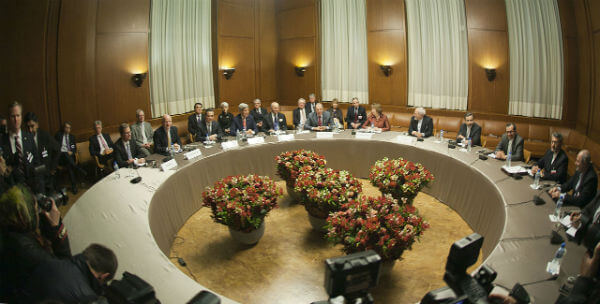
Was the Iran deal worth it?

iran-deal

Last July, after the Joint Comprehensive Plan of Action agreement on Iran’s nuclear program had been reached in Vienna, Shadi Hamid wrote: It was clear from the start of the uprising [in Syria] that Obama did, in fact, have a clear objective – minimizing U.S. involvement as much as possible. But there are other places, such as Iraq, where the Obama administration was pulled back in despite (or, more likely, because of) its best efforts. The unwillingness to rethink Syria strategy in any serious way has been reinforced by the momentum of the Iran negotiations. Why rock the boat and potentially provoke a major international incident, when progress was being made on Iran’s nuclear program? Why even take the chance with so much at stake? “Linkage,” moreover, was been built in to the policy process. As the journalist Josh Rogin noted: “All Syria proposals at State must go through the office of the undersecretary for political affairs, Wendy Sherman, who is also the administration’s lead negotiator over a nuclear deal with Iran.”

On the specifics of a deal, I tend to think, like many, that the U.S. made too many concessions, without getting enough in return. According to the New York Times, in the final days of talks, a television anchor on a hardline Iranian channel said: “The fact is, Obama needs this deal much more than we do.” She went on: “The American president needs a victory, and only a deal with Iran can give him that. They have retreated on several issues and compromised on their own red lines.” Whether or not this perception is fair, it’s a perception nonetheless, and perceptions drive behavior.

Others have noted that Iran, due to its deteriorating economy, needed a deal more than the U.S. did. This is almost certainly true. But while Iran may have needed it more, the U.S. wanted it more – or, at the very least, seemed like it did. Some of this, to be fair, was outside the U.S.’s control. The perception had already solidified throughout the region, drawing on 6 years of observing the Obama administration’s handling of various crises, most notably the backing down from stated “red lines” in Syria. Allies, such as Egypt, and enemies, such as Syria, have grown confident that we’ll blink first in a staring contest, in part because we usually do. This was why I was skeptical that any final deal could ever be the best possible deal. The administration has had tendency to misuse and/or underestimate its leverage in some of our most important bilateral relationships. As the negotiations wrapped to a close, there was no obvious way to address this. It was too late. We couldn’t change how Iran viewed the Obama administration.

There was a related asymmetry during the negotiations. As Pollack writes, “I don’t think that Iran values a nuclear deal as much as it does its positions in these various countries.” With us, it was the reverse: we cared less about Iran’s positions in various countries and more about its nuclear program. This, too, was built in to the talks.

Some are troubled that most people had strong opinions about the deal before reading the actual text of the agreement. One certainly hopes that legislators will eventually read at least some of it. But the specifics of the deal aren’t, ultimately, as important as the broader issues and implications, and those aren’t anywhere to be found in the text. Here, I tend to agree with my colleague Jeremy Shapiro who argued in April that that the devil wasn’t in the details. The details “really don’t matter.” He goes on: “At heart, this is a fight over what to do about Iran’s challenge to U.S. leadership in the Middle East and the threat that Iranian geopolitical ambitions pose to U.S. allies.”

In other words, your position on the Iran deal is likely to depend on how you view the Middle East and America’s role in it more broadly. If you see the Syrian civil war as a, or even the, core regional conflict, then you’re probably worried about the $100 billion in potential sanctions relief. Iran, even we assume it chooses butter over guns as American officials hope and uses, say, only 3 percent of that total, will have $3 billion more to prop up the Syrian regime and other regional allies and proxies. It also depends on your starting assumptions about the nature of the Iranian regime. Are Iranian leaders “rational,” and do you think it matters whether “moderates,” such as President Rouhani and Foreign Minister Zarif, are empowered over their “hardline” counterparts?

For me, at least one other issue comes into play, and it’s a factor which has pushed me to be more supportive of the Iran deal than I expected to be. It’s striking how little discussion there has been about what Iranians think and want. As small-d democrats, Americans should always at least take into account public opinion in other countries. Presumably, Iranians know their country better than American politicians do. According to opinion polls, a majority of Iranians favor a deal. We all saw the pictures of ordinary Iranians celebrating the framework agreement in April. This time around, the regime has been more careful, closing off public spaces, with hardliners warning of the dangers of Iran Deal-induced “happiness.” Importantly, as Nader Hashemi notes, “some of the most vociferous defenders of a nuclear deal with the West are Iranian civil society and human rights activists.” It makes little sense for us to say that an Iran deal will make progress on human rights less likely, when Iran’s own human rights activists seem to think the opposite. In a survey of 22 leading human rights activists, support for ongoing negotiations was “unanimous,” while over half believed that a deal would lead to a significant improvement in human rights in Iran. Of course, they could be wrong, but we shouldn’t bet on that.

To be sure, the link between a deal and the empowerment of Iranian reformers, as intuitive as it might seem, is far from guaranteed. As many have noted, conservatives may be just as likely to gain from a deal for any number of reasons. What seems inescapable, however, is that the failure of negotiations would have been a major, perhaps even decisive loss for Iran’s reformist trend. President Hassan Rouhani, who buoyed expectations with his come-from-behind election victory two years ago, has been losing popularity and goodwill. On human rights, he pledged to expand personal freedoms and broaden space for civil society. As for the economy, it can sputter along, as it has, but without sanctions relief, Rouhani’s hands are tied. His raison d’etre, then, depends on a successful deal. Without one, we would have likely had more of the same: conservatives in control and dominating the country’s politics. Now at the least there is a glimmer of possibility, even if the road toward substantive reforms remains a difficult one.

Taking these various, and very different, factors into account, the deal is, on balance, a mixed bag. I don’t think an Iran nuclear deal deserved the near-obsessive focus it received from this administration. Too much was subsumed and compromised due to the desire for a deal, an administration priority which took precedence over nearly everything else. Now that a deal has been concluded, U.S. officials may have more room to maneuver. Of course, the implementation of a deal will still require constant attention, to say nothing of the domestic fight which is still to come. But perhaps, at some point, the U.S. will be able to act and think beyond Iran’s nuclear program and re-focus attention on the broader issues and conflicts in which Iran plays a major role. The U.S. will now come under pressure to “compensate” (or overcompensate depending on your perspective). It will need to reassure skeptical Gulf allies that it will do more to counter Iran’s regional designs. I agree with Ken Pollack that the best place to do this is probably in Syria. As he writes: “In the aftermath of an Iranian nuclear deal, finally executing the Administration’s proclaimed strategy for Syria, may be the best and only way to regain control over the dangerous confrontation escalating between Iran and America’s Arab allies.”

Now that President Obama’s legacy, however controversial, is secure (both on domestic and foreign policy), he can afford to do the very things he wasn’t willing to do when Iran negotiations were the overwhelming focus. That doesn’t mean he will do them, but that’s where, I hope, the debate over a post-Iran deal Middle East can now turn.

Even after the deal was signed, Obama may have felt his hands remained tied on at least two counts: it remained to be seen whether Iran would follow through in implementing the requirements for sanctions to be lifted, and as we have now just learned, secret negotiations were still under way to secure the release of five Americans imprisoned in Iran. They have now been released and sanctions have been lifted.

One thing that no one was anticipating last July was the impact of Russia’s unforeseen intervention in Syria.

Iran’s president today tweeted:


But stock markets across the Middle East just saw “£27bn wiped off their value” in anticipation of the new wave of Iranian oil flowing into an already flooded market.

Al Jazeera reports:

With the sanctions now removed, Iran is ready to increase its crude oil exports by 500,000 barrels a day, Deputy Oil Minister Amir Hossein Zamaninia was quoted as saying by the Shana news agency on Sunday.

Iran’s return to an already glutted oil market is one of the factors contributing to a global rout in oil prices, which fell below $30 a barrel last week for the first time in 12 years. Iran is the world’s fourth largest oil producer.

The administration sold the Iran deal by claiming that no deal would make another major war inevitable. The ongoing war in Syria was left out of the equation.

The question now is whether that war is any closer to ending or whether, on the contrary, its conclusion is even further away.

I’m inclined to believe that Shadi Hamid’s assessment last July — that Obama’s objective has always been to minimize U.S. involvement in Syria as much as possible — is just as accurate today as it was then.

If Obama is preoccupied with his legacy, he should be asking himself whether his presidency will be remembered more for what he accomplished through negotiations with Iran or more for what he failed to do as the rest of the region unraveled.


Facebooktwittermail

To avoid a 2016 crash, the major powers need to pull in the same direction

By Anton Muscatelli, University of Glasgow

It looks already as if 2016 will be a pivotal year for the world economy. RBS has advised investors to “sell everything except for high-quality bonds” as turmoil has returned to stock markets. The Dow Jones and S&P indices have fallen by more than 6% since the start of the year, which is the worst ever yearly start. There is a similar story in other major markets, with the FTSE leading companies losing some £72bn of value in the same period.

These declines have come on the back of a major shock to the Chinese stock market. China’s stock exchange is very different from that of other major economies, as Chinese companies don’t rely on it to fund themselves to the same extent, using debt instead. All the same, the repeated suspensions of trading as the Chinese circuit-breakers came into operation (as they do when share prices fall too sharply) spooked investors around the world.

On top of that we are seeing commodity prices continuing to retreat. Oil prices have dropped towards $30 per barrel and don’t look likely to increase soon, with Iranian and Saudi oil production continuing to sustain supply. We are seeing many emerging economies dependent on petroleum revenues suffering (Brazil, Russia), and there is speculation that many oil producers (and perhaps even Saudi Arabia) are having to abandon their currencies’ link with the US dollar.

Continue reading

Facebooktwittermail

Iran’s swift release of U.S. sailors hailed as a sign of warmer relations

The New York Times reports: Iran’s release of 10 United States Navy sailors on Wednesday, less than 24 hours after they were detained on the Persian Gulf, is being hailed in both countries as a sign that their relations have evolved since the signing of the nuclear accord last summer.

Secretary of State John Kerry thanked the Iranians “for their cooperation in swiftly resolving this matter” and suggested in a statement that the quick resolution of the issue was a product of the nearly daily back-and-forth that now takes place between Washington and Tehran, after three decades of hostility and stony silence.

In an appearance later Wednesday at the National Defense University in Washington, Mr. Kerry said that his focus on diplomacy with a country “we hadn’t talked to for 35 years” before the nuclear negotiations had paid off.

“These are always situations that as everybody knows, if not properly handled, can get out of control,” Mr. Kerry said. “We can all imagine how a similar situation might have played out three or four years ago.” [Continue reading…]

Facebooktwittermail

How to lose the propaganda war with ISIS

decay11

The New York Times reports: The Obama administration on Friday announced an overhaul of its efforts to respond to online propaganda from the Islamic State after months of acknowledgments that it had largely failed in its attempts to counter extremist recruitment and exhortations to violence on social media.

The administration has emphasized that it needs the assistance of some of the nation’s biggest technology companies, and a group of top White House and national security officials flew to California on Friday to plead their case with executives.

“Given the way the technology works these days, there surely are ways that we can disrupt paths to radicalization, to identify recruitment patterns and to provide metrics that allow us to measure the success of our counter-radicalization efforts,” Josh Earnest, the White House press secretary, said before the meeting began in California.

A task force will be created in the Department of Homeland Security and the Justice Department to coordinate the government’s new effort. The State Department announced the creation of a center to respond to disinformation from extremist groups by highlighting their misdeeds and creating positive images of the West. [Continue reading…]

If one was to picture America as a complex filtration system with Washington DC at its core, the way this operates guarantees that by the time someone passes through the system’s many layers and reaches a position as an influential decision-maker, their psyche has been stripped of every last trace of imagination.

Picture the many meetings that must have taken place over recent months in which policymakers repeatedly said: in order to stop ISIS we need to improve the image of the West.

This proposition should have been met with howls of scorn and yet instead, multiple teams of straight-faced bureaucrats from multiple agencies nodded their heads in agreement.

At the same time, I greatly doubt anyone believes this kind of PR exercise will have any value whatsoever and yet the consensus of support derives from one fact: no one has come up with a better idea.

Better to do something worthless than to do nothing at all — so the thinking goes.

The term radicalization has been pathologized, thereby divorcing it from its psychological meaning. It’s viewed as a disease, with the implication that if the right steps are taken, the contagion can be controlled.

But to be radicalized is to rebel and anyone who has taken up such a position of defiance has, in the case of ISIS, already reached a conclusion about the West. Indeed, they have most likely reflected more deeply on the West than the majority of their generational counterparts who, being less likely to engage in cultural critiques of any kind, don’t have a particularly coherent view of the West — good or bad.

The problem here is not one if inadequate availability of positive images of the West.

Although it’s often said that this is an ideological struggle, ideology is I suspect of less significance than a core value: the willingness to die in the name of ones cause.

This isn’t a value that governments anywhere want to challenge because every state wants to be able to recruit citizens who are willing to die in defense of their country.

Most states don’t overtly recruit would-be martyrs and yet all states promote the idea that anyone who dies for their country has died in the name of a noble cause.

At the same time, this has become an increasingly ambiguous value as professionalized military forces promote their ability to minimize their own loses. They want their soldiers to remain willing to die and yet decreasingly fearful that they might face such a risk.

The religious zealot who is willing to die for what he believes in, will inevitably have a sense of superiority over the non-religious soldier who has submitted to the commands of the state rather than the command of God.

If Washington thinks it can steer ISIS recruits in a different direction, it’s because it sees this as a contest between the might of the United States and the wrong-headed ambitions of a cadre of hapless youth. But the contest inside the minds of these young people is between divine authority and human design. They inevitably side with God.

Facebooktwittermail