
Category Archives: Arab Spring

Where’s the best view of Benghazi?

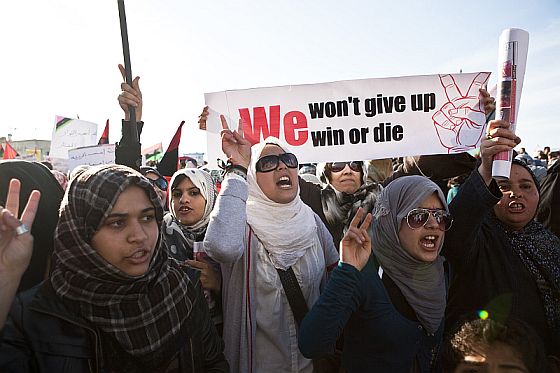
Women in front of the court house in Benghazi demonstrating in favor of a no-fly zone, mid-March, 2011

Whether it’s on the basis of an anti-imperialist narrative or cold-blooded realism, most of the opponents of intervention in Libya have one thing in common: bar those who belong to or a have a direct affiliation with the Gaddafi family, virtually everyone whose been beating this particular antiwar drum is outside and most often many thousands of miles away from Libya.

Stephen Walt, for instance, who writes from the comfort of a tenured chair at Harvard is skeptical about whether, absent Western intervention, bodies were destined to mount up in Benghazi on a scale that could fittingly be termed “mass killings.”

To be clear, I do think rebel lives would have been lost had Qaddafi’s force taken Benghazi, and I have no doubt that the Libyan dictator would have dealt harshly with the rebel leaders and anyone who fought to the bitter end. In other words, I’m pretty sure his forces would have murdered some of the rebels and probably some innocent civilians too. But the [US] president seems to have been convinced that Qaddafi was about to unleash genuine mass killings of perhaps as many as 100,000 people, in a city of roughly 650,000 (remember his pointed reference to Benghazi being nearly the size of Charlotte?). Thus, the president’s rhetoric strongly implied that tens of thousands of innocent bystanders were about to be ruthlessly slaughtered. That same image was reinforced by media references to the “lessons of Rwanda” that supposedly had shaped the views of some of Obama’s advisors.

Yet as I noted in my piece, there were no large-scale massacres in the other cities that the loyalists had recaptured. It is easy to believe that Qaddafi would have gone after the rebel leaders and diehard followers — whom he undoubtedly regards as traitors — but turning Benghazi into a ghost town filled with corpses was probably not in his own interest.

Obviously, one can argue that any substantial loss of life is worth preventing, and that the United States and NATO were justified in intervening even if the number of people at risk was fairly small.

How does one measure a “fairly small” number? I guess Israel’s war on Gaza provides a useful guide since this particular president demonstrated his ability to do no more than monitor the situation as hundreds of civilians — men, women and children, were slaughtered in the days just before Obama was sworn in as president.

If a siege of Benghazi or a direct assault had resulted in 5-10,000 casualties would this have counted in Walt’s mind as “mass killing”? As a reference through which that term might be defined, he cites Final Solutions by Benjamin Valentino, where the author notes: “the intentional slaughter of civilians in the effort to defeat guerrilla insurrgencies was the most common impetus for mass killing in the twentieth century.”

Given that Benghazi is the rebel stronghold, the fact that mass killings did not take place in other towns that Gaddafi’s forces earlier recaptured hardly tells us much about Benghazi’s likely fate in the event that Gaddafi had the opportunity to not merely cut the uprising’s offshoots but to sever its roots.

And having said that, the dehumanizing feature of so many criticisms against intervention has less to do with the fact that some, like Walt’s, rely on an utterly dispassionate realism, than that they are so thoroughly physically and psychologically removed from the experience of individual Libyans. It is no accident that in these arguments there is no Libyan voice.

For that reason, a single vignette from the front line — not the front line on a battle field but the interface through which the outside world and Libyans can connect — can tell us far more about this war than the endless polemics that are intent on telling us what a dreadful mistake this has been.

Ryan Calder provides one such story (and many more).

Last week, during the battle for Ajdabiya, I was sharing a ride from Tobruk to Benghazi with a 25-year-old guy dressed in a green knockoff Adidas soccer jacket with yellow stripes. I struck up a conversation.

“Why are you headed to Benghazi?” I asked.

“I’m stopping in Benghazi for the night and then heading to Ajdabiya,” the young man — I’ll call him Hussein — replied.

“It’s my hometown. Going to fight.” That is, to join the rebel forces.

“Take care of yourself, man,” I said.

“Thanks. What’s your name?”

“My name’s Ryan. I’m from the United States.”

“I’m Hussein. Your name’s Bryan? I love Bryan Adams. Celine Dion, too.”

“Uh, the name’s Ryan. With an ‘R.'”

“Oh.” Hussein told me he had four brothers and one sister. Four of the five sons are fighting with the rebels.

“Your mom must be scared,” I said.

“Yup.”

Hussein had been studying engineering at a university in Benghazi for a while, but dropped out. “What’s the point?” he said. “All of my friends who had graduated weren’t getting jobs anyway.” To get a proper job — an official one, with a regular salary, he later explained — you need to have been in the army. “And even then,” he went on, “it’s pretty damn hard to get a proper job. You need connections.” Most formal employment is controlled by the state. Otherwise, people work in the informal economy.

Hussein told me he had been involved in the rebellion “from the beginning. I was one of the protesters who started even before February 17” — the revolution’s “official” start date, he said.

“How did you know to join the demonstrations in the first place?” I asked.

“Facebook,” he said.

“And how’d you get into Bryan Adams and Celine Dion?”

“Facebook, you know? And other websites. Online, people are always talking music, sharing music.”

In Benghazi’s central square, nationalist songs celebrating Libyan freedom stream out of large speakers in the tent set up by the University of Garyounis, the largest university in the city. (In Benghazi, as in Cairo and Manama, student groups, women’s activists, professional associations, and other organizations set up tents near the center of the protest action, showing their solidarity with the revolutionary cause.) One clever Shargawi (that’s what you call someone from Benghazi) remixed to a beat a speech by Qaddafi in which the colonel vowed to take Benghazi back from the rebels street by street, house by house, room by room. Titled Zenga zenga, dar dar — “Street by street, room by room” — it has become a pop sensation in liberated Libya.

Yesterday, as we drove through a checkpoint, some rebels on inspection duty asked where we were from. “I’m from the United States,” I said in Arabic. “Yeah, man! I loooove heavy metal,” he responded in English, putting his fingers up and rocking his head back and forth, doing his best Ozzy Osbourne impression.

This morning, one of the fighters I had dinner with in Brega — Khalid, a 39-year-old bakery owner from Benghazi — called me over from the next room.

“Hey Ryan — come here for a second.”

“What’s up?”

“You like Sabaringasteen?” he asked.

“Huh?”

“Sabaringasteen? You don’t know Sabaringasteen? He’s American.”

I drew a blank.

“Listen to this,” Khalid said, punching buttons on his phone. I recognized the opening snare hits and guitar riff immediately. Then the Boss’s voice kicked in. “I was … born in the USA…”

“I love Sabaringasteen,” said Khalid with a broad smile. “And Kenny Rogers. You know Kenny Rogers? Kantaree” — country — “music. I love kantaree music.” Khalid was wearing a red turtleneck and stonewashed jeans. He had a handlebar mustache and a bit of a paunch. It worked — all he needed was a ten-gallon hat.

***

As I write this, it’s 7 p.m. on March 29, and we’re driving back from Ras Lanuf to Brega. We pass young rebels with Kalashnikovs who had never touched a gun until the revolution, driving their own cars to the front, wearing camo and black-and-white checked kaffiyehs and reflective sunglasses — thawra chic. Groups of them sit by the side of the road, eating dinner. Some have brought along whatever they could find at home for protection: construction helmets, work boots, and even those plastic dive masks you wear to go snorkeling. Toyota Hilux pickup trucks zoom past, carrying Russian-made artillery pieces older than I am. This is what a 21st-century volunteer army looks like. These guys are all heart, not much coordination, and no training whatsoever.

To the north, in the stone’s throw between us and the Mediterranean, rises an orange gas flare from the Ras Lanuf Oil and Gas Processing Company. Here, from the Sirt Plain, come most of the 1.6 million barrels of oil that Libya produces each day. (Or at least, that was the figure before the revolution; it’s much lower now.) Behind us lie the gutted, burned-out shells of Qaddafi’s tanks and supply vehicles.

We pass a yellow road sign with a camel symbol on it. Camel crossing.

Muhammad, the driver, slips a CD into the stereo. The rapper Akon comes on. “You’re so beautiful… I wanna get with youuuuuu…”


Facebooktwittermail

The fight for Libya

Prospects fade for military overthrow of Gaddafi
Libyan rebels said on Friday they repulsed a government assault on the besieged city of Misrata but prospects faded for a military overthrow of Muammar Gaddafi.

NATO leaders acknowledged the limits of their air power, which has caused rather than broken a military stalemate, and analysts predicted a long-drawn out conflict that could end in the partition of the North African oil producer.

Alliance officials expressed frustration that Gaddafi’s tactics of sheltering his armor in civilian areas had reduced the impact of air supremacy and apologized for a second “friendly fire” incident on Thursday that rebels said killed five fighters. (Reuters)

Ex-Libyan minister foresees more defections
Another former aide to Colonel Muammar Gaddafi has sought asylum in Europe.

One-time Libyan energy minister Omar Fathi Bin Shatwan has fled to Malta.

In this first televised interview since the start of the rebellion, Bin Shatwan said time is running out for Gaddafi’s regime and more Libyan ministers would like to defect.

“Most of the people want to the same as Koussa and some others have done, but they cannot do it because they don’t have the chance to do it,” Bin Shatwan told euronews. (Euronews)

Torture and killing in Kenya – Britain’s double standards
This week, a British human rights lawyer backed by the Foreign Office managed to strong-arm an apology out of Libya’s revolutionary leadership for the actions of the man it is struggling to overthrow.

The apology and promise of compensation over Muammar Gaddafi’s supply of explosives used in IRA bombs and his role in blowing up the Pan Am flight over Lockerbie was made by the rebels in the name of the Libyan people as a whole – a move that astonished and offended many Libyans, who see no reason to take responsibility for the crimes of their oppressor.

But the Foreign Office shared the view of the British lawyer, Jason McCue, that saying sorry for something they had no hand in would somehow be good for the Libyan people as a whole by establishing a newfound commitment to human rights. The promise of money helps, of course.

The truth is that the revolutionary leadership, which has rather more pressing issues to hand such as keeping Gaddafi’s troops from overrunning Benghazi, felt it had to play along to bolster crucial support from the UK and the west. McCue even praised David Cameron for making the case a priority at the Foreign Office.

This demonstration of power politics is made all the more distasteful by the contrasting attitude of the British government at the high court toward victims of the most depraved torture, gruesome killings and mass hangings by Britain during Kenya’s struggle for independence.

Hiding behind legal contortions, the government is refusing to apologise or pay compensation for appalling abuses done in the name of and with the knowledge of the British state, with the intent of preserving a system of racist privilege for white settlers in the east African colony. (Chris McGreal)

Ban Ki-moon learns to love regime change
At U.N. headquarters, regime change has long been viewed as a toxic phrase.

Under former U.N. Secretary General Kofi Annan, the U.N. brass cringed when American politicians and diplomats, both Republican and Democratic, revealed that their true aim in pursuing U.N. arms inspections and sanctions in Iraq was the downfall of Saddam Hussein.

But in the past two months, U.N. Secretary General Ban Ki moon has reversed course, fully embracing the toppling of governments in Ivory Coast and Libya. On Monday, Ban authorized a U.N. military operation, backed by French military power, to strike at key military bases, and installations under the control of Ivorian strongman Laurent Gbabgo.

The operation — which included helicopter gunship attacks against army camps by blue-helmeted Ukrainian pilots — was ostensibly aimed at preventing Gbagbo’s forces from using their heavy weapons against civilians and U.N. personnel. But its impact on the conflict was decisive: The U.N. and French attacks had degraded Gbagbo’s last line of defense, clearing the way for a final offensive by followers of Ivory Coast’s president-elect Alassane Ouattara.

Within 24 hours, Gbagbo’s top generals had written to the United Nations with an offer to halt the fighting and surrender their weapons, together with a request that their fighters be protected. Gbagbo remained holed up in a bunker underneath the presidential residence, under attack by Ouattara’s forces.

The U.N. chief’s action in Ivory Coast is all the more surprising given his readiness throughout most of his term to accommodate some of the world’s most noxious governments, notably Burma, Sri Lanka and Sudan. Ban had bet much of his political capital upon his capacity to use personal, quiet diplomacy, to nudge the likes of Burmese junta leader Than Shwe, Sri Lankan president Mahinda Rajapaksa and Sudanese leader Omar Hassan al-Bashir, to moderate their mistreatment of their own people. (Colum Lynch)

Facebooktwittermail

Intifada update

Friday protests erupt in Arab world
Protests erupted across much of the Arab world on Friday, the Muslim day of prayer, with demonstrators killed in Syria and Yemen while Egyptians staged one of the biggest rallies since President Hosni Mubarak’s fall.
Syrian security forces killed 17 pro-democracy demonstrators and two were shot dead in Yemen. In Saudi Arabia local Shi’ites protested in the oil-producing east to call for the withdrawal of Saudi troops from neighboring Bahrain.

In Cairo’s Tahrir Square, perhaps the spiritual home of the Arab protest movement, crowds demanded Mubarak’s prosecution as discontent with military rule grows; but in Oman heavy security prevented a planned demonstration after Friday prayers. (Reuters)

Egypt rallies swell against military
Protesters poured into Tahrir Square in one of Egypt’s largest marches in two months, marking growing frustration among many here at the military’s perceived slowness in removing and prosecuting officials from the deposed regime.

Friday’s “Day of Trial and Cleansing” drew several thousand protesters, one of the biggest gatherings since President Hosni Mubarak was replaced on Feb. 11 by an interim high council of military officers, a show of the abiding strength of Egypt’s youth-led protest movement.

The gathering also demonstrated how the prosecution of lingering elements of the old regime, such as Mr. Mubarak and his top aides and officials, will be a critical task for Egypt’s military officers if they hope to maintain their high standing among the public.

“People feel they are not doing enough—and if they are doing enough, it’s too slow,” said Ahmed Wahba, 41, referring to the Supreme Council of the Armed Forces, which is leading Egypt’s transition toward democracy. Mr. Wahba, who was protesting in the crowded square Friday, said the Egyptian public won’t be satisfied until they “see Mubarak in the middle of [Tahrir] Square, locked up or executed.” (Wall Street Journal)

U.S. was told of Yemen leader’s vulnerability
A billionaire Yemeni sheik met with a high-ranking officer from the U.S. Embassy in Sanaa less than two years ago and revealed a secret plan to overthrow President Ali Abdullah Saleh, the country’s longtime autocratic ruler.

Hamid al-Ahmar, an opposition party leader and a prominent businessman, vowed to trigger the revolt if Saleh did not guarantee the fairness of parliamentary elections scheduled for 2011, according to a classified U.S. diplomatic cable summarizing the meeting. The sheik said he would organize massive demonstrations modeled on protests that toppled Indonesia’s President Suharto a decade earlier.

“We cannot copy the Indonesians exactly, but the idea is controlled chaos,” Ahmar told the unnamed embassy official. The embassy, however, was dismissive of the sheik, concluding that his challenge posed nothing more than “a mild irritation” for Saleh.

Today, Saleh is barely clinging to power amid a popular uprising in Yemen that is unfolding more or less along the lines that Ahmar predicted. Several previously undisclosed U.S. diplomatic cables, provided by the anti-secrecy site WikiLeaks, show that influential Yemenis and U.S. allies repeatedly warned U.S. diplomats of Saleh’s growing weakness in 2009 and 2010. But despite those warnings, the Obama administration continued to embrace Saleh and became increasingly dependent on him to combat an al-Qaeda affiliate that was plotting attacks against the United States from the Arabian peninsula. (Washington Post)

Facebooktwittermail

The fight for Libya

Turkey working on ‘roadmap’ to end Libya war
Tayyip Erdogan has said Turkey was working on a “roadmap” to end the war in Libya which would include a ceasefire and the withdrawal of Muammar Gaddafi’s forces from some cities.

Turkey has held talks this week with envoys from Gaddafi’s government and representatives of the opposition.

“We are working on the details of this road map,” Prime Minister Erdogan told a news conference on Thursday.

He said a “real ceasefire should be settled immediately” and Gaddafi’s forces should withdraw from besieged cities.

“A comprehensible democratic transformation process that takes into account the legitimate interests of Libyan people should start immediately,” said Erdogan, calling for political reforms.

“The aim of this process should be to settle constitutional order that people freely elect their rulers.” (Al Jazeera)

General says US may consider sending troops into Libya as part of any international force
The U.S. may consider sending troops into Libya with a possible international ground force that could aid the rebels, the former U.S. commander of the military mission said Thursday, describing the current operation as a stalemate that is more likely to go on now that America has handed control to NATO.

But Army Gen. Carter Ham also told lawmakers that American participation in a ground force would not be ideal, since it could erode the international coalition attacking Moammar Gadhafi’s forces and make it more difficult to get Arab support for operations in Libya.

He said NATO has done an effective job in an increasingly complex combat situation. But he noted that, in a new tactic, Gadhafi’s forces are making airstrikes more difficult by staging their fighters and vehicles near civilian areas such as schools and mosques.

The use of an international ground force is a possible plan to bolster the Libyan rebels, Ham said at a Senate Armed Services Committee hearing.

Asked whether the U.S. would provide troops, Ham said, “I suspect there might be some consideration of that. My personal view at this point would be that that’s probably not the ideal circumstance, again for the regional reaction that having American boots on the ground would entail.”

President Barack Obama has said repeatedly there will be no U.S. troops on the ground in Libya, although there are reports of small CIA teams in the country.

Pressed by Sen. John McCain, a leading Republican, about the situation in Libya, Ham agreed that a stalemate “is now more likely” since NATO took command. (Associated Press)

Saif Gaddafi: his father’s son, or the would-be face of Libyan reform?
On 19 February Dr Muhammad al-Houni, a Libyan academic and long-time adviser to Colonel Muammar Gaddafi’s son, Saif al-Islam, finished a speech he had written for his patron to deliver on state television in the midst of a crisis.

Four days into the Libyan uprising, Houni suggested Saif strike a conciliatory tone. He should apologise for those who had died in the country’s east. He should insist too on the necessity of reforming his father’s four-decades-old regime, announcing a tranche of long-promised laws to usher in new freedoms.

“I wrote down what he must say,” Houni recalled on Thursday. “I said he should say sorry for the victims. But he went to his father and his father did not like it. So his father changed the speech.”

When Saif appeared on television, he looked and sounded every inch his father’s son, waving his finger angrily, and saying the words that have since become notorious: “We will fight until the last man, until the last woman, until the last bullet.”

Houni left Tripoli the following day. Shortly afterwards he issued a furious open letter to his former employer, accusing Saif of “donning his father’s cloak, which is contaminated with 40 years of his deeds”.

Once regarded as the Gaddafi family’s friendly, reform-minded western face, Saif, supported by his brother Saadi, has emerged in the past week as the most visible figure in the regime’s efforts to negotiate an end to the conflict on its own terms.

One influential figure, who knows the regime and members of the Gaddafi family well, is convinced that Saif speaks for the family with his father’s support.

“They are looking for a way out,” said the source. “It makes sense for Libya if there is a good exit [for Gaddafi]. What I understand they are saying is that the sons want to continue playing a political role [after the regime has fallen] by having their own party.

“They would accept an interim government and a transition period. What they will not accept is being forced to leave the country. It is what Saif has been working [on]. It is about getting the sides to sit down together and talk and also about having an exit strategy that is not insulting to Gaddafi: that leaves him but without power. That’s what Saif is fighting for.” (The Guardian)

Nato ‘apologises for hitting Libya rebels’
The commander of Libya’s rebel forces has said Nato apologised for mistakenly hitting a column of rebel tanks near the eastern town of Ajdabiya.

Gen Abdelfatah Yunis said the deadly air strike had occurred despite a warning to Nato that the tanks were being moved to the front line.

Nato said it was investigating the claim, without giving further details.

Rebels said four rebels died, while local doctors told the BBC at least 13 fighters had been killed in the strike. (BBC)

Inside Gaddafi’s dark places: The headquarters of Benghazi’s Revolutionary Committees
On February 17, at the beginning of the revolution, one of the first buildings that demonstrators stormed in Benghazi was the headquarters of the Revolutionary Committees. They razed it.

The Revolutionary Committees (al-lijan al-thawriyah) are Gaddafi’s die-hards. Established in the 1977 as the ideological vanguard of the Green revolution, their members have a reputation as thugs who menace, beat up, and sometimes kill those who take issue with the regime.

Being a Revolutionary Committee member can be lucrative, too. It is widely reported that members special benefits — such as cars and cash payments — for their dirty work. Members have also been promoted to senior government posts, in recognition of their loyalty to the Colonel.

When you see footage of Gaddafi supporters in Tripoli waving green flags with gusto and holding Gaddafi’s portrait aloft, many of those you see are probably Revolutionary Committee members.

Their Benghazi headquarters looks like an outsized high-modernist tepee. A fence in green trim surrounds it. Inside its burnt remains, there is a mural that reflects some of the ideological affinities between Gaddafi’s Third Universal Theory and communism. There are heroic laborers, rockets, and lots of right angles. It wouldn’t look out of place in Minsk.

A few other people are walking through the building, poking around. “Is this your first time in this building?” I ask a man in a black faux-leather jacket, probably in his late 20s.

“Yeah — only Revolutionary Committee members were allowed in this place before. And anyway, I wouldn’t have had any reason to come.”

He seems a little nervous talking about it. I imagine how it must feel being in the burnt-out headquarters of an institution whose name has been associated with fear for as long as you can remember.

I talk to another man, in his early 30s. It’s his first time here too. “You know, the Revolutionary Committee members — they’re not the kind of people you’d want to associate with. If someone introduced me to a friend and said he was a Revolutionary Committee member, I’d stay away from the guy.” He shakes an imaginary hand as if only decorum demands it, and then feigns walking away.

He then explains that many people are still uncomfortable speaking about the Revolutionary Committees. “They’re scared that Gaddafi could come back, you know?”

Fear of die-hards dies hard. (Ryan Calder)

Facebooktwittermail

Bahrain King boasted of intelligence ties with Israel

Haaretz reports:

The Bahraini King bragged about intelligence contacts with Israel, and instructed that official statements stop referring to Israel as the “Zionist entity,” according to the latest trove of documents revealed by WikiLeaks.

On February 15, 2005, U.S. ambassador to Bahrain William Monroe met with the leader of the small kingdom, Hamad ibn Isa Al Khalifa – the same king whose position is now threatened by popular protests.

Monroe wrote to Washington the next day, saying the meeting was amiable and that the two sat near the fireplace on a cold and unusually wet day. Their conversation lasted about an hour and a half, and at some point moved to the subject of the Israeli-Palestinian conflict. The king said he was pleased with the developments in the peace process.

He also revealed to the ambassador that he had instructed his public information minister to stop referring to Israel in official statements of the kingdom as the “enemy” or the “Zionist entity.”

The Associated Press reports:

An international humanitarian organization said Thursday that Bahraini authorities turned hospitals into “places to be feared” during a deadly crackdown on anti-government protesters in the Gulf country.

Doctors Without Borders condemned the arrest of injured opposition supporters being treated at medical facilities. In a statement, the organization said Bahrain’s security forces used hospitals and health centers as “bait to identify and arrest those (protesters) who dare seek treatment.”

The capital’s Salmaniya medical complex, in particular, was at the center of the country’s turmoil, treating hundreds of injured demonstrators. The military took control of the facility, and doctors and patients there said soldiers and policemen interrogated and detained them.

The BBC reports:

The BBC has obtained images of alleged police brutality against peaceful protesters in the Bahraini capital Manama, where fears of a systematic crackdown on pro-democracy activists are growing.

Pictures sent by a human rights activist show police from Bahrain’s Interior Ministry, and others in plainclothes, their faces hidden by balaclavas.

The police are seen beating and kicking men who are handcuffed and hooded.

The attack occurred on the outskirts of the capital Manama last Wednesday, 30 March, on a busy stretch of road opposite a popular shopping mall.

Eyewitnesses, some of them crying, described a scene that one said “was like watching a horror film.”

But the attack is not isolated.

Facebooktwittermail

Arab women protesters – not free, just figureheads

Nesrine Malik writes:

A common theme since the Arab uprisings started has been the celebration of the role of women in the protests. Some have even gone so far as to say that the “stereotype of the submissive, repressed victim has been shattered by female protesters in Egypt, Tunisia and Yemen”. I am not sure that women on the ground in these countries feel the same way, or feel that their participation in the protests is unprecedented.

While I understand how tempting it is to draw grand conclusions from such seismic events, those who say the perception of women has been revolutionised are either jejune or lacking in historical perspective.

It is nothing new. Women have often been at the forefront of popular dissent on the rare occasions when it has happened, and activists such as Nawal el Saadawi have been thorns in the side of Arab regimes for decades. Tawakul Karman, the 32-year-old Yemeni human rights activist, who now finds herself heading the popular protest movement had been a campaigner and agitator long before the protests started.

Soumaya Ghannoushi also cites the case of Saida Sadouni, a 77-year-old woman who is now “widely hailed as the mother of Tunisia’s revolution, a living record of her country’s modern history and its struggle for emancipation”. This is not an uncommon theme.

While the prominence of women in the revolutions has been moving, there is a psychology behind celebrating and glorifying women’s political activity when it is part of a popular push. In these times women are almost tokenised by men as the ultimate downtrodden victims, the sign that things are desperate, that even members of the fairer sex are leaving their hearths and taking to the streets. The perception isn’t that women are fighting for their own rights, but merely that they are underwriting the revolution by bringing their matronly dignity to the crowd like some mascot.

Facebooktwittermail

Syria tries to placate Sunnis and Kurds

The New York Times reports:

The government of President Bashar al-Assad of Syria offered several unusual gestures on Wednesday intended to earn it good will among Sunnis and Kurds.

The government announced that Syria’s first and only casino, which had enraged Islamists when it opened on New Year’s Eve, would be closed. It also said that schoolteachers who had been dismissed last year for wearing the niqab, a type of face veil, would be allowed back to work.

These concessions and others were made public as activists were calling for renewed demonstrations to be held on Thursday, which is the 64th anniversary of the formation of the Baath Party, which has been in power since 1963. Protests demanding expanded political rights and a multiparty democracy have spread to cities across Syria over the last three weeks, posing a highly unusual challenge to Mr. Assad.

Ayman Abdel Nour, a Syrian writer and activist who was a childhood friend of Mr. Assad’s, said that about 1,200 women would be affected by the niqab decision, which was the most immediately significant result of a meeting Tuesday between Mr. Assad and a popular Islamist leader, Said Ramadan al-Bouti.

Other concessions offered at the meeting, Mr. Abdel Nour said, included permission to create an Islamist satellite channel and to form an Islamist political party. The party, he said, would be similar to the AKP in Turkey.

“It will be a moderate Islamist party loyal to the regime,” Mr. Abdel Nour said. “This is a very important deal. The regime is trying to weaken the demonstrators.”

Mr. Assad also promised to give citizenship to stateless people within Syria, and to make a national holiday of the Kurdish New Year’s festival Nayrouz, Mr. Abdel Nour said. An estimated 200,000 Kurds living in Syria are stateless, international human rights groups said.

“If the Islamists and the Kurds enter the demonstrations, the regime will lose control,” Mr. Abdel Nour said. “The president is trying to delay the big explosion.”

Facebooktwittermail

Libyan rebels need training

C J Chivers reports:

Late Monday afternoon, as Libyan rebels prepared another desperate attack on the eastern oil town of Brega, a young rebel raised his rocket-propelled grenade as if to fire. The town’s university, shimmering in the distance, was far beyond his weapon’s maximum range. An older rebel urged him to hold fire, telling him the weapon’s back-blast could do little more than reveal their position and draw a mortar attack.

The younger rebel almost spat with disgust. “I have been fighting for 37 days!” he shouted. “Nobody can tell me what to do!”

The outburst midfight — and the ensuing argument between a determined young man who seemed to have almost no understanding of modern war and an older man who wisely counseled caution — underscored a fact that is self-evident almost everywhere on Libya’s eastern front. The rebel military, as it sometimes called, is not really a military at all.

What is visible in battle here is less an organized force than the martial manifestation of a popular uprising.

With throaty cries and weapons they have looted and scrounged, the rebels gather along Libya’s main coastal highway each day, ready to fight. Many of them are brave, even extraordinarily so. Some of them are selfless, swept along by a sense of common purpose and brotherhood that accompanies their revolution.

“Freedom!” they shout, as they pair a yearning to unseat Col. Muammar el-Qaddafi with appeals for divine help. “God is great!”

But by almost all measures by which a military might be assessed, they are a hapless bunch. They have almost no communication equipment. There is no visible officer or noncommissioned officer corps. Their weapons are a mishmash of hastily acquired arms, which few of them know how to use.

With only weeks of fighting experience, they lack an understanding of the fundamentals of offensive and defensive combat, or how to organize fire support. They fire recklessly and sometimes accidentally. Most of them have yet to learn how to hold seized ground, or to protect themselves from their battlefield’s persistent rocket and mortar fire, which might be done by simply digging in.

Prone to panic, they often answer to little more than their mood, which changes in a flash. When their morale spikes upward, their attacks tend to be painfully and bloodily frontal — little more than racing columns down the highway, through a gantlet of the Qaddafi forces’ rocket and mortar fire, face forward into the loyalists’ machine guns.

And their numbers are small. Officials in the rebels’ transitional government have provided many different figures, sometimes saying 10,000 or men are under arms in their ranks.

But a small fraction actually appear at the front each day — often only a few hundred. And some of the men appear without guns, or with aged guns that have no magazines or ammunition.

For the nations that have supported the uprising, the state of the rebels’ armed wing — known as the Forces of Free Libya — raises many questions. It seems unlikely that such a force can carry the war westward, through dug-in Qaddafi units toward the stronghold of Surt, much less beyond, toward Tripoli, the Libyan capital. And a sustained war of attrition could quickly bleed their ranks dry.

The Guardian reports:

Britain is to urge Arab countries to train the disorganised Libyan rebels, and so strengthen their position on the battlefield before negotiations on a ceasefire, senior British defence sources have indicated.

The sources said they were also looking at hiring private security companies, some of which draw on former SAS members, to aid the rebels. These private soldiers could be paid by Arab countries to train the unstructured rebel army.

In what is seen in effect as the second phase of the battle to oust Muammar Gaddafi, it is now being acknowledged that the disorganised Libyan rebels are not going to make headway on their own. Nato member countries are looking at requesting Arab countries, such as Qatar or the United Arab Emirates, to train the rebels, or to fund the training. Qatar and the UAE are already involved in the Nato-led no-fly zone.

Some cabinet sources said that another Arab country that might be willing to train the rebels is Jordan. They are thought to have the best-trained officers, and are possibly the best army in the region, one Cabinet source said. The training of the Libyan rebels might take as long as month to turn them into an effective force capable of holding ground, and organise flanking manoeuvres. A source said: “They’re not advancing, they’re just driving up the road, and when they see guns drawn they turn round and go back again.”

The British decision to find ways to train and equip the rebels is a further sign of the determination of the coalition administration to drive out Gaddafi. It is argued that the training, if requested by the rebels, would not be in breach of the UN resolution as it would be covered by the mandate allowing “all means necessary” to protect the civilians from attacks by Gaddafi.

Meanwhile, the Associated Press reports:

Libya’s former-energy minister said Wednesday that several members of Moammar Gadhafi’s inner circle want to defect, but many are too scared to abandon the dictator fearing the safety of themselves and their families.

Omar Fathi bin Shatwan, who also served as industry minister, told the Associated Press that he had fled by fishing boat to Malta on Friday from the western Libyan city of Misrata.

Shatwan, who left the government in 2007, said he still had contact with some government figures and explained that many feared for their safety. In some cases, their families are under siege, he said.

“Those whose families are outside Libya will flee if they get a chance,” Shatwan said. “But many can’t leave, and all the families of ministers are under siege.”

Shatwan said he had last had contact with Gadhafi in 2006, and had not spoken with the tyrant’s sons since leaving office. “Ministers who are friends of mine, I have spoken to them,” he said.

The 59-year-old said he had spent 40 days at his home in Misrata before escaping from Libya, and witnessed Gadhafi’s forces pounding the city with heavy artillery and relentlessly shooting civilians.

Facebooktwittermail

Revolution or coup?

Patrick Cockburn writes:

Demonstrators fearful that the tide of revolution is on the ebb in Egypt staged a mass protest in Tahrir Square in Cairo last Friday to demand that a less authoritarian form of government be introduced.

The protesters appeared to sense that political power is drifting away from them and the old system is reasserting itself as they gathered after Friday prayers beside the blackened hulk of the old headquarters of the ruling National Democratic Party (NDP).

“I am worried that there are so many forces against the revolution, mainly in the army,” said Ahmed Maher, a 30-year-old civil engineer and coordinator of the 6 April Movement, a group that played a crucial role in organizing the street protests that ended the rule of President Hosni Mubarak. He added: “By demonstrating, we are showing our anger at what is happening.”

Egypt’s revolution is uncertain of its identity, or even if it really was a revolution. Maher would prefer radical change but does not expect it. “I realize the revolution will not bring a new Egypt,” he says. “We will have better people in charge and perhaps less corruption, but not a different system.”

Maher, who was jailed five times and tortured severely under the old regime, does not seem too downcast at present frustrations. The shadowy Supreme Council of the Armed Forces had failed to invite any of the radical groups to a dialogue, but he thought the political situation was fluid and the army would give ground under pressure. He said: “They don’t want a clash with us.”

Facebooktwittermail

The fight for Libya

Gaddafi appeals to Obama to intervene in Libya
Our dear son, Excellency, Baraka Hussein Abu oumama, your intervention is the name of the U.S.A. is a must, so that Nato would withdraw finally from the Libyan affair. Libya should be left to Libyans within the African union frame. (Mu’aumer Qaddaffi, Leader of the Revolution, Tripoli 5.4.2011)

Iran backs Libyan rebels, chastises West over oil, Bahrain
Libya’s rebellion has put Iran in an awkward position. Tehran has tried to balance support for the Libyan opposition, which it views as part of a region-wide “Islamic awakening,” with rejection of the NATO-led military strikes.

Iranian officials charged that the U.N.-endorsed military intervention on humanitarian grounds is hypocritical and part of a secret Western agenda. Tehran opposes any military intervention in the Middle East, even if in Iran’s interest, because of the precedent it sets. Iran also opposed the 2003 U.S. invasion of Iraq, despite the fact Saddam Hussein was Iran’s main adversary in the region.

In his Nowruz (New Year) speech last month, Supreme Leader Ayatollah Ali Khamenei charged that the United States and its allies were motivated by interest in Libyan oil. Iran’s foreign ministry spokesperson said that coalition was pursuing a new form of colonialism. (Tehran Bureau)

Sanctions are dropped against Libyan defector
The Obama administration dropped financial sanctions on Monday against the top Libyan official who fled to Britain last week, saying it hoped the move would encourage other senior aides to abandon Col. Muammar el-Qaddafi, the country’s embattled leader.

But the decision to unfreeze bank accounts and permit business dealings with the official, Moussa Koussa, underscored the predicament his defection poses for American and British authorities, who said on Tuesday that Scottish police and prosecutors planned to interview Mr. Koussa about the 1988 Lockerbie bombing and other issues “in the next few days.”

Mr. Koussa’s close knowledge of the ruling circle, which he is believed to be sharing inside a British safe house, could be invaluable in trying to strip Colonel Qaddafi of support.

But as the longtime Libyan intelligence chief and foreign minister, Mr. Koussa is widely believed to be implicated in acts of terrorism and murder over the last three decades, including the assassination of dissidents, the training of international terrorists and the bombing of Pan Am 103 over Lockerbie, Scotland. (New York Times)

Libya rebels ‘pressured into Lockerbie apology’
Libya’s rebel administration has said that it signed an apology for the Gaddafi regime’s role in IRA attacks and the Lockerbie bombing under pressure from the British government, and that the document is the result of “misunderstanding”.

After initially denying that the document existed, the revolutionaries’ governing council acknowledged that its chairman, Mustafa Abdul Jalil, had indeed signed an apology on behalf of the Libyan people for Gaddafi’s provision of semtex used in IRA bombings and for the blowing up of the Pan Am flight in 1988. It also promised compensation.

Amid division and confusion over the declaration, which some blamed on a translation mix-up, council officials said that the issue of the Libyan government’s responsibility for attacks in the UK came up only because it was pressed on the revolutionary administration by the British. (The Guardian)

Libya’s rebel forces need more than just weapons
Robert Haddick, the managing editor of Small Wars Journal and a columnist for Foreign Policy magazine, said the rebels’ most significant need is basic instruction in both offensive and defensive tactics at the small-unit level — and in identifying and training commanders.

“You could train hundreds of men in those skills, maybe even thousands, in two months, probably,” Mr. Haddick said.

“But I think the more difficult task, and something that would take far more time, would be to select leaders — squad leaders, platoon leaders and company commanders,” he said.

There is no good estimate on how many Libyans have taken up arms on the side of the rebellion. Many are not even full-time, but show up for a fight and then return home. They are of questionable physical conditioning. They have little training in weapons and none in military discipline.

Among the rebels, according to American intelligence estimates, are about 1,000 men who have trained with the Libyan army, as both officers and foot soldiers, before changing sides. The government’s force is estimated at roughly 30,000. (New York Times)

Facebooktwittermail

Intifada update

As quiet returns, Syrians ponder the future
Syria experienced its first day of political calm in over two weeks on April 3. The tsunami of protest and youth awakening that swept over Syria as part of the earthquake that hit the Arab world over two months ago has profoundly shaken Syrians. So accustomed to being the “island of stability” in the Middle East, Syrians are now wondering how long the Assad regime can last.

The Baathist regime has presided over Syria for 48 years; Bashar al-Assad has been president for 11 since inheriting power from his father. Although badly bruised and shaken, both remain in firm control. Western accounts of the protest movement in Syria have been exaggerated. At no time was the regime in peril. No officials resigned or left the country as has happened in Libya. Unlike the Tunisian and Egyptian armies, the Syrian army remained loyal to the president, and the protest movement that grew large in the Syrian countryside failed to take root in the cities. The number of demonstrators that turned out in Damascus, Aleppo, and Hama, three of Syria’s four largest cities, counted in the hundreds and not the thousands.

Damascus was the only one of these three cities to have demonstrations. There were four in all. The two most significant protests occurred early in the process on March 16 and 17. Dozens of young demonstrators marched through the al-Hamidiyeh and Hariqa souqs on March 16 shouting, “God, Syria, Freedom — is enough,” a chant that became the standard slogan of the movement that spread to other parts of Syria in the following two weeks. The day after, scores of human rights activists and the relatives of political prisoners demonstrated in front of the Interior Ministry. After Deraa flared up, the citizens of Damascus fell quiet rather than jumped on the bandwagon.

Aleppo, a hotbed of Muslim Brotherhood support in the 1970s, was completely unaffected by the anti-government movement. Instead, Aleppines turned out in sizable numbers to support the government.

Hama was also unaffected. It was the city that the Muslim Brotherhood was able to take over in 1982 before having its old districts destroyed brutally by the regime. A friend from Hama was asked, “Why isn’t Hama rising against the regime and taking revenge?” He answered: “Syrians demonstrate for their own reasons. Don’t ever think anyone in Daraa will shed a tear for Hama or the other way around.” He said there is no great Syrian revolution — “just locals having internal issues.” (Joshua Landis)

Will Saleh’s resignation bring democratic reform to Yemen?
As the political battle for Yemen’s future unfolds, the country’s most immediate challenge is to avert a bloody civil war. Yet if Yemenis avoid this outcome by peacefully transitioning power, Yemeni President Ali Abdullah Saleh’s replacements will immediately face a daunting economic crisis, festering regional tensions, and an unstable security environment. Moreover, as Saleh negotiates with elites in the capital, powerful tribal and religious interest groups may drown out the youth and civil society protesters demanding far-reaching democratic reform.

Those currently aligned against Saleh represent a diverse group of unlikely allies. Youth and civil society activists originally initiated the anti-regime protests and stand at their symbolic core. But over time and for various reasons — including genuine support for democratic change, opposition to Saleh’s heavy-handed response to the protests, and political opportunism — established opposition parties, Huthis rebels, some southern separatists, religious leaders, prominent tribal sheikhs, businessmen, and army commanders have joined the protests. Although youth and civil society activists welcome assistance in ousting Saleh, they are legitimately skeptical of the role that some of these forces may play in the future. (April Longley Alley)

Salafists’ wrath turns violent in Egypt
The hostility between Sufis and Salafists, long suppressed in the minds and hearts of both parties, has revealed its fangs for all to see. The shrines built to commemorate and worship saints in the Sufi tradition is a very physical embodiment of the clash in ideology and faith of the two groups. For Sufis these are sacred sites at which to pray and worship through celebration, for Salafists they are an abomination against Islam and the teaching of the Prophet.

This fractious relationship has recently taken a violent turn with the destruction of shrines by Salafists across Egypt, attracting attention to the diverging paths of faith as the attacks spread. The latest act was the burning of the tomb of Sidi Izz El-Din in Qalioubiya, which sparked the crisis and confrontation between the two groups. (Ahram Online)

Facebooktwittermail

Moral power, not firepower, is what will ultimately defeat Gaddafi

Jason Pack, a researcher on Libya at St. Antony’s College, Oxford University, writes:

[I]t is nearly impossible to imagine that the revolutionaries can defeat Qaddafi by military force alone. Lacking an effective chain of command or training, they have not yet learned to employ guerrilla tactics, siege tactics, or any formal coordinated military maneuvers. Arming the rebels with more sophisticated munitions will not help them congeal into a coherent fighting force. Training them might help, but it would take too much time.

The best hope for the rebels is that the Qaddafi regime crumbles from within — a distinct possibility as key defections, daily hardships in Tripoli under international siege, and Qaddafi’s diplomatic blunders all progressively demoralize his supporters. So far, coalition air power has been crucial in keeping the rebels alive long enough that Qaddafi’s forces may self-destruct. But merely preventing slaughter and a rebel defeat is not enough. Now that the no-fly zone has fulfilled its key humanitarian and strategic mission, it is time for the coalition to shift gears. As Oliver Miles, former British ambassador to Libya, puts it, “Precisely because it is unlikely that the rebels will be able to militarily defeat Qaddafi even with increased coalition air support or more arms, Western and Arab countries can best help the rebels through politics, diplomacy, and propaganda — all of which, if employed with savoir-faire, may tip the scales away from Qaddafi.”

Helping the rebel political leaders effectively requires understanding who they are and how the Libyan uprising began. On Feb. 15, Qaddafi’s men seized Fathi Terbil, a lawyer and activist, for trying to organize a “Day of Rage” on Feb. 17 to commemorate the five-year anniversary of protests in Benghazi against the Danish cartoons, in which Qaddafi’s security forces killed at least 11 people. His arrest sparked spontaneous, nonviolent demonstrations that were crushed by force. Youth activists were quickly joined by lawyers, judges, local administrators, and technocrats who opposed Qaddafi’s repressive response to the protests. Many of these individuals were previously government officials or consultants who had become increasingly disillusioned by the failure of Libyan détente with the West to produce genuine political reform at home. On Feb. 27, the most prominent among them banded together in Benghazi to form the Transitional National Council (TNC). The TNC has gained legitimacy as grassroots committees have sprung up across eastern Libya to select local town notables, who have in turn endorsed the TNC. (Ironically, this practice is akin to Qaddafi’s ideology of “direct democracy” with its imperative for the creation of local Basic People’s Congresses.)

Thus, what began as a youth revolt has been taken over by reformist regime technocrats and defected diplomats, who are the only groups capable of representing the rebels to the outside world. The TNC top leadership has extensive experience interfacing with Western governments and the international business community. The rest of its members were deliberately chosen to represent the various major factions of the opposition. It includes relatives of the former Libyan king, human rights lawyers, former Qaddafi intimates upset with the slow pace of reforms, conservative Muslims who are against al Qaeda, pro-Western businessmen, technocrats with American Ph.D.s, and representatives for women and youth.

One potential shortcoming of the rebels’ current political structure is its heavily Cyrenaican, Arab, and elite makeup. If the rebels succeed in overthrowing Qaddafi, they will face enormous pressure to rapidly incorporate new players from western Libya, the Libyan diaspora, and the Berber, Tuareg, and Tabu ethnic groups. Simultaneously, they would have to focus on the social and economic issues that concern the youth and the unemployed, not merely those of reformist technocrats. Most crucially, after a hypothetical rebel victory the predominantly Cyrenaican fighters will no doubt clamor for their place in the sun as the saviors of Libya. It would be highly inappropriate for outside powers to attempt to micromanage or pre-empt the delicate evolution of the representative structure for the new Libya.

Amid reports that personality clashes may be enveloping the top TNC leadership, I remain reasonably hopeful that the TNC will be able to successfully incorporate most elements of Libyan society and that political infighting and factionalism can be kept to normal levels. Libya is an artificial colonial creation. But unlike other colonial entities, it lacks the social fissures and historical grievances that have led to sectarian or ethnic violence in places like Lebanon, Iraq, and Afghanistan. The idea that a civil war might ensue between east and west after Qaddafi’s departure is overly pessimistic. Paradoxically, as Qaddafi repressed so many of Libya’s social groups other than the Qadhadhfa and Magarha tribes, it is foreseeable that all the former out-groups will be able to strike a rough consensus about building a post-Qaddafi Libya.

Facebooktwittermail

ElBaradei: We’ll fight back if Israel attacks Gaza

Ynet reports:

Former International Atomic Energy Agency chief Mohamed ElBaradei, who had previously announced his intetions to run for the presidency of Egypt, said Monday that “if Israel attacked Gaza we would declare war against the Zionist regime.”

In an interview with the Al-Watan newspaper he said: “In case of any future Israeli attack on Gaza – as the next president of Egypt – I will open the Rafah border crossing and will consider different ways to implement the joint Arab defense agreement.”

He also stated that “Israel controls Palestinian soil” adding that that “there has been no tangible breakthrough in reconciliation process because of the imbalance of power in the region – a situation that creates a kind of one way peace.”

Discussing his agenda for Egypt, ElBaradei said that distribution of income between the different classes in Egypt would be his most important priority if he were to win the upcoming elections.

Facebooktwittermail

Last act in the Mideast

Andrew Bacevich writes:

Gaddafi’s fall (assuming it occurs) will close a chapter in Libyan history but won’t open a new chapter in the history of the Middle East. Libya is an outlier. It won’t be and can’t be a bellwether. Apart from enabling policymakers in Washington, London, and Paris to reclaim a sense of self-importance, Western intervention in Libya will have little effect on the drama now unfolding in the Middle East. Pundits can talk of the United States shaping history. The truth is that history is shaping itself, while we are left to bear witness.

The result is that for the moment serious policy—as opposed to gestures—has become an impossibility. That leaves Americans in a thoroughly un-American position: they must be patient, waiting on events to ripen. In due course the dust will settle. At that time, prudence will dictate that the West make what it can of the outcome, offering support and assistance to Arab governments that share our interests and values and withholding them from those that do not. The big story is this: the century-long battle to control the Middle East is ending. We lost. They won. No amount of high-tech ordnance can alter the outcome.

Facebooktwittermail

Obama’s unaccomplished mission in Libya

Just over a week ago, President Obama gave a speech on Libya and declared: “The United States of America has done what we said we would do.”

I authorized military action to stop the killing and enforce U.N. Security Council Resolution 1973.

We struck regime forces approaching Benghazi to save that city and the people within it. We hit Qaddafi’s troops in neighboring Ajdabiya, allowing the opposition to drive them out. We hit Qaddafi’s air defenses, which paved the way for a no-fly zone. We targeted tanks and military assets that had been choking off towns and cities, and we cut off much of their source of supply. And tonight, I can report that we have stopped Qaddafi’s deadly advance.

But not in Misurata. The people there must be wondering why the sense of urgency in the international effort to protect Benghazi seems to have withered during Gaddafi’s onslaught on the third largest city in Libya.

MSNBC reports:

Libyans in the besieged city of Misrata are suffering a host of horrors at the hands of forces loyal to Moammar Gadhafi, including beatings, rapes, summary executions and worsening food and medicine shortages, a spokesman for the opposition said Tuesday.

More than 1,000 people have been killed or are presumed dead since the conflict began in early February, and another 100 are listed as missing, said the spokesman, who spoke on condition that he not be identified.
“The security situation remains grave, especially in particular areas where Gadhafi’s forces are still present — whether in the form of heavy artillery tanks on the ground or in the form of groups of snipers positioned alongside some of the areas … very close to the city or in the suburbs,” he told msnbc.com via Skype from Libya’s third largest city.

Opposition fighters managed to repel an advance by Gadhafi forces from the east on Saturday, with the help of bombardments from coalition aircraft. But part of a food supply depot at the city’s port went up in flames. Though residents are grateful for the coalition’s help, they wanted to know why it did not act sooner.

“People are starting to question how come the response of the international coalition is not being … timely enough, but also well spread enough across the city boundaries and within the city center itself … to just eliminate this kind of threat to the city and its population,” the spokesman said.

Washington’s most urgent objective seems to have been to withdraw US combat aircraft as fast as possible — and to do so irrespective of whether their were forces ready to take their place.

The Guardian reports:

Nato is running short of attack aircraft for its bombing campaign against Muammar Gaddafi only days after taking command of the Libyan mission from a coalition led by the US, France and Britain.

David Cameron has pledged four more British Tornado jets on top of eight already being used for the air strikes. But pressure is growing for other European countries, especially France, to offer more after the Americans withdrew their attack aircraft from the campaign on Monday.

“We will need more strike capability,” a Nato official said.

Al Jazeera reports:

Abdul Fatah Younis, the head of the Libyan opposition’s armed forces, has accused NATO of acting too “slowly”, or not acting at all, to protect civilians in their fight against Muammar Gaddafi, the Libyan leader.

Younis’ comments came as the rebels were forced out of the oil town of Brega in the country’s east by a renewed offensive launched by Gaddafi’s forces. The rebels were forced to retreat to Ajdabiya, ending a stalemate over the last five days over who controlled Brega.

Speaking at a press conference in the opposition stronghold of Benghazi, Younis, who was formerly the country’s interior minister, said that NATO had “disappointed” the rebels, even though it is helping them.

“Unfortunately, and I am sorry to say this, NATO has disappointed us. My staff have been in contact with NATO officials to direct them to targets that should protect civilians, but until now, NATO has not given us what we need,” he said.

In particular, Younis was scathing in his criticism of the NATO response to events in Misurata, where residents have been under siege from pro-Gaddafi forces for the last 40 days. Younis said that Gaddafi had contaminated the drinking water, and that residents of the city did not have access to basic supplies.

“Civilians are dying daily because of lack of food or milk, even children are dying. Even by bombing. If NATO waits for another week, it will be a crime that NATO will have to carry. What is NATO doing? It is shelling some defined areas only,” he said.

@ChangeInLibya (via LibyaFeb27.com) provides this translation of Younis’ press conference:

Question: Why has NATO stopped striking Gaddafi forces on the ground and what is the explanation?

AbdulFatah Younis: Sadly, NATO has let us down. Myself and my officers call the NATO officers and give them the targets that if struck will protect the civilians. But respected people, the NATO coalition has not given us what we want. If NATO wanted to destroy the siege around Misratah, then it could have done so days ago. They use “killing civilians” as an excuse, “we do not want to perform air strikes for fear of killing civilians”. The area that Gaddafi forces are stationed in does not have any civilians. Plus, civilians are dying each day. Children, women and old aged that do not have any medicine, they have no milk. Children who do not have the most basic types of medicine. Children are dying each day, and they die each day from bombardment. Men and women. If NATO will wait for another week, then Misratah will be finished. No one will be alive. Its people will die and it will be a crime on the forehead of the international community till the end of time. What is NATO doing? The UN put NATO on our head like a crown and it’s not doing much. A strike here and a strike there. Let me tell you something….translate this first…

**English Translation**

AbdulFatah Younis: When a huge force of tanks, Grad missiles, rocket launchers and 155 (?) cannons appears and heads to Ajdabiya, Brega or Benghazi for example, we inform NATO instantly because we do not have the type of weaponry to block them. NATO’s reaction/respons is very slow. For our message to be delivered from one representative to another to another to the head of NATO to the Field Commander to the fighter jet pilot takes 8 hours. Is this Gaddafi force pushing forward going to wait for 8 hours until it is bombed from the air? Of course not! It will have entered the city and set it alight! NATO needs to either do its job properly with us, or I will ask the National Council of Libya to raise this concern to the UN Security Council. This matter is serious, people are dying each day and all that is mentioned is NATO is with us. Nato is with us, that’s it, where? Air strikes, yes, sometimes, but this slowness is allowing Gaddafi’s forces to kill people. After they enter a city, that’s it. You should strike him before he enters the city and I will give you the coordinates and the points of congregation and points to strikes. Even our planes, we have some planes, a few that we managed to fix after the pure Libyan revolution. We fixed some planes, we have one armed gunship, and some MIG 21s and MIG 23s. Even when we ask to bring out our planes they say no, don’t fly them. But these planes can come out quickly, after 3 minutes of a warning issued they can be in the air. This fixed plane can benefit me because its quick, on the spot, a hand’s reach away, available on the ground. They say to us no don’t use your planes. So you are not being merciful to us and neither are you allowing God’s mercy to come down to us. You were not merciful to us and neither did you allow us to use our planes. We find ourselves in the parting ways of comfort. I leave this message to you as journalists, upright and moral men and women so you can spread it to the world, so that NATO is not considered to be an “asset” helping us.

Facebooktwittermail

Islamophobia — on The Daily Show

It looks like Jon Stewart has discovered his Islamophobe-within as he drums up laughs and fear among those Americans who’ve decided that Libya is the new Afghanistan and Libya’s rebels are destined to become foot soldiers for Osama bin Laden. For Stewart, the armed opponents of Gaddafi aren’t just rebels but something far more ominous: Muslim rebels.

Having implied that Libya is now the training ground for terrorists who might some day attack America, Stewart then goes on to mock the young fighters as though any revolution worthy of the name instantly spawns battalions of skilled soldiers. No doubt in the early days of the American revolution, there were plenty of English satirists who scoffed at the idea that a rag-tag army of disgruntled colonists could possibly defeat the King’s vastly superior forces. And who’s to say whether America’s revolution would have succeeded without outside support through the supply of weapons, training and then French intervention?

A story reported by Wefaq Media, translated by ShababLibya and posted on LibyaFeb17.com, shows that rebels defending Misratah are using cunning to make up for some of the disadvantages they face against Gaddafi’s much larger and better armed forces.

Several days ago, the freedom fighters unloaded the fuel station located on a service road for heavy transport vehicles. The gasoline it contained was emptied and was replaced with water instead. The freedom fighters then retreated thus leaving the fueling station to be accessible to the nearby Gaddafi brigade.

Because it’s easy to trap a mouse in a trap, the rats of Gaddafi looted the fuel station and started filling their armored vehicles with ‘fuel’! When they attempt to leave, their vehicles stopped moving , and that is when our freedom fighters ambushed them! Gaddafi’s solders were forced to flee leaving their dead vehicles behind. I guess the next time they want to fill up, they’ll have to taste the fuel to be sure.

Meanwhile, Ryan Calder on his excellent new blog, Revolutionology, reports on the Orientalist bias among the major news outlets who have an appetite for images that reinforce Western assumptions and fears about those Libyans who have taken up arms.

In an area of desert where literally hundreds of fighters are gathered, freelance photographers go for the salable shots — such as images of men reading the Quaran. These are the pictures the news agencies will have most interest in buying. Why? Because fearmongers like Jon Stewart choose to reinforce the idea that even if liberal peace-loving Americans bear no animosity to Muslims in general, Americans still have reason to be afraid any time a Muslim picks up a gun.

The American left is Muslim-friendly — so long as we’re talking about Muslims who don’t fight and preferably don’t take their religion too seriously.

Facebooktwittermail

The price of the divide on Libya

At KABOBfest, Tasnim writes:

The military intervention in Libya has divided the left into two camps, the pro-interventionists and the anti-imperialists who define it as a military assault equivalent to the war in Iraq. At the centre of this division is an apparent contradiction between supporting the people’s revolution against autocracy and an anti-imperialist stance which denounces western hypocrisy. As a Libyan, I reject this false contradiction. I see myself as an anti-imperialist, I denounce western double standards, and I supported the revolution and the intervention. I see no need to twist myself into an arguing position where I declare myself to be for the people’s revolution, but against the intervention that sustained it. That, to me, would be the contradiction.

The accusations levelled at the pro-interventionists include naivety, hypocrisy, and selling their soul (and dignity) to the devil. The rhetorical questions fly: How can you believe this is a humanitarian intervention? Who bolstered Gaddafi? How about Bahrain, Yemen, Palestine? Afghanistan, Iraq, see what they did there? Rwanda, see what they didn’t do there? Do the three letters O-I-L mean anything to you?

The charge of naivety is popular, because proving you’re not naive can be difficult. I don’t speak for Libyans, but I can speak for myself and those I know, and we don’t need to be told that those intervening in Libya are acting in their own interests. None of us believe that this so-called humanitarian intervention is motivated solely by concern for human life. We know who rehabilitated Gaddafi. We watched Berlusconi kiss his hand and Clinton pose with his son Mutassim and Blair sit in his tent and announce a New Era, all when the brutality of the regime was being masked by the thinnest possible patina of change, the change of Saif’s western bought PR.

We also remember when Gaddafi was lionized by some in the left as an anti-imperialist Nasserite during the 70s and 80s, a time when people were hung in public and Libyans were poisoned against progressive ideas because of the brutality of the regime that pretended to espouse them. We remember when Gaddafi was the enemy of the west. We remember Operation El Dorado Canyon. We remember the collective punishment of sanctions as a whole nation was held responsible for Pan Am 103, only adding to the suffering of the most vulnerable. We remember when we were the pariah-state, and Libyans were the terrorists after the plutonium. We don’t need to be told that this intervention is, as one friend put it, mish ashan sawad eyona – not for the sake of our eyes. None of us are apolitical or naive, we haven’t had a chance to be. Yet all of us support the intervention.

To denounce Libyan pro-interventionist stances as naive is condescending, imperious and an insult to our knowledge of our own history. I find it amusing that self-declared anti-imperialists flourish Libya’s history in the face of Libyans who support the intervention, when some of them knew no more about Libya a couple of months ago than its location on the map. And that it was ruled by a madman.

Cross-examining the military intervention does not make me uncomfortable. I am aware of the need to be wary. I am aware that western countries could easily have looked the other way and continued benefiting from their deals with the Gaddafi regime, and I am aware that by intervening they are banking on new deals and new interests.

What saddens me is the morally bankrupt arguments made by those intent on justifying their anti-imperialist stance at all costs, to the extent they will mine neoconservative material and echo Gaddafi’s accusations to prove the “rebels” are Al Qaeda, or CIA. Some have justified the crackdown, using Gaddafi’s claims of secessionist movements, ignoring the fact that resistance is as strong in Misrata in the West as in Benghazi in the East. Some have gone further than that to deny Gaddafi’s atrocities took place. Others don’t even venture into this territory but still elect to wag their fingers at Libyans for submitting to imperialism. And when these arguments offend a Libyan, an anti-imperialist declares: “I relish in the fact that you are offended. I enjoy it.”

I find it a little counter-intuitive to deny atrocities took place to prove that atrocities will take place. Yet when I look at the arguments of those who oppose the intervention and the methods some of them resort to, I’m reminded why I made my decision. I need the reminder because it was not an easy decision to make. The morning I woke up to find a column of tanks a few kilometres outside Benghazi and wished for air-strikes to make them disappear, I asked myself whether it was only because I am Libyan. I imagined an alternate universe where the Arab League and the UN had made the same choices during the Gaza massacre. For me, it’s a no-brainer. Whether they called it a “no fly zone plus” or a “kinetic military action,” if it took out the jets and the tanks heading into town, I would have supported it, as long as those on the ground supported it.

I look to the cities that have been bombarded by Gaddafi’s forces for over a month – Misrata and Zintan and the western mountain area – and I see none of the intellectual arguments against intervention coming from them. So I support them. I support the opposition in every Arab country rising up, I am an activist for Palestine and against the War on Terror, and I support the Libyan uprising. In all cases, I take my cue from the people most affected, not from pundits. [Continue reading…]

Facebooktwittermail

The fight for Libya

The Guardian reports:

There has been much to terrorise the people of Misrata over the past weeks of bloody siege. Tank shells and mortars have fallen at random in the heart of the rebel-held Libyan city, with little warning bar the final whistle of the explosive flying through the air. Muammar Gaddafi’s planes have periodically bombed the revolutionary enclave in the west of the country.

But residents say there has been nothing like the snipers.

“We are afraid even to step into the street any time. You can just be shot. I’ve seen children shot. They come in here with arms and legs destroyed. The snipers know who they are shooting. It’s terror,” said a doctor reached at one of the town’s hospitals who said he wanted to give his name only as Ali because he feared for the safety of his family elsewhere in Libya.

“Before you could go out when they weren’t shelling and bombing. But now you never know. Some of the snipers are not even wearing uniforms.”

The New York Times reports:

Friendly to Iran even as it serves as a base for the American military, Qatar has long had one of the most creative foreign policies in this unstable region. But now, by sending its tiny air force to fly missions over Libya and granting other critical aid to the Libyan rebels in their fight for freedom and democracy, this very rich Persian Gulf emirate is playing a more ambitious and potentially more risky role.

But for an absolute monarchy that was part of an alliance that supported Saudi Arabia’s move into Bahrain to crush democracy protests there, it is also somewhat incongruous.

A week ago, Qatar became the first Arab country to grant political recognition to the Libyan rebels, and its six Mirage fighter jets flying with Western coalition partners are giving the United States and European allies political cover in a region long suspicious of outside intervention.

Qatari officials say they are discussing ways to market Libyan oil from any ports they might hold in the future, to give the rebels crucial financial support, and they are looking for ways to support them with food and medical supplies. Qatar — the home base for the Al Jazeera satellite news channel, which is supported by the Qatari government — is also helping the Libyan opposition create a television station using a French satellite, to offset the state-controlled media.

Experts who follow Qatar say the current policies are consistent with two long-held objectives: to emerge as a world player despite its tiny size, and to play off its stronger neighbors, particularly Saudi Arabia and Iran, to protect its sovereignty and natural gas wealth.

“They are staking a claim to being a leading voice in defining Arab nationalism for Arabs no matter their location,” said Toby Jones, a Rutgers University historian of the modern Middle East. He added that the nation’s leadership was seeking “to step out of the shadow of more powerful regional neighbors like the Saudis and Iranians.”

The New York Times reports:

At least two sons of Col. Muammar el-Qaddafi are proposing a resolution to the Libyan conflict that would entail pushing their father aside to make way for a transition to a constitutional democracy under the direction of his son Seif al-Islam el-Qaddafi, a diplomat and a Libyan official briefed on the plan said Sunday.

The rebels challenging Colonel Qaddafi as well as the American and European powers supporting them with air strikes have so far insisted on a more radical break with his 40 years of rule. And it is not clear whether Colonel Qaddafi, 68, has signed on to the reported proposal backed by his sons, Seif and Saadi el-Qaddafi, although one person close to the sons said the father appeared willing to go along.

But the proposal offers a new window into the dynamics of the Qaddafi family at a time when the colonel, who has seven sons, is relying heavily on them. Stripped of one of his closest confidantes by the defection of Foreign Minister Moussa Koussa and isolated by decades of attempted coups and internal purges, he is leaning on his sons as trusted aides and military commanders.

The idea also touches on longstanding differences among his sons. While Seif and Saadi have leaned toward Western-style economic and political openings, Colonel Qaddafi’s sons Khamis and Mutuassim are considered hard-liners. Khamis leads a fearsome militia focused on repressing internal unrest.

Al Jazeera reports:

Clashes have continued between pro-democracy troops and forces loyal to Muammar Gaddafi, the Libyan leader, at the key oil town of Brega, with the rebels saying they have taken control of a portion of the town.

On Monday, columns of opposition fighters drove up the main coastal highway, regaining ground they had given up the day before, but the effective use of artillery and landmines by Gaddafi’s troops kept them at bay.

Al Jazeera’s Sue Turton, reporting from the road to the east of Brega, said rebels had spotted trip wires in the sands on either side of the highway and were instructing fellow troops and journalists to stay on the pavement.

Human Rights Watch has reported that Gaddafi’s troops laid anti-tank and anti-personnel mines around Ajdabiya when they controlled the city last week.

The regime’s troops seem better able to hold onto ground than the untrained and undisciplined rebels; they dig entrenchments and have not retreated from Brega, even after another night of coalition air strikes on their positions on Sunday.

Facebooktwittermail