Category Archives: climate change

China is eager to fill the vacuum in climate change leadership that is being left by the U.S.

Larry Buhl writes: Earlier this month China halted more than 100 coal-fired power projects. Scrapping these projects, with combined installed capacity of more than 100 gigawatts, may have more to do with China’s current overcapacity in coal production than its commitment to mitigating climate change. Nevertheless, Chinese leaders are likely happy that the move is framing their nation as a green energy leader, according to experts in Chinese and environmental policy.

That’s because, they say, the Chinese government is now eager to fill the vacuum in climate change leadership that is being left by the U.S. And, they say, China is poised to eat America’s lunch in the renewable energy sector.

Saying that China is doing nothing on climate change has long been a right wing talking point used to stop U.S. regulations such as carbon taxes. While that may have been true a decade ago, it certainly isn’t true now.

Already, China is both the world’s leading producer of renewable energy technologies and its biggest consumer. [Continue reading…]

Facebooktwittermail

Trump has not yet chosen a science advisor

Time reports: President Trump has issued a series of executive actions linked to a range of scientific issues since taking office earlier this month, but he has yet to name a science advisor.

Formally known as the Director of the Office of Science and Technology Policy, the science advisor is responsible for consulting with scientists inside and outside of government to ensure the President has the best available information on any policy issue related to science.

OSTP and the science advisor role have not been a priority for the Trump White House with the position still open and no indications that a nomination is coming soon. The transition team only held one meeting with the office before Trump became president, according to John Holdren, Obama’s OSTP director. That meeting—attended by a single transition staffer—lasted one hour and took place a week prior to inauguration, Holdren said.

“He seemed positive and enthusiastic about the mission of OSTP as we explained it,” Holdren said of the meeting with the transition team. “But I have not had any further contact.” The White House did not reply to a request for comment Monday, and the presidential transition team did not reply to a request on the same topic in December.

Several controversial names have appeared as potential science advisors including Yale University computer scientist David Gelernter and Princeton University physicist William Happer. Both are respected in their fields, but deny the science of climate change. [Continue reading…]

Facebooktwittermail

Doomsday Clock closer to midnight in wake of Trump presidency

The Guardian reports: The election of Donald Trump and wider geopolitical turbulence are so dangerous that the scientists behind the Doomsday Clock have pushed it forward to 2 minutes and 30 seconds before midnight.

The new “time” means experts at the Bulletin of the Atomic Scientists believe the earth is closer to imminent peril than at any point in the last 64 years.

The clock, an indicator of the world’s vulnerability to nuclear, environmental and political threats, was set at 3 minutes to midnight – with midnight being the apocalypse – in 2016.

“The current political situation in the US is a particular concern,” said theoretical physicist Lawrence Krauss at a press conference in Washington DC on Thursday.

“The Trump administration needs to state clearly and unequivocally that it accepts that climate change is caused by human activity,” added Krauss, explaining that although some global progress such as the Paris accord was made last year, 2016 was the hottest year on record.

Several of Trump’s cabinet nominees are climate sceptics, such as Mick Mulvaney as head of the Office of Management and Budget, which Krauss notes “foreshadows the possibility they will be openly hostile to even modest efforts to combat climate change.”

But climate change isn’t the only issue. Nuclear weapons, particularly those held by the United States and Russia and the testing of weapons by North Korea, and tensions in Syria, Ukraine and Kashmir all making the world a more dangerous place than it was last year. [Continue reading…]

Facebooktwittermail

Trump administration tells EPA to cut climate page from website, say sources

Reuters reports: U.S. President Donald Trump’s administration has instructed the Environmental Protection Agency to remove the climate change page from its website, two agency employees told Reuters, the latest move by the newly minted leadership to erase ex-President Barack Obama’s climate change initiatives.

The employees were notified by EPA officials on Tuesday that the administration had instructed EPA’s communications team to remove the website’s climate change page, which contains links to scientific global warming research, as well as detailed data on emissions. The page could go down as early as Wednesday, the sources said.

“If the website goes dark, years of work we have done on climate change will disappear,” one of the EPA staffers told Reuters, who added some employees were scrambling to save some of the information housed on the website, or convince the Trump administration to preserve parts of it. [Continue reading…]

Facebooktwittermail

China’s winding down coal use continues — the country just canceled 104 new coal plants

Vox reports: Because China is such a behemoth, its energy decisions absolutely dwarf anything any other country is doing right now. Case in point: Over the weekend, the Chinese government ordered 13 provinces to cancel 104 coal-fired projects in development, amounting to a whopping 120 gigawatts of capacity in all.

To put that in perspective, the United States has about 305 gigawatts of coal capacity total. The projects that China just ordered halted are equal in size to one-third of the US coal fleet. If the provinces follow through, it’s a very, very big deal for efforts to fight climate change.

This move also shouldn’t come as a big surprise. In recent years, China, the world’s largest emitter of carbon dioxide, has been making major efforts to restrain its coal use and shift to cleaner sources of energy. When Donald Trump and other conservatives in the United States complain that China isn’t doing anything about climate change, they simply haven’t been paying attention. [Continue reading…]

Facebooktwittermail

Donald Trump’s mission? To keep the U.S. in the fossil age

George Monbiot writes: Make America Wait Again. That is what Donald Trump’s energy policy amounts to. Stop all the clocks, put the technological revolution on hold, ensure that the transition from fossil fuels to clean power is delayed for as long as possible.

Trump is the president that corporate luddites have dreamed of: the man who will let them squeeze every last cent from their oil and coal reserves before they become worthless. They need him because science, technology and people’s demands for a safe and stable world have left them stranded. There is no fair fight that they can win, so their last hope lies with a government that will rig the competition.

To this end, Trump has appointed to his cabinet some of those responsible for a universal crime: inflicted not on particular nations or groups, but on everyone. [Continue reading…]

Facebooktwittermail

U.S. faces huge crop losses if temperatures keep rising, says report

Alex Kirby reports: Harvests in the United States are liable to shrink by between a fifth and a half of their present size because of rising temperatures, an international scientific team has found.

They say wheat, maize (known also as corn) and soya are all likely to suffer substantial damage by the end of the century. And while increased irrigation could help to protect them against the growing heat, that will be an option only in regions with enough water.

Their report, published in the journal Nature Communications, says the effects of a warming atmosphere will extend far beyond the US. But as it is one of the largest crop exporters, world market crop prices may increase, causing problems for poor countries. [Continue reading…]

Facebooktwittermail

Earth sets a temperature record for the third straight year

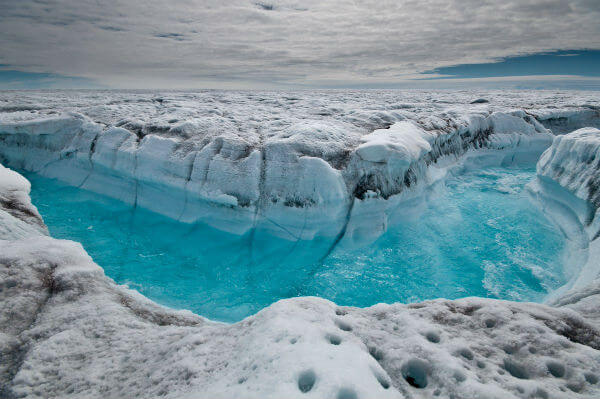
Greenland ice sheet melting

The New York Times reports: Marking another milestone for a changing planet, scientists reported on Wednesday that the Earth reached its highest temperature on record in 2016 — trouncing a record set only a year earlier, which beat one set in 2014. It is the first time in the modern era of global warming data that temperatures have blown past the previous record three years in a row.

The findings come two days before the inauguration of an American president who has called global warming a Chinese plot and vowed to roll back his predecessor’s efforts to cut emissions of heat-trapping gases.

The data show that politicians cannot wish the problem away. The Earth is heating up, a point long beyond serious scientific dispute, but one becoming more evident as the records keep falling. Temperatures are heading toward levels that many experts believe will pose a profound threat to both the natural world and to human civilization. [Continue reading…]

Facebooktwittermail

Parts of U.S. are heating faster than globe as a whole

The Guardian reports: Global warming obviously refers to temperature increases across the entire globe. We know the Earth is warming, we know it is human-caused, we have a pretty good idea about how much the warming will be in the future and what some of the consequences are. In fact, when it comes to the Earth’s average climate, scientists have a pretty good understanding.

On the other hand, no one lives in the average climate. We live spread out north, west, east, and south. On islands, large continents, inland or in coastal regions. Many of us want to know what’s going to happen to the climate where we live. How will my life be affected in the future?

This type of question is answered in a very recent study published by scientists from the University of Massachusetts at Amherst. The team, which includes Dr. Raymond Bradley and researcher Dr. Ambarish Karmalkar looked specifically at the Northeastern United States. They found that this area will warm much more rapidly than the globe as a whole. In fact, it will warm faster than any other United States region. The authors expect the Northeast US will warm 50% faster than the planet as a whole. They also find that the United States will reach a 2 degree Celsius warming 10–20 years before the globe as a whole. [Continue reading…]

Facebooktwittermail

As Trump takes power, scientists scramble to secure wildlife data

Jimmy Tobias writes: In recent weeks, archivists, academics, and other ardent information activists have frantically sought to preserve and protect federal climate science before Donald Trump takes power in Washington. Leading the way is the University of Pennsylvania’s DataRefuge project, which is conducting a nationwide campaign to save and copy massive government data sets that contain critical information about our changing climate. Leaders of this effort fear that such data could disappear from federal websites when the president-elect’s administration gains control of government agencies.

But climate science isn’t the only potential victim. DataRefuge organizers, along with allies like the Union of Concerned Scientists, are equally worried about other forms of federal environmental research.

“There is no reason to think its efforts would be restricted to climate data alone,” says Gretchen Goldman, the research director of the Union of Concerned Scientists’ Center for Science and Democracy.

Goldman stresses the vulnerability of wildlife science, particularly research by the United States Fish and Wildlife Service that pertains to endangered, threatened, or otherwise imperiled species. [Continue reading…]

Facebooktwittermail

Obama vs Trump — academic journals vs Twitter

The Associated Press reports: President Barack Obama cast the adoption of clean energy in the U.S. as “irreversible,” putting pressure Monday on President-elect Donald Trump not to back away from a core strategy to fight climate change.

Obama, penning an opinion article in the journal Science, sought to frame the argument in a way that might appeal to the president-elect: in economic terms. He said the fact that the cost and polluting power of energy have dropped at the same time proves that fighting climate change and spurring economic growth aren’t mutually exclusive.

“Despite the policy uncertainty that we face, I remain convinced that no country is better suited to confront the climate challenge and reap the economic benefits of a low-carbon future than the United States,” Obama wrote.

He peppered his article with subtle references to Trump, noting that the debate about future climate policy was “very much on display during the current presidential transition.”

As he prepares to transfer power to Trump, Obama has turned to an unusual format to make his case to Trump to preserve his policies: academic journals. In the last week, Obama also published articles under his name in the Harvard Law Review about his efforts on criminal justice reform and in the New England Journal of Medicine defending his health care law, which Republicans are poised to repeal.

The articles reflect an effort by Obama to pre-empt the arguments Trump or Republicans are likely to employ as they work to roll back Obama’s key accomplishments in the coming years. Yet it’s unclear whether Trump or the GOP could be swayed by scholarly arguments in relatively obscure publications. [Continue reading…]

At tomorrow’s press conference, Donald Trump is sure to be asked for clarification on questions raised by his recent tweets.

On the other hand, “Did you read any of President Obama’s recent articles in Science, the Harvard Law Review, or the New England Journal of Medicine, Mr Trump?” is an unlikely question.

But on the off-chance something along those lines does come up, Trump is likely to wave it off with something like this: “I’m happy for President Obama to write for academics while I work for the American people.”

It would be understandable if Obama feels like he’s served his time and is now entitled to a quiet life, but I hope he does the opposite — that he doesn’t withdraw to an ivory tower but instead lends his voice (more than his pen) to active and engaged opposition to what promises to be the worst presidency in American history. Writing for academic journals, however, is preaching to the choir.

Scientific challenges against an anti-science president and an anti-science political party are going to get parried by the same expression of mock humility — “I’m not a scientist, but…” — a line that resonates well in a scientifically illiterate nation.

Facebooktwittermail

As Donald Trump denies climate change, these kids die of it


Nicholas Kristof writes: She is just a frightened mom, worrying if her son will survive, and certainly not fretting about American politics — for she has never heard of either President Obama or Donald Trump.

What about America itself? Ranomasy, who lives in an isolated village on this island of Madagascar off southern Africa, shakes her head. It doesn’t ring any bells.

Yet we Americans may be inadvertently killing her infant son. Climate change, disproportionately caused by carbon emissions from America, seems to be behind a severe drought that has led crops to wilt across seven countries in southern Africa. The result is acute malnutrition for 1.3 million children in the region, the United Nations says.

Trump has repeatedly mocked climate change, once even calling it a hoax fabricated by China. But climate change here is as tangible as its victims. Trump should come and feel these children’s ribs and watch them struggle for life. It’s true that the links between our carbon emissions and any particular drought are convoluted, but over all, climate change is as palpable as a wizened, glassy-eyed child dying of starvation. Like Ranomasy’s 18-month-old son, Tsapasoa.

Southern Africa’s drought and food crisis have gone largely unnoticed around the world. The situation has been particularly severe in Madagascar, a lovely island nation known for deserted sandy beaches and playful long-tailed primates called lemurs.

But the southern part of the island doesn’t look anything like the animated movie “Madagascar”: Families are slowly starving because rains and crops have failed for the last few years. They are reduced to eating cactus and even rocks or ashes. The United Nations estimates that nearly one million people in Madagascar alone need emergency food assistance. [Continue reading…]

Facebooktwittermail

The Atlantic Ocean and an actual debate in climate science

Robinson Meyer writes: Many Americans know AMOC [Atlantic Meridional Overturning Circulation] as the Gulf Stream: the warm, surface-level current in the Atlantic Ocean that hugs the East Coast. You may have seen it in the old map by Ben Franklin, pictured above: It flows up the Carolinas, passes by New England and Nova Scotia, and then veers toward Europe. Eventually it arrives near the British isles and northwestern Europe.

The Gulf Stream is part of a much larger system, however. As that warm water flows northeast, it gradually cools, and in cooling, compresses and sinks. Eventually, in the Labrador and Greenland Seas, it becomes dense enough that it plunges down thousands of meters into the deep ocean. There it becomes a new current, running back south. It can remain in this deep-ocean current for many years until it eventually upwells at the equator or in the Southern Ocean.

This global conveyor belt of water is AMOC, and it is critical to the world’s climate. (Most scientists pronounce it as AY-mock.)

When AMOC is strong, it sends millions of cubic meters of ocean water north every day. A strong AMOC seems to shape the entire planet’s climate systems. It moderates the intensity of Atlantic hurricanes, lessens the risk of drought in North America, and assures the health of monsoons in India. AMOC also ferries warm weather from the equator to Western Europe, where it helps bring the region unusually mild winters. (Consider that temperate Berlin is about as far from the equator as the snowy Chilean city of Punta Arenas.)

Crucially, the entire AMOC system depends on cool, dense water “overturning” in the northwest Atlantic Ocean. Without cooled water plunging into the deep ocean near Greenland, and turning back south, the entire conveyor belt will stop.

About 30 years ago, climate researchers became concerned that AMOC could suddenly shut down as a result of anthropogenic climate change. The “paleoclimatic record”—that is, what the planet’s geology and fossil record reveal of previous global climates—showed that the AMOC has rapidly collapsed in the past. “Rapidly” here means “within the span of a human lifetime.”

The crumpling of AMOC could potentially cause big problems for the global economy. AMOC’s disappearance would quickly worsen sea-level rise on the U.S. East Coast and subject the Southeast to unusually intense tropical storms. It could upheave agriculture in India, Europe, and the African Sahel.

But as climate models improved, those fears dissipated. “No current comprehensive climate model projects that the AMOC will abruptly weaken or collapse in the 21st century,” wrote a team of NOAA researchers in 2008. “We therefore conclude that such an event is very unlikely.”

Thomas Delworth was the lead author of that report. Delworth is a researcher at the NOAA Geophysical Fluid Dynamics Laboratory and a professor of atmospheric and oceanic science at Princeton University. He says that scientists are now re-examining those old conclusions.

“Some recent work now is challenging that consensus. It suggests that the real climate system may be less stable than [the models] think,” Delworth told me. [Continue reading…]

Facebooktwittermail

The very real threat of Trump’s climate denialism

Paul A. Offit writes: During the past few months, Scott Pruitt, Donald Trump’s pick to head the Environmental Protection Agency, Rick Perry, Trump’s pick to head the Energy Department, and Donald Trump himself have all said that they don’t believe in climate change. The most upsetting part of their statements has been the misuse of the word believe.

Religion is a belief system. You have to believe that Moses parted the Red Sea or that Lazarus was raised from the dead. Because these phenomena violate the laws of nature, they are matters of faith.

Science, on the other hand, isn’t a belief system. It’s an evidence-based system. For example, you don’t have to believe in the theory of evolution. All you have to do is examine 250,000 years of fossil records to know that humans and apes evolved from a common ancestor. You don’t have to believe in the germ theory. All you have to do is recognize that vaccines, antibiotics, and sanitation programs have increased our lifespan by 30 years during the past century. And you don’t have to believe in the theory of gravity. All you have to do is drop your pen. None of these concepts are theories any more. They’re facts supported by evidence. [Continue reading…]

Facebooktwittermail

China aims to spend at least $360 billion on renewable energy by 2020

The New York Times reports: China intends to spend more than $360 billion through 2020 on renewable power sources like solar and wind, the government’s energy agency said on Thursday.

The country’s National Energy Administration laid out a plan to dominate one of the world’s fastest-growing industries, just at a time when the United States is set to take the opposite tack as Donald J. Trump, a climate-change doubter, prepares to assume the presidency.

The agency said in a statement that China would create more than 13 million jobs in the renewable energy sector by 2020, curb the growth of greenhouse gasses that contribute to global warming and reduce the amount of soot that in recent days has blanketed Beijing and other Chinese cities in a noxious cloud of smog.

China surpassed the United States a decade ago as the world’s biggest emitter of greenhouse gasses, and now discharges about twice as much. For years, its oil and coal industries prospered under powerful political patrons and the growth-above-anything mantra of the ruling Communist Party.

The result was choking pollution and the growing recognition that China, many of whose biggest cities are on the coast, will be threatened by rising sea levels.

But even disregarding the threat of climate change, China’s announcement was a bold claim on leadership in the renewable energy industry, where Chinese companies, buoyed by a huge domestic market, are already among the world’s dominant players. Thanks in part to Chinese manufacturing, costs in the wind and solar industries are plummeting, making them increasingly competitive with power generation from fossil fuels like coal and natural gas. [Continue reading…]

Facebooktwittermail

Earth’s oceans are steadily warming

Robinson Meyer writes: It’s sometimes said that modern science spends too much time on the documentation of a new trend and too little time on the replication of old ones. A new paper published Wednesday in the open-access journal Science Advances is important just because it does the latter. In fact, it sheds light on the scientific process in action—and also reveals how climate-change denialists can muddy that process.

Here’s the big takeaway from the new study: Across the planet, the ocean surface has been warming at a relatively steady clip over the past 50 years.

This warming trend shows up whether the ocean is measured by buoy, by satellite, or by autonomous floating drone. It also shows up in the global temperature dataset created and maintained by the National Oceanic and Atmospheric Administration (NOAA).

In fact, the warming shows up in both datasets in essentially the same way. This is important because it confirms the integrity of the NOAA dataset — and adds further evidence to the argument that ocean temperatures have steadily warmed this century without a significant slowdown.

“Our results essentially confirm that NOAA got it right,” says Zeke Hausfather, a researcher and economist at the University of California Berkeley. “They weren’t cooking the books. They weren’t bowing to any political pressure to find results that show extra warming. They were a bunch of scientists trying their hardest to work with messy data.”

Here’s why the finding matters: In June 2015, NOAA published an update to its long-running dataset of historical global temperatures. Thomas Karl, the director of the National Centers for Environmental Information, and his colleagues at NOAA explained in a paper in Science that the old database had a critical flaw. In trying to merge temperature readings taken by ships and buoys, NOAA had been allowing “cooling bias” to seep into its numbers.

In other words, NOAA’s global temperature estimates had been too low, and its measurement of climate change was too conservative. With this newly updated data in hand, Karl and his colleagues found there had been no slowdown in global warming during the 2000s.

NOAA’s new findings disagreed with those of the U.K. Met Office, whose widely used global temperature dataset does show a slowdown in the 2000s.

So: Was there a slowdown? This is an interesting problem of some scientific interest. Researchers have pointed to El Niño, to multiyear oceanic cycles, and to the post-Soviet reforestation of Russia as possible explanations for the change.

But here’s the thing: The slowdown, or lack thereof, never threw the larger phenomenon of human-caused climate change into question. In fact, even among the most conservative estimates, the globe kept warming right through the slowdown. The overwhelming consensus of Earth scientists is that the planet is harmfully warming due to human industrial activity. What’s more, if a slowdown did occur in the 2000s, it seems to have abated now. The previous three years — 2014, 2015, and 2016 — have all broken the record as the hottest year ever in the modern temperature record.

But this hasn’t seemed to matter in public debate, as climate-change denialists have found enormous success casting doubt on global warming by glomming onto this “slowdown” debate. [Continue reading…]

Facebooktwittermail

Can carbon capture technology prosper under Trump?

The New York Times reports: Can one of the most promising — and troubled — technologies for fighting global warming survive during the administration of Donald J. Trump?

The technology, carbon capture, involves pulling carbon dioxide out of smokestacks and industrial processes before the climate-altering gas can make its way into the atmosphere. Mr. Trump’s denial of the overwhelming scientific evidence supporting climate change, a view shared by many of his cabinet nominees, might appear to doom any such environmental initiatives.

But the new Petra Nova plant about to start running here, about 30 miles southwest of Houston, is a bright spot for the technology’s supporters. It is being completed essentially on time and within its budget, unlike many previous such projects. When it fires up, the plant, which is attached to one of the power company NRG’s hulking coal-burning units, will draw 90 percent of the CO2 from the emissions produced by 240 megawatts of generated power. That is a fraction of the roughly 3,700 megawatts produced at this gargantuan plant, the largest in the Lone Star State. Still, it is enough to capture 1.6 million tons of carbon dioxide each year — equivalent to the greenhouse gas produced by driving 3.5 million miles, or the CO2 from generating electricity for 214,338 homes. [Continue reading…]

Facebooktwittermail

NASA’s overlooked duty to look inward

Elisa Gabbert writes: In 1942, not long after the attack on Pearl Harbor, the poet Archibald MacLeish wrote an essay called “The Image of Victory,” in which he asked what winning the Second World War, the “airman’s war,” would mean for posterity. MacLeish believed that pilots could do more than bring victory; by literally rising above the conflicts on the ground, they could also reshape our very understanding of the planet. “Never in all their history have men been able truly to conceive of the world as one: a single sphere, a globe, having the qualities of a globe, a round earth in which all the directions eventually meet, in which there is no center because every point, or none, is center — an equal earth which all men occupy as equals,” he wrote. The airplane, he felt, was both an engine of perspective and a symbol of unity.

MacLeish could not, perhaps, have imagined the sight of a truly whole Earth. But, twenty-six years after his essay appeared, the three-man crew of Apollo 8 reached the highest vantage point in history, becoming the first humans to witness Earth rising over the surface of the moon. The most iconic photograph of our planet, popularly known as “The Blue Marble,” was taken by their successors on Apollo 17, in 1972. In it, Earth appears in crisp focus, brightly lit, as in studio portraiture, against a black backdrop. The picture clicked with the cultural moment. As the neuroscientist Gregory Petsko observed, in 2011, in an essay on the consciousness-shifting power of images, it became a symbol of the budding environmentalist movement. “Our whole planet suddenly, in this image, seemed tiny, vulnerable, and incredibly lonely against the vast blackness of the cosmos,” Petsko wrote. “Regional conflict and petty differences could be dismissed as trivial compared with environmental dangers that threatened all of humanity.” Apollo 17 marked America’s last mission to the moon, and the last time that humans left Earth’s orbit.

It was always part of NASA’s mission to look inward, not just outward. The National Aeronautics and Space Act of 1958, which established the agency, claimed as its first objective “the expansion of human knowledge of phenomena in the atmosphere and space.” NASA’s early weather satellites were followed, in the seventies and eighties, by a slew of more advanced instruments, which supplied data on the ozone layer, crops and vegetation, and even insect infestations. They allowed scientists to recognize and measure the symptoms of climate change, and their decades’ worth of data helped the Intergovernmental Panel on Climate Change conclude, in 2007, that global warming is “very likely” anthropogenic. According to a report released last month by NASA’s inspector general, the agency’s Earth Science Division helps commercial, government, and military organizations around the world locate areas at risk for storm-related flooding, predict malaria outbreaks, develop wildfire models, assess air quality, identify remote volcanoes whose toxic emissions contribute to acid rain, and determine the precise length of a day. [Continue reading…]

Facebooktwittermail