Category Archives: climate change

Michael Klare: Go green young woman, young man

Excuse me if I take a flier today and write an introduction on the good news about climate change. Yep, the good news. It would, of course, be easy enough to do the opposite. When it comes to climate change, gloomy is a cinch. Just about any piece on the subject is likely to depress the hell out of you. Did you know — as I learned only recently from a New York Times article — that sea levels rose at a rate of 1.7 millimeters annually during the previous century, but from 1993 on, that rate has nearly doubled to 3.2 millimeters? Later this century, scientists estimate that it could be “16 millimeters a year, or about six-tenths of an inch” — at least three feet by century’s end and possibly worse, depending on what’s melting and how fast. If you’re a coastal dweller as I am (the eastern U.S.), that should give you pause, and if you live in a coastal area of China, you should be getting nervous. But I did say good news, didn’t I, and it is the weekend that 195 countries reached a climate agreement in Paris, isn’t it? So here goes.

Let’s start with the divestment movement. In Paris recently, the heroic 350.org announced a startling figure. More than 500 institutions representing $3.4 trillion in assets have agreed to get rid of all or part of the fossil fuel investments in their portfolios. That represents a big leap forward for divestment. And this is just one aspect of a growing global climate change movement that wants to point us toward the exit when it comes to the age of carbon and is proving that it can’t be ignored. And speaking of carbon emissions, here’s a little news flash from the atmospheric front lines: it’s just faintly possible that those emissions are peaking ahead of schedule. Despite a modest global economic recovery, for the last couple of years greenhouse gas emissions have flat-lined and they may even fall by a modest 0.6% in 2015. Don’t dance a jig yet. This may not even be the “peak emissions” moment, but if not, it could be coming more quickly than expected.

On a planet getting hotter all the time, this isn’t exactly nirvana-style news, but add this in: it had been hoped that somehow the negotiating nations of the world gathered in Paris these last two weeks might agree to the goal of keeping the prospective rise in temperature on planet Earth to 2 degrees Celsius. As it happens, climate scientists have increasingly been warning that even that number could result in devastating environmental disruptions. To the surprise of all, the aspirational number now mentioned in the Paris agreement is 1.5 degrees Celsius. (Humanity has already fossil-fueled the temperature upward by about a degree since the industrial revolution began.) Of course, agreeing on such a figure is one thing. Coming anywhere near achieving it is another.

Still, good news and climate change are not normally associated, so let’s give a tiny cheer for these glimpses of upbeat news this week, as well as for the agreement just reached, and then consider what’s positive in the long-term outlook for all of us. There, too, as TomDispatch‘s invaluable energy expert Michael Klare suggests, there’s a green glow on the horizon amid the gloom when it comes to renewable energy sources. So don’t pop that champagne cork yet, but do read on! Tom Engelhardt

A new world beckons
The future belongs to renewables
By Michael T. Klare

Historically, the transition from one energy system to another, as from wood to coal or coal to oil, has proven an enormously complicated process, requiring decades to complete. In similar fashion, it will undoubtedly be many years before renewable forms of energy — wind, solar, tidal, geothermal, and others still in development — replace fossil fuels as the world’s leading energy providers. Nonetheless, 2015 can be viewed as the year in which the epochal transition from one set of fuels to another took off, with renewables making such significant strides that, for the first time in centuries, the beginning of the end of the Fossil Fuel Era has come into sight.


Continue reading

Facebooktwittermail

Five things you need to know about the Paris climate deal

By Simon Lewis, UCL

The UN climate talks in Paris have ended with an agreement between 195 countries to tackle global warming. The climate deal is at once both historic, important – and inadequate. From whether it is enough to avoid dangerous climate change to unexpected wins for vulnerable nations, here are five things to help understand what was just agreed at COP21.

1. This is a momentous, world-changing event

The most striking thing about the agreement is that there is one. For all countries, from superpowers to wealthy city-states, fossil fuel-dependent kingdoms to vulnerable low-lying island nations, to all agree to globally coordinate action on climate change is astonishing.

And it is not just warm words. Any robust agreement has to have four elements. First, it needs a common goal, which has now been defined. The agreement states that the parties will hold temperatures to “well below 2°C above pre-industrial levels and to pursue efforts to limit the temperature increase to 1.5°C above pre-industrial levels”.

Second, it requires matching scientifically credible reductions in carbon dioxide and other greenhouse gas emissions. The agreement is woollier here, but it does state that emissions should peak “as soon as possible” and then be rapidly reduced. The next step is to:

Achieve a balance between anthropogenic emissions by sources and removals by sinks of greenhouse gases in the second half of this century, on the basis of equity …

Third, as current pledges to reduce emissions imply a warming of nearly 3°C above pre-industrial levels, there needs to be a mechanism to move from where countries are today, to zero emissions. There are five-year reviews, and “the efforts of all parties will represent a progression over time”, which means at each step countries should increase their levels of emission cuts from today’s agreements.

Finally, this all means developed countries need to rapidly move from fossil fuel energy to renewable sources. But the challenge is larger for the developing world: these countries must leapfrog the fossil fuel age. They need funds to do so and a key part of the agreement provides US$100 billion per year to 2020, and more than that after 2020.

Continue reading

Facebooktwittermail

Paris emissions cuts aren’t enough – we’ll have to put carbon back in the ground

By Myles Allen, University of Oxford

I wonder how many of the delegates in Paris realise that they have just created the mother of all “take-back schemes”.

As a consumer, you may have already come across this sort of deal: if you don’t want to dispose of the packaging of your new sofa, you can take it back to IKEA and it’s their problem. In many places, you can even take back the sofa itself when your kids have wrecked it. For the Paris climate deal to succeed something similar will have to happen, where companies that rely on fossil fuels will be obliged to “take back” their emissions.

The agreement reaffirms a commitment to stabilising temperature rises well below 2℃, and even retains the option of limiting warming to 1.5℃ if possible. But it also confirms national targets that do little more than stabilise global emissions between now and 2030.

Given those emissions, sticking to within 2℃ will require us to take lots of carbon out of the atmosphere and store it in the ground. The parties to the agreement are, in effect, saying “we’re going to sell this stuff, and we’re going to dispose of it later”.

Continue reading

Facebooktwittermail

After a 400-year population boom, we need to reconnect with the Sun

By Tony Ryan, University of Sheffield

For almost all of our species’ 200,000-year history, man’s relationship with the Earth was no different to that of any other animal. All their energy was provided directly by the sun. Sunlight captured by plants using photosynthesis was converted into food and fuel. They ate roots, fruits and grains (and animals that also ate roots, fruits and grains) to provide their bodies with energy. They burned wood to keep themselves warm and fat to provide light at night.

It was a successful strategy for survival and over tens of thousands of years the human population spread across six continents.

However, locked in to this natural solar cycle, there was a limit to how many people their lifestyle could support, and the total number of inhabitants fluctuated below 500m depending on disease, wars and food supply.

Then, 350 years ago, everything changed. We began to supplement our energy needs with coal and oil (humans had been using coal since pre-historic times but not on a large scale). This was still energy from sunshine, but this time millions of years old. In less than two centuries the human population exploded, doubling in size to 1 billion people. It has continued to grow ever since, but the rate of change has increased significantly. It took 100,000 years to reach the first billion people: today we are adding a further billion every 12 years. The result is a huge squeeze on all natural resources. Over the next two decades we will witness huge increases in demand for energy, food and water – a perfect storm.

Continue reading

Facebooktwittermail

Mother Earth: ‘If you don’t take care of me, I cannot take care of you.’

Mashable reports: This one-minute film, which also has a version in French voiced by actress Marion Cotillard, is the latest in Conservation International’s Nature Is Speaking series, featuring several A-list celebrities lending their voices to personify various aspects of nature. Last month, Mashable debuted the first of this year’s films, Ice, voiced Liam Neeson. [Continue reading…]

Facebooktwittermail

World leaders adopt 1.5 C goal — and we’re damn well going to hold them to it

Bill McKibben writes: Here’s the crucial plaintive paragraph from the preamble to the Paris climate agreement released today, written in the almost indecipherable bureaucratese that attends this international circus:

Emphasizing with serious concern the urgent need to address the significant gap between the aggregate effect of Parties’ mitigation pledges in terms of global annual emissions of greenhouse gases by 2020 and aggregate emission pathways consistent with holding the increase in the global average temperature to well below 2 °C above pre-industrial levels and pursuing efforts to limit the temperature increase to 1.5 °C …

What it says is: The world is a doughy fellow who has promised to drop three suit sizes in time for his wedding, which is now only a month away. The world is an anxious student who has to ace the next morning’s test to pass the course but hasn’t yet started to study. The world has promised his kids a great raft of presents under the tree, but now it’s suddenly Christmas Eve and the shops have started closing.

The “significant gap” is the crucial thing. In the agreement, the world promises to hold the rise in the planet’s temperature to below 2 degrees Celsius. Heck, it promises to aim for 1.5 degrees, which is extraordinary. It’s what actually needs to be done; if we succeeded, it might just head off complete calamity. (We’re now at 1 degree above average pre-industrial temperatures, and considering what that’s already done in terms of melt, flood, and drought, 1.5 C will still be trouble, but maybe manageable trouble.)

But once you get past the promises part, the actual plans submitted by various governments commit the world to a temperature rise of 3.5 degrees, which is more or less the same as hell. It’s a broken planet. [Continue reading…]

Facebooktwittermail

Grand promises of Paris climate deal undermined by squalid retrenchments

George Monbiot writes: By comparison to what it could have been, it’s a miracle. By comparison to what it should have been, it’s a disaster.

Inside the narrow frame within which the talks have taken place, the draft agreement at the UN climate talks in Paris is a great success. The relief and self-congratulation with which the final text was greeted, acknowledges the failure at Copenhagen six years ago, where the negotiations ran wildly over time before collapsing. The Paris agreement is still awaiting formal adoption, but its aspirational limit of 1.5C of global warming, after the rejection of this demand for so many years, can be seen within this frame as a resounding victory. In this respect and others, the final text is stronger than most people anticipated.

Outside the frame it looks like something else. I doubt any of the negotiators believe that there will be no more than 1.5C of global warming as a result of these talks. As the preamble to the agreement acknowledges, even 2C, in view of the weak promises governments brought to Paris, is wildly ambitious. Though negotiated by some nations in good faith, the real outcomes are likely to commit us to levels of climate breakdown that will be dangerous to all and lethal to some. Our governments talk of not burdening future generations with debt. But they have just agreed to burden our successors with a far more dangerous legacy: the carbon dioxide produced by the continued burning of fossil fuels, and the long-running impacts this will exert on the global climate. [Continue reading…]

Facebooktwittermail

This is what will happen to the climate in the next 100 years

By Katja Frieler, Potsdam Institute for Climate Impact Research

At the Paris climate summit, delegates are deciding on a global goal for temperature rise. At the time of publication, the latest draft text calls for the world to “hold the increase in the global average temperature to well below 2℃ above pre-industrial levels and to pursue efforts to limit the temperature increase to 1.5℃”.

But the climate action pledges made by 185 countries ahead of the summit don’t add up to 1.5℃ or warming or even 2℃. Taken together, they add up to a 2.7℃ world.

As the negotiations go on, 2015 is about to set a new global temperature record, and is likely to have reached 1℃ warming already.

Continue reading

Facebooktwittermail

The Arctic as we know it is at stake at the Paris climate talks

By Ilona Mettiäinen, University of Lapland

Type “Arctic climate change” into a Google image search and you’ll see how the issue is largely perceived by the public: stranded polar bears, melting sea ice, icebergs and glaciers.

The anticipated melting of Arctic sea ice has also sparked global interest in the oil and gas resources that could be made available as the ice retreats, raising the prospect of a new Northern sea route between Europe and Asia.

Entirely missing from the results of the image search – and to large extent also the discussion – are the people of the Arctic, both indigenous and non-indigenous.

Continue reading

Facebooktwittermail

Why India’s plan to fight climate change doesn’t hold water

By Steffen Böhm, University of Essex; Sanjay Lanka, University of Essex, and Zareen Pervez Bharucha, University of Essex

As the third-largest emitter of greenhouse gases globally, the pressure is on India to offer something meaningful at the Paris climate talks. Yet the country demands the right to develop and lift its population out of poverty.

In its official submission to the summit, the so-called INDC (Intended Nationally Determined Contributions) which every country had to provide before negotiations began, India pledges to reduce the emissions intensity of GDP by 33 to 35% by 2030 based on 2005 levels. It proposes to achieve this by investing significantly in low-carbon technologies. But do these numbers stack up?

Indian prime minister Narendra Modi addresses the Paris talks.
Guillaume Horcajuelo/EPA

It may have the third highest greenhouse gas emissions on the planet, but India’s emissions per person are much lower than those of all so-called developed countries. This is why stakeholders insist on India’s right to develop.

Continue reading

Facebooktwittermail

On climate, developing countries need more than betting billions on clean energy breakthroughs

By Ambuj D Sagar, The Indian Institute of Technology Delhi

When the heads of state gathered in Paris at the beginning of the climate talks last week, there was much excitement over the launch of Mission Innovation, a program to “reinvigorate and accelerate public and private global clean energy innovation with the objective to make clean energy widely affordable.”

This was a welcome step and, frankly, long overdue – total public energy R&D expenditures of the major industrialized countries are still lower than the peaks reached after the oil shocks of the 1970s.

Yet at the same time, it is symptomatic of the flawed global approach to address climate change. We move forward in some ways but sidestep the key issues – in this case, the provision of adequate and suitable support to developing countries to quickly begin a transition to low-carbon energy. The result is that we leave large gaps in our attempts to avoid dangerous climate change.

Continue reading

Facebooktwittermail

Positive Paris talks not like cynical Copenhagen – but how will media cope?

By James Painter, University of Oxford

It has become a mantra here that Paris 2015 is not Copenhagen 2009. This time, the US and China are on board; the price of renewables has dropped by more than half; the vast majority of countries here have already pledged emission cuts and Paris is seen as a “staging post” not a final destination.

But how different is Paris 2015 for the 3,700 media representatives accredited here?

Like Copenhagen, where there were 4,000 from nearly 120 countries, the sheer volume of journalists makes the summits two of the most media-covered political events ever.

So it’s a daunting task for anyone analysing the bewildering array of content the journalists are producing.

A preliminary look at some of the hundreds of articles already published by the mainstream media suggests that, as in Copenhagen, the main angles are the process of the negotiations, and the political wrangling behind the sticking points.

So in Paris, much has already been published about the position of India, whereas in Copenhagen there was more about China.

More interesting are the other aspects of the climate change “mega-story” that journalists choose to cover beyond the negotiations. One strong impression is that since Copenhagen, as one veteran agency reporter put it to me recently, “climate change has moved from being just an environment story to a business and energy story”.

Continue reading

Facebooktwittermail

Just 6,000 years ago the Sahara was green and fertile. Could the Amazon go the same way?

By Sybren Drijfhout, University of Southampton

As recently as 6,000 years ago the Sahara was green and fertile. We’ve found evidence of large rivers crossing the region, lined by flourishing settlements. Then suddenly things changed. Trees died and the land dried up. Soil blew away or turned into sand and those rivers were no more. In just a few centuries, the Sahara was transformed from a region similar to modern South Africa into the desert we know today.

This is an example of a “tipping point”. Just think of the climate like a chair. It takes a strong push to tip over a chair stood on four legs, but when it’s leaning on only two legs the required push becomes smaller. Indeed, if the inclination becomes large enough, it will tip over by itself.

Today, climate change inclination is increasing – and we know it could suddenly tip over, as our planet has previously witnessed several abrupt switches between different states. Along with the Sahara there are also the flip-flops between ice ages and moderate conditions every 1,000 years, before things settled down 10,000 years ago.

Continue reading

Facebooktwittermail

New research reveals the extent of the Alaska permafrost meltdown

Scientific American reports: Up to a quarter of the permafrost that lies just under the ground surface in Alaska could thaw by the end of the century, releasing long-trapped carbon that could make its way into the atmosphere and exacerbate global warming, a new study finds.

The study, detailed in the journal Remote Sensing of Environment, maps where that near-surface permafrost lies across Alaska in more detail than previous efforts. That detail could help determine where to focus future work and what areas are at risk of other effects of permafrost melt, such as changes to local ecosystems and threats to infrastructure, the study’s authors say.

About one quarter of the land in the Northern Hemisphere is permafrost, or ground that stays frozen for at least two years. Some of it has been in that frozen state for thousands of years, locking up an amount of carbon that is more than double what is currently in the Earth’s atmosphere. But with temperatures in the Arctic rising at twice the rate of the planet as a whole, permafrost across the region is beginning to thaw, releasing that carbon from its icy confines. [Continue reading…]

Facebooktwittermail

What most people don’t understand about climate change

The Atlantic reports: The world’s highest-ranking diplomats are meeting in Paris this week to complete the final version of a new UN agreement on climate change.

They are working on a 48-page draft resolution, prepared during the first week of the talks by lower-ranking climate ministers. One of the questions they’ll take up during the week to come: Should the world’s nations attempt to limit climatic warming to 1.5 degrees Celsius, instead of the previously agreed-upon 2 degrees?

1.5 degrees has become one of the most surprising stories of Paris. Many observers expected the international community to drop the two-degree target at the Paris talks due to its scientific impracticability. Instead, thanks to climate activists and sustained diplomacy from the countries most vulnerable to sea-level rise, it might settle on an even more ambitious target. The United States and China have both signaled tentative support for 1.5, despite Saudi Arabian and Indian opposition.

Yet actually achieving 1.5 degrees will be extraordinarily difficult. Speaking to The Atlantic Monday morning from Paris, President Obama’s top science advisor said that it will be an near impossible target to meet. [Continue reading…]

Facebooktwittermail

Global emissions to fall for first time during a period of economic growth

The Guardian reports: Worldwide greenhouse gas emissions will fall in 2015, researchers have said, in what would mark the first time they have declined while the economy has grown substantially.

Emissions have fallen in previous years but only because of financial crashes, such as the global slump in 2007.

But a decline in coal consumption by China, the world’s carbon juggernaut responsible for more than a quarter of emissions, means global levels are projected to fall 0.6% this year. China’s own emissions are expected to drop 3.9% in 2015, after a decade of rising by nearly 6.7% a year.

The figures, published in the journal Nature Climate Change, will provide a fillip to negotiators from 195 countries entering a second week of climate talks in Paris on Monday.

But the paper’s authors warned the fall may only be temporary and that a switch away from fossil fuels to clean sources of energy needs to be accelerated if dangerous warming is to be avoided. [Continue reading…]

Facebooktwittermail

What passing a key CO2 mark means to climate scientists

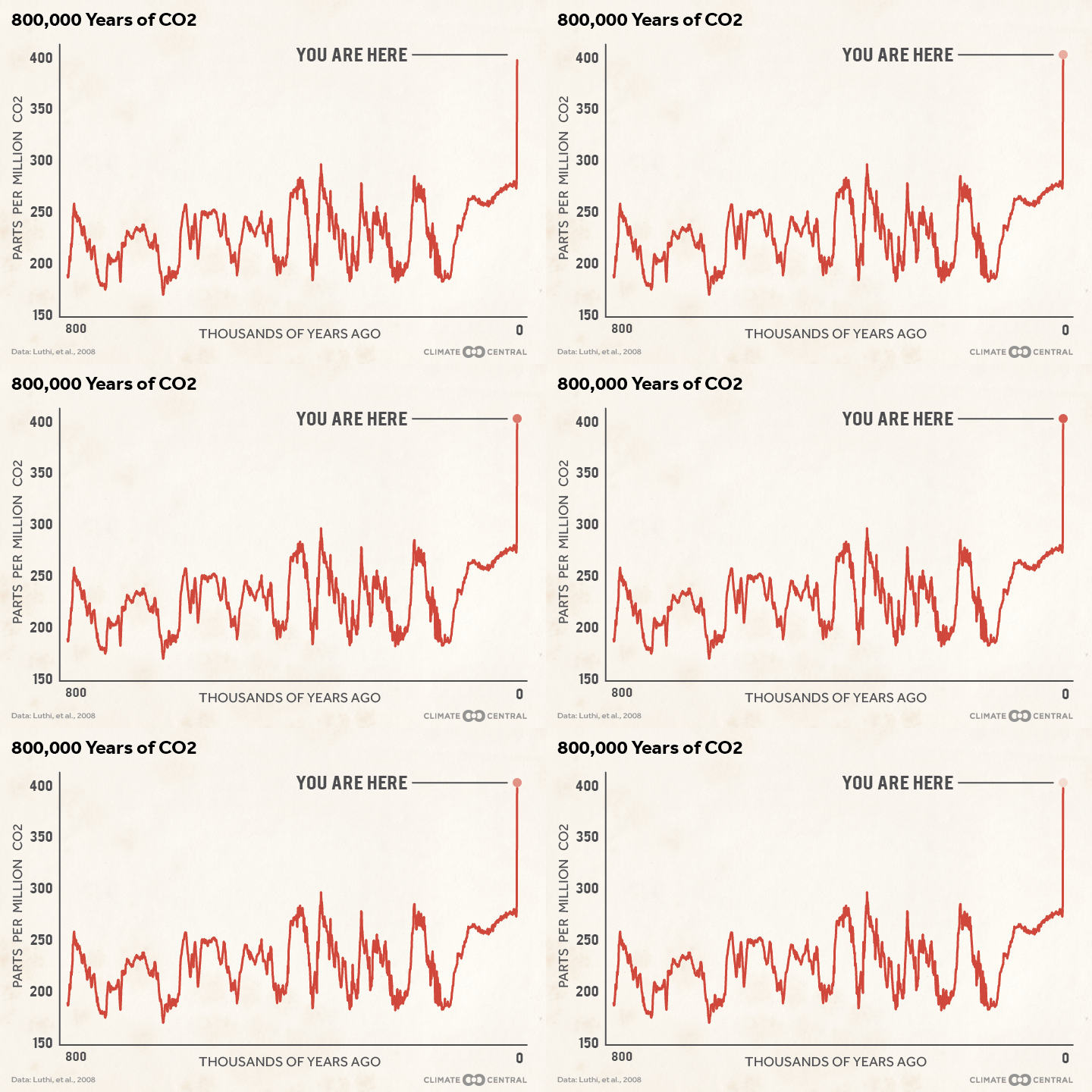
Climate Central reported in November: This week is a big one for our world. Atmospheric carbon dioxide (CO2) levels climbed above the 400 parts per million (ppm) at the Mauna Loa Observatory and it’s distinctly possible they won’t be back below that level again in our lifetimes.

Humans have burned enough fossil fuels to drive atmospheric CO2 to levels that world hasn’t seen in at least 400,000 years. That’s driven up temperatures, melted ice and caused oceans to acidify. Some extreme weather events around the world have become more likely and stronger because of it, and some will likely only get worse as the planet continues to warm.

Because CO2 sits in the atmosphere long after it’s burned, that means we’ve likely lived our last week in a sub-400 ppm world. It also means that the reshaping of our planet will continue for decades and centuries to come, even if climate talks in Paris in two weeks are successful. [Continue reading…]

Facebooktwittermail