Category Archives: climate change

Why Paris worked: A different approach to climate diplomacy

pattern4

David Victor writes: Why did Paris work when almost everything before it failed? The central answer lies in a new style of international cooperation, one that has enabled 195 countries to formally adopt an agreement that is likely to have a real impact on the emissions that cause climate change, as well as on how societies adapt to the big shifts in climate that are coming.

The contrast of Paris with the past could not be starker. The 1992 Rio framework to get serious climate diplomacy going was the right approach, but diplomats and climate activists steered that framework off the rails, and for 23 years — until now — they achieved very little. The 1997 Kyoto Protocol was so riddled with flaws that it had essentially no impact on emissions. The 2009 climate negotiations in Copenhagen ended in acrimony and recriminations.

Now, instead of setting commitments through centralized bargaining, the Paris approach sets countries free to make their own commitments. These “nationally determined contributions” are a starting point for deeper cooperation that will unfold over time. Once the Paris agreement enters into force and is fully in motion, around the year 2020, each nation will be expected to adopt a new pledge every five years in tandem with periodic overall efforts to take stock of how the group of nations is doing. [Continue reading…]


Facebooktwittermail

Marshes can rise to meet flood risks if we don’t disrupt mud flows

marshland

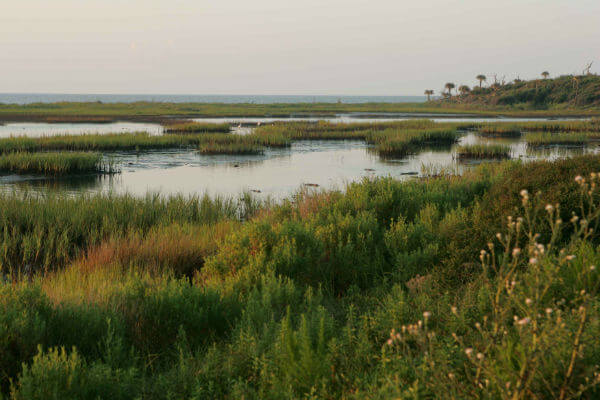
Climate Central reports: In the race to keep their verdure heads above rising seas, marshes that protect coastal regions from floods, storms and erosion harbor the botanical equivalents of nitro boosters: rapid growth fueled by climate-changing pollution.

The same greenhouse gas that’s doing most to warm the planet and uplift its seas can also work as a fertilizer. New research suggests that rising levels of heat-trapping carbon dioxide in the atmosphere could help communities of marsh plants grow quickly enough to keep up with changes that would otherwise inundate them.

“The fertilization effect from increased carbon dioxide in the atmosphere definitely enhances marsh-plant biomass functioning,” said Katherine Ratliff, a PhD candidate at Duke University who led modeling-based research published last month in Proceedings of the National Academy of Sciences.

The findings suggest that mud shortages — not growth rates — could be the greatest challenges for marshes as they strive to grow quickly enough to keep up with rising seas. Sea levels have risen 8 inches since the late 1800s, with several more feet expected this century. The fostering of coastal ecosystems is considered a key defense strategy against future flooding. [Continue reading…]

Facebooktwittermail

Electrifying India, with solar power and small loans

solar-india

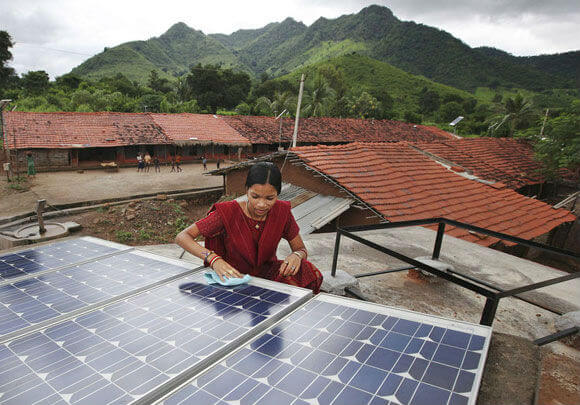
The New York Times reports: A few years ago, the hundred or so residents of Paradeshappanamatha, a secluded hamlet in the southern Indian state of Karnataka, gathered along the central pathway between their 22 densely clustered homes, and watched as government workers hoisted a solar-powered streetlamp. As the first display of electricity in the town, it was an object of mild interest, but, being outside, the light didn’t help anyone cook or study, and only attracted moths.

Still, when B. Prasad arrived two years later to encourage people here to abandon kerosene lighting for solar-powered home systems, people had some idea what he was talking about. What sounded preposterous to the village residents was the price. Mr. Prasad, an agent for Solar Electric Light Company, or Selco, was selling a panel and battery that would power three lights and an attached socket for phone charging for approximately 12,800 rupees, or $192.

“There was no way we could afford that,” P. C. Kalayya remembers thinking. He and his neighbors rise early in the morning to walk miles along a nearly impassable dirt road to work on coffee, pepper and betel nut plantations. Mr. Kalayya earns $3 a day — he’d been earning $2.25 until a raise came through this year — and half his wage is withheld by his employer as repayment for various loans.

And yet, despite what seemed on its face an impossibly high cost, Selco agents succeeded in persuading Mr. Kalayya and 10 other village households to make the switch. Now, his wife can better see how much spice she is putting in as she cooks, and Pratima, their 18-year-old daughter, can study long after dark.

The idea behind Selco, and other companies like it, is to create a business model that will help some of the 1.2 billion people in the world who don’t have electricity to leapfrog the coal-dependent grid straight to renewable energy sources.

About a quarter of the world’s off-the-grid people, or 300 million or so, live in India, mostly in remote, rural communities like Paradeshappanamatha, or in informal urban settlements. Hundreds of millions more get electricity for only a few hours a day. Prime Minister Narendra Modi has pledged to achieve universal electrification in India by the end of 2022. His main effort is adding hundreds of new coal plants, which have contributed to near-apocalyptic pollution levels across large swaths of the country. [Continue reading…]

Facebooktwittermail

2015: A year of record heat shown in charts

Facebooktwittermail

The invasion of Antarctica

antarctica

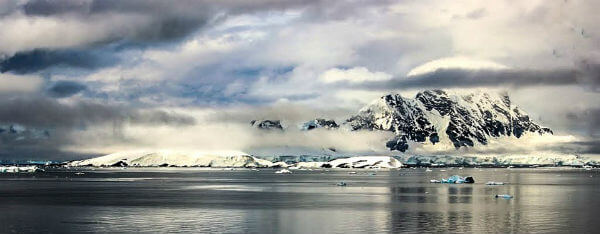
Simon Romero writes: On a glacier-filled island with fjords and elephant seals, Russia has built Antarctica’s first Orthodox church on a hill overlooking its research base, transporting the logs all the way from Siberia.

Less than an hour away by snowmobile, Chinese laborers have updated the Great Wall Station, a linchpin in China’s plan to operate five bases on Antarctica, complete with an indoor badminton court, domes to protect satellite stations and sleeping quarters for 150 people.

Not to be outdone, India’s futuristic new Bharathi base, built on stilts using 134 interlocking shipping containers, resembles a spaceship. Turkey and Iran have announced plans to build bases, too.

More than a century has passed since explorers raced to plant their flags at the bottom of the world, and for decades to come this continent is supposed to be protected as a scientific preserve, shielded from intrusions like military activities and mining.

But an array of countries are rushing to assert greater influence here, with an eye not just toward the day those protective treaties expire, but also for the strategic and commercial opportunities that exist right now.

“The newer players are stepping into what they view as a treasure house of resources,” said Anne-Marie Brady, a scholar at New Zealand’s University of Canterbury who specializes in Antarctic politics. [Continue reading…]

Facebooktwittermail

What’s the biggest reason to be hopeful about the climate at the end of 2015?

lichen8

Climate Central got answers from the following climate experts:
David Titley, director of Penn State’s Center for Solutions to Weather and Climate Risk: Paris, of course, but more substantively for the U.S. domestic movement is the sense more and more different groups are seeing climate change as an issue within their domain: big business, insurance and finance, multiple major religions, the divestment movement, health, national security, movies, and the media, as well as the traditional science and environmental communities. Ultimately, we have to have enough people care enough to get Congress to engage constructively and move both policies and money to transition our energy systems to non-carbon based forms as quickly as possible. Huge task, but if we’re focused we can do this.

Richard Somerville, professor emeritus at Scripps Institution of Oceanography: The biggest reason to be hopeful about the climate at the end of 2015 is the Paris Agreement reached in December 2015 at the COP21 negotiations in Paris. This agreement provides a roadmap to reducing the risk of dangerous climate change. However, when all is said and done, sometimes more is said than done, and the future of the climate system depends on the degree to which nations obey the letter and spirit of this roadmap and work to improve it.

Marshall Shepherd, director of atmospheric sciences at the University of Georgia: I am encouraged that the notion that climate change is a political issue is starting to erode. Key conservatives, major corporations, the military and faith communities recognize the challenges and opportunities. The recent Paris agreement is a bold step. It isn’t perfect, but it is an important signal.

Simon Donner, climate scientist at the University of British Columbia: We’ve thrown down the gauntlet. In Paris, the world agreed that greenhouse gas emissions must reach net zero during the second half of the century to avoid dangerous impacts from climate change. With global emissions peaking this year, and wind and solar prices at all time lows, there’s hope we can meet the ambition of Paris with action. [Continue reading…]

Facebooktwittermail

Americans use more energy on Christmas lights than is used to power entire countries

AFP reports: American household Christmas lights, a favorite holiday tradition, use up more electricity than some poorer countries — such as El Salvador or Ethiopia — do in a year.

Bright lights strung on American trees, rooftops and lawns account for 6.63 billion kilowatt hours of electricity consumption every year, according to a recent blog post by the Center for Global Development.

That’s more than the national electricity consumption of many developing countries. El Salvador for one, uses 5.35 billion kilowatt hours, while Ethiopia consumes 5.30 billion and Tanzania 4.81 billion. [Continue reading…]

Facebooktwittermail

‘Critical slowing down’ — nature’s early warning signal of system failure

lichen2

Natalie Wolchover writes: Nestled in the northern Wisconsin woods, Peter Lake once brimmed with golden shiners, fatheads, and other minnows, which plucked algae-eating fleas from the murky water. Then, seven years ago, a crew of ecologists began stepping up the lake’s population of predatory largemouth bass. To the 39 bass already present, they added 12, then 15 more a year later, and another 15 a month after that. The bass hunted down the minnows and drove survivors to the rocky shoreline, which gave fleas free rein to multiply and pick the water clean. Meanwhile, bass hatchlings — formerly gobbled up by the minnows — flourished, and in 2010, the bass population exploded to more than 1,000. The original algae-laced, minnow-dominated ecosystem was gone, and the reign of bass in clear water began.

Today, largemouth bass still swim rampant. “Once that top predator is dominant, it’s very hard to dislodge,” said Stephen Carpenter, an ecologist at the University of Wisconsin, Madison, who led the experiment. “You could do it, but it’s gonna cost you.”

The Peter Lake experiment demonstrated a well-known problem with complex systems: They are sensitive beasts. Just as when the Earth periodically plunges into an ice age, or when grasslands turn to desert, fisheries suddenly collapse, or a person slumps into a deep depression, systems can drift toward an invisible edge, where only a small change is needed to touch off a dramatic and often disastrous transformation. But systems that exhibit such “critical transitions” tend to be so complicated and riddled with feedback loops that experts cannot hope to calculate in advance where their tipping points lie — or how much additional tampering they can withstand before snapping irrevocably into a new state.

At Peter Lake, though, Carpenter and his team saw the critical transition coming. Rowing from trap to trap counting wriggling minnows and harvesting other data every day for three summers, the researchers captured the first field evidence of an early-warning signal that is theorized to arise in many complex systems as they drift toward their unknown points of no return.

The signal, a phenomenon called “critical slowing down,” is a lengthening of the time that a system takes to recover from small disturbances, such as a disease that reduces the minnow population, in the vicinity of a critical transition. It occurs because a system’s internal stabilizing forces — whatever they might be — become weaker near the point at which they suddenly propel the system toward a different state. [Continue reading…]

Facebooktwittermail

The ominous story of Syria’s climate refugees

shadow17

John Wendle reports: Kemal Ali ran a successful well-digging business for farmers in northern Syria for 30 years. He had everything he needed for the job: a heavy driver to pound pipe into the ground, a battered but reliable truck to carry his machinery, a willing crew of young men to do the grunt work. More than that, he had a sharp sense of where to dig as well as trusted contacts in local government on whom he could count to look the other way if he bent the rules. Then things changed. In the winter of 2006–2007, the water table began sinking like never before.

Ali had a problem. “Before the drought I would have to dig 60 or 70 meters to find water,” he recalls. “Then I had to dig 100 to 200 meters. Then, when the drought hit very strongly, I had to dig 500 meters. The deepest I ever had to dig was 700 meters. The water kept dropping and dropping.” From that winter through 2010, Syria suffered its most devastating drought on record. Ali’s business disappeared. He tried to find work but could not. Social uprisings in the country began to escalate. He was almost killed by crossfire. Now Ali sits in a wheelchair at a camp for wounded and ill refugees on the Greek island of Lesbos.

Climatologists say Syria is a grim preview of what could be in store for the larger Middle East, the Mediterranean and other parts of the world. The drought, they maintain, was exacerbated by climate change. The Fertile Crescent — the birthplace of agriculture some 12,000 years ago — is drying out. Syria’s drought has destroyed crops, killed livestock and displaced as many as 1.5 million Syrian farmers. In the process, it touched off the social turmoil that burst into civil war, according to a study published in March in Proceedings of the National Academy of Sciences USA. A dozen farmers and former business owners like Ali with whom I recently spoke at camps for Syrian refugees say that’s exactly what happened. [Continue reading…]

Facebooktwittermail

What next after Paris? Time to listen to those most at risk from climate change

By James Dyke, University of Southampton

Pick any day over the past few weeks and the mainstream media would have told you that the COP21 Paris climate change negotiations were crucial and productive, an irrelevant sideshow, doomed to failure, or even humanity’s last ditch attempt to avoid climate catastrophe.

Dig a little deeper into the internet and you will discover that such United Nations events are in fact an attempt to establish a world government, replete with eye-watering taxes.

Conspiracy theories aside, what actually happened in Paris is that humans came up with an agreed plan to put a brake on climate change. We won’t reverse global warming but we should slow it down.

If we don’t come to our collective senses and rapidly reduce carbon emissions, then we will have to revert to drastic geoengineering to rein in further warming. There is no guarantee that such climate brakes will work. If they fail, our civilisation will be on a collision course with a hotter planet.

Continue reading

Facebooktwittermail

The world needs drastic action to meet Paris climate goals

Wired reports: Last week’s UN climate meeting took place inside six massive, climate-controlled warehouses, on the grounds of France’s oldest commercial airport. That airport is in the suburb of Le Bourget, which itself is part of the Paris metropolitan region—home to some 12 million people and their homes, workplaces, commutes, appetites, and pastimes. With the exception of a small but growing slice powered by renewables, the majority of everything that everybody does in Paris and beyond is powered by fossil fuels.

That’s the electricity powering your computer, Xbox, microwave, refrigerator, and heater. Gas goes in your car, into the trucks that deliver your year-round vegetables, into the ship that brought your hoverboard over from China. Coal provides the heat to make the steel in every building, every train track. It’s essential for concrete, too.

The goal of the Paris climate deal is to keep average global temperature increase well below 2 degrees Celsius, and as close to 1.5 degrees Celsius as possible. Let’s assume the best case scenario, compliance-wise. Every nation outdoes their pre-submitted plans (which currently add up to 2.7 degrees above global average by the end of the century). Every five years every nation ratchets up their commitments, and carbon pricing sends a planet-wide price signal to the economy that it is cheaper to do business with renewables. What does all that look like? What exactly needs to happen in order to meet that ambitious goal? [Continue reading…]

Facebooktwittermail

CNN debate ignores climate change, does not ask GOP candidates about historic Paris agreement

Media Matters reports: Three days before CNN hosted the fifth Republican presidential debate, leaders from every country in the world struck a historic climate change agreement in Paris to reduce fossil fuel emissions and face up to one of the greatest threats facing our country and our planet. The Paris agreement was a front page story in newspapers throughout the U.S. and around the globe. So considering that the Pentagon says climate change “could impact national security” and experts have identified a relationship between global warming and the rise of ISIS, the issue clearly belonged in the December 15 CNN debate, which co-moderator Wolf Blitzer described as a “discussion about the security of this nation.”

CNN’s own Michael Smerconish pointed to the significance of the Paris climate agreement in the cable outlet’s debate preview coverage the night beforehand, yet CNN failed to ask a single question about the agreement or climate change more broadly during the debate itself. While GOP candidates may have their own political reasons for avoiding the issue — and a couple of them dismissively brought climate change up on their own — CNN is a news organization with a responsibility to press the candidates for our nation’s highest office on the most important issues facing the country and the world, particularly when there are major new developments to address. [Continue reading…]

Facebooktwittermail

What happens when Mother Earth gets angry

Keith Schneider writes: The momentous climate accord reached last weekend in Paris recognizes three powerful and unyielding economic and ecological trends. These were prompted by the collision of the resource-abundant development approach of the 20th century with the increasingly dire environmental conditions of the 21st.

By far, the most important has been that Mother Earth is fuming. Hurricanes have drowned two American cities in recent years. Mammoth wildfires have raced across the American West. Toxic algae contaminate drinking water drawn from warmer and more polluted rivers and lakes all over the world. In June 2013, a flood that scientists linked to climate change killed thousands of people in Uttarakhand, India, and wrecked that Himalayan state’s hydropower sector.

Deep droughts have been especially worrisome. Brazil’s largest city, America’s most populous state and nearly all of South Africa now contend with serious water scarcity. Earlier this year, a paper in the Proceedings of the National Academy of Sciences of the United States added fresh, peer-reviewed details about how a destructive drought from 2007 to 2010 in Syria played a role in igniting the calamitous civil war there in 2011. With the farm economy ruined, more than one million farmers and their families ended up in unstable, resource-scarce cities, where people were inspired by the Arab Spring to rebel against the country’s authoritarian rule.

The second trend has been the growth of influential civic campaigns to push for climate action, and against big infrastructure projects, especially energy and mining undertakings. [Continue reading…]

Facebooktwittermail

Local ecological disasters are too easily obscured by the lofty discourse of climate change

Brandon Keim writes: In the Great Basin desert of the western United States, not far from the Great Salt Lake, is a kind of time machine. Homestead Cave has been inhabited for the past 13,000 years by successive generations of owls, beneath whose roosts accumulated millennia-deep piles of undigested fur and bone. By examining these piles, researchers have been able to reconstruct the region’s ecological history. It contains a very timely lesson.

Those 13,000 years spanned some profound environmental upheavals. Indeed, the cave opened when Lake Bonneville, a vast prehistoric water body that covered much of the region, receded at the last ice age’s end, and the Great Basin shifted from rainfall-rich coolness to its present hot, dry state. Yet despite these changes, life was pretty stable. Different species flourished at different times, but the total amount of biological energy – a metric used by ecologists to describe all the metabolic activity in an ecosystem – remained steady.

About a century ago, though, all that changed. There’s now about 20 per cent less biological energy flowing through the Great Basin than at the 20th century’s beginning. To put it another way: life’s richness contracted by one-fifth in an eyeblink of geological time. The culprit? Not climate change, as one might expect, but human activity, in particular the spread of invasive non-native grasses that flourish in disturbed areas and have little nutritional value, sustaining less life than would the native plants they’ve displaced.

I find myself thinking often of the parable of Homestead Cave, as I’ve come to call it. It underscores how resilient nature can be, and also the enormity of human impacts, which in this case dwarfed the transition to an entirely new climate state. The latter point, I fear, is too often overlooked these days, obscured by a fixation on climate change as Earth’s great ecological problem.

Make no mistake: climate change is a huge, desperately important issue. And it feels strange, if not downright traitorous, to raise concerns about the attention it receives. The parable of Homestead Cave is no licence to shirk climate duties on the assumption that nature will adapt, or to imagine that a rapidly warming, weather-extremed Earth won’t be calamitous for non‑human life. It will be. But so is a great deal else that we do. Paying attention to climate change and to other human impacts shouldn’t be a zero-sum game, but it too often seems that way. [Continue reading…]

Facebooktwittermail

When languages die, we lose a part of who we are

By Anouschka Foltz, Bangor University

The 2015 Paris Climate Conference (COP21) is in full gear and climate change is again on everyone’s mind. It conjures up images of melting glaciers, rising sea levels, droughts, flooding, threatened habitats, endangered species, and displaced people. We know it threatens biodiversity, but what about linguistic diversity?

Humans are the only species on the planet whose communication system exhibits enormous diversity. And linguistic diversity is crucial for understanding our capacity for language. An increase in climate-change related natural disasters may affect linguistic diversity. A good example is Vanuatu, an island state in the Pacific, with quite a dramatic recent rise in sea levels.

There are over 7,000 languages spoken in the world today. These languages exhibit enormous diversity, from the number of distinctive sounds (there are languages with as few as 11 different sounds and as many as 118) to the vast range of possible word orders, structures and concepts that languages use to convey meaning. Every absolute that linguists have posited has been challenged, and linguists are busy debating if there is anything at all that is common to all languages in the world or anything at all that does not exist in the languages of the world. Sign languages show us that languages do not even need to be spoken. This diversity is evidence of the enormous flexibility and plasticity of the human brain and its capacity for communication.

Studying diverse languages gives us invaluable insights into human cognition. But language diversity is at risk. Languages are dying every year. Often a language’s death is recorded when the last known speaker dies, and about 35% of languages in the world are currently losing speakers or are more seriously endangered. Most of these have never been recorded and so would be lost forever. Linguists estimate that about 50% of the languages spoken today will disappear in the next 100 years. Some even argue that up to 90% of today’s languages will have disappeared by 2115.

Continue reading

Facebooktwittermail

The Paris climate agreement — infographic

By Emil Jeyaratnam, The Conversation; James Whitmore, The Conversation; Michael Hopkin, The Conversation, and Wes Mountain, The Conversation

On December 12, 2015 in Paris, the United Nations Framework Convention on Climate Change finally came to a landmark agreement.

Signed by 196 nations, the Paris Agreement is the first comprehensive global treaty to combat climate change, and will follow on from the Kyoto Protocol when it ends in 2020. It will enter into force once it is ratified by at least 55 countries, covering at least 55% of global greenhouse gas emissions.

Here are the key points.

Continue reading

Facebooktwittermail

Why soft climate deals are better than tough ones

By Richard Fairchild, University of Bath and Baris Yalabik, University of Bath

The Paris climate talks have been heralded as a historic deal. But while they have been praised for the very feat of reaching an agreement and for setting an ambitious aim to keep warming below 2℃ and endeavouring to limit it to 1.5℃, the agreement has been criticised for being weak. In terms of achieving the 1.5℃ limit, it is up to the states themselves to change their behaviour and they can pull out of the agreement at any point. This, however, might not be such a bad thing.

A significant amount of research into the mixed successes of past international environmental agreements shows that tough agreements are not always as successful as less ambitious ones. There was failure to reach agreement in the Hague negotiations in 2000, then failure by the US to ratify the Kyoto protocol in 2001. Triumphs, including the Bonn and Marrakesh Accords in 2001, have been put down to some provisions in the original treaty being watered down considerably.

In fact there is significant evidence that softer, more accommodating agreements have resulted in greater compliance, for the betterment of the planet. The same evidence indicates that the agreements with the toughest targets for reducing emissions have failed. Countries either quit the agreements or break the rules and return to old, selfish, excessive polluting ways. And there are analyses using game theory that demonstrate how softer targets are more successful.

Continue reading

Facebooktwittermail