Haaretz reports: [Israeli] President Shimon Peres is expected to tell U.S. President Barack Obama early next month that he does not believe Israel should attack Iran in the near future.
Political and diplomatic officials who are familiar with Peres’ positions and are helping prepare for the Obama meeting said yesterday Peres has been apprised of all sensitive information involving Iran.
Peres Dempsey – Reuters – 2.2012President Shimon Peres, right, meeting with the chairman of the U.S. Joint Chiefs of Staff, Gen. Martin Dempsey, in Jerusalem in January..
Photo by: ReutersAccording to these officials, Peres is close to Prime Minister Benjamin Netanyahu’s position on Iran, while Defense Minister Ehud Barak is perceived, at least by the Americans, as pushing for an attack.
Peres told officials that there is no point in what he called the “unceasing self-intimidation” being voiced by senior Israeli spokesmen. This is what he intends to tell Obama.
Peres has told officials that the recent threats by Israel are unnecessary warmongering and that Israel should leave the Iran issue to the superpowers, first and foremost the United States.
Peres leaves for the United States on Tuesday, and the following Sunday he is to meet with Obama in Washington on the sidelines of the American Israel Public Affairs Committee conference.
Peres’ meeting with the U.S. president will take place a day before Netanyahu meets with Obama. Netanyahu will arrive in Washington after a visit to Canada.
Category Archives: Iran deal
An attack on Iran would be an act of criminal stupidity
Seumas Milne writes: If an attack [on Iran] is launched by Israel or the US, it would not just be an act of criminal aggression, but of wanton destructive stupidity. As Michael Clarke, director of the British defence establishment’s Royal United Services Institute, points out, such an attack would be entirely illegal: “There is no basis in international law for preventative, rather than pre-emptive, war.”
It would also be guaranteed to trigger a regional conflagration with uncontrollable global consequences. Iran could be expected to retaliate against Israel, the US and its allies, both directly and indirectly, and block the fifth of international oil supplies shipped through the Strait of Hormuz. The trail of death, destruction and economic havoc would be awesome.
But while in the case of Iraq an attack was launched over weapons of mass destruction that didn’t in fact exist, the US isn’t even claiming that Iran is attempting to build a bomb. “Are they trying to develop a nuclear weapon? No,” Panetta said bluntly last month. Israeli intelligence is said to be of the same view. Unlike Israel itself, which has had nuclear weapons for decades, it believes the Iranian leadership has taken no decision to go nuclear.
The issue, instead, is whether Iran – which has always insisted it doesn’t want nuclear weapons – might develop the capability to build them. So Iran – surrounded by US bases and occupation troops, nuclear-armed states from Israel to Pakistan and Gulf autocracies begging the Americans to “cut off the head of the snake” – is threatened with a military onslaught because of a future potential the aggressor states have long ago turned into reality.
Such a capability wouldn’t be the “existential threat” Israeli politicians have claimed. It might, of course, blunt Israel’s strategic edge. Or as Matthew Kroenig, the US defence secretary’s special adviser until last summer, spelled it out recently, a nuclear Iran “would immediately limit US freedom of action in the Middle East”. Which gets to the heart of the matter: freedom of action in the Middle East is the prerogative of the US and its allies, not independent Middle Eastern states.
Video: Does the U.S. want to prevent or merely delay an attack on Iran?
The creative destruction of Iran
Lara Friedman writes: Discussion of military action against Iran is again taking center stage. It takes me back to a late September 2002 meeting, when I brought a former senior Israeli official to see the late Congressman Tom Lantos, then the ranking minority member of the House International Relations Committee. Our meeting focused on Iraq, with Lantos arguing passionately for pre-emptive U.S. military action against Saddam Hussein, who he compared to Hitler. Lantos dismissed out of hand our Israeli visitor’s suggestion that a war might be destabilizing to the region and to Israel, telling us (and this is close to a direct quote):
The Middle East is like a kaleidoscope. If you pick up a kaleidoscope and look through it, you don’t see anything special. But if you shake the kaleidoscope and look through it again, you see something more beautiful than was there before.
We were taken aback. One of the most powerful members of Congress — a Holocaust survivor with unchallenged moral authority — was saying, in effect, that the U.S. should wage war not to achieve a specific goal, but to shake things up, in the hopes that out of the chaos would emerge more attractive options.
Advocates of military action against Iran today are relying on a similar “shake the kaleidoscope” approach. Their arguments are predicated on the belief that all other presently available options are unacceptable. They believe that Iran is immune to pressure; that Iran will abuse diplomacy to run out the clock and go nuclear before the world can stop it; and that containment — learning to live with a nuclear or even a “nuclear-capable” Iran — is a non-starter.
Most war advocates concede that military action will at best delay — not stop — Iran’s nuclear program. Most admit that it will probably kill many innocent Iranian civilians — the same civilians whose human rights many of them also claim to defend (AIPAC’s simultaneous campaign for human rights in Iran, and its campaign for an ever-harder line on Iran, culminating in the current effort to get the Senate to adopt a pro-war resolution, is a prominent example of this phenomenon). And most acknowledge that an attack on Iran could be profoundly destabilizing to the region and could threaten U.S. interests around the world.
Yet their conclusion is that military action is nonetheless both desirable and inevitable. [Continue reading…]
Nuclear alarmism over Iran is backing us into a corner
Shashank Joshi warns that nuclear alarmism on both sides of the Atlantic “could drag us into an unwinnable and unnecessary war.”
A nuclear Iran is profoundly undesirable – but it’s also eminently containable.
The … argument, that Iran is too crazy to be deterred, is historically untenable. Stalin’s Soviet Union was viewed in exactly the same terms. NSC-68, one of the most famous American intelligence assessments of the cold war, judged Moscow to be “animated by a new fanatic faith, antithetical to our own”, aimed at “domination of the Eurasian landmass”. That was the year after the Soviets’ first nuclear test. Mao Zedong, who was to acquire a bomb shortly thereafter, welcomed a nuclear war in which “imperialism would be razed to the ground, and the whole world would become socialist”.
Senator Joseph Lieberman last week fumed that “containment might have been viable for the Soviet Union during the cold war, but it’s not going to work with the current fanatical Islamist regime in Tehran”. Well, fanaticism has pedigree. Stalin and Mao might have been bloodthirsty fanatics, but they were not suicidal. Nor is Mahmoud Ahmadinejad.
Last week, two of America’s top intelligence officials told a senate hearing two important things. First, any Iranian decision to build a nuclear weapon would be based “on a cost-benefit analysis”. Even fanatical theocracies are governed by reason. Second, “Iran is unlikely to initiate or intentionally provoke a conflict”. If Iran is deemed to be unlikely to start a conventional war, it’s not going to start a nuclear war.
And there’s a simple reason for this. The area around Tehran contains a fifth of Iran’s population, and half of the country’s industry. A single Israeli thermonuclear bomb would wipe this out in the blink of an eye. Iran’s abhorrent calls to wipe Israel off the map are gestures as empty as Mao’s nuclear posturing.
Fear mounts in Israel of Iranian counterattack
The Associated Press reports: Despite its confident saber-rattling, Israel’s concern is growing that the country is vulnerable to a devastating counterstrike if it attacks Iran’s nuclear program.
An announcement this week that a mobile rocket-defense system will soon be built just outside Tel Aviv, where Israel’s sprawling military headquarters sits smack in the middle of office towers, museums, night spots and hotels, caused some jitters. Israeli officials cite intelligence reports that Tel Aviv would be a main target of any attack.
Increasingly, the debate in Israel is turning to whether a strike can do enough damage to the Iranian program to be worth the risks. Experts believe that any attack would at best set back, but not cripple, the Iranians.
Skepticism about Israel’s ability to defend itself runs deep here. Israelis still remember Iraqi Scuds landing in the center of the country 20 years ago. In 2006, the Lebanese Hezbollah militia seemed able to rain rockets at will during a monthlong conflict with the Jewish state. A scathing government report issued months ago suggested the nation is still woefully unprepared.
In a questionably timed move, the Cabinet minister in charge of civil defense in recent days resigned to become the ambassador to faraway China.
The Iron Dome missile defense shield has frequently been touted as a vital element in Israel’s multilayered missile defense program, yet surprisingly a week ago it was reported that new batteries will not be deployed even though so far only three have been deployed while 14 are estimated to be needed to cover te whole country.
Hebrew daily “Yediot Ahronot” reports that the Ministry of Defense will stop procurements of the Iron Dome anti-missile system, due to cuts in the defense budget.
Ministry of Defense director general Udi Shani notified Iron Dome’s manufacturer, Rafael Advanced Defense Systems Ltd. that it will not procure another Iron Dome battery. The IDF currently operates three batteries, and the Ministry of Defense had planned to procure two more.
Shani notified his US counterparts of the decision, saying that it was due to budget constraints. A defense official said that US aid did not meet all the requirements, and that the Ministry of Defense will have to make up one third of the expenditure from its shekel budget.
An IDF source said, “The current budget sends the Army back to 2003, when the IDF trained less than in any year.” Last week, “Yediot Ahronot” reported that the IDF cancelled a division-level exercise and five brigade-level exercises.
Ministry of Defense said in response, “In the economic reality, the budget is insufficient to complete procurement of the batteries. This issue will be submitted to the cabinet shortly.”
Video: Iran a ‘rational actor’ but is the U.S. one?
Does AIPAC want war?
Robert Naiman writes: For all it has done to promote confrontation between the United States and Iran, the American Israel Public Affairs Committee has worked to avoid the public perception that AIPAC is openly promoting war. In AIPAC’s public documents, the emphasis has always been on tougher sanctions. (If you make sanctions “tough” enough – an effective embargo – that is an act of war, but it is still at one remove from saying that the US should start bombing.)
But a new Senate effort to move the goalposts of US policy to declare it “unacceptable” for Iran to develop a nuclear weapons capability – not a nuclear weapon, but the technical capacity to create one – gives AIPAC the opportunity to make a choice which all can observe. If the Lieberman resolution becomes an ask for AIPAC lobbyists at the March AIPAC policy conference, then the world will know: AIPAC is lobbying Congress for war with Iran.
Sponsors of the Lieberman resolution deny that it is an “authorisation for military force”, and in a legal, technical sense, they are absolutely correct: it is not a legal authorisation for military force. But it is an attempt to enact a political authorisation for military force. It is an attempt to pressure the administration politically to move forward the tripwire for war, to a place indistinguishable from the status quo that exists today. If successful, this political move would make it impossible for the administration to pursue meaningful diplomatic engagement with Iran, shutting down the most plausible alternative to war.
The first “resolved” paragraph of the Lieberman resolution affirms that it is a “vital national interest” of the United States to prevent Iran from acquiring a “nuclear weapons capability“.
The phrase “vital national interest” is a “term of art”. It means something that the US should be willing to go to war for. Recall the debate over whether the US military intervention in Libya was a “vital national interest” of the United States (which Defence Secretary Robert Gates said it wasn’t.) It was a debate over whether the bar was met to justify the United States going to war.
The resolution seeks to establish it as US policy that a nuclear weapons capability – not acquisition of a nuclear weapon, but the technical capacity to create one – is a “red line” for the United States. If the US were to announce to Iran that achieving “nuclear weapons capability” is a red line for the US, the US would be saying that it is ready to attack Iran with military force in order to try to prevent Iran from crossing this “line” to achieve “nuclear weapons capability”.
Video: Congress pushes Iran regime change over diplomacy
Videos: Trita Parsi on Iran and the push for war
Trita Parsi, president of the National Iranian American Council and author of the newly released A Single Roll of the Dice: Obama’s Diplomacy with Iran, speaks to the Huffington Post.
Israelis prepare for war with Iran
Larry Derfner reports: After bombs went off near Israeli embassies in New Delhi and Tbilisi, and a man with an Iranian passport accidentally blew himself up in Bangkok, Israeli Prime Minister Binyamin Netanyahu couldn’t let the opportunity pass. Yediot Aharonot, the country’s most widely read newspaper, reported Wednesday:
An updated list of talking points distributed by the national advocacy desk in the Prime Minister’s Office sought to connect the wave of terror with the international community’s efforts at tightening sanctions on Iran, and also to prepare the ground for a military option to stop Iran’s nuclear program.
According to Yediot, the new talking points read: “Iran and Hizbullah are behind these terror attempts. If this is what Iran is doing now, imagine what it will do if its nuclear arms project reaches the goal.” The tabloid’s story was headlined “Iran’s long arm,” and the subhead read, “Israel to the world: ‘Terror acts show nuclear Iran cannot be allowed.’” The story’s ominous tone meshed perfectly with the talking points.
Israel’s whole body politic – politicians, media, influential public figures and public at large – is now leaning into a war with Iran. Defense Secretary Leon Panetta’s recently reported opinion that Israel would likely strike between April and June is shared, give or take a month or two, by countless others.
The consequences of such an attack range from a bilateral missile war and intensified international terror attacks, to a regional war involving weapons of mass destruction. Israel may not pull the trigger, of course. But at this point, that seems the only realistic working assumption.
Israeli talking points are coming faster and sharper. Iran’s nuclear project is marching toward the “zone of immunity,” says Defense Minister Ehud Barak. “It is our duty to rely on ourselves when we are concerned with a threat to our very existence,” says Netanyahu. Their apparent aim is to create an aura of inevitability around an imminent Israeli strike. Leading the drive, Netanyahu and his one-time army commando unit leader, Barak, want full support at home and no serious opposition from the U.S. if and when they send the jet bombers on their mission. Naturally, they would prefer that the U.S. do the job – inflicting lasting damage on Iran’s nuclear infrastructure could well be beyond Israel’s military capability – but from here, at least, the American military option looks unlikely, certainly within a time frame Israel accepts.
Some skeptics think Netanyahu and Barak may just be engaging in psychological warfare aimed at keeping Western economic pressure on Iran, the goal being to force or scare the Tehran regime into giving up its pursuit of nuclear weapons, which it denies pursuing. But it’s hard to imagine anything short of visibly destroyed hardware on a massive scale that might convince Israel’s leadership that the nuclear threat had been lifted.
Yet while there is skepticism about the leadership team’s true intentions, there is virtually none being expressed here about the wisdom of going to war. The paucity of dissent is remarkable, not to say depressing, in a country that prides itself on being a “vibrant democracy.”
At the end of last week, the media were talking about which towns had good bomb shelters and air raid sirens and which didn’t. The likelihood that Israel would soon be attacking Iran had begun to sink in. An antiwar demonstration was held across the boulevard from the Defense Ministry compound in Tel Aviv. About 25 people showed up. They held signs that read, “Don’t bomb – talk” to the evening rush hour traffic going past. One driver honked. [Continue reading…]

Can Obama avert war with Iran?
Gareth Porter writes: President Barack Obama has finally begun in recent months to signal to Israel that the United States would not get involved in a war started by Binyamin Netanyahu without US approval. If it is pursued firmly and consistently through 2012, the approach stands a very good chance of averting war altogether. If Obama falters, however, the temptation for Netanyahu to launch an attack on Iran, indulging in what one close Israeli observer calls his “messianism” toward the issue of Iran.
Netanyahu, like every previous Israeli prime minister, understands that an Israeli strike against Iran depends not only on US tolerance, but direct involvement against Iran, at least after the initial attack. In May 2008, his predecessor, Ehud Olmert, had requested the approval of George W Bush for an air attack on Iran, only to be refused by Bush.
Netanyahu apparently feels, however, that he can manipulate right-wing Israeli influence on American politics to make it impossible for Obama to stay out of an Israeli war on Iran. He has defied the Obama administration by refusing to assure Washington that he would consult them before making any decision on war with Iran.
The Obama administration’s warning signal on the danger of an Israeli attack began flashing red after Secretary of Defence Leon Panetta came back empty-handed from a trip to Israel in September.
US officials then came up with a new strategy for pulling Israel back from the precipice of war by letting Netanyahu know that, if the US were denied a full role in coordinating military policy toward Iran, it would not come to Israel’s aid in such a war.
The first step in the strategy came when Panetta was answering questions after a talk at the Saban Centre of Brookings Institution on December 2. He not only expressed clear disapproval of an Israeli attack as counter-productive – something the administration had avoided in 2009 and 2010 – but went on to indicate that the US was concerned that it “could possibly be the target of retaliation from Iran, striking our ships, striking our military bases”.
Without saying so directly, that remark hinted that the US would take steps to avoid that situation, if necessary. It was evidently aimed at planting the seed of doubt in Netanyahu’s mind that Obama would be willing to respond to Iranian retaliation against Israel in the event of an Israeli strike.
U.S. media pushing for war against Iran
Glenn Greenwald writes: Many have compared the coordinated propaganda campaign now being disseminated about The Iranian Threat to that which preceded the Iraq War, but there is one notable difference. Whereas the American media in 2002 followed the lead of the U.S. government in beating the war drums against Saddam, they now seem even more eager for war against Iran than the U.S. government itself, which actually appears somewhat reluctant. Consider this highly illustrative, one-minute report yesterday from the nightly broadcast of NBC News with Brian Williams, by the network’s Chief Pentagon Correspondent Jim “Mik” Miklaszewski, which packs multiple misleading narratives into one short package:
We’re told that if the U.S. ends up in a war with Iran, then “the U.S. Navy’s Fifth Fleet would be the world’s first line of defense“: because Iran is threatening the entire world, and the U.S. would be defending “the world” from this grave Persian menace. Then there’s the ominous claim that “Iranian leaders have threatened all-out war”: but that’s “if Israel launches air strikes against Iran’s nuclear program,” which would already itself be “all-out war.” The NBC story — which begins with video shots of Iranians in lab coats lurking around complex, James-Bond-villain-like nuclear-ish machines — ends with twenty seconds of scary video footage of Iranian missiles being launched, accompanied with this narration: “U.S. officials warn that Iran’s massive stockpile of ballistic missiles is the more serious threat”; after all, “within just the past few days, Iranian leaders [cue video of a scary, ranting Ahmedinijad] have threatened that if attacked, they would launch those missiles at U.S. targets.”
It’s just remarkable to watch the American media depict Iran as the threatening, aggressive party here. Literally on a daily basis, political and media figures in both the U.S. and Israel openly threaten to attack Iran and debate how the attack should happen with a casualness that most people use to contemplate what to have for lunch. The U.S. has orchestrated devastating and always-escalating sanctions which, by design, are wrecking the Iranian economy, collapsing its currency, and generating serious hardship for its 75 million citizens. The U.S. military has that country almost completely encircled. The U.S. military behemoth, and Israel’s massive nuclear stockpile and sophisticated weaponry, make the Iranian military by comparison look almost as laughable as Saddam’s. Iran’s scientists have been serially murdered on its own soil, their facilities bombarded with sophisticated cyber attacks, and dissident groups devoted to the overthrow of their government (ones even the U.S. designates as Terrorists) have been armed, trained and funded by Israel while leading American politicians openly shill for them in exchange for substantial payments. [Continue reading…]

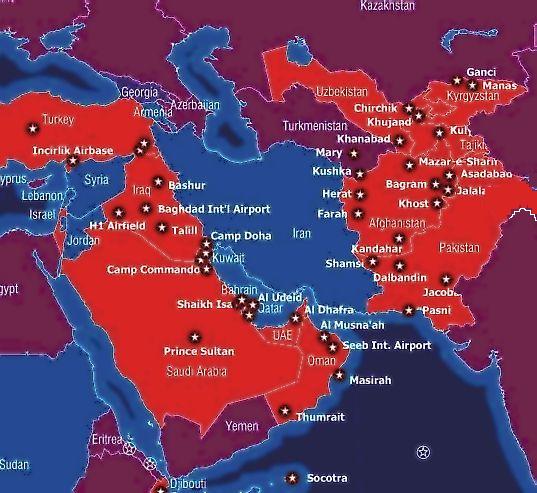
Iran under siege: Each star represents a U.S.-manned beacon of hope -- the only thing that stands between us and Armageddon.
Video: Debate about Iran strategy heats up in Israel
India explores economic opportunities in Iran, denting Western sanctions plan
The New York Times reports: India emerged as a major new irritant on Thursday in Western efforts to isolate Iran, announcing that it was sending a large trade delegation there within weeks to exploit opportunities created by the American and European antinuclear sanctions that are increasingly disrupting Iran’s economy.
The trade delegation announcement coincided with new reports that India, an important consumer of Iranian oil, had eclipsed China for the first time as Iran’s No. 1 petroleum customer last month, subverting efforts by the United States to persuade other countries to find non-Iranian sources for their energy needs or risk onerous penalties under a new American sanctions law.
The announcement also came ahead of a planned visit to India by Herman Van Rompuy, the European Union president, who was quoted in an interview with The Times of India as saying that he intended to seek the Indian government’s help in pressing Iran to give up its nuclear program.
It was unclear whether Mr. Rompuy knew at the time of the interview that India’s commerce secretary, Rahul Khullar, was about to announce a big economic push into Iran that could serve to counteract the effects of the very sanctions Mr. Rompuy has helped to promote.
“We will be mounting a mission to Iran at the end of the month to promote our own exports,” Mr. Khullar told reporters in New Delhi, according to Indian and Western accounts of his news conference. “A huge delegation will be going.”
In what amounted to a rejection of an underlying motive in the American-European sanction effort, Mr. Khullar said India already was honoring the four rounds of United Nations sanctions aimed at dissuading Iran from its uranium enrichment program. Those sanctions, he told reporters, do not apply to “a vast range of products which India can export to Iran.”
Even if the United States and European Union wished to shun business with Iran, Mr. Khullar said, “Tell me why I should follow suit?”
“Why shouldn’t I take up that business opportunity?” he asked.
The growing Iranian military behemoth
Glenn Greenwald writes: The tranquility of my Saturday morning was disrupted — and that’s putting it mildly — when I read on Glenn Reynolds’ popular right-wing “Instapundit” blog that we can learn important “Lessons About Iran From Hitler.” To know that we have yet another New Hitler in our midst is alarming indeed. Reynolds’ link takes one to an even more jarring warning about the Persian menace, by David Goldman, that extensively compares the fallen Nazi leader to Iranian President Mahmoud Ahmadinejad and argues that because both figures are maniacal monsters presiding over a dying nation, only a full-scale military attack can stop them. ”However much it costs in Iranian blood and well-being, it’s still worth it,” Goldman casually decrees.
Sociopathic calls for aggressive attacks on other nations and cheap invocations of Hitler are not worth commenting on: neocons churn those out reflexively. But what is worth noting is the event Goldman is flagging as proof of Iran’s aggressive intentions: “Iran is planning to double its defense budget even though its currency is collapsing,” he warns. A doubling of its defense budget! Who among us can remain calm in the face of such naked militarism?
That Ahmadinejad claims that Iran will increase its military budget for next year by 127% was widely reported this week. For a variety of reasons relating to Iran’s economic difficulties, that plan is quite infeasible — typical Ahmadinejad blustering — but let’s assume for the moment that it will actually happen. According to the Stockholm International Peace Research Institute (SIPRI) Military Expenditure Database, Iran’s total annual military spending is $7 billion; an increase of 127% would take it to $15.8 billion — also known as: less than 2% of total U.S. military spending (which was $698 billion for fiscal year 2010).
U.S. leak on Israeli attack weakened a warning to Netanyahu
Gareth Porter writes: When Defense Secretary Leon Panetta told Washington Post columnist David Ignatius this week that he believes Israel was likely to attack Iran between April and June, it was ostensibly yet another expression of alarm at the Israeli government’s threats of military action.
But even though the administration is undoubtedly concerned about that Israeli threat, the Panetta leak had a different objective. The White House was taking advantage of the current crisis atmosphere over that Israeli threat and even seeking to make it more urgent in order to put pressure on Iran to make diplomatic concessions to the United States and its allies on its nuclear program in the coming months.
The real aim of the leak brings into sharper focus a contradiction in the Barack Obama administration’s Iran policy between its effort to reduce the likelihood of being drawn into a war with Iran and its desire to exploit the Israeli threat of war to gain diplomatic leverage on Iran.
The Panetta leak makes it less likely that either Israeli Prime Minister Benjamin Netanyahu or Iranian strategists will take seriously Obama’s effort to keep the United States out of a war initiated by an Israeli attack. It seriously undercut the message carried to the Israelis by Gen. Martin Dempsey, chairman of the Joint Chiefs of Staff, last month that the United States would not come to Israel’s defense if it launched a unilateral attack on Iran, as IPS reported Feb. 1.
Baghdad says U.S. Iran sanctions a problem for Iraq
AFP reports: American sanctions on Iran pose difficulties for Iraq because of its close economic ties with the Islamic republic, so Baghdad plans to seek a waiver from the US, the government spokesman told AFP.
The United States, European Union and others have ramped up sanctions to target Iran’s oil industry and central bank in an effort to pressure Tehran over its nuclear programme, which the West suspects is part of a secret drive to build an atomic bomb.
Iran insists its nuclear project is peaceful and has threatened retaliation over the fresh sanctions, including possibly disrupting shipping through the strategic Strait of Hormuz, a Gulf chokepoint for global oil shipments.
“We have a huge relation financially between the private sectors” of “Iraq and Iran, as Iran is the main supplier for many of the foodstuff and the other commodities here in Iraq,” spokesman Ali al-Dabbagh said in an interview in Baghdad’s heavily fortified Green Zone.
Trade between Iraq and Iran is in the billions of dollars and also includes Iraqi government purchases, Dabbagh said, noting that Iranian exports to Iraq range from electricity and fuel to food and various other commodities.
“It is not possible for Iraq to follow such sanctions,” Dabbagh said. “We are looking for our own interests.”
“In a few days we are going to submit a request to the United States to exempt us.”
The US embassy in Baghdad on Thursday declined to comment on the issue, as it had not received a request from Iraq.