Category Archives: Iran deal

Israel’s military leaders warn against Iran attack

The Independent reports: Almost the entire senior hierarchy of Israel’s military and security establishment is worried about a premature attack on Iran and apprehensive about the possible repercussions, a former chief of the country’s defence forces told The Independent yesterday.

Lt-Gen Amnon Lipkin-Shahak, who is close to Defence Minister Ehud Barak, said there had been little analysis of what happens the “day after” when the Tehran regime and its paramilitary allies retaliate. He warned that an assault may lead to Mahmoud Ahmadinejad benefiting from popular anger against foreign aggression.

General Lipkin-Shahak stressed that Iran with a nuclear arsenal would be a hugely destabilising factor in the region. But, he said: “It is quite clear that much if not all of the IDF [Israeli Defence Forces] leadership do not support military action at this point.”

The risks of military action underlined by the highly decorated former commander show the apparent divisions within the establishment over the best way to combat Iran’s nuclear programme. The Prime Minister, Benjamin Netanyahu, and Mr Barak are reported to be veering towards military action while fellow ministers as well as the defence and intelligence communities have reservations about this path.

Facebooktwittermail

Obama ready to signal U.S. may stay out of conflict if Israel launches unilateral strike on Iran

The Washington Post columnist, David Ignatius, often serves as an unofficial mouthpiece for the White House, CIA, State Department, or Pentagon. His column today should probably be read in this way.

While funneling the chatter that with increasing volume in recent weeks has suggested that an Israeli attack on Iran is imminent, Ignatius adds some important details on the way the Obama administration is responding.

The Obama administration is conducting intense discussions about what an Israeli attack would mean for the United States: whether Iran would target U.S. ships in the region or try to close the Strait of Hormuz, and what effect the conflict and a likely spike in oil prices would have on the fragile global economy.

The administration appears to favor a policy of staying out of the conflict, unless Iran hits U.S. assets, which would trigger a strong U.S. response.

This U.S. policy — signaling that Israel is acting on its own — might open a breach like the one in 1956, when President Eisenhower condemned an Israeli-European attack on the Suez Canal. Complicating matters is the 2012 presidential campaign, which has Republicans candidates clamoring for stronger U.S. support of Israel.

Administration officials caution that Tehran shouldn’t misunderstand: The United States has a 60-year commitment to Israeli security, and if Israel’s population centers were hit, the United States could feel obligated to come to Israel’s defense.

Israelis are said to believe that a military strike could be limited and contained. They would bomb the uranium-enrichment facility at Natanz and other targets; an attack on the buried enrichment facility at Qom would be harder from the air. Iranians would retaliate, but Israelis doubt the action would be an overwhelming barrage, with rockets from Hezbollah forces in Lebanon. One Israeli estimate is that the Jewish state might have to absorb 500 casualties.

Israelis point to Syria’s lack of response to an Israeli attack on a nuclear reactor there in 2007. Iranians might show similar restraint, because of fear the regime would be endangered by all-out war. Some Israelis have also likened a strike on Iran to the 1976 hostage-rescue raid on Entebbe, Uganda, which was followed by a change of regime in that country.

Israeli leaders are said to accept, and even welcome, the prospect of going it alone and demonstrating their resolve at a time when their security is undermined by the “Arab Spring.”

Assuming that Ignatius has not misconstrued the messaging from the administration, there are several ways in which it can be read:

  • That this is in effect, yet a further escalation in the war-making rhetoric — that Iran is being told that if the U.S ever had the capacity to restrain Israel, that capacity has been relinquished. Mad dog Israel is now being let off the leash;
  • or, that Israel is being warned that it may suffer the consequences of its own bravado and won’t get bailed out by the U.S. in the event that Iran strikes back in a proportionate and appropriate way — perhaps through missile attacks on the Dimona nuclear facility;
  • and that Washington wants Tehran to understand that the United States draws a clear distinction between its own interests and those of Israel and that the Iranians should keep this in mind when making their own strategic calculations.
Facebooktwittermail

Will Israel really attack Iran?

Gary Sick, responding to the question in the headline, writes: The real answer is no, they will not. But you would never figure that out by reading the New York Times.

The sensationalist article in the Sunday New York Times Magazine (Jan. 29) adds to the hysteria surrounding U.S. and Israeli relations with Iran. Ronen Bergman, a columnist with the leading Israeli newspaper Yedioth Ahronoth, concludes that Israel will probably attack Iran this year.

He draws this fearful conclusion after recounting his discussions with key Israeli military and intelligence officials, present and former, who describe to him in great detail: (1) why Israel is incapable of conducting such an attack; (2) why such a foolhardy action would fail to stop Iran’s nuclear program; and (3) why it would actually leave the situation far worse than it is now.

Say what?

Not only is his conclusion at odds with virtually everything he produces as evidence, but there are some omissions in his analysis that regrettably have become predictably routine in talking about the Iranian nuclear program:

He darkly quotes “the latest intelligence” about the number and current activity of Iran’s centrifuges. Where did he get that secret information? Well, just like you or me, he can read the periodic reports of the International Atomic Energy Agency, which are published on the web virtually the same day they are handed to member states.

How did the IAEA get that “intelligence?” Not hard: they have inspectors in all the sites where Iran is producing enriched uranium. These inspectors, who make frequent surprise visits, keep cameras in place to watch every move, and they carefully measure Iran’s input of feed stock to the centrifuges and the output of low enriched uranium, which is then placed under seal. You would think that would be worth mentioning, at least in passing, but it gets overlooked by virtually every journalist writing on this subject.

Facebooktwittermail

Iran oil halt ‘would raise price 30 per cent’

Al Jazeera reports: The International Monetary Fund (IMF) has warned that global crude prices could rise as much as 30 per cent if Iran halted oil exports as a result of US and European Union sanctions.

If Iran halts exports to countries without offsets from other sources, it would likely trigger an “initial” oil price jump of 20 to 30 per cent, or about $20 to $30 per barrel, the IMF said in its first public comment on a possible Iranian oil supply disruption.

The IMF highlighted the risks of rising tensions over Iran sanctions in a note on Wednesday sent to deputies from G20 countries who met in Mexico City last week.

The price impact caused by a cut in Iranian exports could be exacerbated by below average oil stocks in many countries, the result of tight oil market conditions through much of last year, the IMF said.

Facebooktwittermail

Can Israel suspend the law of unintended consequences?

Exceptionalism takes many forms but perhaps its most universal expression can be found among politicians and petty criminals. When contemplating doing something really stupid, they have an unusual capacity to become convinced that nothing can go wrong.

When it comes to Israel’s view of Iran, the contradictions seem boundless. The Islamic republic is the modern equivalent of Nazi Germany, Netanyahu and others like to say. But as for the risks involved in attacking Iran, the same fear-mongers claim that these risks have all been wildly overstated.

The lesson of the Holocaust, Netanyahu says, is: “We can only rely on ourselves.” So why does Israel still accept massive amounts of U.S. military aid and the support of such a powerful lobby in Washington?

The New York Times reports: Israeli intelligence estimates, backed by academic studies, have cast doubt on the widespread assumption that a military strike on Iranian nuclear facilities would set off a catastrophic set of events like a regional conflagration, widespread acts of terrorism and sky-high oil prices.

The estimates, which have been largely adopted by the country’s most senior officials, conclude that the threat of Iranian retaliation is partly bluff. They are playing an important role in Israel’s calculation of whether ultimately to strike Iran, or to try to persuade the United States to do so, even as Tehran faces tough new economic sanctions from the West.

“A war is no picnic,” Defense Minister Ehud Barak told Israel Radio in November. But if Israel feels itself forced into action, the retaliation would be bearable, he said. “There will not be 100,000 dead or 10,000 dead or 1,000 dead. The state of Israel will not be destroyed.”

The Iranian government, which says its nuclear program is for civilian purposes, has threatened to close the Strait of Hormuz — through which 90 percent of gulf oil passes — and if attacked, to retaliate with all its military might.

But Israeli assessments reject the threats as overblown. Mr. Barak and Prime Minister Benjamin Netanyahu have embraced those analyses as they focus on how to stop what they view as Iran’s determination to obtain nuclear weapons.

Facebooktwittermail

How to start a war with Iran

In May 1967, Israel was itching to launch a preemptive attack on Egypt. The director of Mossad at that time, Meir Amit, had a meeting with John Hadden, the CIA chief in Tel Aviv. Hadden warned Amit that if Israel attacked Egypt, the United States would send in troops to defend Egypt. Hadden advised his counterpart that if Israel wanted the U.S. on its side, it would need a suitable pretext.

“Help us by giving us a good reason to come in on your side. Get them to fire at something, a ship, for example,” Hadden told Amit.

This exchange is revealed by the Israeli journalist, Ronen Bergman, in the cover story for this weekend’s New York Times magazine.

Bergman writes: “Since 1967, the unspoken understanding that America should agree, at least tacitly, to Israeli military actions has been at the center of relations between the two countries.”

The telling of the Amit-Hadden exchange, seems like a way of signalling that as far as Israel is concerned, come the time that it decides to launch an attack on Iran, the United States has no choice but to “agree.” Indeed, Israel is happy to point to the history of U.S. complicity in Israel’s acts of war, including the willingness of an American official to invite an Israeli instigated attack on a U.S. ship in order to fabricate a justification for entering a war.

In other words, transposing the 1967 incident to the current context, the Israelis want to insinuate that if the U.S. Fifth Fleet is attacked by “Iran” in the coming months and Israel covertly has a hand in this attack, then in truth Israel will merely be “helping” the United States to do what it wants to do at a time when domestic political considerations prevent Washington from being open about its intentions.

The irony about Hadden’s invitation in 1967 is that in some sense the Israelis did pick it up two weeks later. But rather than engineer an “Egyptian” attack on a U.S. ship, the Israelis attacked the U.S.S. Liberty claiming they thought it was an Egyptian ship.

Was Israel punishing the U.S. for its neutrality in the Six-Day War — knowing that it could do so with impunity because the U.S. could not suffer the embarrassment that would have been caused by revealing the CIA’s willingness to sacrifice Americans?

Bergman writes:

In June 2007, I met with a former director of the Mossad, Meir Amit, who handed me a document stamped, “Top secret, for your eyes only.” Amit wanted to demonstrate the complexity of the relations between the United States and Israel, especially when it comes to Israeli military operations in the Middle East that could significantly impact American interests in the region.

Almost 45 years ago, on May 25, 1967, in the midst of the international crisis that precipitated the Six-Day War, Amit, then head of the Mossad, summoned John Hadden, the C.I.A. chief in Tel Aviv, to an urgent meeting at his home. The meeting took place against the background of the mounting tensions in the Middle East, the concentration of a massive Egyptian force in the Sinai Peninsula, the closing of the Straits of Tiran to Israeli shipping and the threats by President Gamal Abdel Nasser to destroy the State of Israel.

In what he later described as “the most difficult meeting I have ever had with a representative of a foreign intelligence service,” Amit laid out Israel’s arguments for attacking Egypt. The conversation between them, which was transcribed in the document Amit passed on to me, went as follows:

Amit: “We are approaching a turning point that is more important for you than it is for us. After all, you people know everything. We are in a grave situation, and I believe we have reached it, because we have not acted yet. . . . Personally, I am sorry that we did not react immediately. It is possible that we may have broken some rules if we had, but the outcome would have been to your benefit. I was in favor of acting. We should have struck before the build-up.”

Hadden: “That would have brought Russia and the United States against you.”

Amit: “You are wrong. . . . We have now reached a new stage, after the expulsion of the U.N. inspectors. You should know that it’s your problem, not ours.”

Hadden: “Help us by giving us a good reason to come in on your side. Get them to fire at something, a ship, for example.”

Amit: “That is not the point.”

Hadden: “If you attack, the United States will land forces to help the attacked state protect itself.”

Amit: “I can’t believe what I am hearing.”

Hadden: “Do not surprise us.”

Amit: “Surprise is one of the secrets of success.”

Hadden: “I don’t know what the significance of American aid is for you.”

Amit: “It isn’t aid for us, it is for yourselves.”

That ill-tempered meeting, and Hadden’s threats, encouraged the Israeli security cabinet to ban the military from carrying out an immediate assault against the Egyptian troops in the Sinai, although they were perceived as a grave threat to the existence of Israel. Amit did not accept Hadden’s response as final, however, and flew to the United States to meet with Defense Secretary Robert McNamara. Upon his return, he reported to the Israeli cabinet that when he told McNamara that Israel could not reconcile itself to Egypt’s military actions, the secretary replied, “I read you very clearly.” When Amit then asked McNamara if he should remain in Washington for another week, to see how matters developed, McNamara responded, “Young man, go home, that is where you are needed now.”

From this exchange, Amit concluded that the United States was giving Israel “a flickering green light” to attack Egypt. He told the cabinet that if the Americans were given one more week to exhaust their diplomatic efforts, “they will hesitate to act against us.” The next day, the cabinet decided to begin the Six-Day War, which changed the course of Middle Eastern history.

Amit handed me the minutes of that conversation from the same armchair that he sat in during his meeting with Hadden. It is striking how that dialogue anticipated the one now under way between Israel and the United States. Substitute “Tehran” for “Cairo” and “Strait of Hormuz” for “Straits of Tiran,” and it could have taken place this past week. Since 1967, the unspoken understanding that America should agree, at least tacitly, to Israeli military actions has been at the center of relations between the two countries.

During my lengthy conversation with Barak, I pulled out the transcript of the Amit-Hadden meeting. Amit was his commander when Barak was a young officer, in a unit that carried out commando raids deep inside enemy territory. Barak, a history buff, smiled at the comparison, and then he completely rejected it. “Relations with the United States are far closer today,” he said. “There are no threats, no recriminations, only cooperation and mutual respect for each other’s sovereignty.”

That characterization of U.S.-Israeli relations certainly jives with President Obama’s description of an unbreakable bond between the two nations. At the same time, Mark Perry’s recent report on an Israeli false flag operation in which Mossad agents posed as CIA officers suggests that those who think they are protecting a nation facing an existential threat tend to believe that anything goes.

Facebooktwittermail

The deal the West could strike with Iran

Peter Jenkins, Britain’s permanent representative to the IAEA, 2001–06, argues that the West has dangerously over-reached by insisting that Iran abandon nuclear enrichment instead of merely insisting that it complies with the Nuclear Non-Proliferation Treaty (NPT), which permits enrichment.

For years, the Western assessment has been that Iran seeks the capability to build nuclear weapons, but has not taken a decision to produce them.

Imposing sanctions or even going to war could be a proportionate – and therefore a just – reaction to any Iranian decision to break the NPT and acquire nuclear weapons. But these measures are a disproportionate response to a state acting on its right to enrich uranium. The correct way to handle enrichment is the NPT way, namely that the process can go ahead, but only under the strictest safeguards. This embodies a principle dear to President Reagan in his later years: “trust but verify”. If ever Iran goes for nuclear weapons, the world will be united in condemning such a betrayal of trust. The West could be confident the Security Council would approve whatever steps were necessary to counter a violation of one of the most valuable global treaties.

At the moment, however, we are locked into a process of imposing ever tighter sanctions on Iran. This economic warfare has many drawbacks. It requires an exaggeration of the Iranian “threat” that fuels the scare-mongering of those who want this pressure to be a mere step on the way to war. It risks provoking retaliation, while hurting ordinary Iranians. And it risks higher oil prices that the West can ill afford. Moreover, even if Iran were unexpectedly to give way, coercion rarely delivers durable solutions. Its effect on motives is unpredictable. It can breed resentment, while restrictions can be circumvented in time.

It may be asking a lot of our leaders that they swallow their words, lower their sights and focus on a realistic target. They could do it, though, and the talks due to take place shortly in Turkey could be the setting for a change of course. What is much more likely, unhappily, is that we will continue to see a variant on the devil having the best tunes. Far too many American politicians see advantage in whipping up fear of Iran. I can almost hear them sneering that the NPT is for wimps. The odds must be that they will continue to propel the West toward yet another Gulf war. Still, nothing is inevitable.

Facebooktwittermail

Iran is not an existential threat

Bruce Riedel writes: The danger of war is growing again over Iran’s nuclear ambitions. Iran is rattling its sabers, the Republican presidential candidates and others are rattling theirs. But even if Tehran gets the bomb, Israel will have overwhelming military superiority over Iran, a fact that should not be lost in all the heated rhetoric.

The former head of Israel’s Mossad, Meir Dagan, says Iran won’t get the bomb until at least 2015. In contrast, Israel has had nuclear weapons since the late 1960s and has jealously guarded its monopoly on them in the region. The Israelis have used force in the past against developing nuclear threats. Iraq in 1981 and Syria in 2007 were the targets of highly effective Israeli airstrikes against developing nuclear weapons programs. Israel has seriously considered conducting such a strike against Iran and may do so, especially now that it has special bunker-busting bombs from the United States.

Estimates of the size of the Israeli arsenal by international think tanks generally concur that Israel has about 100 nuclear weapons, possibly 200. Even under a crash program, Iran won’t achieve an arsenal that size for many years – perhaps decades.

Israel also has multiple delivery systems. It has intermediate range ballistic missiles, the Jericho, that are capable of reaching any target in Iran. Its fleet of F-15 long-range strike aircraft can also deliver nuclear payloads. Some analysts have suggested that it can also deliver nuclear weapons from its German-made Dolphin submarines using cruise missiles.

Israel will also continue to have conventional military superiority over Iran and the rest of the region. The Israeli military has a demonstrated qualitative edge over all of its potential regional adversaries, including Iran. The Israeli air force has the capability to penetrate air defense systems with virtual impunity, as it demonstrated in 2007 when it destroyed Syria’s nascent nuclear capability. The Israeli armed forces’ intelligence and electronic warfare capabilities are vastly superior to those of its potential rivals. The 2006 Lebanon war and the 2009 Gaza war demonstrated that there are limits to Israel’s conventional capabilities, but those limits should not obscure the underlying reality of Israel’s conventional military superiority over its enemies.

Iran, on the other hand, has never fully rebuilt its conventional military from the damage suffered in the Iran-Iraq war. It still relies heavily for air and sea power on equipment purchased by the shah 40 years ago, much of which is antique today.

Facebooktwittermail

Obama’s Iran choice

M.J. Rosenberg writes: An article in Tuesday’s New York Times suggests that there is a method to the madness of the Republican presidential candidates’ hawkish rhetoric on Iran. I had thought that the reason all the Republican candidates (with the exception of Ron Paul) are such noisy warmongers is because that is their natural proclivity – and because it pleases donors (such as Sheldon Adelson, Newt Gingrich’s big campaign funder) who base their political choices on Binyamin Netanyahu’s desires.

But Times reporter Mark Landler suggests that one of the results of this year’s conveniently timed Iran crisis is to present President Barack Obama with a choice of two options, either of which the GOP could successfully exploit to defeat him in the election.

As Landler points out:

In late June, when the campaign is in full swing, Mr Obama will have to decide whether to take action against countries, including some staunch allies, if they continue to buy Iranian oil through its central bank.

After fierce lobbying by the White House, which opposed this hardening in the sanctions that have been its main tool in pressuring Tehran, Congress agreed to modify the legislation to give Mr Obama leeway to delay action if he concludes the clampdown would disrupt the oil market. He may also invoke a waiver to exempt any country from sanctions based on national security considerations.

Under normal circumstances, a president’s decision to invoke a national security waiver on any foreign policy matter is hard to challenge. In this case, the president’s concern that imposing new sanctions would cause oil prices to soar (and disrupt economic recovery) would be good reason to pass on the latest congressional sanctions law.

But the political consequences of waiving could be dire.

Remember, the sanctions law in question is a creation of AIPAC and has been at the top of its agenda during this entire Congress. If Obama waives it, Netanyahu would use the media to make sure that his displeasure was known. The lobby, the Republican presidential candidate and even many of AIPAC’s Democratic cutouts on Capitol Hill would all scream bloody murder. [Continue reading…]

Facebooktwittermail

New poll: Americans aren’t ready for another war

Emily Ekins writes: For those tuning into the myriad Republican presidential debates over the past few months, they may have been surprised to learn that many GOP candidates believe a military intervention in Iran could be likely.

Yet despite the cheers the candidates received for taking hawkish foreign policy stances with Iran, a recent Rasmussen poll finds that only 35 percent of Americans favor using military force if sanctions fail to prevent Iran from developing their nuclear capabilities.

This finding is especially interesting given that 81 percent of Americans think it is either somewhat or very likely that Iran will develop a nuclear weapon in the near future, and that 63 percent of Americans do not believe it is very or at all likely that stiff economic sanctions will effectively force Iran to disband its nuclear program.

Although 76 percent of Americans believe that Iran is a serious national security threat to the United States, only 35 percent are ready to favor military intervention. This means that even though most Americans believe it’s quite likely Iran will develop a nuclear weapon and that economic sanctions will fail to work, they aren’t willing for Americans to engage in another military intervention. This suggests that Americans may recognize there are other means to promote peace, prosperity, and American defense,
besides intervening militarily.

Facebooktwittermail

Obama’s assassination problem

In a column that appeared in the Jerusalem Post a few days ago, Avi Perry made this prediction about “The looming war with Iran”:

Iran, just like Nazi Germany in the 1940s, will take the initiative and “help” the US president and the American public make up their mind by making the first move, by attacking a US aircraft carrier in the Persian Gulf.

The Iranian attack on an American military vessel will serve as a justification and a pretext for a retaliatory move by the US military against the Iranian regime. The target would not be Iran’s nuclear facilities. The US would retaliate by attacking Iran’s navy, their military installations, missile silos, airfields. The US would target Iran’s ability to retaliate, to close down the Strait of Hormuz. The US would then follow by targeting the regime itself.

Elimination of Iran’s nuclear facilities? Yes. This part would turn out to be the final act, the grand finale. It might have been the major target, had the US initiated the attack. However, under this “Pearl Harbor” scenario, in which Iran had launched a “surprise” attack on the US navy, the US would have the perfect rationalization to finish them off, to put an end to this ugly game.

Unlike the latest attempt at an Iranian revolution, this time the US would not shy away, rather, it would go public, openly calling for the Iranian people to join in with the US in working to overthrow the corrupt Islamic fundamentalist regime. The Iranian people would respond in numbers.

Spring would reemerge, and the Iranian people would join the rest of the Middle East – this time with the direct support of the US.

The greatest irony behind this most significant episode in 2012 is that the Iranian regime would affect their own demise. Attacking the US navy in the open seas is equivalent to carrying out a suicide bombing.

Is there any reason to take Perry’s prediction seriously?

He is described by the Jerusalem Post as having “served as an intelligence expert for the Israeli government.” Keep in mind though that in Israel, intelligence experts come a dime a dozen.

In Perry’s case his intelligence expertise does not seem to extend further than the experience he gained as a youngster serving in the IDF during the 1967 Six-Day War. Perhaps it’s of just as much relevance that he also served as an accordionist and comedian in an army troupe that entertained the soldiers. And probably even more telling is the fact that he is now a novelist who enjoys fiction because it allows him to “play god.”

So why would I bother quoting from Perry’s column?

Firstly, because some readers who have looked no further than the biographical information the Jerusalem Post provided, believe that his prediction provides confirmation that some kind of Gulf of Tonkin Incident is about to trigger a war with Iran.

But whether Perry has any credibility is besides the point — the risk’s of such an event are very real. Unlike Vietnam, where Washington was looking for a pretext to escalate the war, this time it looks much more likely that Israel will try and drag the U.S. into a war — a war which Israel is incapable of fighting on its own.

Perry implausibly conjures up a Pearl Harbor-like trigger for war. More likely might be a USS Cole-type attack. Were such an attack to take place, given Israel’s willingness to recruit members of the terrorist group Jundallah to conduct attacks in Tehran, might it not also be willing to instigate a war-triggering incident in the Strait of Hormuz?

Secondly, the fact that a column such as this would garner any attention is in some measure a reflection of a wider problem: that few if any of the statements currently coming out of Washington can be taken at face value.

Following the assassination of the Iranian nuclear scientist, Mostafa Ahmadi Roshan, Secretary of State Hillary Clinton said: “I want to categorically deny any United States involvement in any kind of act of violence inside Iran.”

U.S. Defense Secretary Leon Panetta said: “We were not involved in any way — in any way — with regards to the assassination that took place there…. that’s not what the United States does.”

In the Foreign Policy report, “False Flag,” an American intelligence officer is quoted saying: “There’s no question that the U.S. has cooperated with Israel in intelligence-gathering operations against the Iranians, but this was different. No matter what anyone thinks, we’re not in the business of assassinating Iranian officials or killing Iranian civilians.” And a recently retired intelligence officer says: “And we don’t do political assassinations.”

The United States does not conduct assassinations.

Really?

Why exactly should the Iranian government take Clinton and Panetta at their word when it is common knowledge that President Obama has authorized multiple assassinations?

Does anyone believe that the Navy SEALs operation that resulted in Osama bin Laden being shot in the head and his body dumped in the ocean, might instead have resulted in him being arrested and put on trial? “This was a kill operation,” a U.S. national security official told Reuters.

And in Yemen in September the killing of the U.S. citizens, Anwar Awlaki and Samir Khan, both of whom operated as al Qaeda propagandists — was this not the definition of a political assassination?

The official line is that Awlaki had an operational role in planning terrorist attacks and that he could therefore be killed as an “enemy combatant” on the “battlefield,” but these are merely terms of political and legal convenience. It remains a matter of debate whether Awlaki did much more than preach — as unpalatable to American ears as much of his preaching might have been. As for Khan, when he was investigated by the FBI they couldn’t gather sufficient evidence to indict him. Neither was he on the hit list of individuals that Obama claims a right to execute.

It isn’t — as leading members of the current administration now claim — that the United States doesn’t do assassinations, but rather that it generally follows guidelines dictating who can or cannot be assassinated. Iranian nuclear scientists are currently not deemed suitable targets — at least that’s the administration’s stated position, but there are others with a more expansive view.

Even before the terrorist attack that resulted in the latest death of an Iranian nuclear scientist, GOP presidential hopeful Rick Santorum declared in November that he favored “sending out a very clear message to nuclear scientists who work on that program that they are enemy combatants similar to the Taliban and al-Qaeda.”

In the latest development, Iran says that it sent Washington evidence of the CIA’s role in this week’s assassination. Even so, given the sanctions strategy Obama is pursuing, the method of the attack, and the indications that Israel wants to provoke Iran in order to create a pretext for war, there seems to be much more reason to assume that Mossad, rather than the CIA, was behind Roshan’s killing.

But rather than implausibly assert that the U.S. is not in the assassination business, perhaps all that Obama can honestly say is that it is not currently the policy of his administration to assassinate Iranian nuclear scientists.

At the same time, anyone who wants to try and probe that policy a bit more deeply should request some amplification on a phrase that officials never hesitate to repeat: “all options are open.”

Since it’s generally understood the “all options” includes the option to bomb Iran’s nuclear facilities, why exactly would we infer that it precludes assassinating nuclear scientists? Are we to understand that the bombing would only take place outside office hours?

A U.S. president, however inspiring his rhetoric might sometimes be, should be in no doubt that at the most critical moment the power of his word hinges on its truthfulness. The president who promised hope, dialogue, transparency and an end to the mindset that took us to war, has a serious credibility problem. Since he’s willing to joke about his ability to assassinate people, why should his administration’s denials now be taken seriously?

Facebooktwittermail

Joint U.S.-Israel drill postponed to ‘defuse Iran tensions’

It sounds like the 2012 Netanyahu-led anti-Obama campaign got ahead of the administration when framing this story. Obama wants to defuse tensions with Iran and the Pentagon is hamstrung by budget cuts — the GOP candidates are going to love this one.

Ynet reports: A major joint Israel-US military drill, which was set to take place in a few weeks time with the participation of thousands of IDF and US army soldiers, has been postponed by at least six months, Ynet reported Sunday

The decision was made by Defense Ministry officials in coordination with the Pentagon.

A number of global media outlets said the exercise will likely take place in the summer – at the earliest.

Israeli officials said the Americans asked to delay the drill so as not to heighten tensions with Iran over its nuclear program and avoid draw any additional attention from the Arab countries during such a turbulent period.

Security establishment officials said the decision was also related, in part, to budgetary concerns.

The decision to postpone the drill comes after the US condemned last week’s assassination of a nuclear scientist in Tehran and after US President Barack Obama and Prime Minister Benjamin Netanyahu discussed the recent developments in the Islamic Republic.

Ron Ben-Yishai, Ynet’s military analyst, said Washington is looking to defuse tensions in the region following Iran’s military exercise in the Strait of Hormuz and the raid by Iranian protesters on the British Embassy in Tehran.

The Americans also hope the economic and diplomatic pressure on Iran will force it to engage in talks over its nuclear program, he said.

According to Ben-Yishai, the decision to delay the drill is also related to financial concerns. Washington has cut its defense budget for 2012 by $450 billion dollars – a move which is aimed at helping the US tackle its national debt, which has affected the country’s credit rating.

During the drill, which just a few days ago was dubbed as the largest drill joint US-Israel exercise ever, the countries were set to test air-defense capabilities, as well as test-fire new missiles.

Facebooktwittermail

U.S. warns Israel against military strike on Iran

The Wall Street Journal reports: U.S. defense leaders are increasingly concerned that Israel is preparing to take military action against Iran, over U.S. objections, and have stepped up contingency planning to safeguard U.S. facilities in the region in case of a conflict.

President Barack Obama, Defense Secretary Leon Panetta and other top officials have delivered a string of private messages to Israeli leaders warning about the dire consequences of a strike. The U.S. wants Israel to give more time for the effects of sanctions and other measures intended to force Iran to abandon its perceived efforts to build nuclear weapons.

Stepping up the pressure, Mr. Obama spoke by telephone on Thursday with Israeli Prime Minister Benjamin Netanyahu, and U.S. Gen. Martin Dempsey, chairman of the Joint Chiefs of Staff, will meet with Israeli military officials in Tel Aviv next week.

The high-stakes planning and diplomacy comes as U.S. officials warn Tehran, including through what administration officials described Friday as direct messages to Iran’s leaders, against provocative actions.

Tehran has warned that it could retaliate to tightened sanctions by blocking oil trade through the Strait of Hormuz. On Thursday, Iran’s Supreme Leader Ayatollah Ali Khamenei vowed to punish the perpetrators of the assassination—blamed by Iran on the U.S. and Israel—of an Iranian scientist involved in the nuclear program.

The U.S. denied the charge and condemned the attack. Israel hasn’t commented.

The U.S. and Iran, however, have taken steps in recent days apparently designed to ease tensions. Iran has agreed to host a delegation of United Nations nuclear inspectors this month. The U.S., meanwhile, has twice this month rescued Iranian sailors in the region’s seas.

Covert efforts by Israel’s intelligence service to prevent Tehran from developing nuclear weapons have been credited with slowing the program without the high risk of military conflict that could be sparked by an airstrike. Iran says its nuclear program is for peaceful uses.

But Israel has declined to rule out a strike, as has the U.S.

“It is the policy of the Israeli government, and the Obama administration, that all options remain on the table. And it is crucial that the ayatollahs in Tehran take this policy seriously,” said Michael Oren, Israel’s ambassador to the U.S.

Mr. Netanyahu said in a recent interview that Iran has begun to “wobble,” a signal some U.S. officials believe suggests he is willing to follow the current U.S. strategy, which seeks to avoid a military confrontation with Iran.

“Recent comments by the Israelis show they understand how tough the sanctions we’ve put in place are and are giving them time to work,” said a senior Obama administration official.

The U.S. military is preparing for a number of possible responses to an Israeli strike, including assaults by pro-Iranian Shiite militias in Iraq against the U.S. Embassy in Baghdad, according to U.S. officials.

The U.S. believes its embassy and other diplomatic outposts in Iraq are more vulnerable following the withdrawal of U.S. forces last month. Up to 15,000 U.S. diplomats, federal employees and contractors are expected to remain in Iraq.

Facebooktwittermail

Why not to attack Iran

Elbridge Colby and Austin Long write: The pressure for an attack on Iran is building. Media reports suggest that the Obama administration is under pressure to take action and may even be considering action itself, and Foreign Affairs published an article in its opening 2012 issue by nuclear expert Matthew Kroenig forthrightly stating that it is “time to attack Iran.” Many argue that strikes against Iran’s nuclear program are the only responsible course. Defense Secretary Leon Panetta declared on December 18 that if the United States receives “intelligence that [the Iranians] are proceeding with developing a nuclear weapon, then we will take whatever steps necessary to stop it.” And former White House Middle East chief Dennis Ross suggested in a December 23 op-ed that, if pressure fails, the military option is the only sensible recourse. The United States cannot live with a nuclear Iran, he argues.

The reality, however, is that attacking Iran without provocation is a dangerous course. The arguments for avoiding military strikes are well known: deterrence, while neither easy nor cheap, can work; the costs of likely Iranian retaliation outweigh the likely benefits, perhaps markedly; and the United States (and its allies) have considered preventive attacks against adversary nuclear programs before, thought the better of it and come out tolerably.

But perhaps the most important argument against attacking Iran has received less attention. That is that none of the attack proponents can give a sensible answer to the question General David Petraeus posed at the beginning of the Iraq war: “How does this end?” Kroenig and other advocates for war note, correctly, that a strike against Iran could do substantial damage to Iran’s program. But they fail to explain how the United States will prevent Iran from simply restarting its program, this time in deadly earnest. Moreover, they don’t explain why such strikes won’t contribute to the immediate rallying of the Iranian people around the otherwise reviled regime.

Facebooktwittermail

The smell of war

Iranian Christians pray during New Year Mass at the Vank church in the central city of Isfahan, Iran, on Sunday, January 1, 2012. (AP Photo/Vahid Salemi)

Hooman Majd writes: The ransacking of the British embassy capped an annus horribilis for the Iranian leadership. Throughout the year, the supreme leader, Ayatollah Ali Khamenei, Ahmadinejad, and every politician in between have seemingly been at odds with each other over just about every possible matter of state. The result is an uncertainty and nervousness among officials, and a kind of political paralysis in which it has become hard for people to know exactly who is in charge, or even whom to blame for policy gone bad. But it was also a terrible year for the Iranian people. They are baffled by the West’s approach to dealing with their country’s nuclear program — the stated aim is a change in policy, but the result is only general hardship. Big-city dwellers complain about rampant inflation, a strangled economy, and general inconvenience on a daily basis.

On the street, nowhere is the impact more evident than at any one of the many foreign exchange bureaus where Iranians gather to monitor the flat screens that show the almost minute-by-minute slide in the rial. Men and women gather at the kiosks to buy dollars as a hedge against crippling inflation; many think that the government will soon run out of greenbacks as international sanctions clinch Iranian banks. The country’s financial culture is cash — there are no credit cards — and the government routinely pumps hundred-dollar bills into circulation in an effort to keep the currency stable. The strategy has backfired. By the end of last year, confidence that the regime could withstand international financial pressure — particularly after the British government cut all financial ties with Tehran — had sunk to an all-time low.

By December, escalating talk of military strikes, promoted by respectable Western and Israeli politicians, analysts, and commentators — in the pages of this journal, too — raised anxieties in Tehran to a level not witnessed in many years. In years past, war over the nuclear program had always been the subject of chatter in Iran, but few took it very seriously. In fact, if war came up in ordinary conversation, it was mentioned jokingly. In December, however, my optician, an older Isfahani with a wry sense of humor who hosts a salon of sorts with locals every evening in his shop, captured the mood of the city when he said of the worry over a coming war, “You can smell it,” he said. “This time, you can smell it.”

If you live in Iran it is hard to imagine what the West, particularly the United States, is trying to accomplish. No one doubts that Israeli and Western operators are behind recent assassinations of nuclear scientists on the streets of Tehran. And the sudden frequency of “accidents” at various factories and Revolutionary Guards bases (which a majority — their government’s denial notwithstanding — also believe are the work of foreign agencies) has done nothing to change the minds of either government officials or the general public about the nuclear program.

Few in Iran believe that the nuclear program is a quest for a Shia bomb to obliterate Israel once and for all. No, the Iranian people, from my greengrocer to college students who resent their government, still consider the nuclear question in generally nationalistic terms. The particular regime in power is of passing relevance. So sanctioning Iran’s central bank and embargoing Iranian oil, tactics the White House may be using as a way to avoid having to make a decision for war, will neither change minds in Tehran nor do much of anything besides bring more pain to ordinary Iranians. And making life difficult for them has not, so far, resulted in their rising up to overthrow the autocratic regime, as some might have hoped in Washington or London.

Facebooktwittermail

United States condemns latest murder of an Iranian nuclear scientist

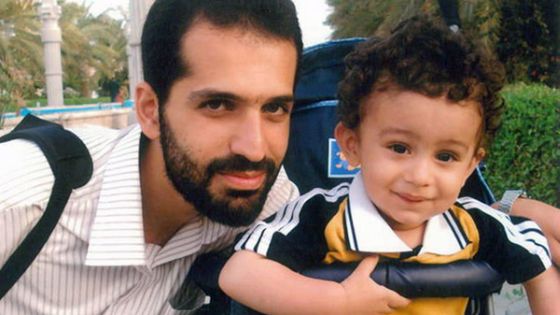
Mostafa Ahmadi Roshan with his son. Roshan is the fifth Iranian nuclear scientist whose murder is being linked to Israel.

The New York Times reports: As arguments flare in Israel and the United States about a possible military strike to set back Iran’s nuclear program, an accelerating covert campaign of assassinations, bombings, cyberattacks and defections appears intended to make that debate irrelevant, according to current and former American officials and specialists on Iran.

The campaign, which experts believe is being carried out mainly by Israel, apparently claimed its latest victim on Wednesday when a bomb killed a 32-year-old nuclear scientist in Tehran’s morning rush hour.

The scientist, Mostafa Ahmadi Roshan, was a department supervisor at the Natanz uranium enrichment plant, a participant in what Western leaders believe is Iran’s halting but determined progress toward a nuclear weapon. He was at least the fifth scientist with nuclear connections to be killed since 2007; a sixth scientist, Fereydoon Abbasi, survived a 2010 attack and was put in charge of Iran’s Atomic Energy Organization.

Iranian officials immediately blamed both Israel and the United States for the latest death, which came less than two months after a suspicious explosion at an Iranian missile base that killed a top general and 16 other people. While American officials deny a role in lethal activities, the United States is believed to engage in other covert efforts against the Iranian nuclear program.

The assassination drew an unusually strong condemnation from the White House and the State Department, which disavowed any American complicity. The statements by the United States appeared to reflect serious concern about the growing number of lethal attacks, which some experts believe could backfire by undercutting future negotiations and prompting Iran to redouble what the West suspects is a quest for a nuclear capacity.

“The United States had absolutely nothing to do with this,” said Tommy Vietor, a spokesman for the National Security Council. Secretary of State Hillary Rodham Clinton appeared to expand the denial beyond Wednesday’s killing, “categorically” denying “any United States involvement in any kind of act of violence inside Iran.”

Facebooktwittermail

Another nuclear scientist assassinated in Tehran

Mostafa Ahmadi-Roshan

An Iranian university professor and deputy director at Natanz enrichment facility was killed in a terrorist bomb blast in a Northern Tehran neighborhood on Wednesday morning, the Fars News Agency reports.

Some guy says this was a joint operation carried out by Mossad and the Iranian terrorist group, Mujahideen-e Khalq (MEK) — though when I say “some guy,” if that’s taken to imply that the source of this information is a man, I am perhaps being too specific.

Richard Silverstein heard about the Mossad-MEK connection from his “own confidential Israeli source.” This attribution of responsibility for the attack may indeed be accurate, but to describe a source no more specifically than to say that this source is an “Israeli” tells us next to nothing. It does however allow newspaper journalists to repeat this “information” as though it was news. Hence the Fars News Agency itself repeats Silverstein’s claim and tries to boost his credibility by describing him as “a senior Jewish American journalist.” Israel’s Ynet plays the same game, though with the embellishment that Silverstein’s source has been elevated to a “senior Israeli source.”

Having said all that, it seems reasonable to assume that this attack — an attack that were it to take place anywhere outside Iran would widely be described as a terrorist attack — was conducted with the direct or indirect involvement of the Israeli and/or United States governments.

One of the strange ethical anomalies of the era in which we live is that an American president willingly accepts responsibility for authorizing assassinations conducted by special forces or drone-launched Hellfire missiles, even though in both types of operation the target may be mistaken and innocent bystanders frequently get killed, yet no government official is willing to claim responsibility for a cold-blooded murder. For the killing to be legitimized it has to given the legal pretext that it is being conducted on a “battlefield” during a “war.”

For as long as the streets of Tehran are not regarded as a battlefield and neither the United States nor Israel is officially at war with Iran, no one will acknowledge that a campaign of state terrorism is indeed being waged, since to do so would be offer an open invitation for Iran to respond in kind.

Bloomberg reports:

Today’s attack “comes in the middle of heightened tensions and it helps Iran to play on a sense of threat that it is under a lot of pressure,” Gala Riani, a Middle East analyst at London-based forecaster IHS Global Insight, said by telephone. “It can also be beneficial to more extremist elements in the government who are supporting further military drills in the Strait of Hormuz.”

Iran conducted naval exercises near the Strait of Hormuz for 10 days that ended early this month.

Previous attacks against Iranian nuclear scientists include the assassination of Massoud Ali-Mohammadi, killed by a bomb outside his Tehran home in January 2010, and an explosion in November of that year that took the life of Majid Shahriari and wounded Fereydoun Abbasi-Davani, who is now the head of Iran’s Atomic Energy Organization.

Oil pared losses of as much as 0.6 percent after the report on Roshan’s death. Crude for February delivery was at $102.25 a barrel, up 1 cent, in electronic trading on the New York Mercantile Exchange at 4:06 p.m. Singapore time.

“While it is difficult to gauge the impact of the scientists’ deaths on the country’s nuclear development, Iranian officials have already acknowledged they have a human-resources problem in the program largely because of the sharp political differences within the country,” Meir Javedanfar, lecturer on Iranian politics at the Herzliya Interdisciplinary Center in Israel, said in a telephone interview.

The explosion follows an Iranian court’s Jan. 9 decision to sentence an American of Iranian descent, Amir Mirzaei Hekmati, to death for spying. U.S. State Department spokesperson Victoria Nuland said allegations that Hekmati worked for the CIA were “simply untrue.”

Facebooktwittermail

Obama administration’s mixed message on regime change in Iran

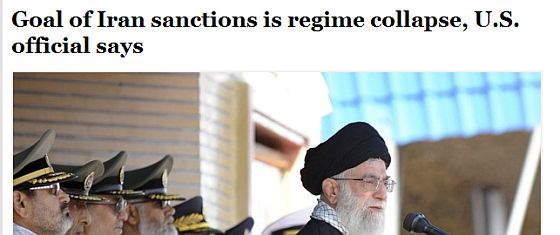
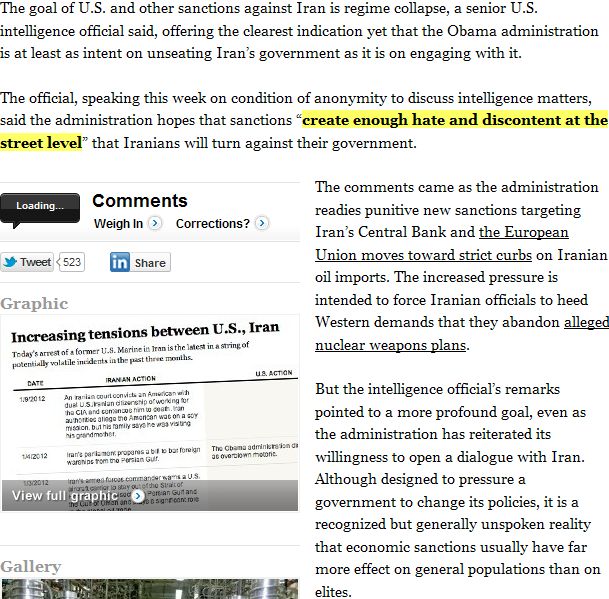
How does a senior U.S. intelligence official tell a Washington Post reporter that the administration’s goal in imposing sanctions on Iran is to bring about regime change, if that is not in fact the goal?

Washington Post -- By Karen DeYoung and Scott Wilson, Tuesday, January 10, 4:22 PM

The article (cached version) with this headline (which was later substantially re-written) begins:

The revised version of the article, under a revised headline, “Public ire one goal of Iran sanctions, U.S. official says”, begins:

The Obama administration sees economic sanctions against Iran as building public discontent that will help compel the government to abandon an alleged nuclear weapons program, according to a senior U.S. intelligence official.

In addition to influencing Iranian leaders directly, the official said, “another option here is that [sanctions] will create hate and discontent at the street level so that the Iranian leaders realize that they need to change their ways.”

The intelligence official’s remarks pointed to what has long been an unstated reality of sanctions: Although designed to pressure a government to change its policies, they often impose broad hardships on a population.

So who would this senior intelligence official be? CIA director David Petraeus? And was he misquoted? Or was he being too candid? Or is the Washington Post colluding with the administration in sending out a mixed message?

Facebooktwittermail