US relations with Saudi Arabia are always something of a proverbial black box. And President Barack Obama’s meeting with Saudi King Abdullah last month was no exception. A late add-on to Obama’s planned June itinerary to Egypt, Germany, and France and conducted at King Abdullah’s horse ranch outside of Riyadh, the June 3 meeting was quickly overtaken by coverage of Obama’s high-profile June 4 speech to the Muslim world from Cairo.
But two sources, one a former U.S. official who recently traveled there and one a current official speaking anonymously, say the meeting did not go well from Obama’s perspective. What’s more, the former official says that Dennis Ross has told associates that part of what prompted Obama to bring him on as his special assistant and NSC senior director for the “Central Region” last month was the president’s feeling that the preparation for the trip was insufficient. The White House vigorously disputes all of that, some of which was previously reported by the New York Times.
Sources say Obama was hoping to persuade the king to be ready to show reciprocal gestures to Israel, which Washington has been pushing to halt settlements with the goal of advancing regional peace and the creation of a Palestinian state.
“The more time goes by, the more the Saudi meeting was a watershed event,” said the former U.S. official who recently traveled to Riyadh. “It was the first time that President Obama as a senator, candidate, or president was not able to get almost anything or any movement using his personal power of persuasion.” [continued…]
The U.S. should proceed cautiously in its engagement strategy with Iran, while moving quickly toward final-status negotiations between Israelis and Palestinians, according to a new report by a team of veteran diplomats and Middle East policymakers.
The policy paper, released Wednesday by the Israel Policy Forum (IPF), an organisation that promotes U.S. diplomatic engagement in the Middle East, expresses support for President Barack Obama’s ambitious Middle East strategy.
Thousands of road signs are the latest front in Israel’s battle to erase the Arab heritage from much of the Holy Land, according to critics in both Israel and the wider Arab world.
Israel Katz, the transport minister, announced this week that signs on all major roads in Israel, East Jerusalem and possibly parts of the West Bank would be “standardised”, converting English and Arabic place names into straight transliterations of the Hebrew name.
Currently, road signs include the place name as it is traditionally rendered in all three languages.
Under the new scheme, the Arab identity of important Palestinian communities will be obscured: Jerusalem, or “al Quds” in Arabic, will be Hebraised to “Yerushalayim”; Nazareth, or “al Nasra” in Arabic, the city of Jesus’s childhood, will become “Natzrat”; and Jaffa, the port city after which Palestine’s oranges were named, will be “Yafo”. [continued…]
The head of Hamas’s political bureau, Khaled Meshaal, gave a qualified welcome here Thursday to the big speech that Pres. Barack Obama addressed to the Muslim world in Cairo.
“The speech was cleverly written in the way it addressed the Muslim world… and in the way it showed respect to the Muslim heritage,” Meshaal told IPS in an exclusive interview. “But I think it’s not enough. What’s needed are deeds, actions on the ground, and a change of policies.”
His remarks came just hours after the speech, in a wide-ranging interview in one of the Hamas leader’s offices here in the Syrian capital.
In the interview, Meshaal was friendly, quietly self-confident, and thoughtful. He was firm in describing his movement’s positions, including when he restated that he wants Hamas to be treated as “part of the solution and not part of the problem”. [continued…]
Most people across Muslim and Arab lands viewed President Obama’s speech in Cairo, Egypt, as “excellent,” a spokesman for the hard-line Palestinian movement Hamas said.
But the official, Ahmed Yousef, interviewed on CNN’s “American Morning” from Gaza City, said there’s a question on the street: Is the American president “ready to walk the way he talks?”
“This is the question,” said Yousef, the senior adviser for former Palestinian Prime Minister Ismail Haniya.
In his address to Muslims, Obama called for bridging gaps between Israelis and Palestinians and urged the establishment of a two-state solution to the conflict. He called for an end to Israeli settlement building, and he called for the Palestinians to end violence against the Jewish state. [continued…]
Now is the time for Palestinians to focus on what they can build. The Palestinian Authority must develop its capacity to govern, with institutions that serve the needs of its people. Hamas does have support among some Palestinians, but they also have responsibilities. To play a role in fulfilling Palestinian aspirations, and to unify the Palestinian people, Hamas must put an end to violence, recognize past agreements, and recognize Israel’s right to exist.
At the same time, Israelis must acknowledge that just as Israel’s right to exist cannot be denied, neither can Palestine’s. The United States does not accept the legitimacy of continued Israeli settlements. This construction violates previous agreements and undermines efforts to achieve peace. It is time for these settlements to stop.
Israel must also live up to its obligations to ensure that Palestinians can live, and work, and develop their society. And just as it devastates Palestinian families, the continuing humanitarian crisis in Gaza does not serve Israel’s security; neither does the continuing lack of opportunity in the West Bank. Progress in the daily lives of the Palestinian people must be part of a road to peace, and Israel must take concrete steps to enable such progress. [continued…]
Editor’s Comment — It’s easy enough to criticize Obama’s speech in terms of specifics – the fact that he denounced Palestinian violence at a time when Palestinians are overwhelmingly the victims of Israeli violence; the fact that he implied that Hamas merely has fringe support from “some Palestinians” rather than acknowledging that they won one election fair and square and will most likely win the next – but probably the most important thing about the speech is that the US president comes away having accrued political capital and in a better position to continue applying persistent pressure on the Israelis.
The glaring gap in the political equation is an effective process that will lead to Palestinian reconciliation. Sooner or later the US is going to have to involve itself. Egyptian mediators, fearful that empowering Hamas will empower their own Muslim Brotherhood, are not up to the task.
In characterizing Obama’s approach I would say we should expect incremental advances without high drama. He will pressure the Israelis through persistence — by convincing them of his seriousness and unwillingness to become distracted.
It is true, the official said, that a succession of U.S. administrations has called on Israel to halt expansion of Jewish settlements in East Jerusalem and the West Bank, but he insisted those demands were designed for public consumption.
Privately, he said, the two countries have agreed for years that some new construction could go ahead, provided it met certain conditions worked out informally between the two governments.
Traditionally, the official explained, a “halt” to new settlement construction meant Israel could go ahead with building, provided such activity took place within existing settlement boundaries, did not include financial incentives for prospective settlers, and did not involve expropriation of private land.
These were the rules worked out privately with Washington, he said, and Israel has abided by them.
“Israel,” he said, “has not been hoodwinking anyone.”
In the past, rather than condemn Israel for such activity, Washington would instead react with muted dissent, using vapid adjectives such as “unhelpful” to describe the ongoing settlement construction.
Such words, the official said, were actually meant to signal Washington’s acceptance of Israel’s actions, not its disapproval.
Now, he complained, the administration of President Barack Obama is abandoning such unwritten “understandings” by insisting its demand for a halt to new construction means exactly what it says – no new construction.
In other words, “no” no longer means “yes.” [continued…]
The US has invited leading critics of the Egyptian regime, including members of parliament from the Muslim Brotherhood, the Islamist group, to attend President Barack Obama’s much-awaited speech to the Muslim world in Cairo on Thursday.
The audience at Cairo University will include bloggers critical of the Egyptian government, Ayman Nour, the former presidential candidate whose imprisonment had strained relations between Cairo and the previous US administration, as well as independent deputies who belong to the banned Brotherhood, the country’s largest opposition group.
The guest list marks an apparent US attempt to balance closer relations with Arab leaders with an outreach to civil society and opposition groups. Mr Obama has carefully refrained from criticising the Egyptian authorities even when pressed on their human rights record. And he arrives in Cairo after lavishing praise on King Abdullah of Saudi Arabia during a visit to Riyadh. [continued…]
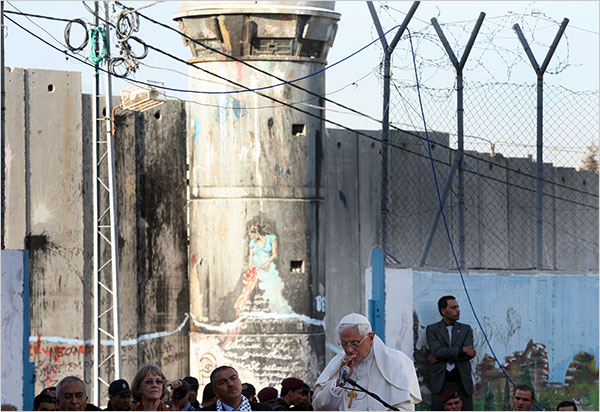
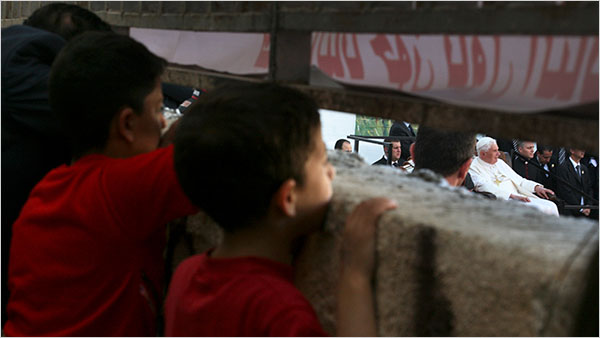
The New York Times ran an article with the headline: “In Bethlehem, Pope laments Israeli wall“. The perfect place to use the image above — the one their own photographer had provided. Right?
Wrong. Instead, they went with a poetic Getty image: little children peaking over a little wall. How enchanting!
The Obama administration, already on treacherous political ground because of its outreach to traditional adversaries such as Iran and Cuba, has opened the door a crack to engagement with the militant group Hamas.
The Palestinian group is designated by the U.S. government as a terrorist organization and under law may not receive federal aid.
But the administration has asked Congress for minor changes in U.S. law that would permit aid to continue flowing to Palestinians in the event Hamas-backed officials become part of a unified Palestinian government. [continued…]
Editor’s Comment — The Israel lobby will want to portray this as a step down the slippery slope towards the legitimization of Hamas. What it really means is that the Obama administration is setting aside the Bush administration’s policy of fomenting division among Palestinians.
For the former administration, under Elliot Abrams’ direction, Palestinian “unity” was only of value if it involved the exclusion of Hamas. What the Obama administration appears to recognize is that Palestinian unity based on reconciliation between Fatah and Hamas is a practical necessity if any semblance of a peace process can be revived.
The Foreign Ministry said Monday that Palestinian recognition of Israel as a Jewish state was ‘crucial’ for reconciliation between the two sides after Palestinian President Mahmoud Abbas dismissed Israeli calls to do so.
“Recognition of Israel as the sovereign state of the Jewish people is an essential and necessary step in the historic reconciliation process between Israel and the Palestinians,” the ministry said in a statement.
“The sooner the Palestinians internalize this basic and essential fact, peace between the two peoples will progress and come to fruition.” [continued…]
Editor’s Comment — Here’s one of the central paradoxes of the Israeli-Palestinian conflict. Supposedly, Israelis attach a great deal of importance to what Palestinians think — do the Palestinians recognize our right to exist? Do they accept that Israel is a Jewish state?
At the same time, the Israelis think its acceptable to kill Palestinians, hold them under siege, restrict their movements and curtail their political rights.
It’s an absurd contradiction. The only rational way of interpreting these demands for recognition is to see them as facets of a more fundamental demand: We reserve the right to exert absolute control over the terms of our co-existence.
[In an interview with Haaretz that appears in full on Friday, Israel’s defense minister, Ehud Barak] struck a blustery yet pragmatic tone [on Iran’s nuclear program]. “There is no one who will dare try to destroy Israel. We are not in a position of being able to tell the Americans whether to talk to the Iranians. I told American leaders: First learn from the professionals about what is going on in Iran, what they are doing behind the smoke screen, acquaint yourselves with the intelligence material, and from this you will understand they are working determinedly to deceive, confuse and blur things, and that under the headline of ‘nuclear power for peaceful purposes,’ they are trying to achieve military nuclear capability.
“I told them negotiations should be short and have a deadline, accompanied by ‘soft’ sanctions such as limitations on money transfers, while preparing the ground for harsh sanctions that involve authorizing action afterward. This has to be done in deep cooperation with the Russians and the Chinese, and we say we are not removing any option from the table. We have a tendency to hope for a heroic operation that will end everything, as with the bombing of the Iraqi reactor in 1981. Is that realistic?
“There is no comparison,” he said. “In the Iraqi case there was one target that existed and was working, and a surgical strike eliminated it. We thought we were delaying the project for three to four years, whereas in practice it was delayed forever. Here we are up against something far more complex, sophisticated and extensive.”
“The Iranians don’t play backgammon, they play chess, and in fact they invented the game. They are proceeding with far greater sophistication and are far more methodical. The Iranian nation is a collection of people held together by an identity that includes the perception of being an empire from the dawn of history. Part of their nuclear pretensions have nothing to do with Israel, but with their place in the world and the Orient.” [continued…]
The Israel Defense Forces announced on Wednesday that an internal investigation has determined that no civilians were purposefully harmed by IDF troops during Operation Cast Lead in the Gaza Strip.
Following the release of the investigation results, Defense Minister Ehud Barak said that the army’s willingness to probe itself “once again proves that the IDF is one of the most moral armies in the world.
“The IDF is not afraid to investigate itself and in that, proves that its operations are ethical,” said Barak. The defense minister added that he has “complete faith in the IDF, from the chief of staff to the last of the combat soldiers.” [continued…]
Editor’s Comment — Oh my! And to think that cynics like me could have judged the IDF so harshly. What better time could there be to watch again this rousing anthem and wonderful tribute to the most moral army in the world: Don’t mess with the IDF.
The Obama Administration will put forth new peace initiatives only if Israel wants it to, said Foreign Minister Avigdor Lieberman in his first comprehensive interview on foreign policy since taking office.
“Believe me, America accepts all our decisions,” Lieberman told the Russian daily Moskovskiy Komosolets.
Lieberman granted his first major interview to Alexander Rosensaft, the Israel correspondent of one of the oldest Russian dailies, not to an Israeli newspaper. The role of Israel is to “bring the U.S. and Russia closer,” he declared. [continued…]
A senior Hamas official said yesterday that firing rockets at Israel ultimately does a disservice to Palestinian interests.
Ismail al-Ashkar is a member of the security committee in the Palestinian Legislative Council and a leading candidate for the interior minister position. “The firing of rockets at Israel is against the Palestinian interest. It benefits certain individuals and groups, but not the Palestinians themselves,” he said yesterday.
Since January 18, the Hamas armed wing, the Iz al-Din al-Qassam Brigades, has not taken credit for a single Qassam rocket. Sources in the Gaza Strip said just two weeks ago that Hamas detained Islamic Jihad operatives for trying to launch rockets.
Yesterday Hamas representatives met delegates from Islamic Jihad and smaller militant groups in order to ensure the cease-fire with Israel remains in force for now. [continued…]
Israel accused former Labour Cabinet minister Clare Short of undermining the Middle East peace process today after she invited the political leader of Hamas to address a meeting in Parliament.
Khaled Mashaal is due to address MPs and peers tonight by video link from Damascus at the event organised by Ms Short, now a independent MP, and Liberal Democrat peer Lord Alderdice.
They say that dialogue with Hamas – which is regarded as a terrorist organisation by the UK, the US and the EU – is crucial if a solution is to be found to the Palestinian crisis. [continued…]
A majority of both Palestinians and Israelis are willing to accept a two-state solution, according to a poll from the international grassroots movement One Voice.
Based on public opinion research methods used in Northern Ireland, 500 interviews were completed in Israel and 600 in the West Bank and Gaza immediately following the Gaza war and the Israeli elections.
Each side was asked which problems they thought were “very significant” and what the solutions might be.
The results indicate that 74% of Palestinians and 78% of Israelis are willing to accept a two-state solution on an option range from “tolerable” to “essential”, while 59% of Palestinians and 66% of Israelis find a single bi-national state “unacceptable”. [continued…]
The new Israeli government will not move ahead on the core issues of peace talks with the Palestinians until it sees progress in U.S. efforts to stop Iran’s suspected pursuit of a nuclear weapon and limit Tehran’s rising influence in the region, according to top government officials familiar with Prime Minister Binyamin Netanyahu’s developing policy on the issue.
“It’s a crucial condition if we want to move forward,” said Deputy Foreign Minister Daniel Ayalon, a member of the Israeli parliament and former ambassador to the United States. “If we want to have a real political process with the Palestinians, then you can’t have the Iranians undermining and sabotaging.”
The emerging Israeli position, a significant change from that of previous governments, presents a challenge for President Obama, who has made quick progress on Palestinian statehood a key foreign policy goal. Obama is also trying to begin engagement with Iran as part of a broad effort to slow its nuclear program and curtail its growing strength in the Middle East. [continued…]
Barack Obama is to invite Israeli, Palestinian and Egyptian leaders to the White House within the next two months in a fresh push for Middle East peace.
Obama, speaking at the White House yesterday, said there was a need to try to rise above the cynicism about prospects for peace. The decision appeared to mark the end of a debate within the Obama administration between those who argued in favour of devoting time and energy to trying to resolve the conflict and those who argued it was a blind alley.
Meeting King Abdullah of Jordan at the White House yesterday, Obama said he hoped “gestures of good faith” would be made “on all sides” in the coming months. He did not say what these gestures, intended as confidence-building measures, would amount to. [continued…]
Word games By Gideon Levy, Haaretz, April 22, 2009
Lord have mercy: Prime Minister Benjamin Netanyahu has relinquished for the moment his demand that the Palestinians recognize Israel as “a Jewish state” as a condition for negotiations. He has deigned to postpone the demand until future stages. Listen up, world: Perhaps, just perhaps, Netanyahu will also see fit to utter the forbidden phrase “two states for two peoples.”
The slogan of yesterday’s illegitimate radical left will be heard publicly in Washington from the mouth of Israel’s most right-wing prime minister ever, and everyone will sing the praises of the historic turnaround. The diplomatic process will again take wing and the expectations will soar. Peace is just around the corner.
Once again the diplomatic arena has become a playground of words. This will be said and that will be declared and the other will be proclaimed. This is a guarantee of another foregone failure.
Whether or not Netanyahu says two states, nothing will change. The Americans will rejoice, the Europeans will be thrilled, the Israeli right will wax wrathful, commentators will again write with pathos about how the dream of the greater land of Israel has been shelved – and the occupation will flourish. [continued…]
President Shimon Peres has threatened that Israel will take military action against Iran if talks proposed by the US president Barack Obama fail to halt Iran’s nuclear programme. In an interview on the Israeli Kol Hai radio station on Sunday, Mr Peres warned that if the talks don’t soften the approach of the Iranian president, “we’ll strike him”.
Mr Peres ruled out the possibility of Israel engaging in a unilateral attack, and said: “We certainly cannot go it alone, without the US, and we definitely can’t go against the US. This would be unnecessary.”
The Israeli president’s statement comes just a few days after the US Vice President Joe Biden issued a high-level warning to Israel’s new government that it would be “ill advised” to launch a military strike against Iran.
Mr Peres also suggested that the arrest last week of 49 alleged agents of Hizbollah by Egyptian authorities was a blow to the Iranian president’s ambitions. [continued…]
Editor’s Comment — Israel threatens to attack Iran has become a dog-bites-man story. What’s significant here is that Peres went out of his way to say that Israel will not go it alone. An attack either gets US backing or it’s not going to happen.
The subtext here is that the Israelis are becoming genuinely afraid of a US-Israeli rift. And the driving force behind this rift is one that the Israel lobby is powerless to rein in: Avigdor Lieberman.
The diplomatic sleight of hand that the Israelis love to play is to gloss over disagreements and brush away criticisms by suggesting that the differences only exist in the eye of the beholder — that Israel and the US are of one heart, indivisible. But no one makes this posture more difficult than Lieberman, a man who is now too powerful to dismiss as a somewhat harmless embarrassment.
As Douglas Bloomfield wrote in the Jerusalem Post on Sunday, Lieberman “could do what the Arabs and their supporters could only dream of – drive a wedge between Americans and Israel.”
Israel does not have the military capability to successfully eliminate Iran’s nuclear program. Even the most successful bombing campaign would only set back the known program for a few years — without affecting any potential clandestine program. This is not classified information. Military experts are well aware of Israel’s capabilities — and its limits.
Yet, the threat of military action, or rather the bluff, serves a purpose: Threats of military action militarizes the atmosphere. It creates an environment that renders diplomacy less likely to succeed — it may even prevent diplomacy from being pursued in the first place.
In the Iranian case, Netanyahu’s tough talk undermines the Obama administration’s prospects for diplomacy in the following ways.
Getting to the negotiating table has proven an arduous task for the US and Iran. Both sides are currently testing each other’s intentions, asking themselves if the other side is serious about diplomacy or if the perceived desire for talks is merely a tactical maneuver to either buy time or build greater international support for more confrontational policies down the road. From Tehran’s perspective, uncertainty about Washington’s intentions during the Bush administration was partly fueled by the insistence of the military option remaining on the table. Tehran seemed to fear entering negotiations that could have been designed to fail, since that could strengthen the case for military action against Iran. [continued…]
The Obama administration and its European allies are preparing proposals that would shift strategy toward Iran by dropping a longstanding American insistence that Tehran rapidly shut down nuclear facilities during the early phases of negotiations over its atomic program, according to officials involved in the discussions.
The proposals, exchanged in confidential strategy sessions with European allies, would press Tehran to open up its nuclear program gradually to wide-ranging inspection. But the proposals would also allow Iran to continue enriching uranium for some period during the talks. That would be a sharp break from the approach taken by the Bush administration, which had demanded that Iran halt its enrichment activities, at least briefly to initiate negotiations.
The proposals under consideration would go somewhat beyond President Obama’s promise, during the presidential campaign, to open negotiations with Iran “without preconditions.” Officials involved in the discussion said they were being fashioned to draw Iran into nuclear talks that it had so far shunned.
A review of Iran policy that Mr. Obama ordered after taking office is still under way, and aides say it is not clear how long he would be willing to allow Iran to continue its fuel production, and at what pace. But European officials said there was general agreement that Iran would not accept the kind of immediate shutdown of its facilities that the Bush administration had demanded. [continued…]
Iran now controls the entire cycle for producing nuclear fuel with the opening of a new facility to produce uranium fuel pellets, the Iranian president said Saturday.
Mahmoud Ahmadinejad made the speech two days after the inauguration of the facility which produces uranium oxide pellets for a planned 40-megawatt heavy-water nuclear reactor near the town of Arak, central Iran.
Production of nuclear fuel pellets is the final step in the long, complicated chain of nuclear fuel cycle. The U.S. and its allies have expressed concern over Iran’s developing nuclear program for fear it masks a nuclear weapons program — a charge Iran denies. [continued…]
Differences between Israel and the United States over the Middle East conflict are fundamentally semantic and will be harmonised within a few weeks, an Israeli minister said on Saturday.
“There are differences of approach toward the problems in the Middle East between our government and the administration of (US President Barack) Obama, but they point more to wording and semantics than to reality,” Transport Minister Israel Katz told public radio.
Israel’s hawkish new Prime Minister Benjamin Netanyahu “has already had meetings with American leaders, and our policies will converge,” he added. [continued…]
Israel has lobbied Russia to pull away from selling a strategic air-defense system to Iran but has received only vague assurances, Israeli defense sources said on Monday.
Last week Israel agreed to supply surveillance drones worth $50 million to Russia. The Israeli Haaretz newspaper said this followed a pledge by Moscow not to sell Iran the S-300, which could protect Iranian nuclear facilities against air strikes.
An Israeli defense official said he had no knowledge of such an undertaking by Russia in its talks with Israel on the matter. Moscow has given mixed messages on the prospects of Iran buying S-300s, a deal one Russian newspaper valued at $800 million. [continued…]
U.S. troops took part in a missile defense exercise in Israel last week that for the first time incorporated a U.S.-owned radar system deployed to the country in October.
About 100 Europe-based troops continue to operate the X-Band radar, which is intended to give Israel early warning in the event of a missile launch from Iran.
While it’s not a permanent assignment for U.S. troops, as long as the radar is in use, U.S. personnel will be there to operate it, U.S. European Command said. [continued…]
The Israeli government never approved Annapolis, neither the Cabinet nor the Knesset, so anyone who wants to amuse himself can continue to do so. I have seen all the proposals made so generously by Ehud Olmert, but I have not seen any results.
So we will therefore act exactly according to the Road Map, including the Tenet document and the Zinni document. I will never agree to our waiving all the clauses – I believe there are 48 of them – and going directly to the last clause, negotiations on a permanent settlement. No. These concessions do not achieve anything. We will adhere to it to the letter, exactly as written. Clauses one, two, three, four – dismantling terrorist organizations, establishing an effective government, making a profound constitutional change in the Palestinian Authority. We will proceed exactly according to the clauses. [continued…]
Editor’s Comment — Lieberman needs to study the agreement that he just promised Israel will assiduously abide by. Phase One concludes:
— Government of Israel immediately dismantles settlement outposts erected since March 2001.
— Consistent with the Mitchell Report, GOI freezes all settlement activity (including natural growth of settlements).
This post is not aimed at Jews. Note the headline. Many non-Jews have not come into this space–Criticizing Israel– because of fears of being called anti-Semites and written off. Years ago my friend Rob Buchanan said to me, Phil you have to speak out on this ’cause they’ll just smear non-Jews as anti-Semites. And I accepted that responsibility.
But the point of this post is that the passivity of likeminded gentiles has now become a problem. We need more prominent gentiles to step forward. [continued…]
Editor’s Comment — I can’t claim to be a prominent gentile but I’m certainly one who has never been terribly worried about being accused of being an anti-Semite. (Everyone has to be able to read their own moral compass and so long as you are confident in doing that, it doesn’t really matter what kinds of slurs get flung in your direction.)
But the challenge now is not one of recruiting gentiles; it is one of transcending tribalism.
Pro-Israel Jews have two weapons that they predictably unleash. They demean and belittle fellow Jews by calling them “self-hating” whereas they vilify non-Jews by implying that they harbor the murderous intent of anti-Semites.
This is a divide-and-rule tactic and maybe the best way of responding to it is by forging solidarity and recognizing that those who draw attention to the ethnicity of Israel’s critics are merely trying to deflect attention from the criticism to the critic.
The sign in big, red Hebrew letters reads “Welcome to Mevasseret Adumim, the Harbinger of the Hills”. A three-lane road with roundabouts leads up the hill to a police station and street lamps line the flyover that links the new town to neighbouring Ma’aleh Adumim, one of the largest Jewish settlements in Israel.
There are no houses, cars or people in Mevasseret Adumim: it is a town laid out, waiting to be built. That is because international pressure has so far prevented construction from going ahead. The area is the last piece of open land linking Arab East Jerusalem to the West Bank and critics said that to develop it would bury the very notion of a two-state solution to the Middle East crisis.
According to reports in the Israeli media, the area has been earmarked for development under a secret accord between Binyamin Netanyahu, the new, conservative Israeli Prime Minister, and his ultra-nationalist Foreign Minister, Avigdor Lieberman. [continued…]
To understand how Israel’s new Netanyahu government will handle relations with its neighbours, and a US administration with which it is clearly at odds, it is worth recounting an old Hasidic Jewish folktale
A man’s wife nags him relentlessly that their home is too small. A poor man, he can afford nothing larger, so he asks the advice of his rabbi. “Bring your chickens into the house,” the rabbi advises, which the man duly goes home and does. Naturally his wife’s anger escalates, which he reports back to the rabbi the following day. “Now bring in your goat,” the sage advises – a course of action with predictable consequences, but when the man returns the rabbi orders him to bring a cow into the house the next night. The man returns red-eyed and frantic after a sleepless night. “Rabbi, what can I do, my wife is threatening to leave.” To which the rabbi replies: “Now, take out the cow.”
The basic principle is simple: when you have a problem you can’t solve, create a bigger one. Plainly, Benjamin Netanyahu has a problem he can’t solve: Israel is highly dependent on US support, but America now has an administration determined to move quickly to end the conflict that has raged since Israel’s creation in 1948 by creating a viable, independent Palestinian state. And Mr Netanyahu has repeatedly insisted that he cannot accept such an outcome because he deems sovereign independence for the Palestinians to be an intolerable threat to Israel’s security. [continued…]
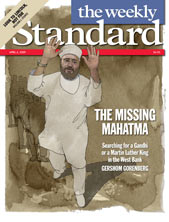
When the long sought solution to the Israeli-Palestinian conflict is being trumpeted from the cover of The Weekly Standard there’s every reason to scoff. Middle East peace has thus far not appeared high up on the neoconservative agenda and I really doubt that Bill Kristol and his cronies suddenly had some extraordinary change of heart.
What’s sad is that Gershom Gorenberg, who is clearly a man of integrity, chose to lend his support to the Israel apologists who happily massage their consciences by pretending that Palestinian violence is the one insurmountable obstacle to ending the conflict.
In a celebration of Israeli impotence we are presented with a mirage of peace in the form of an unfound Palestinian Mahatma. If only a Palestinian Gandhi emerged, anything would be possible.
It’s not that the appeal of a saintly leader of a non-violent resistance movement is lost on me, but the parallels between British India and Israel are beyond tenuous.
Gandhi’s resistance to British rule galvanized the support of a massive population governed by a tiny colonial elite who never had the pretense that Britain was reclaiming a long-lost homeland. To the British, India was a land brimming with resources that could be shipped back to the actual homeland and traded for handsome profits. By the end of World War Two, Britain was bankrupt and in a rush to free itself of what had become its colonial burdens. With or without a gentle shove from the Mahatma, the sun had already set on the British Empire.
As for Gandhi’s nominal success in non-violently waving goodbye to colonial rule, we should not forget that it was accompanied by the horrific failure of partition and a bloodbath in which as many as a million people died.
Another model of non-violent leadership that Gorenberg could have considered is that of the Dalai Lama.
After fifty years of principled resistance to Chinese rule, Tibetans are still no closer to winning autonomy. Thus far, the majority of the Dalai Lama’s followers remain loyal to the religious values that he practices and advocates, yet many are starting to wonder whether it is their pacifism that enables China to retain its firm grip on Tibet.
Of course the most obvious model of political leadership that Gorenberg should have mentioned is that of Nelson Mandela.
The problem is — at least from Gorenberg and The Weekly Standard‘s point of view — Mandela resolutely refused to renounce armed resistance. Apartheid didn’t end because its opponents adopted a spiritually enlightened non-violent perspective. It ended because white South Africans were forced to recognize they were clinging on to a politically unsustainable system.
Israelis still cling on to a politically unsustainable situation, but unlike white South Africans, they are still able to hold on to a security blanket stitched together by American military and economic aid and political protection.
President Obama might say that for Palestinians and Israelis “the status quo is unsustainable”, but unless the US takes away the security blanket, Israel will remain in its manipulatively infantile condition: vacillating between a manicured helplessness that occasionally gets punctuated by a violent tantrum.
Must Israel and its friends wait in frustration for an elusive Palestinian Mahatma or instead might an earnest search for an Israeli FW de Klerk be long overdue?
Pressure on President Obama to recast the failed American approach to Israel-Palestine is building from former senior officials whose counsel he respects.
Following up on a letter dated Nov. 6, 2008, that was handed to Obama late last year by Paul Volcker, now a senior economic adviser to the president, these foreign policy mandarins have concluded a “Bipartisan Statement on U.S. Middle East Peacemaking” [PDF] that should become an essential template.
Deploring “seven years of absenteeism” under the Bush administration, they call for intense American mediation in pursuit of a two-state solution, “a more pragmatic approach toward Hamas,” and eventual U.S. leadership of a multinational force to police transitional security between Israel and Palestine. [continued…]
Emphasizing diplomacy and engagement over isolation and confrontation, President Obama has spoken eloquently of a new era of American leadership. Of the changes he has promised, the most important to Palestinians is his commitment to reinvigorating the Middle East peace process.
Resolving the Palestinian-Israeli conflict remains crucial to achieving stability and peace in the Middle East as well as to advancing vital U.S. interests. The Obama administration clearly understands this, prioritizing the peace process as part of a more integrated approach to U.S. policy in the region. America’s renewed commitment to brokering a just and lasting peace between Palestinians and Israelis offers a measure of hope to Palestinians living under the weight of occupation. But it also comes at a time when Israel’s own commitment to peace is in doubt after the formation of a right-wing coalition government.
Peace is not a word that sits comfortably with the Israeli right, which will dominate Israel’s new government, even with Labor’s decision this week to join it. Among its ranks are those who have long opposed peace with Palestinians, no matter the cost; who use the cover of religion to advocate extremist views; and who have supported the expulsion of Palestinians or now devise loyalty tests designed to achieve the same result. [continued…]
For many years, the United States has had a policy against spending aid money to fund Israeli settlements in the West Bank, which successive administrations have regarded as an obstacle to peace. Yet private organizations in the United States continue to raise tax-exempt contributions for the very activities that the government opposes.
There’s nothing illegal about the charitable contributions to pro-settlement organizations, which are documented in filings with the Internal Revenue Service. They’re similar to tax-exempt donations made to thousands of foreign organizations around the world through groups that are often described as “American friends of” the recipient.
But critics of Israeli settlements question why American taxpayers are supporting indirectly, through the exempt contributions, a process that the government condemns. A search of IRS records identified 28 U.S. charitable groups that made a total of $33.4 million in tax-exempt contributions to settlements and related organizations between 2004 and 2007. [continued…]
Lieberman is not a passing phenomenon. He represents the integration into Israeli politics of the million immigrants from the former Soviet Union. These new immigrants have displaced the old Labour party, once the elite of the country and the so-called party of peace. In every Labour voter there was a sepia-tinted memory of a kibbutznik taking his horse to be shod in an Arab village. If this fantasy of Jewish-Arab co-operation was ever true, it stopped being so in the 1920s. But the Labour party has always felt that somehow the Arabs can be forced to love, or just get along with, Zionism – a viewpoint which used to sell easily in Europe and the US, even if it never corresponded with facts on the ground. Continue reading →
Israel, whose founding idea was branded as racism by the United Nations General Assembly in 1975 and which faced an Arab boycott for decades, is no stranger to isolation. But in the weeks since its Gaza war, and as it prepares to inaugurate a hawkish right-wing government, it is facing its worst diplomatic crisis in two decades. Continue reading →
A decade after being ousted by Israelis entranced by his then rival’s pledges of peace accords and modest governance, Benjamin Netanyahu has won a new lease on power over a country now more given to disaffection and fears of war.
President Shimon Peres on Friday handed him a mandate to form Israel’s next government, and the right-wing Likud leader now has 42 days to put together a coalition. He should manage that with like-minded allies, even if his appeal to centrist and left-wing rivals for a unity government falls on deaf ears. [continued…]
George Mitchell, the US special envoy to Mideast said Thursday that while the development of the West Bank’s economy remains important, it cannot take precedent to the diplomatic route.
Mitchell, who held a conference call with the heads of various Jewish groups in the United States, refrained from answering questions regarding the political situation in Israel, saying he would not address the subject before President Shimon Peres’ tasked one of the parties’ leaders with forming the government. Continue reading →
The Israelis are understandably nervous about the prospect of pressure from the US. But if the Obama administration does push Israel much harder to move towards a peace agreement with the Palestinians, it will in fact be doing the country a favour.
For the biggest existential threat to Israel is not Iran or Hamas – it is the prospect that Jews will eventually be outnumbered by Arabs in the combined territory of Israel and Palestine. The long-term existential choice is between three alternatives: two states; one state without a Jewish majority; or an undemocratic state, with Israel as a permanent occupying power over a voteless, violent and anarchic Palestine.
Israel’s election campaign suggests the country is not yet ready to face up to that choice. So it may need the Obama administration to frame the choice for it. [continued…]
In the first Hamas interview with the Western media since last month’s ceasefire in Gaza, its deputy leader Musa Abu Marzouk told The Daily Telegraph that the Palestinian group was ready for a period of “calm”.
A chandeliered room in the Syrian capital Damascus – where several Hamas leaders live in exile – is a long way from the ruins of the Gaza Strip but a weary frustration with the deprivations of war was pervasive.
“We need to rebuild the buildings destroyed in the aggression,” said Mr Marzouk. “We need to treat the wounded – more than 5,000 need serious treatment. We need to help all the families without food and shelter. We need the gates of Gaza to open to lift the siege.
“All this can only be dealt with by period of calm between the two sides.”
Hamas negotiators have been instructed to accept the terms of a ceasefire pact negotiated by Egyptian mediators in Cairo.
Hamas regards its offer as a Tahdia, an Arabic word indicating non-aggression in a stand-off, usually described as a “calm”. A longer-term Hudna, or ceasefire, would be withheld until a peace agreement that would see Israel withdraw from Palestinian territory.
“Israel owns the West Bank and Gaza Strip right now but if it withdrew from these and let the Palestinians have access to Jerusalem, we would turn our face to rebuild our lives and live alongside as in other parts of the world,” said Mr Marzouk. [continued…]
Editor’s Comment — When Shimon Peres feels compelled to pen an op-ed in the Washington Post arguing against the one-state solution, there are two obvious conclusions we can draw:
1. The viability of the two-state solution has become transparently flimsy.
2. Whereas the one-state solution has for a long time only garnered only marginal attention it is now not only being taken seriously but it increasingly is acquiring the appearance of being the unavoidable conclusion of a historical trend.
For those Israelis and Jews outside Israel who still cherish the concept of a Jewish state, here’s a message that may sound unbelievable yet needs to be considered carefully: the best hope for preserving the Jewish state is being offered by Hamas.
Hamas is not in the habit of crafting its statements merely to meet the expectations of others. So, when they say, end the occupation, allow Palestinians access to Jerusalem and then we can live side by side, this is not a statement that should casually be dismissed.
Remember back on the campaign trail when Hillary Clinton said she helped bring peace to Northern Ireland? A bit of fact checking soon revealed that her rather minor role amounted to no more than assisting with “the general atmospherics.” That’s worth keeping in mind while Washington’s foreign policy elite smothers Obama with praise after his appearance on Al-Arabiya.
“It’s impossible to exaggerate the symbolic importance of Barack Obama choosing an Arabic satellite television station for his first formal interview as President,” gushed Marc Lynch in response to the implementation of his own recommendations.
“By most accounts, Obama’s decision — shocking to some, refreshing to others — to talk to the Muslim world in his first formal, sit down press interview hit the ball out of the park,” Steve Clemons said in an equally enthusiastic review.
“We support Israel’s right to self-defence. The (Palestinian) rocket barrages which are getting closer and closer to populated areas (in Israel) cannot go unanswered,” Hillary Clinton said in her first news conference at the State Department.
And there’s the rub. How does the US marry it’s “we can feel your pain” message, with “but it’s OK if Israel inflicts some more”?
For Obama to give his first interview to Al-Arabiya was a positive step in changing the tone of US relations with the Muslim world, but let’s not get carried away. Soothing words provide no relief to the victims of Israeli atrocities committed in Gaza.
Talking to a Saudi-owned television station no doubt went down well with Saudi Arabia’s rulers, but if Obama wants to engage with the largest audience he’ll need to have the courage to go on Al Jazeera. The response of the most widely watched network to Obama’s first step was quite telling. They barely mentioned it.
But if Washington wants to remain close to its old friends in Riyadh, it should also head their advice. Just a few days ago, Prince Turki al-Faisal directed a passionate plea at the new president:
Let us all pray that Mr Obama possesses the foresight, fairness and resolve to rein in the murderous Israeli regime and open a new chapter in this most intractable of conflicts.
It’s nice that Obama has had the experience of living in a Muslim country, that he has Muslim relatives, and that he wants to pursue relations with the Muslim world based on mutual respect. But beyond the atmospherics, the people of the Middle East are looking for substance from America’s new celebrity president. He has a receptive audience, but they’ll only remain open if he can deliver.
Prince Turki laid out what is expected:
President Barack Obama must address the disaster in Gaza and its causes. Inevitably, he will condemn Hamas’s firing of rockets at Israel. When he does that, he should also condemn Israel’s atrocities against the Palestinians and support a UN resolution to that effect; condemn the Israeli actions that led to this conflict, from settlement building in the West Bank to the blockade of Gaza and the targeted killings and arbitrary arrests of Palestinians; declare America’s intention to work for a Middle East free of weapons of mass destruction, with a security umbrella for countries that sign up and sanctions for those that do not; call for an immediate withdrawal of Israeli forces from Shab’ah Farms in Lebanon; encourage Israeli-Syrian negotiations for peace; and support a UN resolution guaranteeing Iraq’s territorial integrity.
Mr Obama should strongly promote the Abdullah peace initiative, which calls on Israel to pursue the course laid out in various international resolutions and laws: to withdraw completely from the lands occupied in 1967, including East Jerusalem, returning to the lines of June 4 1967; to accept a mutually agreed just solution to the refugee problem according to UN resolution 194; and to recognise the independent state of Palestine with East Jerusalem as its capital. In return, there would be an end to hostilities between Israel and all Arab countries, and Israel would get full diplomatic and normal relations.
What the Saudis know is that they — and the US — are running out of time. George Mitchell’s patience may be an indispensable negotiating skill, but what the Middle East is looking for is Obama’s “fierce urgency of now” — not just the borrowed slogan but words embodied in actions.
If you did not see it already, watch Bob Simon’s report (below), “Is Peace Out Of Reach?” from last night’s edition of 60 Minutes. In the history of American reporting on the Palestinian-Israeli conflict, this is an exceptional piece of journalism. But don’t just watch it — share it by email, embed it on your web site and do whatever else you can to enlighten other Americans who at this time understand so little about the core issues behind the conflict. (The following video is preceded by a 30-second commercial.)
As President Obama’s Middle East Envoy for Peace, George Mitchell, makes his way to the region this week, he should keep in mind a statement that Osama Hamdan, Hamas’s representative in Lebanon, made in a speech in Beirut yesterday. Hamdan said, “the peace process is irreversibly over.”
This bears repeating:
…the peace process is irreversibly over.
There are commentators who will say that this statement is an expression of intransigence and belligerence coming from a resistance movement dedicated to the destruction of Israel.
Far from it — it is merely a statement of fact. Indeed, it is an assessment of an objective reality that is remarkably lacking in venom.
Just suppose that we were at a juncture where 1,300 Israelis had just been brutally killed, 5,000 were wounded, many in a grave condition, 20,000 houses had been destroyed and tens of thousands were now homeless.
Suppose in such a situation Israel’s leaders were to declare that the peace process was irreversibly over, we would now be commenting on their remarkable composure. We would marvel that they would bother making a political statement and not simply a blood-curdling cry of vengeance.
Hamas on the other hand, in spite of the devastation of Gaza, is still committed to politics.
The political imperative of the moment is one of clarification. Hamas sees that Palestinian unity and a Palestinian national movement cannot be built on an illusory foundation.
Meanwhile, Tzipi Livni claims that the carnage in Gaza has advanced the peace process. This is an Orwellian, obscene, and outrageous insult to common sense. It displays a sociopathic view of human suffering.
But it also serves as a reminder and confirmation that Osama Hamdan is right: the peace process is irreversibly over.
If this is a conclusion which can commonly be agreed upon, where do we go from here? Is this not a conclusion that will feed utter despair or a justification for endless conflict?
I believe not.
Political change can only gain traction when it is rooted in objective reality. We can only advance from the conditions we actually inhabit.
For several years now the peace process has floundered because of a glaring contradiction between Israel’s stated aim — a two-state solution — and its actions, which consistently advanced in the opposite direction.
By its own choice, Israel has abandoned the goal of a two-state solution. The so-called peace process has provided the water and the sustenance that has allowed the occupation to flourish.
America has been the enabler. It has provided a stage upon which a pantomime of peace could be performed. It has quite effectively silenced those who would disrupt the performance and insisted that we all silently enjoy a show whose tedious enactment perpetually held out the promise of a happy ending.
“When Israel supports a solution of two states for two people, the pressure won’t be on Israel,” Tzipi Livni correctly observed over the weekend.
George Mitchell’s duty, the duty of the international community and of all Palestinian leaders, is to say: the game is up, the show is over. The charade has gone on for long enough. Israel has stated its position on the ground. It’s words have proved to be of no consequence.
Given the realities and ignoring the empty declarations, where does Israel want to go from here?
Democracy: a one-state solution in which Jews and Palestinians have equal rights;
Ethnic cleansing: a state that solidifies its Jewish identity by purging itself of every non-Jewish element; or
Apartheid: the explicit formalization of what is already a practical reality.
These, as Bob Simons correctly observers, are Israel’s choices. America can no longer serve as Israel’s shield in its efforts to conceal a painful reality.
On December 18, 2008, Tel Aviv’s Institute for National Security Studies welcomed an honored American guest who participated in the 2nd Annual International Conference: Security Challenges of the 21st Century.
Former US Senator George Mitchell presented, “The American Perspective.” Note the definite article — Mitchell was not simply presenting an American perspective. Indeed, Haaretz reported yesterday that the institute’s director, Oded Eran, “found out on the eve of the conference that Mitchell had been chosen as the next Mideast envoy, though the envoy-designate did not discuss his new position.”
Did Mitchell’s anticipated imminent return to the region as President Obama’s Middle East envoy provide an added incentive for Israel to launch its assault of Gaza? After January 20 the strain on US-Israeli relations would have been severe.
But what could be so threatening about such a renowned American elder statesman? How could someone with Mitchell’s track record — a pivotal role in bringing peace to Northern Ireland — not provide an invaluable contribution to a moribund peace process?
Among Israel’s leaders and some of its most influential supporters it is Mitchell’s virtues that present the most ominous threat.
In The Jerusalem Post, under the headline, “Mitchell: Every conflict can be solved,” Herb Keinon candidly exposes Israel’s fear of an honest broker. Citing the findings of Mitchell’s 2001 report on the causes of the Second Intifada, Keinon writes:
The Mitchell Report called for an immediate cessation of violence and a resumption of Israeli-Palestinian Authority security cooperation, and a series of “confidence-building measures” to follow the cease-fire. The two key measures were that the PA had to “make clear through concrete action to Palestinians and Israelis alike that terrorism is reprehensible and unacceptable and that the PA will make a 100-percent effort to prevent terrorist operations and to punish perpetrators”; and that Israel had to “freeze all settlement activity, including the ‘natural growth’ of existing settlements.”
One government official said Mitchell’s position on zero settlement construction, together with new National Security Adviser James Jones’s previous articulation of frustration at Israel’s inability to dismantle outposts, would likely put Israel and the new administration on a collision course.
The official said that while Mitchell had been considered “a friend of Israel” when he was Senate majority leader from 1989-1995, his tenure as head of the Mitchell Committee left some in Jerusalem with the feeling that he was trying to be “too balanced.”
The official said the apparent selection of Mitchell as special envoy, over more high-profile Jewish Middle East experts surrounding Obama – such as Dennis Ross, Daniel Kurtzer, Martin Indyk and Richard Holbrooke – might indicate that for the sake of balance, Obama did not want a Jew in that position.
Echoing the same fear that Mitchell’s appointment puts Israel at risk because he will be “too” fair, one of Israel’s most prominent American defenders was equally frank in revealing his doubts:
“Sen. Mitchell is fair. He’s been meticulously even-handed,” said Abraham Foxman, national director of the Anti-Defamation League. “But the fact is, American policy in the Middle East hasn’t been ‘even handed’ — it has been supportive of Israel when it felt Israel needed critical U.S. support.
“So I’m concerned,” Foxman continued. “I’m not sure the situation requires that kind of approach in the Middle East.”
In as much as George Mitchell provokes fear among Israelis, he also crystallizes what should now be under debate.
The peace process has become a facade. Behind this facade, inside Israel, there has arisen a hardening conviction that peace is not possible. Mitchell poses a direct challenge to that conviction because he comes in with the opposite view:
…from my experience in Northern Ireland I formed the conviction that there is no such thing as a conflict that can’t be ended. Conflicts are created and conducted by human beings. They can be ended by human beings. I saw it happen in Northern Ireland although admittedly it took a very long time. I believe deeply that with committed, persevering and active diplomacy it can happen in the Middle East.
The real question that confronts Israel is not, what can advance the peace process? The question is much starker: does Israel still believe in the possibility of peace or has it become resigned to existing in a perpetual state of war?
Yet to pose this question is to expose the fragility of the security bubble inside which Israel currently chooses to reside. For as much as Israel likes to assume the posture of an indomitable military power, the simple truth is that Israel’s military might is utterly dependent on America’s patronage — hence the threat posed by America as honest broker, as opposed to loyal defender. As honest broker, America cannot perpetually provide Israel with the option of choosing war instead of peace.
This website or its third-party tools use cookies, which are necessary to its functioning. By closing this banner, you agree to the use of cookies.





 hen the long sought solution to the Israeli-Palestinian conflict is being trumpeted from the cover of