Category Archives: Issues

French authorities given broader powers to fight terrorism

The New York Times reports: The French Parliament on Wednesday approved a law that gives the police and judicial authorities new powers to detain terrorism suspects, put people under house arrest and use deadly force to stop attacks.

The Senate, France’s upper house of Parliament, approved the bill by a show of hands. The National Assembly, the lower house, had already approved it.

The measure is the latest in a series of legislative changes that the government of President François Hollande has pushed through to give the authorities greater policing powers after the deadly terrorist attacks in Paris last year, sometimes prompting debates over civil liberties. [Continue reading…]

Facebooktwittermail

ExxonMobil CEO: Ending oil production ‘not acceptable for humanity’

The Guardian reports: Rex Tillerson, the boss of oil giant ExxonMobil, said cutting oil production was “not acceptable for humanity” as he fought off shareholders’ and activists’ attempts to force the company to fully acknowledge the impact of climate change on the environment and Exxon’s future profits.

During a long and fractious annual meeting in Dallas on Wednesday, Tillerson, who serves as Exxon’s chairman and chief executive, beat back several proposals to force the company to take more action on climate change.

However, dissident shareholders won a vote that could make it easier for them to propose board candidates concerned about climate change and remove incumbent directors.

Tillerson said Exxon had invested $7bn in green technology, but the science and technology had not yet achieved the breakthroughs needed to compete with fossil fuels. “Until we have those, just saying ‘turn the taps off’ is not acceptable to humanity,” he said. “The world is going to have to continue using fossil fuels, whether they like it or not.” [Continue reading…]

Facebooktwittermail

Behind the barricades of Turkey’s hidden war against the Kurds

The New York Times reports: On the morning of Oct. 29, 2014, a long convoy of armored vehicles and trucks rolled northward in the shadow of Iraq’s Zagros Mountains and crossed a bridge over the Khabur River, which marks the border with Turkey. As the convoy rumbled past the border gate, the road for miles ahead was lined with thousands of ecstatic Kurds, who clapped, cheered and waved the Kurdish flag. Many had tears in their eyes. Some even kissed the tanks and trucks as they passed. The soldiers, Iraqi Kurds, were on their way through Turkey to help defend Kobani, a Syrian border city, against ISIS. Their route that day traced an arc from northern Iraq through southeastern Turkey and onward into northern Syria: the historical heartland of the Kurdish people. For the bystanders who cheered them on under a hazy autumn sky, the date was deliciously symbolic. It was Turkey’s Republic Day. What had long been a grim annual reminder of Turkish rule over the Kurds was transformed into rapture, as they watched Kurdish soldiers parade through three countries where they have long dreamed of founding their own republic.

Some who stood on the roadside that day have told me it changed their lives. The battle against the Islamic State had made the downtrodden Kurds into heroes. In the weeks and months that followed, the Kurds watched in amazement as fighters aligned with the Kurdistan Workers’ Party, or P.K.K. — long branded a terrorist group by Turkey and the United States — became the central protagonists in the defense of Kobani. The P.K.K.’s Syrian affiliate worked closely with the American military, identifying ISIS targets for airstrikes.

By the time ISIS withdrew from Kobani in January 2015, the Kurdish militants had paid a heavy price in blood. But they gained admirers all over the world. The Pentagon, impressed by their skill at guerrilla warfare, saw an essential new ally against ISIS. There was renewed talk in Europe of removing the P.K.K. from terrorism lists, often in news articles accompanied by images of beautiful female Kurdish soldiers in combat gear. For many Turkish Kurds, the lesson was unmistakable: Their time had come. I met a 27-year-old P.K.K. activist in Turkey, who asked not to be named, fearing reprisals from the government, and who first went to Kobani in 2012, when the Kurds began carving out a state for themselves in Syria called Rojava. “I remember talking to P.K.K. fighters, and I thought, They’re crazy to think they can do this,” she said. “Now I look back and think, If they can do it there, we can do it here.”

Nineteen months after that convoy passed, the feelings it inspired have helped to start a renewed war between Turkey and its Kurdish rebels. Turkish tanks are now blasting the ancient cities of the Kurdish southeast, where young P.K.K.-supported rebels have built barricades and declared “liberated zones.” More than a thousand people have been killed and as many as 350,000 displaced, according to figures from the International Crisis Group. The fighting, which intensified last fall, has spread to Ankara, the Turkish capital, where two suicide bombings by Kurdish militants in February and March killed 66 people. Another sharp escalation came in mid-May, when P.K.K. supporters released a video online seeming to show one of the group’s fighters bringing down a Turkish attack helicopter with a shoulder-fired missile, a weapon to which the Kurds have rarely had access. Yet much of the violence has been hidden from public view by state censorship and military “curfews” — a government word that scarcely conveys the reality of tanks encircling a Kurdish town and drilling it with shellfire for weeks or months on end.

The conflict has revived and in some ways exceeded the worst days of the P.K.K.’s war with the Turkish state in the 1990s. The fighting then was brutal, but it was mostly confined to remote mountains and villages. Now it is devastating cities as well and threatening to cripple an economy already burdened by ISIS bombings and waves of refugees from Syria. In Diyarbakir, the capital of a largely Kurdish province, artillery and bombs have destroyed much of the historic district, which contains Unesco world heritage sites. Churches, mosques and khans that have stood for centuries lie in ruins. Tourism has collapsed. Images of shattered houses and dead children are stirring outrage in other countries where Kurds live: Iraq, Syria and Iran. [Continue reading…]

Facebooktwittermail

Report slams Israel’s military law enforcement system

Al Jazeera reports: Citing a raft of deep systemic failures, human rights group B’Tselem has announced that it will no longer cooperate with Israel’s military law enforcement system.

For the past 25 years, B’Tselem, which documents Israeli human rights violations in the occupied Palestinian territories, has served as a “subcontractor” for the system by submitting complaints about soldiers’ alleged misconduct, gathering relevant documents and evidence, and requesting updates for affected Palestinian families.

While the goal was to help to bring justice to Palestinian victims and deter future misconduct, the reality has been the opposite, B’Tselem said in a scathing report released on Wednesday. [Continue reading…]

Facebooktwittermail

‘My grandsons’ fight to avenge their father’: Child soldiers in Afghanistan

The Guardian reports: When Firoza handed her two grandsons Kalashnikovs and enlisted them in her militia, it was, she says, to give them a chance to avenge their father who was killed by the Taliban.

Known in Helmand by her nom de guerre – Hajani – 54-year-old Firoza fought for years to repel the militants from Sistani, in Marjah district, commanding a unit of the US-backed government militia called the Afghan Local Police (ALP). During the war, in which she lost three of her six adult sons, she armed most of her male family members, including two children.

The eldest, Nabi*, a shy boy with bags under his eyes, echoes his grandmother. “The enemy killed my father so I am also fighting,” he says.

According to Firoza, the government pays Nabi the standard 9,500 afghanis (£100) local police salary; his younger brother, Habib, is not paid.

Firoza says Nabi is 18. Many Afghans don’t know their age, but that claim seems improbable. Face smooth, voice unbroken, he looks perhaps 14. Firoza says she gave her grandsons weapons five years ago.

Despite government pledges to rid its armed forces of children, a growing number of minors are recruited to fight in the intensifying war, according to experts. [Continue reading…]

Facebooktwittermail

Taliban leader was made to ‘face the consequences’ of refusing to negotiate

The Wall Street Journal reports: President Barack Obama secretly ordered the strike on Mullah Mansour after first trying to bring him to the negotiating table. Initially, there was hope in Washington that Mullah Mansour would be more open to negotiations than his predecessor, Mullah Mohammad Omar.

Obama administration officials were divided over whether the Pakistanis were capable or willing to deliver Mullah Mansour for the negotiations.

U.S. officials said the Pakistanis tried and grew frustrated in February by Mullah Mansour’s refusal to send representatives to meet with the Afghan government.

Around the same time, people who maintain contacts with the Taliban began to report that Mullah Mansour had left Pakistan and was spending time in Iran.

U.S. intelligence agencies received information that allowed them to track Mullah Mansour’s movements, including details about devices he used for communications, U.S. officials said.

That allowed the spy agencies to present policy makers with a choice: If and when Mullah Mansour were located in Pakistan, should the U.S. strike?

Mullah Mansour’s travels made it easier to find him. In contrast, the Central Intelligence Agency spent years looking in vain for an opportunity to kill the reclusive cleric he replaced, Mullah Omar.

An April 19 Taliban attack in Kabul targeted Afghanistan’s secret service, killing more than 60 people and underlining for the Americans the extent to which Mullah Mansour had chosen a military course. A decision was made that he should “face the consequences” of his refusal to negotiate, a senior administration official said. [Continue reading…]

Facebooktwittermail

5 ways Bernie Sanders may impact the Democratic Party platform

Jason Linkins writes: Every four years, as Democrats and Republicans plan for their national conventions, party leaders come together to decide on how to best dust off and shine up their respective parties’ platform — that catch-all proclamation that signals their political priorities and policy goals. Typically, the publication of these platforms results in a couple days of news stories, in which noteworthy alterations are documented and the other side levies partisan objections.

But this year, there’s an interesting twist: Bernie Sanders — the presumptive second-place finisher in the Democratic primary — has been granted the opportunity to play a role on the platform committee. Which means that the Democratic Party’s platform document may receive up to four days of coverage. Perhaps even five.

If this seems like a cynical way of viewing what is ostensibly an important party document, I invite you to muddle through the last Democratic party platform, authored in President Barack Obama’s re-election year. A red-hot manifesto it is not. Over the course of some 25,000-or-so words, the party outlines, in the safest possible terms, what it stands for. Everything is poll-tested to within an inch of its literary life.

Along the way, the platform is salted with marketing bromides and vague political platitudes. Credit is given to Obama for many accomplishments which need to, in the eyes of the party, continue being accomplished. And, in keeping with recent Democratic Party election-year strategies, much effort is undertaken to cast the GOP in a bad light (“The other guys are crazy!”). It’s a tradition that will no doubt continue now that the presumptive Republican Party nominee is reality TV personality and North Pacific Subtropical Gyre garbage patch Donald Trump.

The objectionable nature of Trump’s candidacy may be one thing on which this year’s platform committee might be able to quickly agree. In an unusual move, Democratic National Committee Chairwoman Debbie Wasserman-Schultz is allowing Sanders to name five appointees to the 15-member committee, instead of reserving the right to name the entire committee for herself. Under this arrangement, presidential rival Hillary Clinton‘s campaign will get to pick six members and Wasserman-Schultz will name four, including the committee chair, Rep. Elijah Cummings (D-Md.).

As Mother Jones’ Kevin Drum points out, the buried news may be that Sanders is signaling that he understands he won’t win this nomination. Whether or not this is true, the independent Vermont senator is hailing this as a major, substantive concession. And he’s named a quintet of unconventional-by-party-insider standards as his emissaries: Rep. Keith Ellison (D-Minn.), environmental campaigner Bill McKibben, Native American activist Deborah Parker, racial justice advocate (and Obama critic) Cornel West and DNC member James Zogby.

Clinton’s picks are decidedly more in keeping with her “barrier-breakers” theme: American Federation of State, County and Municipal Employees union leader Paul Booth, former EPA head Carol Browner, Rep. Luis Gutiérrez (D-Ill.), Ohio state Rep. Alicia Reece, former State Department official Wendy Sherman and Center for American Progress head Neera Tanden.

So, one way in which this arrangement will generate more news than is typically created by the platform committee will be watching West and Tanden co-author a document. But beyond the soap opera aspect of this collaboration, there are several areas in which Sanders’ representatives could alter what’s traditionally a very staid and cautious party declaration in significant ways. [Continue reading…]

Facebooktwittermail

The radical future of interrogation

shadow16

Robert Kolker writes: The trouble with modern interrogation technique… is that, despite its scientific pose, it has almost no science to back it up. Reid and Inbau [authors of Criminal Interrogation and Confessions, which in 1962 set the mold for police interrogations in America] claimed, for instance, that a well-trained investigator could catch suspects lying with 85 percent accuracy; their manual instructs detectives to conduct an initial, nonaccusatory “behavioral analysis interview,” in which they should look for physical tells like fidgeting and broken eye contact. But when German forensic psychologist Günter Köhnken actually studied the matter in 1987, he found that trained police officers were no better than the average person at detecting lies. Several subsequent studies have cast doubt on the notion that there are any clear-cut behavioral tells. (Truth tellers often fidget more than liars.) In fact, the more confident police officers are about their judgments, the more likely they are to be wrong.

But the scientific case against police interrogations really began to mount in the early 1990s, when the first DNA-based exonerations started rolling in. According to the Innocence Project, a group dedicated to freeing the wrongfully imprisoned, about a third of the 337 people who’ve had their convictions overturned by DNA evidence confessed or incriminated themselves falsely. These and other exonera­tions furnished scientists with dozens of known false-confession cases to study, giving rise to a veritable subfield of social psychology and the behavioral sciences. (At least one confession elicited by John Reid himself — in a 1955 murder case — turned out to be inaccurate; the real killer confessed 23 years later.)

Researchers have even broken down these false confession cases into categories. There are “voluntary” false confessions, like the many presumably unstable people who claimed credit for the Lindbergh baby kidnapping in order to get attention. Then there are “compliant,” or “coerced,” false confessions, in which people are so ground down by an intense interrogation that, out of desperation and naïveté, they think that confessing will be better for them in the long run. The third category, “persuaded,” or “internalized,” false confessions, may be the most poignant. Here, the interrogator’s Reid-style theming is so relentless, the deployment of lies so persuasive, that suspects — often young and impressionable or mentally impaired — end up believing they did it, however fleetingly. [Continue reading…]

Facebooktwittermail

Did Obama just carry out an experimental execution?

Reuters reports: U.S. President Barack Obama approved the drone strike that killed Mullah Akhtar Mansour because the Taliban leader was overseeing plans for new attacks on American targets in Kabul, the Afghan capital, U.S. officials said on Monday. [Continue reading…]

Drone strikes are always carried out in the name of necessity. From the president on down, everyone wants to be able to claim that the decision to launch a deadly attack was driven by an imminent threat, there being no legal basis for indiscriminate killing or vengeance.

In the case of the assassination of the Taliban leader, Mullah Akhtar Mansour, in Pakistan over the weekend, Obama’s comments on the killing suggest that this actually had less to do with preventing an imminent attack, than it was a kind of experiment.

No one knows what the consequence of killing Mansour will be, but Obama apparently thought that the potential benefits outweighed the risks.

An otherwise risk-averse president always seems confident about the bets he places when they involve Hellfire missiles.

The Wall Street Journal reports: Mr. Obama, speaking Monday during a visit to Hanoi, said the drone strike against Mr. Mansour did not constitute a “shift” in the U.S. mission. “We are not re-entering the day-to-day combat operations that are currently being conducted by Afghan forces,” he said.

He stressed Saturday’s airstrike was an opportunity for the Taliban to shift direction in favor of reconciliation talks, because Mr. Mansour for months has been against those talks.

Whether Mr. Mansour’s death changes things remains to be seen, according to those who track the group. Some believe his death could lead to a power struggle, accelerating the Taliban’s breakup. A main breakaway group already is being funded by the Afghan government as part of an effort to splinter the movement, The Wall Street Journal reported.

It was disclosed last year that the former Taliban leader, Mullah Mohammad Omar, had died two years earlier.

However, the infighting is unlikely to encourage the group to negotiate with the Afghan government, according to those familiar with its operations. Mr. Mansour’s death actually may make it difficult for moderates among the Taliban to negotiate. [Continue reading…]

Facebooktwittermail

UK anti-radicalisation chief says ministers’ plans risk creating ‘thought police’

The Guardian reports: The police chief leading the fight to stop people becoming terrorists has said government plans targeting alleged extremists are so flawed they risk creating a “thought police” in Britain.

Simon Cole, the police lead for the government’s own Prevent anti-radicalisation programme, said that the plans may not be enforceable and risk making police officers judges of “what people can and can not say”.

His comments in a Guardian interview expose opposition in part of Britain’s security establishment against the planned Conservative government bill which was unveiled last week in the Queen’s speech.

The bill widens Britain’s counter-terrorism fight to legislate against those defined as extremists but who do not advocate terrorism. Supporters of the measures say such people encourage those who want to commit atrocities and are ideological fellow travellers, who undermine common bedrock British values.

However, Cole said that other senior police officers have concerns about the plans and the Guardian has learned separately that several British police chiefs are opposed or have serious reservations. [Continue reading…]

Facebooktwittermail

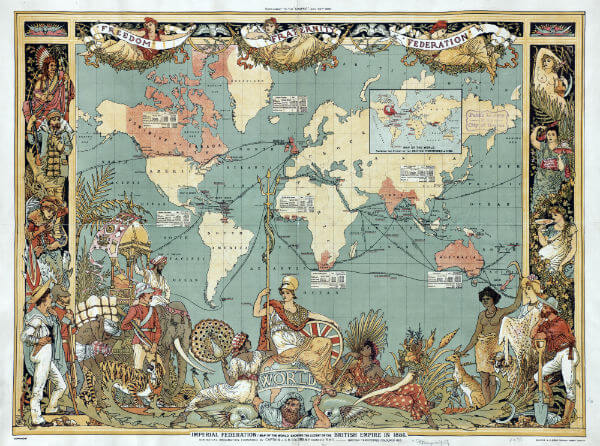
A beleaguered Britain takes comfort in nostalgia for empire

british-empire

Paul Harris writes: The British empire never lacked contradictions. A global juggernaut standing with its military boot on millions of necks, practising commercial coercion and diplomatic cynicism, it nonetheless routinely thought of itself as a plucky underdog. Its heroes were the handful of redcoats at Rorke’s Drift fighting off the Zulu masses, or General Charles Gordon of Khartoum, going down against the odds in a last stand against religious zealots in the Sudan.

British soldiers, diplomats and traders pictured themselves as almost accidental conquerors, vanquishing a quarter of the planet’s landmass in between tea, tiffin and cricket matches. They maintained a detached stiff upper lip and publicly ignored the unpleasant reality of the Maxim gun – a luxury not afforded to the locals on its business end.

Britain preferred to see its dominance of a fifth of the world’s population as some sort of benevolent, God-given mission to bring law, order and free trade to benighted corners of the world. As George Bernard Shaw complained: ‘The ordinary Britisher imagines that God is an Englishman.’

It was a powerful notion and it has not gone away. Even though the Empire is reduced to a scattering of tiny islands with names few Britons would recognise, the imperial past remains implausibly popular. Early this year, a poll showed that a full 44 per cent of Britons were proud of colonialism, far outnumbering the mere 21 per cent who regretted their country’s imperial past. The survey was not an outlier. A 2014 report showed a mere 15 per cent of Britons thought the colonised might just have been left worse off by the experience. [Continue reading…]

Facebooktwittermail

Exxon investors aim to force reckoning with impact of climate change policies

oil-industry

The Guardian reports: ExxonMobil will face a revolt from some of its biggest and most influential shareholders on Wednesday as they fight to force the world’s largest oil company to open up about the effect of climate change on its future profits.

Investors managing more than $10tn (£6.9tn) of assets will vote in favour of a resolution calling on Exxon to “publish an annual assessment of long term portfolio impacts of public climate change policies” following the Paris Agreement to limit the global temperature rise to less than 2C (3.6F).

The resolution up for discussion at Exxon’s annual meeting in Dallas has been proposed by the New York state comptroller, a trustee of the New York State Common Retirement Fund, the third largest US pension fund, and the Church of England.

More than 30 of Exxon’s largest shareholders, including the pension funds of the governments of Norway, Canada and California, Legal & General Investment Management and Schroder’s, have said they will also vote in favour of the motion. Other supporters of the motion include the pension funds of local authority workers in Greater Manchester and Tyne & Wear. [Continue reading…]

Facebooktwittermail

China’s scary lesson to the world: Censoring the Internet works

The Washington Post reports: First there was the Berlin Wall. Now there is the Great Firewall of China, not a physical barrier preventing people from leaving, but a virtual one, preventing information harmful to the Communist Party from entering the country.

Just as one fell, so will the other be eventually dismantled, because information, like people, cannot be held back forever.

Or so the argument goes.

But try telling that to Beijing. Far from knocking down the world’s largest system of censorship, China in fact is moving ever more confidently in the opposite direction, strengthening the wall’s legal foundations, closing breaches and reinforcing its control of the Web behind the wall.

Defensive no more about its censorship record, China is trumpeting its vision of “Internet sovereignty” as a model for the world and is moving to make it a legal reality at home. At the same time — confounding Western skeptics — the Internet is nonetheless thriving in China, with nearly 700 million users, putting almost 1 in 4 of the world’s online population behind the Great Firewall.

China is the world’s leader in e-commerce, with digital retail sales volume double that of the United States and accounting for a staggering 40 percent of the global total, according to digital business research company eMarketer. Last year, it also boasted four of the top 10 Internet companies in the world ranked by market capitalization, according to the data website Statista, including e-commerce giant Alibaba, social-media and gaming company Tencent and search specialists Baidu. [Continue reading…]

Facebooktwittermail

Why pro-Israel Democrats Bernie Sanders and Hillary Clinton could have a fight about Israel

The Washington Post reports: The only Jewish candidate in the 2016 presidential race, who calls himself “100 percent pro-Israel,” and one of Israel’s strongest U.S. defenders are nearing a fight over what being a pro-Israel Democrat means.

Sen. Bernie Sanders of Vermont plans to push for revisions in the Democratic Party position about relations with Israel, with a focus on elevating Palestinian rights as a U.S. priority, people involved in discussions over potential changes to the Democratic Party’s platform said.

Sanders wants revisions in wording about U.S. relations with Israel and commitment to seeking peace between the U.S. ally and the Palestinians while preserving the commitment to Israel’s security, those people said. They requested anonymity to discuss ideas for the platform that are still being developed. The platform is drafted by a Democratic National Committee panel and presented at the party convention in July.

The proposed new language on Israel is expected to seek what Sanders has elsewhere called a more even-handed U.S. approach to Israeli occupation of land Palestinians claim for a future state. [Continue reading…]

Facebooktwittermail

Afghan government secretly fosters Taliban splinter groups

The Wall Street Journal reports: The Afghan government is giving financial and military support to a breakaway Taliban faction, according to some Afghan and U.S. coalition officials, in an effort to sow rifts within the insurgency and nudge some of its leaders toward peace talks.

The effort comes as the U.S. military conducted an airstrike inside Pakistan that American officials said likely killed Taliban leader Mullah Akhtar Mansour, potentially setting the stage for another leadership struggle that could fragment the group further in the coming days. The Taliban, which usually respond promptly to requests for comment, hadn’t issued a statement by late Sunday.

Senior Afghan and U.S. diplomatic, military and intelligence officials, including several who had roles in creating the program, described its details and said that resources provided by the U.S. were used to support it.

The Afghan intelligence agency is leading the drive to recruit new Taliban assets, Afghan and U.S. officials said. The agency relies on the U.S. for most of its funding and is still mentored by the Central Intelligence Agency. The CIA declined to comment for this article.

Despite billions invested in reconstruction, Afghanistan still relies on aid for most of its funding and the U.S. pays more than $4 billion a year for its security forces.

The program’s goal, Afghan and U.S. officials said, is to exploit divisions that emerged after the Taliban’s longtime leader, Mullah Mohammad Omar, was revealed last July to have been dead for years, a disclosure that stunned local Taliban leaders and threw the group into disarray.

It targets southern Zabul, Helmand, eastern Paktika and western Farah and Herat provinces, where groups of insurgents and their commanders, unhappy with the Taliban’s leadership, have defected to a commander named Mullah Mohammad Rasool.

Afghan and U.S. officials said Mullah Rasool’s faction and other fractious Taliban groups have been receiving cash, ammunition and weapons from the Afghan government. [Continue reading…]

Facebooktwittermail

U.S. takes war back to Pakistan with drone strike aimed at Taliban leader

The Washington Post reports: The U.S. drone strike that killed Taliban chief Akhtar ­Mo­hammad Mansour represents another escalation of U.S. involvement in the war in Afghanistan by trying to cripple an insurgent group that has for years found refuge on Pakistani soil.

The strike early Saturday marks the most aggressive U.S. military action in Pakistan since the 2011 raid that killed Osama bin Laden. It is also thought to be the first time that the U.S. military has directly targeted the top leader of the Afghan Taliban, a potentially destabilizing action that could leave the group violently lashing out as it seeks to find a new leader.

President Obama called Mansour’s death “an important milestone.”

“We have a high-profile leader who has been consistently part of operations and plans to potentially harm U.S. personnel and has been resistant to the kinds of peace talks and reconciliation that could ultimately bring an end to decades of war in Afghanistan,” he said during a visit to Vietnam.

While Obama denied that the attack represented a shift in the U.S. approach, analysts see it as an escalation.

“This is an unprecedented move to decapitate the Taliban leadership in its safe haven of Pakistan,” said Bruce Riedel, a South Asia expert at the Brookings Institution. “It exposes Pakistan’s role in promoting and protecting the Taliban, and will provoke a crisis in U.S.-Pakistan relations.”

But unlike the bin Laden raid, which prompted outrage in Pakistan, the reported strike on Mansour drew a fairly muted reaction Sunday from Pakistani government and military leaders, even as Afghan officials cheered and described the attack as proof of the Afghan Taliban’s deep presence in Pakistan. [Continue reading…]

The Guardian reports: The killing of Mansoor represents a remarkable expansion of the programme because it happened well outside the tribal agencies of North and South Waziristan where nearly all known strikes have taken place, usually focusing on al-Qaida and allied groups.

US officials said the attack took place near Ahmad Wal, suggesting it was the first ever known strike in the vast southern province of Balochistan, where the insurgency’s “Quetta Shura” leadership council is thought to be based, and one of very few to target a senior member of the Afghan Taliban.

The drones were described as having been piloted by US special forces – suggesting it was not a CIA operation, as is usually the case with attacks inside Pakistan. [Continue reading…]

Facebooktwittermail

New political earthquake in Brazil: Is it now time for media outlets to call this a ‘coup’?

The Intercept reports: Brazil today awoke to stunning news of secret, genuinely shocking conversations involving a key minister in Brazil’s newly installed government, which shine a bright light on the actual motives and participants driving the impeachment of the country’s democratically elected president, Dilma Rousseff. The transcripts were published by the country’s largest newspaper, Folha de São Paulo, and reveal secret conversations that took place in March, just weeks before the impeachment vote in the lower house took place. They show explicit plotting between the new planning minister (then-senator), Romero Jucá, and former oil executive Sergio Machado — both of whom are formal targets of the “Car Wash” corruption investigation — as they agree that removing Dilma is the only means for ending the corruption investigation. The conversations also include discussions of the important role played in Dilma’s removal by the most powerful national institutions, including — most importantly — Brazil’s military leaders.

The transcripts are filled with profoundly incriminating statements about the real goals of impeachment and who was behind it. The crux of this plot is what Jucá calls “a national pact” — involving all of Brazil’s most powerful institutions — to leave Michel Temer in place as president (notwithstanding his multiple corruption scandals) and to kill the corruption investigation once Dilma is removed. In the words of Folha, Jucá made clear that impeachment will “end the pressure from the media and other sectors to continue the Car Wash investigation.” It is unclear who is responsible for recording and leaking the 75-minute conversation, but Folha reports that the files are currently in the hand of the prosecutor general. The next few hours and days will likely see new revelations that will shed additional light on the implications and meaning of these transcripts.

The transcripts contain two extraordinary revelations that should lead all media outlets to seriously consider whether they should call what took place in Brazil a “coup”: a term Dilma and her supporters have used for months. When discussing the plot to remove Dilma as a means of ending the Car Wash investigation, Jucá said the Brazilian military is supporting the plot: “I am talking to the generals, the military commanders. They are fine with this, they said they will guarantee it.” He also said the military is “monitoring the Landless Workers Movement” (Movimento dos Trabalhadores Rurais Sem Terra, or MST), the social movement of rural workers that supports PT’s efforts of land reform and inequality reduction and has led the protests against impeachment. [Continue reading…]

Facebooktwittermail

Snowden calls for whistleblower shield after claims by new Pentagon source

The Guardian reports: Edward Snowden has called for a complete overhaul of US whistleblower protections after a new source from deep inside the Pentagon came forward with a startling account of how the system became a “trap” for those seeking to expose wrongdoing.

The account of John Crane, a former senior Pentagon investigator, appears to undermine Barack Obama, Hillary Clinton and other major establishment figures who argue that there were established routes for Snowden other than leaking to the media.

Crane, a longtime assistant inspector general at the Pentagon, has accused his old office of retaliating against a major surveillance whistleblower, Thomas Drake, in an episode that helps explain Snowden’s 2013 National Security Agency disclosures. Not only did Pentagon officials provide Drake’s name to criminal investigators, Crane told the Guardian, they destroyed documents relevant to his defence. [Continue reading…]

Facebooktwittermail