Michael Lind writes: More than half a decade has passed since the recession that triggered the financial panic and the Great Recession, but the condition of the world continues to be summed up by what I’ve called ‘turboparalysis’ — a prolonged condition of furious motion without movement in any particular direction, a situation in which the engine roars and the wheels spin but the vehicle refuses to move.
The greatest economic crisis since the Great Depression might have been expected to produce revolutions in politics and the world of ideas alike. Outside of the Arab world, however, revolutions are hard to find. Mass unemployment and austerity policies have caused riots in Greece and Spain, but most developed nations are remarkably sedate. Scandal and sputtering economic growth appear unlikely to prevent another peaceful transition of power within the Communist party of China. And in the US, the re-election of President Obama and the strengthening of his Democratic party in the US Senate reflect long-term demographic changes in an increasingly non-white and secular American electorate, not the endorsement of a bold agenda for the future by the Democrats. They don’t have one.
In the realm of ideas, turboparalysis is even more striking. On both sides of the Atlantic, political and economic debate proceed as though the bursting of the global bubble economy did not discredit any school of thought. Right, left and centre, the players are the same and so are their familiar moves. Public debate is dominated by the same three groups — market fundamentalists, centrist neoliberals, and mildly reformist social democrats — who have been debating one another since the 1980s. Someone who went to sleep like Rip Van Winkle in the 1980s when Reagan and Thatcher were in power and awoke today would find nothing new in the way of economic theories or political doctrines.
By now one might have expected the emergence of innovative and taboo-breaking schools of thought seeking to account for and respond to the global crisis. But to date there is no insurgent political and intellectual left, nor a new right, for that matter. In the US, the militant Tea Party right, many of whose candidates went down to defeat in this year’s elections, represents the last gasp of the Goldwater-Reagan coalition, not something fresh. The American centre-left under Obama is intellectually exhausted and politically feeble, reduced to rebranding as ‘progressive’ policies like the individual mandate system (‘Obamacare’) and tax cuts for the middle class which originated on the moderate right a generation ago. In Britain, the manifestos of various ‘colour revolutions’ — Blue Labour, Red Tory and so on — have the feel of PR brochures promoting rival cliques of ambitious apparatchiks rather than the epochal thinking the times require.
Why has a global calamity produced so little political change and, at the same time, so little rethinking? Part of the answer, I think, has to do with the collapse of the two-way transmission belt that linked the public to the political elite. Institutions such as mass political parties, trade unions, and local civic associations, which once connected elected leaders to constituents, have withered away in more individualistic and anonymous societies. One result is a perpetual crisis of legitimacy on the part of political elites, who owe their electoral successes increasingly to rich donors and skilful advertising consultants. New political movements are hard to found. At the same time, anachronistic movements can continue to raise funds or entertain audiences, even if, like America’s conservative movement, they lose election after election.
But there is a deeper, structural reason for the persistence of turboparalysis. And that has to do with the power and wealth that incumbent elites accumulated during the decades of the global bubble economy. [Continue reading…]
Category Archives: Issues
Britain’s Israel lobby and Israel’s U.S.-assisted suicide
Peter Oborne writes: It is impossible to understand the modern Conservative Party without a grasp of the scale and profundity of its links to the state of Israel. The connection dates back at least as far the historic meeting between the great Zionist leader Chaim Weizmann and the Conservative prime minister A J Balfour in 1905, during which Weizmann convinced Balfour of the case for a Jewish national state.
The warmth forged 107 years ago is today sustained by the Conservative Friends of Israel (CFI). Some 80 per cent of all Tory MPs are members, including most Cabinet ministers. No other lobbying organisation – and certainly not one that acts in the interests of a foreign country – carries as much weight at Westminster. Every year, it takes a significant number of parliamentarians to Israel. Meanwhile, its sponsors play an important role in financing both the Tories nationally, and MPs at the local level.
There is no doubt that the CFI has exercised a powerful influence over policy. The Conservative politician and historian Robert Rhodes James, writing in the Jerusalem Post in 1995, called it “the largest organisation in Western Europe dedicated to the cause of the people of Israel”. Its power has not waned since. On Tuesday, it hosted approximately 100 Tory MPs, including six Cabinet ministers, and a further 40 peers, at a lunch in central London. The speaker was David Cameron, who pronounced himself a “passionate friend” of Israel, making clear (as he has done in the past) that nothing could break that friendship.
This speech can be seen as part of a pattern. The CFI can call almost at will upon the Prime Minister, Chancellor of the Exchequer or Foreign Secretary. The Palestinians enjoy no such access. They would be lucky to get a single Conservative MP in the audience for their events, and perhaps some moribund peer to make an address. There is no such organisation as the Conservative Friends of Palestinians. [Continue reading…]
Climate change is established — there is no scientific debate

James Lawrence Powell writes: Polls show that many members of the public believe that scientists substantially disagree about human-caused global warming. The gold standard of science is the peer-reviewed literature. If there is disagreement among scientists, based not on opinion but on hard evidence, it will be found in the peer-reviewed literature.
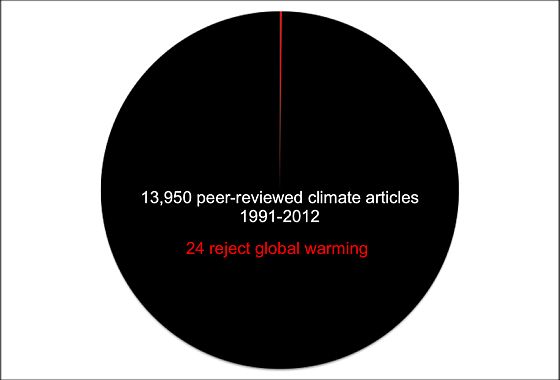
I searched the Web of Science for peer-reviewed scientific articles published between 1 January 1991 and 9 November 2012 that have the keyword phrases “global warming” or “global climate change.” The search produced 13,950 articles. See methodology.
I read whatever combination of titles, abstracts, and entire articles was necessary to identify articles that “reject” human-caused global warming. To be classified as rejecting, an article had to clearly and explicitly state that the theory of global warming is false or, as happened in a few cases, that some other process better explains the observed warming. Articles that merely claimed to have found some discrepancy, some minor flaw, some reason for doubt, I did not classify as rejecting global warming. Articles about methods, paleoclimatology, mitigation, adaptation, and effects at least implicitly accept human-caused global warming and were usually obvious from the title alone. John Cook and Dana Nuccitelli also reviewed and assigned some of these articles; John provided invaluable technical expertise.
This work follows that of Oreskes (Science, 2005) who searched for articles published between 1993 and 2003 with the keyword phrase “global climate change.” She found 928, read the abstracts of each and classified them. None rejected human-caused global warming. Using her criteria and time-span, I get the same result. Deniers attacked Oreskes and her findings, but they have held up.
Some articles on global warming may use other keywords, for example, “climate change” without the “global” prefix. But there is no reason to think that the proportion rejecting global warming would be any higher.
By my definition, 24 of the 13,950 articles, 0.17% or 1 in 581, clearly reject global warming or endorse a cause other than CO2 emissions for observed warming. [Continue reading…]
Fracking our food supply
Food & Environment Reporting Network: Earlier this year, Michele Bamberger, an Ithaca veterinarian, and Robert Oswald, a professor of molecular medicine at Cornell’s College of Veterinary Medicine, published the first (and so far, only) peer-reviewed report to suggest a link between fracking and illness in food animals. The authors compiled case studies of twenty-four farmers in six shale-gas states whose livestock experienced neurological, reproductive and acute gastrointestinal problems. Exposed either accidentally or incidentally to fracking chemicals in the water or air, scores of animals have died. The death toll is insignificant when measured against the nation’s livestock population (some 97 million beef cattle go to market each year), but environmental advocates believe these animals constitute an early warning.
“They’re making their way into the food system, and it’s very worrisome to us,” Bamberger says. “They live in areas that have tested positive for air, water and soil contamination. Some of these chemicals could appear in milk and meat products made from these animals.”
In Louisiana, seventeen cows died after an hour’s exposure to spilled fracking fluid. (Most likely cause of death: respiratory failure.) In northern central Pennsylvania, 140 cattle were exposed to fracking wastewater when an impoundment was breached. Approximately seventy cows died; the remainder produced eleven calves, of which only three survived. In western Pennsylvania, an overflowing waste pit sent fracking chemicals into a pond and a pasture where pregnant cows grazed: half their calves were born dead. The following year’s production was sexually skewed, with ten females and two males, instead of the usual fifty-fifty or sixty-forty split.
In addition to the cases documented by Bamberger, hair testing of sick cattle that grazed around well pads in New Mexico found petroleum residues in fifty-four of fifty-six animals. In North Dakota, wind-borne fly ash, which is used to solidify the waste from drilling holes and contains heavy metals, settled over a farm: one cow, which either inhaled or ingested the caustic dust, died, and a stock pond was contaminated with arsenic at double the accepted level for drinking water.
Cattle that die on the farm don’t make it into the nation’s food system. (Though they’re often rendered to make animal feed for chickens and pigs—yet another cause for concern.) But herd mates that appear healthy, despite being exposed to the same compounds, do: farmers aren’t required to prove their livestock are free of fracking contaminants before middlemen purchase them. Bamberger and Oswald consider these animals sentinels for human health. “They’re outdoors all day long, so they’re constantly exposed to air, soil and groundwater, with no break to go to work or the supermarket,” Bamberger says. “And they have more frequent reproductive cycles, so we can see toxic effects much sooner than with humans.”
Fracking a single well requires up to 7 million gallons of water, plus an additional 400,000 gallons of additives, including lubricants, biocides, scale and rust inhibitors, solvents, foaming and defoaming agents, emulsifiers and de-emulsifiers, stabilizers and breakers. About 70 percent of the liquid that goes down a borehole eventually comes up—now further tainted with such deep-earth compounds as sodium, chloride, bromide, arsenic, barium, uranium, radium and radon. (These substances occur naturally, but many of them can cause illness if ingested or inhaled over time.) This super-salty “produced” water, or brine, can be stored on-site for reuse. Depending on state regulations, it can also be held in plastic-lined pits until it evaporates, is injected back into the earth, or gets hauled to municipal wastewater treatment plants, which aren’t designed to neutralize or sequester fracking chemicals (in other words, they’re discharged with effluent into nearby streams). [Continue reading…]
Oh God, what have we done?
Jackson Lears reviews Inside the Centre: The Life of J. Robert Oppenheimer by Ray Monk: Reasonable men can dream monstrous dreams. It is the lesson of the 20th century: a lesson articulated from various perspectives since Adorno and Horkheimer wrote Dialectic of Enlightenment amid the wreckage of World War Two. Defenders of the Enlightenment can cogently argue (and many have) that Nazi science was a grotesque caricature, that the Holocaust was a betrayal of the Enlightenment rather than a fulfilment of its fatal dialectic. But it is harder to make that case with respect to the development of nuclear weapons. Indeed the subject seems designed to lay bare the contradictions at the core of Enlightenment culture by revealing them at work in the subculture of professional physicists bent to the needs of government power. Few social laboratories could more clearly reveal the tensions between chauvinist impulses and humanist aspirations, or between careerist plotting and disinterested service, or – perhaps most important – between the Enlightenment ideal of intellectual openness and the demands for secrecy made by the national security state.
The history of nuclear weapons began in an atmosphere of creative ferment and international trade in ideas. This was the world of Knaben3physik (‘boy physics’) in the 1920s and 1930s, when young men who had not been shaving for more than a few years were excitedly reading one another’s papers and poring over the results of experiments in Cambridge, Göttingen, Copenhagen and (eventually) Berkeley. This was how Niels Bohr, Werner Heisenberg and others created the foundations of quantum physics. Yet within less than a decade this moment had passed. Olympian conversations were drowned out by fascist chants. Jewish physicists, led by Einstein, fled to America; Heisenberg stayed in Germany; Bohr stayed out of sight in occupied Denmark. The concentration of research effort shifted westwards across the Atlantic. But it was research with a new, pragmatic mission: to build an atomic bomb before Hitler did. Theories conceived in open exchange were harnessed to secret purposes, and illuminating ideas were pressed into the service of mass death. No wonder some of the atomic scientists felt remorse, or at least ambivalence, about their achievement; no wonder some began to glimpse the darker dimensions of Enlightenment when the blinding flash of the first atomic explosion revealed their labours had not been in vain.
J. Robert Oppenheimer, the physicist in charge of the Manhattan Project and hence ‘father of the atomic bomb’, was never openly remorseful. But he was nothing if not ambivalent, as Ray Monk makes clear in his superb biography. When the fireball burst Oppenheimer remembered the words from Vishnu in the Bhagavad Gita: ‘I am become death, destroyer of worlds.’ It was his own idiosyncratic translation, and it became his most famous remark. The next day, though, his mood was anything but sombre as he jumped out of a jeep at Los Alamos base camp. His friend and fellow physicist Isidor Rabi said: ‘I’ll never forget the way he stepped out of the car … his walk was like High Noon … this kind of strut. He had done it.’ His colleague Enrico Fermi ‘seemed shrunken and aged, made of old parchment’ by comparison. Yet his euphoria passed, and he sank into second thoughts, despondent about the calamitous consequences awaiting the Japanese. He walked the corridors mournfully, muttering: ‘I just keep thinking about all those poor little people.’ Racial condescension aside, he meant what he said, and during the days following the test his secretary said he looked as though he were thinking: ‘Oh God, what have we done!’ [Continue reading…]
U.S. intelligence community warns of rising climate security threat
The Guardian reports: Climate change has the potential to stoke regional instabilities and fuel international tensions, according to a major new report from the US National Intelligence Council.
Released yesterday, the Global Trends 2030 report seeks to map out the security trends that will shape international relations over the next two decades. It is the latest in a series of studies from national security bodies around the world to acknowledge that climate change and its likely impacts on food, water, and natural resource supplies represents an emerging security threat.
“Demand for food, water, and energy will grow by approximately 35, 40 and 50 per cent respectively, owing to an increase in the global population and the consumption patterns of an expanding middle class,” the report states. “Climate change will worsen the outlook for the availability of these critical resources.”
The report argues that scarcities can be avoided, but only if co-ordinated steps are taken to improve productivity and efficiency across a raft of industries and economies.
“We are not necessarily headed into a world of scarcities, but policymakers and their private sector partners will need to be proactive to avoid such a future,” the report states. “Many countries probably won’t have the wherewithal to avoid food and water shortages without massive help from outside.”
It also acknowledges that a series of technology breakthroughs will be needed to address climate-related risks. “Key technologies likely to be at the forefront of maintaining [energy, food and water] resources in the next 15-20 years will include genetically modified crops, precision agriculture, water irrigation techniques, solar energy, advanced bio-based fuels, and enhanced oil and natural gas extraction via fracturing,” the report argues.
“Given the vulnerabilities of developing economies to key resource supplies and prices and the early impacts of climate change, key developing countries may realise substantial rewards in commercialising many next-generation resource technologies first.”
So, in order to mitigate the effects of the environmental damage caused by the excessive use of fossil fuels, the “intelligence” community recommends expanding the use of environmentally destructive fracking, increased toxification of agricultural land through the use of GMOs and in the process there will be profits to be made. Something’s wrong with this picture.
Why Asia’s insurgencies are Europe’s shame
Pankaj Mishra writes: It wasn’t an incredible photo-op, and it’s unlikely to be included in this month’s valedictory roundup of 2012 highlights. In fact, it was barely reported.
One of this year’s most remarkable events, however, was the agreement between the Philippine government and the insurgent group Moro Islamic Liberation Front.
If successful, it may not only terminate decades of secessionist violence in Mindanao, the second largest island in the Philippines; it may also inspire hope in a wide swath of Asian countries damaged, politically as well as economically, by internecine conflicts.
Divide-and-rule European imperialists, favoring one ethnic group and persecuting or neglecting another, or drawing arbitrary lines in the sand or the grass, originally transformed social and religious differences into political antagonisms within Asian societies. Their local opponents — mostly educated natives — hardened religious and ethnic identities by turning them into a basis of anti-imperialist solidarity.
In the end, the principle of self-determination was widely exported from relatively homogenous Europe to multicultural Asia, where it was embraced by rising native elites. The result was the proliferation of hastily and poorly imagined national communities — unwieldy nation-states where patchworks of relatively autonomous groups and individuals with multiple, overlapping identities had existed.
Since then, postcolonial rulers eager to hold on to their inheritance — centralized states, administrations and large, resource-rich territories — have made the map of Asia bleed red. [Continue reading…]
Israel suspected over Iran nuclear programme inquiry leaks
The Guardian reports: Israel is suspected of carrying out a series of leaks implicating Iran in nuclear weapons experiments in an attempt to raise international pressure on Tehran and halt its programme.
Western diplomats believe the leaks may have backfired, compromising a UN-sanctioned investigation into Iran’s past nuclear activities and current aspirations.
The latest leak, published by the Associated Press (AP), purported to be an Iranian diagram showing the physics of a nuclear blast, but scientists quickly pointed out an elementary mistake that cast doubt on its significance and authenticity. An article in the Bulletin of the Atomic Scientists declared: “This diagram does nothing more than indicate either slipshod analysis or an amateurish hoax.”
The leaked diagram raised questions about an investigation being carried out by International Atomic Energy Agency (IAEA) inspectors after it emerged that it formed part of a file of intelligence on alleged Iranian nuclear weapons work held by the agency.
The IAEA’s publication of a summary of the file in November 2011 helped trigger a new round of punitive EU and US sanctions.
Western officials say they have reasons to suspect Israel of being behind the most recent leak and a series of previous disclosures from the IAEA investigation, pointing to Israel’s impatience at what it sees as international complacency over Iranian nuclear activity.
The leaks are part of an intensifying shadow war over Iran’s atomic programme being played out in Vienna, home to the IAEA’s headquarters.
The Israeli spy agency, the Mossad, is highly active in the Austrian capital, as is Iran and most of the world’s major intelligence agencies, leading to frequent comparisons with its earlier incarnation as a battleground for spies in the early years of the cold war. The Israeli government did not reply to a request for comment and AP described the source of the latest leak only as “officials from a country critical of Iran’s atomic programme”.
Three worries about next Iran talks
Trita Parsi writes: Sometime in the next few weeks, the permanent members of the UN Security Council plus Germany (P5+1) will meet with Iran to pick up diplomacy from where it left off last summer. So far, neither side has shown much appetite for compromise. Both sides have insisted on maximalist objectives; consequently, progress has been absent.
This time around it might be different. Fabricated or not, there is a sense that the end game is near. The window for this breakthrough likely closes by March of next year as Iran enters its New Year festivities followed by its paralyzing presidential elections. But there are three things that worry me, that can cause the parties to lose yet another opportunity for peace.
1. Grandstanding versus statesmanship
In the words of Massachusetts Institute of Technology nuclear expert Jim Walsh, diplomacy is not about getting everything you desire and leaving the other side with nothing. Ultimately, it is about compromise, even though that word carries a negative connotation in both the American and Iranian political discourse.
In past talks, both sides have pushed for wildly unrealistic proposals, demanding a lot from the other side and offering little in return. If such grandstanding continues, rather than the courageous statesmanship that is needed to reach a deal, then we are in trouble.
Iran can’t expect that merely stopping enrichment at the 20% level will be sufficient to close the Iranian file and lift all sanctions. At the same time, lifting of both US and EU sanctions must be part of the solution. In previous rounds, Washington refused to put sanctions relief on the table, thinking — innocently perhaps — that pressure alone would bring the Iranians to compromise. Obama administration officials have told experts in Washington that it will likely go back to the table with the same package as in the summer; that is, with no sanctions relief. European diplomats, while admitting that no deal is possible without sanctions relief, tell me that they do not expect any sanctions to begin to be lifted until late 2013 at the earliest. Continued refusal to make sanctions relief part of the mix from the outset will prove to be a decisive mistake. [Continue reading…]
A decade of western folly has erased hope from Afghanistan
Jonathan Steele writes: Clouds of uncertainty and foreboding hang over Kabul as heavily as the traffic pollution, which obscures its once stunning vista of surrounding mountains. Eleven years after the west’s military intervention, the withdrawal of US, British and other international forces has started, but no one knows whether their departure will lead to more or less instability for a country that has been mired in civil war for almost 40 years.
Most Afghans say they are happy to see foreign troops depart, yet many are also concerned at the vacuum they will leave, in spite of international pledges of billions of dollars for the next decade. In seven visits to the country since the Taliban were toppled I have never found the Afghan mood so febrile and gloomy.
Disappointment and bitterness are widespread. Long gone are the high hopes sparked by regime change in 2001. The foreigners delivered far less than they promised. Kabul was transformed into a canyon of concrete blast walls and watchtowers shielding enclaves from which foreign diplomats only emerge in armoured vehicles for official contacts. Journalists, NGO staff and independent westerners who have lived here for years sense a rising mood of anger, and most have stopped going around Kabul on foot for fear of hostile looks, insults hissed in Dari or Pashto, or stones being thrown.
While Afghans blame government officials for creaming off much of the aid money, they blame western donors for doing too little to reduce corruption. US military commanders who handed out cash for “quick impact” projects are accused of encouraging it. [Continue reading…]
U.S. Treasury exits AIG with bailout profit of $22.7 billion
Reuters reports: American International Group Inc said the U.S. Treasury will sell its last remaining stake in the company, giving a total profit to taxpayers of $22.7 billion on the bailout.
The Treasury is selling its last 234.2 million shares of AIG common stock for $32.50 per share, raising around $7.6 billion.
The Treasury said it had realized a positive return of $5 billion on the $182 billion bailout while the Federal Reserve had made $17.7 billion.
Atheists around world suffer persecution, discrimination
Reuters reports: Atheists and other religious skeptics suffer persecution or discrimination in many parts of the world and in at least seven nations can be executed if their beliefs become known, according to a report issued on Monday.
The study, from the International Humanist and Ethical Union (IHEU), showed that “unbelievers” in Islamic countries face the most severe – sometimes brutal – treatment at the hands of the state and adherents of the official religion.
But it also points to policies in some European countries and the United States which favor the religious and their organizations and treat atheists and humanists as outsiders.
The report, “Freedom of Thought 2012“, said “there are laws that deny atheists’ right to exist, curtail their freedom of belief and expression, revoke their right to citizenship, restrict their right to marry.”
Other laws “obstruct their access to public education, prohibit them from holding public office, prevent them from working for the state, criminalize their criticism of religion, and execute them for leaving the religion of their parents.”
Video: Israel and Palestine, an animated introduction
Syria not alone in spying on citizens
CSO: The Internet, long viewed as a tool to expand freedom, is an equally effective tool for repression. That is just as true in the United States as anywhere else.
Security guru Bruce Schneier noted in a recent blog post, citing Evgeny Morozov’s book, “The Net Delusion: The Dark Side of Internet Freedom,” that, “Repressive regimes all over the world are using the Internet to more efficiently implement surveillance, censorship, and propaganda. And they’re getting really good at it.”
Schneier, chief security technology officer at BT and a well-known author, wrote that while IT technologies are generally mastered first, “by the more agile individuals and groups outside the formal power structures … unfortunately, and inevitably, governments have caught up.”
One of the most visible examples of that at present is Syria, where in February 2011, at the height of the Arab Spring demonstrations, the government of President Bashar al-Assad inexplicably reversed a long-standing ban on websites such as Facebook, Twitter, YouTube, and the Arabic version of Wikipedia.
But it was essentially a sting. The government used those social networking sites to spy on and track dissidents, and then to arrest and torture them, Stephan Faris reported for Bloomberg Businessweek.
Faris reported on the case of Taymour Karim, who withstood torture under interrogation and refused to give up the names of his friends, all for naught.
“It didn’t matter,” Faris wrote. “His computer had already told all. ‘They knew everything about me,’ Karim said. ‘The people I talked to, the plans, the dates, the stories of other people, every movement, every word I said through Skype. They even knew the password of my Skype account … My computer was arrested before me.'”
Assad has long been known as an oppressive dictator, and U.S. officials including President Obama have called for his ouster. But Americans watching from half a world away should not get too smug, say some security experts. If the U.S. ever gets its own version of a President Assad, the tools are not only in place to monitor the activities of citizens, they are already in use. [Continue reading…]
End the war on terror and save billions
Fareed Zacharia writes: As we debate whether the two parties can ever come together and get things done, here’s something President Obama could probably do by himself that would be a signal accomplishment of his presidency: End the war on terror. Or, more realistically, start planning and preparing the country for phasing it out.
For 11 years, the United States has been operating under emergency wartime powers granted under the 2001 “Authorization for Use of Military Force.” That is a longer period than the country spent fighting the Civil War, World War I and World War II combined. It grants the president and the federal government extraordinary authorities at home and abroad, effectively suspends civil liberties for anyone the government deems an enemy and keeps us on a permanent war footing in all kinds of ways.
Now, for the first time since Sept. 11, 2001, an administration official has sketched a possible endpoint.
In a thoughtful speech at the Oxford Union last week, Jeh Johnson, the outgoing general counsel for the Pentagon, recognized that “we cannot and should not expect al-Qaeda and its associated forces to all surrender, all lay down their weapons in an open field, or to sign a peace treaty with us. They are terrorist organizations. Nor can we capture or kill every last terrorist who claims an affiliation with al-Qaeda.”
But, he argued, “There will come a tipping point . . . at which so many of the leaders and operatives of al-Qaeda and its affiliates have been killed or captured, and the group is no longer able to attempt or launch a strategic attack against the United States, such that al-Qaeda as we know it, the organization that our Congress authorized the military to pursue in 2001, has been effectively destroyed.” At that point, “our efforts should no longer be considered an armed conflict.”
Phasing out or modifying these emergency powers should be something that would appeal to both left and right. James Madison, father of the Constitution, was clear on the topic. “Of all the enemies to public liberty,” he wrote, “war is, perhaps, the most to be dreaded, because it comprises and develops the germ of every other. War is the parent of armies; from these proceed debts and taxes. . . . No nation could preserve its freedom in the midst of continual warfare.”
If you want to know why we’re in such a deep budgetary hole, one large piece of it is that we have spent around $2 trillion on foreign wars in the past decade. [Continue reading…]
And ending the war on terror wouldn’t just save money — it would allow for the possibility that America as a nation might be able to climb out of one of the most destructive expressions of collective insanity into which any nation has ever fallen.
Politics might dictate that this war can only be ended through some kind of declaration of victory, but an honest reckoning will eventually require acknowledging that this was the greatest blunder in America’s history. A trap was laid, and like a brainless giant, the United States stepped right into it.
Who could imagine that by making the meager investment of a few flying lessons and some box cutters, a small band of fanatics could persuade a country that prides itself as “the greatest nation on earth” to near bankrupt itself, act with such stupidity and inflict such enormous harm?
Video: Carving up the Arctic
AJ’s The Stream frames the question: Will the melting of the Arctic sea ice bring about a change in the geopolitical landscape?
This seems like the wrong question to be asking. When global warming caused by the use of fossil fuels is what is opening up this ‘bonanza’ of new fossil fuel reserves, it’s a bit like a man with lung cancer discovering a wonderful new source of cheap cigarettes.
If not two states, then one
Saree Makdisi writes: Israel did not wait long to reveal its first response to the United Nations General Assembly’s overwhelming recognition of Palestine as a non-member state, almost immediately announcing its intention to push forward with plans to build housing for Jewish settlers in E1, an area of the West Bank just to the east of Jerusalem.
Although it is sometimes misleadingly referred to as “disputed” or “controversial,” settlement construction in E1 is no more and no less of a contravention of international law than settlement construction elsewhere in the West Bank or East Jerusalem. What makes this development significant is E1’s location, sealing tight the gap between East Jerusalem and Israel’s largest settlement, Maale Adumim, further to the east.
That gap is the last remaining link for Palestinians between the northern and southern parts of the West Bank; it also occupies the interface among and between the Palestinian communities of Ramallah, Bethlehem and East Jerusalem — which, apart from being the cultural, religious, social and economic focal point of Palestinian life, is also one day supposed to be the capital of Palestine.
In moving forward with long-threatened plans to develop E1, Israel will be breaking the back of the West Bank and isolating the capital of the prospective Palestinian state from its hinterland. In so doing, it will be terminating once and for all the very prospect of that state — and with it, by definition, any lingering possibility of a two-state solution to the Israeli-Palestinian conflict. [Continue reading…]
How Obama can get tough with Bibi
Lara Friedman writes: Recently, the European Union adopted harsh new Iran sanctions, strongly supported by Israel. Shortly thereafter, Israel announced new East Jerusalem settlement construction. The EU’s top official Catherine Ashton, who was about to visit Israel, condemned the announcement in measured terms; Israel’s Foreign Minister, Avigdor Lieberman, publicly told her, in effect, to shove it. Imagine if in response, Ashton had indefinitely postponed her trip. Imagine that Israeli ambassadors in EU capitals were summoned to the local foreign ministries and read the riot act. Imagine that Israeli press had been alerted, leading to headlines about how Prime Minister Netanyahu and Lieberman were squandering the friendship of the EU and European support on Iran for the sake of settlement expansion.
None of that happened. Instead, Lieberman’s comments were politely ignored. Ashton went to Israel. And settlement construction advanced.
This episode demonstrates how things got to the point where they are today. Netanyahu and Lieberman believe they are unaccountable because they have never been called to account. They’ve seen that their defiance of Israel’s closest allies carries no price, either diplomatically or in the domestic arena. The two are, of course, linked: Israel’s allies acquiescing to Netanyahu treating them as underlings and enemies has only strengthened Netanyahu politically, and added to his aura as “King Bibi.” [Continue reading…]