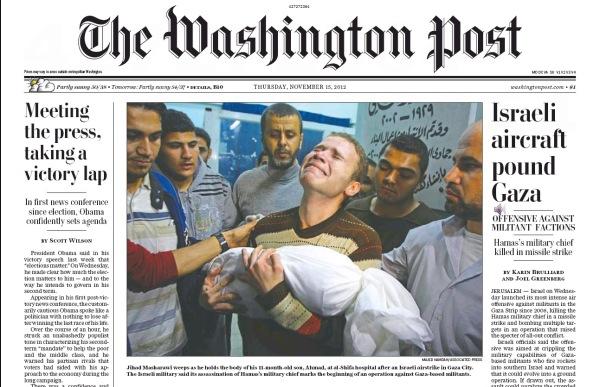
Amahl Bishara writes: One of the most wrenching images from the November 2012 conflict between Israel and Hamas was that of BBC journalist Jihad Masharawi holding the shrouded body of his eleven-month-old son. His face is gripped with agony, his eyes closed as he looks upward. We can imagine that he feels utterly alone in his grief, but he must also be aware of the men around him in this hospital room. Some or all of the men are likely fathers, uncles, or older brothers to young children. They reach out to touch Masharawi on his shoulder. In their downcast glances, I feel I recognize the strange shame of people who wish they could do more. Behind the camera, taking the picture, is a colleague, Majed Hamdan, a photographer for the Associated Press. Behind the photographer are all of us.
The photograph was on the front page of the The Washington Post on 15 November, and apparently it caused a hassle for the paper. According to ombudsman Patrick Pexton, many accused its placement of being biased. Many asked why this image was not “balanced” with one of Israeli suffering. Pexton replied that no such image existed, since, as of the day of Masharawi’s son’s death, no Israeli civilians had been killed by Gaza rocket fire for over a year. Pexton also described the fundamental imbalance in arms between Israel and Hamas, and concluded, “Let’s be clear: The overwhelming majority of rockets fired from Gaza are like bee stings on the Israeli bear’s behind.”
He is suggesting, but does not say outright, that an expectation of balance is unreasonable not only because an equivalent image from the “other side” may not be available but for another reason as well. Expecting balance obfuscates our understanding of conflicts that are not in reality balanced. Israel has some of the most advanced military technology in the world. Hamas has rockets with limited range and accuracy. Even more fundamentally, Israel remains the occupying power over Gaza, and thus has ultimate responsibility for civilian welfare — as well as a legal responsibility to end the occupation. (The metaphor of balance and the seesaw image it evokes has other problems, too. The myth of “two sides” to the conflict obscures differences of opinion and hierarchies of power within Israeli and Palestinian societies.) [Continue reading…]
Reuters reports: Iran has obtained data from a U.S. intelligence drone that shows it was spying on the country’s military sites and oil terminals, Iranian media reported its armed forces as saying on Wednesday.
Iran announced on Tuesday that it had captured a ScanEagle drone belonging to the United States, but Washington said there was no evidence to support the assertion.
The incident has underscored tensions in the Gulf as Iran and the United States draw attention to their military capabilities in the vital oil exporting region in a standoff over Iran’s disputed nuclear program.
“We have fully extracted the drone’s information,” Iran’s Islamic Revolutionary Guard Corps (IRGC) said in a statement on Wednesday, according to Iran’s English-language Press TV.
Henry Siegman writes: With his decision to oppose the U.N. General Assembly’s granting Palestine non-member state observer status, U.S. President Barack Obama leaves no doubt he is not modifying his pre-election position that “There is no daylight between Israel and the United States,” and that no matter how deeply Israeli behavior violates international norms and existing agreements, U.S. support for Israel remains “rock solid.” This continuity of U.S. Middle East peace policy was promptly reinforced by Secretary of State Hillary Clinton when she assured Israel that despite her condemnation of its decision to proceed with new construction in the E1 corridor of the West Bank that will doom the two-state solution, this administration will continue to “have Israel’s back.”
The decision confirms America’s irrelevance not only to a possible resolution of the Israel-Palestine conflict but to the emerging political architecture of the entire region, the shape and direction of which will increasingly be determined by popular Arab opinion, not autocratic regimes dependent on the United States for their survival.
The efforts promised by President Obama to renew Israeli-Palestinian peace talks will be seen universally for the empty and purposeless exercise they will be. To be taken seriously, a new U.S. peace initiative would have to begin with an insistence that Israel’s government accept the pre-1967 border as the starting point of resumed negotiations. Without such a U.S. demand, backed by effective diplomatic pressure, the United States will have no right to ask Palestinians to return to negotiations that have no terms of reference, and therefore no prospect of producing anything other than cover for Israel’s continuing predatory colonial behavior in the West Bank.
The administration’s admonitions to the Palestinians that they find the political courage to return to negotiations with a government whose intention to prevent viable Palestinian statehood has been clearly and repeatedly demonstrated are singularly inappropriate. A U.S. administration that since the third year of its first term has been pandering to the Israel lobby by withdrawing its insistence that Israel’s illegal settlements project must end, followed by a muting of its demand that resumed negotiations be framed by reasonable terms of reference, should exercise considerably greater restraint before presuming to preach to others on the subject of political courage. [Continue reading…]
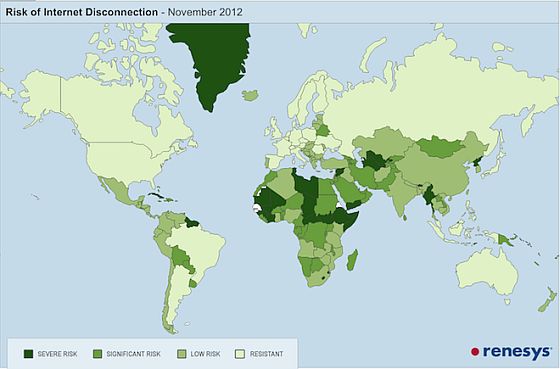
Wired: It’s becoming the trademark move of failing regimes: silence your critics and cripple their communications by cutting off the internet. Libya did it. Egypt too. And last week, Syria pulled the plug on its own internet system.
According to new research from network monitoring company Renesys, it could just as easily happen in many other countries too, including Greenland, Yemen, and Ethiopia. Sixty-one of the world’s countries have just one or two service providers connecting them to the rest of the internet.
“If you’re a sufficiently small place it’s almost inescapable that there will be so little internet that it’s almost trivial to turn it off,” says James Cowie, chief technology officer with Renesys.
On the other extreme, more than 30 countries — including the U.S., Canada and the Netherlands — have over 40 network providers each at their electronic frontiers. They’re almost impossible to unplug.
No disrespect intended towards Greenlanders, but I think they should have been left off the map. The massive dark green country at the top of the map jumps out as the largest country in jeopardy of having its internet access cut off. But there are only 56,749 people who live there. How many ISPs could they expect to have?
The Economist: A mob attacked Alexander Aan even before an Indonesian court in June jailed him for two and a half years for “inciting religious hatred”. His crime was to write “God does not exist” on a Facebook group he had founded for atheists in Minang, a province of the world’s most populous Muslim nation. Like most non-believers in Islamic regions, he was brought up as a Muslim. And like many who profess godlessness openly, he has been punished.
In a handful of majority-Muslim countries atheists can live safely, if quietly; Turkey is one example, Lebanon another. None makes atheism a specific crime. But none gives atheists legal protection or recognition. Indonesia, for example, demands that people declare themselves as one of six religions; atheism and agnosticism do not count. Egypt’s draft constitution makes room for only three faiths: Christianity, Judaism and Islam.
Sharia law, which covers only Muslims unless incorporated into national law, assumes people are born into their parents’ religion. Thus ex-Muslim atheists are guilty of apostasy—a hudud crime against God, like adultery and drinking alcohol. Potential sanctions can be severe: eight states, including Iran, Saudi Arabia, Mauritania and Sudan have the death penalty on their statute books for such offences.
In reality such punishments are rarely meted out. Most atheists are prosecuted for blasphemy or for inciting hatred. (Atheists born to non-Muslim families are not considered apostates, but they can still be prosecuted for other crimes against religion.) Even in places where laws are lenient, religious authorities and social attitudes can be harsh, with vigilantes inflicting beatings or beheadings.
Many, like Kacem el-Ghazzali, a Moroccan, reckon the only solution is to escape abroad. The 23-year-old was granted asylum in Switzerland after people found out he was the author of an anonymous blog, Atheistica.com. Even in non-Muslim lands ex-believers are scared of being open, says Nahla Mahmoud, a 25-year-old Sudanese atheist who fled to Britain in 2010. “Muslim communities here don’t feel comfortable with having an ex-Muslim around,” she says, noting that extremists living in the West may harass non-believers there too.
Facebook groups for atheists, mostly pseudonymous, exist in almost every Muslim country. Social media give non-believers more clout—but also make them more conspicuous, and therefore vulnerable. But the real blame lies with religious intolerance. In the 1950s and 1960s secularism and tolerance prevailed in many majority-Muslim countries; today religion pervades public and political life. Sami Zubaida, a scholar at London’s Birkbeck College, speaks of increasing polarisation, with “growing religiosity at one end of the spectrum and growing atheism and secularism at the other.”
The rise to power of Islamist parties after the Arab revolutions is likely to make life more miserable still for those who leave Islam. New rulers in Tunisia and Egypt have jailed several young people who have been outspoken about their lack of belief. Such cases occurred before the revolutions, but seem to have become more common. Alber Saber Ayad, an Egyptian Christian activist who ran a Facebook page for atheists, has been in custody since September for “insulting religion”. His alleged offence was posting a link to an infamous YouTube video that caused protests in the Islamic world that month. He was arrested by a Christian policeman: Egypt’s Coptic church does not look kindly on atheism either.
The irony and perversity of religious intolerance — or any other form of intolerance — is that it rewards hypocrisy and deceit. In other words, such efforts to police faith will primarily have the effect of making most of the faithless prudently disguise their true beliefs. A few will dare to speak out, but many more will remain married to a religion of convenience.
The protectors of the faith would apparently rather have their houses of worship accommodate hollow expressions of faith rather than encourage individuals to act with integrity.
When ideology thus becomes a bludgeon of conformity, what this suggests is that the core of faithlessness actually resides in the hearts of those who fix their attention on the beliefs of others. A faith that depends on such rigid external buttresses is no faith at all.
On Sunday the New York Times reported that the Obama administration, prompted by the possibility of losing the election, has been developing a “formal rule book” to govern the use of drone strikes, which have killed roughly 2,500 people under President Obama.
One aspect of the piece in particular caught our eye: While administration officials frequently talk about how drone strikes target suspected terrorists plotting against the U.S., the Times says the U.S. has shifted away from that. Instead, it has often targeted enemies of allied governments in countries such as Yemen and Pakistan. From the Times:
[F]or at least two years in Pakistan, partly because of the C.I.A.’s success in decimating Al Qaeda’s top ranks, most strikes have been directed at militants whose main battle is with the Pakistani authorities or who fight with the Taliban against American troops in Afghanistan.
In Yemen, some strikes apparently launched by the United States killed militants who were preparing to attack Yemeni military forces. Some of those killed were wearing suicide vests, according to Yemeni news reports.
To learn more about this underappreciated aspect of U.S. drone policy, I spoke to Micah Zenko, a fellow at the Council on Foreign Relations who has been critical of U.S. drone policy and was quoted in the Times piece. This conversation has been edited for length and clarity.
You were quoted over the weekend arguing that the U.S., with the campaign of drone strikes, is acting as the “counterinsurgency air force of Pakistan, Yemen and Somalia.” How did you come to this conclusion?
Under the Obama administration, officials have argued that the drone strikes are only hitting operational Al Qaeda leaders or people who posed significant and imminent threats to the U.S. homeland. If you actually look at the vast majority of people who have been targeted by the United States, that’s not who they are.
There are a couple pieces of data showing this. Peter Bergen of the New America Foundation has done estimates on who among those killed could be considered “militant leaders” u2014 either of the Pakistani Taliban, the Afghan Taliban, or Al Qaeda. Under the Bush administration, about 30 percent of those killed could be considered militant leaders. Under Obama, that figure is only 13 percent.
Most of the people who are killed don’t have as their objective to strike the U.S. homeland. Most of the people who are killed by drones want to impose some degree of sharia law where they live, they want to fight a defensive jihad against security service and the central government, or they want to unseat what they perceive as an apostate regime that rules their country.
Why does this distinction matter so much?
This is a huge outstanding dilemma. Is the primary purpose of the drone attacks counter-terrorism, or is it counter-insurgency? If it’s counter-insurgency, that is a very different mission, and you have to rethink the justifications and rethink what the ultimate goal is of using lethal force.
There was a February article in the New York Times reporting that the goal of U.S. policy in Yemen was to kill about two dozen Al Qaeda leaders. There’s been about 50 drone strikes in Yemen since that article. Meanwhile, according to U.S. government statements, the size of AQAP has grown from “several hundred” to “a few thousand members.” So the question is, who is actually being targeted, and how does this further U.S. counterterrorism objectives?
Is this use of drone strikes to kill people who are not imminent threats to the U.S. new?
No. The marked shift was in summer 2008 when the Bush administration decided to significantly lower the threshold of who could be attacked.
The purpose of this change was to reduce threats to U.S. servicemembers in southern Afghanistan and to intervene where some suicide attacks were organized in the tribal areas of Pakistan. This was the time when the “signature strikes” really became ingrained. Bush administration officials called this the “u2018reasonable man’ standard,” and if you were displaying what are called “patterns of behavior,” you could be killed.
People mistakenly think that this policy started under Obama, but it didn’t. It did accelerate markedly under Obama. He has had more drones to do this, was much more vigorous about authorizing their use, and expanded the signature strikes into Yemen.
How does this use of drone attacks square with official administration statements describing the policy?
They will never say that the United States uses drones to fight local insurgencies. If they made that case, they would have to create a new bastion of justifications. The current stated justifications are very carefully thought out and very deliberate to loosely adhere to the post-9/11 Authorization to Use Military Force and principles of Article 51 of the UN Charter, governing the use of force.
There has been a long-term fight with people within the administration who want to reform the policy and think the U.S. needs to be more transparent u2014 both for domestic reasons and because of the precedents being set for the use of drone strikes. If other countries follow our practice in how they will use drone strikes, that would be a very unstable, dangerous world to live in.
***
Note: We asked White House spokesman Tommy Vietor to respond the notion that drones strikes often involve those who are not a threat to the U.S. He declined to comment.
From a speech delivered by Chas Freeman in Moscow yesterday: The objective of the 9/11 attacks was to provoke the United States into military overreactions that would enrage and arouse the world’s Muslims, estrange Americans from Arabs, stimulate a war of religion between Islam and the West, undermine the close ties between Washington and Riyadh, curtail the commanding influence of the United States in the Middle East, and overthrow the Saudi monarchy. The aftershocks of Al Qaeda’s 9/11 kamikaze operation against the United States have so far failed to shake the Saudi monarchy but — to one degree or another — the operation has achieved its other goals.
Among other things, the violent interaction between America and the Muslim world since 9/11 has burdened future generations of Americans with over $5 trillion in war debt, with more debt yet to come. This has thrust the United States into fiscal crisis. The 9/11 attacks evoked reactions that have eroded the rule of law at home and abroad, tarnished the global appeal of Western democracy, and militarized American foreign policy. They precipitated military interventions in the Middle East that have energized reactionary religious dogmatism among Muslims. In other words, the continuing struggle is reshaping the ideologies and political economies of non-Muslim and Muslim societies alike. And most of the changes are not for the better.
As Islamist terrorism has gained global reach, it has provided political justification for a general retreat from civil liberties and ethical standards of governance in secular societies everywhere, not just in the United States. Russia is not an exception to this trend. Ironically, the Middle East was where the moral values upon which modern societies are founded had their origin. The European Enlightenment transformed these norms into secular ideals of reason, tolerance, and human and civil rights that spread widely throughout the world. Trends and events in the Middle East are now setting back prospects for the advance of tolerance in that region even as they drive a widening deviation from the values of the Enlightenment elsewhere.
Although there is a long tradition of heroic sacrifice in Islam, the use of self-immolation as a weapon by Muslims began only in the early 1980s, when Israel’s invasion of Lebanon led to the widening and ultimately successful Shiite use of suicide bombings against Israeli, American, and French forces. By the early 1990s, Sunni Palestinians had embraced the suicide belt as a means of resistance and reprisal to the Israeli occupation and settlement of the West Bank and Gaza. As this century began, various forms of explosive self-destruction began to be widely employed in acts of terrorism against non-Muslims outside the Middle East, including with tragic regularity here in Moscow and elsewhere in Russia, in the 9/11 attacks on the United States, and subsequently in the capitals of Western Europe.
When the U.S. invasion of Iraq catalyzed bitterly lethal strife between Iraqi Sunnis and Shiites, suicide bombing quickly became the weapon of choice for Sunni extremists there. By the middle of the last decade, this technique had begun to be widely used in Afghanistan. What began as a means of last-ditch resistance to invasion and occupation is now a preferred means of retaliation against foreigners seen to have offended the peace of the Muslim umma. Although it is completely contrary to Islamic scripture, suicide bombing has become a predictable aspect of civil strife everywhere in the Islamic world and beyond it. And civil strife is widespread. Much-resented foreign intrusions into Muslim lands have exacerbated intra-Muslim sectarian differences.
Al Qaeda’s kamikaze attack on the United States drew America into a punitive raid in Afghanistan. This soon became a campaign of pacification there. It eventually grew into a widening circle of armed interventions in other Muslim societies. These include the now-ended, tragically counterproductive American attempt to transform the political culture of Iraq and the frustrating, continuing effort by the United States and NATO to do the same in Afghanistan.
It has long been said that Afghanistan is where empires go to die. Many would argue that the Soviet Union’s experience in Afghanistan was what finally broke both its spirit and its treasury. Most Muslims believe this. They also believe that America’s misadventures in the Middle East are having a similar, if so far less decisive effect on the United States. As they see it, a great deal of the melancholy among Americans today derives from mounting recognition that U.S. military campaigns in Muslim countries are failing to accomplish their objectives, even as they become both apparently endless and ever more unaffordable.
The Associated Press reports: An area of Arctic sea ice bigger than the United States melted this year, according the U.N. weather agency, which said the dramatic decline illustrates that climate change is happening “before our eyes.”
In a report released at U.N. climate talks in the Qatari capital of Doha, the World Meteorological Organization said the Arctic ice melt was one of a myriad of extreme and record-breaking weather events to hit the planet in 2012. Droughts devastated nearly two-thirds of the United States as well western Russia and southern Europe. Floods swamped west Africa and heat waves left much of the Northern Hemisphere sweltering.
But it was the ice melt that seemed to dominate the annual climate report, with the U.N. concluding ice cover had reached “a new record low” in the area around the North Pole and that the loss from March to September was a staggering 11.83 million square kilometers (4.57 million square miles) — an area bigger than the United States.
The graphic has not yet been authenticated; however, even if authentic, it would not qualify as proof of a nuclear weapons program. Besides the issue of authenticity, the diagram features quite a massive error, which is unlikely to have been made by research scientists working at a national level.
The image released to the Associated Press shows two curves: one that plots the energy versus time, and another that plots the power output versus time, presumably from a fission device. But these two curves do not correspond: If the energy curve is correct, then the peak power should be much lower — around 300 million ( 3×10⁸) kt per second, instead of the currently stated 17 trillion (1.7 x10¹³) kt per second. As is, the diagram features a nearly million-fold error.
This diagram does nothing more than indicate either slipshod analysis or an amateurish hoax.
In any case, the level of scientific sophistication needed to produce such a graph corresponds to that typically found in graduate- or advanced undergraduate-level nuclear physics courses.
While such a graphic, if authentic, may be a concern, it is not a cause for alarm. And it certainly is not something proscribed by the Comprehensive Safeguards Agreement between the International Atomic Energy Agency and Iran, nor any other international agreements to which Iran is a party. No secrets are needed to produce the plot of the explosive force of a nuclear weapon — just straightforward nuclear physics.
Though the image does not imply that computer simulations were actually run, even if they were, this is the type of project a student could present in a nuclear-science course. [Continue reading…]
Tony Karon writes: Mowing the lawn. That’s how some Israeli securocrats described their recent air-strike campaign in Gaza. Periodic bombardment won’t eliminate Hamas or resolve the conflict, but they hope to re-establish a temporary deterrent against militant rocket fire.
Callousness aside, the metaphor shows that Israel has no political strategy for dealing with the challenge posed by Hamas in Gaza. Nor, for that matter, does it have any strategy for dealing with the efforts of President Mahmoud Abbas, who tomorrow takes his quest for UN recognition of Palestinian statehood to the General Assembly.
The Israelis may not drop bombs on Ramallah, but neither have they offered Mr Abbas any credible pathway for ending the occupation through diplomatic petitioning.
Pathological as it may seem, Israel’s leaders are following a long-term survival strategy based on blasting the Palestinians into temporary submission, while strengthening their defences for a renewal of hostilities they see as inevitable.
On the wall of prime minister Benjamin Netanyahu’s office hangs a portrait of Zeev Jabotinsky, ideological forefather of his Likud Party. In his 1923 pamphlet The Iron Wall, Jabotinsky warned that it was Israel’s fate to be perpetually at war. “That the Arabs of the Land of Israel should willingly come to an agreement with us is beyond all hopes and dreams,” Jabotinsky wrote, because native peoples have always resisted the arrival of foreign settlers to claim their land. “As long as there is a spark of hope that they can get rid of us, they will not sell these hopes, not for any kind of sweet words or tasty morsels, because they are not a rabble but a nation, perhaps somewhat tattered, but still living.”
As a result, Jabotinsky warned, Israel would have to be created unilaterally, behind an impregnable “iron wall” of military force – only once it had been brutally demonstrated to to the Palestinians that resistance was futile and that they had been utterly defeated, he argued, would they be willing to accept the diminished status Israel could then offer them. “A living people makes such enormous concessions on such fateful questions only when there is no hope left.”
In that spirit, Israeli military doctrine has long rested on aggressive “deterrence”, unleashing overwhelming force against any challengers. From the raids on nationalist Palestinian villages that made Moshe Dayan an Israeli hero in 1948 to Ariel Sharon’s Unit 101, which bludgeoned Palestinian villages suspected of housing fedayeen fighters in the 1950s, “deterrence” has meant imposing a prohibitive cost on the entire Palestinian population for any resistance. The same logic has driven recent Israeli policy on Gaza. [Continue reading…]
John Arquilla writes: Today marks the bicentennial of the culminating catastrophe that befell the Grande Armée as it retreated from Russia. This past weekend one of the French Emperor’s descendants, Charles Napoleon, traveled to Minsk in Belarus to attend ceremonies commemorating the disaster at the nearby Beresina River crossing, where thousands died — many by drowning — in a final, panicked rout in freezing weather. Bonaparte had marched deep into Russia with nearly half a million soldiers; he returned with less than 25,000.
Given that Napoleon was the great captain of his time — perhaps of all time — and that his armies had conquered and held most of Europe, the tragic events on the Beresina demand explanation. His defeat is something of a puzzle, too, as the Grande Armée won the campaign’s pitched battles fought at Smolensk and Borodino. Harsh winter weather, the commonly assumed culprit, cannot explain the result either; the first frost didn’t arrive to bedevil the retreat until just a few weeks before the Beresina crossing.
The answer to the puzzle is that Napoleon and his forces were beaten by what a young Russian hussar, Denis Davydov, called his “indestructible swarm” of Cossacks and other raiders who constantly harried the French columns on the march. They also struck relentlessly, repeatedly, and to fatal effect at the Grande Armée‘s supply lines. As David Chandler, an eminent historian of Napoleon’s campaigns, put it: “raids of Cossacks and partisan bands did more harm to the Emperor than all the endeavors of the regular field armies of Holy Russia.”
Davydov, who probably inspired Tolstoy’s character “Denisov” in War and Peace, had lobbied his superiors hard for the creation of a small force of behind-the-lines raiders. General Pyotr Bagration, not long before his death in battle at Borodino, gave Davydov permission to launch his swarm — though he detached only a single troop of riders to accompany him. This was all that Davydov needed, though, as he picked up Cossacks, freed Russian soldiers taken prisoner, and recruited willing peasants along the way. Soon the French knew no rest. In Davydov’s own words, they “had no choice but to retreat, preceded and surrounded by partisans.”
The Beresina bicentennial provides us a moment to contemplate one of history’s greatest military debacles from an alternative point of view: as an outcome driven not by the clash of hundreds of thousands of troops massed tightly on some constricted battlefield, but rather as the result of constant pinprick attacks from all directions, mounted by a relative handful of irregulars. Who acted like a swarm of bees.
Davydov’s concept of operations portended an entirely different approach to military affairs, one that would grow ever more valuable with the advance of technology. The Russian partisans of 1812 attacked French wagon convoys. Fifty years later, in the Civil War, Confederate raiders disrupted rail lines, imposing near-fatal delays on the advance of Federal forces. In World War I, T.E. Lawrence and his Arab irregulars swarmed the 800-mile-long rail line from Damascus to Medina, contributing mightily to the eventual Turkish collapse. At sea in World War II, U-boat wolf packs swarmed Allied convoys, nearly winning the war for Hitler.
Throughout the Cold War, and on into the post-9/11 era, the swarm — simultaneous attack from several directions — has been the favored fighting method of insurgents and terrorists. [Continue reading…]
Al-Masry Al-Youm reports: Cairo Criminal Court on Wednesday sentenced seven expatriate Coptic Egyptians to death in absentia over involvement in the production of an anti-Islam film made in the US.
The amateur film, “Innocence of Muslims,” sparked protests in Cairo and among Muslim communities around the world who saw the film’s portrayal of Prophet Mohamed and Islam as offensive.
The text of the ruling has been forwarded to Egypt’s grand mufti for approval and has been asked to make a decision by 29 January.
The seven defendants are the film’s alleged producer Nakoula Basseley Nakoula, Maurice Sadeq Girgis Abdel Shahid, a lawyer and a founder of the Washington-based National American Coptic Assembly, the assembly’s spokesperson Nabil Adib Bassada, physician Fekry Abdel Masih Zoqloma, religious program presenter Morcos Aziz Khalil, Phoebe Abdel Masih Paules Salib and Nader Farid Nicola.
Five of the defendants live in the United States, one in Australia and another in Canada.
President Obama insists that his right to kill anyone anywhere is based on law, but if the legal basis for his assassination program is so strong, why would there be any need to write a “rules” on how it gets carried out? The crafting of rules after 2,500 people have already been killed suggests two things:
1. That the process through which Obama’s kill list has been developed and applied, has to some degree been ad hoc in its nature, and
2. that the legality of this program is highly contestable — in other words, that the White House’s partially drafted rule book is nothing more than a legal fig leaf.
Facing the possibility that President Obama might not win a second term, his administration accelerated work in the weeks before the election to develop explicit rules for the targeted killing of terrorists by unmanned drones, so that a new president would inherit clear standards and procedures, according to two administration officials.
The matter may have lost some urgency after Nov. 6. But with more than 300 drone strikes and some 2,500 people killed by the Central Intelligence Agency and the military since Mr. Obama first took office, the administration is still pushing to make the rules formal and resolve internal uncertainty and disagreement about exactly when lethal action is justified.
Mr. Obama and his advisers are still debating whether remote-control killing should be a measure of last resort against imminent threats to the United States, or a more flexible tool, available to help allied governments attack their enemies or to prevent militants from controlling territory.
Though publicly the administration presents a united front on the use of drones, behind the scenes there is longstanding tension. The Defense Department and the C.I.A. continue to press for greater latitude to carry out strikes; Justice Department and State Department officials, and the president’s counterterrorism adviser, John O. Brennan, have argued for restraint, officials involved in the discussions say.
More broadly, the administration’s legal reasoning has not persuaded many other countries that the strikes are acceptable under international law. For years before the Sept. 11, 2001, attacks, the United States routinely condemned targeted killings of suspected terrorists by Israel, and most countries still object to such measures. [Continue reading…]
The Guardian adds: Human-rights groups and peace groups opposed to the CIA-operated targeted-killing programme, which remains officially classified, said the administration had already rejected international law in pursuing its drone operations.
“To say they are rewriting the rulebook implies that there isn’t already a rulebook” said Jameel Jaffer, the director of the American Civil Liberties Union’s Center for Democracy. “But what they are already doing is rejecting a rulebook – of international law – that has been in place since [the second world war].”
He said the news was “frustrating”, because it relied on “self-serving sources”. The New York Times piece was written by one of the journalists who first exposed the existence of a White House “kill list”, in May.
The ACLU is currently involved in a legal battle with the US government over the legal memo underlying the controversial targeted killing programme, the basis for drone strikes that have killed American citizens and the process by which individuals are placed on the kill list.
Jaffer said it was impossible to make a judgement about whether the “rulebook” being discussed, according to the Times, was legal or illegal.
“It is frustrating how we are reliant on self-serving leaks” said Jaffer. “We are left with interpreting shadows cast on the wall. The terms that are being used by these officials are undefined, malleable and without definition. It is impossible to know whether they are talking about something lawful or unlawful.
“We are litigating for the release of legal memos. We don’t think the public should have to reply on self-serving leaking by unnamed administrative officials.”
Benjamin Strauss and Robert Kopp write: The oceans have risen and fallen throughout Earth’s history, following the planet’s natural temperature cycles. Twenty thousand years ago, what is now New York City was at the edge of a giant ice sheet, and the sea was roughly 400 feet lower. But as the last ice age thawed, the sea rose to where it is today.
Now we are in a new warming phase, and the oceans are rising again after thousands of years of stability. As scientists who study sea level change and storm surge, we fear that Hurricane Sandy gave only a modest preview of the dangers to come, as we continue to power our global economy by burning fuels that pollute the air with heat-trapping gases.
This past summer, a disconcerting new scientific study by the climate scientist Michiel Schaeffer and colleagues — published in the journal Nature Climate Change — suggested that no matter how quickly we cut this pollution, we are unlikely to keep the seas from climbing less than five feet.
More than six million Americans live on land less than five feet above the local high tide. (Searchable maps and analyses are available at SurgingSeas.org for every low-lying coastal community in the contiguous United States.) Worse, rising seas raise the launching pad for storm surge, the thick wall of water that the wind can drive ahead of a storm. In a world with oceans that are five feet higher, our calculations show that New York City would average one flood as high as Hurricane Sandy’s about every 15 years, even without accounting for the stronger storms and bigger surges that are likely to result from warming. [Continue reading…]
Melanne Verveer and Peter Westmacott write: Nearly 40,000 people have died already in Syria’s civil war, and close to 100 are still being killed each day. Homes, hospitals, water infrastructure, and sanitation systems have been destroyed. But one element of this ongoing brutality has been largely overlooked in the media: the appalling sexual violence being visited on the Syrian people by government and militia forces. Such use of sexual violence as a tactic of war is shocking — yet depressingly familiar.
Today, Nov. 25, marks International Day for the Elimination of Violence Against Women, the beginning of the 16 days of Activism Against Gender Violence. These awareness-raising campaigns are vital, both because, as U.S. Secretary of State Hillary Clinton has repeated time and again, women’s rights are human rights; and because, without accountability for sexual violence and other acts of severe violence against women and girls—which are often designed to humiliate and degrade victims and the groups with which they identify — security and development are impossible.
William Hague, the British foreign secretary, has referred to sexual violence as the “silent scourge of war.” The sheer scale of the brutality, and the lack of accountability surrounding it, is nothing short of sickening. During the Bosnian War, between 20,000 and 50,000 women were raped, many of them in camps specifically designed for the purpose. But this tidal wave of systematic brutality has resulted in only 30 convictions. All this took place in Europe within the past two decades.
Elsewhere the numbers are even starker. In the 100 days of the 1994 Rwandan genocide, up to half a million women are estimated to have been raped, a staggering figure in a total population of only 6 million people at the time. Of the 14,200 cases of sexual violence recorded in neighboring South Kivu province of the Democratic Republic of the Congo between 2005 and 2009, fewer than 1 percent were ever heard in court. It has been estimated that in some conflicts as many as 90 percent of cases of sexual violence go unreported because of stigma, weak legal and judicial systems, or fear of retribution. Gender-based violence constitutes a global epidemic that persists today in both conflict and nonconflict settings. [Continue reading…]
Patrick Cockburn writes: No sooner was Israel’s bombardment of Gaza over than Israeli and US officials started to ratchet up the prospects of an Israeli air attack on Iran in the next few months.
This is scarcely surprising. The threat has served Tel Aviv and Washington well in the past because it enabled them to persuade the rest of the world to impose swingeing sanctions on Iran as the only alternative to war. Even so, claims that a final confrontation with Iran is only months away are looking a bit dog-eared, given that this must be one of the most frequently postponed wars in history.
Within hours of the ceasefire being announced, anonymous Israeli and American sources were claiming that the air strikes on Gaza were a dry run for an assault on Iran. Michael Oren, the Israeli ambassador in Washington, compared what happened in Gaza this month to the Cuban missile crisis in 1962. He said that “in the Cuban missile crisis, the US was not confronting Cuba, but rather the Soviet Union. In Operation Pillar of Defence [Israel’s name for its Gaza operation] Israel was not confronting Gaza, but Iran.”
This flatters the Iranians who, at best, are only a regional power and nowhere near a superpower like the old Soviet Union. And even as a regional power it is in retreat as its main ally in the Arab world, Syria, collapses into civil war. The backers of Hamas in Gaza these days are not Iran and Syria but a powerful array of Sunni states including Egypt, Qatar, Turkey, Tunisia and others. [Continue reading…]
Sadly, this isn’t Scripture you hear many evangelicals quoting when discussing the Israeli-Palestinian conflict, though Jesus uttered the words in the Sermon on the Mount. Instead of making peace, American evangelicals have mostly picked sides and offered unquestioning, blind loyalty to Israel, with little to no regard for the plight of the Palestinian people.
“Declaring that evangelical Christians are ‘on the front line of defense for Israel in the United States of America,’ the Rev. John Hagee brought delegates to the Christians United for Israel Washington Summit 2012 to their feet with loud cheering and even the sounds of shofars being blown,” The Times of Israel reported in April 2012.
That same month, Richard Land, president of the Southern Baptist Convention’s Ethics and Religious Liberty Commission, told NBC News of evangelical support of Israel, “American evangelicals have it in their DNA: God blesses those who bless the Jews and curses whoever curses the Jews.”
During the GOP primary, many evangelicals expressed support for Newt Gingrich, who called Palestinians “invented people.” Someone from a country that is a few hundred years old complaining about “invented” national identities would be comical if the crux of his message weren’t so offensive. Such despicable nonsense is spouted for one reason: to dehumanize Palestinians. After all, if they are just invented, pretend people, then who cares what happens to them?
Since when is dehumanizing people — God’s creation — an acceptable Christian view? [Continue reading…]
AFP reports: Algeria, the world’s fourth-largest gas exporter, has decided to develop its shale gas potential, but experts fear this could cause severe environmental problems.
Officials say the country’s shale gas reserves are 600 trillion cubic feet (17 trillion cubic meters), or around four times greater than its current known gas reserves.
Algeria may be the world’s eighth-largest natural gas producer in 2011, according to the BP Statistical Review of Energy, but domestic consumption is surging. Official forecasts say that, from 2019, local demand will eat up all the country’s production.
At present, 50 years after it gained independence, the country remains almost totally dependent on hydrocarbons, which account for 90 percent of its exports.
So as long as it fails to diversify its export base, it has no alternative than to develop shale gas, an unconventional fossil fuel, to secure its energy future, experts say.
A new hydrocarbons bill, to be introduced in parliament in the coming weeks, encourages the exploration of unconventional gas and oil resources.
However, the effect on the environment of the production of shale gas is of great concern to ecologists.
Chems Eddine Chitour, director of fossil energy development at Algiers’ Ecole Polytechnique, is concerned that the method used for obtaining the fuel trapped in formations of shale rock could be geologically dangerous and also put a strain on the largely desert country’s water supplies. [Continue reading…]
This website or its third-party tools use cookies, which are necessary to its functioning. By closing this banner, you agree to the use of cookies.

Amahl Bishara writes: One of the most wrenching images from the November 2012 conflict between Israel and Hamas was that of BBC journalist Jihad Masharawi holding the shrouded body of his eleven-month-old son. His face is gripped with agony, his eyes closed as he looks upward. We can imagine that he feels utterly alone in his grief, but he must also be aware of the men around him in this hospital room. Some or all of the men are likely fathers, uncles, or older brothers to young children. They reach out to touch Masharawi on his shoulder. In their downcast glances, I feel I recognize the strange shame of people who wish they could do more. Behind the camera, taking the picture, is a colleague, Majed Hamdan, a photographer for the Associated Press. Behind the photographer are all of us.