Category Archives: Issues

Puerto Rico votes in favor of statehood

BuzzFeed: Puerto Ricans voted Tuesday to adjust the relationship between the territory and the United States and pursue statehood, advancing the quest of many on the island to become the nation’s 51st state.

In a two-part referendum, voters supported abandoning the status quo and embracing statehood — the first time such an effort has received a majority.

President Barack Obama pledged in 2011 to respect “a clear decision” of the people of Puerto Rico on statehood. It is unclear if the 60 percent margin on Tuesday meets that test.

Under Article IV the Constitution, Congress would have to approve statehood for the territory — though it is not clear where congressional leaders stand on the issue.

Facebooktwittermail

Big losses for casino boss Sheldon Adelson on election night

The Forward reports: It’s been a tough night for Jewish political mega-donor Sheldon Adelson, the Las Vegas casino magnate who was the biggest political donor of the election cycle.

Adelson and his wife had backed Mitt Romney with $20 million in donations to the pro-Romney super PAC. But his spending on failed Republican candidates went well beyond the top of the ticket.

Three additional Adelson-backed candidates lost their races tonight. In Virginia, Tim Kaine won the governorship over George Allen, whose super PAC had received $1.5 million from Adelson. In Florida, Bill Nelson won the Senate seat over Connie Mack, who Adelson had backed with $1 million. And in New Jersey, Adelson-backed Orthodox Jewish Republican Shmuley Boteach lost to Democratic incumbent Congressman Bill Pascrell.

One bright point for Adelson on a grim evening could be Florida’s 18th Congressional District, where Adelson-backed Republican Allen West is holding on to a slim lead over Democrat Patrick Murphy.

But that glimmer appears already lost. As of 7AM Eastern, Murphy is the projected winner.

Facebooktwittermail

From Sudan to cyber, secret war with Iran heats up

Reuters reports: From a suspected Israeli airstrike in Sudan to cyber warfare in the Gulf and a drone shot down over Israel, the largely hidden war between Iran and its foes seems heating up and spreading.

Despite months of speculation, most experts and governments believe the risk of a direct Israeli strike on Tehran’s nuclear program stirring regional conflict has eased, at least for now. But all sides, it seems, are finding other ways to fight.

For the US and European powers , the main focus remains on oil export sanctions that are inflicting ever more damage on Iran’s economy.

But the Obama administration and Israel have also ploughed resources into covert operations – a campaign that now appears to have prompted an increasingly sophisticated Iranian reaction.

With Iranian hackers suspected of severely damaging Saudi oil facility computers and a suspected Hezbollah drone shot down over Israel, tactics and tools once seen as the sole purview of the United States are now clearly being used on both sides.

The mounting body count in Syria, some believe, is also in part a consequence of the proxy war being waged there.

“In many ways, it’s reminiscent of the Cold War, particularly the proxy conflicts,” says Hayat Alvi, lecturer in Middle Eastern politics at the US Naval War College. “But unlike in the Cold War, there are now a much larger number of asymmetrical warfare techniques. Most of this is happening behind the scenes, but in the modern world we are finding it difficult to keep them secret for that long.”

Facebooktwittermail

Netanyahu’s effort to do ‘anything possible to stop’ Obama being re-elected president

The New York Times reports: Prime Minister Benjamin Netanyahu on Monday reiterated his willingness to attack the Iranian nuclear program without support from Washington or the world, returning to an aggressive posture that he had largely abandoned since his United Nations speech in September.

“When David Ben-Gurion declared the foundation of the state of Israel, was it done with American approval?” Mr. Netanyahu asked in an interview broadcast on Israel’s Channel 2 on Monday night. “When Levi Eshkol was forced to act in order to loosen the siege before 1967, was it done with the Americans’ support?

“If someone sits here as the prime minister of Israel and he can’t take action on matters that are cardinal to the existence of this country, its future and its security, and he is totally dependent on receiving approval from others, then he is not worthy of leading,” Mr. Netanyahu added. “I can make these decisions.”

Though American officials, including President Obama, have always acknowledged that Israel ultimately has the right to decide how to defend itself, Mr. Netanyahu’s tough tone and timing — on the eve of the American presidential election — are sure to reignite rifts with Washington over how best to prevent Tehran from developing a nuclear bomb.

As has been the case over the past two years, however, it is impossible to know whether his hawkish words are harbingers of deeds or part of a strategic campaign to scare nations into increasing economic and diplomatic pressure on Iran.

“I am not eager to go to war,” Mr. Netanyahu said in the seven-minute interview. “I have been creating very heavy pressure, and part of this pressure comes from the knowledge some of the most powerful nations in the world have that we are serious. This isn’t a show, this is not false.”

Besides the creation of diplomatic tensions if Israel were to act alone against Washington’s wishes, there is a more practical concern: the Israeli military lacks the capacity to penetrate all of Iran’s underground nuclear facilities, and thus could most likely only delay the potential development of a nuclear weapon by a few years. The United States has bunker-busting bombs that could do far more damage.

The interview was broadcast on “Fact,” a program often compared to “60 Minutes,” at the end of an hourlong documentary on Israeli decision making regarding Iran over the past decade. The program highlighted the opposition of Israel’s own security establishment to a unilateral strike, saying that Mr. Netanyahu and his defense minister, Ehud Barak, ordered the Israel Defense Forces to prepare for an imminent operation in 2010 but were rebuffed by the chiefs of their military and international intelligence service.

Among those interviewed was Ehud Olmert, the former prime minister currently contemplating a political comeback. He accused Mr. Netanyahu of “spitting in the face” of Mr. Obama and “doing anything possible to stop him from being elected president of the United States,” a harsh critique in a country that regards safeguarding its special relationship with Washington as a sacred priority. [Continue reading…]

Facebooktwittermail

Obama and Romney remain silent on climate change, the biggest issue of all

George Monbiot writes: Here’s a remarkable thing. Neither Mitt Romney nor Barack Obama – with the exception of one throwaway line each – have mentioned climate change in the wake of hurricane Sandy.

They are struck dumb. During a Romney rally in Virginia on Thursday, a protester held up a banner and shouted “What about climate? That’s what caused this monster storm”. The candidate stood grinning and nodding as the crowd drowned out the heckler by chanting “USA! USA!”. Romney paused, then resumed his speech as if nothing had happened. The poster the man held up? It said “End climate silence”.

While other Democrats expound the urgent need to act, the man they support will not take up the call. Barack Obama, responding to his endorsement by the mayor of New York, mentioned climate change last week as “a threat to our children’s future”. Otherwise, I have been able to find nothing; nor have the many people I have asked on Twitter. Something has gone horribly wrong.

There are several ways in which the impact of hurricane Sandy is likely to have been exacerbated by climate breakdown. Warmer oceans make hurricanes more likely and more severe. A warmer atmosphere holds more moisture, increasing the maximum rainfall. Higher sea levels aggravate storm surges. Sandy might not have hit the United States at all, had it not been for a blocking ridge of high pressure over Greenland, which diverted the storm westwards. The blocking high – rare there at this time of year – could be the result of the record ice melt in the Arctic this autumn.

This might sound like the wisdom of hindsight. But in February the journal Nature Climate Change published an article warning that global warming is likely to “increase the surge risk for New York City”. As storms intensify and the sea level rises, it predicted that storm surges previously described as 100-year events would become between five and 30 times as frequent.

Four years ago, Obama pledged that “my presidency will mark a new chapter in America’s leadership on climate change”. He promised a federal cap and trade system and “strong annual targets” to reduce carbon pollution. But he ran into a ridge of high pressure. His cap and trade bill was killed in the Senate in 2010.

At a meeting in the White House in 2009, his strategists decided that climate change was a banned topic: it caused too much trouble. From then onwards, Obama would talk about clean energy and green jobs and improvements in fuel economy, but would seldom explain why these shifts were necessary. The problem with this approach is that you cannot engineer a sustained reduction of greenhouse gas emissions only by getting into clean energy: you also have to get out of dirty energy. And that requires statesmanship: active and persuasive engagement with the public. [Continue reading…]

As a second-term president there’s some chance that Obama could rise to that challenge. The chances of Romney taking up the issue are I would say precisely zero.

Facebooktwittermail

World on track for 6 degrees Celsius warming without carbon cuts, study shows

The Guardian reports: The slow rate of emissions cuts in major economies has put the world on track for “at least six degrees of warming” by the end of the century, analysts will warn today.

New research by consultancy giant PwC finds an unprecedented 5.1 per cent annual cut in global emissions per unit of GDP, known as carbon intensity, is needed through to 2050 if the world is to avoid the worst effects of climate change and meet an internationally agreed target of limiting average temperature increases to just two degrees above pre-industrial levels.

Such deep reductions in carbon intensity would be over six times greater than the 0.8 per cent average annual cuts achieved since 2000.

The report also confirms that greatest rises in greenhouse gas emissions came from the emerging E7 economies of China, India, Brazil, Mexico, Russia, Indonesia and Turkey, whose cumulative 7.4 per cent annual increase in emissions swamped record levels of reductions in the UK, France, and Germany.

PwC warns sustained economic growth in these countries could “lock in” high carbon assets that will make it significantly harder for them to decarbonise over the coming decades, a point likely to be raised at the UN-backed Doha Climate Summit when it kicks off later this month.

Facebooktwittermail

Why sea level is rising faster than predicted

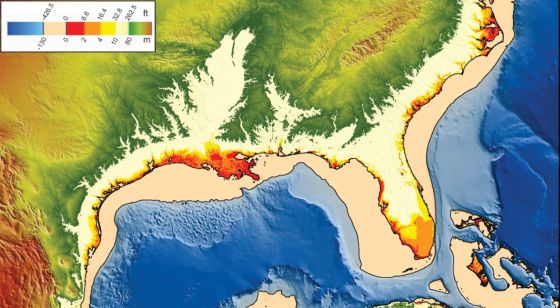
Map showing the impact on the South East U.S. coastline from changing sea levels.

Deborah Byrd writes: The 2007 IPCC report projected a global sea level rise between 0.2 and 0.5 meters by the year 2100. But current measurements of sea level rise suggest Earth’s seas are rising at the maximum rate proposed by the IPCC – or faster. These measurements suggest a rise of one meter or more by the end of the century. That’s according to University of Colorado geologist Bill Hay, who presented his results yesterday (November 4, 2012) at a meeting of The Geological Society of America. Hay said:

Modern climate models … do not include the many feedbacks we are just discovering.

For example, he said, Arctic sea ice and Greenland ice cap melting, and groundwater mining, all lead to feedbacks not included in climate models predicting sea level rise.

Arctic sea ice – which is already in the ocean – does not in itself raise sea level. But this melting plays a role in the overall warming of the Arctic, which leads to ice losses in nearby Greenland and northern Canada. In other words, when sea ice melts, it releases fresh water from the Arctic, which is then replaced by saltier, warmer water from the south. That warmer water pushes the Arctic toward more ice-free waters, which absorb sunlight rather than reflect it back into space like sea ice does. The more open water there is, the more heat is trapped in the Arctic waters, and the warmer things can get. So, according to Hay, melting Arctic sea ice is “a big heat pump that brings heat to the Arctic.” That feedback is not typically in climate models predicting sea level rise. [Continue reading…]

Facebooktwittermail

Reading guide: Where Romney and Obama actually stand on global warming

By Cora Currier and Theodoric Meyer, ProPublica, November 1, 2012

In the aftermath of Hurricane Sandy on Tuesday, New York Gov. Andrew Cuomo linked the storm to a broader change in the weather. “I don’t call it ‘global warming’ because you trigger a whole political debate,” Cuomo said. “But the frequency of extreme weather is going way up.”

President Obama and Mitt Romney have been even more reluctant to utter the words “global warming.” Neither candidate mentioned climate change over four presidential debates and none of the moderators asked about it — the first time that’s happened since 1988.

Obama has barely spoken of it on the campaign trail, while Romney has mocked the president’s earlier promise to address climate change.

As reporters and scientists discuss what role climate change may have played in fueling the storm, we’ve looked beyond the candidates’ rhetoric — or lack thereof — to find out where they actually stand:

Continue reading

Facebooktwittermail

Five countries (and regions) where the U.S. election matters most

Tony Karon writes: Superbarrio Gómez ran the most underreported campaign of the 1996 U.S. presidential election. The masked Mexican wrestler turned social activist showed up in New Hampshire during the primary season and declared himself a “candidate” even though his foreign citizenship rendered him ineligible. Decisions affecting the lives of Mexicans are made in the White House, he reasoned, so Mexicans should have a say in choosing its occupant. It’s a sentiment that’s widely shared: two-thirds of the 26,000 respondents from 32 countries in a recent poll believe that the White House has an important impact on their lives, and for that reason, almost half believe they should have a vote in the U.S. presidential election. (If they did, President Barack Obama would be a shoo-in, according to almost every poll.)

The level of interest in this U.S. election, however, is considerably lower than that of 2008. One reason for this may be that any global citizen tuning in to the campaign’s foreign policy debate would have struggled to find substantial differences between what Governor Mitt Romney advocated and what the White House is doing. There is also a growing sense of the relative decline of U.S. global power. The U.S. remains the world’s most militarily powerful country and its largest economy, but its ability to shape economic and geopolitical events in distant climes has steadily declined over the past decade — whether it’s Afghanistan or Iraq, the rapidly changing Arab world or Europe’s debt crisis, Washington struggles to impose its will.

That said, the Oval Office remains the world’s strongest single center of power, and the outcome of Tuesday’s vote will be closely watched. Here are five places [Syria, Israel, China, EU, and the Arctic] where the stakes are particularly high [Continue reading…]

Facebooktwittermail

British Muslims split along sectarian lines over Arab uprisings

HA Hellyer writes: For more than a decade I have been studying the community dynamics of Muslim Britons. Their views on the Arab uprisings are intriguing: sectarian fears, disappointments, scepticism, hope and ethnic concerns are all there.

Muslim British community activists have not ignored the Arab uprisings. They could not have. The Arab world is at the heart of the Muslim world.

True, most Muslim Britons do not have Arab ethnic backgrounds, and most have evolved to become essentially “post-Islamist”. Post-Islamism, in this sense, means their initial impetus for engaging in political life was from an emotional attachment to Islamism, but they have a secular rationale in the public arena that is not dissimilar from British social conservatives. But many of them have roots in Islamist community organisations and links, if only symbolic ones, to the Muslim Brotherhood.

So even the many Muslim Britons who are post-Islamist are deeply interested in the Islamist project in power, and in the challenges that project finds in Egypt and Tunisia, in particular.

There are, of course, differences of opinion. Many ordinary Muslim Britons of Pakistani descent, for example, now consider Pakistani politics to be utterly hopeless – and instinctively assume that the political state of the Arab world is likewise impervious to constructive change.

In activist circles, however, there is something of a quandary. On the one hand, many Muslim British activists came to political maturity in the anti-war movement, and their stances on the Arab uprisings are imbued by that experience, and by left, and far-left, opinions.

After the Nato intervention in Libya, I heard an interesting interview illustrating that tension. An activist intellectual was talking to a representative of the Libyan Muslim Brotherhood who had lived in the UK for many years. The activist, as a staunch supporter of the anti-war movement, was opposed to the intervention. But the Libyan was very much in support of it.

That activist was not alone; his opinion is common among many Muslim British activists, who have come to be sceptical of any western engagement in the Muslim world. [Continue reading…]

Facebooktwittermail

Mahmoud Abbas outrages Palestinian refugees by waiving his right to return

The Guardian reports: The Palestinian president, Mahmoud Abbas, is facing widespread condemnation and anger in the Palestinian territories and abroad after he publicly waived his right to return to live in the town from which his family was forced to flee in 1948, a repudiation of huge significance for Palestinian refugees.

After his image was burned in refugee camps in Gaza, Abbas rejected accusations that he had conceded one of the most emotional and visceral issues on the Palestinian agenda, the demand by millions of refugees to return to their former homes in what is now Israel.

He insisted that comments made in an interview with an Israeli television channel were selectively quoted and the remarks were his personal stance, rather than a change of policy.

Abbas told Channel 2 he accepted he had no right to live in Safed, the town of his birth, from which his family was forced to flee in 1948 when Abbas was 13.

“I visited Safed before once, he said. “But I want to see Safed. It’s my right to see it, but not to live there.”

Referring to the internationally-recognised pre-1967 border, he went on: “Palestine now for me is ’67 borders, with East Jerusalem as its capital. This is now and forever … This is Palestine for me. I am a refugee, but I am living in Ramallah. I believe that the West Bank and Gaza is Palestine and the other parts are Israel.”

The comments sparked protests in Gaza, where people in refugee camps burned images of the Palestinian president. Abbas was denounced on Twitter by pro-Palestinian activists.

Ismail Haniyeh, the Hamas ruler in Gaza, said the issue was not about Abbas’s right to return to Safed but “the rights of 6 million Palestinians”.

Facebooktwittermail

Israeli report cites a thwarted 2010 move on Iran

The New York Times reports: An Israeli news channel reported Sunday night that Prime Minister Benjamin Netanyahu and Defense Minister Ehud Barak asked the Israeli military in 2010 to prepare for an imminent attack on the Iranian nuclear program, but that their efforts were blocked by concerns over whether the military could do so and whether the men had the authority to give such an order.

The report, by the respected investigative journalist Ilana Dayan, came in the form of a promotional preview for an hourlong documentary about Israel’s decision-making process regarding Iran, which is scheduled to be broadcast Monday night. Ms. Dayan said on the channel’s evening newscast on Sunday that Mr. Netanyahu, in a meeting with a small circle of top ministers, turned to Gabi Ashkenazi, the head of the Israeli Defense Forces at the time, and told him to “set the systems for P-plus,” a term meaning that an operation would start soon.

Mr. Ashkenazi and Meir Dagan, who was the head of the Israeli intelligence service, the Mossad, at the time, would later say that this was an attempt at “stealing a war,” Ms. Dayan reported, because in their view such an order required a decision of the full cabinet, not the smaller group in the meeting, who were then known as the forum of seven.

Both Mr. Ashkenazi, who is now retired, and Mr. Dagan, who stepped down after the meeting, have become vocal critics of plans for a unilateral Israeli attack on Iran, and of Mr. Netanyahu and Mr. Barak’s aggressive approach.

Ms. Dayan said in the preview report on Sunday that the issue deepened a divide in Israel’s top echelon.

Mr. Ashkenazi was quoted saying of the P-plus order: “This is not something you do unless you are certain you want to execute at the end. This accordion will make music if you keep playing it.” But Mr. Barak told Ms. Dayan that “it is not true that creating a situation where the I.D.F. and the country’s operational systems are, for a few hours or for a few days, on alert to carry out certain operations means the state of Israel is compelled to act.”

“Eventually, at the moment of truth, the answer that was given was that, in fact, the ability did not exist,” Mr. Barak said in the clip that was shown on Sunday. [Continue reading…]

Facebooktwittermail

The politics of fear

Mark Danner writes: Amid the clamorous controversies of this election campaign, what strikes one here on the West Bank of the Jordan is the silences. Though the issue of Palestine promises to have a much more vital part in the volatile, populist politics of the Middle East’s new democracies—whose vulnerable governments actually must take some account of what moves ordinary people—here in Ramallah we have heard virtually nothing substantive about it, apart, that is, from Mitt Romney’s repeated charge that President Obama, presumably in extracting from Israel a hard-fought ten-month freeze on settlement building early on in his administration, had “thrown Israel under the bus.”

In fact, the West Bank is perhaps the place on the globe that has seen the least of President Obama’s promised “change you can believe in.” Nearly fifty years after Israel conquered the territories, its young soldiers are still on patrol, herding millions of Palestinians through and around an increasingly elaborate labyrinth of checkpoints, walls, and access roads, while Israeli settlers, now numbering in all more than half a million, flow over the hills, swelling their gated and fortified towns, creating one “fact on the ground” after another. Even as the land of the long-promised Palestinian state vanishes behind these barricades, the phrase “two-state solution” lives on, hovering like a ghost over the settlements, a remnant mirage of a permanently moribund “peace process” that has produced no agreement of consequence in twenty years, since the Oslo Accords vowed a Palestinian state would be declared no later than 1999.

Governor Romney’s own view of how to achieve Middle East peace is decidedly more modest—indeed, almost Buddhist in its fatalism. As he told guests at the now-infamous Boca Raton “47 percent” fund-raiser:

You hope for some degree of stability, but you recognize that it’s going to remain an unsolved problem…. And we kick the ball down the field and hope that ultimately, somehow, something will happen and resolve it.

Whatever that “something” that will “somehow…happen” might be, it will presumably not come at the initiative of a Romney administration, since, as the governor went on, “The idea of pushing on the Israelis to give something up, to get the Palestinians to act, is the worst idea in the world.” [Continue reading…]

Facebooktwittermail

Israelis imagine an attack on Iran would be a cakewalk

David Patrikarakos describes witnessing a recently conducted war game “designed to explore the likely outcome of an Israeli pre-emptive attack on Iran.” All participants were Israelis and their conclusion was that Israel would accomplish its goal — almost total destruction of Iran’s nuclear facilities — and that the global response would effectively focus on preventing military escalation. Simply put, Israel would win and Iran would lose.

I had seen Israel’s perspective on a possible attack and now wanted an Iranian view, so I caught a flight to Istanbul to put the game’s results to Hossein Mousavian, a former member of Iran’s nuclear negotiating team. He believed the game was deeply flawed.

Dismissing the limited nature of Iran’s response, Mousavian argued that in reality Iran would respond ‘by all means’, employing the total power of its armed forces to draw Israel into a long-term war. Perhaps, more importantly, Mousavian argued that Iran would see the US as complicit.

Iranians, he said, are convinced that Israel is too small to attack Iran unilaterally Iran. “They see Israeli as just a baby,” he said. “One that would never act without US assistance.”

The attack would also have huge regional consequences, he continued. Most obviously, Iran would use its status as the symbol of resistance against Israel in the Middle East to stoke the high levels of anti-Americanism that already exist there. Even groups like Al Qaeda, he argued, who are Iran’s enemies, would use “inflamed Muslim sentiment to launch attacks at American citizens across the world and on US soldiers on the many American bases in the region.”

At the end of our interview, he leaned forward, took my arm and looked me right in the eyes. He recalled the Israeli strikes on an Iraqi nuclear reactor in 1981 and a Syrian reactor in 2007.

“This is the big mistake that people make,” he told me. “To think if Israel attacks Iran, like it attacked Iraq and Syria, the Iranians would not retaliate.

“The nation is one hundred percent different. The whole region would be engulfed.”

Facebooktwittermail