Category Archives: Issues

The death of Arab secularism

Faisal Al Yafai writes: The death of Arab secularism is the story of a country that no longer exists and a world almost impossible to imagine.

That world can be glimpsed in old newsreels from the Arab cities of the 1950s and 1960s. The cities of the post-war period – Cairo, Beirut and Damascus, Baghdad and Aden – look much the same as many developing countries of the time: American-built cars, European-style suits, a certain easy mingling of men and women.

Unseen is something difficult to describe, but immediately apparent to anyone familiar with the Egypt or Yemen of today: the thick beards of men and the tightly wrapped headscarves of women – symbols of religious devotion, but also symbols of a public expression of Islam – were almost entirely absent from the new urban world then being created.

The vision of the future the men and women in those over-saturated newsreels had, how they saw their modern world unfolding, cannot easily be understood.

But it can perhaps be surmised from a joke, told by Egypt’s leader Gamal Abdel Nasser to an audience in the years after the Muslim Brotherhood was accused of attempting to assassinate him. Nasser described meeting with the Brotherhood’s leader in 1953 in an attempt to reconcile the group with his leadership. (Nasser doesn’t mention whom he met, but it was most likely Hassan Al Hudaybi, a judge who led the group for 20 years from 1951.)

“The first thing he asked me was to make the wearing of hijab mandatory in Egypt,” says Nasser, “and to force every woman walking on the street to wear a hijab.” The crowd laughs and Nasser hams it up for them, looking perplexed at such an outlandish request. “Let him wear it!” shouts an audience member, and the crowd erupts in laughter and applause.

But that’s not the punchline. Nasser tells Al Hudaybi he knows the Brotherhood’s leader has a daughter studying medicine, and his daughter doesn’t wear the hijab. “Why haven’t you made her wear the hijab?” he asks, before delivering a knockout blow: “If you cannot make one girl – who is your own daughter – wear the hijab,” he says, “how do you expect me to make 10 million women wear the hijab, all by myself?” The crowd roars its approval.

Nasser’s joke is instructive for the world view it implies. The middle and upper classes of 1950s Egypt considered it ridiculous that the wearing of the hijab could be enshrined in law. Most did not wear it; they considered the proper role of religion to be private, outside the realm of government and politics. Nasser himself explicitly declared the same thing.

Contrast that with today’s Egypt, and indeed the wider Arab world, and it is clear how much has changed in just half a century. [Continue reading…]


Facebooktwittermail

Is Occupy Sandy outperforming the Red Cross in hurricane relief?

Slate reports: In Sunset Park, a predominantly Mexican and Chinese neighborhood in South Brooklyn, St. Jacobi’s Church was one of the go-to hubs for people who wanted to donate food, clothing, and warm blankets or volunteer help other New Yorkers who were still suffering in the aftermath of Hurricane Sandy. On Saturday, Ethan Murphy, one of the people heading the kitchen operation, estimated they would prepare and send out 10,000 meals to people in need. Thousands and thousands of pounds of clothes were being sorted, labeled, and distributed, and valuable supplies like heaters and generators were being loaded up in cars to be taken out to the Rockaways, Staten Island and other places in need. However, this well-oiled operation wasn’t organized by the Red Cross, New York Cares, or some other well-established volunteer group. This massive effort was the handiwork of none other than Occupy Wall Street—the effort is known as Occupy Sandy.

The scene at St. Jacobis on Saturday was friendly, orderly chaos. Unlike other shelters that had stopped collecting donations or were looking for volunteers with special skills such as medical training, Occupy Sandy was ready to take anyone willing to help. A wide range of people pitched in, including a few small children making peanut butter sandwiches, but most volunteers were in their 20s and 30s. A large basement rec room had become a hive of vegetable chopping and clothes bagging. They held orientations throughout the day for new volunteers. One of the orientation leaders, Ian Horst, who has been involved with a local group called Occupy Sunset Park for the past year, says he was “totally blown away by the response” and the sheer numbers of people who showed up and wanted to help. He estimated that he’d given an orientation to 200 people in the previous hour.

By midday, a line stretched all the way down the block of people who’d already attended orientation and were waiting for rides to be dispatched to volunteer. Kiley Edgley and Eric Schneider had been waiting about 20 minutes and were toward the front of the line. Like several people I spoke to, the fact that this effort was being organized by the occupy movement wasn’t a motivating factor—they found out about the opportunity to volunteer online and just wanted to help.

Facebooktwittermail

With Glenn Beck’s help, can Romney win over the ultimate undecided voter?

The New York Times reports: On radio and on his Internet network, the influential conservative pundit Glenn Beck frequently invokes God, religious freedom and the founding fathers, but he does not regularly discuss his own Mormon faith.

But in early September, he broke with practice and hosted a special one-hour show, asking his audience, “Does Mitt Romney’s Mormonism make him too scary or weird to be elected to president of the United States?”

Mr. Beck has not always supported Mr. Romney. (“I think he’s an honorable man, but I don’t trust him,” he said last year.) But as perhaps the best-known Mormon after the Republican presidential candidate and a major influence on evangelical Christians, Mr. Beck has emerged as an unlikely theological bridge between the first Mormon presidential nominee and a critical electorate.

At the same time, Mr. Beck’s defense of his and Mr. Romney’s shared faith speaks to the long-frayed relationship between evangelical Christians and Mormons and raises the question of whether evangelicals will ultimately put aside religious differences and vote on common conservative issues.

During his special program, Mr. Beck took questions from mostly evangelical Christian listeners, colorfully debunking misperceptions about Mormonism. The “magic underwear” was compared to a skullcap, and Mr. Beck insisted that polygamy was seen as a “perversion” in the modern church.

“It’s not weird to be a Mormon,” he assured his listeners at the end of the program, “and it’s not weird to be president if you’re Mormon.”

Although Mr. Beck’s national media profile has waned since he left Fox News last year, his support among his core audience remains strong. “The Glenn Beck Program” is typically the third-most-popular talk-news radio show, after “The Rush Limbaugh Show” and “The Sean Hannity Show.” In September, an agreement was reached with Dish Network to bring Mr. Beck’s online network, The Blaze, to traditional television.

Mr. Beck’s unique position as both a Mormon and a prominent voice among evangelicals has been too tempting for Mr. Romney’s campaign to pass up. Campaign officials have quietly courted Mr. Beck, according to a person briefed on his meetings with campaign surrogates who could not discuss private conversations publicly. Mr. Beck declined to comment for this article.

Last month, Mr. Beck, along with former Vice President Dick Cheney and Mr. Romney’s son Josh, headlined a Dallas fund-raiser that brought in more than $250,000 for the Romney Victory committee, and on Friday Mr. Beck held a rally in Columbus, Ohio, intended to influence voters in that swing state. On Saturday, he attended Mr. Romney’s rally in Dubuque, Iowa.

Stalwart conservatives who support the Romney-Ryan ticket, like Representative Louie Gohmert, Republican of Texas; Rick Santorum, a former senator and Republican presidential candidate; and retired Lt. Gen. William Boykin, have appeared on Mr. Beck’s program not so much to tout Mr. Romney directly as to discuss hot-button political issues like the handling of the attack on the United States mission in Benghazi, Libya.

Mostly Mr. Beck has helped Mr. Romney by directly addressing his devout Mormon faith, something the candidate himself rarely does. “I believe Mr. Romney prays on his knees every day,” Mr. Beck said recently on his radio program. “I believe he is being guided.” He has also said that a Romney victory would be “a sign from God.” [Continue reading…]

But as usual, God is struggling to make up her/his/its mind. Maybe the saturation advertising ends up confusing an omniscient mind — just imagine having to hear/see all those robocalls and commercials simultaneously.

Maybe the sign from God in this election will end up being revealed not by who wins but how many Americans bother voting.

Facebooktwittermail

Barack Obama and the paradox behind his African American support base

Gary Younge writes: The symbolic resonance of Obama’s victory for black Americans has not diminished [since he took office]. At rallies the hawkers are still there with T-shirts setting him alongside Martin Luther King, setting his logo within Superman’s crest or insisting: “I like my coffee black. Like my president”. According to Gallup 90% of African Americans intend to back him and they plan to turn out at the same rate as white voters. No other block of voters is more loyal.

No other block of voters is more optimistic. Over the past few years polls have consistently shown that African Americans are more likely than any other group to be bullish about their own future, to think the country’s best days are yet to come and that the economy is already recovering.

A Pew survey in January 2010 indicated that the percentage of black Americans who thought blacks were better off than they were five years before had almost doubled since 2007. There were also significant increases in the percentages who believed the standard-of-living gap between whites and blacks was decreasing. No wonder they love the president.

There was only one trouble with these assessments. They weren’t true. African Americans, as a group, are far worse off now than they were when Obama came to power and the gap between whites and blacks in terms of wealth and income has increased under Obama’s tenure. The overall rate of unemployment may be close to where it was when Obama took office, but black unemployment is up 11%. Meanwhile the wealth gap has doubled during this recession with the average white American now having 22 times more wealth than their black counterparts. So too has the educational achievement gap with the rate at which white Americans graduate from high school growing at a far faster clip than black students. [Continue reading…]

Facebooktwittermail

Republicans more likely to believe in demon possession than climate change

Huffington Post reports: A new poll reveals the majority of registered Republican voters believe that demonic possession is a real phenomenon.

The “Halloween-centric” poll, conducted by Public Policy Polling showed that 68 percent of Republican voters think it’s possible to be possessed by demons.

Meanwhile, as news website AlterNet notes, only 48 percent of Republicans polled in an earlier survey conducted by the Pew Research Center survey said they believe in climate change.

As the election looms ever closer, the topic of climate change and global warming has been in the air — with some experts and politicians calling the recent devastation caused by Hurricane Sandy a reality check.

However, while 88 percent of Obama supporters believe that there is “solid evidence that the earth is warming,” only 42 percent of Romney supporters said that this is true, according to the Pew survey.

But before Democrats get too smug about being less inclined to superstition, it turns out that 49 percent of Democrats believe it’s possible to be possessed by a demon and overall, only 35 percent of registered voters think demon possession is impossible.

Facebooktwittermail

Obama exposes the daylight separating American and Israeli Jews

The Jerusalem Post reports: Were Israel America’s 51st state, it is clear – at least based on various polls in Israel over the last five months – that it would be giving its hypothetical 13 electoral votes (based on the size of its population) to Republican candidate Mitt Romney in the upcoming US elections.

In other words, Israel – in American political terms – is a deep red state. Unlike the popular stereotypes of Jews, we here in Israel are Texas, Nebraska and Indiana.

What is so jarring about this is the degree to which it stands in sharp contrast to the voting trends of American Jews.

An Israel Democracy Institute/Tel Aviv University Peace Index poll released this week found that when asked “in terms of Israeli interests, who would be preferable to win the elections next month in the US,” 57.2 percent of Israeli Jews said Romney, and only 21.5% said Obama.

These findings are consistent with other findings over the last few months, including a Jerusalem Post poll in mid October that found that only 18% of Israelis believe Obama is pro- Israel, while 28% believe him to be pro-Palestinian; another Peace Index poll from August showing that 40% of Israeli Jews believe Romney assigns “more importance to defending Israel’s national interests,” compared to 19% for Obama; and a Begin-Sadat Center for Strategic Studies poll from June showing that 29% of Israelis believe Romney would better promote Israel’s interests, as opposed to 22% for Obama.

What is clear from all those figures is that over the past four years Obama has not exactly won over the Israeli Jewish public. In other words, Israelis have not felt the love. The same, of course, cannot be said of Israel’s American Jewish brethren.

Jews, according to 2008 exit polls, voted for Obama over John McCain by a 78% to 22% margin.

And Obama’s numbers among American Jews, four years down the line, are still very high, though not as high as they were back then, something that could play a significant role in a close election.

A Gallup tracking poll from July 1 – September 10 found that Jews planned to vote for Obama over Romney by a 64% – 25% margin. And an American Jewish Committee poll in mid September put that number at 65% for Obama, 24% for Romney and 10% undecided. [Continue reading…]

Facebooktwittermail

Why seas are rising ahead of predictions: Estimates of rate of future sea-level rise may be too low

Science Daily reports: Sea levels are rising faster than expected from global warming, and University of Colorado geologist Bill Hay has a good idea why. The last official IPCC report in 2007 projected a global sea level rise between 0.2 and 0.5 meters by the year 2100. But current sea-level rise measurements meet or exceed the high end of that range and suggest a rise of one meter or more by the end of the century.

“What’s missing from the models used to forecast sea-level rise are critical feedbacks that speed everything up,” says Hay. He will be presenting some of these feedbacks in a talk on Nov. 4, at the meeting of The Geological Society of America in Charlotte, North Carolina, USA.

One of those feedbacks involves Arctic sea ice, another the Greenland ice cap, and another soil moisture and groundwater mining.

“There is an Arctic sea ice connection,” says Hay, despite the fact that melting sea ice — which is already in the ocean — does not itself raise sea level. Instead, it plays a role in the overall warming of the Arctic, which leads to ice losses in nearby Greenland and northern Canada. When sea ice melts, Hay explains, there is an oceanographic effect of releasing more fresh water from the Arctic, which is then replaced by inflows of brinier, warmer water from the south.

“So it’s a big heat pump that brings heat to the Arctic,” says Hay. “That’s not in any of the models.” That warmer water pushes the Arctic toward more ice-free waters, which absorb sunlight rather than reflect it back into space like sea ice does. The more open water there is, the more heat is trapped in the Arctic waters, and the warmer things can get. [Continue reading…]

Facebooktwittermail

Why Europe deserves your respect: They had first word on Hurricane Sandy

Jim Galloway writes: If you’re familiar with Republican talking points, then you understand that “Europe” has become political shorthand for “socialist, debt-ridden mediocrity.”

We must now make an exception for the art of weather forecasting. How did U.S. meteorologists first learn that Hurricane Sandy would make a deadly beeline for the Jersey shore? Socialist, debt-ridden Europe told them.

Specifically, while U.S. computer models still had Hurricane Sandy dying in the deep Atlantic, the European Centre for Medium-Range Weather Forecasts, located in the United Kingdom town of Reading, declared that Sandy was about to give the northeastern United States a devastating right hook.

European superiority is an accepted fact within the forecasting craft. Which is why – nine days ago — Marshall Shepherd pointed to the calculations coming out of Britain and told his students in Athens to keep their eyes open.

“It’s fairly well known that the European model is a bit better than our model because they use something called four-dimensional data assimilation in their weather model,” said Shepherd, a professor of geography and director of the atmospheric sciences program at the University of Georgia.

We’ll offer a translation later.

For the moment, what you need to know is that, in January, Shepherd will become president of the 15,000-member American Meteorological Society. Which means that both he and Hurricane Sandy will have significant parts to play in the next chapter of the ongoing debate on the size and role of our federal government.

While Republicans would prefer to discuss Benghazi, Sandy is all but certain to dominate the final days of the presidential contest. President Barack Obama will push photos of himself touring the devastation with a well-known Republican governor of New Jersey.

Mitt Romney will continue to fend off questions about that 2011 primary debate in which he suggested a return of disaster relief duties to the states, or privatizing the process. (The Federal Emergency Management Agency is “really important,” but states are “first responders,” a Romney aide said Thursday.)

But the debate over the reach of federal government won’t disappear after next Tuesday. Rather, it will ratchet up, as Congress turns its attention toward a lame-duck session and a “fiscal cliff” of automated tax hikes and spending cuts.

“When you have a Katrina, or you have a Sandy, that’s the time to get things done in the policy world,” Shepherd said. “With Sandy, I think it’s raising the right questions about the role of government.” [Continue reading…]

Facebooktwittermail

A two-state solution is the most practical route for Israel and Palestine

David Wearing writes: Obituaries for the two-state solution to the Israeli-Palestinian conflict are appearing with increasing regularity, with examples including recent pieces in the Guardian by Rachel Shabi and Ghada Karmi. Among supporters of the Palestinian national struggle, those now calling for a single bi-national state are clearly in the ascendency, but the view is not unanimous. People such as Norman Finkelstein and Noam Chomsky continue to advocate the establishment of two states along the 1967 borders “subject to very minor and mutual adjustments”. The disagreement is over tactics and analysis, rather than politics or principle, but it is no less significant for that.

The case for a single, bi-national state is now reasonably familiar. Israel’s illegal settlements are so entrenched that uprooting them to make way for a viable Palestinian state has become impossible. We should therefore call instead for a single, democratic state in the whole of the former British Mandate for Palestine.

But the logic is incomplete. Declaring the two-state solution unrealistic does not, by itself, make self-evident the greater feasibility of one bi-national state. The latter would entail the end of Israel, and of Zionism, as we understand those terms today. Is this really a more likely scenario than the colonial infrastructure in the occupied territories being dismantled? Recent polls showing alarming levels of racism in Israeli public opinion, reflected in the new hard-right alliance between Likud and Yisrael Beitenu, suggest a polity that is not currently minded to dissolve itself under any amount of political pressure. [Continue reading…]

Facebooktwittermail

Anatomy of a deal with Iran

Rajan Menon writes: The on-again, off-again musings about a deal between Washington and Tehran are on again. A deal might reconcile the most important demands of each side: Iran’s insistence that it has a legal right to an independent fuel cycle for what it insists is a nonmilitary nuclear program and the declaration of the United States that Iran must not be permitted to build nuclear weapons. The latest round of speculation follows recent press reports that the two parties have agreed to hold bilateral negotiations following the U.S. presidential elections.

Yet soon after the news broke, both sides weighed in with their own spin. The White House, while reiterating that it has always been open to direct talks, insisted that there has been no formal agreement to hold them. Was this clarification meant to ensure that the American pubic received an accurate account? Was the denial of a formal agreement, preceded as it was by what appears to have been a leak about possible talks between Tehran and Washington, meant to prevent rising expectations that could then be dashed, making the Obama administration look feckless? Or was it, given that Election Day is nigh, designed to show that the administration is making progress on a diplomatic solution but to do in a way that would provide parry charges by Mitt Romney that Obama is rushing toward talks that would allow Iran time to build nuclear arms? There is no clear answer.

Iran quickly dismissed the reports about impending one-on-one talks. Foreign Minister Ali Akbar Salehi insisted that Iran was engaged in negotiations with the five permanent members of the Security Council and Germany, the so-called P5+1 but that it was not conducting talks with the United States. This was a tad ambiguous: given his choice of words, Salehi did not deny that Iran had broached the idea of talks or that it had responded positively after the United States had done so.

Is Iran trying to prove that the economic sanctions and the resulting tumble in the rial’s value have not forced it to change course and deal directly with the United States in hopes of relief? Is Salehi’s denial just a tactic designed to allow Tehran to negotiate with Washington eventually but without seeming desperate in the run-up to talks? Is it meant to calm Iranian hard-liners, ever vigilant for indications that the regime is yielding to pressure? Is it a sign that, despite the power attributed to Supreme Leader Ayatollah Ali Khamenei, there is no consensus within Iran’s leadership about how to cope with the pressures created by the sanctions? (The rial has lost some 40 percent of its value, Iran has lost half the revenue it gets from oil sale and ordinary Iranians are facing rising prices for basic goods.) Again, this remains unclear. [Continue reading…]

(Note – The web servers of The National Interest got knocked out by Hurricane Sandy — while they are being fixed TNI is using a WordPress backup site.)

Facebooktwittermail

What’s the foreign policy agenda for the next four years?

Stephen Walt writes: Is it too early to talk about the foreign policy and national security agenda that will face the next president? No matter who wins on November 6, the feature that is going to dominate U.S. national security planning over the next four years is constraint. Even if we avoid going off the sequestration cliff, there is going to be considerable pressure on the defense budget. Forget all those promises that Romney made about ramping up defense spending, expanding the Navy, etc. If he does beat Obama and has to face reality (as opposed to his Etch-a-Sketch approach to campaigning) he’ll figure out that budget math is real and unforgiving. And given the budget picture these days, that means limits.

Of course, foreign policy and national security tends to produce a lot of surprises; it’s probably the least predictable part of a president’s agenda. Remember that George W. Bush was totally blindsided by 9/11, an event that shaped almost everything he subsequently did in foreign and defense policy. Barack Obama didn’t see the Arab spring coming, yet he’s had to devote a lot of time and attention to figuring out what to do (or not to do) in Egypt, Libya, Syria, Bahrain, and elsewhere. No list of agenda items will cover all the possible topics, and it’s a safe bet the next president will get to deal with something that hardly anybody anticipated.

That said, what do I see as some obvious items that the next president will have to address? Obviously, he’ll have to manage the withdrawal from Afghanistan, keep relations with China on an even keel, cultivate reasonable ties with Mexico and other neighbors in the western hemisphere, and hope that the Eurozone mess doesn’t get worse. But here’s my list of the items that might take up even more of his time. [Continue reading…]

Facebooktwittermail

It’s global warming, stupid

Paul M. Barrett writes: Yes, yes, it’s unsophisticated to blame any given storm on climate change. Men and women in white lab coats tell us — and they’re right — that many factors contribute to each severe weather episode. Climate deniers exploit scientific complexity to avoid any discussion at all.

Clarity, however, is not beyond reach. Hurricane Sandy demands it: At least 40 U.S. deaths. Economic losses expected to climb as high as $50 billion. Eight million homes without power. Hundreds of thousands of people evacuated. More than 15,000 flights grounded. Factories, stores, and hospitals shut. Lower Manhattan dark, silent, and underwater.

An unscientific survey of the social networking literature on Sandy reveals an illuminating tweet (you read that correctly) from Jonathan Foley, director of the Institute on the Environment at the University of Minnesota. On Oct. 29, Foley thumbed thusly: “Would this kind of storm happen without climate change? Yes. Fueled by many factors. Is storm stronger because of climate change? Yes.” Eric Pooley, senior vice president of the Environmental Defense Fund (and former deputy editor of Bloomberg Businessweek), offers a baseball analogy: “We can’t say that steroids caused any one home run by Barry Bonds, but steroids sure helped him hit more and hit them farther. Now we have weather on steroids.”

In an Oct. 30 blog post, Mark Fischetti of Scientific American took a spin through Ph.D.-land and found more and more credentialed experts willing to shrug off the climate caveats. The broadening consensus: “Climate change amps up other basic factors that contribute to big storms. For example, the oceans have warmed, providing more energy for storms. And the Earth’s atmosphere has warmed, so it retains more moisture, which is drawn into storms and is then dumped on us.” Even those of us who are science-phobic can get the gist of that.

Sandy featured a scary extra twist implicating climate change. An Atlantic hurricane moving up the East Coast crashed into cold air dipping south from Canada. The collision supercharged the storm’s energy level and extended its geographical reach. Pushing that cold air south was an atmospheric pattern, known as a blocking high, above the Arctic Ocean. Climate scientists Charles Greene and Bruce Monger of Cornell University, writing earlier this year in Oceanography, provided evidence that Arctic icemelts linked to global warming contribute to the very atmospheric pattern that sent the frigid burst down across Canada and the eastern U.S..

Facebooktwittermail

Bloomberg endorses Obama, citing climate change

The New York Times reports: In a surprise announcement, Mayor Michael R. Bloomberg said Thursday that Hurricane Sandy had reshaped his thinking about the presidential campaign and that as a result he was endorsing President Obama.

Mr. Bloomberg, a political independent in his third term leading New York City, has been sharply critical of both Mr. Obama, a Democrat, and Mitt Romney, the president’s Republican rival, saying that both men have failed to candidly confront the problems afflicting the nation. But he said he had decided over the past several days that Mr. Obama was the best candidate to tackle the global climate change that the mayor believes contributed to the violent storm, which took the lives of at least 38 New Yorkers and caused billions of dollars in damage.

“The devastation that Hurricane Sandy brought to New York City and much of the Northeast — in lost lives, lost homes and lost business — brought the stakes of next Tuesday’s presidential election into sharp relief,” Mr. Bloomberg wrote in an editorial for Bloomberg View.

“Our climate is changing,” he wrote. “And while the increase in extreme weather we have experienced in New York City and around the world may or may not be the result of it, the risk that it may be — given the devastation it is wreaking — should be enough to compel all elected leaders to take immediate action.”

Mr. Bloomberg’s announcement is another indication that Hurricane Sandy has influenced the presidential campaign. The storm, and the destruction it left in its wake, has dominated news coverage, transfixing the nation and prompting the candidates to halt their campaigning briefly. [Continue reading…]

Facebooktwittermail

Sandy forces climate change on U.S. election despite fossil fuel lobby

Bill McKibben writes: Here’s a sentence I wish I hadn’t written – it rolled out of my Macbook in May, part of an article for Rolling Stone that quickly went viral:

“Say something so big finally happens (a giant hurricane swamps Manhattan, a megadrought wipes out Midwest agriculture) that even the political power of the industry is inadequate to restrain legislators, who manage to regulate carbon.”

I wish I hadn’t written it because the first half gives me entirely undeserved credit for prescience: I had no idea both would, in fact, happen in the next six months. And I wish I hadn’t written it because now that my bluff’s been called, I’m doubting that even Sandy, the largest storm ever, will be enough to make our political class serious about climate change.

Maybe I’m wrong, though. Maybe – just maybe – the arrival of a giant wall of water in the exact middle of the financial and media capital of our home planet will be enough to get this conversation unstuck. Maybe that obscene slick of ocean spreading unnaturally into the tubes and tunnels of the greatest city on earth will shock enough people to change the debate. New York Governor Andrew Cuomo, at a press conference Tuesday afternoon, allowed as how:

“There has been a series of extreme weather incidents. That is not a political statement, that is a factual statement … Anyone who says there’s not a dramatic change in weather patterns, I think, is denying reality.”

New York Mayor Michael Bloomberg added:

“What is clear is that the storms we’ve experienced in the last year or so around this country and around the world are much more severe than before.”

Truthfully, I think I’d just as soon see statements like that as carefully thought-out endorsements of climate science. It’s experience that changes people: the summer’s drought left more than half of American counties as federal disaster areas, and meteorologist Jeff Masters estimates Sandy hit 100 million Americans with “extreme weather”. Add in the largest forest fires in Colorado and New Mexico, the hottest month in US history, and the completely absurd summer-in-March heatwave that kicked off our year of living sweatily, and you can begin to understand why the percentage of Americans worrying about global warming has spiked sharply this year. Spiked high enough that even a few politicians are willing to speak out. [Continue reading…]

Facebooktwittermail

A convenient excuse

Wen Stephenson writes: On October 2, I led a climate protest inside the offices of the Boston Globe.

OK, it was really a meeting in a small conference room with editorial page editor Peter Canellos and members of his staff. But it was, in essence, a protest.

I used to be a card-carrying member of the mainstream media; just a few years ago, I was the editor of the Globe‘s Ideas section. Peter is a former colleague.

With me was Craig Altemose, founder and executive director of Better Future Project, a Cambridge-based non-profit dedicated to climate action, on whose working board I serve as a volunteer. We were joined by two members of BFP’s advisory board: MIT’s Kerry Emanuel, one of the country’s leading climate scientists (and, until recently, a Republican); and Boston College’s Juliet Schor, a sociologist and economist who is a respected thinker on climate and the economy. Last year, Altemose was arrested protesting the Keystone XL pipeline at the White House along with another advisory board member, Bill McKibben of 350.org, and 1251 other concerned citizens.

After a quick round of introductions, I explained to my former Globe colleagues that I wasn’t there to “save the planet” or to protect some abstraction called “the environment.” I’m really not an environmentalist, and never have been. No, I said, I was there for my kids: my son, who’s 12, and my daughter, who’s 8. And not only my kids — all of our kids, everywhere. Because on our current trajectory, it’s entirely possible that we’ll no longer have a livable climate — one that allows for stable, secure societies to survive — within the lifetimes of today’s children.

And I told them that I was there, in that room, because the national conversation we’re having about this situation, this emergency, is utterly inadequate — or, really, nonexistent. And I looked Peter in the eye, and told him that I’m sorry, but that’s completely unacceptable to me. If we can’t speak honestly about this crisis — if we can’t lay it on the line — then how can we look at ourselves in the mirror?

Since I had requested the meeting, I told Peter that I hoped to frame the discussion around two points:

First: We need to see a much greater sense of urgency in the media’s coverage of climate change, including in the Globe’s editorial and opinion pages. This is more than an environmental crisis: it’s an existential threat, and it should be treated like one, without fear of sounding alarmist, rather than covered as just another special interest, something only environmentalists care about. And it should be treated as a central issue in this election, regardless of whether the candidates or the political media are talking about it.

Second: Business-as-usual, politics-as-usual, and journalism-as-usual are failing us when it comes to addressing the climate threat. If there’s to be any hope for the kind of bold action we need, a great deal of pressure must be brought from outside the system, in the form of a broad-based grassroots movement, in order to break the stranglehold of the big-money fossil fuel lobby on our politics. And in fact, there is a movement emerging on campuses and in communities across the country — especially here in New England — and the Globe should be paying attention to it.

But that wasn’t the conversation Peter was prepared to have — and we never got around to having it.

Canellos, the paper’s former Washington bureau chief, was more interested in the short-term politics of the Keystone pipeline debate, and the economic impact of natural gas expansion in Massachusetts, and what raising renewable energy standards would mean for regional jobs. Smart, sensible questions. Balanced. Analytical. Above the fray. In short, what counts as serious on the opinion pages of mainstream American newspapers.

And, it has to be said, they were questions that revealed precisely the kind of narrow, incremental, politically straitjacketed mindset that’s leading us off the climate cliff. Indeed, they were the kind of questions that make you wonder whether the speaker is even aware of the cliff we’re racing toward — or what planet we’re living on. [Continue reading…]

Facebooktwittermail

Mitt Romney offers answer on his FEMA stance

The Associated Press reports: There’s nothing like a natural disaster to test the depth of politicians’ preference for small government.

And so it turns out that after superstorm Sandy battered the East Coast, Mitt Romney is far more supportive of the government agency in charge of coordinating disaster relief. Only last year, as Romney hewed to the right while battling for the GOP nomination, he seemed to downplay the federal government’s role in disaster response.

“Every time you have an occasion to take something from the federal government and send it back to the states, that’s the right direction,” Romney said at a debate last June. “And if you can go even further, and send it back to the private sector, that’s even better.”

Asked by moderator John King of CNN whether that would include disaster relief, Romney said: “We cannot afford to do those things without jeopardizing the future for our kids. It is simply immoral, in my view, for us to continue to rack up larger and larger debts and pass them on to our kids.”

Now, a week before Election Day, after of a massive disaster, Romney’s campaign is reassuring voters that his administration wouldn’t leave disaster victims in the lurch. The public’s attention is locked on the devastation caused by Sandy at a time when Romney and President Barack Obama are locked in a close presidential campaign. With Obama heavily involved in getting federal funds to those in trouble, the Romney campaign moved quickly to reassure the public it supports a strong program of storm relief.

“I believe that FEMA plays a key role in working with states and localities to prepare for and respond to natural disasters,” Romney said in a statement supplied by his campaign Wednesday. “As president, I will ensure FEMA has the funding it needs to fulfill its mission, while directing maximum resources to the first responders who work tirelessly to help those in need, because states and localities are in the best position to get aid to the individuals and communities affected by natural disasters.”

Wednesday’s statement came after the candidate ducked a spate of opportunities Tuesday to personally clarify his position and the statement essentially endorsed the current disaster aid system.

But what the campaign wouldn’t do is say whether a President Romney would insist that help for disaster victims be funded by cutting other programs in the federal budget, as many conservative Republicans insist. [Continue reading…]

Facebooktwittermail

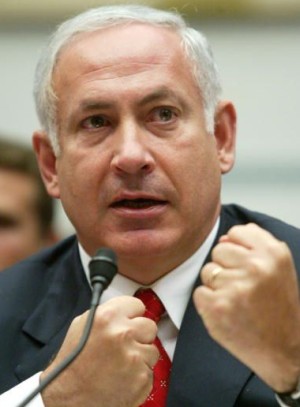
Netanyahu: Israeli strike on Iran nuclear plants will only serve to calm Mideast

Haaretz reports: An Israeli strike against Iran’s nuclear facilities won’t destabilize the Middle East, Prime Minister Benjamin Netanyahu said in an interview to a French magazine on Tuesday, adding, moreover, that such a move would only serve to restore security in the region.

“Five minutes after [an attack], contrary to what the skeptics say, I think a feeling of relief will spread across the region,” Netanyahu told Paris Match, adding: “Iran isn’t popular in the Arab world, far from it. Some governments in the region, as well as their citizens, have understood that a nuclear-armed Iran would be dangerous for them, not just for Israel.”

The premier’s interview, one to which he gave much importance, was geared at influencing public opinion in France ahead of his visit to the country on Wednesday.

Facebooktwittermail