



Ahmed Moor writes: The United States is a sovereign country. That is sometimes hard to remember.
Illinois Senator Mark Kirk had a stroke in January. The serious neurological event sent him into surgery, where doctors excised two, tiny, damaged pieces of his brain. By all accounts, the senator is now in great recovery, his office releasing a video in May, which showed him walking on a treadmill and describing his eagerness to “get back to work”. Yet it appears that he has already got back to it.
At the end of last month, Kirk sponsored an amendment to a Senate appropriations bill, seemingly intent on stripping the United Nations Relief and Works Agency of some of its funding. His attempt to re-determine the definition of Palestinian refugees was met by stiff opposition from the State Department, but the senator prevailed – a considerable feat for a recovering patient.
The amendment requires the State Department to distinguish between and report on how many of those Palestinians who receive assistance from UNRWA were personally displaced from their homes as a result of the 1948 war, and those who are their descendants – which the UN agency continues to count as refugees, unable to return to their ancestral homes.
Ha’aretz reported that the senator had some help with his legislative burden, and not only from his deputy chief of staff, Richard Goldberg. It turns out that the amendment to the bill was first written by an Israeli politician. Einat Wilf, a member of the Israeli parliament, reportedly spent months working with current and former AIPAC employees, including Steve Rosen – who was once suspected by FBI agents of obtaining classified US government information and passing it on to Israeli officials – to deliver the language on Palestinian refugees to the US legislature.
In summary: a senator who suffered crippling neurological damage received legislation from an Israeli politician by way of AIPAC before he slipped it into a US bill that eventually became law. In other words, an Israeli politician helped write a US law. Then she boasted about it. [Continue reading…]
Hadi Kahalzadeh and John Schiemann write: The latest wave of sanctions against Iran comes into effect today. Such measures are largely predicated on a “rational actor model” in which the west hopes Iran’s leaders will eventually find it in their own interests to give up their nuclear programme. The problem with such a strategy is not that Iran’s leaders are irrational but that such a game only works if the west knows how Iran evaluates costs and benefits and the options Iran believes it has available.
After the failure of previous sanctions, the west has imposed a new set of much tougher sanctions while Iran has adopted a more assertive stance vis-a-vis the west, stating that it will respond to economic and military threats with its “own threats”. Why, then, has Iran failed to respond to international pressure?
According to the basic sanctions model, the target of sanctions will alter its behaviour in the desired direction when the costs of defiance become greater than its perceived costs of compliance. Yet despite Iran’s reliance on oil, the structural weakness of its economy, and deep economic costs such as the sharp rise in inflation, negative economic growth and increasing unemployment, it has failed to bend. This should prompt policymakers to ask how Iran evaluates the costs of sanctions and defying the west. [Continue reading…]
Reuters reports: Rising sea levels cannot be stopped over the next several hundred years, even if deep emissions cuts lower global average temperatures, but they can be slowed down, climate scientists said in a study on Sunday.
A lot of climate research shows that rising greenhouse gas emissions are responsible for increasing global average surface temperatures by about 0.17 degrees Celsius a decade from 1980-2010 and for a sea level rise of about 2.3mm a year from 2005-2010 as ice caps and glaciers melt.
Rising sea levels threaten about a tenth of the world’s population who live in low-lying areas and islands which are at risk of flooding, including the Caribbean, Maldives and Asia-Pacific island groups.
More than 180 countries are negotiating a new global climate pact which will come into force by 2020 and force all nations to cut emissions to limit warming to below 2 degrees Celsius this century – a level scientists say is the minimum required to avert catastrophic effects.
But even if the most ambitious emissions cuts are made, it might not be enough to stop sea levels rising due to the thermal expansion of sea water, said scientists at the United States’ National Centre for Atmospheric Research, U.S. research organization Climate Central and Centre for Australian Weather and Climate Research in Melbourne.
“Even with aggressive mitigation measures that limit global warming to less than 2 degrees above pre-industrial values by 2100, and with decreases of global temperature in the 22nd and 23rd centuries … sea level continues to rise after 2100,” they said in the journal Nature Climate Change.
David Shulman writes: In 1949, shortly after Israel’s War of Independence, S. Yizhar—the doyen of modern Hebrew prose writers—published a story that became an instant classic. “Khirbet Khizeh” is a fictionalized account of the destruction of a Palestinian village and the expulsion of all its inhabitants by Israeli soldiers in the course of the war. The narrator, a soldier in the unit that carries out the order, is sickened by what is being done to the innocent villagers. Here he is in Nicholas de Lange and Yaacob Dweck’s translation (Ibis Publications, 2008):
I felt a terrifying collapse inside me. I had a single, set idea, like a hammered nail, that I could never be reconciled to anything, so long as the tears of a weeping child still glistened as he walked along with his mother, who furiously fought back her soundless tears, on his way into exile, bearing with him a roar of injustice and such a scream that—it was impossible that no one in the world would gather that scream in when the moment came….
Still, the narrator goes along with the expulsion without overt protest. Yizhar himself was an intelligence officer during the war; he describes events he may well have seen himself: “We came, we shot, we burned; we blew up, expelled, drove out, and sent into exile. What in God’s name were we doing in this place?”
Somewhat surprisingly, this story was taught for many years in Israeli secondary schools as part of the modern Hebrew canon; even today it is still on the books as an optional text for the matriculation exam (unless the Netanyahu government has secretly removed it). The story embodies the conscience of Israel at the moment of the state’s formation. It also gives voice to a much older Jewish tradition of moral protest and the struggle for social justice. When I was growing up in the Midwest in the 1950s and 1960s, I mistakenly thought that this tradition was at the core of what it meant to be Jewish.
Sixty-three years have passed since Yizhar wrote “Khirbet Khizeh.” I wish I could say that what he described was an ugly exception and that such actions don’t happen any more. It is not, and they do. This week I find myself in Susya, in the South Hebron hills, near the southern corner of the West Bank. Like their counterparts in many other Palestinian villages, Susya’s approximately 300 inhabitants are impoverished, badly scarred, terrified, and defenseless. The week before last the officers of the Civil Administration, that is, the Israeli occupation authority, turned up with new demolition orders in their hands; these orders apply to nearly all the standing structures in the village — mostly tents, ramshackle huts, sheep-pens, latrines, and the wind-and-sun-powered turbine that Israeli activists put up some three years back to generate electricity on this stony, thirsty hilltop in the desert. If the orders are carried out — this could happen at any moment — then it means the nearly complete destruction of an entire village and the violent expulsion of its people. They will be, quite literally, cast into the desert. [Continue reading…]
The Financial Times reports: Yitzhak Shamir, who has died at the age of 96, is most likely to be remembered as a terrorist against British rule in Palestine during the 1940s and as a man whose aggressive Jewish settlement policy on Arab lands may have stymied Middle East peace for a generation.
Benjamin Netanyahu, Israel’s prime minister, said Shamir “belonged to the generation of giants that established the state of Israel and fought for the freedom of the Jewish people in its land”.
In the New York Times, Joel Brinkley writes: Under [Shamir’s] leadership [in 1942 the Stern Gang] began a campaign of what it called personal terror, assassinating top British military and government officers, often gunning them down in the street.
To the Jewish public, and even to the other Jewish underground groups, Mr. Shamir’s gang was “lacking even a spark of humanity and Jewish conscience,” Israel Rokach, the mayor of Tel Aviv, said in 1944 after Stern Gang gunmen shot three British police officers on the streets of his city.
Years later, however, Mr. Shamir contended that it had been more humane to assassinate specific military or political figures than to attack military installations and possibly kill innocent people, as the other underground groups did. Besides, he once said, “a man who goes forth to take the life of another whom he does not know must believe only one thing: that by his act he will change the course of history.”
Several histories of the period have asserted that he masterminded a failed attempt to kill the British high commissioner, Sir Harold MacMichael, and the killing in Cairo of Britain’s minister of state for the Middle East, Lord Moyne. When Mr. Shamir was asked about these episodes in later years, his denials held a certain evasive tone.
It was during his time in the underground that Mr. Shamir met Shulamit Levy, who was his courier and confidante, he wrote in his autobiography, “Summing Up.” The couple married in 1944, meeting at a location in Jerusalem and gathering people off the street as witnesses, said their daughter, Gilada Diamant. After a hasty ceremony in deep cover, each departed immediately for a separate city.
In addition to his daughter, Mr. Shamir is survived by a son, Yair, five grandchildren and seven great-grandchildren. His wife died last year.
For a brief period after World War II, the three major Jewish underground groups cooperated — until the bombing of the King David Hotel in Jerusalem on July 22, 1946. Scores of people were killed, and Mr. Shamir was among those arrested and exiled to an internment camp in Eritrea. But he escaped a few months later and took refuge in France. He arrived in the newly independent Israel in May 1948.
Mr. Shamir was a pariah of sorts to the new Labor government of Israel, which regarded him as a terrorist. Rebuffed in his efforts to work in the government, he drifted from one small job to another until 1955, when he finally found a government agency that appreciated his past: the Mossad, Israel’s intelligence service.
President Obama: “Yitzhak Shamir dedicated his life to the State of Israel. From his days working for Israel’s independence to his service as Prime Minister, he strengthened Israel’s security and advanced the partnership between the United States and Israel. Our thoughts and prayers are with his family and the people of Israel.”

Fox News reports: A small surveillance drone flies over an Austin stadium, diligently following a series of GPS waypoints that have been programmed into its flight computer. By all appearances, the mission is routine.
Suddenly, the drone veers dramatically off course, careering eastward from its intended flight path. A few moments later, it is clear something is seriously wrong as the drone makes a hard right turn, streaking toward the south. Then, as if some phantom has given the drone a self-destruct order, it hurtles toward the ground. Just a few feet from certain catastrophe, a safety pilot with a radio control saves the drone from crashing into the field.
From the sidelines, there are smiles all around over this near-disaster. Professor Todd Humphreys and his team at the University of Texas at Austin’s Radionavigation Laboratory have just completed a successful experiment: illuminating a gaping hole in the government’s plan to open US airspace to thousands of drones.
They could be turned into weapons.
“Spoofing a GPS receiver on a UAV is just another way of hijacking a plane,” Humphreys told Fox News.
In other words, with the right equipment, anyone can take control of a GPS-guided drone and make it do anything they want it to.
“Spoofing” is a relatively new concern in the world of GPS navigation. Until now, the main problem has been GPS jammers, readily available over the Internet, which people use to, for example, hide illicit use of a GPS-tracked company van. It’s also believed Iran brought down that U.S. spy drone last December by jamming its GPS, forcing it into an automatic landing mode after it lost its bearings.
From Jerusalem, David Ignatius writes: A popular new slogan making the rounds among government ministers here is that in dealing with Iran, Israel faces a decision between “bombing or the bomb.” In other words, if Israel doesn’t attack, Iran will eventually obtain nuclear weapons.
This stark choice sums up the mood among top officials of the government of Prime Minister Benjamin Netanyahu: It’s clear that Israel’s military option is still very much on the table, despite the success of economic sanctions in forcing Iran into negotiations.
“It’s not a bluff, they’re serious about it,” says Efraim Halevy, a former head of the Mossad, Israel’s intelligence service. A half-dozen other experts and officials made the same point in interviews last week: The world shouldn’t relax and assume that a showdown with Iran has been postponed until next year. Here, the alarm light is still flashing red.
Israeli leaders have been warning the Obama administration that the heat isn’t off for 2012. When a senior Israeli politician visited Washington recently and was advised that the mood was calmer than in the spring, the Israeli cautioned that the Netanyahu government hadn’t changed its position “one iota.”
The negotiations with Iran by the group of leading nations known as the “P5+1,” rather than easing Israel’s anxieties, may actually have deepened them. That’s not just because Netanyahu thinks the Iranians are stalling. He fears that even if negotiators won their demand that Iran stop enriching uranium to 20 percent and export its stockpile of fuel already enriched to that level, this would still leave more than 6,000 kilograms of low-enriched uranium that, within a year or less, could be augmented to bomb-grade material.
Netanyahu wants to turn back the Iranian nuclear clock, by shipping out all the enriched uranium. And if negotiations can’t achieve this, he may be ready to try by military means.
The numbers game on enrichment reveals a deeper difference: For President Obama, the trigger for military action would be a “breakout” decision by Iran’s supreme leader to go for a bomb, something he hasn’t yet done. For Netanyahu, the red line is preventing Iran from ever reaching “threshold” capability where it could contemplate a breakout. He isn’t comfortable with letting Tehran have the enrichment capability that could be used to make a bomb, even under a nominally peaceful program.
Netanyahu sees his country’s very existence at stake, and he’s prepared for Israel to go it alone because he’s unwilling to entrust the survival of the Jewish state to others.
As Halevy says, a war against Iran would be “an event that would affect the course of this century,” but when Ignatius says Netanyahu is prepared for Israel to go it alone, the columnist is merely parroting his sources.
If Israel really has the ability or intention to go it alone, what is it waiting for? Netanyahu’s red line of threshold capability has almost certainly already been reached. In spite of this, Israel threatens military action yet doesn’t act.
What Netanyahu can do is trigger a war that Americans must then fight. Israel’s war will then become America’s war for the simple reason that no one in Washington has the guts to let Israel do what it claims it can: go it alone.
When Halevy says that the threats of war are not a bluff, what he should really be saying is that Netanyahu is willing to start a war, but he’s not willing to accept responsibility for its consequences.
By Peter Maass, ProPublica, June 28, 2012
June 28: This story has been corrected.
This story was co-published with Wired.
Jonathan Mayer had a hunch.
A gifted computer scientist, Mayer suspected that online advertisers might be getting around browser settings that are designed to block tracking devices known as cookies. If his instinct was right, advertisers were following people as they moved from one website to another even though their browsers were configured to prevent this sort of digital shadowing. Working long hours at his office, Mayer ran a series of clever tests in which he purchased ads that acted as sniffers for the sort of unauthorized cookies he was looking for. He hit the jackpot, unearthing one of the biggest privacy scandals of the past year: Google was secretly planting cookies on a vast number of iPhone browsers. Mayer thinks millions of iPhones were targeted by Google.
This is precisely the type of privacy violation the Federal Trade Commission aims to protect consumers from, and Google, which claims the cookies were not planted in an unethical way, now reportedly faces a fine of more than $10 million. But the FTC didn’t discover the violation. Mayer is a 25-year-old student working on law and computer science degrees at Stanford University. He shoehorned his sleuthing between classes and homework, working from an office he shares in the Gates Computer Science Building with students from New Zealand and Hong Kong. He doesn’t get paid for his work and he doesn’t get much rest.
If it seems odd that a federal regulator was scooped by a sleep-deprived student, get used to it, because the federal government is often the last to know about digital invasions of your privacy. The largest privacy scandal of the past year, also involving Google, wasn’t discovered by federal regulators, either. A privacy official in Germany forced Google to hand over the hard drives of cars equipped with 360-degree digital cameras that were taking pictures for its Street View program. The Germans discovered that Google wasn’t just shooting photos: The cars downloaded a panoply of sensitive data, including emails and passwords, from open Wi-Fi networks. Google had secretly done the same in the United States, but the FTC, as well as the Federal Communications Commission, which oversees broadcast issues, had no idea until the Germans figured it out.
Nearly every day, and often several times a day, there is fresh news of privacy invasions as companies hone their ability to imperceptibly assemble a vast amount of data about anyone with a smartphone, laptop or credit card. Retailers, search engines, social media sites, news organizations 2014 all want to know as much as they can about their visitors and users so that ads can be targeted as precisely as possible. But data mining, which has become central to the corporate bottom line, can be downright creepy, with companies knowing what you search for, what you buy, which websites you visit, how long you browse 2014 and more. Earlier this year, it was revealed that Target realized a teenage customer was pregnant before her father knew; the firm identifies first-term pregnancies through, among other things, purchases of scent-free products. It’s akin to someone rifling through your wallet, closet or medicine cabinet, but in the digital sphere no one picks your pocket or breaks into your house. The tracking is done mostly without your knowledge and, in many cases, despite your attempts to stop it, as Mayer discovered.
The FTC is the lead agency in the government’s effort to ensure that companies do not cross the still-hazy border between acceptable and unacceptable data collection. But the agency’s ambitions are clipped by a lack of both funding and legal authority, reflecting a broader uncertainty about the role government should play in what is arguably America’s most promising new industry. Companies like Facebook and Google are global brands for which data mining is at the core of present and future profits. How far should they go? Current laws provide few limits, mainly banning data collection from children under 13 and prohibiting the sale of personal medical data. Beyond that, it’s a digital mosh pit, and it’s likely to remain that way because more regulation tends to be regarded by politicians in both parties as meaning fewer jobs. Students will probably continue to beat the FTC to the punch: The agency just has one privacy technologist working in its Division of Privacy and Identity Protection and one in the Division of Financial Practices. “I don’t think it’s controversial to note that they seem to be understaffed,” Mayer said in a phone interview between classes. “I think that’s pretty clear.”
This isn’t the usual sort of story about regulation watered down by intimate ties between government officials and the industry they oversee. Unlike the U.S. Minerals Management Service, where not long ago a number of officials were found to have shared drugs and had sex with representatives of the oil and gas industry, key FTC officials hired by the Obama administration are privacy hawks who worked previously for consumer-rights groups like Public Citizen and the Electronic Frontier Foundation. Under Chairman Jon Liebowitz, a Democrat appointed to the FTC in 2004 and tapped as chairman by President Obama in 2009, the FTC has pushed boundaries; its first privacy technologist, hired shortly after Liebowitz became chairman, was a semifamous activist who made a name for himself by printing fake boarding passes to draw attention to airline security lapses (the FBI, which raided his house, was not pleased). The agency is working with the tech industry to create and voluntarily adopt a Do Not Track option, so that consumers can avoid some intrusive web tracking by advertising firms. And it issued a report this year that called for new legislation to define what data miners can and cannot do.
Yet the FTC is ill-equipped to find out, on its own, what companies like Google and Facebook are doing behind the scenes. For instance, ProPublica discovered that the FTC’s Privacy and Identity Protection technologist has a digital hand tied behind his back because the computer in his office has security filters that restrict access to key websites. While Mayer has an ultrafast Internet connection, top-of-the-line computer, an office chair he loves and tasty lunches for free (“Stanford students do not want in any way,” he notes), the FTC technologist uses his personal laptop and, because there is no Wi-Fi at the agency, connects to the Internet by tethering it to his iPhone. He browses the Web at cellphone speed. There are no free lunches.
Rami G Khouri writes: I was in the United States 16 months ago when an Egyptian national popular uprising forced Hosni Mubarak to quit the presidency. And I was in the United States again this week when Mohammed Mursi was elected as the new Egyptian president. Then and now, Americans remain unsure about how to react to the popular revolutions that felled their longtime autocratic Arab allies, who in most cases were replaced by more legitimate, Islamist-led governments.
At the same time, though, Americans – who helped to define the modern revolutionary and democratic era in the 18th century – instinctively tend to support national populist revolutions that create government systems based on the consent of the governed and democratic electoral pluralism. When Arabs carry out these revolutionary and democratic endeavors, however, American society reacts with obvious hesitancy alongside the flashes of enthusiasm.
It is important for Americans and Arabs alike to understand this phenomenon, because it reflects much deeper perceptions, sentiments or biases that will continue to haunt relations between Arabs and Americans and prevent them from ever fully embracing one another, or simply developing normal relations.
My own sense is that two main underlying problems are to blame: the intrusion of the Arab-Israeli conflict and Washington’s deep pro-Israel bias into American-Arab relations, and the lingering consequences of several unpleasant encounters between the United States and various Arab, Iranian or South Asian parties that defined themselves in Islamist terms (Iran, Hezbollah, Al-Qaeda and others).
This was evident this week when I was reading through some “quality” American press coverage of the Mursi election victory (The New York Times, The Wall Street Journal and The San Francisco Chronicle). One story in The Wall Street Journal’s coverage on June 25 was a textbook case of the recurring bias and confusion in American reactions to the transformational events in the Arab world; and one sentence in a front-page story captured this phenomenon succinctly: “Many secular Egyptians watched uneasily, wondering what Islamist rule will mean for a country that has long been a bulwark of secular, moderate and pro-American governance,” the newspaper observed. [Continue reading…]
Louis Proyect writes: After a brief period of relative optimism tied to the “green shoots” of recovery, the woes of the Great Recession continued into 2012 and forced the hucksters running Obama’s re-election campaign to hoist a new message up the flagpole and see if anyone would salute.
That new message amounted to undraping a 60 foot tall bronze statue of Obama as muscular Commander-in-Chief after the fashion of Reagan chopping wood or George W. Bush in a flight suit. If those precious swing voters, perceived as white and centrist, could not be assuaged by a non-existent recovery, then maybe they would vote for Obama since he was able to deliver on at least another element of Teddy Roosevelt’s record, namely his willingness to use the “big stick” against weaker nations.
The campaign kicked into high gear with a speech that the president gave on Memorial Day a couple of weeks ago. It is filled with what the great Edmund Wilson called “patriotic gore”. This paragraph, in particular, sounds like it could have been lifted from the preview to a Rambo movie:
You persevered though some of the most brutal conditions ever faced by Americans in war. The suffocating heat. The drenching monsoon rains. An enemy that could come out of nowhere and vanish just as quickly. Some of the most intense urban combat in history, and battles for a single hill that could rage for weeks. Let it be said — in those hellholes like Briarpatch, and the Zoo and the Hanoi Hilton — our Vietnam POWs didn’t simply endure; you wrote one of the most extraordinary stories of bravery and integrity in the annals of military history.
Activist Jack A. Smith, an editor at the radical newsweekly The Guardian in the 1960s who soldiers on for the cause of peace in upstate N.Y., commented on Vietnam war revisionism in the Hudson Valley Activist Newsletter:
The Pentagon has just launched a multi-year national public relations campaign to justify, glorify and honor Washington’s catastrophic, aggressive and losing war against Vietnam — America’s most controversial and unpopular military conflict.
President Barack Obama opened the militarist event, which was overwhelmingly approved by Congress four years ago, during a speech at the Vietnam Wall on Memorial Day, May 28. The entire campaign, which will consist of tens of thousands of events over the next 13 years, is ostensibly intended to “finally honor” the U.S. troops who fought in Vietnam. The last troops were evacuated nearly 40 years ago.
One of the more disgusting passages in this altogether disgusting speech had to do with the peace movement’s alleged abuse of returning GI’s:
You were sometimes blamed for misdeeds of a few, when the honorable service of the many should have been praised. You came home and sometimes were denigrated, when you should have been celebrated. It was a national shame, a disgrace that should have never happened. And that’s why here today we resolve that it will not happen again.
David Sirota, one of the nation’s more principled liberals and hence a trenchant critic of Obama, told Salon.com readers:
It’s undeniable that chronic underfunding of the Veterans Administration unduly harmed Vietnam-era soldiers. However, that lamentable failure was not what Obama was referring to. As the president who escalated the Vietnam-esque war in Afghanistan, he was making a larger argument. Deliberately parroting Rambo’s claim about “a quiet war against all the soldiers returning,” he was asserting that America, as a whole, spat on soldiers when they came home — even though there’s no proof that this happened on any mass scale.
In his exhaustive book titled “The Spitting Image,” Vietnam vet and Holy Cross professor Jerry Lembcke documents veterans who claim they were spat on by antiwar protestors, but he found no physical evidence (photographs, news reports, etc.) that these transgressions actually occurred. His findings are supported by surveys of his fellow Vietnam veterans as they came home.
Keep in mind that Obama’s speech sounds exactly like the kind of thing that John McCain would have written–a product of his captivity in Vietnam and his yahoo Republican Party politics. That this Ivy League “liberal” could spew out the same kind of rightwing bullshit, while in all likelihood knowing that it is bullshit, epitomizes the political impasse facing voters. You vote for someone enlightened and you end up with a Chuck Norris wannabe. It really doesn’t matter what you voted for, after all. The people who run the country have their own agenda and it doesn’t include you. [Continue reading…]
David Bromwich writes: I went to see Barack Obama speak in New York, in spring 2007, at a preliminary ‘sounding’ for donors and assorted others. This was a few weeks after he announced his candidacy, and the audience of a hundred or so, in a spacious Upper West Side apartment, were brought in close enough to let everyone have a glimpse. Impartial curiosity was the mood about Obama then. There was no fuss at his entrance; he shook a few hands, chatted with the friendly strangers, and stayed within himself. He talked for something under half an hour, and what we heard was an attitude more than a programme.
It was a bad time, he said. We had to get the country going in the right direction. The wars were taking a heavy toll and drawing us away from our responsibilities towards each other. He spoke fluently and agreeably, without passion. George W. Bush had lately ignored the advice of the Baker Commission to withdraw from Iraq, and had ordered the ‘surge’ of additional troops headed by General Petraeus; there was a feeling close to despair among the arts and media crowd in the room, but Obama mentioned none of that: you might have thought the year was 1992 and his opponent George H.W. Bush. What struck me was his proficiency at blending in. Yet his sense of crisis was impersonal and oddly minimal. A woman with a worried look said afterwards: ‘I’m not sure he’s what we need.’
The glamorous Obama who emerged in 2008 – the greetings to whole cities with a celebrity shout, ‘Hello, Miami!’, the faithful cry of ‘Fired up, ready to go!’: none of this seemed to fit the man we heard, though his 2004 convention address had given hints of another side that accounted for the loyalty of his warmer enthusiasts. But as it has fallen out, most of his presidency has been conducted in the style of that living-room talk. Ceremonial speeches like the State of the Union or the occasional solemn bulletins from the Oval Office or orations such as he offered after the Tucson shootings in 2011 have marked episodic returns to the grand style, but when you hear those speeches you wonder what office he thinks he occupies, and in what country. The dignified and commanding presentation suits a theatrical impulse that lies deep in Obama’s idea of his proper powers – an impulse he has always recognised, which, at most times in his life, he has taken great care to repress.
One reward of David Maraniss’s biography of Obama’s first 27 years is that it confirms a hunch about Obama’s self-invention. His vagabond life with a bohemian intellectual mother, and the charismatic and reckless father who went back to Africa, belong to an early childhood that the Maraniss book recalls in detail and others have explored too, but those years explain less than has been supposed. Young Barack was always cared for, and from the age of ten, his education saw a passage with apparent ease through elite institutions. The Punahou school in Hawaii is one of the top preparatory schools in the United States, Occidental College in Southern California is a small liberal arts school of high quality, and for his last two years Obama transferred to Columbia. By the age of 22 his ambition encompassed the presidency – a hope that emerged with matter-of-fact seriousness in a conversation with a New York friend. During his last year at Columbia, and at a low-level corporate job that followed, Obama brooded over his need to acquire a black identity – a sign was the copy of Ellison’s Invisible Man which he took with him everywhere. He had never thought of himself as black before. The two girlfriends of those years whom Maraniss has traced, and an unnamed third in his first year in Chicago, were white, and so were many of his friends.
Obama’s memoir Dreams from My Father condensed several partners into one, and offered a scene of mutual alienation between the hero and his girlfriend over divided reactions to a play about black Americans. Here, Maraniss indicates, an incident from another time and place, with another person, was transferred for the sake of narrative economy. It went down more easily to have his temporary estrangement from white society follow a single arc with a single romantic foil. More generally, the data of Obama’s early years, Maraniss has found, are so stretched and tweaked in his memoir, the incidents and characters so altered and transposed that Dreams from My Father is best thought of as a ‘work of literature’ rather than personal history. [Continue reading…]
Jeff Tietz writes: Every night around nine, Janis Adkins falls asleep in the back of her Toyota Sienna van in a church parking lot at the edge of Santa Barbara, California. On the van’s roof is a black Yakima SpaceBooster, full of previous-life belongings like a snorkel and fins and camping gear. Adkins, who is 56 years old, parks the van at the lot’s remotest corner, aligning its side with a row of dense, shading avocado trees. The trees provide privacy, but they are also useful because she can pick their fallen fruit, and she doesn’t always have enough to eat. Despite a continuous, two-year job search, she remains without dependable work. She says she doesn’t need to eat much – if she gets a decent hot meal in the morning, she can get by for the rest of the day on a piece of fruit or bulk-purchased almonds – but food stamps supply only a fraction of her nutritional needs, so foraging opportunities are welcome.
Prior to the Great Recession, Adkins owned and ran a successful plant nursery in Moab, Utah. At its peak, it was grossing $300,000 a year. She had never before been unemployed – she’d worked for 40 years, through three major recessions. During her first year of unemployment, in 2010, she wrote three or four cover letters a day, five days a week. Now, to keep her mind occupied when she’s not looking for work or doing odd jobs, she volunteers at an animal shelter called the Santa Barbara Wildlife Care Network. (“I always ask for the most physically hard jobs just to get out my frustration,” she says.) She has permission to pick fruit directly from the branches of the shelter’s orange and avocado trees. Another benefit is that when she scrambles eggs to hand-feed wounded seabirds, she can surreptitiously make a dish for herself.
By the time Adkins goes to bed – early, because she has to get up soon after sunrise, before parishioners or church employees arrive – the four other people who overnight in the lot have usually settled in: a single mother who lives in a van with her two teenage children and keeps assiduously to herself, and a wrathful, mentally unstable woman in an old Mercedes sedan whom Adkins avoids. By mutual unspoken agreement, the three women park in the same spots every night, keeping a minimum distance from each other. When you live in your car in a parking lot, you value any reliable area of enclosing stillness. “You get very territorial,” Adkins says.
Each evening, 150 people in 113 vehicles spend the night in 23 parking lots in Santa Barbara. The lots are part of Safe Parking, a program that offers overnight permits to people living in their vehicles. The nonprofit that runs the program, New Beginnings Counseling Center, requires participants to have a valid driver’s license and current registration and insurance. The number of vehicles per lot ranges from one to 15, and lot hours are generally from 7 p.m. to 7 a.m. Fraternization among those who sleep in the lots is implicitly discouraged – the fainter the program’s presence, the less likely it will provoke complaints from neighboring homes and churches and businesses.
The Safe Parking program is not the product of a benevolent government. Santa Barbara’s mild climate and sheltered beachfront have long attracted the homeless, and the city has sometimes responded with punitive measures. (An appeals court compared one city ordinance forbidding overnight RV parking to anti-Okie laws in the 1930s.) To aid Santa Barbara’s large homeless population, local activists launched the Safe Parking program in 2003. But since the Great Recession began, the number of lots and participants in the program has doubled. By 2009, formerly middle-class people like Janis Adkins had begun turning up – teachers and computer repairmen and yoga instructors seeking refuge in the city’s parking lots. Safe-parking programs in other cities have experienced a similar influx of middle-class exiles, and their numbers are not expected to decrease anytime soon. It can take years for unemployed workers from the middle class to burn through their resources – savings, credit, salable belongings, home equity, loans from family and friends. Some 5.4 million Americans have been without work for at least six months, and an estimated 750,000 of them are completely broke or heading inexorably toward destitution. In California, where unemployment remains at 11 percent, middle-class refugees like Janis Adkins are only the earliest arrivals. “She’s the tip of the iceberg,” says Nancy Kapp, the coordinator of the Safe Parking program. “There are many people out there who haven’t hit bottom yet, but they’re on their way – they’re on their way.” [Continue reading…]
M.J. Rosenberg writes: Back in 2007-8, I was an outspoken promoter of Barack Obama’s nomination and election. I believed he had both the skills and the progressive views that would make him another FDR. Additionally, as the first black president, his election would be a hugely significant milestone in the history of a country cursed by racism from the very beginning.
I was right only on that last point: race. Obama’s presidency changes America forever. No matter how successful or unsuccessful his presidency is judged to be, or whether he wins a second term, the very idea that the United States elected Barack Hussein Obama shows that a clear majority of the country accepts the revolutionary (for Americans) fact of racial equality. Yes, America is still cursed with racism but Obama’s face among the 44 presidents depicted in every child’s history book or on the post office wall, changes America in a profound way.
Unfortunately, I do not believe he has been a particularly good president. Former Chief Justice Oliver Wendell Holmes famously said of FDR that he was a born leader because, although he had a “second class intellect,” he had “a first class temperament. ” In my opinion, Obama is the opposite.
He is a brilliant man but he does not have the temperament for the presidency. He is reclusive, avoiding the glad handing of Congress that is necessary to get individual members of the House and Senate to feel personally close or loyal to him. He is not a fighter, always seeking to conciliate the opposition rather than defeat it. He refuses to use the presidency as a “bully pulpit” (in Theodore Roosevelt’s phrase), reaching over Congress and the media to rally the people behind him.
Worst of all, his critical policy decisions have been informed by timidity.
His two most significant efforts — reviving the economy and health care reform — were both hobbled by a lack of boldness and propensity for preemptive compromising. His stronger actions, as on gay equality and on immigration, were only undertaken after he had lost the strong mandate he was elected with and needed to solidify his base in advance of re-election
Obama’s foreign policy record is even worse. Between intensifying drone attacks, staying the course in Afghanistan, keeping Guantanamo open, and aligning our Middle East policies with Israel, Obama’s foreign policy is pretty much a continuation of George W. Bush’s.
In short, for progressives like me, Obama is a big disappointment. Nonetheless, it is absolutely critical that he be re-elected.
If M.J. wanted win this argument among the rest of us who have been particularly disappointed by Obama’s foreign policy record, he would need to show why with Obama as president there is less chance that the U.S. will go to war with Iran. That’s a difficult argument to make and thus it’s not surprising M.J. makes no mention of Iran.
A lot of the support Obama got in 2008 derived simply from antipathy for everything George Bush represented, but then we discovered that the opponent of torture preferred summary executions and that far from being the opposite of Bush, Obama turned out to be more like Bush 2.0.
Does he now deserve a second term just because he’s not a Republican?
The only thing that seems reasonable to predict about the 2012 election is that there will be a miserably low turnout. And the one person who will bear the primary responsibility for that will be the man who took a cynical ride on the hope of millions of Americans.
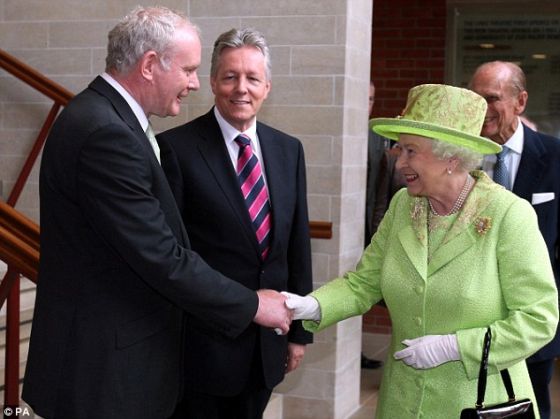
Martin McGuiness, Northern Ireland's deputy first minister, shakes hands with Queen Elizabeth II. The former IRA commander said when he shook the hand of the Queen he would be symbolically shaking the hand of every unionist in Northern Ireland.
The Guardian reports: Anglo-Irish relations took a momentous step forward on Wednesday when the Queen shook hands with Sinn Féin’s Martin McGuinness.
The historic encounter between the former IRA commander – now Northern Ireland’s deputy first minister – and the Queen was unthinkable a little over 10 years ago.
But the success of the peace process and the Queen’s acclaimed visit to the Republic of Ireland last year, when her conciliatory words and gestures won over many critics of the monarchy, paved the way for their meeting.
The much-anticipated first handshake took place away from the media spotlight behind closed doors.
They later shook hands in public. McGuinness held the monarch’s hands for a few moments and spoke to her in Irish. He told her the words meant: “Goodbye and God’s speed.”
McGuinness was a senior member of the IRA when it killed the Queen’s cousin Lord Mountbatten in a bomb blast in 1979.
The Queen is the head of Britain’s armed forces, seen in the past by Republicans as occupying troops in Northern Ireland.

Der Spiegel reports: It wasn’t long ago that Mario Draghi was spreading confidence and good cheer. “The worst is over,” the head of the European Central Bank (ECB) told Germany’s Bild newspaper only a few weeks ago. The situation in the euro zone had “stabilized,” Draghi said, and “investor confidence was returning.” And because everything seemed to be on track, Draghi even accepted a Prussian spiked helmet from the reporters. Hurrah.
Last week, however, Europe’s chief monetary watchdog wasn’t looking nearly as happy in photos taken in front of a circle of blue-and-yellow stars inside the Euro Tower, the ECB’s Frankfurt headquarters, where he was congratulating the winners of an international student contest. He smiled, shook hands and handed out certificates. But what he had to tell his listeners no longer sounded optimistic. Instead, Draghi sounded deeply concerned and even displayed a touch of resignation. “You are the first generation that has grown up with the euro and is no longer familiar with the old currencies,” he said. “I hope we won’t experience them again.”
The fact that Europe’s top central banker is no longer willing to rule out a return to the old national currencies shows how serious the situation is. Until recently, it was seen as a sign of political correctness to not even consider the possibility of a euro collapse. But now that the currency dispute has escalated in Europe, the inconceivable is becoming conceivable, at all levels of politics and the economy.
Investment experts at Deutsche Bank now feel that a collapse of the common currency is “a very likely scenario.” German companies are preparing themselves for the possibility that their business contacts in Madrid and Barcelona could soon be paying with pesetas again. And in Italy, former Prime Minister Silvio Berlusconi is thinking of running a new election campaign, possibly this year, on a return-to-the-lira platform.
Nothing seems impossible anymore, not even a scenario in which all members of the currency zone dust off their old coins and bills — bidding farewell to the euro, and instead welcoming back the guilder, deutsche mark and drachma.
It would be a dream for nationalist politicians, and a nightmare for the economy. Everything that has grown together in two decades of euro history would have to be painstakingly torn apart. Millions of contracts, business relationships and partnerships would have to be reassessed, while thousands of companies would need protection from bankruptcy. All of Europe would plunge into a deep recession. Governments, which would be forced to borrow additional billions to meet their needs, would face the choice between two unattractive options: either to drastically increase taxes or to impose significant financial burdens on their citizens in the form of higher inflation.
A horrific scenario would become a reality, a prospect so frightening that it ought to convince every European leader to seek a consensus as quickly as possible. But there can be no talk of consensus today. On the contrary, as the economic crisis worsens in southern Europe, the fronts between governments are only becoming more rigid.
The Italians and Spaniards want Germany to issue stronger guarantees for their debts. But the Germans are only willing to do so if all euro countries transfer more power to Brussels — steps the southern member states, for their part, don’t want to take.
The discussion has been going in circles for months, which is why the continent’s debtor countries continue to squander confidence, among both the international financial markets and their citizens. No matter what medicine European politicians prescribe, the patient isn’t getting any better. In fact, it’s only getting worse. [Continue reading…]
AFP reports: Circumcising young boys on religious grounds causes grievous bodily harm, a German court ruled Tuesday in a landmark decision that the Jewish community said trampled on parents’ religious rights.
The regional court in Cologne, western Germany, ruled that the “fundamental right of the child to bodily integrity outweighed the fundamental rights of the parents”, a judgement that is expected to set a legal precedent.
“The religious freedom of the parents and their right to educate their child would not be unacceptably compromised, if they were obliged to wait until the child could himself decide to be circumcised,” the court added.
The case was brought against a doctor in Cologne who had circumcised a four-year-old Muslim boy on his parents’ wishes.
A few days after the operation, his parents took him to hospital as he was bleeding heavily. Prosecutors then charged the doctor with grievous bodily harm.
The doctor was acquitted by a lower court that judged he had acted within the law as the parents had given their consent.
On appeal, the regional court also acquitted the doctor but for different reasons.
The regional court upheld the original charge of grievous bodily harm but also ruled that the doctor was innocent as there was too much confusion on the legal situation around circumcision.
The court came down firmly against parents’ right to have the ritual performed on young children.
“The body of the child is irreparably and permanently changed by a circumcision,” the court said. “This change contravenes the interests of the child to decide later on his religious beliefs.”
The decision caused outrage in Germany’s Jewish community.