Clive Stafford Smith writes: Last October I was at a jirga in Islamabad where 80 people from Waziristan had assembled to talk about the US Predator drones that buzz around overhead, periodically delivering death by Hellfire missile. A jirga is the traditional forum for discussing and resolving disputes, part parliament, part court of law. The turbaned tribal elders were joined by their young sons on a rare foray out of their region to meet outsiders and discuss the killing. The isolation of the Waziris is almost total – no western journalist has been to Miranshah for several years.
At our meeting I spoke as the representative westerner. I reported the CIA claim that not one single innocent civilian had been killed in over a year. I did not need to understand Pashtu to translate the snorts of derision when this claim was translated.
During the day I shook the hand of a 16-year-old kid from Waziristan named Tariq Aziz. One of his cousins had died in a missile strike, and he wanted to know what he could do to bring the truth to the west. At the Reprieve charity, we have a transparency project: importing cameras to the region to try to export the truth back out. Tariq wanted to take part, but I thought him too young.
Then, three days later, the CIA announced that it had eliminated “four militants”. In truth there were only two victims: Tariq had been driving his 12-year-old cousin to their aunt’s house when the Hellfire missile killed them both. This came just 24 hours after the CIA boasted of eliminating six other “militants” – actually, four chromite workers driving home from work. In both cases a local informant apparently tagged the car with a GPS monitor and lied to earn his fee. [Continue reading…]
Category Archives: Issues
Journalism in the service of killing

Daniel Klaidman
An excerpt from his book which appeared at the Daily Beast earlier this week is an example of servile propaganda at its worst.
At least in totalitarian states with their ministries of information and state-controlled newspapers, no one is under any illusion about the way in which governments shape public discourse. But in the United States with a nominally free press, accounts such as Klaidman’s purport to offer Americans outside government a rare glimpse into its innermost workings.
In this case we are being led to believe that we can now better understand what is actually happening when President Obama and a small circle of advisers make the weightiest decision anyone could ever make: when (if ever) it is justifiable to execute someone while suspending the legal constraints that otherwise control the use of capital punishment.
Klaidman’s approach to this story suggests that he investigated the issues in a similar way that an interior designer might discuss color choices with her client. His idea of depth is that he wants to find out how his subjects feel about killing people.
Klaidman tells us that Harold Hongju Koh and Jeh C. Johnson, the top lawyers at the State Department and the Pentagon, have found it stressful helping decide who gets to live or die. In other words, those observers who might imagine that a cold bureaucratic process is at work can be assured that Obama’s death panel operates with feeling and sensitivity and an acute sense of moral responsibility. These are not casual killers.
Like Koh, [Johnson] wondered whether he could withstand the heavy pressure exerted by the military to expand operations. After approving his first targeted killings one evening, he watched the digital images of the strike in real time — “Kill TV,” the military calls the live battlefield feed. Johnson could see the shadowy images of militants running drills in a training camp in Yemen. Then suddenly there was a bright flash. The figures that had been moving across the screen were gone. Johnson returned to his Georgetown home around midnight that evening, drained and exhausted. Later there were reports from human-rights groups that dozens of women and children had been killed in the attacks, reports that a military source involved in the operation termed “persuasive.” Johnson would confide to others, “If I were Catholic, I’d have to go to confession.”
If watching ones victims get executed on Kill TV evokes an image of cold brutality, we are assured that Washington’s practitioners of targeted killing, just like their Israeli counterparts, shoot and cry.
What Klaidman does through this style of narrative is set up a false intimacy — a sense that we really know what goes on in the so-called Terror Tuesday meetings because we now know that when Obama decides to kill someone who considers the matter very carefully.
The president is not a robotic killing machine. The choices he faces are brutally difficult, and he has struggled with them — sometimes turning them over in his mind again and again.
Is this what “due process” now means: that when executioner Obama issues a death sentence, it’s not an impulsive action; it’s something he actually spends some time thinking about? How reassuring!
If Klaidman was a serious journalist he would ask some serious questions. For instance, even though he might not be shown the intelligence information that forms the basis for Obama’s “kill list”, there are some relevant comparisons that he could attempt in order to expose the legal implications of what is now happening inside the White House.
For instance, is the process of deliberation inside Obama’s Star Chamber, more thorough than what happens inside a district attorney’s office in the process of considering a major criminal indictment? I suspect not, but if he had chosen to approach his subject with this amount of seriousness, Klaidman could easily have collected the kind of anecdotal evidence that would most likely make it clear that in the Obama administration, death sentences get handed out more casually than indictments. (In a summary of key moments from Klaidman’s book we learn that the State Department’s top legal adviser “would be presented with the classified PowerPoint slides, and would often have less than an hour to flick through them and determine whether or not the government had the legal authority to take out the target.”)
The picture Klaidman prefers to construct is one framed to a tee by the interests of President Obama. Whereas the CIA and the military are eager to kill as many suspected terrorists as possible, Obama is deeply concerned about the risk to innocent life.
Schooled as a constitutional lawyer, he had had to adjust quickly to the hardest part of the job: deciding whom to kill, when to kill them, and when it makes sense to put Americans in harm’s way. His instincts tilted toward justice and protecting the innocent, but he also knew that war is a messy business no matter how carefully it is conducted.
What Klaidman is doing here — and I suspect doing so in a completely mindless way — is sustaining a narrative that shapes the whole approach to drone warfare: that it goes without saying that the targets of drone strikes are guilty. In other words, no one even raises the possibility that the innocent might not only include bystanders but even the target himself.
The only time “mistakes” get reported they are of the form that a strike targeted such-and-such a suspect but ended up killing someone else. Whenever the intended target gets killed, it’s case closed. The dead are always guilty.
But how could this possibly be so? We know that it’s possible inside the elaborately constructed American capital punishment system, that after lengthy trials, appeals and sentence reviews, innocent people can still end up being executed. Why on earth would we assume that Obama’s execution process operates more efficiently?
When Klaidman presents the case of the first presidentially authorized assassination of a U.S. citizen, he doesn’t stray a fraction from the official narrative.
In Barack Obama’s mind, Anwar al-Awlaki was threat No. 1. The Yemen-based leader of AQAP had grown up in the United States, spoke fluent American-accented English, and had a charisma similar to that of Osama bin Laden: soft eyes, a mastery of language, and a sickening capacity for terror. Obama told his advisers that Awlaki was a higher priority than even Ayman al-Zawahiri, who had succeeded bin Laden as al Qaeda’s top commander. “Awlaki had things on the stove that were ready to boil over,” one of Obama’s national-security advisers observed. “Zawahiri was still looking for ingredients in the cupboard.”
What worried President Obama most was Awlaki’s ingenuity in developing murderous schemes that could evade America’s best defenses. Already he had launched the Christmas Day plot, in which a Nigerian operative had nearly brought down a packed airliner by trying to set off explosives hidden in his underwear. Then, in October 2010, AQAP had managed to put improvised bombs—ink toner cartridges filled with explosive material—on cargo planes headed to the United States. (They were intercepted as a result of a tip from Saudi intelligence.) During the summer of 2011 Obama was regularly updated on a particularly diabolical plan that AQAP’s master bomb builder, Ibrahim Hassan Tali al-Asiri, was devising. The intelligence indicated that he was close to being able to surgically implant bombs in people’s bodies. The wiring was cleverly designed to circumvent airport security, including full-body scanners. AQAP’s terror doctors had already successfully experimented with dogs and other animals.
The president made sure he got updates on Awlaki at every Terror Tuesday briefing. “I want Awlaki,” he said at one. “Don’t let up on him.” Hoss Cartwright even thought Obama’s rhetoric was starting to sound like that of George W. Bush, whom Cartwright had also briefed on many occasions. “Do you have everything you need to get this guy?” Obama would ask.
But that sense of fierce determination was a product of long experience and didn’t come easily. By the time United States intelligence agents got Awlaki in their sights, Obama had adjusted and readjusted his views on targeted killings several times. Usually he tried to measure the possible benefits of a specific killing or killings against the possible downsides, including the slaying of innocents and getting the United States more deeply embroiled in civil conflicts. The Awlaki case was in a special category, however: By almost anyone’s definition, he was a threat to the homeland, but he was also an American citizen, born in New Mexico.
The capture of a Somali operative who worked closely with Awlaki produced key intelligence, including how he traveled, the configuration of his convoys, his modes of communication, and the elaborate security measures he and his entourage took. Finally, in the spring and summer of last year, U.S. and Yemeni intelligence started to draw a bead on him. A tip from a Yemeni source and a fatal lapse in operational security by the cleric eventually did him in.
The claims that Awlaki masterminded and led terrorist operations have never been substantiated. If there really was significant evidence that he had such an operational role, it seems extremely unlikely that Obama would have any reason to need to press the case for the urgency of Awlaki’s elimination. The CIA and the Pentagon would be leading that charge without any need for Obama to crack the whip.
A much more plausible explanation for Obama’s obsession with Awlaki is one that could not be easily accommodated inside a legal framework. It wasn’t that the American cleric was in the process of devising a dastardly new way to insert explosives into underwear; it was the real threat he posed as a propagandist. That is, Awlaki represented one of the worst fears of anyone involved in counterterrorism: that as an American-born, charismatic and articulate preacher, he was capable of recruiting radicalized Caucasian converts to Islam.
Of course it this was Obama’s fear, killing Awlaki with a drone strike was no way to avert the danger since even now, as a propagandist he remains alive and well on YouTube. But these are issues that are of no apparent interest to Klaidman as he tells us how Obama learned to kill.
Perhaps the worst feature of Klaidman’s work is that he is collaborating in the definition of the new normal.
When Bush and Cheney instituted the use of torture, this provoked national debate. Even if they were able to exploit national fears that had produced a widely permissive attitude towards so-called “harsh interrogation” methods, Bush and Cheney were in some measure held accountable for choosing to adopt these practices.
When Obama entered office with the support of many Americans who imagined he was the antidote to the extremism of the previous administration, he swiftly reinforced that perception by banning the use of torture.
But when it transpired that he had banned torture only to replace it with murder, rather than this prompt loud expressions of outrage, we are being told to see this as the “evolution” of a president who is grappling with the harsh realities of the era.
This is a much more insidious message: that Obama is simply doing what anyone in his shoes would feel compelled to do; that targeted killing should now be seen as an enduring feature of U.S. foreign policy.

How Islam saved Judaism
David J Wasserstein writes: Islam saved Jewry. This is an unpopular, discomforting claim in the modern world. But it is a historical truth. The argument for it is double. First, in 570 CE, when the Prophet Mohammad was born, the Jews and Judaism were on the way to oblivion. And second, the coming of Islam saved them, providing a new context in which they not only survived, but flourished, laying foundations for subsequent Jewish cultural prosperity – also in Christendom – through the medieval period into the modern world.
By the fourth century, Christianity had become the dominant religion in the Roman empire. One aspect of this success was opposition to rival faiths, including Judaism, along with massive conversion of members of such faiths, sometimes by force, to Christianity. Much of our testimony about Jewish existence in the Roman empire from this time on consists of accounts of conversions.
Great and permanent reductions in numbers through conversion, between the fourth and the seventh centuries, brought with them a gradual but relentless whittling away of the status, rights, social and economic existence, and religious and cultural life of Jews all over the Roman empire.
A long series of enactments deprived Jewish people of their rights as citizens, prevented them from fulfilling their religious obligations, and excluded them from the society of their fellows.
This went along with the centuries-long military and political struggle with Persia. As a tiny element in the Christian world, the Jews should not have been affected much by this broad, political issue. Yet it affected them critically, because the Persian empire at this time included Babylon – now Iraq – at the time home to the world’s greatest concentration of Jews.
Here also were the greatest centres of Jewish intellectual life. The most important single work of Jewish cultural creativity in over 3,000 years, apart from the Bible itself – the Talmud – came into being in Babylon. The struggle between Persia and Byzantium, in our period, led increasingly to a separation between Jews under Byzantine, Christian rule and Jews under Persian rule.
Beyond all this, the Jews who lived under Christian rule seemed to have lost the knowledge of their own culturally specific languages – Hebrew and Aramaic – and to have taken on the use of Latin or Greek or other non-Jewish, local, languages. This in turn must have meant that they also lost access to the central literary works of Jewish culture – the Torah, Mishnah, poetry, midrash, even liturgy.
The loss of the unifying force represented by language – and of the associated literature – was a major step towards assimilation and disappearance. In these circumstances, with contact with the one place where Jewish cultural life continued to prosper – Babylon – cut off by conflict with Persia, Jewish life in the Christian world of late antiquity was not simply a pale shadow of what it had been three or four centuries earlier. It was doomed. [Continue reading…]
Video: Will the eurozone collapse?
Afghanistan: Charges amended for soldier accused in civilian deaths
The New York Times reports: The Army has amended its charges against Staff Sgt. Robert Bales, the soldier accused of murdering civilians in southern Afghanistan in March, reducing the murder count by one, to 16, and adding charges of illegal steroid use and alcohol consumption.
In its statement accompanying the amended charges, the Army did not explain why it had eliminated one of the murder counts, though it initially reported 16 dead shortly after the killings.
The added charge of alcohol consumption was expected, as military officials had previously said that soldiers on Sergeant Bales’s combat outpost in Kandahar Province reported seeing him drinking the night of the killings.
But the report of steroid use is new. The Army’s new charging sheet said that Sergeant Bales had illegally possessed and used stanozolol, an anabolic steroid commonly used by athletes to build muscle mass.
While anabolic steroids can promote rapid muscle growth, they carry an array of risks, including for higher blood pressure and cancer, and have been linked to psychological changes.
Video: Listening in at the Leveson Inquiry
The One Percent’s problem
Joseph E. Stiglitz writes: Let’s start by laying down the baseline premise: inequality in America has been widening for decades. We’re all aware of the fact. Yes, there are some on the right who deny this reality, but serious analysts across the political spectrum take it for granted. I won’t run through all the evidence here, except to say that the gap between the 1 percent and the 99 percent is vast when looked at in terms of annual income, and even vaster when looked at in terms of wealth—that is, in terms of accumulated capital and other assets. Consider the Walton family: the six heirs to the Walmart empire possess a combined wealth of some $90 billion, which is equivalent to the wealth of the entire bottom 30 percent of U.S. society. (Many at the bottom have zero or negative net worth, especially after the housing debacle.) Warren Buffett put the matter correctly when he said, “There’s been class warfare going on for the last 20 years and my class has won.”
So, no: there’s little debate over the basic fact of widening inequality. The debate is over its meaning. From the right, you sometimes hear the argument made that inequality is basically a good thing: as the rich increasingly benefit, so does everyone else. This argument is false: while the rich have been growing richer, most Americans (and not just those at the bottom) have been unable to maintain their standard of living, let alone to keep pace. A typical full-time male worker receives the same income today he did a third of a century ago.
From the left, meanwhile, the widening inequality often elicits an appeal for simple justice: why should so few have so much when so many have so little? It’s not hard to see why, in a market-driven age where justice itself is a commodity to be bought and sold, some would dismiss that argument as the stuff of pious sentiment.
Put sentiment aside. There are good reasons why plutocrats should care about inequality anyway—even if they’re thinking only about themselves. The rich do not exist in a vacuum. They need a functioning society around them to sustain their position. Widely unequal societies do not function efficiently and their economies are neither stable nor sustainable. The evidence from history and from around the modern world is unequivocal: there comes a point when inequality spirals into economic dysfunction for the whole society, and when it does, even the rich pay a steep price. [Continue reading…]
Imprisoned in America
In a review of The Collapse of American Criminal Justice by William J Stuntz, David Garland writes: The scandal of criminal justice in the United States is by now a familiar one, its facts are well known, its causes extensively canvassed. So what can another book tell us that we don’t already know? A surprising amount, as it turns out. The existing analyses are mostly conducted by sociologists and political scientists. William J. Stuntz brings the perspective of a law professor – focused on substantive law, procedural rules, and the evolution of legal doctrine. He reminds us that, whatever its underlying social, political and cultural causes, the build-up of racialized mass imprisonment was the product of legal actors – police, prosecutors and judges – and the legal rules and organizational incentives that governed their actions. And if America’s astonishing levels of imprisonment, its harsh sentencing, and its racial disparities are tolerated, it is because the Supreme Court has repeatedly affirmed that they comply with constitutional law.
The book also offers a different political perspective. Most critiques of American criminal justice are by liberals and progressives, but Bill Stuntz – who died, aged fifty-two, shortly before this book was published – was a registered Republican, an evangelical Christian, and a revisionist thinker with a fondness for “law and economic” perspectives. His viewpoint is refreshingly unpredictable and runs against the grain of conventional wisdom. It is a devastatingly critical account nevertheless. American criminal justice is, he writes, devoid of the rule of law, “wildly unjust” and the “harshest in the history of democratic government”.
The core problem, Stuntz says, is the massive and unrestrained power of police and prosecutors. Over the past forty years, criminal law in the US has become all-encompassing. There are now 40,000 federal criminal offences – above and beyond the state crimes that constitute the vast majority of offences (and which also grow apace). Many of these new offences, above all, drug and gun legislation, require little evidence, no proof of criminal intent, admit of little mitigation, and carry harsh penalties. Instead of restraining officials, criminal law provides them with an extensive battery of weapons which they can use as they see fit. [Continue reading…]
Video: Obama’s and Brennan’s ‘kill list’
Paul Fussell: The culture of war
Iran nuclear talks succeed just by continuing
Daniel Levy writes: The economic and political news out of Europe may be grim, but on the diplomatic front Europe is leading what may be the most consequential negotiations of 2012 – the so-called E3+3 talks with Iran. Those talks are being managed by the EU foreign policy chief, Catherine Ashton, and shepherded by the European External Action Service’s trouble-shooter, Helga Schmid.
Accounts from all sides suggest that Ashton and Schmid are making rather a good fist of it – the Iranians are still at the table (with a third round of talks scheduled for Moscow in mid-June) – and that the countries participating have remained sufficiently united to avoid descending into mutual recriminations. No easy task given how high the stakes are, the history of failed talks, the tensions within participants and the curveballs that Israel, the US Congress and Iran itself have a habit of throwing.
That’s all good and dandy, but the Europeans may soon have to make a decisive call on substance rather than management. What does Europe want out of these talks? At the Pollyanna-ish end of the spectrum would be a definitive, implementable and sustainable deal laying to rest nuclear suspicions towards Iran and opening a door to western-Iranian co-operation across a range of issues (think Afghanistan, Horn of Africa security, and possibly Syria and Iraq; but even Pollyanna might balk at co-operation on Israel/Palestine or democracy promotion). While the contours for such a deal exist (variations on Iran’s right to enrich being recognised, being limited and being verified), the political realities in 2012 – notably in the US and Iran – decisively undermine this prospect.
The opposite end of that scale would see talks as intended to expose Iranian malfeasance, helping to maintain international commonality of purpose as sanctions are ratcheted up further. If the ultimate goal is regime change induced by economic strangulation or Iranian capitulation (as opposed to negotiated compromise), or even to provoke Iran as a justification for military intervention, then this makes sense. Yet it is hard to view this as being the desired European outcome.
Which brings us to what is desirable and achievable in 2012. The best, realistic prognosis for these talks is that they deliver a partial enrichment freeze in return for partial sanctions relief. Short of that, the goal is more talks – improving mutual understanding for when there is greater political room for compromise – in Iran, the US or both. Crucially, military action is averted. [Continue reading…]
Video: U.S. 2012 — What happened to hope and change?
America’s murderous drone campaign is fueling terror
Seumas Milne writes: More than a decade after George W Bush launched it, the “war on terror” was supposed to be winding down. US military occupation of Iraq has ended and Nato is looking for a way out of Afghanistan, even as the carnage continues. But another war – the undeclared drone war that has already killed thousands – is now being relentlessly escalated.
From Pakistan to Somalia, CIA-controlled pilotless aircraft rain down Hellfire missiles on an ever-expanding hit list of terrorist suspects – they have already killed hundreds, perhaps thousands, of civilians in the process.
At least 15 drone strikes have been launched in Yemen this month, as many as in the whole of the past decade, killing dozens; while in Pakistan, a string of US attacks has been launched against supposed “militant” targets in the past week, incinerating up to 35 people and hitting a mosque and a bakery.
The US’s decision to step up the drone war again in Pakistan, opposed by both government and parliament in Islamabad as illegal and a violation of sovereignty, reflects its fury at the jailing of a CIA agent involved in the Bin Laden hunt and Pakistan’s refusal to reopen supply routes for Nato forces in Afghanistan. Those routes were closed in protest at the US killing of 24 Pakistani soldiers last November, for which Washington still refuses to apologise.
Wajid Shamsul Hasan, Pakistan’s high commissioner in London, describes the latest US escalation as “punitive”. But then Predators and Reapers are Barack Obama’s weapons of choice and coercion, deployed only on the territory of troublesome US allies, such as Pakistan and Yemen – and the drone war is Obama’s war. [Continue reading…]
Obama moves to expand drone warfare
Reuters reports: President Barack Obama’s administration appears set to notify the U.S. Congress of plans to arm a fleet of Italian MQ-9 Reaper drones, a step that may spur a wider spread of remotely piloted hunter-killer aircraft.
The administration could move ahead within two weeks on the proposal to let Italy join Britain in deploying U.S. drones with weapons such as laser-guided bombs and Hellfire missiles, U.S. officials said.
Italy has a fleet of six Reapers. The sale of the technology to arm them, including bomb racks and “weaponization” kits costing up to $17 million, would help the United States redistribute the burden of its global military operations as the Pentagon’s budget is being squeezed by deficit-reduction requirements.
Aides to Obama have been informally consulting the House of Representatives’ and Senate’s foreign affairs committees about the proposed sale to Italy since last year, congressional staff said.
The latest such period of “pre-consultations” ended May 27 without a move to block the sale, according to the Wall Street Journal, which first reported the coming formal notification to lawmakers.
A transfer to Italy would make it harder for the United States to deny armed-drone technology if asked for it by other members of the 28-country NATO alliance or by close U.S. partners such as South Korea, Japan and Australia, arms-sale analysts said.
“I think that if you sell armed drones to Italy, you will very likely make a decision that any member of NATO that wants them can also get them,” said a former congressional staff member who followed the issue.
Some lawmakers fear that a decision to arm Italian drones may spur overseas sales of related technology by Israel, Russia and China.
Video: Songs of war — music and violence
MEK: Terrorists? Us?
Owen Bennett-Jones writes: The story of the People’s Mujahedin of Iran, also known as the Mujahedin e Khalq (MEK), is all about the way image management can enable a diehard enemy to become a cherished ally. The MEK is currently campaigning to be officially delisted in the US as a terrorist organisation. Once off the list it will be free to make use of its support on Capitol Hill in order to become America’s most favoured, and no doubt best funded, Iranian opposition group.
The last outfit to achieve something similar was the Iraqi National Congress, the lobby group led by Ahmed Chalabi that talked of democracy and paved the way for the US invasion of Iraq by presenting Washington with highly questionable ‘evidence’ of weapons of mass destruction and Saddam Hussein’s links with al-Qaida. Then, as George Bush took the US to war, all that remained for the INC and its leaders was to sit back and prepare for government. Many in Washington believe that, for better or worse, the US will go to war with Iran and that the MEK will have a role to play. But first they will have to persuade Hillary Clinton to take the group off the US’s official terrorist list. Some of Clinton’s officials are urging her to keep the MEK on it but some of the big beasts in Washington are angrily demanding that she delist. After an exhaustive inter-agency process the MEK file is now in her in-tray. Recent State Department statements indicate that she is likely to delist the group.
Formed in the 1960s as an anti-imperialist, Islamist organisation with socialist leanings, dedicated to the overthrow of the shah, the MEK originally stood not only for Islamic revolution but also for such causes as women’s rights – an appealing combination on Iran’s university campuses. It went on to build a genuine popular base and played a significant role in overthrowing the shah in 1979. It was popular enough for Ayatollah Khomeini to feel he had to destroy it; throughout the 1980s he instigated show trials and public executions of its members. The MEK retaliated with attacks on senior clerical leaders inside Iran.
Fearing for their lives, MEK members fled first to Paris and later to Iraq, where Saddam Hussein, desperate for allies in the war with Iran, provided them with millions of dollars of funding as well as tanks, artillery pieces and other weapons. He also made land available to them. Camp Ashraf became their home, a citadel in the desert, 80 kilometres north of Baghdad and an hour’s drive from the Iranian border. Since the 1970s, the MEK’s rhetoric has changed from Islamist to secular, from socialist to capitalist, from pro-revolution to anti-revolution. And since Saddam’s fall it has portrayed itself as pro-American, peaceful and dedicated to democracy and human rights. Continual reinvention can be dangerous, however, and the new, pro-Iranian Iraqi government is under pressure from Tehran to close down Camp Ashraf, which has grown over three decades to the size of a small town. And it’s not just Iran. Many Iraqis too bear grudges against the MEK, not only for having worked alongside Saddam Hussein but also for having taken part in his violent suppression of the Kurds and Shias. [Continue reading…]
The face of collateral damage
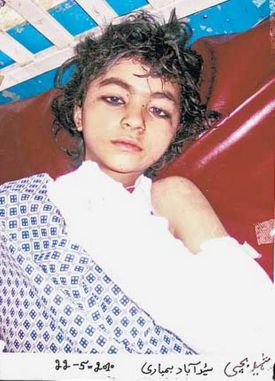
Jefferson Morley writes: Around midnight on May 21, 2010, a girl named Fatima was killed when a succession of U.S.-made Hellfire missiles, each of them five-feet long and traveling at close to 1,000 miles per hour, smashed a compound of houses in a mountain village of Mohammed Khel in North Waziristan along the Afghanistan-Pakistan border. Wounded in the explosions, which killed a half dozen men, Fatima and two other children were taken to a nearby hospital, where they died a few hours later.
Behram Noor, a Pakistani journalist, went to the hospital and took a picture of Fatima shortly before her death. Then, he went back to the scene of the explosions looking for evidence that might show who was responsible for the attack. In the rubble, he found a mechanism from a U.S.-made Hellfire missile and gave it to Reprieve, a British organization opposed to capital punishment, which shared photographs of the material with Salon. Reprieve executive director Clive Stafford Smith alluded to the missile fragments in an Op-Ed piece for the New York Times last fall. They have also been displayed in England.
“Forensically, it is important to show how the crime of murder happened (which is what it is here),” said Stafford Smith in an email. “One almost always uses the murder weapon in a case. But perhaps more important, I think this physical proof — this missile killed this child — is important to have people take it seriously.”
In the religious rhetoric used by al-Qaida’s online allies, Fatima was a “martyr.” In a statement quoted by Long War Journal, the al-Ansara forum said the senior al-Qaida commander Mustafa Abu Yazid had been killed in a “convoy of martyrs on the road with his wife and three daughters and his granddaughter; men, women and children; neighbors and loved ones.” But Fatima was not Yazid’s daughter, according to Noor, who reported from the scene. She was the daughter of another man who lost two wives and three children in the barrage.
In the euphemistic jargon of Washington, Fatima was “collateral damage” in the successful effort to assassinate Yazid, an Egyptian jihadist also known as Saeed al-Masri. In disregard for the official secrecy that envelops the drone war, U.S. intelligence officials leaked the classified details of the attack, telling the New York Times that they considered Yazid to be al-Qaida’s “No. 3 leader.” Relying on similar sources, the Washington Post said that al-Masri was the group’s “chief organizational manager.” Unlike other news organizations reporting on the attack, neither the Post nor the Times mentioned that women and children had been killed in the attack. [Continue reading…]