Michael Hastings writes: President Obama will arrive in Chicago this weekend to participate in a charade that has one not-so-hidden goal: Get the hell out of Afghanistan.
After Obama made what many around him now privately acknowledge was a mistake to escalate the conflict three years ago — essentially creating a new war of his own, tripling the size of U.S. forces after he caved under intense pressure from the Pentagon — the White House has been desperately searching for a way out. Ideally, one that couldn’t be spun as a full on retreat.
The administration didn’t find it at the last NATO Summit in Lisbon, Portugal, two years ago. The U.S. still had to pretend they were in it for the next decade. There, NATO Secretary General Anders Foghs Rasmussen boldly committed the U.S. and Europe beyond 2014. “One thing must be very clear: NATO is in this for the long term,” he told reporters at the time.
Today, the calculus has changed completely, while the strategy’s failure is nearly impossible to deny. Bin Laden’s killing — which, for what it’s worth, had zero relationship to the counterinsurgency plan we adopted — gave Obama the political cover to pull it off. Finally, Obama could overrule his generals (which he did a month after the Osama raid) whose plan called for 130,000 troops to stay for years more to come.
“People are ready to see the war be wound down,” says Heather Hurlburt, executive director of the National Security Network. “They don’t really understand. It’s been ten years, Bin Laden is gone, what exactly are we there for again?”
By rarely speaking about the war publicly — Obama has given only four major addresses on Afghanistan, or, about one speech for every 484 soldiers killed — the president allowed the horrible news to fill the void. The public was treated to one fiasco, embarrassment, or atrocity after the other, culminating with a crescendo of upsetting events this year that seemed to solidify public opinion against the fight. (The Koran burning, urinating on the Taliban, the massacre of 17 civilians, posing with dead body photos…)
With almost 70 percent of the public now against it, the war became politically safe enough to quit. “Since [the majority of] Americans neither care nor understand what the hell we’ve done there or in Iraq, he can do as he likes,” says Colonel Douglas MacGregror, a retired officer and influential military analyst. “We are at the beginning of turning inward for ten years.” [Continue reading…]
Category Archives: Issues
U.S. envoy to Israel: U.S. ready to strike Iran
The Associated Press reports: The U.S. has plans in place to attack Iran if necessary to prevent it from developing nuclear weapons, Washington’s envoy to Israel said, days ahead of a crucial round of nuclear talks with Tehran.
Dan Shapiro’s message resonated Thursday far beyond the closed forum in which it was made: Iran should not test Washington’s resolve to act on its promise to strike if diplomacy and sanctions fail to pressure Tehran to abandon its disputed nuclear program.
Shapiro told the Israel Bar Association the U.S. hopes it will not have to resort to military force.
“But that doesn’t mean that option is not fully available. Not just available, but it’s ready,” he said. “The necessary planning has been done to ensure that it’s ready.”
Iran says its nuclear program is for peaceful purposes, like energy production. The U.S. and Israel suspect Iran is pursuing nuclear weapons, but differences have emerged in how to persuade Tehran to curb its program.
Washington says diplomacy and economic sanctions must be given a chance to run its course, and is taking the lead in the ongoing talks between six global powers and Iran.
Israel, while saying it would prefer a diplomatic solution, has expressed skepticism about these talks and says time is running out for military action to be effective.
President Barack Obama has assured Israel that the U.S. is prepared to take military action if necessary, and it is standard procedure for armies to draw up plans for a broad range of possible scenarios. But Shapiro’s comments were the most explicit sign yet that preparations have been stepped up.
In his speech, Shapiro acknowledged the clock is ticking.
“We do believe there is time. Some time, not an unlimited amount of time,” Shapiro said. “But at a certain point, we may have to make a judgment that the diplomacy will not work.”
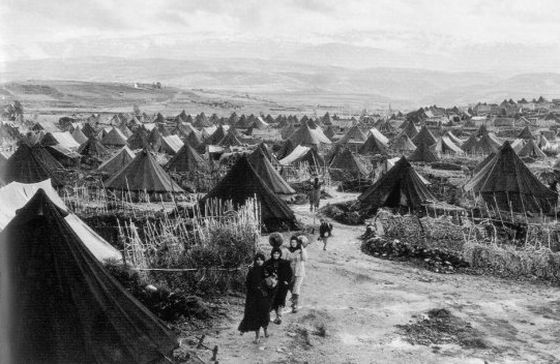
Erasing the Nakba

A refugee crisis that has lasted for 64 years following the ethnic cleansing of Palestine in 1948 in which the indigenous population was driven out by Zionists.
Neve Gordon writes: I first heard about the Nakba in the late 1980s, while I was an undergraduate student of philosophy at Hebrew University. This, I believe, is a revealing fact, particularly since, as a teenager, I was a member of Peace Now and was raised in a liberal home. I grew up in the southern city of Be’er-Sheva, which is just a few kilometres from several unrecognised Bedouin villages that, today, are home to thousands of residents who were displaced in 1948. I now know that the vast majority of the Negev’s Bedouin population was not as lucky, and that, in the late 1940s and early 1950s, most Bedouin either fled or were expelled from their ancestral lands to Jordan or Gaza.
How is it possible that a left-leaning Israeli teenager who was living in the Negev during the early 1980s (I graduated from high-school in 1983) had never heard the word “Nakba”?
How, in other words, is collective amnesia engendered?
There are many explanations of how master narratives are created and how they suppress and marginalise competing historical accounts. In addition to the work carried out by state institutions and apparata, this careful erasure also demands the ongoing mobilisation of scholars, novelists and artists – as well as other producers of popular culture.
When I was growing up, the history depicted in Israeli high-school textbooks, as well as the historical narrative promulgated by the mass media (there was only one television channel in Israel at the time, which was government run), was validated by famous novelists and public intellectuals. According to a PhD thesis written by Alon Gan from Tel Aviv University, Amos Oz, for example, interviewed soldiers after the 1967 war and used his editorial prerogative to excise descriptions of abuse in order to produce an image of the moral Israeli combatant.
Thinking back to the days when I was involved in Peace Now, I now realise that, even for most Israeli doves at the time, a conflicted history only emerged post-1967 – with the occupation of the Sinai, West Bank, Gaza Strip and the Golan Heights. Accordingly, the solution offered by Peace Now addressed the wrongs created in 1967, but had nothing to say about 1948. Indeed, I do not recall any reference to the Palestinian refugees in their publications. The seamless way in which the state had managed to completely suture the happenings of 1948, even among the Israeli peace camp, was indeed remarkable. [Continue reading…]
TED responds to criticism
This is the talk which TED earlier declined to post:
And this is Chris Anderson’s explanation about what happened:
Today TED was subject to a story so misleading it would be funny… except it successfully launched an aggressive online campaign against us.
The National Journal alleged we had censored a talk because we considered the issue of inequality “too hot to handle.” The story ignited a firestorm of outrage on Reddit, Huffington Post and elsewhere. We were accused of being cowards. We were in the pay of our corporate partners. We were the despicable puppets of the Republican party.
Here’s what actually happened.
At TED this year, an attendee pitched a 3-minute audience talk on inequality. The talk tapped into a really important and timely issue. But it framed the issue in a way that was explicitly partisan. And it included a number of arguments that were unconvincing, even to those of us who supported his overall stance. The audience at TED who heard it live (and who are often accused of being overly enthusiastic about left-leaning ideas) gave it, on average, mediocre ratings.
At TED we post one talk a day on our home page. We’re drawing from a pool of 250+ that we record at our own conferences each year and up to 10,000 recorded at the various TEDx events around the world, not to mention our other conference partners. Our policy is to post only talks that are truly special. And we try to steer clear of talks that are bound to descend into the same dismal partisan head-butting people can find every day elsewhere in the media.
We discussed internally and ultimately told the speaker we did not plan to post. He did not react well. He had hired a PR firm to promote the talk to MoveOn and others, and the PR firm warned us that unless we posted he would go to the press and accuse us of censoring him. We again declined and this time I wrote him and tried gently to explain in detail why I thought his talk was flawed.
So he forwarded portions of the private emails to a reporter and the National Journal duly bit on the story. And it was picked up by various other outlets.
And a non-story about a talk not being chosen, because we believed we had better ones, somehow got turned into a scandal about censorship. Which is like saying that if I call the New York Times and they turn down my request to publish an op-ed by me, they’re censoring me.
For the record, pretty much everyone at TED, including me, worries a great deal about the issue of rising inequality. We’ve carried talks on it in the past, like this one from Richard Wilkinson. We’d carry more in the future if someone can find a way of framing the issue that is convincing and avoids being needlessly partisan in tone.
Also, for the record, we have never sought advice from any of our advertisers on what we carry editorially. To anyone who knows how TED operates, or who has observed the noncommercial look and feel of the website, the notion that we would is laughable. We only care about one thing: finding the best speakers and the best ideas we can, and sharing them with the world. For free. I’ve devoted the rest of my life to doing this, and honestly, it’s pretty disheartening to have motives and intentions taken to task so viciously by people who simply don’t know the facts.
One takeaway for us is that we’re considering at some point posting the full archive from future conferences (somewhere away from the home page). Perhaps this would draw the sting from the accusations of censorship. Here, for starters, is the talk concerned. You can judge for yourself…
No doubt it will now, ironically, get stupendous viewing numbers and spark a magnificent debate, and then the conspiracy theorists will say the whole thing was a set-up!
OK… thanks for listening. Over and out.
The way Anderson tells the story it sounds simply like a case of someone getting turned down at an audition and then not being willing to accept a rejection. But given that Anderson describes this as an account of “what actually happened,” he fails to explain what appears to be a key component of the story: that he had written to Hanauer telling him that his talk “probably ranks as one of the most politically controversial talks we’ve ever run, and we need to be really careful when” to post it. He wrote “when” not “if” but later backtracked.
No doubt Anderson and the other folks at TED don’t appreciate the way Hanauer and his PR representatives have handled this and his talk certainly doesn’t rank as one of the most inspired TED talks, but was it really so politically controversial?
A bombed Libyan village where NATO’s ‘collateral damage’ has a name and a face
Le Monde reports: Nine months have passed but the rubble has yet to be removed. Bombed by NATO last August, the house of the Gafez family in Majer, a town about 150 kilometers east of Tripoli, still looks like a shriveled soufflé. Fourteen people died in the explosion. Twenty others died a few minutes later when bombs struck the farm of the neighbors, the Jaroods. Men, women and children, struck dead in the middle of a Ramadan evening.
What about clearing away the debris? Rebuilding? Haj Ali, the patriarch of the Gafez family never considered it. There are questions of money and of health, but also of honor, says the friendly mustachioed man. That’s because NATO doesn’t want to hear about the martyrs of Majer. The military alliance continues to insist that the bombs dropped on Aug. 8 were aimed at “legitimate military targets.”
International human rights organizations disagree. New York-based Human Rights Watch (HRW) published a well-documented report this week citing numerous errors NATO committed during its 2011 Libya campaign. According to the authors, the seven months of bombings that led to the fall of the Muammar Gaddafi regime caused the death of 72 civilians. The “relatively low” toll “shows that NATO acted with caution” all along the operation, the report states. This said, HRW laments that the military organization did not recognize its faults, did not open any probes, and did not pay any compensation to the victims of its firepower.
As an act of protest, the surviving members of the Gafez family have transformed the ruins of their house into a memorial museum. Visitors are greeted by a furious message painted on the front gate: “Is that human rights?” The words are in reference to the principle of “protecting the civilians” that French Foreign Minister Alain Juppé invoked when lobbying the U.N. Security Council to support the NATO bombing campaign. [Continue reading…]
The NDAA’s section 1021 coup d’etat foiled
Naomi Wolf writes: On Wednesday 16 May, at about 4pm, the republic of the United States of America was drawn back – at least for now – from a precipice that would have plunged our country into moral darkness. One brave and principled newly-appointed judge ruled against a law that would have brought the legal powers of the authorities of Guantánamo home to our own courthouses, streets and backyards.
US district judge Katherine Forrest, in New York City’s eastern district, found that section 1021 – the key section of the National Defense Authorization Act (NDAA) – which had been rushed into law amid secrecy and in haste on New Year’s Eve 2011, bestowing on any president the power to detain US citizens indefinitely, without charge or trial, “facially unconstitutional”. Forrest concluded that the law does indeed have, as the journalists and peaceful activists who brought the lawsuit against the president and Leon Panetta have argued, a “chilling impact on first amendment rights”. Her ruling enjoins that section of the NDAA from becoming law.
In her written opinion, the judge noted that she had been persuaded by what the lead plaintiffs – who include Pulitzer prize-winner Chris Hedges of the Nation Institute, editor Jennifer Bolen of RevolutionTruth, Noam Chomsky, Daniel Ellsberg, co-founder of Occupy London Kai Wargalla, Days of Rage editor Alexa O’Brien, and the Icelandic parliamentarian and WikiLeaks activist Birgitta Jónsdóttir – had argued. In their testimonies (in court and by affidavit), these plaintiffs compiled a persuasive case that they had “standing” to sue because it was reasonable for them to worry that they could conceivably could be detained indefinitely under the section 1021 law because their work requires them to have contact with sources the US government might assert were “terrorists” or “associated forces” of al-Qaida.
The key claim made by the plaintiffs – of which Judge Forrest was persuaded – was that the language in section 1021 is so vague that it could sweep up anyone. The law fails to define or specify what “associated forces” or the concept of “substantial support” actually mean. [Continue reading…]
Glenn Greenwald writes: The ruling was a sweeping victory for the plaintiffs, as it rejected each of the Obama DOJ’s three arguments: (1) because none of the plaintiffs has yet been indefinitely detained, they lack “standing” to challenge the statute; (2) even if they have standing, the lack of imminent enforcement against them renders injunctive relief unnecessary; and (3) the NDAA creates no new detention powers beyond what the 2001 AUMF already provides.
As for the DOJ’s first argument — lack of standing — the court found that the plaintiffs are already suffering substantial injury from the reasonable fear that they could be indefinitely detained under section 1021 of the NDAA as a result of their constitutionally protected activities. As the court explained (h/t Charles Michael):
In support of their motion, Plaintiffs assert that § 1021 already has impacted their associational and expressive activities–and would continue to impact them, and that § 1021 is vague to such an extent that it provokes fear that certain of their associational and expressive activities could subject them to indefinite or prolonged military detention.
The court found that the plaintiffs have “shown an actual fear that their expressive and associational activities” could subject them to indefinite detention under the law,and “each of them has put forward uncontroverted evidence of concrete — non-hypothetical — ways in which the presence of the legislation has already impacted those expressive and associational activities” (as but one example, Hedges presented evidence that his “prior journalistic activities relating to certain organizations such as al-Qaeda and the Taliban” proves “he has a realistic fear that those activities will subject him to detention under § 1021″). Thus, concluded the court, these plaintiffs have the right to challenge the constitutionality of the statute notwithstanding the fact that they have not yet been detained under it; that’s because its broad, menacing detention powers are already harming them and the exercise of their constitutional rights.
Significantly, the court here repeatedly told the DOJ that it could preclude standing for the plaintiffs if they were willing to state clearly that none of the journalistic and free speech conduct that the plaintiffs engage in could subject them to indefinite detention. But the Government refused to make any such representation. Thus, concluded the court, “plaintiffs have stated a more than plausible claim that the statute inappropriately encroaches on their rights under the First Amendment.” [Continue reading…]
A pundit’s rosy view of the Pax Americana
Andrew Bacevich reviews Robert Kagan’s The World America Made: Call it a hallowed tradition. To invest their views with greater authority, big thinkers—especially those given to pontificating about the course of world history—appropriate bits of wisdom penned by brand-name sages. Nothing adds ballast to an otherwise frothy argument like a pithy quotation from John Quincy Adams or George F. Kennan or Reinhold Niebuhr. In The World America Made, a slim volume of mythopoeia decked out in analytic drag, the historian and pundit Robert Kagan cites all three of those renowned figures. For real inspiration, however, he turns to a different and altogether unlikely source: Hollywood director Frank Capra. The World America Made begins and ends with Kagan urging Americans to heed the lessons of that hoariest of Christmas fantasies, It’s a Wonderful Life.
Remember Clarence, the probationary guardian angel? Clarence saves George Bailey from suicidal despair (and earns his wings) by showing George what a miserable place Bedford Falls would have been without him.
As Kagan sees it, America’s impact on history mirrors George Bailey’s impact on Bedford Falls. Thanks to the power wielded by the United States, the entire postwar era has been “a golden age for humanity.” Among the hallmarks of this golden age have been the spread of democracy, a huge reduction in world poverty, and, above all, “the absence of war among great powers.” All of this Kagan ascribes to the United States and to what he calls the “American world order.”
Accept any diminution of American preeminence and you can kiss the golden age goodbye. Just like Bedford Falls without George Bailey, the world will inevitably become a dark and miserable place. Upstart nations will “demand particular spheres of influence,” and the weakened United States will “have little choice but to retrench and cede some influence.” China, Russia, India, and others will begin flexing their expansionist muscles, with doom and gloom sure to follow. “The notion that the world could make a smooth and entirely peaceful transition” to a new order, Kagan writes, is mere “wishful thinking.”
Fortunately, none of this need come to pass if only Americans will be of good heart and heed the counsel of their own guardian angel, whose name happens to be Robert Kagan. His self-assigned mission is to prevent the United States from “committing preemptive superpower suicide out of a misplaced fear of declining power.” After all, our decline is far from inevitable. The key is to believe. Once George Bailey recovers his faith, “he solves his [firm’s] fiscal crisis and lives happily ever after.” If Americans just keep the faith, they can do likewise. [Continue reading…]
Video: Facebook IPO — is your online personal data up for sale?
Attacks by Taliban rise in surge areas
The Wall Street Journal reports: Taliban attacks are jumping in the southern Afghan areas that were the focus of the 2010 U.S. troop surge, posing a renewed challenge to the American-led coalition that hoped to pacify the crucial region before withdrawing from the country.
Making sure the fledgling Afghan security forces will be able to hold the Taliban at bay here in Kandahar and elsewhere after most American forces pull out over the next two years is the focus of a North Atlantic Treaty Organization summit that begins in Chicago on Sunday.
The summit unfolds as the coalition, after saying it has reversed the Taliban’s momentum, is gradually transferring security responsibilities across the country to the Afghan troops.
Over the past two years, the farming districts of Zhari, Panjway and Maiwand northwest of Kandahar city—the cradle of the Taliban movement—were the key battlefield of the U.S.-led military campaign in southern Afghanistan. The U.S. has held up its successes in routing the Taliban there as proof that it is winning the war.
Pushed out of these rural districts by the surge, the Taliban last year concentrated on Kandahar city, ramping up their campaign of assassinating government officials. This fighting season, however, they appear to have trickled back to their old home turf.
TED turns stupid
As readers here will know, I like TED talks. TED provides a great forum for lively, pithy presentations on “ideas worth spreading.”
Apparently, the organizers of TED have decided that the idea that widening income inequality is harming America is not an idea worth spreading.
National Journal reports: TED organizers invited a multimillionaire Seattle venture capitalist named Nick Hanauer – the first nonfamily investor in Amazon.com – to give a speech on March 1 at their TED University conference. Inequality was the topic – specifically, Hanauer’s contention that the middle class, and not wealthy innovators like himself, are America’s true “job creators.”
“We’ve had it backward for the last 30 years,” he said. “Rich businesspeople like me don’t create jobs. Rather they are a consequence of an ecosystemic feedback loop animated by middle-class consumers, and when they thrive, businesses grow and hire, and owners profit. That’s why taxing the rich to pay for investments that benefit all is a great deal for both the middle class and the rich.”
You can’t find that speech online. TED officials told Hanauer initially they were eager to distribute it. “I want to put this talk out into the world!” one of them wrote him in an e-mail in late April. But early this month they changed course, telling Hanauer that his remarks were too “political” and too controversial for posting.
Not only was this decision dumb — it was also bizarre.
Just six months ago TED posted Richard Wilkinson’s talk: “How economic inequality harms societies.”
Wilkinson is the co-author of The Spirit Level: Why Greater Equality Makes Societies Stronger which documents in great detail how inequality worsens social problems and equality promotes social health — ideas worth spreading in 2011 but not 2012?
Hopefully TED will review their decision on Hanauer’s talk and acknowledge that what they did was dumb — that would be the smart thing to do. After all, Hanauer just appeared on Charlie Rose and he’s been on NPR, neither of which can be described as venues for political radicalism.
Hanauer was interviewed on NPR’s Weekend Edition in December:
Who is delegitimizing Israel?
A recent poll conducted by the University of Maryland in which 24,090 citizens across 22 countries were interviewed, revealed that around the world Israel is viewed as negatively as North Korea.
Considering the fact that Israel has vastly greater opportunities and resources to promote its image than does North Korea and that the North Korean government has little apparent interest in improving its global image, Israelis should be asking themselves why they have a government that is doing such an appalling job of promoting their interests.
According to those whose job it is to represent Israel, the failure is not their own — it is the result of a powerful global movement hellbent on “delegitimizing” poor little Israel.
Israel’s ambassador to the United States, Michael Oren, laments:
[W]hy have anti-Israel libels once consigned to hate groups become media mainstays? How can we explain the assertion that an insidious “Israel Lobby” purchases votes in Congress, or that Israel oppresses Christians? Why is Israel’s record on gay rights dismissed as camouflage for discrimination against others?
The answer lies in the systematic delegitimization of the Jewish state. Having failed to destroy Israel by conventional arms and terrorism, Israel’s enemies alit on a subtler and more sinister tactic that hampers Israel’s ability to defend itself, even to justify its existence.
It began with PLO Chairman Yasser Arafat’s 1974 speech to the U.N., when he received a standing ovation for equating Zionism with racism—a view the U.N. General Assembly endorsed the following year. It gained credibility on college campuses through anti-Israel courses and “Israel Apartheid Weeks.” It burgeoned through the boycott of Israeli scholars, artists and athletes, and the embargo of Israeli products. It was perpetuated by journalists who published doctored photos and false Palestinian accounts of Israeli massacres.
Israel must confront the acute dangers of delegitimization as it did armies and bombers in the past. Along with celebrating our technology, pioneering science and medicine, we need to stand by the facts of our past.
The fallacy embedded in the idea that Israel is threatened by delegitimization is that Israel does not face legitimate criticism it must answer. “There’s nothing wrong with criticizing Israel…” government officials dutifully repeat yet never acknowledge the specific ways in which Israel has a responsibility to answer its critics.
The real challenge Israel faces is that it is being defended by dissembling whiners like Oren and shrill ranters like Alan Dershowitz. The message of victimhood which they disseminate resonates only with those who already hold the same view. They utterly lack any ability to influence observers who are still in the process of weighing up the issues. Indeed, they do nothing more than present Israel as a crybaby which protests it is being treated unfairly.
Contrast these voices with those that they tar as “delegitimizers” and it becomes apparent that Israel’s image problem stems not only from Israel’s actions and political failings but the fact that among Israel’s defenders there appears to be no one who can speak with integrity.
Take note, Michael Oren, this is what integrity sounds like:
American actor, Mandy Patinkin, addressing the Peace Now conference in Tel Aviv, May 11, 2012
Anyone who is really afraid of the delegitimization of Israel should consider that Israel may face no greater threat than the one posed by its own defenders.
Israel’s ties to MEK terrorism
NBC News reported in February: “Deadly attacks on Iranian nuclear scientists are being carried out by an Iranian dissident group that is financed, trained and armed by Israel’s secret service, U.S. officials tell NBC News, confirming charges leveled by Iran’s leaders.”
Mohammad Javad Larijani, a senior aide to Ayatollah Ali Khamenei, describes Israel’s role in training MEK operatives to conduct assassinations inside Iran:
Exactly when Israel’s ties with the MEK were established is unclear. But by the early 1990s, as I describe in my book, a relationship was forming, though its full nature and extent remains unknown.
At the time, Deputy Defense Minister Ephraim Sneh pushed Yitzhak Rabin to signal Tehran that Israel could also play the terrorist card. Sneh argued that whenever Iran used Islamic Jihad or Hamas to blow up a bus in Jerusalem, Israel should use the MEK to respond in kind in Tehran.
But cooler heads prevailed. Rabin refrained from entering into a public relationship with the organization. But the Labor government left the door to the MEK half open: it permitted the Iranian terrorist group to use two Israeli satellites to beam their TV broadcasts into Iran.
Even the MEK’s alleged revelation of the Iranian nuclear facilities at Natanz in 2002 was based on information leaked to the organization by Israel, according to Israeli intelligence expert Ronen Bergman. Indeed, a former US State Department official told me recently that while Israel does not publicly acknowledge its ties to the MEK, Israeli officials privately tell the US that the MEK is “useful.”
All of this has fueled suspicions in DC that the current multi-million dollar lobbying campaign by the MEK to get off of the State Department’s terror list is bankrolled by Israeli sources. Dozens of former US officials have received tens and thousands of dollars in speakers’ fees from the MEK or its surrogates to speak out on their behalf. These former officials have likely violated US laws on material support to terrorist organizations, and several of them have had their records subpoenaed by the US Treasury in an ongoing investigation.
MEK in court to force U.S. to drop terrorist label
Video: Creatively resisting occupation
Video: Is the U.S.-Yemen strategy counter-productive?
Top 10 facts you probably didn’t know about the Nakba
Yousef Munayyer writes:
1. Nakba is the Arabic word for catastrophe. It is used to describe the Palestinian loss of land and property during the depopulation of Palestine from 1947-1949 and does not refer simply to the declaration of a state of Israel.
Residents of Yaffa Pushed Into The Sea Prior to May15th, 19482. 212 localities depopulated and at least half of the refugees created during the Nakba were created prior to May 15th, which is, prior to the entry of armies of other Arab states. The largest Palestinian cities at the time, Yaffa and Haifa, were emptied of the vast majority of their inhabitants before May 15th, 1948. The idea that refugee creation happened only after, or only as a result of, the mobilization of Arab armies is patently false.
3. At every stage of the war, the Yishuv/Israeli forces were superior in training, equipment and numbers to the combined Arab armies.
4. The Zionists prepared extensive data collection efforts to map out intelligence relating to the Palestinian villages for a decade prior to the war. Detailed information about each village was kept including information on the number of inhabitants, the village’s resources, the potential activists that resided within it and what its political affiliations were. [Continue reading…]
Israel’s drone dominance
Jefferson Morley writes: Stark Aerospace of Mississippi is perhaps the only foreign-owned company with FAA permission to fly a drone in U.S. airspace. Based in the town of Columbus, the home of Mississippi State University, Stark is a subsidiary of the state-owned Israel Aerospace Industries — not that you could tell from looking at the company’s website, executive leadership or affiliations. You have to go to the Mississippi secretary of state website to learn that two of Stark’s three directors are Israelis.
So too with the America’s drone industry. The Israeli influence is not visible but it is real, documented and extremely relevant to the future of drones in America. If you want to know how drones may change American airspace in coming years, just look to Israel, where the unmanned aerial vehicle market is thriving and drones are considered a reliable instrument of “homeland security.”
“There are three explanations for Israel’s success in becoming a world leader in development and production of UAVs,” a top Israeli official explained to the Jerusalem Post last year. “We have unbelievable people and innovation, combat experience that helps us understand what we need and immediate operational use since we are always in a conflict which allows us to perfect our systems.”
Israel’s drone expertise goes back to at least 1970, according to the UAV page of the Israeli Air Force. Mark Daly, an expert on unmanned aircraft at Jane’s Defense in London, notes the Israelis were the first to make widespread use of drones in Israel’s 1982 invasion of Lebanon, when the aircraft were used to monitor troop movements.
Now, as the Arab media and Western reporters such as Scott Wilson of the Washington Post have reported, the Israeli Defense Force uses fleets of constantly hovering drones to intimidate and control the Arab population in the Gaza Strip. (The residents call these drones “zenana,” which both sounds like the aircraft’s distinctive buzz and is Arabic slang for a nagging wife.) The IDF regularly uses drones for targeted assassinations of suspected militants, saying the drones enable them to use “precision strikes” to avoid hurting civilians. Yet as Human Rights Watch has documented, the drone strikes during the Gaza War killed scores of children who were nowhere near armed combatants.
Video: The Great Book Robbery
When the Arab-Israeli war raged in 1948, librarians from Israel’s National Library followed soldiers as they entered Palestinian homes in towns and villages. Their mission was to collect as many valuable books and manuscripts as possible. They are said to have gathered over 30,000 books from Jerusalem and another 30,000 from Haifa and Jaffa.
Officially it was a ‘cultural rescue operation’ but for Palestinians it was ‘cultural theft’.
It was only in 2008 when an Israeli PhD student stumbled across documents in the national archive that the full extent of the ‘collection’ policy was revealed.
Using eyewitness accounts, this film tries to understand why thousands of books appropriated from Palestinian homes still languish in the Israeli National Library vaults and why they have not been returned to their rightful owners. Was it cultural preservation or robbery?