The Guardian reports: A United Nations investigator probing discrimination against Native Americans has called on the US government to return some of the land stolen from Indian tribes as a step toward combatting continuing and systemic racial discrimination.
James Anaya, the UN special rapporteur on the rights of indigenous peoples, said no member of the US Congress would meet him as he investigated the part played by the government in the considerable difficulties faced by Indian tribes.
Anaya said that in nearly two weeks of visiting Indian reservations, indigenous communities in Alaska and Hawaii, and Native Americans now living in cities, he encountered people who suffered a history of dispossession of their lands and resources, the breakdown of their societies and “numerous instances of outright brutality, all grounded on racial discrimination”.
“It’s a racial discrimination that they feel is both systemic and also specific instances of ongoing discrimination that is felt at the individual level,” he said.
Anaya said racism extended from the broad relationship between federal or state governments and tribes down to local issues such as education.
“For example, with the treatment of children in schools both by their peers and by teachers as well as the educational system itself; the way native Americans and indigenous peoples are reflected in the school curriculum and teaching,” he said.
“And discrimination in the sense of the invisibility of Native Americans in the country overall that often is reflected in the popular media. The idea that is often projected through the mainstream media and among public figures that indigenous peoples are either gone or as a group are insignificant or that they’re out to get benefits in terms of handouts, or their communities and cultures are reduced to casinos, which are just flatly wrong.”
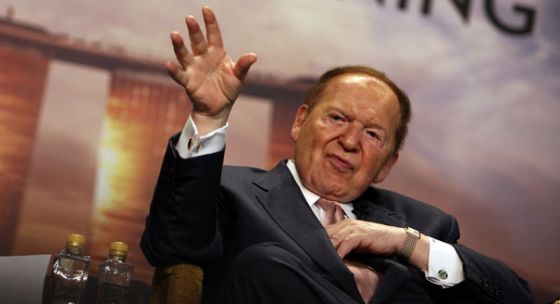
Sheldon Adelson on the Olmert government: 'This is an illegitimate government. It must be thrown out.'
CNN reports: In the explosive second part of his exclusive interview on Friday’s Amanpour, Ehud Olmert, former Israeli Prime Minister, said certain elements in the Jewish community in the United States had deliberately derailed the peace process.
Olmert was speaking of the peace plan he proposed in 2008, when he was Prime Minister. Knowing the political risks, Olmert sought a “full comprehensive peace between us and the Palestinians” – a two-state solution based on the 1967 borders.
“It broke my heart, the most difficult decision of my life,” said Olmert, once the Mayor of Jerusalem. “Because for me to propose a division of Jerusalem was really terrible. I did it because I reached a conclusion that without which, there will not be peace.”
“It was a killer for me,” he said. “It was a killer for me not only because of the opposition in Israel. I think that, by the way, in Israel the majority of the Israelis would have supported my plan, had it come for elections.”
Then, he leveled his astonishing charge: “But I had to fight against superior powers, including millions and millions of dollars that were transferred from this country (the U.S.) by figures which were from the extreme right wing, that were aimed to topple me as Prime Minister of Israel. There is no question about it.”
When asked to name names, Olmert answered: “Next time.”
If and when Olmert names names, there’s little doubt who will be at the top of his list: the American casino boss and billionaire, Sheldon Adelson.
In May 2008, this is how Nahum Barnea, a columnist for Israel’s Hebrew daily Yediot Ahronot, described Adelson’s plans to topple Olmert. “This is an illegitimate government. It must be thrown out,” Barnea quotes Adelson as saying.
Adelson is convinced that Netanyahu, not Olmert, must be prime minister of Israel. In order to advance this idea, Adelson established an anti-Olmert newspaper devoted to praising Netanyahu. Allegedly, this investment is the largest election gift ever given to Israel.
Daniel Levy translated the bulk of Barnea’s column which appeared just after Adelson appeared as the keynote speaker at a presidential conference celebrating Israel’s 60th anniversary.
When Sheldon Adelson gave his speech on the podium of the International Convention Center two days ago, I looked at Shimon Peres. I was happy for him. The impressive, sparkling conference that he convened will warm his heart…Many important, highly-respected people. An excellent organization. Well done.
As a citizen of the country, I was less happy. I saw a gambling tycoon from Las Vegas who bought my country’s birthday with three million dollars. I thought with sorrow: Is the country worth so very little? Were the champagne, wine and sushi that were given out for free in the lobby—breaking convention for such events—worth the humiliation?
Adelson is a Jew who loves Israel. Like some other Jews who live at a safe distance from here, his love is great, passionate, smothering. It is important to him that he influences the policies, decisions and compositions of Israeli governments. He is not alone in this, either: even back in the days of Baron Rothschild, wealthy Jews from the Diaspora felt that this country lay in their pocket, alongside their wallet. Regrettably, in the latest generation, we are being led by politicians who look at these millionaires with calf’s eyes.
Such deference to the wallets of other people—that is the common denominator of Rabin and Peres, Netanyahu, Barak and Olmert…
Adelson is like the others, and yet different. He has the gift of authority and the bluntness of someone who made a lot of money quickly. He does not ask; he commands.
“He talks to me as though I were his property,” the director of an important Jewish-American organization, one of the guests at the conference, told me. I heard similar complaints from others—both Israelis and Americans— about Adelson. Not long ago, the mayor of a large city received word that he had to meet Adelson immediately. He acceded, of course—the man is a big donor. When they met, Adelson ordered him to tell the municipal inspectors to leave the employees of his business (who were violating municipal law) alone.
There is a story about an anti-Arab propaganda film that Adelson had heard of. When he telephoned the director-general of a Jewish organization, asking him to buy and distribute the film, the man told him that the film was distorted, and that no one would believe it. Adelson responded—“so edit it”. When the man countered that film could not be edited, Adelson replied that he would buy the film at his expense, but that the other man would then distribute it. “He would like all the Arabs to disappear,” another activist for a Jewish organization told me. “It seems that he thinks that the Arabs are chips to be gambled with.”
Several months ago, Adelson contacted another Jewish-American millionaire and asked him to donate a large sum of money for a campaign that he was organizing against the current Israeli government. The man politely refused. “You know what”, Adelson told him, “do not donate, just sign”. When the man refused again, Adelson accused him of funding anti-Israel research. “I do not know what you mean”, the man answered. “When my man in charge of these things is in Las Vegas, he will come to you and he’ll look into the matter.”
The ensuing meeting at Adelson’s office, in the Venetian hotel-casino, was a stormy one. Adelson took out a written list of accusations, many of them childish. “You hosted (PA prime minister) Salam Fayyad,” he said. “He is a terrorist with blood on his hands. He is one of the founders of Fatah.” “Salam Fayyad was never involved in terrorism,” said the interlocutor. “He is not a member of Fatah. Where did you get these accusations from?”
Adelson responded that he had gotten them from Steve Emerson (an American Jew who often analyzes terrorism). “You work with Olmert’s government,” he added. “This is an illegitimate government. It must be thrown out.” “I thought”, said the man, “that Olmert is your friend.”
And, indeed, they were friends. Such good friends that Olmert wrote him [Adelson] a letter, asking him to buy mini-bars for his hotels from a company that Talansky represented.
Adelson is convinced that Netanyahu, not Olmert, must be prime minister of Israel. In order to advance this idea, Adelson established an anti-Olmert newspaper devoted to praising Netanyahu. Allegedly, this investment is the largest election gift ever given to Israel. I do not claim this. Firstly, it is a legitimate legal gift. Secondly, when Netanyahu is elected prime minister, he will have to act within the constraints of the State of Israel, not take dictates of a patron from Las Vegas.
Adelson, surrounded by guards, was king of the conference. He sat in the first row, with Shimon Peres between him and Olmert. He put his hand out to Olmert. Olmert shook it with a sour face. They did not exchange a single word.
Mairead Maguire writes: In 2009 Israel’s foreign minister Avigdor Liebermann ordered all foreign missions to distribute a 1941 photograph of the then Palestinian leader in exile, Haj Amin Al Husseini meeting Hitler. The motivation behind Liebermann’s order lay in international criticism of Israel’s decision to further expand its illegal settlements in occupied East Jerusalem; the not too subtle subtext being that as Palestinians are Nazis any policy implemented against them is justified.
This week the David Horowitz’s Freedom Center perpetrated the same historical distortion in its advertisement comparing college professors who advocate Boycott, Divestment and Sanctions (BDS) against the state of Israel to the Nazi government’s persecution of Jews. Ignoring the political and human rights context in which the call for BDS has been made, and its ultimate aim of securing compliance with international human rights standards, its proponents are instead vilified as Jew haters and their opposition to illegal Israeli policies presented as hatred of ‘the Jewish state.’ Through a series of outrageous assertions their support for Palestinian human rights is linked to the Nazis, calls for genocide and the Toulouse murders.
The truth however is that the call for BDS lies neither anti-Semitic in intent or effect, but reflects the recognition that after 20 years of failed negotiations and almost 44 years of military occupation and illegal colonization, there is no means by which Palestinians can achieve their basic human rights and freedoms except through the activism of international civil society. [Continue reading…]
Paul Krugman writes: The depression we’re in is essentially gratuitous: we don’t need to be suffering so much pain and destroying so many lives. We could end it both more easily and more quickly than anyone imagines—anyone, that is, except those who have actually studied the economics of depressed economies and the historical evidence on how policies work in such economies.
The truth is that recovery would be almost ridiculously easy to achieve: all we need is to reverse the austerity policies of the past couple of years and temporarily boost spending. Never mind all the talk of how we have a long-run problem that can’t have a short-run solution — this may sound sophisticated, but it isn’t. With a boost in spending, we could be back to more or less full employment faster than anyone imagines.
But don’t we have to worry about long-run budget deficits? Keynes wrote that “the boom, not the slump, is the time for austerity.” Now, as I argue in my forthcoming book — and show later in the data discussed in this article — is the time for the government to spend more until the private sector is ready to carry the economy forward again. At that point, the US would be in a far better position to deal with deficits, entitlements, and the costs of financing them.
Meanwhile, the strong measures that would all go a long way toward lifting us out of this depression should include, among other policies, increased federal aid to state and local governments, which would restore the jobs of many public employees; a more aggressive approach by the Federal Reserve to quantitative easing (that is, purchasing bonds in an attempt to reduce long-term interest rates); and less timid efforts by the Obama administration to reduce homeowner debt.
But some readers will wonder, isn’t a recovery program along the lines I’ve described just out of the question as a political matter? And isn’t advocating such a program a waste of time? My answers to these two questions are: not necessarily, and definitely not. The chances of a real turn in policy, away from the austerity mania of the last few years and toward a renewed focus on job creation, are much better than conventional wisdom would have you believe. And recent experience also teaches us a crucial political lesson: it’s much better to stand up for what you believe, to make the case for what really should be done, than to try to seem moderate and reasonable by essentially accepting your opponents’ arguments. Compromise, if you must, on the policy—but never on the truth. [Continue reading…]
Nicholas Carr writes: With a reported 900 million active members, Facebook is, by far, the largest digital-sharecropping operation that the internet has yet produced. About one out of every eight people on the planet sharecrops for Facebook today – and their collective labor is expected to put about a billion dollars of cash into CEO Mark Zuckerberg’s pocket when the company goes public in a few weeks. In a 2006 post, I explained why sharecropping is such a powerful business model for social networks and other online businesses:
One of the fundamental economic characteristics of Web 2.0 is the distribution of production into the hands of the many and the concentration of the economic rewards into the hands of the few. It’s a sharecropping system, but the sharecroppers are generally happy because their interest lies in self-expression or socializing, not in making money, and, besides, the economic value of each of their individual contributions is trivial. It’s only by aggregating those contributions on a massive scale – on a web scale – that the business becomes lucrative. To put it a different way, the sharecroppers operate happily in an attention economy while their overseers operate happily in a cash economy. In this view, the attention economy does not operate separately from the cash economy; it’s simply a means of creating cheap inputs for the cash economy.
Facebook’s most recent financial filing provides a great illustration of the “two economies” that underpin digital sharecropping. As Techcrunch noted, Facebook reported that it earned an average of $1.21 in revenue from each of its members during the first quarter of this year. [Continue reading…]
Henry A Giroux writes: Since 9/11, the war on terror and the campaign for homeland security have increasingly mimicked the tactics of the enemies they sought to crush. Violence and punishment as both a media spectacle and a bone-crushing reality have become prominent and influential forces shaping American society. As the boundaries between “the realms of war and civil life have collapsed,” social relations and the public services needed to make them viable have been increasingly privatized and militarized. The logic of profitability works its magic in channeling the public funding of warfare and organized violence into universities, market-based service providers and deregulated contractors. The metaphysics of war and associated forms of violence now creep into every aspect of American society.
As the preferred “instrument of statecraft,” war and its intensifying production of violence cross borders, time, space and places. Seemingly without any measure of self-restraint, state-sponsored violence flows and regroups, contaminating both foreign and domestic policies. One consequence of the permanent warfare state is evident in the public revelations concerning a number of war crimes committed recently by US government forces. These include the indiscriminate killings of Afghan civilians by US drone aircraft; the barbaric murder of Afghan children and peasant farmers by American infantrymen infamously labeled as “the kill team”; disclosures concerning four American Marines urinating on dead Taliban fighters; and the recent uncovering of photographs showing “more than a dozen soldiers of the 82nd Airborne Division’s Fourth Brigade Combat Team, along with some Afghan security forces, posing with the severed hands and legs of Taliban attackers in Zabul Province in 2010.” And, shocking even for those acquainted with standard military combat, there is the case of Army Staff Sgt. Robert Bales, who “walked off a small combat outpost in Kandahar province and slaughtered 17 villagers, most of them women and children and later walked back to his base and turned himself in.” Mind-numbing violence, war crimes and indiscriminate military attacks on civilians on the part of the US government are far from new, of course, and date back to infamous acts such as the air attacks on civilians in Dresden along with the atomic bombings of Hiroshima and Nagasaki during World War II. Military spokespersons are typically quick to remind the American public that such practices are part of the price one pays for combat and are endemic to war itself.
The history of atrocities committed by the United States in the name of war need not be repeated here, but some of these incidents have doubled in on themselves and fueled public outrage against the violence of war. One of the most famous was the My Lai massacre, which played a crucial role in mobilizing anti-war protests against the Vietnam War. Even dubious appeals to national defense and honor can provide no excuse for mass killings of civilians, rapes and other acts of destruction that completely lack any justifiable military objective. Not only does the alleged normative violence of war disguise the moral cowardice of the warmongers, it also demonizes the enemy and dehumanizes soldiers. It is this brutalizing psychology of desensitization, emotional hardness and the freezing of moral responsibility that is particularly crucial to understand, because it grows out of a formative culture in which war, violence and the dehumanization of others becomes routine, commonplace and removed from any sense of ethical accountability. [Continue reading…]
Joel Bleifuss writes: Last July, Adbusters sent out this invitation addressed to those “ready for a Tahrir moment”: “On Sept. 17, flood into lower Manhattan, set up tents, kitchens, peaceful barricades and occupy Wall Street.” And thus, the Vancouver-based nonprofit magazine published by self-described “culture jammers and creatives working to change the way information flows, the way corporations wield power and the way meaning is produced in our society” sparked a movement.
Estonian-born documentary filmmaker Kalle Lasn co-founded Adbusters in 1989. Lasn, 70-years-young (“old,” as in “old Left,” is an adjective he eschews), draws his inspiration from the Situationists, avant-garde European revolutionaries who believed corporate capitalism perverted the human spirit. The Situationists reached their zenith in 1968 Paris and disbanded in 1972, but their efforts to affirm what it means to be free live on in Adbusters.
In These Times spoke with Lasn in March to see what “the man behind the curtain” had to say for himself and the movement he helped ignite.
What challenges does the Occupy movement face?
It is a replay of what happened in 1968 when an insurrection in the Latin Quarter of Paris exploded onto campuses and cities around the world. For a few brief moments it looked like the first global revolution. Occupy is round two of 1968. Young people around the world have this sinking feeling that the next 30, 40 or 50 years of their lives will be one big black hole of ecological and political and financial and personal crisis. And if you are facing that sort of prospect you realize that unless you stand up and fight for a different kind of future, you don’t have a future. Unlike 1968, it is going to have legs.
We on the Left have become an ineffective, whiny, complaining, finger-pointing kind of movement that hasn’t had a new out-of-the-box idea for a couple of generations. Everything we’ve tried, including the Battle of Seattle and all sorts of anti-globalization movements, has fizzled out.
A power struggle is going on in the movement, between the old vertical type of a Left and a new young Left that has social media at its finger tips and isn’t so enamored with the old wolf pack mentality but is ready to do things in a much more horizontal way without leaders – sometimes even without demands. The question is: In this tussle between the old Left and the new Left, who will win? And if temporarily the old Left triumphs then we’re in for a hard year this year and possibly even next, but bit by bit this movement does herald a new Left. This movement has made the Left cool again. [Continue reading…]
Narges Bajoghli writes: From the Green Movement in Iran in 2009 through the Arab revolts that began in 2011, social media have held center stage in coverage of popular protest in the Middle East. Though the first flush of overwrought enthusiasm is long past, there is consensus that Facebook, Twitter and other Web 2.0 applications, particularly on handheld devices, have been an effective organizing tool against the slower-moving security apparatuses of authoritarian states. The new technology has also helped social movements to tell their story to the outside world, unhindered by official news blackouts, unbothered by state censors and unfiltered by the traditional Western media.
But what happens when digital means of communication and coordination are no longer an option for activists or, at least, a very dangerous option? The state of activism in Iran, nearly three years after the largest protests since the 1979 revolution, offers a cautionary tale for partisans of social media’s emancipatory promise. The Internet, in fact, has become the site of a protracted cat-and-mouse game as the state attempts to reassert its control after the 2009 presidential election, which large segments of the population believe to have been stolen by the state for Mahmoud Ahmadinejad. The very qualities that make new media so attractive to people seeking change from below also make them an ideal means of surveillance and manipulation from above. [Continue reading…]
SC: This company was born of a merger closed in late 1999 between Exxon and Mobil, two “Baby Standards” — two independent decedents of the breakup of Standard Oil in 1911 that was ordered by the United States Supreme Court. Essentially it was a merger of equals when there were a lot of combinations of big oil companies in the late 1990s when prices fell and the whole industry was confronted with structural problems. They combined to better manage their positions and also to compete with the state-owned companies that were rising in Russia and Brazil and elsewhere, but the merger was really Exxon buying Mobil.
When Exxon bought Mobil, however, it bought a company whose overseas holdings were in far more adventurous places than Exxon’s were. So they basically bought a bunch of wars and they bought a lot of Africa and they ended up with a map that had geopolitical risk in it to a much greater degree than Exxon alone had been forced to confront.
Probably the most important property they bought in 2000 was this giant gas field in Aceh, Indonesia, and some liquefied natural-gas facilities next door to the field. At that time, this Aceh field accounted for about a quarter of Mobil’s overseas profits; it was an enormous cash cow due to some contracts they had set up with the Japanese and South Koreans. So Exxon buys this thing, and somehow their investment bankers didn’t do full due diligence to report to the board of directors, “Oh yes, you’re also buying a war.”
Their separatist movement really ramped up and started attacking ExxonMobil’s gas fields directly, and the Indonesian military, which did not want to see Aceh go after losing East Timor, was determined that that was it — they were going to draw the line at Aceh. At that point, they were essentially under contract with ExxonMobil to defend these gas fields and they undertook a pretty brutal campaign to put down the Acehnese rebellion. This included setting up detention centers on the perimeter of Exxon’s gas fields where they detained Acehnese men and tortured them, and also conducted sweep operations in local villages that could also be violent and menacing.
This presented Exxon with a series of dilemmas that they frankly hadn’t had to reckon with in the previous 10 years when they were operating on their own in places like Australia and or in Europe. They had entered Angola but it had settled down; they had a field in Chad but they hadn’t developed it yet. They had a few of these dilemmas in places like Yemen, but nothing of this scale. And the records from the lawsuits that were eventually filed claiming human rights violations that ExxonMobil either had known about or should have known show that the company was pretty much over its head, at least initially and really didn’t know quite what to do about this.
FP: So how does a massive company like ExxonMobil set itself up to absorb a significantly higher degree of risk? These are the same sorts of problems that got Chevron in trouble in South America, Shell in Nigeria. How do they reconfigure corporate culture to absorb an entirely different type of business?
SC: They have basically a political risk department that is central to their corporate planning and to their annual strategy discussions at headquarters. It’s run by a woman named Rosemarie Forsythe who used to be on the National Security Council, and she basically goes into the management committee — which is the top group of executives that’s looking out over the world from quarter to quarter and year to year — and she presents political risk analysis, both regional and global. I spoke to her a little bit about what her PowerPoint show sounds like, and basically she describes a world in which more and more of the oil that ExxonMobil is going to be interested in or already owns is in unstable places; that’s what the basic map looks like. They color code it and they divide the world into different groups and so forth, but fundamentally the oil they can access is in unstable places. Now an academic might also point out that the oil is in unstable places because oil can be destabilizing in weak countries, but I’m not sure ExxonMobil does that analysis.
The New York Times reports: The newest heroes of the Palestinian cause are not burly young men hurling stones or wielding automatic weapons. They are gaunt adults, wrists in chains, starving themselves inside Israeli prisons.
Each day since April 17, scores of Palestinian prisoners have joined a hunger strike that officials say now counts more than 1,500 participants. And on Thursday, the Palestinian Authority’s minister of detainees said that if Israel did not yield to their demands for improved prison conditions, the remaining 3,200 would soon join in.
The two longest-striking prisoners, who have gone without food for 66 days, appeared in wheelchairs before Israel’s Supreme Court on Thursday morning, pleading for their release from what is known here as administrative detention — incarceration without formal charges. One of them, Bilal Diab, 27, fainted during the hearing.
“I am a man who loves life, and I want to live in dignity,” the other man, Thaer Halahleh, 33, testified, according to an advocacy group that had a supporter in the courtroom. “No human can accept being in jail for one hour without any charge or reason.”
As the strike has swelled, the prisoners’ names and faces have been plastered on protest tents in villages throughout the West Bank. With the peace process stalled and internal Palestinian politics adrift, many analysts here see nonviolent resistance as a critical tactic for the Palestinian national movement, and the hunger strike as a potential catalyst to bring an Arab Spring-style uprising to the West Bank. [Continue reading…]
Rick Perlstein writes: In the suburban Midwestern Reform Jewish world I was raised in, in the nineteen-seventies and eighties, grown men built plastic scale models of Israeli tanks and F-15 jets and displayed them throughout the house, dangling the warplanes from bedroom ceilings with fishing line. My dad, who had a replica Uzi sub-machine gun on his office wall, wore a tiepin that read, in Hebrew letters, Zachor, which means “remember.” What was meant to be remembered was the “six million,” the number of Jews killed in the Holocaust, a number seared into all of our souls – at home, in Sunday school, at religious services, and at the Jewish Community Center summer camp in the Wisconsin North Woods, where we began each morning by raising the Israeli and American flags side by side.
This all felt right and proper. What didn’t sit so well (with me, at any rate) was the catechism that accompanied the injunction to remember. It held that the next six million, just like the poem says, were still getting ready to die, right here in River City – or in Australia, in Timbuktu, in our own Milwaukee, or anywhere else Jews were granted the privilege – the temporary, conditional privilege — to live. The one safe haven: Israel, whose formidable tanks and planes would hold the line against the eliminationist contempt in which most of the world held us. The message provided a kind of quasi-spiritual ballast to our acquisitive upper-middle-class lives; but as an morally precocious little dude I found it all so far from observable reality, it made me want to puke.
All of which background made Peter Beinart’s recollections, in his powerful new book The Crisis of Zionism, seem very familiar – which felt uncanny, because I thought I had been alone.
As an adult, I’ve always found the stereotype that Jews are liberal a curious one; my parents’ circle was predominantly conservative, not just on Israel but on most political issues. Most of all, they were intensely (and this is a word I remember repeating in my own angry adolescent dialogues with myself) tribal. What I didn’t fully comprehend, until now, was why. Beinart unearths a story of 1970s politics that was unknown to me – except as I so intimately lived it – showing that at the root of this sense of embattled tribalism was a transformation worked by the leaders of right-leaning American Jewish organizations, who traded in their founding (liberal) aspirations to universal justice for a wagon-circling parochalism. [Continue reading…]
Gareth Porter writes: A few days after US Navy Seals killed Osama bin Laden in a raid in Abbottabad, Pakistan, a “senior intelligence official” briefing reporters on the materials seized from bin Laden’s compound said the materials revealed that bin Laden had, “continued to direct even tactical details of the group’s management.” Bin Laden was, “not just a strategic thinker for the group,” said the official. “He was active in operational planning and in driving tactical decisions.” The official called the bin Laden compound, “an active command and control center.”
The senior intelligence official triumphantly called the discovery of bin Laden’s hideout, “the greatest intelligence success perhaps of a generation,” and administration officials could not resist leaking to reporters that a key element in that success was that the CIA interrogators had gotten the name of bin Laden’s trusted courier from al-Qaeda detainees at Guantanamo. CIA Director Leon Panetta was quite willing to leave the implication that some of the information had been obtained from detainees by “enhanced interrogation techniques.”
Such was the official line at the time. But none of it was true. It is now clear that CIA officials were blatantly misrepresenting both bin Laden’s role in al-Qaeda when he was killed and how the agency came to focus on his compound in Abbottabad, Pakistan.
In fact, during his six years in Abbottabad, bin Laden was not the functioning head of al-Qaeda at all, but an isolated figurehead who had become irrelevant to the actual operations of the organization. The real story, told here for the first time, is that bin Laden was in the compound in Abbottabad because he had been forced into exile by the al-Qaeda leadership.
The CIA’s claim that it found bin Laden on its own is equally false. In fact, the intensive focus on the compound in Abbottabad was the result of crucial intelligence provided by the Pakistani intelligence agency, the Directorate for Inter-Services Intelligence (ISI).
Truthout has been able to reconstruct the real story of bin Laden’s exile in Abbottabad, as well as how the CIA found him, thanks in large part to information gathered last year from Pakistani tribal and ISI sources by retired Pakistani Brig. Gen. Shaukat Qadir. But that information was confirmed, in essence, in remarks after the bin Laden raid by the same senior intelligence official cited above – remarks that have been ignored until now. [Continue reading…]
Even if the recession is over as far as Wall Street is concerned, it sounds like the 1% still feel deeply wounded by a nation that fails to recognize their true value.
Nicholas Confessore describes the Obama campaign’s struggle to collect money from those who were once the president’s biggest financial backers.
One day in late October, Jim Messina, Obama’s campaign manager, slipped into the Regency Hotel in New York and walked up to a second-floor meeting room reserved by his aides. More than 20 of Obama’s top donors and fund-raisers, many of them from the financial industry, sat in leather chairs around a granite conference table.
Messina told them he had a problem: New York City and its suburbs, Obama’s top source of money in 2008, were behind quota. He needed their help bringing the financial community back on board.
For the next hour, the donors relayed to Messina what their friends had been saying. They felt unfairly demonized for being wealthy. They felt scapegoated for the recession. It was a few weeks into the Occupy Wall Street movement, with mass protests against the 1 percent springing up all around the country, and they blamed the president and his party for the public’s nasty mood. The administration, some suggested, had created a hostile environment for job creators.
Messina politely pushed back. It’s not the president’s fault that Americans are still upset with Wall Street, he told them, and given the public’s mood, the administration’s rhetoric had been notably restrained.
One of the guests raised his hand; he knew how to solve the problem. The president had won plaudits for his speech on race during the last campaign, the guest noted. It was a soaring address that acknowledged white resentment and urged national unity. What if Obama gave a similarly healing speech about class and inequality? What if he urged an end to attacks on the rich? Around the table, some people shook their heads in disbelief.
“Most people in the financial world,” a top Obama donor later told me, “do not understand how most of America feels about them.” But they think they understand how the president’s inner circle feels about them. “This administration has a more contemptuous view of big money and of Wall Street than any administration in 40 years,” the donor said. “And it shows.”
Historically, Wall Street, like many large and heavily regulated industries, has been Republican in its politics but pragmatic when it comes to political giving. For most of the last two decades, according to the Center for Responsive Politics, the financial world has split its donations between the two parties, usually favoring Republicans but also giving generously to the Democratic lawmakers who dominate New York.
Even if they didn’t agree with Obama on everything in 2008, many in the financial industry looked at him then and saw a reflection of their imagined best selves: brainy, self-made, above the mewlings and histrionics of partisan politics. He seemed like the kind of Democrat even white-shoe Republican bankers and libertarian hedge-funders could get behind, and many of them did. “There is a growing belief on Wall Street that Barack Obama has the capacity to lead us out of this wilderness,” Jim Cramer, the financial journalist, wrote several weeks before Election Day.
Obama far outraised his Republican rival, John McCain, on Wall Street — around $16 million to $9 million — and Goldman Sachs executives sent Obama more money than employees of any other company in the world. But four years, one recession and a host of battles — over financial regulation and the nomination of Elizabeth Warren, over Dodd-Frank and the Buffett Rule — have taken their toll. Some on Wall Street are apoplectic. One former supporter, Dan Loeb, compared Obama to Nero; the president’s enemies insinuated worse. In 2010, Stephen A. Schwarzman, a founder of Blackstone, said that an Obama proposal to raise taxes on “carried interest” — the main source of income for most private-equity managers — reminded him of “when Hitler invaded Poland in 1939.”
The New York Times reports: On Monday, the New York Police Department sent its warrant squads after an unusual set of suspects: people who had old warrants for the lowliest of violations, misconduct too minor, usually, to draw the attention of those squads.
But those who were questioned by the warrant squads said the officers had an ulterior motive: gathering intelligence for the Occupy Wall Street protests scheduled for May 1, or May Day. One person said he was interviewed about his plans for May Day. A second person said the police examined political fliers in his apartment, and then arrested him on a warrant for a 2007 open-container-of-alcohol violation.
Officials have yet to respond to questions about the tactics, but one police official, who spoke on condition of anonymity because he was not authorized to speak to reporters about police policy, said the strategy appeared to be an extension of a policy used at events where crowd control could be an issue. Before certain parades that have been marred by shootings, for example, the warrant squads have tracked down gang members who live nearby to execute outstanding warrants, no matter how minor, the official said.
But the department’s use of this tactic as part of its strategy for policing the Occupy Wall Street movement raises new questions about the surveillance efforts by the Police Department, which faces restrictions in monitoring political groups.
Zachary Dempster, 31, said he was wakened at 6:15 a.m. Monday by plainclothes police officers who entered his apartment on Myrtle Avenue in Brooklyn and herded him and two roommates into the living room. There, Mr. Dempster said, the police announced they were there that morning to serve an open-container warrant on one of the roommates, Joseph Ryan, a musician who goes by the name Joe Crow Ryan. But then one of the officers led Mr. Dempster back to his room for questioning.
“The officer said, ‘What are you doing tomorrow?’ ” Mr. Dempster recalled. “Do you have plans for May Day?”
“I said, ‘I’m not going to talk to you without my lawyer present,’ ” Mr. Dempster said, adding, “It didn’t seem right.” [Continue reading…]
The Guardian reports: Rupert Murdoch’s global media empire is facing a challenge on a new front in the billowing phone-hacking scandal after a powerful US Senate committee opened direct contact with British investigators in an attempt to find out whether News Corporation has broken American laws.
Jay Rockefeller, chairman of the Senate committee on commerce, science and transportation, has written to Lord Justice Leveson, who leads the British judicial inquiry into media ethics, asking if he has uncovered any evidence relating questionable practices in the US.
“I would like to know whether any of the evidence you are reviewing suggests that these unethical and sometimes illegal business practices occurred in the United States or involved US citizens,” Rockefeller writes in a letter released on Wednesday.
The development adds to the potential dangers facing News Corp, a publicly-traded company with its headquarters in New York. Rockefeller has taken a close interest in the unfolding phone-hacking saga, but it is the first time that a Senate committee member has acted in his official capacity.
Gareth Porter writes: The optics surrounding the Barack Obama administration’s “Enduring Strategic Partnership” agreement with Afghanistan and the Memorandums of Understanding accompanying it emphasise transition to Afghan responsibility and an end to U.S. war.
But the only substantive agreement reached between the U.S. and Afghanistan – well hidden in the agreements – has been to allow powerful U.S. Special Operations Forces (SOF) to continue to carry out the unilateral night raids on private homes that are universally hated in the Pashtun zones of Afghanistan.
The presentation of the new agreement on a surprise trip by President Obama to Afghanistan, with a prime time presidential address and repeated briefings for the press, allows Obama to go into a tight presidential election campaign on a platform of ending an unpopular U.S. war in Afghanistan.
It also allows President Hamid Karzai to claim he has gotten control over the SOF night raids while getting a 10-year commitment of U.S. economic support.
But the actual text of the agreement and of the Memorandum of Understanding (MOU) on night raids included in it by reference will not end the U.S. war in Afghanistan, nor will they give Karzai control over night raids.
The Obama administration’s success in obscuring those facts is the real story behind the ostensible story of the agreement. [Continue reading…]
Desmond Tutu writes: A quarter-century ago I barnstormed around the United States encouraging Americans, particularly students, to press for divestment from South Africa. Today, regrettably, the time has come for similar action to force an end to Israel’s long-standing occupation of Palestinian territory and refusal to extend equal rights to Palestinian citizens who suffer from some 35 discriminatory laws.
I have reached this conclusion slowly and painfully. I am aware that many of our Jewish brothers and sisters who were so instrumental in the fight against South African apartheid are not yet ready to reckon with the apartheid nature of Israel and its current government. And I am enormously concerned that raising this issue will cause heartache to some in the Jewish community with whom I have worked closely and successfully for decades. But I cannot ignore the Palestinian suffering I have witnessed, nor the voices of those courageous Jews troubled by Israel’s discriminatory course.
Within the past few days, some 1,200 American rabbis signed a letter — timed to coincide with resolutions considered by the United Methodist Church and the Presbyterian Church (USA) — urging Christians not “to selectively divest from certain companies whose products are used by Israel.” They argue that a “one-sided approach” on divestment resolutions, even the selective divestment from companies profiting from the occupation proposed by the Methodists and Presbyterians, “damages the relationship between Jews and Christians that has been nurtured for decades.”
While they are no doubt well-meaning, I believe that the rabbis and other opponents of divestment are sadly misguided. My voice will always be raised in support of Christian-Jewish ties and against the anti-Semitism that all sensible people fear and detest. But this cannot be an excuse for doing nothing and for standing aside as successive Israeli governments colonize the West Bank and advance racist laws. [Continue reading…]
James Joyner writes: In a speech Monday at the Woodrow Wilson Center in Washington, John Brennan, President Obama’s counter-terrorism advisor, made a forthright defense of the drone war currently being conducted against Islamic militants in Pakistan, Yemen, and Somalia. “As a result of our efforts,” he declared, “the United States is more secure and the American people are safer.” Brennan’s argument deserves credit for its boldness. Unfortunately, however, there’s good reason to doubt its veracity.
The first point in need of recognition is that while the Obama administration has long since dropped the phrase “Global War on Terror” from its lexicon, it has, through its amplified use of drones, escalated and expanded that war in all but name. On Monday, Brennan cited his administration’s achievements—the “death of bin Laden was our most strategic blow yet against al Qaeda” and “al Qaeda’s leadership ranks have continued to suffer heavy losses” from drone strikes inside Pakistan—but he also acknowledged that the government’s strategic focus simply shifted elsewhere as a result. Yemen’s al Qaeda in the Arabian Peninsula (AQAP) has become “al Qaeda’s most active affiliate and it continues to seek the opportunity to strike our homeland.” Additionally, he pointed out, al Qaeda in the Islamic Maghreb (AQIM) has a growing presence in North and West Africa, while the al Qaeda affiliate Boko Haram is gaining steam in Nigeria.
The wider the drone war spreads, however, the more scrutiny it deserves. After all, strikes aimed at truly high-value targets like Osama bin Laden and other major terrorist leaders make obvious tactical and strategic sense. But willy-nilly targeting of low-level militants is quite likely do more harm than good. In a now-famous October 2003 memo, then-Defense Secretary Donald Rumsfeld reasonably figured that the key question in determining whether “we are winning or losing the global war on terror” was “Are we capturing, killing or deterring and dissuading more terrorists every day than the madrassas and the radical clerics are recruiting, training and deploying against us?” [Continue reading…]
This website or its third-party tools use cookies, which are necessary to its functioning. By closing this banner, you agree to the use of cookies.