Gary Younge writes: Shortly after Mitt Romney’s failed 2008 campaign for the Republican nomination his son Tagg set up a private equity fund with the campaign’s top fundraiser. One of the first donors was his mum, Anne. Next came several of his dad’s financial backers. Tagg had no experience in the world of finance, but after two years in the middle of a deep recession the company had netted $244m from just 64 investors.
Tagg insists that neither his name nor the fact that his father had made it clear he would run for the presidency again had anything to do with his success. “The reason people invested in us is that they liked our strategies,” he told the New York Times.
Class privilege, and the power it confers, is often conveniently misunderstood by its beneficiaries as the product of their own genius rather than generations of advantage, stoutly defended and faithfully bequeathed. Evidence of such advantages is not freely available. It is not in the powerful’s interest for the rest of us to know how their influence is attained or exercised. But every now and then a dam bursts and the facts come flooding forth. [Continue reading…]
Category Archives: Issues
The rise of the Occupy movement makes it clear the institutional church has failed

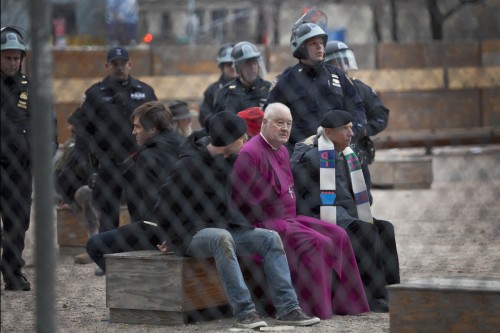
Chris Hedges writes: Retired Episcopal Bishop George Packard was arrested in Vietnam Veterans Memorial Plaza in New York City on Tuesday night as he participated in the May 1 Occupy demonstrations. He and 15 other military veterans were taken into custody after they linked arms to hold the plaza against a police attempt to clear it. There were protesters behind them who, perhaps because of confusion, perhaps because of miscommunication or perhaps they were unwilling to risk arrest, melted into the urban landscape. But those in the thin line from Veterans for Peace, of which the bishop is a member, stood their ground. They were handcuffed, herded into a paddy wagon and taken to jail.
It was Packard’s second arrest as part of the Occupy protests. Last Dec. 17 he was arrested when he leapt over a fence in his flowing bishop’s robe to spearhead an attempt to occupy a vacant lot owned by Trinity Church in lower Manhattan. The December action by the Occupy movement was a response to the New York City Police Department’s storming and eradication of the encampment in Zuccotti Park. Packard will appear in court in June to face the trespassing charge that resulted. Now, because of this second arrest, he faces the possibility of three months in jail.
Packard’s moral and intellectual courage stands in stark contrast with the timidity of nearly all clergy and congregants in all of our major religious institutions. Religious leaders, in churches, synagogues and mosques, at best voice pious and empty platitudes about justice or carry out nominal acts of charity aimed at those bearing the weight of resistance in the streets. And Packard’s arrests serve as a reminder of the price that we—especially those who claim to be informed by the message of the Christian Gospel—must be willing to pay to defy the destruction visited on us all by the corporate state. He is one of the few clergy members who dare to bear a genuine Christian witness in an age that cries out in anguish for moral guidance.
“Arrests are not arrests anymore,” Packard said as we talked Friday in a restaurant overlooking Zuccotti Park in New York. “They are badges of honor. They are, as you are taken away with your comrades, exhilarating. The spirit is calling us now into the streets, calling us to reject the old institutional orders. There is no going back. You can’t sit anymore in churches listening to stodgy liturgies. They put you to sleep. Most of these churches are museums with floorshows. They are a caricature of what Jesus intended. Jesus would be turning over the money-changing tables in their vestibules. Those in the church may be good-hearted and even well-meaning, but they are ignoring the urgent, beckoning call to engage with the world. It is only outside the church that you will find the spirit of God and Christ. And with the rise of the Occupy movement it has become clear that the institutional church has failed. It mouths hollow statements. It publishes pale Lenten study tracts. It observes from a distance without getting its hands dirty. It makes itself feel good by doing marginal charitable works, like making cocoa for Occupy protesters or providing bathrooms from 9 to 5 at Trinity Church’s Charlotte’s Place. We don’t need these little acts of charity. We need the church to have a real presence on the Jericho Road. We need people in the church to leave their comfort zones, to turn away from the hierarchy, and this is still terrifying to a lot of people in the church and especially the church leadership.” [Continue reading…]
The corporate media’s attempt to kill the Occupy movement
Michael Corcoran and Stephen Maher write: This May Day brought the explosive global resurgence of Occupy, one of the most significant social movement in decades. In New York City, the heart of global capitalism and center of the movement, the New York Civil Liberties Union estimated that 30,000 demonstrators took part in a massive rally and march down Broadway, led by a score of city taxicabs. As has become alarmingly common for a country that constantly proclaims its zealous devotion to democracy, the day ended with brutal police violence and arrests.
The visible success of Occupy in creating a space for the voice of the people impelled uncontrolled thousands to pour onto the streets of New York City, Oakland, and elsewhere around the country and across the world on May Day, in the start of what US organizers have called an “American Spring.” Touting its message of class solidarity–“we are the 99 percent” – Occupy has revealed the profoundly undemocratic nature of a democratic consensus expressed by corporate-sponsored political representatives, demanding direct popular involvement in areas of social and political life normally dominated by ruling class power.
The powerful rejuvenation of the Occupy movement, however, was used by the US media – owned by the very same interests that Occupy directly threatens – as an opportunity to finally kill the Occupy movement and marginalize the voices of its participants. Since September, the mainstream press in the US has systematically ignored and demonized the Occupy movement. The nakedness of the class bias in this case, however, was especially jarring: the size and significance of the protests were downplayed, reports of police brutality were largely ignored, and the movement was portrayed as violent and dangerous. Many of the most prominent US news outlets, such as The New York Times, practically ignored the protests altogether. These shameful distortions by the corporate press display the function of the media as an organ of the rule of “the 1 percent,” and reveal how threatened elites are by organized, direct action and democratic participation.
Meet the former right-wing blogger who realized conservatives are crazy
Joshua Holland writes: For years, Charles Johnson was a prominent right-wing “war-blogger.” On his site, Little Green Footballs, he coined the term “anti-idiotarian,” wrote frequently of a “leftist-Islamist axis,” called Daily Kos founder Markos Moulitsas “a fanatical, deadly enemy of Western civilization” and inspired the hawkish Israeli journalist Gil Ronen to gush, “If anyone ever compiles a list of Internet sites that contribute to Israel’s public relations effort, Johnson’s site will probably come in first, far above the Israeli Foreign Ministry’s site.” His comments section became an infamous hotbed of xenophobia and wingnuttery.
That was then and this is now. Visit LGF today, and you’ll find posts decrying his former fellow travelers’ knee-jerk Islamophobia, debunking the Breitbrats’ steaming piles of nonsense and defending the Obama administration against scurrilous charges from Fox News. Johnson has undergone a remarkable political transformation over the past five years, but it didn’t come without a cost; he is now among the top targets of the right blogosphere – an apostate drawing an enormous amount of venom from people he once considered his allies. [Continue reading…]
A plan to turn on the peace process or start a war?
A month ago, Shaul Mofaz, the then newly-elected leader of Israel’s Kadima party said, “I intend to replace Netanyahu,” and insisted, “I will not join his government.” Some time between then and now, he changed his mind.
The New York Times reports: The chairman of the opposition in the Israeli Parliament agreed early Tuesday morning to join the government of Prime Minister Benjamin Netanyahu, a surprise move that staves off early elections and creates a new unity coalition with a huge legislative majority, according to a spokesman for the chairman.
The spokesman, Yuval Harel, said that Shaul Mofaz, the newly elected head of the centrist Kadima Party, would become a special minister in Mr. Netanyahu’s cabinet “in charge of the process with the Palestinians.” Two other conditions of the agreement, which Mr. Harel said would be announced at a 10:30 a.m. news conference on Tuesday, were that the Parliament would pass legislation to require national or military service of all Israeli citizens, including ultra-Orthodox Jews, and to overhaul the electoral process itself. The agreement is scheduled to run until late next year.
Mr. Harel said that Mr. Mofaz, a former defense minister and military chief who ousted Tzipi Livni in last month’s Kadima primary, met with Mr. Netanyahu “at midnight at the prime minister’s home in Jerusalem and they signed a contract.”
“It was at the initiation of both sides,” Mr. Harel added. “This is the best way to get influence.”
Mr. Netanyahu had said in a speech to the convention of his right-leaning Likud Party on Sunday night that he wanted early elections to avoid the instability of a campaign season stretching more than a year. With his coalition divided over how to replace a law expiring Aug. 1 that exempted many religious Jews from military service, it seemed that the current government had decided to disband. Elections were scheduled for Sept. 4 rather than when the government’s term expires, in October 2013.
The deal, which was first reported online by The Jerusalem Post, came after the Israeli Parliament took the first steps Monday to dissolve itself. “Moments before the dissolution of the Knesset, a hasty meeting to establish a national unity government,” Carmel Shama-Cohen, a Likud member of Parliament, wrote on his Facebook wall.
With Kadima’s 28 seats in Parliament, Mr. Netanyahu will have a government that includes 96 of the 120 lawmakers, covering a broad section of the political spectrum.
A spokesman for the prime minister’s office said he could not confirm the online reports of the deal. But Mr. Harel said that Mr. Mofaz met in the early hours with the members of his faction and that they had all approved it, though the chairman is the only Kadima member who will get a minister’s portfolio and join in Mr. Netanyahu’s closed cabinet forums.
If taking over a peace process that has been hopelessly stalled seems a dubious prize, Mr. Harel said it would soon be proven otherwise. “That’s part of the deal,” he said. “To turn on the process.”
Larry Derfner writes: Why does a national leader decide to scrap new elections that he and everyone else knows he’s going to win by a landslide, which is what Bibi did last night? Because he’s got important work to do and he wants what’s called “industrial peace” – or, as Netanyahu himself put it, “stability.” Our national leader wants to bomb Iran’s nuclear facilities and he’s waiting for the right opportunity to do so – when the Obama administration is hard put to stop him, meaning sometime between now and the November 2 U.S. presidential elections. Starting such a war is going to require every gram of attention and effort Bibi can call forth, and he doesn’t want the pressure of elections and forming a new government as (huge) distractions, which he would have had from now into October if he’d gone ahead with elections in September. Now, without those elections and with an absolutely unshakable coalition, he can give his full concentration to saving Israel from annihilation, as he sees it.
In preparation for war against Iran, U.S. set to give Israel largest grant of military aid ever
Following a decision by the U.S. House of Representatives Defense Appropriations Subcommittee which just approved over $948 million in funding for Israel’s anti-missile defense programs, Israel will receive a record $4 billion in military aid in 2013.
The Jewish Press reports: Approximately $679 million of the funding will go to the Iron Dome, thanks in large part to legislation initiated last month by Reps. Ileana Ros-Lehtinen (R-Fla.) and Howard Berman (D-Calif.), chairwoman and ranking Democrat on the House Foreign Affairs Committee, respectively.
The remaining $269 million will go to Israel’s other anti-missile initiatives: the short-range David’s Sling ($149.7 million), and the current long-range Arrow anti-ballistic missile system and its successor the Arrow 3 ($119.3 million). These projects, unlike the Iron Dome, are joint Israel-US projects.
While the increase in funding for the Iron Dome was expected, with the Department of Defense stating in March that it “intends to request an appropriate level of funding from Congress to support such acquisitions based on Israeli requirements and production capacity,” the funding for the other projects represents an increase of $169 million over the Obama administration’s proposed number.
Secret U.S. program releases high-level Taliban prisoners in exchange for pledges of peace
The Washington Post reports: The United States has for several years been secretly releasing high-level detainees from a military prison in Afghanistan as part of negotiations with insurgent groups, a bold effort to quell violence but one that U.S. officials acknowledge poses substantial risks.
As the United States has unsuccessfully pursued a peace deal with the Taliban, the “strategic release” program has quietly served as a live diplomatic channel, allowing American officials to use prisoners as bargaining chips in restive provinces where military power has reached its limits.
But the releases are an inherent gamble: The freed detainees are often notorious fighters who would not be released under the traditional legal system for military prisoners in Afghanistan. They must promise to give up violence — and U.S. officials warn them that if they are caught attacking American troops, they will be detained once again.
There are no absolute guarantees, however, and officials would not say whether those who have been released under the program have later returned to attack U.S. and Afghan forces once again.
“Everyone agrees they are guilty of what they have done and should remain in detention. Everyone agrees that these are bad guys. But the benefits outweigh the risks,” said one U.S. official who, like others, discussed the issue on the condition of anonymity because of the sensitivity of the program.
Election puts French Afghan force on notice
The New York Times reports: A spokesman for the French military here said that about a fourth of French troops were on course to leave Afghanistan by the end of this year, while they awaited word on whether the new French president would speed up their withdrawal.
Troops from France, the fifth-biggest troop-contributing country in the NATO-led coalition, would drop to 2,600 by the end of the year, from 3,400 now, according to Lt. Col. Francois Guillermet, a spokesman for the French military.
About 200 French troops, mostly combat forces, left Afghanistan in March ahead of schedule in the wake of an attack by a rogue Afghan soldier that killed four French soldiers and wounded 15.
President-elect François Hollande of France had said during the election campaign that he would withdraw all French combat troops from Afghanistan by the end of 2012 — a year sooner than France’s already accelerated withdrawal.
The emperor has no clothes: Palestinians and the end of the peace process
International Crisis Group, Middle East Report #122, executive summary: Does anybody still believe in the Middle East Peace Process? Nineteen years after Oslo and thirteen years after a final settlement was supposed to be reached, prospects for a two-state solution are as dim as ever. The international community mechanically goes through the motions, with as little energy as conviction. The parties most directly concerned, the Israeli and Palestinian people, appear long ago to have lost hope. Substantive gaps are wide, and it has become a challenge to get the sides in the same room. The bad news is the U.S. presidential campaign, Arab Spring, Israel’s focus on Iran and European financial woes portend a peacemaking hiatus. The good news is such a hiatus is badly needed. The expected diplomatic lull is a chance to reconsider basic pillars of the process – not to discard the two-state solution, for no other option can possibly attract mutual assent; nor to give up on negotiations, for no outcome will be imposed from outside. But to incorporate new issues and constituencies; rethink Palestinian strategy to alter the balance of power; and put in place a more effective international architecture.
For all the scepticism surrounding the ways of the past, breaking with them will not come easily. Few may still believe in the peace process, but many still see significant utility in it. Ongoing negotiations help Washington manage its relations with the Arab world and to compensate for close ties to Israel with ostensible efforts to meet Palestinian aspirations. Europeans have found a role, bankrolling the Palestinian Authority and, via the Quartet, earning a seat at one of the most prestigious diplomatic tables – a satisfaction they share with Russia and the UN Secretary-General. Peace talks are highly useful to Israel for deflecting international criticism and pressure.
Palestinians suffer most from the status quo, yet even they stand to lose if the comatose process finally were pronounced dead. The Palestinian Authority (PA) might collapse and with it the economic and political benefits it generates as well as the assistance it attracts. For the Palestinian elite, the peace process has meant relative comfort in the West Bank as well as constant, high-level diplomatic attention. Without negotiations, Fatah would lose much of what has come to be seen as its raison d’être and would be even more exposed to Hamas’s criticism.
But the reason most often cited for maintaining the existing peace process is the conviction that halting it risks creating a vacuum that would be filled with despair and chaos. The end result is that the peace process, for all its acknowledged shortcomings, over time has become a collective addiction that serves all manner of needs, reaching an agreement no longer being the main one. And so the illusion continues, for that largely is what it is.
More than any others, Palestinians have become aware of this trap, so have been the first to tinker with different approaches. But tinker is the appropriate term: their leadership, in its quest to reshuffle the deck, has flitted from one idea to another and pursued tracks simultaneously without fully thinking through the alternatives or committing to a single one. For a time, it seemed that President Mahmoud Abbas’s September 2011 speech at the UN General Assembly – resolute and assertive – might presage a momentous shift in strategy. But after the Security Council buried Palestine’s application for UN membership in committee, the logical follow-up – an effort to gain support for statehood at the General Assembly – was ignored. After admittance to one UN agency, the leadership froze further efforts. After refusing negotiations unless Israel froze settlements and without clear terms of reference, Abbas consented to talks. After threatening to dissolve the PA, central figures waved off the idea and declared the PA a strategic asset. After reaching a reconciliation agreement with Hamas, the two parties reverted to bickering.
One can fault the Palestinian leadership for lack of vision, yet there is good reason for its irresoluteness. Whatever it chooses to do would carry a potentially heavy price and at best uncertain gain. Negotiations are viewed by a majority of Palestinians as a fool’s errand, so a decision to resume without fulfilment of Abbas’s demands (settlement freeze and agreed terms of reference) could be costly for his movement’s future. His hesitation is all the stronger now that he has persuaded himself that Prime Minister Netanyahu’s positions are incompatible with a two-state solution. A decisive Palestinian move at the UN (whether at the General Assembly or in seeking agency membership) likely would prompt a cut-off in U.S. aid and suspension of tax clearance revenue transfers by Israel. A joint government with Hamas could trigger similar consequences without assurance that elections could be held or territorial unity between the West Bank and Gaza restored. Getting rid of the PA could backfire badly, leaving many public employees and their families penniless while also leading to painful Israeli counter-measures.
The trouble with all these domestic and international justifications for not rocking the boat is that they are less and less convincing and that perpetuating the status quo is not cost-free. A process that is turning in circles undermines the credibility of all its advocates. It cannot effectively shelter the U.S. from criticism or Israel from condemnation. Europe can fund a PA whose expiration date has passed only for so long. The Palestinian leadership is facing ever sharpening questioning of its approach. Most of all, the idea that to end the existing process would create a dangerous vacuum wildly exaggerates the process’s remaining credibility and thus assumes it still serves as a substitute for a vacuum – when in reality it widely is considered vacuous itself.
Finding an alternative approach is no mean feat. Contrary to what some say, or hope, it is not a one-state solution – which is championed, in very different versions, by elements of both the Israeli and Palestinian political spectrums. A one-state reality already is in place, but as a solution it almost certainly would face insurmountable challenges – beginning with the fact that it is fiercely opposed by a vast majority of Jewish Israelis, who view it as antithetical to their basic aspiration. By the same token, even though alternatives to the current process should be pursued, a solution ultimately will be found only through negotiations.
What should be explored is a novel approach to a negotiated two-state solution that seeks to heighten incentives for reaching a deal and disincentives for sticking with the status quo, while offering a different type of third-party mediation. In this spirit, four traditionally neglected areas ought to be addressed:
New issues. At the core of the Oslo process was the notion that a peace agreement would need to deal with issues emanating from the 1967 War – the occupation of the West Bank and Gaza – as opposed to those that arose in 1948 from the establishment of Israel, the trauma of the accompanying war and the displacement of the vast majority of Palestinians. But if that logic was ever persuasive, it no longer is. On one side, the character of the State of Israel; recognition of Jewish history; regional security concerns extending beyond the Jordan River; and the connection with the entire Land of Israel have been pushed to the fore. On the other, the issue of the right of return and the Nakba (the “catastrophe” that befell Palestinians in 1948); the place of the Arab minority in Israel; and, more broadly, the Palestinian connection to Historic Palestine have become more prominent. Within Jewish and Muslim communities alike, religion has become more prevalent in political discussions, and its influence on peacemaking looms larger than before.
As difficult as it is to imagine a solution that addresses these issues, it is harder still to imagine one that does not. If the two sides are to be induced to reach agreement, such matters almost certainly need to be tackled. Israelis and Palestinians, rather than refusing to deal with the others’ core concerns, both might use them as a springboard to address their own.
New constituencies. The process for most of the past two decades has been led by a relatively narrow array of actors. But the interests of those who have been excluded resonate deeply with their respective mainstreams. In Israel, this includes the Right, both religious and national, as well as settlers. Among Palestinians, it includes Islamists, Palestinian citizens of Israel and the diaspora. That needs to be rectified. A proposed deal that is attractive to new constituencies would minimise opposition and could attract support from unexpected quarters.
New Palestinian strategy. The Palestinian leadership has tested various waters but is apprehensive about taking the plunge. That approach appears less sustainable by the day, eroding the leadership’s credibility and international patience. Rather than ad-hoc, shifting tactical moves, the entire Palestinian national movement needs to think seriously through its various options – including reconciliation, internationalisation, popular resistance and fate of the PA – and decide whether it is prepared to pay the costs for pursuing them fully. If the answer is “no”, then it would be better to stop the loose talk that has been surrounding them of late.
New international architecture. Palestinian recourse to the UN is a symptom, at base, of international failure to lead and provide effective mediation. The body responsible for doing so, the Quartet, has delivered precious little since its 2002 inception; by creating an international forum whose survival depends on perpetuation of the process and whose mode of operation entails silencing individual voices in favour of a mushy, lowest-common-denominator consensus, it arguably has done more harm than good. Whether the body should be entirely disbanded or restructured – and if so, how – is a question with which the international community needs to grapple. Whatever the form, it ought to address the profound changes taking place in the Middle East, the opportunities they present and the risks they pose.
The inescapable truth, almost two decades into the peace process, is that all actors are now engaged in a game of make-believe: that a resumption of talks in the current context can lead to success; that an agreement can be reached within a short timeframe; that the Quartet is an effective mediator; that the Palestinian leadership is serious about reconciliation, or the UN, or popular resistance, or disbanding the PA. This is not to say that the process itself has run its course. Continued meetings and even partial agreements – invariably welcomed as breakthroughs – are possible precisely because so many have an interest in its perpetuation. But it will not bring about a durable and lasting peace. The first step in breaking what has become an injurious addiction to a futile process is to recognise that it is so – to acknowledge, at long last, that the emperor has no clothes.

Read the complete report, The Emperor Has No Clothes: Palestinians and the End of the Peace Process [PDF].
The Pentagon’s addiction to failed wars
From a national security perspective, failure in war is war with no victory or tangible accomplishments.
From the commercial perspective of the military-industrial complex however, what has turned into the hidden success of the American way of war is that it can be made never-ending. In other words, failure in war has become the Pentagon’s bread and butter.
With U.S. troops withdrawn from Iraq, a significantly reduced military presence in Afghanistan not far away and a gradual winding down of the war on terror likely, the Pentagon needs new reasons to justify its bloated budget.
At a time when political leaders in Central and South America have become increasingly critical of the United States’ war on drugs, the Pentagon wants to put out a different message — one that the New York Times, as a government-sanctioned information service, is only too happy to deliver.
In Honduras, where the grimmest social service is on offer — free caskets and funerals for the poor who are getting murdered almost once an hour — the Pentagon’s happy message is that it can help this drug-violence afflicted nation through lessons learned in Iraq and the war on terror.
The Pentagon, delivering its message through a reliable Times “reporter”, is that an expanding U.S. military presence in Central America should not be seen as expanding because it employs “small-footprint missions.” And it shouldn’t be perceived as a military engagement because Americans are not doing the shooting.
Honduras is the latest focal point in America’s drug war. As Mexico puts the squeeze on narcotics barons using its territory as a transit hub, more than 90 percent of the cocaine from Colombia and Venezuela bound for the United States passes through Central America. More than a third of those narcotics make their way through Honduras, a country with vast ungoverned areas — and one of the highest per capita homicide rates in the world.
This new offensive, emerging just as the United States military winds down its conflicts in Iraq and Afghanistan and is moving to confront emerging threats, also showcases the nation’s new way of war: small-footprint missions with limited numbers of troops, partnerships with foreign military and police forces that take the lead in security operations, and narrowly defined goals, whether aimed at insurgents, terrorists or criminal groups that threaten American interests.
The effort draws on hard lessons learned from a decade of counterinsurgency in Afghanistan and Iraq, where troops were moved from giant bases to outposts scattered across remote, hostile areas so they could face off against insurgents.
But the mission here has been adapted to strict rules of engagement prohibiting American combat in Central America, a delicate issue given Washington’s messy history in Honduras, which was the base for the secret operation once run by Oliver North to funnel money and arms to rebels fighting in neighboring Nicaragua. Some skeptics still worry that the American military might accidentally empower thuggish elements of local security forces.
While there is increasing skepticism that law enforcement backed up with military muscle can ever thwart a drug trade that is driven by American drug consumption, the Pentagon counters that fighting drug cartels is just like fighting terrorism. Indeed, deploying the rhetorical tactic that anything can be justified if it can be presented as a form of counter-terrorism, the war on drugs is now being framed as an integral part of the war on terror.
“The drug demand in the United States certainly exacerbates challenges placed upon our neighboring countries fighting against these organizations — and why it is so important that we partner with them in their countering efforts,” said Vice Adm. Joseph D. Kernan, the No. 2 officer at Southern Command, which is responsible for military activities in Central and South America.
Before this assignment, Admiral Kernan spent years in Navy SEAL combat units, and he sees the effort to combat drug cartels as necessary to preventing terrorists from co-opting criminal groups for attacks in this hemisphere.
There are “insidious” parallels between regional criminal organizations and terror networks, Admiral Kernan said. “They operate without regard to borders,” he said, in order to smuggle drugs, people, weapons and money.
Of course there is also one very large and powerful state that has a habit of operating without regard to borders.
One word that gets no mention in the New York Times article is decriminalization. It’s a subject that several Latin American presidents have said needs to be debated.
The war on drugs has been no more successful than prohibition, but whereas prohibition was abandoned after just 13 years, the war on drugs is now in its fifth decade. The United States doesn’t need to merely stop using the phrase “war on drugs” — it needs to end the mindset that led to a war on drugs.
Any politician willing to take on that challenge will also have to take on a serious fight against those who are profiting from this war: the military-industrial complex, the prison-industrial complex, and multiple U.S. government agencies.
After the recent Summit of the Americas conference in Columbia, Amy Goodman hosted a discussion on the issues on Democracy Now!
U.S. has made war on terror a war without end
Fareed Zacharia writes: Whatever you thought of President Obama’s recent speech on Afghanistan, it is now increasingly clear that the United States is winding down its massive military commitments to the two wars of the last decade.
We are out of Iraq and we will soon be largely out of Afghanistan. Osama bin Laden is dead, and al Qaeda is a shadow of its former self. Threats remain but these are being handled using special forces and intelligence. So, finally, after a decade, we seem to be right-sizing the threat from terrorist groups.
Or are we?
While we will leave the battlefields of the greater Middle East, we are firmly committed to the war on terror at home. What do I mean by that? Well, look at the expansion of federal bureaucracies to tackle this war.
Since September 11, 2001, the U.S. government has created or reconfigured at least 263 organizations to tackle some aspect of the war on terror. Thirty-three new building complexes have been built for the intelligence bureaucracies alone, occupying 17 million square feet – the equivalent of 22 U.S. Capitols or three Pentagons. The largest bureaucracy after the Pentagon and the Department of Veterans Affairs is now the Department of Homeland Security, which has a workforce of 230,000 people.
The rise of this national security state has entailed a vast expansion in the government’s powers that now touch every aspect of American life, even when seemingly unrelated to terrorism. Some 30,000 people, for example, are now employed exclusively to listen in on phone conversations and other communications within the United States.
In the past, the U.S. government has built up for wars, assumed emergency authority and sometimes abused that power, yet always demobilized after the war. But this is, of course, a war without end. [Continue reading…]
What could become a fatal remedy for climate change
Michael Specter writes: Late in the afternoon on April 2, 1991, Mt. Pinatubo, a volcano on the Philippine island of Luzon, began to rumble with a series of the powerful steam explosions that typically precede an eruption. Pinatubo had been dormant for more than four centuries, and in the volcanological world the mountain had become little more than a footnote. The tremors continued in a steady crescendo for the next two months, until June 15th, when the mountain exploded with enough force to expel molten lava at the speed of six hundred miles an hour. The lava flooded a two-hundred-and-fifty-square-mile area, requiring the evacuation of two hundred thousand people.
Within hours, the plume of gas and ash had penetrated the stratosphere, eventually reaching an altitude of twenty-one miles. Three weeks later, an aerosol cloud had encircled the earth, and it remained for nearly two years. Twenty million metric tons of sulfur dioxide mixed with droplets of water, creating a kind of gaseous mirror, which reflected solar rays back into the sky. Throughout 1992 and 1993, the amount of sunlight that reached the surface of the earth was reduced by more than ten per cent.
The heavy industrial activity of the previous hundred years had caused the earth’s climate to warm by roughly three-quarters of a degree Celsius, helping to make the twentieth century the hottest in at least a thousand years. The eruption of Mt. Pinatubo, however, reduced global temperatures by nearly that much in a single year. It also disrupted patterns of precipitation throughout the planet. It is believed to have influenced events as varied as floods along the Mississippi River in 1993 and, later that year, the drought that devastated the African Sahel. Most people considered the eruption a calamity.
For geophysical scientists, though, Mt. Pinatubo provided the best model in at least a century to help us understand what might happen if humans attempted to ameliorate global warming by deliberately altering the climate of the earth.
For years, even to entertain the possibility of human intervention on such a scale—geoengineering, as the practice is known—has been denounced as hubris. Predicting long-term climatic behavior by using computer models has proved difficult, and the notion of fiddling with the planet’s climate based on the results generated by those models worries even scientists who are fully engaged in the research. “There will be no easy victories, but at some point we are going to have to take the facts seriously,’’ David Keith, a professor of engineering and public policy at Harvard and one of geoengineering’s most thoughtful supporters, told me. “Nonetheless,’’ he added, “it is hyperbolic to say this, but no less true: when you start to reflect light away from the planet, you can easily imagine a chain of events that would extinguish life on earth.”
There is only one reason to consider deploying a scheme with even a tiny chance of causing such a catastrophe: if the risks of not deploying it were clearly higher. No one is yet prepared to make such a calculation, but researchers are moving in that direction. To offer guidance, the Intergovernmental Panel on Climate Change (I.P.C.C.) has developed a series of scenarios on global warming. The cheeriest assessment predicts that by the end of the century the earth’s average temperature will rise between 1.1 and 2.9 degrees Celsius. A more pessimistic projection envisages a rise of between 2.4 and 6.4 degrees—far higher than at any time in recorded history. (There are nearly two degrees Fahrenheit in one degree Celsius. A rise of 2.4 to 6.4 degrees Celsius would equal 4.3 to 11.5 degrees Fahrenheit.) Until recently, climate scientists believed that a six-degree rise, the effects of which would be an undeniable disaster, was unlikely. But new data have changed the minds of many. Late last year, Fatih Birol, the chief economist for the International Energy Agency, said that current levels of consumption “put the world perfectly on track for a six-degree Celsius rise in temperature. . . . Everybody, even schoolchildren, knows this will have catastrophic implications for all of us.” [Continue reading…]
Video: Will the 9/11 suspects receive a fair trial?
Arab Spring has washed the region’s appalling racism out of the news
Robert Fisk writes: How many tracts, books, documentaries, speeches and doctoral theses have been written and produced about Islamophobia? How many denunciations have been made against the Sarkozys and the Le Pens and the Wilders for their anti-immigration (for which, read largely anti-Muslim) policies or – let us go down far darker paths – against the plague of Breivik-style racism?
The problem with all this is that Muslim societies – or shall we whittle this down to Middle Eastern societies? – are allowed to appear squeaky-clean in the face of such trash, and innocent of any racism themselves.
A health warning, therefore, to all Arab readers of this column: you may not like this week’s rant from yours truly. Because I fear very much that the video of Alem Dechasa’s recent torment in Beirut is all too typical of the treatment meted out to foreign domestic workers across the Arab world (there are 200,000 in Lebanon alone).
Many hundreds of thousands have now seen the footage of 33-year-old Ms Dechasa being abused and humiliated and pushed into a taxi by Ali Mahfouz, the Lebanese agent who brought her to Lebanon as a domestic worker. Ms Dechasa was transported to hospital where she was placed in the psychiatric wing and where, on 14 March, she hanged herself. She was a mother of two and could not stand the thought of being deported back to her native Ethiopia. That may not have been the only reason for her mental agony.
Lebanese women protested in the centre of Beirut, the UN protested, everyone protested. Ali Mahfouz has been formally accused of contributing to her death. But that’s it. [Continue reading…]
U.S. will be dragged into conflict if Israel hits Iran
The Jerusalem Post reports: A former senior Pentagon official said Saturday that now is not an opportune time for an Israeli strike on Iran, and that any such strike would inevitably draw in the United States.
Colin Kahl, who served as deputy assistant secretary of defense for the Middle East until December, said that any Israeli strike that prompted an Iranian retaliation would affect the United States.
“Even if it’s just retaliation against Israel, the Americans will be in it from the beginning,” he said, since the US would provide assistance to Israeli defense and because Iran would see an Israeli attack as inseparable from an American attack.
Kahl assessed that the Iranian response would be far-reaching and include rocket attacks on American embassies in the region, using area allies and proxies and threatening the functioning of the Strait of Hormuz.
“No one should delude themselves that … the prospect of America getting dragged into this is minor. It’s not,” he warned.
Kahl also laid out conditions that he felt should be in place before any country undertook a strike on Iran: that other options such as diplomacy and sanctions have run their course; that Iran had clearly decided to move toward nuclear weaponization; that the military action could seriously degrade Tehran’s capabilities; that an international coalition could be maintained after a strike.
“One reason I’ve been so critical about the Israelis taking action against Iran’s nuclear program is that at this moment they don’t satisfy any of those four criteria,” he said.
Hunger strikers shake foundations of Israeli justice system
Omar H Rahman writes: As midnight approached on April 17, Khader Adnan, a Palestinian political prisoner who made headlines around the world after going on hunger strike for 66 days, was given a hero’s welcome as he returned to his home. Fireworks coloured the night sky, horns blared and people on foot, in cars, and on tractors rushed off to receive Adnan at the gates of his village.
“I won’t believe he is out of prison until I see him for myself,” said his visibly anxious wife, Randa, who had borne a heavy burden during her husband’s four-month ordeal. Yet, in a gesture indicative of the leader Adnan has recently become, he refused to be taken to his own home before visiting relatives of those other political prisoners from his village who remained in prison and on hunger strike.
Adnan, who had been detained for four months, was never charged with a criminal offence or presented any evidence of wrongdoing. In addition, as part of the agreement that eventually led to his release, Israel had the ability to bring new evidence against him and put him on trial. By failing to do so in the nearly two months between the end of his hunger strike and his release, Israel tacitly admitted that it lacked such evidence to begin with. It has also exposed once more the ease with which a Palestinian can be taken from his or her home without charge and incarcerated for months or, in the worst cases, even years.
His hunger strike set off a wave of similar protests in Israeli prisons and on the day he gained his freedom, approximately 1,500 Palestinian prisoners began a collective, open-ended hunger strike to protest Israel’s continued policy of wide-scale detention and its treatment of prisoners. What has been billed the “War of Empty Stomachs” now has all the makings of a movement. [Continue reading…]
Palestinian Christians against the occupation
Philip Farah writes: In a recent op-ed in the Wall Street Journal, Israeli Ambassador Michael Oren claimed that Christians in Israel are better off than their brethren anywhere else in the Middle East. Two Sundays ago, “60 Minutes” made clear he attempted to intimidate Bob Simon by going over Simon’s head to speak to Jeff Fager, the head of CBS News and executive producer of “60 Minutes,” to complain that Simon’s story on Christian Palestinians was “a hatchet job” against Israel. In fact, it was a hard-hitting, but honest piece in which Simon helped to expose the terrible harm the Israeli occupation — not Muslim Palestinians as the ambassador claimed — is doing to Christian Palestinians in the Holy Land.
I am a Palestinian Christian, now a U.S. citizen, and my own experience and that of my family attest to the falsity of Ambassador Oren’s assertion. I was born in East Jerusalem, Jordan in 1952, only a few years after my family and the majority of Palestinians fled from their homes when the newly established Jewish state took over three-quarters of historical Palestine. My family, like almost all the other Palestinians who fled — Christians and Muslims alike — became refugees, losing their fields, orchards, homes and practically everything else, to Israel. Israel defied the international consensus and a U.N. resolution calling on it to allow the Palestinian refugees to return.
Had Israel allowed the Palestinians to return, it would not have become a majority Jewish state. Israel’s fear of a Palestinian presence within its borders continues to drive its brutal policies of occupation, which victimize Palestinian Christians as well as Muslims. Israel occupied the rest of historical Palestine in 1967, gaining control over a large Palestinian Arab population which many Israelis view as a threat to the “Jewish character” of their country.
There is a simple test of Ambassador Oren’s claims: I say to him, “Mr. Ambassador: If your country is so good to Christians, why don’t you allow me, my family and thousands of Palestinian Christians to return to our homes in the part of Jerusalem which Israel occupied in 1967 or the western part of the city from which Palestinians were forced out in 1948? Why is it that any Jew from any country in the world can claim full rights of citizenship as soon as he or she sets foot in Jerusalem, while I, whose family roots in Jerusalem go back many centuries, am barred from living with full human rights in my hometown?” [Continue reading…]
HWR: U.S. ‘targeted killing’ policy disregards human rights law
Human Rights Watch: In a statement at the Woodrow Wilson Center on April 30, 2012, chief US counterterrorism advisor John Brennan sought to clarify and justify the US use of aerial drones in targeted killings in Pakistan, Yemen, and elsewhere.
He acknowledged that all targeted killings are governed by the requirements of international and domestic US law. At the same time, he asserted, consistent with previous statements of administration officials, that targeted killings are justified under the laws of war against anyone who is “part of” al Qaeda, the Taliban, or associated forces, even in situations far from a recognizable battlefield. However, including anyone ambiguously considered “part of” an armed group as a valid military target exceeds what is permissible under the laws of war. During an armed conflict between a state and a non-state armed group, it is lawful to target only persons taking a direct part in hostilities. This would include individuals planning and directing operations, but not those linked to the armed group in a non-operational way.
Moreover, “part of” is an elastic standard, and given the unilateral way in which it is being applied, it is dangerous to suggest that only the laws of war are relevant. Rather, in situations away from a recognized battlefield, the more appropriate standard is found in international human rights law. It permits the use of force only as a last resort to stop an imminent threat to life, not simply because someone is “part of” a violent organization or may have committed acts of violence in the past. Brennan mentioned these standards – pledging that the US will use lethal force not to punish individuals for past acts, but against those it believes are planning or carrying out future attacks, and only in parts of the world where arresting a suspect is not feasible. But he treats these as discretionary, not as legal requirements. In the case of the “imminence” requirement, he incorrectly suggests it is legally binding only when US citizens are targeted, though in fact it applies to all people, irrespective of citizenship.
Addressing these concerns is all the more important because, as Brennan acknowledged, many nations are seeking and will obtain drone technology. He said the administration was “very mindful that as our nation uses this technology, we are establishing precedents that other nations may follow, and not all of them will be nations that share our interests or the premium we put on protecting human life, including innocent civilians.” Because the US treats many of the most important constraints on the use of force as matters of discretionary prudence rather than legal requirements, the US approach would not forbid the Russians to target an alleged Chechen militant in New York, or the Chinese a Uighur separatist in Washington, DC, if they said they were at war with these groups and the US didn’t apprehend them. That is a deeply troublesome precedent to set. If the US is in fact willing to live within these constraints as a matter of policy, it should be willing to promote wider observance of them as a matter of law.
Brennan says the administration is committed to “greater transparency,” but then suggests that this commitment is satisfied – if not exceeded – by his speech. Despite administration assertions that “innocent civilians” have not been injured or killed, except in the “rarest of circumstances,” there has been no clear accounting of civilian loss or opportunity to meaningfully examine the administration’s assertions. Moreover, given that the CIA is one of the least transparent agencies, with no tradition of public accountability, Human Rights Watch repeats its call to transfer command of drone operations to the US armed forces.