Category Archives: Issues

A family’s billions, artfully sheltered

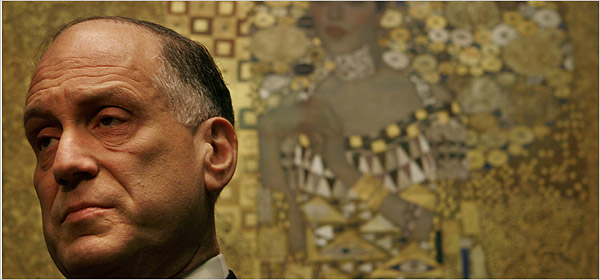
The New York Times reports: As he stood in the opulent marble foyer of a Fifth Avenue mansion late last month, greeting the coterie of prominent guests arriving at his private art gallery, Ronald S. Lauder was doing more than just being a gracious host.

To celebrate the 10th anniversary of the Neue Galerie, Mr. Lauder’s museum of Austrian and German art, he exhibited many of the treasures of a personal collection valued at more than $1 billion, including works by Van Gogh, Cézanne and Matisse, and a Klimt portrait he bought five years ago for $135 million.

Yet for Mr. Lauder, an heir to the Estée Lauder fortune whose net worth is estimated at more than $3.1 billion, the evening went beyond social and cultural significance. As is often the case with his activities, just beneath the surface was a shrewd use of the United States tax code. By donating his art to his private foundation, Mr. Lauder has qualified for deductions worth tens of millions of dollars in federal income taxes over the years, savings that help defray the hundreds of millions he has spent creating one of New York City’s cultural gems.

The charitable deductions generated by Mr. Lauder — whose donations have aided causes as varied as hospitals and efforts to rebuild Jewish identity in Eastern Europe — are just one facet of a sophisticated tax strategy used to preserve a fortune that Forbes magazine says makes him the world’s 362nd wealthiest person. From offshore havens to a tax-sheltering stock deal so audacious that Congress later enacted a law forbidding the tactic, Mr. Lauder has for decades aggressively taken advantage of tax breaks that are useful only for the most affluent.

The debate over whether to reduce tax shelters and preferences for the rich is one of the most volatile in Washington and will move to the presidential campaign, now that repeated attempts in Congress to strike a grand bargain over spending cuts and an overhaul of the tax code have failed.

There’s an interesting backstory to this article. Charles Finch notes that since the Lauder group of companies are among the most lucrative of the New York Times‘ advertisers, “endangering this cosmetic revenue stream seems suicidal at best.” But Finch goes on to note the fiercely competitive relationship between the Lauder brothers, Ronald and Leonard (both collectors of Klimt), and writes:

[T]o ascertain, perhaps, what is really going on, one must go back to the book of Genesis, specifically to the tale of Cain and Abel. There has always been a presumptive sense of art-collecting museo-competition between the czar of MoMA, Ron, and the head of the inferior Whitney Museum, Leonard. Ron has always won this battle convincingly, in spite of the fact that he has been (as copiously detailed in the Times article) a dilettante, while older brother Leonard has run the family business.

Additionally, Leonard’s deceased bride Evelyn was a major hands-on executive and new product innovator in the Lauder cream stream. So let’s look deeper into the Times‘ expose. First, Ron’s position as CEO of Clinique is characterized as a sinecure and his business skills, relative to the company, as nonexistent.

Elements of Ron’s checkered career, especially his short and troubled stint as Ronald Reagan’s Ambassador to Vienna and his multimillion-dollar run for NYC mayor, are elucidated. And who do you think the Lauder relatives were who lent all their company stock to Ronald for tax avoidance purposes? The Leonard Lauder family.

To conclude, dear readers, who would be the only source kosher enough to green light the Times expose of Ronald Lauder’s tax strategies, while keeping the paper’s relationship with Estée Lauder safe and enjoying a little fraternal revenge under a cloud of personal grief? Leonard Lauder, of course!


Facebooktwittermail

World on track for nearly 11-degree temperature rise, energy expert says

The Washington Post reports: The chief economist for the International Energy Agency said Monday that current global energy consumption levels put the Earth on a trajectory to warm by 6 degrees Celsius (10.8 degrees Fahrenheit) above pre-industrial levels by 2100, an outcome he called “a catastrophe for all of us.”

Fatih Birol [PDF] spoke as as delegates from nearly 200 countries convened the opening day of annual U.N. climate talks in Durban, South Africa.

International climate negotiators have pledged to keep the global temperature rise to 2 degrees Celsius, or 3.6 degrees Fahrenheit, above pre-industrial levels. The Earth has already warmed 0.8 degrees Celsius, or 1.4 Fahrenheit, so far, according to climate scientists.

According to the IEA’s most recent analysis, heat-trapping emissions from the world’s energy infrastructure will lead to a 2-degree Celsius increase in the Earth’s temperature that, as more capacity is added to the system, will climb to 6 degrees Celsius of warming by 2100.

Unless there is a shift away from some of the fossil fuel energy now used for electricity generation and transportation, Birol said, “the world is perfectly on track for a six-degree Celsius increase in temperature.

“Everybody, even the schoolchildren, knows this is a catastrophe for all of us,” he said at the Carnegie Endowment for International Peace.

Facebooktwittermail

Hank Paulson’s inside jobs

Felix Salmon writes: What on earth did Hank Paulson think his job was in the summer of 2008? As far as most of us were concerned, he was secretary of the US Treasury, answerable to the US people and to the president. But at the same time, in secret meetings, Paulson was hanging out with his old Goldman Sachs buddies, giving them invaluable information about what he was thinking in his new job.

The first news of this behavior came in October 2009, when Andrew Ross Sorkin revealed that Paulson had met with the entire board of Goldman Sachs in a Moscow hotel suite for an hour at the end of June 2008. He told them his views of the US and global economies, he previewed a market-moving speech he was about to give, and he even talked about the possibility that Lehman Brothers might blow up. Maybe it’s not so surprising that Goldman Sachs turned out to be so well positioned when Lehman did indeed do just that a few months later.

Today we learn that the Goldman meeting in Moscow was not some kind of aberration. A few weeks later, on July 28 2008, Paulson met with a who’s who of the hedge-fund world in the headquarters of Eton Park Capital Management — a fund founded by former Goldman superstar Eric Mindich.

Facebooktwittermail

Funds and refiners ponder oil Armageddon, war on Iran

Reuters reports: Oil consuming nations, hedge funds and big oil refineries are quietly preparing for a Doomsday scenario: An attack on Iran that would halt oil supplies from OPEC’s second-largest producer.

Most political analysts and oil traders say the probability of military action is low, but they caution the risks of such an event have risen as the West and Israel grow increasingly alarmed by signs that Tehran is building nuclear weapons.

That has Chinese refiners drawing up new contingency plans, hedge funds taking out options on $170 crude, and energy experts scrambling to determine how a disruption in Iran’s oil supply — however remote the possibility — would impact world markets.

With production of about 3.5 million barrels per day, Iran supplies 2.5 percent of the world’s oil.

“I think the market has paid too little attention to the possibility of an attack on Iran. It’s still an unlikely event, but more likely than oil traders have been expecting,” says Bob McNally, once a White House energy advisor and now head of consultancy Rapidan Group.

Rising tensions were clear this week as Iranian protesters stormed two British diplomatic missions in Tehran in response to sanctions, smashing windows and burning the British flag.

Facebooktwittermail

Disappearing dissent: How Bahrain buried its revolution

Time magazine reports: Every dictator worth his epaulets knows that the best way to nip a revolution in the bud is to have his opponents “disappear.” No body to mourn, no martyrs raised, and of course the ever-useful plausible deniability. But in Bahrain, with its tightly packed population of 230,000 citizens living on a small sandy archipelago in the Persian Gulf, it is difficult to bury the bodies. People notice. So what’s an authoritarian government to do when the people rise up and protest the regime? Bury the evidence and pretend it never happened.

Pearl Roundabout was the locus of Bahrain’s anti-government protests last spring, the Bahraini answer to Egypt’s Tahrir Square. The roundabout, located at the intersection of several major roads leading to the capital’s major business centers, was crowned by a soaring white monument constructed in 1982 on the occasion of the third Gulf Cooperation Council Summit, which was held in Manama that year. The six convex arches, one for each of the council member nations, were topped by a giant pearl, symbol of the region’s maritime heritage. Before oil transformed the coast from sand spit to skyscrapers, the gulf was best known for its pearling industry.

But soon after the protests started on Feb. 14, the monument took on a new symbolism—defiance against a regime that had repeatedly failed to deliver on a decade old promises of reform and political freedoms. As in Tahrir, protestors set up a camp around the monument, and used the hexagonal fountain at its base as a stage for rallies. In the early hours of Feb. 17, security forces broke up the camp with a combination of rubber bullets, tear gas and live ammunition. Six people died and the Bahraini revolution was born. What started as a unified protest soon devolved into a ugly sectarian split; Bahrain’s Sunni minority rallied in support of the Sunni royal family, and Shias, who make up an estimated 70% of the population, lobbied for rights they said they had long been denied. Protestors started calling their movement the Lulu Revolution after the Arabic word for pearl.

A month later the government ordered the monument pulled down. Officials declared on state TV that it had been “violated” and “desecrated” by the protestors, and needed to be “cleansed.” But by then the symbolism had already taken on a life of its own. Nothing remains of the monument now, just a barren patch of land encircled by not one, but two, layers of fencing and guarded by armed soldiers. Nevertheless the nation remains divided. You are either “pro-roundabout,” meaning you want reform. Or “anti-roundabout,” meaning you prefer the status quo.

Even your choice of coffee is a declaration of allegiance: The Costa Coffee franchise, which is owned by an apolitical Shia businessman, is considered “pro-roundabout.” Starbucks’ franchise in Bahrain, owned by a presumably bemused Kuwaiti, is anti. Jassim Hussein Ali, a well-known member of the Shia opposition Wefaq party and, until the party resigned in protest last spring, a member of Parliament, was recently approached at his neighborhood Starbucks and told that he might be more comfortable at a Costa. “The guy made it sound like a joke, but the kind of joke that wasn’t really a joke,” he told me over coffee a few weeks later. We met, of course, at Costa.

Efforts to bury the revolution haven’t stopped with the destruction of monuments. The half-dinar, Bahrain’s highest value coin ($1.5), features the monument. It has completely disappeared from circulation. So quickly and so quietly that no one knew to retain any as mementos. “They were just gone one day,” says Fatima Haji. “It’s revenge. They [the government] want nothing that is a reminder of our protest.”

Facebooktwittermail

Night raids and death squads in Afghanistan

What’s the difference between the death squads being operated by the Haqqani network and the night raids by US Special Operations forces? Chances are that the Haqqanis know the names of a much higher percentage of their victims. That isn’t the only difference, but it’s significant. As far as the U.S. and its allies are concerned, any adult male who gets shot in the night by their forces gets counted as an insurgent.

The New York Times reports: As targeted killings have risen sharply across Afghanistan, American and Afghan officials believe that many are the work of counterintelligence units of the Haqqani militant network and Al Qaeda, charged with killing suspected informants and terrorizing the populace on both sides of the Afghanistan-Pakistan border.

Military intelligence officials say that the units essentially act as death squads and that one of them, a large group known as the Khurasan that operates primarily in Pakistan’s tribal areas, has been responsible for at least 250 assassinations and public executions.

Another group, whose name is not known, works mainly in Afghanistan and may be responsible for at least 20 killings in Khost Province over the summer alone, including a mass beheading that came to light only after a video was found in the possession of a captured insurgent. The video shows 10 headless bodies evenly spaced along a paved road, while their heads sit nearby in a semicircle, their faces clearly visible.

It is another indication that the Haqqanis, a mostly Pakistan-based faction, remain the most dangerous part of an insurgency that makes full use of a porous and often ill-defined border, as the NATO strike that killed 24 Pakistani soldiers over the weekend showed.

Though the circumstances of that strike remain murky, it has now further upset relations between Pakistan and the United States, even as it once again demonstrated how havens inside Pakistan remained a critical part of the insurgent strategy.

The Americans have geared their offensive around bloodying the insurgents as they enter Afghanistan. But the new wave of assassinations shows that, even as NATO portrays the insurgents as a weakening force, the Haqqanis can still assert their influence, not only with headline-grabbing bombings but also through intimidation and by controlling perceptions.

One chilling case attributed to the second death squad came after American forces captured the senior Afghanistan-based leader for the Haqqanis, Hajji Mali Khan, and killed his top deputy this summer. Just days later, the bodies of two men accused of helping the Americans turned up near the village where Mr. Khan was captured. Scalding iron rods had been shoved through their legs. One victim had been disemboweled, and both had been shot through the head and crushed by boulders. Fear shot through the entire village.

“You could hardly recognize them,” said a witness who viewed the bodies.

Across Afghanistan, assassinations have jumped 61 percent, to 131 reported killings, through the first nine months of this year, compared with the same period in 2010, according to NATO statistics. United Nations officials say they began noticing a sharp increase in 2010, with 462 assassinations according to their records, double the number from the previous year. The figures may not include many killings in remote areas, like the mass beheading, because fearful villagers never reported them.

Early this month, Gareth Porter wrote: U.S. Special Operations Forces (SOF) killed well over 1,500 civilians in night raids in less than 10 months in 2010 and early 2011, analysis of official statistics on the raids released by the U.S.-NATO command reveals.

That number would make U.S. night raids by far the largest cause of civilian casualties in the war in Afghanistan. The report by the U.N. Assistance Mission in Afghanistan on civilian casualties in 2010 had said the use of Improvised Explosive Devices (IEDs) by insurgents was the leading cause of civilian deaths, with 904.

Except for a relatively few women and children killed by accident, the civilians who died in the raids were all adult males who were counted as insurgents in press releases and official data released by the International Security Assistance Force (ISAF).

The data on night raids, which were given to selected news media, cover three distinct 90-day night raid campaigns from May through July 2010, early August to early November, and mid-November to mid- February. The combined totals for the three periods indicate that a minimum of 2,599 rank and file insurgents were killed and an additional 723 “leaders” killed or captured in raids.

Assuming conservatively that one-third of the alleged leaders were killed, the total number of alleged insurgents killed in the raids was 2,844.

SOF night raids during the 10-month period totaled 6,282, according to the same ISAF data.

A third crucial statistic, repeated frequently by U.S and NATO officials in 2010 and 2011, is that shots were fired by SOF units in only 20 percent of night raids.

A U.S. military source who has been briefed on SOF operation confirmed to IPS what has been generally known among outside observers – that anytime shots are fired by SOF troops in a night raid, someone is killed.

If shots were fired in 20 percent of the 6,282 raids, it means that 2,844 were killed in 1,256 raids.

With very rare exceptions, night raids target only individuals rather than groups. They are carried out at night because they are aimed at catching the individual at home asleep and therefore taken completely by surprise.

Therefore, a minimum of 1,588 people (2,844 total killed minus the 1,256 targets in the lethal raids) were killed in the raids even though they weren’t targeted.

Facebooktwittermail

Kasich, Koch and big-industry bucks: Why Ohio is the next fracking frontier

Truth Out reports: Fracking opponents in southern Ohio won a victory last week when the United States Forest Service (USFS) withdrew more than 3,000 acres of public lands from a federal oil and gas lease sale scheduled for December 7, 2012. The USFS announced that it needed more time to review the potential effects of fracking after receiving petitions and letters from local leaders who used the old-fashioned method of collecting signatures to catch the attention of government officials.

The fracking industry, on the other hand, has spent $747 million dollars in the past decade to lobby Congress and support politicians in states like Ohio, Michigan and New York as part of a campaign to keep fracking unregulated, according to a recent Common Cause report.

Fracking is short for horizontal hydraulic fracturing, and Ohio is the next ground zero for the rapidly expanding natural-gas drilling method, which has enraged environmentalists and provoked controversy across the country. Fracking involves injecting millions of gallons of water and chemicals – some of them toxic – into deep underground wells to break up rock and release natural gas.

Common Cause reports that fracking companies spent $2.8 million in political contributions to Ohio parties and candidates since 2001. Republican Gov. John Kasich tops the list and has received $213,519 in campaign contributions from the industry.

Additional analysis of campaign records by Truthout reveals that wealthy executives of companies connected to the natural gas industry, including billionaires William “Bill” Koch and David Koch of Koch brothers fame, funneled an additional $127,268 in personal donations through a political action committee (PAC) to support Kasich’s election in 2010.

Earlier this year, Kasich signed a law passed by Ohio’s Republican-controlled legislature allowing drilling companies to frack in state parks, a big signal to the industry that Ohio is open for business.

Facebooktwittermail

Banks may have illegally foreclosed on 5,000 members of the military

Think Progress reports: For months, major banks have been dealing with the fallout of the “robo-signing” scandal, following reports that the banks were improperly foreclosing on homeowners and, in many instances, falsifying paperwork that they were submitting to courts. Banks have been forced to go back and re-examine foreclosures to ensure that homeowners did not lose their homes unlawfully.

In the latest episode of this mess, the Office of the Comptroller of the Currency has found that banks — including Bank of America, Wells Fargo, and Citigroup — may have improperly foreclosed on up to 5,000 active members of the military:

Facebooktwittermail

Israel — still an embarrassment to its friends

Joe Klein writes: My friend and colleague, the great war photographer Lynsey Addario, has been through a lot this year — kidnapped by the Libyans, difficult assignments in Afghanistan, Somalia and Gaza, and a much less taxing three weeks hanging with me on my annual road trip, all while pregnant… and now she has been utterly humiliated at a checkpoint by the Israeli army while on assignment for the New York Times.

Lynsey asked not to pass through the x-ray machine at the border, since she is nearly 8 months pregnant — and obviously so — but she was forced to pass through the machine 3 times while being verbally abused and then strip-searched for good measure.

This is completely outrageous, of course. It is another indication that Israel has been brutalized by its occupation of Arab territories since 1967. For those of us who feel strongly about the need for Israel to exist–especially those of us who love the place, warts and all–this incident is yet another reason to fear for Israel’s future.

There’s something not quite right about Klein’s phrasing: “Israel has been brutalized by its occupation of Arab territories since 1967.”

Israel, the eternal victim, is now the victim of its own behavior.

I doubt that this was Klein’s intention. To be more blunt and precise he should have said, Israel has brutalized itself by its occupation of Arab territories since 1967.

What Klein and Israel’s other friends still refuse to acknowledge is that this institutional brutality did not begin in 1967 but was already fully evident in 1948. The ethnic cleansing of Palestine was no accident.

Meanwhile, the New York Times itself apparently regards Addario’s treatment by Israeli soldiers as an issue more appropriately dealt with through written correspondence with Israeli officials than by giving it the weight of a front page news item (or even any page in print), nor deeming it worthy of editorial comment. (This has been its only coverage so far.)

Is this out of deference to the Palestinians? An implicit acknowledgment that the occasional affronts that foreign journalists suffer at the hands of Israelis are everyday occurrences for the population that for 44 years has lived under Israeli military rule?

Unlikely. Much more likely is that the New York Times wants to minimize the embarrassment of its friends and staff reporters in Israel.

Facebooktwittermail

Secret Fed loans helped banks net $13 billion

Bloomberg Markets Magazine reports: The Federal Reserve and the big banks fought for more than two years to keep details of the largest bailout in U.S. history a secret. Now, the rest of the world can see what it was missing.

The Fed didn’t tell anyone which banks were in trouble so deep they required a combined $1.2 trillion on Dec. 5, 2008, their single neediest day. Bankers didn’t mention that they took tens of billions of dollars in emergency loans at the same time they were assuring investors their firms were healthy. And no one calculated until now that banks reaped an estimated $13 billion of income by taking advantage of the Fed’s below-market rates, Bloomberg Markets magazine reports in its January issue.

Saved by the bailout, bankers lobbied against government regulations, a job made easier by the Fed, which never disclosed the details of the rescue to lawmakers even as Congress doled out more money and debated new rules aimed at preventing the next collapse.

A fresh narrative of the financial crisis of 2007 to 2009 emerges from 29,000 pages of Fed documents obtained under the Freedom of Information Act and central bank records of more than 21,000 transactions. While Fed officials say that almost all of the loans were repaid and there have been no losses, details suggest taxpayers paid a price beyond dollars as the secret funding helped preserve a broken status quo and enabled the biggest banks to grow even bigger.

“When you see the dollars the banks got, it’s hard to make the case these were successful institutions,” says Sherrod Brown, a Democratic Senator from Ohio who in 2010 introduced an unsuccessful bill to limit bank size. “This is an issue that can unite the Tea Party and Occupy Wall Street. There are lawmakers in both parties who would change their votes now.”

Facebooktwittermail

Occupy economics

Nancy Folbre writes: The Occupy Wall Street movement, displaced from some key geographic locations, now enjoys a small but significant encampment among economists.

Concerns about the impact of growing economic inequality fit neatly into a larger critique of mainstream economic theory and its deep faith in the efficiency of markets.

Many unbelievers (including me) insist that we inhabit a global capitalist system rather than an efficient market. Willingness to use the C-word (capitalism) often signals concerns about a concentration of economic power that unfairly limits individual choices, undermines political democracy, generates financial and ecological crises and limits access to alternative economic ideas.

We can’t address these concerns effectively without a wider discussion of them.

Seventy Harvard students dramatized dissatisfaction with the economics profession when they walked out of Prof. Gregory Mankiw’s introductory economics class on Nov. 2, protesting, in an open letter to their instructor, that the course “espouses a specific — and limited — view of economics that we believe perpetuates problematic and inefficient systems of economic inequality in our society today.” (Professor Mankiw, a periodic contributor to the Economic View column in the Sunday Business section of The New York Times, discussed the protest in an interview with National Public Radio.)

The event prompted online discussion of conservative bias in introductory economics textbooks, including an anti-Mankiw blog set up by Daniel MacDonald, a graduate student in my own department. Prof. John Davis of the University of Amsterdam and Marquette University posted a video arguing that economic researchers, like fish, engage in herd behavior in order to minimize individual risk.

Facebooktwittermail

Tahrir is not Egypt — and neither are the generals

Tony Karon writes: The message of the historic Egyptian election, which began Monday with huge crowds turning out to vote in the protest-scarred cities of Cairo and Alexandra, is a simple one: Egypt’s immediate political future will not be written in Tahrir Square, or by the revolutionaries who last week lost 40 of their comrades to violence by the security forces. But nor will the Supreme Council of the Armed Forces (SCAF), the junta that eased out former President Hosni Mubarak in February, be able to sustain its claim to a monopoly on decision making over the transition process. By creating a democratically elected assembly — no matter how flawed by SCAF’s arcane election laws, and how limited its mandate may be according to the junta’s plan — the election process, which may take months to complete, creates a political voice whose legitimacy to speak for Egyptians trumps that of both SCAF and Tahrir Square. And that could profoundly change the power game in the coming months.

“Egypt is not Tahrir Square,” a SCAF spokesman warned last week, vowing that the elections would go ahead despite calls from the revolutionaries that they be postponed, and that the junta immediately cede power to a civilian “government of national salvation” acceptable to the parties on the Square. The revolutionaries had even offered the job of Prime Minister to Dr. Mohammed ElBaradei, the Nobel Laureate former head of the International Atomic Energy Agency and liberal presidential candidate, who had reportedly accepted and vowed to drop his presidential bid in order to take the job.

But Tahrir Square had no real job to offer, outside of the fevered political imagination stoked by the protesters’ brave and bloody battle to hold their ground, with each new casualty deepening the protesters’ sense of their own legitimacy and claim to write their country’s future. The brutal reality, however, was that most of Cairo had stayed on the sidelines for last week’s “second revolution,” and huge numbers of Cairenes turned out to participate enthusiastically in an election widely dismissed by those on the Square as irrelevant or counterproductive.

The election turnout, alone, challenges last week’s picture of Egypt’s future being decided in the outcome of a Tahrir Square vs. SCAF showdown, each claiming popular legitimacy for its own claim to direct the post-Mubarak transition. The military claimed to represent a “silent majority” and vowed not to yield to a “slogan chanting crowd.” Those leading the Tahrir demonstrations demanded the ouster of the junta, which has essentially maintained the repressive autocratic foundation of Mubarak’s regime, insisting that power be handed to a civilian government selected from opposition political forces, and that “now is not the time for elections.”

But there were other options on offer: Last week’s protests, in fact, began as a far larger, peaceful demonstration called by the Muslim Brotherhood against the junta’s plans to entrench their own power over any new elected government. A far smaller group — led by secular liberal groups competing with both SCAF and the Brotherhood to shape the post-Mubarak agenda — remained behind to reoccupy the Square, and press their demands for a handover to a handpicked civilian government. It was the authorities’ decision to violently evict this group that touched off the latest wave of clashes.

The Muslim Brotherhood came under fierce criticism from liberal groups for failing to support the renewed occupation of Tahrir Square, with even many members of the organization questioning the leadership’s reluctance to more forcefully challenge the junta’s violent crackdown. Liberal groups accused the Brotherhood of “opportunism” for insisting that the elections go ahead, largely because it is widely expected that the Islamist movement’s Freedom and Justice Party will be the big winner at the polls. But, of course, the Brotherhood could make the same complaint against the liberals’ demand to postpone a poll in which they’re likely to be marginalized: most of the liberal parties lack a clear political identity, much less the grassroots presence and organizational machinery that the Brotherhood has built in working class communities despite decades of repression.

Facebooktwittermail

Israeli soldiers treat New York Times photographer like a Palestinian

After Lynsey Addario, a Pulitzer Prize-winning war photographer working for the New York Times, was forced by Israeli soldiers to pass through an X-ray machine three times in spite of her protests that it might harm her unborn child, Jerusalem bureau chief Ethan Bronner expresses shock:

The Times remains shocked at the treatment Lynsey Addario received and shocked at how long the investigation has taken since our complaint was lodged a month ago. The careless and mocking way in which she was handled should not be considered accepted security procedure.

What Bronner and everyone else knows is that there is nothing shocking about the brutal treatment Addario received — unless the shock is not at the treatment itself but the fact that it was dished out to a New York Times journalist. But Bronner makes it clear that that is not what he means. He goes on to say: “We welcome the announcement by the Defense Ministry of plans to hone that procedure.”

This is how the Times reported what happened:

In a letter to the Israeli ministry last month, Ms. Addario wrote that soldiers at the Erez Crossing in northern Gaza had treated her with “blatant cruelty” when she arrived there on Oct. 24 and asked not to have to pass through the X-ray machine. Because she was seven months pregnant at the time, she had been advised by her obstetrician to avoid exposure to radiation.

Ms. Addario had phoned an official at the border crossing in advance to make her request and had been assured that there would be no problem. When she arrived at checkpoint, however, she was told that if she did not pass through the X-ray machine, she would have to remove all of her clothes down to her underwear for a search. To “avoid the humiliation,” Ms. Addario decided to pass through the X-ray machine.

“As I passed through,” she wrote, “a handful of soldiers watched from the glass above the machine smiling triumphantly. They proceeded to say there was a ‘problem’ with the initial scan, and made me pass through two additional times as they watched and laughed from above. I expressed each time that I was concerned with the effect the radiation would have on my pregnancy.”

She added:

After three passes through the X-ray, I was then brought into a room where a woman proceeded to ask me to take off my pants. She lifted up my shirt to expose my entire body while I stood in my underwear. I asked if this was necessary after the three machine checks, and she told me it was “procedure” — which I am quite sure it is not. They were unprofessional for soldiers from any nation.

In an e-mail to The Times on Monday, the Defense Ministry wrote that, after “a deep and serious investigation into the matter of Ms. Addario’s security check last month,” it had concluded that her request to avoid the machine had not been passed on to the security officials at the checkpoint because of “faulty coordination between the parties involved.”

So it was a bureaucratic mix-up. It was a “mishap in coordination,” the ministry says and now it has “sharpened” its inspection procedures. And at the same time, a vacuous apology was offered, the Jerusalem Post reports:

“The Defense Ministry employs strict security measures in order to prevent attacks by terrorist groups. We expect people to understand this. Nevertheless, we have apologized to the New York Times and the photographer,” the statement read.

But maybe the apology should not have come from the Israeli Defense Ministry and instead should be made by the New York Times to its readers.

Why go in search of a worthless apology instead of using the incident as an opportunity to provide a graphic, first-hand report on the way Israeli soldiers abuse the civilians under their control? The Times reporters seem to have been busier writing letters to Israeli officials than doing their own jobs: reporting.

Facebooktwittermail

‘It’s time to stop the bully’: Adbusters editor Kalle Lasn on Occupy Wall Street, the Israel lobby and the New York Times

Mondoweiss interviews the founder of Adbusters: When the Occupy Wall Street protests began to attract attention in the fall, everyone wanted to know where the idea to set up a permanent protest at the heart of Manhattan’s financial district came from. The answer was the mind of Kalle Lasn, the co-editor (along with Micah White) of the anti-consumerist “culture jamming” magazine Adbusters. It was Adbusters, calling for an American “Tahrir moment,” that originally put out the call to occupy Wall Street on September 17.

But not all the attention Lasn and his magazine received was positive, though. It was the New York Times coverage of Adbusters and Lasn’s role in the Occupy movement that caused him the most grief by smearing them as anti-Semitic.

“For me, the New York Times is really important right now, because it was one of the most ugly experiences of my year, where they took a couple of quick swipes at my magazine and me personally,” Lasn told Mondoweiss in a recent phone interview. “I have such huge respect for the New York Times and I subscribe to it and I’ve been reading it every morning for the last ten years of my life.”

Now, Lasn is speaking out about the New York Times‘ refusal to print his response to two articles in the newspaper that alleged Adbusters was anti-Semitic. (Read more about the controversy here, and read this New Yorker article on the origins and future of Occupy Wall Street for more about Lasn and White.)

Mondoweiss recently caught up with Lasn for an extended interview with the sixty-nine year old activist to discuss Occupy Wall Street, Palestine, the Israel lobby and more. [Continue reading…]

The New York Times also features an article on Lasn today which includes this line: “In 2004, Adbusters published an article claiming that a large percentage of neoconservatives behind American foreign policy were Jewish.” This is a classic example of the way the New York Times subtly distorts the truth.

Lasn’s article did indeed make that claim, but to call it a claim is to suspend judgement on whether it has a factual basis. It is to say that Lasn made such an assertion but the journalist reporting it was in no position to verify or refute its validity. If there was a disputable claim it was that the 50 individuals Lasn named were indeed the most influential among the neoconservative — though Lasn himself attached the caveat that “neoconservative” is for some a badge of honor while for others an unwanted label and thus identifying who is and who is not a neoconservative is not that easy. But among those 50, Lasn pointed out that half of them are Jewish.

Now if he was pointing this out because he was conducting some kind of “Jew watch”, then he could reasonably be accused of being antisemtic. But far from doing that, he was instead asserting that the centrality that many neoconservatives give to Israel’s interests is not just coincidentally related to the fact that a disproportionate number of neoconservatives are Jews. The fact that he got attacked for pointing out a fairly obvious connection, rather than indicating that he must have had an insidious motive, much more strongly indicates how easily the neoconservatives feel threatened by anyone who highlights their ties to Israel.

Facebooktwittermail