



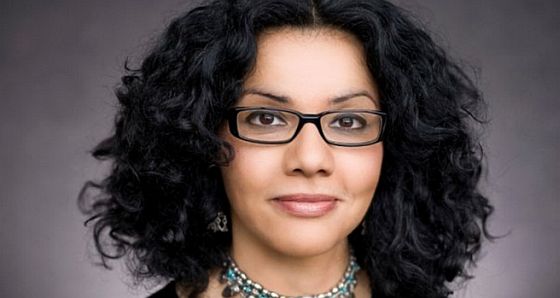
Mona Eltahawy, Egyptian-American journalist and columnist.
The Guardian reports: The US-based Egyptian journalist Mona Eltahawy has been released according to her personal twitter account after 12 hours in detention at the hands of Cairo security forces. An earlier tweet from the account @monaeltahawy said that she was sexually and physically assaulted while being held inside the interior ministry in Cairo, in the early hours of Thursday morning.
A US embassy representative in Cairo told the Guardian that the reports of her detention were “very concerning” and that “US embassy consulate officers are engaging Egyptian authorities”.
At 10:30am on Thursday, the former Reuters Middle East correspondent who has been lauded for her recent coverage of the Egyptian uprising, began tweeting that she had spent 12 hours in detention under the authority of interior ministry and military intelligence officials and that she had suffered a serious sexual assault by up to half a dozen members of the Egyptian security forces. She also said that she had been kept blindfolded for hours and also posted a picture of her severely bruised hand.
She also thanked supporters after #freemona began trending around the world on twitter.
In a series of tweets on Wednesday night, Eltahaway who is a columnist for various papers including the Toronto Star, the Jerusalem Report and Denmark’s Politiken, and has also written for the Guardian, described scenes in and around Tahrir Square including news that a relative of hers had been killed. She ended the message by damning the Supreme Council of the Armed Forces (Scaf) who have control over Egypt‘s transition.
At approximately 11pm GMT she wrote “Pitch black, only flashing ambulance lights and air thick with gas Mohamed Mahmoud #Tahrir”. At around the same time she then described the violence occurring around the gates of the American University in Cairo of which she is an alumnus.
“Across street from AUC gate I used to enter every day Mohamed Mansour. Can’t believe it. A cacophony sirens, horns, flashing ambulance lights” In a penultimate tweet she appeared to write “Beaten arrested in interior ministry”.
In one of her latest tweets after her release, Eltahawy says X-rays show her left arm and right hand are broken.

The New York Times reports: Egyptian generals offered an unusual apology on Thursday for the killings of protesters in Tahrir Square, the iconic landmark of the country’s revolution, but rejected the demonstrators’ demands for an immediate end to military rule.
As violence around the square eased after five days of intense clashes, the military also insisted that parliamentary elections, scheduled for next Monday, would proceed as planned.
“We will not delay elections. This is the final word,” Gen. Mamdouh Shaheen, a member of the ruling military council told a news conference.
Maj. Gen. Mukhtar el-Mallah, another council member, told the news conference that the military would not relinquish power because to do so would be “a betrayal of the trust placed in our hands by the people.” Egyptians must focus on the elections, he said, not on street protests.
“We will not relinquish power because of a slogan-chanting crowd,” he said, according to The Associated Press, “Being in power is not a blessing. It is a curse. It’s a very heavy responsibility.”
On what had been the front line of the confrontation near the square, army troops in black helmets and visors replaced the police — reviled by many protesters — and a crane lowered cement barricades behind a line of coiled barbed wire to separate the protesters from the Interior Ministry building, near the library of the American University in Cairo.
“The Supreme Council of the Armed Forces presents its regrets and deep apologies for the deaths of martyrs from among Egypt’s loyal sons during the recent events in Tahrir Square,” two generals said in a statement on a Facebook page. “The council also offers its condolences to the families of the martyrs across Egypt.”
The message struck an apparently conciliatory tone as the ruling military commanders seek to defuse the crisis in time for the elections. But thousands of people remained in Tahrir Square, many demanding the ouster of Field Marshal Mohamed Hussein Tantawi, the de facto leader and a longtime colleague of the deposed former president, Hosni Mubarak.
Robin Yassin-Kassab writes: The Syrian regime’s blanket ban on journalist access has some carefully selected exceptions. Robert Fisk, for instance, who seems to be compensating for the naive anti-Syrian and pro-March 14th line in his reporting of Lebanon over the last years by treating the statements of Syrian regime figures – professional liar Boutheina Shaaban is one – with great naivety. At least he didn’t apply the ‘glorious’ epithet to her which he used to describe Walid Jumblatt’s wife. Fisk’s book on Lebanon “Pity the Nation” is a classic, his account of the massacres at Sabra and Shatila remain fresh in the mind (the blood-footed flies clambering over his notebook), and for many years he was one of the very few English-language journalists with some real knowledge of the Middle East. Sadly, his knowledge doesn’t extend to a working familiarity with Arabic. In several recent articles he has informed us that that the slogan of the Ba‘ath Party – umma arabiya wahda zat risala khalida – means ‘the mother of the Arab nation.’ In fact it means ‘one Arab nation with an eternal message’. Fisk is confusing ‘um’ – mother – with ‘umma’ – nation. It’s a rather disastrous mistake. Someone ought to tell him about it.
Nir Rosen is an excellent journalist who clearly does speak Arabic and who makes the effort to talk to ordinary people rather than just politicians and PR people. His book “Aftermath” is essential reading for anyone who wants to understand how the American occupation of Iraq catalysed an outbreak of Sunni-Shia sectarian hatred across the Arab world. His recent visit to Syria (see here and here and here and here) seems to have been both above and below regime radar. While he appears to have been smuggled in to certain locations he also interviews such regime figures as the state Mufti Hassoun – someone once known for his touchy-feely liberalism and his campaign against honour killing now making absurd threats about armies of pro-Asad suicide bombers lying low in Western countries. Unfortunately, Rosen sees Syria through the prism of Iraq’s sectarian war. He expects to find expressions of sectarian hatred, and he finds them aplenty. He can’t be blamed for making it up, because sectarian hatred certainly does exist in Syria, and because he honestly reports what people say to him. The danger of this method, however, is twofold. First, his selection of informants necessarily reinforces his bias. He does interview some pro-regime Sunni figures (like Hassoun) but chooses not to interview Alawi, Christian, Ismaili or secularist figures who support the revolution. He doesn’t consider such people to be representative of the revolution because he’s decided that the dynamic must be sectarian, even if the Ismaili town of Selemiyeh has been demonstrating for months and secularists like Suhair Atassi are very prominent in the revolution’s Coordination Committees. (Indeed, Burhan Ghalyoun, the head of the umbrella Syrian National Council, to which many demonstrations have proclaimed allegiance, is fiercely anti-clerical).
Watch A Perfect Terrorist on PBS. See more from FRONTLINE.
See also Sebastian Rotella’s companion article in ProPublica, The American behind India’s 9/11—and how U.S. botched chances to stop him.
McClatchy reports: An international human rights panel concluded Wednesday that the Sunni Muslim government of the small gulf island of Bahrain carried out “deliberate” and “systematic” torture against many of the 2,929 people it arrested last spring during protests demanding more democracy.
The panel, headed by Egyptian-born U.S. lawyer Cherif Bassiouni, also said the Bahraini government systematically used excessive force in arrests, deprived defendants of due process in special military courts, and allowed an atmosphere of impunity to take hold, where no one was accountable for upholding Bahrain’s own laws.
Bassiouni also dismissed the Bahrain government’s allegations that Iran, whose population, like Bahrain’s, is majority Shiite Muslim, interfered in the uprising. The evidence presented to the commission “does not establish a discernible link” between specific incidents in Bahrain and the Iranian government, he wrote.
At least 35 people died in the two months after the protests began Feb. 14, including three police officers allegedly killed by demonstrators; 4,439 people were fired from their jobs and charged with joining the protests; and 534 students were expelled from university for the same reason, the report said. In addition, the government destroyed or severely damaged more than 40 places of worship, almost all Shiite.
Bahrain’s King Hamad bin Isa Al Khalifa, who established the commission in June, welcomed the report for identifying the “serious shortcomings” in his government’s response to the demonstrations. He promised legal reforms to ensure free speech and prohibit torture and said that officials who violated the law would be held accountable and replaced.
The Guardian reports: After nine months of mass protests calling for his resignation, Ali Abdullah Saleh has signed an agreement in Saudi Arabia transferring his powers to the vice president in return for immunity from prosecution.
With the economy on the verge of collapse and bloody clashes breaking out between armed factions of the military, Yemenis are hoping the agreement will offer a way out of the ten-month long turmoil that has left hundreds dead and the country teetering on the brink of civil war.
Saudi state television showed a smiling Saleh sitting next to Saudi King Abdullah in the Saudi capital, Riyadh, on Wednesday as he signed four copies of the proposal. He then clapped briefly before speaking for a few minutes to members of the Saudi royal families and international diplomats, promising to cooperate with the new Yemeni government.
“This disagreement for the last 10 months has had a big impact on Yemen in the realms of culture, development, politics, which led to a threat to national unity and destroyed what has been built in past years,” he said.
The deal, drawn up by the gulf monarchies and supported by the US, allows Saleh to retain the honorary title of President while his deputy, ‘Abd al-Rabb Mansour al-Hadi, forms and presides over a government of national unity until early presidential elections in February. In return for signing Saleh and his family are to be guaranteed immunity from prosecution.
Saleh had clung to power despite months’ of street protests, defections by top generals, ambassadors and senior members of his government and a June bomb attack on his palace that left him bed-ridden for three months in a Saudi Arabian hospital. But the recent involvement of the UN along with the potential threat of sanctions and asset freezing seemed to have convince him to go.
Despite having backed out of signing on three previous occasions, the UN envoy Jamal Benomar, who has spent the past week shuttling back and forth between the president and his various opponents in Sana’a was able to get the two sides to reach a deal.
“The agreement can become an important milestone towards restoring peace and stability, maintaining national unity and territorial integrity, and laying the foundation for economic recovery,” Benomar, told reporters in the marble lobby of a hotel in Sana’a, shortly before boarding a plane to Riyadh along with opposition officials and foreign ambassadors for the official signing ceremony.
In a bizarre turn of events, the signing coincided with an announcement from the U.N. Secretary-General Ban Ki-moon that Saleh would be travelling to New York for medical treatment after signing the agreement. Ban told reporters Wednesday that he talked with Saleh by telephone, and would be happy to meet with him in New York but provided no information about when Saleh planned to arrive in America, nor what treatment he would be seeking.
The Guardian reports: Egyptian security forces are believed to be using a powerful incapacitating gas against civilian protesters in Tahrir Square following multiple cases of unconsciousness and epileptic-like convulsions among those exposed.
The Guardian has collected video footage as well as witness accounts from doctors and victims who have offered strong evidence that at least two other crowd control gases have been used on demonstrators in addition to CS gas.
Suspicion has fallen on two other agents: CN gas, which was the crowd control gas used by the US before CS was brought into use; and CR gas.
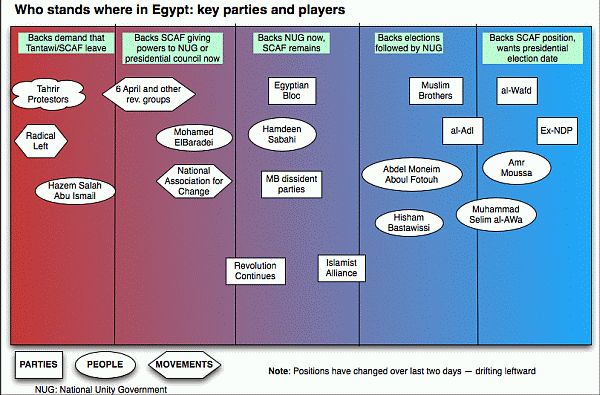
Issandr El Amrani has created a useful chart to show where the various political actors are positioned in the current crisis as the rule of the Supreme Council of the Armed Forces (SCAF) is challenged by protesters in Tahrir Square.

Dean Baker writes: Those who want lower deficits now also want higher unemployment. They may not know this, but that is the reality – since employers are not going to hire people because the government has cut its spending or fired government employees. The world does not work that way.
While this is the reality, the supercommittee was about turning reality on its head. Instead of the problem being a Congress that is too corrupt and/or incompetent to rein in the sort of Wall Street excesses that wrecked the economy, we were told that the problem was a Congress that could not deal with the budget deficit.
To address this invented problem, the supercommittee created an end-run around the normal congressional process. This was a long-held dream of the people financed by investment banker Peter Peterson. Their strategy was derived from the conclusion that it would not be possible to make major cuts to social security and Medicare through the normal congressional process because these programs are too popular.
Both programs enjoy enormous support across the political spectrum. Even large majorities of self-identified conservatives and Republicans are opposed to cuts in social security and Medicare. For this reason, they have wanted to set up a special process that could insulate members of Congress from political pressure. The hope was that both parties would sign on to cuts in these programs, so that voters would have nowhere to go.
However, this effort went down in flames this week. Much of the credit goes to the Occupy Wall Street (OWS) movement: OWS and the response it has drawn from around the country has hugely altered the political debate. It has put inequality and the incredible upward redistribution of income over the last three decades at the center of the national debate. In this context, it became impossible for Congress to back a package that had cuts to social security and Medicare at its center, while actually lowering taxes for the richest 1%, as the Republican members of the supercommittee were demanding.
Glenn Greenwald writes: Anonymous U.S. officials this morning are announcing in The Washington Post that they have effectively defeated what they call “the organization that brought us 9/11″ — Al Qaeda — by rendering it “operationally ineffective.” Specifically, “the leadership ranks of the main al-Qaeda terrorist network have been reduced to just two figures whose demise would mean the group’s defeat, U.S. counterterrorism and intelligence officials said.” And: “asked what exists of al-Qaeda’s leadership group beyond the top two positions, the official said: ‘Not very much’.”
You might think this means that the vastly expanded National Security and Surveillance States justified in the name of 9/11, as well as the slew of wars and other aggressive deployments which it spawned, can now be reversed and wound down. After all, the stated purpose of the 2001 Authorization to Use Military Force (AUMF) which provided legal cover to all of this was expressed in the very first line: “To authorize the use of United States Armed Forces against those responsible for the recent attacks launched against the United States.” The purpose of this authorized force was equally clear and limited: “to use all necessary and appropriate force against those nations, organizations, or persons [the President] determines planned, authorized, committed, or aided the terrorist attacks that occurred on September 11, 2001, or harbored such organizations or persons.”
Now, the group which the U.S. government has always said was the one that “planned, authorized, committed, or aided the terrorist attacks that occurred on September 11, 2001″ is, according to this same government, “operationally ineffective.” So what does that mean in terms of policy? Absolutely nothing:
U.S. officials stressed that al-Qaeda’s influence extends far beyond its operational reach, meaning that the terrorist group will remain a major security threat for years.
Not just a threat — but a major security threat — “for years” to come. In fact, it turns out that the version of Al Qaeda that the U.S. just spent the last decade “defeating” on the ground that it perpetrated 9/11 does not even really matter: “U.S. counterterrorism officials now assess al-Qaeda’s offshoot in Yemen as a significantly greater threat.” Even in Pakistan, where the “effectively inoperable” group is based, the CIA refuses even to reduce its activities: “letting up now could allow them to regenerate,” an anonymous official decreed. And if that’s not enough to keep your fear levels sufficiently high to support (or at least acquiesce to) more militarism, there is always this: “The arrest this week of an alleged al-Qaeda sympathizer in New York underscored the group’s ability to inspire ‘lone wolf’ attacks.”
Motoko Rich reports: With the Census Bureau fine-tuning its definition of poverty, a group of “near poor” has emerged — those who are not officially poor but are perilously close to it.
Another way of putting that is to look at “economic security,” the amount of income necessary to cover basic expenses without relying on public subsidies.
A new report from Wider Opportunities for Women, a nonprofit group that previously produced an index of what it takes to do more than survive while working, shows that 45 percent of United States residents live without economic security. That means they are not earning enough income to cover basic expenses, plan for important life events like college or save for emergencies like unexpected health bills.
“What does it take for households in this country to get by and be able to plan for their own futures based on the work that they do?” said Donna Addkison, president and chief executive of Wider Opportunities for Women. “We’re really looking at not just the lowest of the lowest income households but that slice of households that live somewhere above the poverty line but are constantly in danger of being thrown into financial catastrophe, and that’s a much larger slice of the American public than we are currently talking about.”
Although the study uses median incomes on a national basis, Wider Opportunities and its research partners are working on tables that define what economic security would mean on a state-by-state basis. Obviously, the income needed to cover basic expenses would be higher in New York City than in Omaha.
The report showed that 55 percent of children live in households where families do not earn enough to achieve economic security. Even among those households with two full-time workers, 22 percent of those families with children earn less than is necessary to guarantee economic security.
Amnesty International: Egypt’s military rulers have completely failed to live up to their promises to Egyptians to improve human rights and have instead been responsible for a catalogue of abuses which in some cases exceeds the record of Hosni Mubarak, Amnesty International said today in a new report.
In Broken Promises: Egypt’s Military Rulers Erode Human Rights [PDF], the organization documents a woeful performance on human rights by the Supreme Council of Armed Forces (SCAF) which assumed power after the fall of former President Hosni Mubarak in February.
The report’s release follows a bloody few days in Egypt that has left many dead and hundreds injured after army and security forces violently attempted to disperse anti-SCAF protesters from Cairo’s Tahrir square.
“By using military courts to try thousands of civilians, cracking down on peaceful protest and expanding the remit of Mubarak’s Emergency Law, the SCAF has continued the tradition of repressive rule which the January 25 demonstrators fought so hard to get rid of,” said Philip Luther, Amnesty International’s Middle East and North Africa Acting Director.
“Those who have challenged or criticized the military council – like demonstrators. journalists, bloggers, striking workers – have been ruthlessly suppressed, in an attempt at silencing their voices.
“The human rights balance sheet for SCAF shows that after nine months in charge of Egypt, the aims and aspirations of the January 25 revolution have been crushed. The brutal and heavy-handed response to protests in the last few days bears all the hallmarks of the Mubarak era.”
Ursula Lindsey writes: At the edge of Tahrir Square on Tuesday night young men—and a few women—vied for a place in the front lines fighting the riot police, where, decked out in scarfs, goggles, and surgical masks, they formed a fearless rank.
When the protestors fell and were carried to the motorcycles and ambulances ready to spirit them to makeshift clinics and hospitals, others were ready to take their place.
The fiery confrontation taking place in Egypt today is about pushing the Army out of power. It’s also about teaching the police once and for all that the unchecked brutality it has long considered its privilege will no longer stand.
One might have though that lesson had been learned already. But “nothing has changed since the revolution,” says Mohammed Mahfouz, a former police officer. “The Ministry of Interior doesn’t respect the law, doesn’t respect human rights, doesn’t respect the dignity of citizens.”
The police force, which collapsed during the uprising against former Egyptian president and dictator Hosni Mubarak last January, “feel they’re in a feud against society,” says Mahfouz. “They have a desire for revenge.”
Police and protesters have clashed more or less continuously for the last four days. The police feel “not that they are enforcing the law but it’s a battle for their survival,” says Ihab Youssef, a former high-ranking officer in the Ministry of Interior who left the force to found an NGO dedicated to improving relations between citizens and the police.
The police’s use of excessive force in clearing a small encampment in the square Saturday morning is what led thousands of indignant Egyptians to come out into the streets in protest. The brutality that followed, with policemen aiming tear-gas canisters and rubber bullets at protesters’ heads and piling bodies on the curb like so much garbage, triggered the most violent confrontation and intense political crisis Egypt has witnessed since Mubarak’s ouster.