Category Archives: Issues

Routine life under Israeli military rule

TPM reports: In an exchange in Iowa on Friday, Rick Santorum defended Israel’s right to build settlements in the West Bank — saying that it is fully part of Israel, having been conquered in the 1967 war, and that as a result all of the people in the West Bank are Israelis, not “Palestinians.”

This would, however, differ from Israel’s actual policy in the West Bank since 1967, which does not extend Israeli citizenship to the territory’s Palestinian inhabitants.

Santorum likened the West Bank’s situation to how the United States gained the West in the Mexican-American War of the 1840s. “So we should have given it back — we should have given New Mexico and Texas back 150 years go?” Santorum asked defiantly in the CNN Web feed, picked up by Think Progress.

Nabi Saleh is a village in the middle of the West Bank. When Israeli soldiers wake up families in the middle of the night and photograph their children, does Santorum think these are Israeli families who are not being allowed to sleep and live in peace?

Facebooktwittermail

Israel and ‘pinkwashing’

Sarah Schulman writes: “In dreams begin responsibilities,” wrote Yeats in 1914. These words resonate with lesbian, gay, bisexual and transgender people who have witnessed dramatic shifts in our relationship to power. After generations of sacrifice and organization, gay people in parts of the world have won protection from discrimination and relationship recognition. But these changes have given rise to a nefarious phenomenon: the co-opting of white gay people by anti-immigrant and anti-Muslim political forces in Western Europe and Israel.

In the Netherlands, some Dutch gay people have been drawn to the messages of Geert Wilders, who inherited many followers of the assassinated anti-immigration gay leader Pim Fortuyn, and whose Party for Freedom is now the country’s third largest political party. In Norway, Anders Behring Breivik, the extremist who massacred 77 people in July, cited Bruce Bawer, a gay American writer critical of Muslim immigration, as an influence. The Guardian reported last year that the racist English Defense League had 115 members in its gay wing. The German Lesbian and Gay Federation has issued statements citing Muslim immigrants as enemies of gay people.

These depictions of immigrants — usually Muslims of Arab, South Asian, Turkish or African origin — as “homophobic fanatics” opportunistically ignore the existence of Muslim gays and their allies within their communities. They also render invisible the role that fundamentalist Christians, the Roman Catholic Church and Orthodox Jews play in perpetuating fear and even hatred of gays. And that cynical message has now spread from its roots in European xenophobia to become a potent tool in the long-running Israeli-Palestinian conflict.

In 2005, with help from American marketing executives, the Israeli government began a marketing campaign, “Brand Israel,” aimed at men ages 18 to 34. The campaign, as reported by The Jewish Daily Forward, sought to depict Israel as “relevant and modern.” The government later expanded the marketing plan by harnessing the gay community to reposition its global image.

Last year, the Israeli news site Ynet reported that the Tel Aviv tourism board had begun a campaign of around $90 million to brand the city as “an international gay vacation destination.” The promotion, which received support from the Tourism Ministry and Israel’s overseas consulates, includes depictions of young same-sex couples and financing for pro-Israeli movie screenings at lesbian and gay film festivals in the United States. (The government isn’t alone; an Israeli pornography producer even shot a film, “Men of Israel,” on the site of a former Palestinian village.)

This message is being articulated at the highest levels. In May, Prime Minister Benjamin Netanyahu told Congress that the Middle East was “a region where women are stoned, gays are hanged, Christians are persecuted.”

The growing global gay movement against the Israeli occupation has named these tactics “pinkwashing”: a deliberate strategy to conceal the continuing violations of Palestinians’ human rights behind an image of modernity signified by Israeli gay life. Aeyal Gross, a professor of law at Tel Aviv University, argues that “gay rights have essentially become a public-relations tool,” even though “conservative and especially religious politicians remain fiercely homophobic.”

Facebooktwittermail

New winds in Mideast favor Hamas

The New York Times reports: For years, the imposing black gate that sealed the border between Egypt and Gaza symbolized the pain and isolation that decades of conflict have wrought on this tiny coastal strip, especially under Hamas in recent years.

But recently, the gate has come to represent a new turn for the increasingly confident Hamas leadership. The twin arches of the border crossing have swung open twice in recent weeks for V.I.P. arrivals, first to receive hundreds of Palestinian prisoners from Israeli jails as one captive Israeli soldier moved in the other direction, and a second time for Egypt’s Muslim Brotherhood to visit Gaza for the first time in decades.

Both instances lifted the fortunes of the Islamists at a critical time ahead of negotiations scheduled to be held in Cairo this week with their main rival, President Mahmoud Abbas of the Palestinian Authority, who leads the Fatah party.

Hamas’s leader, Khalid Meshal, arrives at those talks with a sense of regional winds at his back. Dictators have fallen, replaced by protest movements and governments that include the Islamist movements those dictators suppressed. Hamas has lost no opportunity to highlight this development as it basks in the growing regional importance of its parent organization, the Muslim Brotherhood, the oldest and most powerful Islamist movement in the world.

“This is a hot Arab winter that has not until now ripened into spring,” a Hamas official, Dr. Mahmoud Zahar, proclaimed in Gaza last month as he claimed the Arab revolutions for Islamic revivalism. The campaigns to oust corrupted leaders have reached a “critical stage,” he said, before concluding, “With God’s help, next year we will see the flowering of Islam.”

Mr. Abbas, by contrast, arrives with mixed success for his plan to gain United Nations recognition of statehood for Palestine. He has gained huge domestic support — polls are 80 percent in his favor — but the bid has faltered and he has alienated a crucial ally in Washington.

Hamas, on the other hand, trumpets its success in trading one captive Israeli soldier, Sgt. First Class Gilad Shalit, for more than 1,000 Palestinian prisoners, hoping that the Egyptian-brokered exchange will erase Palestinians’ memories of the increased isolation and blockades that Gaza suffered during Sergeant Shalit’s captivity.

Boaz Ganor, an Israeli security analyst and the founder of the International Policy Institute for Counterterrorism, believes that Hamas is now “much stronger” than it was before. The Shalit deal, he believes, was part of a “very detailed, sophisticated plan” by Hamas, which the United States and the European Union have labeled a terrorist organization, to break free from its Gaza enclave and secure greater legitimacy “at least in the international arena, if not in the eyes of Israel,” before Palestinian elections, scheduled for May.

“As long as they were holding an Israeli soldier against the Geneva Conventions and so forth, they would not be regarded as a legitimate candidate,” he said.

Both Hamas and Fatah leaders say that the Cairo talks will focus on setting up a unity transitional government of technocrats to take Palestinians through to elections, already long overdue.

Nabil Shaath, a member of Fatah’s Central Committee, said that the talks would focus on unity, nonviolence and finding a cabinet and a prime minister acceptable to both sides. He said there was now a “much better opportunity” for agreement. Hamas had enjoyed success with the prisoner swap, and Fatah gained domestic support for the statehood bid, he said, and “success reduces the need for competition.”

Facebooktwittermail

Vestiges of old order stifle birth of a new Egypt

Anthony Shadid writes: If the demonstrations that culminated in February were an uprising against President Hosni Mubarak, the revolt today is against his legacy.

“This is the real revolution,” said Mohammed Aitman, helping at a first-aid clinic in a turbulent, roiling and, at times, ecstatic Tahrir Square.

The vestiges of Mr. Mubarak’s order —the military, the Muslim Brotherhood and other Islamists, or fragmented liberals and leftists — seem ill prepared to navigate the transition from his rule. It is an altogether more difficult reckoning that has echoed in the Arab revolts in Syria, Libya, Yemen and Bahrain.

The strategy that for so long successfully repressed public anger and sapped people’s will to rebel was no longer working. As a result, it is not at all clear what path Egypt will find to go forward. The authorities hoped that the protesters would exhaust themselves and go home, but they have not. The military tried violence, but it has not worked. It has tried limited concessions, but that did not work. And it has blamed foreigners for inciting the violence, and that did not work.

This may foreshadow a dangerous and prolonged period of unrest in Egypt, as the spectacular show of discontent on Tuesday in Tahrir Square demonstrates that there is no existing institution to channel their frustrations.

The military appears largely oblivious to the scale of the protests, and Islamist parties are single-mindedly pursuing their political goals as they predict a healthy showing in the coming elections. No leader, of any ideological bent, has emerged to capture the full array of discontent once again spilling out onto the streets.

“Today, it is a failure of the political class,” said Ibrahim el-Houdaiby, a political analyst at Dar al-Hikma, a research center in Cairo. “People feel betrayed.”

Facebooktwittermail

Obama reserves the right to use torture

Eric Lewis writes: As a candidate in 2008, President Obama stated categorically, “We’ll reject torture — without exception or equivocation.” During his first month in office, he made good on his pledge, signing an executive order prohibiting torture or inhumane treatment. There is no reason to doubt that the order has been followed. This was a huge step forward for the United States.

But if he loses the presidency next year, Obama’s failure to deal with the legacy of torture that he inherited may turn out to be a huge problem. He has left the door open for state-sanctioned torture to be part of the next administration’s tool kit for dealing with the “global war on terror.” The leading Republican candidates understand that in many circles advocating torture is good politics. In their debates and in their foreign policy pronouncements, they are effectively capitalizing on a series of decisions that the Obama administration made as it failed to enshrine its own ban on torture as an absolute legal norm. Torture remains on the table as a future policy choice.

So what happened? The president has rejected three clear opportunities to erect a high legal wall against the return of torture: he has made it clear that criminal prosecutions for torture will not go forward; he has opposed the creation of a truth commission to examine events comprehensively; and he has affirmatively intervened to stop civil litigation by detainees against their torturers.

When President Obama took office, I was in the midst of litigating a civil case against former Secretary of Defense Donald Rumsfeld and the military chain of command for torture. A panel of judges from the United States Court of Appeals for the District of Columbia Circuit had found that as “aliens without presence or property in the United States,” Guantánamo detainees had no right not to be tortured under the Constitution and, in any event, even if there were such rights, there was no reason that Rumsfeld and other military leaders should have been aware that the right to be free from torture was “clearly established.” Accordingly they were immune from suit. In 2009, the Supreme Court directed that the Court of Appeals reconsider its decision in light of its recent finding in Boumediene v. Bush of a constitutional right to habeas corpus for detainees at Guantánamo.

Surely, I thought, the new administration would weigh in and support the argument that there was an inarguable and fundamental right not to be tortured by the government of the United States. What’s more, supporting civil actions for damages would have allowed the facts of torture to emerge through judicial proceedings, avoiding the political conflict of direct executive involvement.

Instead, the Obama administration slammed the door on constitutional challenges to torture. It reiterated the Bush administration’s position, arguing that “aliens held at Guantánamo do not have due process rights,” limiting the Supreme Court’s decision in Boumediene to habeas corpus only. In other words, it was the position of the Obama administration that even though the Supreme Court had found a constitutional right for detainees to challenge their confinement, detainees had no constitutional right not to be tortured while in confinement. The Obama administration also insisted that it was not sufficiently clear that the Constitution prohibited torture of aliens, and so “a reasonable officer would not have concluded that plaintiffs here possessed Fifth and Eighth Amendment rights while they were detained at Guantánamo.”

Yet reasonable officers have known since the founding of the republic that military law prohibits torturing prisoners and, since the 1930s, that it was cruel and unusual punishment and a violation of due process to torture prisoners in the custody of the United States. What these officers apparently could not have been expected to figure out was whether by bringing prisoners to Guantánamo, they could evade the Constitutional ban on torture or prisoners. Finally, the Obama administration warned that civil remedies for torture would “enmesh the courts in military, national security, and foreign affairs matters that are the exclusive province of the political branches.” In plain English, it is up to us — the executive — and not you — the courts — to decide whether detainees can be tortured or not.

Facebooktwittermail

Occupy Seattle protester claims police caused her miscarriage

The Guardian reports: A pregnant woman who was pepper sprayed during the Occupy Seattle protests in the US claims she had a miscarriage five days later as a result of injuries allegedly inflicted by the police.

Jennifer Fox, 19, claims that she was also struck in the stomach twice – once by a police officer’s foot and once by an officer’s bicycle – as police moved in to disperse marchers on 15 November.

A picture of Fox being carried away became one of the abiding images of the police crackdown on the Occupy Seattle protests, along with that of 84-year-old Dorli Rainey, who was pictured with pepper spray – and liquid used to treat it – dripping from her chin.

Fox told the Stranger blog: “I was standing in the middle of the crowd when the police started moving in. I was screaming, ‘I am pregnant, I am pregnant. Let me through. I am trying to get out.’ ” It was at that point, she said, that one officer lifted his foot and hit her in the stomach and another pushed his bicycle in the crowd, again hitting her in the stomach. She did not state whether she thought their actions were deliberate.

“Right before I turned, both cops lifted their pepper spray and sprayed me,” she continued. “My eyes puffed up and my eyes swelled shut.”

Video of Fox in distress at the protests was posted online on Tuesday. She can be seen telling people who have come to her assistance “I can’t see” and wailing.

Facebooktwittermail

#OWS: Movement surges 10% online since Zuccotti eviction

Micah Sifry writes: A week ago, early Tuesday morning November 15th, New York City police forcibly evicted the Occupy Wall Street protest encampment at Zuccotti Park. Since then, there’s been an interesting shift in how some key observers in the mainstream media talk about the movement. For example, David Carr, an influential media columnist for the New York Times, wrote yesterday as if the Occupy movement had essentially ended, with no recognition that there are still many other cities and campuses with physical occupations underway. “A tipping point is at hand,” he intoned about the movement, “now that it is not gathered around campfires.” He added, darkly, “When the spectacle disappears reporters often fold up their tents as well.”

Not to pick on Carr, whose column and work I often enjoy, but since when did reporters treat political movements like passing fads? The Times, like many other newspapers, has given plenty of coverage to the Tea Party movement–even when the available data suggested that the Tea Party had nowhere as big a following on the ground as its media presence and polling numbers suggested.

Interestingly enough, since last Tuesday’s eviction in NYC, support for the overall Occupy Wall Street movement has risen significantly online.

Facebooktwittermail

News organizations complain about treatment during protests

The New York Times reports: A cross-section of 13 news organizations in New York City lodged complaints on Monday about the New York Police Department’s treatment of journalists covering the Occupy Wall Street movement. Separately, 10 press clubs, unions and other groups that represent journalists called for an investigation and said they had formed a coalition to monitor police behavior going forward.

Monday’s actions were prompted by a rash of incidents on Nov. 15, when police officers impeded and even arrested reporters during and after the evictions of Occupy Wall Street protesters from Zuccotti Park, the birthplace of the two-month-old movement.

At a news conference after the park was cleared that day, Mayor Michael R. Bloomberg defended the police behavior, saying that the media were kept away “to prevent a situation from getting worse and to protect members of the press.”

The news organizations said in a joint letter to the Police Department that officers had clearly violated their own procedures by threatening, arresting and injuring reporters and photographers. The letter said there were “numerous inappropriate, if not unconstitutional, actions and abuses” by the police against both “credentialed and noncredentialed journalists in the last few days.” It requested an immediate meeting with the city’s police commissioner, Raymond W. Kelly, and his chief spokesman, Paul J. Browne.

The letter was written by George Freeman, vice president and assistant general counsel for The New York Times Company, and signed by representatives for The Associated Press, The New York Post, The Daily News, Thomson Reuters, Dow Jones & Company, and three local television stations, WABC, WCBS and WNBC. It was also signed by representatives for the National Press Photographers Association, New York Press Photographers Association, Reporters Committee for Freedom of the Press, and the New York Press Club.

Facebooktwittermail

Egypt military accused of using banned chemical warfare agents against protesters

Al-Masry Al-Youm reports: The Euromediterranean Human Rights Network (EMHRN) on Monday condemned the targeting of peaceful protesters in Cairo with internationally banned gases. The Geneva-based group said it was rallying an international condemnation against these violations. The EMHRN strongly condemned the targeting of peaceful protestors by the police and the armed forces as well as the use of excessive violence against them, leading to dozens of deaths and hundreds of injuries.

In a statement on Monday, the EMHRN said the use of tear gas, live ammunition and snipers to disperse a peaceful sit-in was “unacceptable and fully against all international norms and conventions.” EMHRN Regional Director Amany al-Sinwar said that testimonies by several Egyptian activists described the use of an internationally banned gas known as CR gas by security forces and the armed forces. She added that the EMHRN received similar testimonies of vomiting, paralysis and temporary loss of vision after exposure to the gas. Sinwar added that the EMHRN documented the use of this gas against protestors for the first time since the escalation of the peaceful uprising on 25 January.

The EMHRN denounced this “serious violation against civilians by using internationally banned gas, which is classified as a being a carcinogenic and of being deadly when exposed to it for long periods of time.”

The 1993 Paris Convention on chemical warfare criminalized the use of such gases. The 1907 Hague Convention also prohibited the use of toxic warfare that results in torture, while the 1925 Geneva Protocol prohibits the use of asphyxiating and poisonous gases.

The EMHRN called on the leadership of Egypt’s police force and that of the Egyptian army to “immediately stop targeting civilians, and respect their right to peaceful sit-ins, while punishing those responsible for the crimes committed against them.”

Facebooktwittermail

Inside the corporate plan to occupy the Pentagon

Adam Weinstein reports: With time fast running out for the so-called deficit supercommittee, the mammoth amount of government money spent on the military has become a prime target in Washington. But the main focus isn’t on big-ticket weapons projects or expensive wars—it’s on retirement benefits for the roughly 17 percent of soldiers, Marines, sailors, and airmen who have served 20 years or more in uniform. Currently the total cost of their benefits is about $50 billion a year.

Cuts to military pensions are “the kind of thing you have to consider,” Defense Secretary Leon Panetta said in September. When President Obama unveiled his $3 trillion debt reduction plan the same month, it called GIs’ benefits “out of line” with private employee retirement plans, saying the system was “designed for a different era of work.” When Congress held a hearing on military retirements in October, Rep. Austin Scott (R-Ga.) promoted a cheaper 401(k)-style plan that would slash existing benefits for many troops. “I see nothing wrong with them being able to choose a different retirement plan,” he said.

These ideas may sound like a bold new approach in an urgent moment—but in fact, the push for pension cuts and other corporate “reforms” at the Pentagon originates from an obscure advisory panel that has existed for a decade: the Defense Business Board. Its 21 members know little about military affairs, but they are rich in Wall Street experience, including with some of the biggest companies implicated in the 2008 financial meltdown. They are investment bank CEOs and CFOs, outsourcing experts, and layoff specialists who promote a corporate agenda of “behavior change” and “business solutions” [PDF] in the military bureaucracy. The board proposes not only to slash and privatize military pensions, but also to have the Pentagon invest in oil futures, boost pay for its executives and political appointees, and make it easier for them to fire rank-and-file employees while scaling back those workers’ collective-bargaining rights.

Indeed, “this sounds like what’s being done now around the country with the public unions,” affirms Charles Tiefer, a University of Baltimore law professor and defense contracting watchdog who’s testified to Congress about the board’s recommendations. The board was launched in 2001 by then Defense Secretary Donald Rumsfeld, who famously wanted to downsize the military and corporatize its management system. The essential reason it exists, Tiefer says, is so that “a pro-business attitude—especially on personnel issues—remains intact” inside the Pentagon.

Facebooktwittermail

Socialism for the rich, capitalism for the poor

George Monbiot writes: In the documentary series which finished on Friday evening, the heiress Tamara Ecclestone set out to prove that she isn’t “a pointless, quite spoilt, really stupid, vacuous, empty human being”. This endeavour was not wholly successful. Channel 5 showed her supervising the refurbishment of her £45m home in London, in which she commissioned a £1m bathtub carved from Mexican crystal, an underground swimming pool complex, her own nightclub, a lift for her Ferrari, a bowling alley with crystal-studded balls and a spa and massage parlour for her five dogs, to save her the trouble of taking them to Harrods to have their hair sprayed and their nails painted. But there was something the series didn’t tell us: how much of this you helped to pay for.

In court a fortnight ago, her father, the Formula One boss Bernie Ecclestone, revealed that the fact his family’s offshore trust, Bambino Holdings, was controlled by his ex-wife rather than himself could have saved him “in excess of £2bn” in tax. The name suggests that the trust could have something to do with supporting his daughter’s attempt to follow the teachings of St Francis of Assisi.

Ecclestone has also been adept at making use of the corporate welfare state: the transfer by the government of wealth and power from the rest of us to the 1%. After the mogul made a donation to Labour’s election fund, Tony Blair demanded that F1 be exempted from the European Union’s ban on tobacco sponsorship. The government built a new dual carriageway to the F1 racetrack at Silverstone.

In other countries his business has received massive state subsidies. Russia, for example, has recently agreed to build a circuit for Ecclestone to race his cars, and then charge itself $280m for the privilege of letting him use it. Working in India in 2004, I came across the leaked minutes of a cabinet meeting in which the consultancy McKinsey insisted that the desperately poor state of Andhra Pradesh – where millions die of preventable diseases – cough up between £50m and £75m a year to support F1. The minutes also revealed that the state’s chief minister had lobbied the prime minister of India to exempt Ecclestone’s business from the national ban on tobacco advertising.

Socialism for the rich, capitalism for the poor: that is how our economies work. Those at the bottom are subject to the rigours of the free market. Those at the top are as pampered and protected as Tamara Ecclestone’s dogs.

Facebooktwittermail

Bill McKibben, Keystone XL, and Barack Obama

Jane Mayer writes: Last spring, months before Wall Street was Occupied, civil disobedience of the kind sweeping the Arab world was hard to imagine happening here. But at Middlebury College, in Vermont, Bill McKibben, a scholar-in-residence, was leading a class discussion about Taylor Branch’s trilogy on Martin Luther King, Jr., and he began to wonder if the tactics that had won the civil-rights battle could work in this country again. McKibben, who is an author and an environmental activist (and a former New Yorker staff writer), had been alarmed by a conversation he had had about the proposed Keystone XL oil pipeline with James Hansen, the head of NASA’s Goddard Institute for Space Studies, and one of the country’s foremost climate scientists. If the pipeline was built, it would hasten the extraction of exceptionally dirty crude oil, using huge amounts of water and heat, from the tar sands of Alberta, Canada, which would then be piped across the United States, where it would be refined and burned as fuel, releasing a vast new volume of greenhouse gas into the atmosphere. “What would the effect be on the climate?” McKibben asked. Hansen replied, “Essentially, it’s game over for the planet.”

It seemed a moment when, literally, a line had to be drawn in the sand. Crossing it, environmentalists believed, meant entering a more perilous phase of “extreme energy.” The tar sands’ oil deposits may be a treasure trove second in value only to Saudi Arabia’s, and the pipeline, as McKibben saw it, posed a powerful test of America’s resolve to develop cleaner sources of energy, as Barack Obama had promised to do in the 2008 campaign.

But TransCanada, the Canadian company proposing the project, was already two years into the process of applying for the necessary U.S. permit. The decision, which was expected by the end of this year, would ultimately be made by Obama, but, because the pipeline would cross an international border, the State Department had the lead role in evaluating the project, and Secretary of State Hillary Clinton had already indicated that she was “inclined” to approve it. Both TransCanada and the Laborers’ International Union of North America touted the construction jobs that the pipeline would create and the national-security bonus that it would confer by replacing Middle Eastern oil with Canadian.

The lineup promoting TransCanada’s interests was a textbook study in modern, bipartisan corporate influence peddling. Lobbyists ranged from the arch-conservative Grover Norquist’s Americans for Tax Reform to TransCanada’s in-house lobbyist Paul Elliott, who worked on both Hillary and Bill Clinton’s Presidential campaigns. President Clinton’s former Ambassador to Canada, Gordon Giffin, a major contributor to Hillary Clinton’s Presidential and Senate campaigns, was on TransCanada’s payroll, too. (Giffin says that he has never spoken to Secretary Clinton about the pipeline.) Most of the big oil companies also had a stake in the project. In a recent National Journal poll of “energy insiders,” opinion was virtually unanimous that the project would be approved.

Facebooktwittermail

Egyptians challenge military rule

The New York Times reports: Huge crowds of protesters filled Tahrir Square in central Cairo on Tuesday and battled with the police in nearby streets for the fourth straight day, braving an increasingly lethal crackdown to demand an end to military rule.

Each day the crowds have grown; on Tuesday, a day after the civilian cabinet offered its resignation to Egypt’s transitional military government, the protesters massed at the epicenter of Egyptian resistance — first to the former president, Hosni Mubarak, ousted in February and now to the military commanders who replaced him — appeared to number well over 100,000.

Such was the nervousness about the test of wills that trading was briefly suspended on the Cairo stock exchange after its main index slumped for a third successive day, deepening the sense of crisis that has built since street fighting began on Saturday. The first parliamentary elections since Mr. Mubarak was forced from power are scheduled to begin next week, and there is widespread concern that they will be postponed.

Intense skirmishes continued for a fourth day on the main avenue leading to the Interior Ministry. For the protesters, the outburst still seemed to represent a leaderless expression of rage.

Issandr El Amrani writes: The situation in Alexandria appears to have really escalated. This is no longer just about Tahrir. The loss of Egyptian Current Party (offshoot of Muslim Brotherhood) member Bahei Eddin al-Senoussi, a major activist in Alexandria, has galvanized people there. Follow Rawya Ragei’s reporting for al-Jazeera English on this.

The resignation of Essam Sharaf’s cabinet does not seem to have moved the protest movement. The SCAF is said to be negotiating its replacement with political forces, but here they must be treading carefully: if they join in a national unity cabinet, can they be assured that the protestors in Tahrir will accept? They now risk discrediting themselves in doing so. They have to be sure they can sell it to the public, and that means a hard sell. Meanwhile, the best presidential candidates (ElBaradei and Aboul Fotouh) are scathing about SCAF but offer different ways to get to a national unity government. And the most populist one, Hazem Saleh Abu Ismail, has called for more protestors to come down onto the streets. But he still wants elections, and his criticism of SCAF is partly put as a threat.

The Washington Post reports: Three Americans studying at the American University in Cairo have been arrested and accused of participating in the violent demonstrations that are posing the greatest threat to Egypt’s military leaders since the ouster of President Hosni Mubarak last February.

As angry crowds gathered in the capital’s Tahrir Square for a fourth consecutive day, Egypt’s military leaders held a meeting with political leaders in hopes of diffusing the deepening political crisis.

But major figures refused to attend, including Mohamed ElBaradei, the Nobel Peace Prize winner who has emerged as a possibility to head a national unity government, and Shady Ghazali Harb, a leading member of the Revolutionary Youth Coalition, and a close ally of ElBaradei’s.

“I refused to go because of the violence still going on in Tahrir Square,” Harb said. “We can not negotiate with anyone still doing such violence. The legitimacy comes from the square, not the military council.”

Al-Masry Al-Youm reports: Egyptian diplomats on Tuesday signed a statement urging the ruling Supreme Council of the Armed Forces (SCAF) to pledge to conduct presidential elections and hand over power to civilians by mid-2012 at the latest.

The statement, which was signed by 245 diplomats, called on the governing military council to “stop systematic assaults by security on protesters.”

Among those who signed the statement were ambassadors and advisers at the Foreign Ministry, including Ambassor to Russia Alaa al-Hadidy and ministry spokesperson Amr Roshdy.

Al-Masry Al-Youm obtained a copy of the statement, which emphasizes the SCAF’s responsibility to preserve security and safeguard the right of peaceful protest, as is outlined in international charters and agreements.

Facebooktwittermail

Glenn Beck receives ‘Defender of Israel Award’

The Zionist Organization of America gave its first “Defender of Israel Award” to Glenn Beck on Sunday. The award was presented by American billionaire casino magnate and backer of Benjamin Netanyahu, Sheldon Adelson.

Beck, in his acceptance speech, said, “I am a proud Zionist and an obvious defender of Israel. I speak the truth and have been awarded the Defender of Israel Award, which only reveals the kind of trouble we are in.”

He also added, “The current U.S. government is not a friend of Israel.” Beck has been one of the most outspoken and vocal critics of U.S. President Barack Obama.

Beck, who left Fox News several months ago, strongly hinted of political aspirations as he wrapped up his speech. “There is a vacuum [in American politics] that I intend to fill. I am not asking you to join me. I would rather join you,” he said.

Several American politicians were on hand at the ceremony as well. Republican presidential hopeful Congresswoman Michele Bachmann spoke at the event saying, “The Pentagon must prepare a plan for war against Iran, as a last resort.” The congresswoman called for crushing economic sanctions on Iran, and promised that on the day she is sworn in as president, she would move the U.S. embassy in Israel from Tel Aviv to Jerusalem.

Chairwoman of the House Foreign Affairs Committee Ileana Ros-Lehtinen (R-FL), who also received an honorary ZOA award, pledged that the House of Representatives would work to increase sanctions against Iran. (Source)

Facebooktwittermail

Jordan starts to shake

Nicolas Pelham writes: To measure the sturdiness of King Abdullah of Jordan against the tide of upheaval sweeping the Arab world, go to Tafila, an impoverished town tucked into a sandy bowl encircled by the Moabite Mountains 110 miles south of the royal seat of Amman. Outside the courthouse where four youths recently awaited trial on charges of cursing the king, a crime punishable in this hitherto deferential kingdom by up to three years in jail, one hundred protesters continue cussing the king, until the order comes from on high to let the four go.

Such protests are growing in intensity and geographic reach, degrading the royal stature with every chant. Last season’s innuendo against his courtiers and queen has become this season’s naked repudiation of the King. In September, demonstrators chanted S-S-S, a deliberately ambiguous call for both the regime’s islah, Arabic for reform, and isqat, overthrow. The protesters outside Tafila’s courthouse dispense with such niceties, spicing the crude one-liners with which Egypt’s revolutionaries toppled Hosni Mubarak with cheeky Bedouin rhyming couplets: “O Abdullah son of Hussein/Qadaffi’s a goner, whither your reign?”

Among the flashy young men who staff the royal court, it is common to dismiss the protests as coming from unruly poor peasants after money and jobs. But in the more sober milieux of their parents where much of Jordan’s business is conducted, the King’s inability to impose his will on the south is a cause of greater unease. For though peripheral and small in number, comprising 10 percent of the kingdom’s six million subjects, the tribesmen dominate the ranks of his security apparatus. If their dissatisfaction grows, some might be tempted, as in Egypt, to jettison their leader in order to preserve their power. Doomsday may yet be far off, but, a former senior Jordanian intelligence official tells me, each month seems worse than the last. By way of comparison he cites Black September of 1970, when an armed force rose up against the King, only this time the forces challenging his rule are those already running the country, not Palestinians opposing it.

Facebooktwittermail

Life after occupation

Arun Gupta visits Mobile, Alabama and Chicago, and asks: Can an occupation movement survive if it no longer occupies a space?

Emily Schuler, a Mobile native and college student, says the Occupy movement made her rethink her place in society, calling it “one of the best things that has ever happened to me.” Schuler says, “I love Mobile, but it’s ultra-conservative.” She explains, “I always felt like the black sheep because I sensed that the way the world was working was not good … There is a lot of pain and suffering. I think it has a lot to do with the way the system works. Because right now it’s profit over people. And it should be people over profit.”

To the world-weary in New York, a silent protest and proposition that the American system values “profit over people” may seem prosaic. And it would be prosaic were it not happening in a place like Mobile, Ala., and all over the United States. Dozens of occupiers have told us this movement is an “awakening” for them or for others.

One eye-opening aspect of our evening with Occupy Mobile was that none of these people knew each other a month before. The movement has created a new political community virtually overnight.

“We all felt alone,” Chelsy Wilson says. “Now we know that’s not the case. We’re going to try to reach out to other people who feel this wa … People say they have a new hope for Mobile. A lot of us were looking for jobs outside the city, we wanted to move away as fast as we could, and a lot of us have changed our minds. We want to stay here now.”

In smaller, conservative cities, the creation of a new community may be success enough for the movement, enabling a new network to consolidate and spread its message without a public encampment. But for larger cities that already have a strong progressive presence, the experience of Occupy Chicago is more relevant — and more sobering.

Occupy Chicago is forging ahead with maintaining a public presence despite never having established an occupation in the first place. It’s not for lack of trying. On two consecutive Saturdays in mid-October, Occupy Chicago tried to take Grant Park, known for Chicago’s head-bashing police plying their trade during the 1968 Democratic National Convention.

On the day of the second action, Oct. 22, we caught up with the protest as it was marching to the horse, a statue that provided the rally cry, “Take the horse.” It was impressive compared to New York. A march some 3,000 strong, bullhorns, banners, resounding chants and marshals providing a buffer from the police. Occupy Chicago felt like any of hundreds of demonstrations I’ve been on in the last 20 years. To be fair, the energy and stakes were higher, but it seemed like protest as usual. It was far better organized than Occupy Wall Street’s chaotic peregrinations — and that was the problem.

In New York, Occupy Wall Street actions surge with electricity. No one quite seems in control because everyone is in control. Amoebic blobs of protesters break off and take the streets. Chants are thrown out, and the hive mind picks a winner. It is atavistic, often lacking signs, denied sound systems and shunning permits, but powered by hearts, lungs and passion. Exciting and unpredictable, it attracted greenhorns, drove the cops nuts, paralyzed Bloomberg for weeks and captured the world’s attention. That was why it worked and why the boot came down in the end.

In Chicago, the first time protesters tried to take the space on Oct. 15, 175 people were arrested. We were there for the second round of arrests of about 130 people. I talked to Jan Rodolfo, a 36-year-old oncology nurse and National Nurses United staff member. While preparing to be arrested along with other union members and scores of others, Rodolfo said Occupy Chicago needed “a permanent encampment because it allows the movement to grow by creating a central place for people to come. ”

Another activist said, “It would have been a big victory for the students, unions and other groups putting their efforts into the movement.”

It wouldn’t have just been a victory; it would have created a different movement. What made occupations in New York City and other cities so successful is that they brought new people into the movement in droves. Chicago has strong networks of activists, unionists and community groups, which are all involved in the Occupy movement. What they were missing was crucial: the people who were previously non-political.

Facebooktwittermail

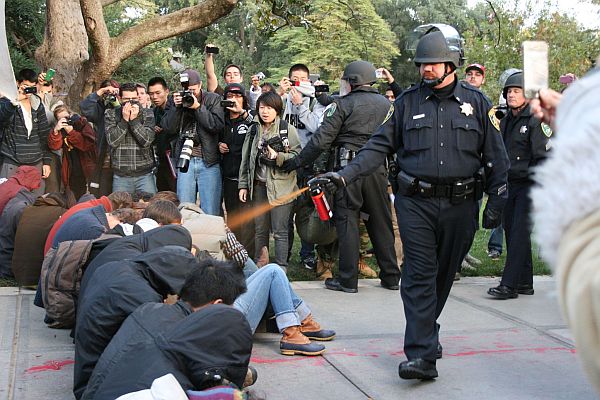
How the Pepper Spray Cop could change the trajectory of Occupy Wall Street

Megan Garber writes: This weekend, a series of photographs — images of a riot-gear-wearing cop shooting a group of students in the face with pepper spray — made their transition from journalistic documents to sources of outrage to, soon enough, Official Internet Meme. Perhaps the most iconic image (taken by UC Davis student Brian Nguyen, and shown above) isn’t explicitly political; instead, it captures a moment of violence and resistance in almost allegoric dimensions: the solidarity of the students versus the singularity of the cop in question, Lt. Pike; their steely resolve versus his sauntering nonchalance; the panic of the observers, gathered chorus-like and open-mouthed at the edges of the frame. The human figures here are layered, classified, distant from each other: cops, protestors, observers, each occupying distinct spaces — physical, psychical, moral — within the image’s landscape.

As James Fallows put it, “You don’t have to idealize everything about them or the Occupy movement to recognize this as a moral drama that the protestors clearly won.”

Exactly. The image — and its subsequent meme-ification — marked the moment when the Occupy movement expanded its purview: It moved beyond its concern with economic justice to espouse, simply, justice. It became as much about inequality as a kind of Platonic concern as it is about income inequality as a practical one. It became, in other words, something more than a political movement.

The image itself, I think — as a singular artifact that took different shapes — contributed to that transition, in large part because the photo’s narrative is built into its imagery. It depicts not just a scene, but a story. It requires of viewers very little background knowledge; even more significantly, it requires of them very few political convictions, save for the blanket assumption that justice, somehow, means fairness. The human drama the photo lays bare — the powerless being exploited by the powerful — has a universality that makes its particularities (geographical location, political context) all but irrelevant.

Facebooktwittermail

The Serpent’s Egg hatchlings in Greece’s postmodern Great Depression

The Greek economist, Yanis Varoufakis, writes: It will prove George Papandreou’s ugliest legacy: that his last-minute childish maneuvering to maximise his waning hold on power (while negotiating his eviction from the PM’s job), has brought into the new ‘national unity’ government four self-declared racists (some of whom are neo-Fascists and one a neo-Nazi of some renown). It is also wildly ironic: for Mr Papandreou’s best quality has traditionally been his ardent cosmopolitanism, his demonstrated anti-nationalism, a genuine commitment to minorities and a deep seated intolerance of racism. Alas, such is the lure of power, it seems, that the entry into the new government of one minister and three junior ministers representing LAOS (a small ultra-right wing party) was cynically judged as a smaller price to pay than handing more control of the new regime to Mr Papandreou’s political opponents in the two major parties – his own PASOK and New Democracy, the conservative opposition.

To non-Greeks watching breathlessly the swearing into government of the serpent’s egg latest hatchlings, these news from Greece will surely resonate terribly. As they should! For yet again a Great Depression has given fascism another twirl. And while Greece is small and ought to be irrelevant, its past has spawned great perils for the world at large. Lest we forget, the Cold War did not begin in the streets of Berlin but in the alleys of Athens back in December 1944. Greece was also one of the first countries to have established a fully fledged fascist regime after the Crash of 1929: the Metaxas dictatorship in 1936. More recently, a CIA-backed coup brought Greek fascists in power six years before General Pinochet rolled his tanks against the Presidential palace in Santiago, quite obviously inspired by the ‘success’ of his Greek brethren. Nowadays, with Greece leading the chorus of Europe’s headlong dive into a new recession, and a renewed disintegration complete with racial overtones (Germans loathing the Greeks and vice versa), it is time for the world to take note. Feeling the irony of Papandreou’s tragic end will simply not do. Progressives around the world must remain vigilant. [Continue reading…]

Facebooktwittermail