Category Archives: Issues

Afghanistan’s other front

Afghanistan’s other front

Allegations of ballot-stuffing in the presidential election in Afghanistan last month are now so widespread that a recount is necessary, and perhaps even a runoff. Yet this electoral chicanery pales in comparison to the systemic, day-to-day corruption within the administration of President Hamid Karzai, who has claimed victory in the election. Without a concerted campaign to fight this pervasive venality, all our efforts there, including the sending of additional troops, will be in vain.

I have just returned from Afghanistan, where I spent seven months as a special adviser to NATO’s director of communications. On listening tours across the country, we left behind the official procession of armored S.U.V.’s, bristling guns and imposing flak jackets that too often encumber coalition forces when they arrive in local villages. Dressed in civilian clothes and driven in ordinary cars, we were able to move around in a manner less likely to intimidate and more likely to elicit candor.

The recurring complaint I heard from Afghans centered on the untenable encroachment of government corruption into their daily lives — the homeowner who has to pay a bribe to get connected to the sewage system, the defendant who tenders payment to a judge for a favorable verdict. People were so incensed with the current government’s misdeeds that I often heard the disturbing refrain: “If Karzai is re-elected, then I am going to join the Taliban.” [continued…]

Can we bribe our way to victory?

…the unlikely figure of Sen. Lindsey Graham, R-S.C., raised the key issue of the day. He began his questioning of Adm. Mullen by asking whether the Taliban had any tanks. No, Mullen replied. Graham then asked how many airplanes they have. None, the admiral answered, perhaps wondering where this line of inquiry was going.

Then Graham zeroed in. If that’s the case, he asked, how is it that the Taliban are gaining ground? The problem isn’t the Taliban, it’s the Afghan government, isn’t that right?

Mullen agreed. The problem, he said, “is clearly the lack of legitimacy of the government.”

Graham pushed the matter. “We could send a million troops, and that wouldn’t restore legitimacy in the government?” he asked.

Mullen replied, “That is correct.”

A few minutes later, under questioning from Sen. Susan Collins, R-Maine, Mullen elaborated: “The Afghan government needs to have some legitimacy in the eyes of the people. The core issue is the corruption. … It’s been a way of life for some time, and it’s just got to change. That threat is every bit as significant as the Taliban.” [continued…]

Editor’s Comment — Fred Kaplan’s proposal — that the US government can “legitimize” an Afghan government by heavily bribing its officials — is, I imagine he would say, “counter-intuitive”. I’d call it stupid. It presupposes that everyone is bribable — everyone has their price. That certainly applies to those who are already corrupt, but I see no reason to view all Afghans as corruptable. On the contrary, those who have the strongest allegiance to their country or their tribe are least likely to have any interest in doing the bidding of an American paymaster.

Maybe the real solution requires that the Americans have the humility to accept that homegrown solutions are ultimately the only ones that take root.

Call for an Afghan surge

America’s top military officer endorsed sending more U.S. troops to Afghanistan, a shift in Pentagon rhetoric that heralds a potential deepening of involvement in the Afghan war despite flagging support from the public and top Democrats in Congress. [continued…]

Afghan recount presents huge task

One out of every seven ballots in last month’s Afghan presidential elections — and possibly many more — will be examined as part of a huge recount and fraud audit that may force the incumbent, Hamid Karzai, into a runoff, Afghan election officials said Tuesday.

A United Nations-backed commission serving as the ultimate arbiter of the election ordered the recount from around 10 percent of the country’s polling stations because of suspected fraud, the head of the panel said Tuesday, though the number of actual votes covered by the order is much higher, numbers from a top Afghan election official showed.

The Aug. 20 ballot was racked by egregious voting fraud and ballot stuffing, international and Afghan election observers have said, throwing Afghanistan into an electoral crisis even as the Taliban gains ground in the rugged countryside. [continued…]


Facebooktwittermail

Is Bagram Obama’s new secret prison?

Is Bagram Obama’s new secret prison?

On Monday, one day after the New York Times and the Washington Post reported that the Obama administration was planning to introduce tribunals for the prisoners held in the U.S. prison at Bagram airbase, Afghanistan, the reason for the specifically timed leaks that led to the publication of the stories became clear.

The government was hoping that offering tribunals to evaluate the prisoners’ status would perform a useful PR function, making the administration appear to be granting important rights to the 600 or so prisoners held in Bagram, and distracting attention from the real reason for its purported generosity: a 76-page brief to the Court of Appeals for the District of Columbia [.pdf], submitted yesterday, in which the government attempted to claim that “Habeas rights under the United States Constitution do not extend to enemy aliens detained in the active war zone at Bagram Airfield in Afghanistan.”

The main reason for this brazen attempt to secure a PR victory before the appeal was filed is blindingly obvious to anyone who has been studying the Bagram litigation over the last five months. In April, Judge John D. Bates ruled that three foreign prisoners seized in other countries and “rendered” to Bagram, where they have been held for up to six years, had the right to challenge the basis of their detention in U.S. courts. [continued…]

Obama supports extending Patriot Act provisions

The Obama administration supports extending three key provisions of the Patriot Act that are due to expire at the end of the year, the Justice Department told Congress in a letter made public Tuesday.

Lawmakers and civil rights groups had been pressing the Democratic administration to say whether it wants to preserve the post-Sept. 11 law’s authority to access business records, as well as monitor so-called “lone wolf” terrorists and conduct roving wiretaps.

The provision on business records was long criticized by rights groups as giving the government access to citizens’ library records, and a coalition of liberal and conservative groups complained that the Patriot Act gives the government too much authority to snoop into Americans’ private lives. [continued…]

Facebooktwittermail

Israel’s war against human rights

UN: Evidence Israeli ‘war crimes’ and ‘crimes against humanity’ a ‘result of deliberate planning and policy decisions’

A United Nations fact-finding mission investigating the three-week war in Gaza issued a lengthy, scathing report [PDF] on Tuesday that concluded that both the Israeli military and Palestinian armed groups “committed actions amounting to war crimes,” and possibly crimes against humanity.

The four-member mission, led by Justice Richard Goldstone, a widely respected South African judge, also concluded that neither Israel nor the Palestinian groups had carried out any “credible investigations” into the alleged violations. If that did not change within six months, the United Nations Security Council should refer the situation to the International Criminal Court in the Hague for possible prosecution, the panel concluded.

“The prolonged situation of impunity has created a justice crisis in the Occupied Palestinian Territory that warrants action,” the members said in their 574-page report on the war, during which some 1,200 Palestinians were killed, including at least several hundred civilians, and 13 Israelis died, 10 soldiers and 3 civilians. [continued…]

Editor’s Comment — Perhaps the report’s most disturbing finding says less about the past than it portends for Gaza and Israel’s future:

Some 30 per cent of children screened at UNRWA schools had mental health problems, while some 10 per cent of children had lost relatives or friends or lost their homes and possessions. WHO estimated that some 30,000 children would need continued psychological support and warned of the potential for many to grow up with aggressive attitudes and hatred.

Judge Goldstone and the pollution of argument

The despicable attacks on human rights organisations investigating Israel’s Gaza offensive in January confirm Churchill’s observation: “A lie gets halfway around the world before the truth has a chance to get its pants on.” The mission led by the South African judge Richard Goldstone to investigate international human rights and international humanitarian law violations during Israel’s offensive, established by the UN Human Rights Council (UNHRC), is the latest victim. His findings are about to be made public. The knives have been out for the mission for months. Now they are being plunged into him and his colleagues. Until the report is out Goldstone can’t defend it. So the smears and misrepresentation are left free to pollute public discourse.

The New York-based Human Rights Watch (HRW) has assiduously responded to a deluge of scurrilous attacks on its credibility and staff, yet totally unfounded allegations – for example, about accepting Saudi government funding and failing to give a critical report to the Israel Defence Forces before releasing it to the public – are constantly being recycled. HRW messed up by failing to see that the nerdy and, to most people, disturbing hobby of its weapons expert Marc Garlasco (he collects German and American second world war memorabilia) could be used to discredit his role as author of highly critical reports of Israel’s military conduct in Gaza. But when this story broke last week, the equation implied in some allegations – “Nazi” object-collector plus “Israel-basher” equals “antisemite” – was baseless and defamatory. That he also worked on reports critical of Hamas and Hezbollah was ignored. As another excuse to attack HRW, and deflect attention from its reports’ findings, the Garlasco affair was a gift.

The human rights world is not beyond reproach. UNHRC has hardly been impartial on Israel. Goldstone accepted his role only after the council president agreed to the alteration of the mission’s mandate to cover all parties to the conflict, not just Israel. But mistrust alone does not explain the extraordinary scale of the attacks on human rights organisations, including all Israeli ones, for their reports on Israel. [continued…]

Facebooktwittermail

Withdrawal without winning?

Withdrawal without winning?

Most discussion about Afghanistan has concentrated on whether and how we can defeat the Taliban. Less attention has been paid to the probable consequences of a withdrawal without winning, an option toward which I incline. What is most striking is not that what I take to be the majority view is wrong, but that it has not been adequately defended. This is especially important because the U.S.has embarked on a war that will require great effort with prospects that are uncertain at best. Furthermore, it appears that Obama’s commitment to Afghanistan was less the product of careful analysis than of the political need to find a “tough” pair to his attacks on the war in Iraq during the presidential campaign. It similarly appears that in the months since his election he has devoted much more attention to how to wage the war than to whether we need to wage it.

The claim that this is a “necessary war” invokes two main claims and one subsidiary one. The strongest argument is that we have to fight them there so that we don’t have to fight them here. The fact that Bush said this about Iraq does not make it wrong, and as in Iraq, it matters what we mean by “them.” Presumably if we withdrew the Taliban would take over much of southern and eastern Afghanistan.This would be terrible for the inhabitants, but would it harm us? I don’t think anyone believes that the Taliban would launch attacks against us or our allies, so that the menace is not a direct one.

Instead, the fear is of a repetition of the pre-2001 situation in which al Qaeda would have bases that would facilitate attacks. Obviously,this is a danger, but how great a one? The Taliban would not want to repeat what happened after 2001, and so I do not think one can simply assume that Taliban control would automatically lead to al Qaeda control. Nor is Afghanistan the only country that might permit an al Qaeda presence. Somalia is perhaps as troublesome, and yet no one calls for the U.S.to re-intervene there. Furthermore, al Qaeda has some sort of base of operations in Pakistan now (and is not likely to lose it even in the best outcome across the border); how much worse would it be if we withdrew? Continue reading

Facebooktwittermail

UN chief Peter Galbraith is removed in Afghanistan poll clash

UN chief Peter Galbraith is removed in Afghanistan poll clash

America’s top diplomat at the United Nations mission in Afghanistan has been ordered out of the country after a row with his boss over how to respond to last month’s fraud-riddled presidential elections, it has been alleged.

The alleged quarrel is threatening to spark a mutiny within the UN mission. At least a dozen senior staff are backing the American, Peter Galbraith, in the dispute with his Norwegian superior, Kai Eide.

Mr Galbraith, a close friend of the US special envoy Richard Holbrooke, left for Boston on Sunday after a heated meeting with Afghan election officials. His “pointed” questions to the Independent Election Commission (IEC) were evidence of a much tougher line towards the Afghan authorities than the “softly-softly” approach of Mr Eide, who heads the UN mission to Kabul.

“The relationship between Kai and Peter has completely broken down,” said a diplomat in Kabul. “Peter has left the country. The official line is that he’s on a three-week mission to New York. But Kai just turned round to Peter and said, ‘I want you out’.” [continued…]

Facebooktwittermail

U.S. kills top Qaeda militant in southern Somalia

U.S. kills top Qaeda militant in southern Somalia

American commandos killed one of the most wanted Islamic militants in Africa in a daylight raid in southern Somalia on Monday, according to American and Somali officials, an indication of the Obama administration’s willingness to use combat troops strategically against Al Qaeda’s growing influence in the region.

Western intelligence agents have described the militant, Saleh Ali Saleh Nabhan, as the ringleader of a Qaeda cell in Kenya responsible for the bombing of an Israeli hotel on the Kenyan coast in 2002. Mr. Nabhan may have also played a role in the attacks on two American embassies in East Africa in 1998.

American military forces have been hunting him for years, and on Monday, around 1 p.m., villagers near the town of Baraawe said four military helicopters suddenly materialized over the horizon and shot at two trucks rumbling through the desert.

The trucks were carrying leaders of the Shabab, an Islamist extremist group fighting to overthrow Somalia’s weak but internationally recognized government. The Shabab work hand-in-hand with foreign terrorists, according to Western and Somali agents, and in the past few months, as the battle for control of Somalia has intensified, the group seems to be drawing increasingly close to Al Qaeda. [continued…]

Facebooktwittermail

Iran agrees to meeting on nuclear program

Iran agrees to meeting on nuclear program

The Obama administration, hoping to persuade Tehran to curtail its nuclear program and initiate a dialogue that focuses on other issues, will have its first formal meeting since it took office with Iran on Oct. 1.

The four other United Nations Security Council permanent members — China, Russia, France, and the U.K. — along with Germany will participate in the meeting, which was brokered Monday in a call between Javier Solana, the European Union’s foreign-policy chief, and Saeed Jalili, Iran’s main nuclear negotiator.

The event, whose location hasn’t been decided, won’t be a “formal negotiation,” a spokeswoman for Mr. Solana said. There will be no set agenda or specific goals. Instead, she said, it will serve as an opportunity to question Iran on a proposal it released last week calling for a discussion with the international community on a range of security and development issues. [continued…]

Facebooktwittermail

Terror group builds big base under Pakistani officials’ noses

Terror group builds big base under Pakistani officials’ noses

A Pakistani terrorist group that’s allied with al Qaida and sends jihadists to Afghanistan to fight U.S. and government troops is building a huge new base in full view of the authorities in Pakistan’s most heavily populated province, locals and officials told McClatchy.

Jaish-e-Mohammad (“Army of Mohammad”), which is linked to a series of atrocities, including an attack on the Indian parliament in Delhi and the murder of American journalist Daniel Pearl, has walled off a 4.5-acre compound three miles outside the town of Bahawalpur in the far south of the Pakistan’s heartland Punjab province.

Jaish, which the State Department designated a “foreign terrorist organization” in December 2001 and Pakistan banned in 2002, already has a headquarters and a seminary in the town’s center. However, the new facility, surrounded by a high brick and mud wall, has a tiled swimming pool, stabling for more than a dozen horses, an ornamental fountain and even swings and a slide for children. [continued…]

Pakistan army said to be linked to Swat killings

Two months after the Pakistani Army wrested control of the Swat Valley from Taliban militants, a new campaign of fear has taken hold, with scores, perhaps hundreds, of bodies dumped on the streets in what human rights advocates and local residents say is the work of the military.

In some cases, people may simply have been seeking revenge against the ruthless Taliban, in a society that tends to accept tit-for-tat reprisals, local politicians said.

But the scale of the retaliation, the similarities in the way that many of the victims have been tortured and the systematic nature of the deaths and disappearances in areas that the military firmly controls have led local residents, human rights workers and some Pakistani officials to conclude that the military has had a role in the campaign. [continued…]

Facebooktwittermail

The point of no return

The point of no return

Let’s just ask ourselves what would have happened in Israel itself without what is known as the “settlement enterprise.” Where would another half a million women, children, and men live within the 1967 borders? How many new towns, neighborhoods, and communities would have to be built? What kind of infrastructure would have to be built? How many additional roads would we need to pave, instead of the ones paved in the West Bank, some of them for Israelis only? And what would have happened to the population density in central Israel and in western Jerusalem?

The evacuation of 8,000 Jewish settlers from the Gaza Strip and their absorption in Israel cost taxpayers NIS 10 billion. Those interested in turning back time and evacuating Israelis from the areas beyond the 1967 borders would have to invest NIS 600 billion [$160 billion] for that end. An unreal figure.

Without the Palestinians grasping the process, and without most of Israeli citizens giving it some thought, the areas beyond the 1967 borders have become the main absorption area for new Israeli citizens: New immigrants from the former Soviet Union, young Jerusalemites, haredim facing economic distress, etc. The “territories” served as Israel’s territorial backbone, and played this role with great success.

Israel’s Leftist camp believes that it has the upper hand, referring as ultimate proof to Likud Prime Minister Benjamin Netanyau’s declaration in favor of a Palestinian state, albeit with some conditions. Yet the Left is wrong: While it was engaged in the futile “diplomatic process,” the active Rightist camp, with the backing and assistance of all of Israel’s governments with the exception of one, engaged in developing Jewish settlements in the territories.

Half a million Jews beyond the Green Line constitute the point of no return. The talk about a “construction freeze” or “construction suspicion” at certain settlements are a joke and an insurance policy for the leaders – in Israel, in Palestine, and in the world – who know deep in their hearts that the decision had been made.

What we have here is two peoples that cannot be divided: A mixture of Jews and Palestinians that cannot be separated. It’s too late. [continued…]

Editor’s Comment — When Benjamin Netanyahu uttered the phrase, “Palestinian state”, it should have been taken as a signal that the two-state solution was well and truly dead.

Shimon Peres now says Salam Fayyad is a “Palestinian Ben-Gurion”. A Ben-Gurion or a Pétain?

The state Fayyad envisions may indeed provide the means for the effective pacification of the majority of Palestinians. And as a Haaretz commenter put it, the Palestinians may end up being able “to elect their own dog catchers, … issue Palestinian stamps and sing their own anthem and even have an Olympic ping-pong team.” What they will not gain is sovereignty.

As a Jewish 36-year-old mother of five told The National recently when asked whether her Palestinian neighbors had any right to their shared water supply:

“We should take care of the foreigners here, and give them running water and help them survive and live the proper way,” she says firmly, like a schoolmarm. “But we should do this only after they understand we are the rulers of this country. Until they deserve it, they can’t have the best conditions.”

Cap in hand, the Palestinians must ask their masters if they can be given a state — a little patchwork one without any real power.

Maybe they’d be better off simply asking for a vote.

EU sources: Terms set for renewal of Israel-PA talks

Negotiations between Israel and the Palestinians will resume next month on the basis of an understanding that the establishment of a Palestinian state will be officially announced in two years.

Palestinian and European Union sources told Haaretz that talks will initially focus on determining the permanent border between Israel and the West Bank.

Due to the Palestinians’ reservations over establishing a state with temporary borders, as was proposed during the second stage of the road map, this step will probably be defined as “early recognition” of Palestine. [continued…]

Borders first?

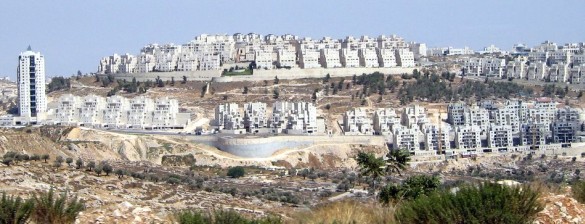
The most immediate issue raised by ‘borders first’ is whether it will deal with the Greater Jerusalem border. The issue here is not the Old City, the central focus of so much emotion and identity. It is the large central area of the West Bank, an area far beyond the old municipal boundaries of the city which extends deep into the central West Bank. Israel has developed huge settlements and a massive infrastructure which now almost surrounds East Jerusalem and which all but prevents any meaningful connection between the north and the south, and between the West Bank and East Jerusalem.

Will the negotiated border between the West Bank and Israel deal with the Jerusalem area? If the negotiated borders ratify the Israeli settlements and infrastructure as currently configured and proposed (including the controversial E-1 area), then the supposed Palestinian state would be essentially non-viable. It’s hard to imagine a government led by Netanyahu agreeing to remove existing settlements around the Greater Jerusalem area. But no Palestinian leader is likely to be able to sell a deal which ignores or ratifies the Greater Jerusalem settlement areas to his people, even if pressured to accept. If the negotiated borders ignore or defer the Jerusalem area – an idea I’ve heard in circulation – then the outcome would be meaningless and counter-productive. [continued…]

Dividing war spoils: Israel’s robbery of Palestinian property

While the news headlines were occupied with the freeze or suspension of Jewish settlements in the Occupied Palestinian Territories or with the competition for positions in the sixth Fateh conference in Bethlehem, Israel is putting into effect the most devastating operation since the ethnic cleansing of Palestine in al Nakba of 1948. This new operation aims to eliminate irrevocably Palestinian rights and historical roots in Palestine.

Ironically, Arab and Palestinian leaderships remain oblivious to these cataclysmic developments. In particular, the Palestinian leadership, whose main duty is to defend Palestinian rights, is bogged down with the assignment of internal political posts and fighting what it sees as its primary enemy, Hamas.

The Zionist leadership in Israel felt bold enough to transform the ideological slogan of ‘Jewish Israel’ into a reality on the ground. The Knesset, the Israel Parliament, passed a law on August 3rd, 2009, after its second and third readings, which allowed the sale of “Absentees” Palestinian refugees’ land to Jewish individuals and Jewish institutions exclusively anywhere in the world. Thus, the legal right of the original Palestinian owner to his land would be severed through creating a barrier between the owner and his property. The passing of the new law represents an audacious initiative by the current Israeli government that no previous Israeli government dared contemplate or venture into. [continued…]

Wobbly stools

There no question anymore that the only recipe for healing the Israeli-Palestinian wound is the termination of the occupation and the establishment of peace between the State of Israel and the new State of Palestine beside it. This demands meaningful and intense negotiations, within a fixed time span. That is impossible if at the same time settlements continue to expand. As the Palestinian lawyer Michael Tarasi aptly put it: ‘We are negotiating about the division of a pizza and in the meantime Israel is eating the pizza.’

That’s why Obama has presented the Israeli government with an unequivocal demand: an immediate stop to all building in the settlements, including East Jerusalem. A clear and logical demand. But while pressuring Netanyahu, he himself is exposed to heavy pressure at home over the health insurance system and the Afghan war…

The Americans recognise, of course, that our government is trying to deceive them. If they allow the building of just another 500 houses in the settlement blocks, and the completion of just another 2500 houses whose construction has already begun, and just a few more in East Jerusalem, in practice the building will go on unchecked.

The settlers know perfectly well that their whole enterprise has been based on deceit and trickery, house after house and neighbourhood after neighbourhood, and they are happy to allow Netanyahu to continue with this method. For the time being, they do not cry out, they are not worried, the more so as no large Israeli public movement has yet arisen in support of Obama’s peace efforts. [continued…]

Facebooktwittermail

Obama’s tough choice on Iran

Obama’s tough choice on Iran

The U.S. and its allies are not saying Iran is currently developing nuclear weapons; they’re warning that allowing Iran to assemble the full nuclear fuel cycle to which it is entitled as a signatory of the Non Proliferation Treaty — particularly uranium enrichment — gives it an infrastructure that could quickly be converted to produce bomb materiel. Stating Washington’s case at the International Atomic Energy Agency in Vienna this week, Ambassador Glyn Davies warned that Iran had already created enough low-enriched uranium that, if it kicked out nuclear inspectors and reconfigured its enrichment plant, could be re-enriched to provide materiel for a single bomb. “We have serious concerns that Iran is deliberately attempting, at a minimum, to preserve a nuclear option,” Davies said.

Moscow sees the problem in terms of strengthening the safeguards against Iran weaponizing nuclear materials, rather than trying to prevent it attaining “breakout” capacity by denying its right to enrich uranium.

President Mahmoud Ahmadinejad reiterated this week that Iran no intention of ending uranium enrichment, or of negotiating away its nuclear rights. That doesn’t necessarily preclude a diplomatic solution to the standoff, but it underscores the likelihood that the Western powers might have to compromise on their own demands in order to achieve one. In some previous rounds of negotiation, Iran has been more open to discussing strengthening of the IAEA monitoring regime and other safeguards against weaponization. Right now, however, it’s far from clear that Iran is in an accommodating mood, given its fierce and ongoing domestic power struggle. [continued…]

Secret Iranian missile memos

I have been given a series of what appear to be internal secret Iranian documents by sources I trust. If authentic, and I believe they are, they provide important insights into Iran’s missile development program and have important implications for North Korea’s as well. Unfortunately, to protect my sources and the Iranians who spirited these documents out to the West, I cannot be too explicit about their contents. The following examination of these memos contains both information from and my analysis of them. I have tried to explicitly point out what is my speculation.

The memos cover, in a somewhat sketchy way, a lot of ground. Perhaps the most important aspects are those that deal with how several countries collaborate in either developing missiles or selling missile technology to Iran. The memos use codes for the different collaborator countries but I think I know the meanings of the codes. If my understanding is correct, they indicate that representatives from North Korea and China have been present at all phases of production and flight testing. Iran has also gotten important help from Russia, though Russians do not appear to have been as ubiquitous as the Chinese and the North Koreans. The evidence from the memos indicates that this help is on the governmental level rather than “rogue” individuals. This includes Russian help though Russia has been particularly vocal in its denials of such assistance. Despite these denials, the evidence of foreign assistance, both images of engines and turbopumps that are obviously of Russian origin—either their actual production or at the very least their designs—and these internal Iranian memos, make the case overwhelmingly. [continued…]

Facebooktwittermail

A somber warning on Afghanistan

A somber warning on Afghanistan

Western powers now in Afghanistan run the risk of suffering the fate of the Soviet Union there if they cannot halt the growing insurgency and an Afghan perception that they are foreign invaders, according to Zbigniew Brzezinski, the former U.S. national security adviser to President Jimmy Carter.

In a speech opening a weekend gathering of military and foreign policy experts, Mr. Brzezinski, who was national security adviser when the Soviet Union invaded Afghanistan in late 1979, endorsed a British and German call, backed by France, for a new international conference on the country. He also set the tone for a weekend of somber assessments of the situation.

He noted that it took about 300 U.S. Special Forces — fighting with Northern Alliance troops — to overthrow Taliban rule after the Sept. 11 attacks in 2001.

Now, however, with about 100,000 U.S. and allied troops in Afghanistan, those forces are increasingly perceived as foreign invaders, much as the Soviet troops were from the start, Mr. Brzezinski said. [continued…]

In Kandahar, a Taliban on the rise

The slow and quiet fall of Kandahar, the country’s second-largest city, poses a complex new challenge for the NATO effort to stabilize Afghanistan. It is factoring prominently into discussions between Gen. Stanley A. McChrystal, the overall U.S. and NATO commander, and his advisers about how many more troops to seek from Washington.

“Kandahar is at the top of the list,” one senior U.S. military official in Afghanistan said. “We simply do not have enough resources to address the challenges there.”

Kandahar in many ways is a microcosm of the challenges the United States faces in stabilizing Afghanistan. The city is filled with ineffective government officials and police officers whom the governor calls looters and kidnappers. Unemployment is rampant. Municipal services are nonexistent. Reconstruction projects have not changed many lives. A lack of NATO forces allowed militants free rein. [continued…]

Are US taxpayers funding the Taliban?

The United States Agency for International Development has opened an investigation into allegations that its funds for road and bridge construction in Afghanistan are ending up in the hands of the Taliban, through a protection racket for contractors.

And House Foreign Affairs Committee member, Rep. Bill Delahunt (D-Mass.) vowed to hold hearings on the issue in the fall, saying: “The idea that American taxpayer dollars are ending up with the Taliban is a case for grave concern.”

U.S. officials confirmed that the preliminary investigation and the proposed hearings were sparked by a GlobalPost special report on the funding of the Taliban last month that uncovered a process that has been an open secret in Afghanistan for years among those in international aid organizations.

The report exposed that the Taliban takes a percentage of the billions of dollars in aid from U.S. and other international coalition members that goes to large organizations and their subcontractors for development projects, in exchange for protection in remote areas controlled by the insurgency. [continued…]

McChrystal: No major al-Qaida signs in Afghanistan

The top commander of U.S. and international forces in Afghanistan said Friday he sees no signs of a major al-Qaida presence in the country, but says the terror group still maintains close links to insurgents. [continued…]

Bin Laden calls Obama ‘powerless’ in Afghan war

Al-Qaida leader Osama bin Laden described President Barack Obama as “powerless” to stop the war in Afghanistan and threatened to step up guerrilla warfare there in a new audiotape released to mark the anniversary of the Sept. 11 attacks in the United States.

In the 11-minute tape, addressed to the American people, bin Laden said Obama is only following the warlike policies of his predecessor George W. Bush and Vice President Dick Cheney and he urged Americans to “liberate” themselves from the influence of “neo-conservatives and the Israeli lobby.”

The tape was posted on Islamic militant Web sites two days after the eighth anniversary of the 2001 suicide plane hijackings. The terror leader usually addresses Americans in a message timed around the date of the attacks, which sparked the U.S.-led war in Afghanistan the same year, and then in Iraq two years later.

Bin Laden said Americans had failed to understand that al-Qaida carried out the attacks in retaliation for U.S. support for Israel. If America reconsiders its alliance with the Jewish state, al-Qaida will respond on “sound and just bases.” [continued…]

Facebooktwittermail

Dismantling the matrix of control

Dismantling the matrix of control

Many Palestinian, Israeli and international proponents of a just peace took heart in Obama’s early gestures. Beginning with the appointment of former Sen. George Mitchell as special envoy and continuing through the president’s June 4 speech in Cairo, these proponents allowed themselves, after years of disappointment and struggle, a cautious hopefulness. Some of the speech’s formulations, like the nods to the “pain of dislocation” felt by Palestinians and the “daily humiliations” of occupation, had been heard before. But one sentence had not been: Obama said that a two-state solution “is in Israel’s interest, Palestine’s interest, America’s interest and the world’s interest.” Obama seemed to “get it,” that is, he seemed to understand that the US is isolated politically by its unquestioning backing of Israel, which is seen as obstructing a solution to the conflict. And, for the first time, a US president actually said that resolving the Israeli-Palestinian conflict is in the vital national interest, not just a nice thing to do. These words significantly raise the bar. Framing the conflict in this way makes it easier for the administration to win Congressional support for tougher demands upon Israel while undermining the ability of the American Israel Public Affairs Committee (AIPAC) to mount an effective resistance, given American Jewish sensibilities about suspicions of dual loyalty.

Since the Cairo speech, however, fundamental doubts about US efforts have resurfaced. The only demand made by Obama upon Israel has been for a settlement “freeze,” a welcome symbolic gesture, to be sure, yet irrelevant to any peace process. Israel has enough settlement-cities in strategic “blocs” that it could in fact freeze all construction without compromising its control over the West Bank and “greater” Jerusalem, the Arab areas to the north, south and east of the city where Israel has planted its flag. Focusing on this one issue — which, months later, is still being haggled over — has provided Israel with a smokescreen behind which it can actively and freely pursue more significant and urgent construction that, when completed, will truly render the occupation irreversible. It is rushing to complete the separation barrier, which is already being presented as the new border, replacing the “Green Line,” the pre-June 1967 boundary to which Israel is supposed to withdraw, by the terms of UN Security Council resolutions, but on which even the most ardent two-staters have long since given up. Israel is demolishing homes, expelling Palestinian residents and permitting Jewish settlement throughout East Jerusalem, measurably advancing the “judaization” of the city. It is confiscating vast tracts of land in the West Bank and “greater” Jerusalem and pouring bypass road asphalt at a feverish pace so as to permanently redraw the map. It is laying track on Palestinian land for a light-rail line connecting the West Bank settlement-city of Pisgat Ze’ev to Israel. It is drying up the main agricultural areas of the West Bank, forcing thousands of people off their lands, while instituting visa restrictions that either keep visiting Palestinians and internationals out of the country altogether, or limit their movement to the truncated Palestinian enclaves of the West Bank.

“Quiet,” behind-the-scenes diplomacy is surely taking place, but the few details that have emerged are far from reassuring. The State Department has mocked as “fiction” a ten-point document given to the Arab press by Fatah figure Hasan Khreisheh that promises an “international presence” in parts of the West Bank and US backing for a Palestinian state by 2011. The component of this alleged plan that seems more likely is that the US wants a partial freeze on settlement activity from Israel in exchange for a pledge from Washington to push for more stringent sanctions upon Iran for its nuclear research. On August 25, the Guardian quoted “an official close to the negotiations” saying: “The message is: Iran is an existential threat to Israel; settlements are not.” By all indications, if the Obama administration does present a regional peace plan, which it is expected by many to do around the time of the UN General Assembly meeting on September 20, it will be nothing more than a “rough draft.” It is no exaggeration to say a two-state solution will rise or fall on the outlines of this draft — and may perhaps fall forever if no concrete plan is presented at all, which is also possible. Although the two-state solution has been eulogized many times in the past, Obama represents a best-case scenario. If he presents, in the end, a disappointing peace plan that offers no genuine breakthrough, then the shift to a one-state solution on the part of the Palestinian people and their international supporters will be inescapable. [continued…]

Facebooktwittermail

‘I told the US to talk to the Taliban. They jailed me’

‘I told the US to talk to the Taliban. They jailed me’

He was the man they called the mullah with a human face, the internet mullah, or the Rudolph Hess of the Taliban. Wakil Ahmed Muttawakil was the Taliban’s foreign minister. It was he who in October 2001, a month after 9/11 and weeks before the US-led invasion of Afghanistan, broke ranks with the hardline clerical leadership and tried to broker a peace deal with Washington.

Eight years on, as the West struggles to form a coherent policy on Afghanistan amid mounting domestic opposition to the war, Mullah Muttawakil has claimed that the West has repeatedly squandered chances for peace.

“We have seen a lot of fighting since then, a lot of blood has been spilt, all for what?” he asked. “They are saying now that they will talk to some of the Taliban. That is what I said to them just after the war. I offered to put them in touch with the relevant people. Their answer was to put me in jail.” [continued…]

Facebooktwittermail

How Islamist gangs use internet to track, torture and kill Iraqi gays

How Islamist gangs use internet to track, torture and kill Iraqi gays

Sitting on the floor, wearing traditional Islamic clothes and holding an old notebook, Abu Hamizi, 22, spends at least six hours a day searching internet chatrooms linked to gay websites. He is not looking for new friends, but for victims.

“It is the easiest way to find those people who are destroying Islam and who want to dirty the reputation we took centuries to build up,” he said. When he finds them, Hamizi arranges for them to be attacked and sometimes killed.

Hamizi, a computer science graduate, is at the cutting edge of a new wave of violence against gay men in Iraq. Made up of hardline extremists, Hamizi’s group and others like it are believed to be responsible for the deaths of more than 130 gay Iraqi men since the beginning of the year alone.

The deputy leader of the group, which is based in Baghdad, explained its campaign using a stream of homophobic invective. “Animals deserve more pity than the dirty people who practise such sexual depraved acts,” he told the Observer. “We make sure they know why they are being held and give them the chance to ask God’s forgiveness before they are killed.”

The violence against Iraqi gays is a key test of the government’s ability to protect vulnerable minority groups after the Americans have gone.

Dr Toby Dodge, of London University’s Queen Mary College, believes that the violence may be a consequence of the success of the government of Nouri al-Maliki. “Militia groups whose raison d’être was security in their communities are seeing that function now fulfilled by the police. So their focus has shifted to the moral and cultural sphere, reverting to classic Islamist tactics of policing moral boundaries,” Dodge said. [continued…]

Facebooktwittermail

U.S. accepts offer from Tehran for broad talks

U.S. accepts offer from Tehran for broad talks

The United States has decided to ignore Iran’s refusal to discuss its nuclear program and instead accept a vague Iranian plan for talks on security issues as the opening gambit to draw Tehran into real negotiation.

The effort to “test” Iran’s intentions, announced on Friday, came after Russian Prime Minister Vladimir Putin said his country is skeptical of the need for new sanctions on Iran, giving the Americans little choice but to treat seriously Iran’s latest offer.

Iran this week ruled out talks on its program, instead offering a five-page plan that it said would lay the groundwork for peace and stability in the region. The document, first posted Thursday on the Web site of ProPublica news service, made no reference to international demands that Iran suspend its efforts to enrich uranium, but did mention ending proliferation in nuclear weapons as well as a broad offer of dialogue. [continued…]

Why Washington should welcome Iran’s broadening of the agenda

The Iranian proposal is best understood not from the prism of the West’s focus on the nuclear program, but from the vantage point of Iran’s long standing objective to be recognized as a regional power with a permanent seat at the table of regional decision making. Iran believes it suffers from severe role deficit — though it is one of the most powerful countries in the region, its neighbors view it by and large as a disruptive, anti-status quo power and have consequently refrained from giving it access to recognized and institutionalized avenues of influence.

After all, the reigning order in the Middle East is one defined and upheld by the United States, which for the past thirty years has sought Iran’s isolation and exclusion, not its inclusion and rehabilitation. Breaking out of this isolation and forcing Washington and the regional capitols to grant Iran the role it craves have been overarching strategic goals of Iranian foreign policy for several decades now.

Iran believes that the nuclear stand-off provides it with an opportunity to achieve this objective. By broadening the agenda for negotiations, Iran takes the opportunity to discuss with the great powers matters where the views of the Iranian government hardly have been taken into account in the past. The broader aim is to institutionalize the great power’s recognition of Iran’s role and seat at the table.

Perhaps more importantly, the Iranians refuse to permit the P5 plus 1 to single-handedly set the parameters of the talks. By presenting its own proposal, Iran is introducing its own parameters. The Iranians are in essence negotiating about the shape of the table before negotiating matters of substance. This is hardly surprising. During the EU-Iranian negotiations on the nuclear issue, Tehran was immensely frustrated by Europe’s dismissal of several Iranian proposals and its insistence on solely discussing its own set of ideas and demands. By now, Iran seems determined not to let that happen again. [continued…]

Facebooktwittermail

Iran urges disposal of all nuclear arms

Iran urges disposal of all nuclear arms

Iran is not prepared to discuss halting its uranium enrichment program in response to Western demands but is proposing instead a worldwide control system aimed at eliminating nuclear weapons, President Mahmoud Ahmadinejad’s top political aide said in an interview Thursday.

In a set of proposals handed to the permanent members of the U.N. Security Council and Germany on Wednesday, Iran also offered to cooperate on solving problems in Afghanistan and fighting terrorism and to collaborate on oil and gas projects, Mojtaba Samareh Hashemi said. A longtime confidant of the president’s, Samareh Hashemi is reportedly being considered for the key post of first vice president in Ahmadinejad’s new government.

As described by Samareh Hashemi, Iran’s offer is similar to a call by President Obama in April to eliminate the world’s nuclear weapons. Later this month, Obama is scheduled to chair a special session of the U.N. General Assembly’s annual meeting aimed at seeking consensus on preventing the spread of nuclear weapons, rather than targeting individual nations such as Iran and North Korea. Ahmadinejad is also scheduled to attend the U.N. meeting and has said he is ready to debate Obama publicly.

“It’s not really responsive to our greatest concern, which is obviously Iran’s nuclear program,” State Department spokesman P.J. Crowley said of Tehran’s package of proposals. “Iran reiterated its view that as far as it is concerned, its nuclear file is closed. . . . That is certainly not the case. There are many outstanding issues.” [continued…]

Editor’s Comment — As usual, Iran’s position is portrayed as being one of intransigence, yet at the core of the conflict here is a dispute over whether one side can claim the “right” to dictate the parameters of engagement. The US and its allies are in effect saying: we are the ones who get to set the agenda.

Is 2009 a real change from 2008? I’m still waiting to spot the difference.

The specific nuclear clause in Iran’s proposal is this:

Promoting the universality of NPT mobilizing global resolve and putting into action real and fundamental programmes toward complete disarmament and preventing development and proliferation of nuclear, chemical and microbial weapons.

How serious a proposal is this?

In a way it’s clearly simply a rhetorical challenge. It’s a way of calling Obama’s bluff. Was his Prague declaration more than a piece of campaign-style fluff? A way of offering Europeans a feel-good moment that would make his tour Kennedyesque? Or was he serious?

If nuclear disarmament is ever going to reach the negotiating table then the Middle East’s sole nuclear power is first going to have to come out of the closet. And this goes to the heart of the current impasse: Iran’s opponents insist that the nuclear file cannot include discussion about Israel’s nuclear weapons. Iran must curtail its nuclear aspirations (even though we don’t actually know what they are) while Israel is at liberty to conceal its nuclear actualities.

“They’re baaaaack….”

When I started blogging back in January, one of my early posts questioned the belief that Obama’s election had ended talk of military action against Iran. I thought this view was “almost certainly premature,” because I didn’t think a rapid diplomatic breakthrough was likely and I knew that advocates of a more forceful approach would soon come out of the woodwork and start pushing the new administration to get tough with Tehran.

Well, I hate to say I told you so, but … Right on cue, Wednesday’s Wall Street Journal had an op-ed from former Senators Dan Coats and Chuck Robb and retired Air Force general Chuck Wald, recommending that Obama “begin preparations for the use of military options” against Iran’s nuclear facilities. They argue that keeping the threat of force “on the table” is the only way to achieve a diplomatic solution, but they also make it clear that they favor bombing Iran if diplomacy fails. In their words, “making preparations now will enable the president, should all other measures fail to bring Tehran to the negotiating table, to use military force to retard Iran’s nuclear program.” [continued…]

Russia says sanctions against Iran are unlikely

Foreign Minister Sergey V. Lavrov on Thursday all but ruled out imposing new sanctions against Iran over its nuclear program, brushing aside growing Western concerns that Iran had made significant progress in recent months in a bid for nuclear weapons.

Mr. Lavrov said he believed that a new set of proposals that Iran gave to European nations on Wednesday offered a viable basis for negotiations to end the dispute. He said he did not believe that the United Nations Security Council would approve new sanctions against Iran, which could ban Iran from exporting oil or importing gasoline.

“Based on a brief review of the Iranian papers, my impression is there is something there to use,” Mr. Lavrov said at a gathering of experts on Russia. “The most important thing is Iran is ready for a comprehensive discussion of the situation, what positive role it can play in Iraq, Afghanistan and the region.” [continued…]

Facebooktwittermail

To save Afghanistan, look to its past

To save Afghanistan, look to its past

No matter who is ultimately certified as the winner of Afghanistan’s presidential election, the vote was plagued by so much fraud and violence, and had such low turnout, that it is inconceivable the Afghan people will regard the victor as a legitimate leader. And if a majority of Afghans do not consider the president and his government to be legitimate, the military campaign now being waged by the United States and its allies is doomed to fail, regardless of the number of troops deployed.

Current discussions about cobbling together mistrustful factions into a new power-sharing government will produce neither enduring democracy nor short-term peace. The slate must be wiped clean. Afghans need to start again from scratch and choose their leader by a fresh process that restores legitimacy to the national government.

Fortunately, such a process already exists — one that is both highly respected by the Afghan people and recognized in the Afghan Constitution: the convening of an emergency loya jirga, or grand assembly. The loya jirga has been called in times of national crisis in Afghanistan for centuries. In 1747, such an assembly in Kandahar selected Ahmad Shah Durrani as the first king of Afghanistan, uniting a patchwork of contentious tribal entities into the modern Afghan state. The loya jirga, moreover, is not only deeply rooted in Pashtun tradition, but is also consistent with notions of Western representative democracy. [continued…]

Obama faces doubts from Democrats on Afghanistan

The leading Senate Democrat on military matters said Thursday that he was against sending more American combat troops to Afghanistan until the United States speeded up the training and equipping of more Afghan security forces.

The comments by the senator, Carl Levin, a Michigan Democrat who is the chairman of the Armed Services Committee, illustrate the growing skepticism President Obama is facing in his own party as the White House decides whether to commit more deeply to a war that has begun losing public support, even as American commanders acknowledge that the situation on the ground has deteriorated.

Senator Levin’s comments, made in an interview and in the draft of a speech he will deliver Friday, are significant because his stature on military matters gives him the ability to sway fellow lawmakers, and his pivotal committee position provides a platform for vetting Mr. Obama’s major decisions on troops. [continued…]

Pelosi sees support ebbing for Afghan war

House Speaker Nancy Pelosi said she sees little congressional support for boosting troop levels in Afghanistan, putting the Democratic majority in Congress on a possible collision course with the Obama administration over the future conduct of the war there.

The remarks Thursday by Ms. Pelosi (D., Calif.) make her the highest-ranking Democrat to signal opposition to the administration’s handling of the Afghan war, a top national-security priority.

The remarks also underscored the increasingly complex political dynamics confronting President Barack Obama as he considers whether to send additional U.S. forces to Afghanistan. [continued…]

Afghan warlord General Atta Mohammad Nur warning raises fear of election violence

One of Afghanistan’s most powerful warlords has defended the popular right to protest against the presidential election results, raising fears that the country could be engulfed by violence if supporters of the losing candidates reject the poll as being rigged.

General Atta Mohammad Nur, who broke ranks with the Government to support President Karzai’s main election rival, insisted: “It is the right of our people to defend their votes. Demonstrations, gatherings, strikes and protests against fraud being carried out by the current system are the absolute right of the people.”

Speaking on national television, he accused the country’s Interior Minister, Hanif Atmar, of “forcing people to keep silent”. [continued…]

Facebooktwittermail

How 9/11 should be remembered

How 9/11 should be remembered

Eight years ago, 2,600 people lost their lives in Manhattan, and then several million people lost their story. The al-Qaeda attack on the Twin Towers did not defeat New Yorkers. It destroyed the buildings, contaminated the region, killed thousands, and disrupted the global economy, but it most assuredly did not conquer the citizenry. They were only defeated when their resilience was stolen from them by clichés, by the invisibility of what they accomplished that extraordinary morning, and by the very word “terrorism,” which suggests that they, or we, were all terrified. The distortion, even obliteration, of what actually happened was a necessary precursor to launching the obscene response that culminated in a war on Iraq, a war we lost (even if some of us don’t know that yet), and the loss of civil liberties and democratic principles that went with it. [continued…]

Facebooktwittermail