Category Archives: Issues

CAMPAIGN 08 & EDITOR’S COMMENT: What’s Hillary’s position on the Hitler Concept?

Hillary’s prayer: Hillary Clinton’s religion and politics

When Clinton first came to Washington in 1993, one of her first steps was to join a Bible study group. For the next eight years, she regularly met with a Christian “cell” whose members included Susan Baker, wife of Bush consigliere James Baker; Joanne Kemp, wife of conservative icon Jack Kemp; Eileen Bakke, wife of Dennis Bakke, a leader in the anti-union Christian management movement; and Grace Nelson, the wife of Senator Bill Nelson, a conservative Florida Democrat.

Clinton’s prayer group was part of the Fellowship (or “the Family”), a network of sex-segregated cells of political, business, and military leaders dedicated to “spiritual war” on behalf of Christ, many of them recruited at the Fellowship’s only public event, the annual National Prayer Breakfast. (Aside from the breakfast, the group has “made a fetish of being invisible,” former Republican Senator William Armstrong has said.) The Fellowship believes that the elite win power by the will of God, who uses them for his purposes. Its mission is to help the powerful understand their role in God’s plan.

Clinton declined our requests for an interview about her faith, but in Living History, she describes her first encounter with Fellowship leader Doug Coe at a 1993 lunch with her prayer cell at the Cedars, the Fellowship’s majestic estate on the Potomac. Coe, she writes, “is a unique presence in Washington: a genuinely loving spiritual mentor and guide to anyone, regardless of party or faith, who wants to deepen his or her relationship with God.” [complete article]

Editor’s Comment — In a 2006 New York Times interview, Hillary Clinton said warmly that “Doug [Coe] was always very supportive of me.” One wonders then what her position might be on Coe’s promotion of the “Hitler concept”?

This is how Coe explained the concept in a conversation recounted in Harper’s:

“Do you know what a difference a friend can make? A friend you can agree with?” He smiled. “Two or three agree, and they pray? They can do anything. Agree. Agreement. What’s that mean?” Doug looked at me. “You’re a writer. What does that mean?”

I remembered Paul’s letter to the Philippians, which we had begun to memorize. Fulfill ye my joy, that ye be likeminded.

“Unity,” I said. “Agreement means unity.”

Doug didn’t smile. “Yes,” he said. “Total unity. Two, or three, become one. Do you know,” he asked, “that there’s another word for that?”

No one spoke.

“It’s called a covenant. Two, or three, agree? They can do anything. A covenant is . . . powerful. Can you think of anyone who made a covenant with his friends?”

We all knew the answer to this, having heard his name invoked numerous times in this context. Andrew from Australia, sitting beside Doug, cleared his throat: “Hitler.”

“Yes,” Doug said. “Yes, Hitler made a covenant. The Mafia makes a covenant. It is such a very powerful thing. Two, or three, agree.”

And Jeff Sharlet, the author of the Harper’s piece, in a subsequent interview went on to explain more about this concept as understood by members of Coe’s secretive organization:

All these guys Hitler, Lenin, Pol Pot and Osama bin Laden is another guy they cite a lot, are guys who understood the power of a political avant garde. That’s what they mean by the Hitler Concept.

If the evidence of disarray inside her campaign is any indication, it doesn’t seem that Hillary is making use of this Family principle. Even so, her association with Coe and his organization does little to burnish her Democratic credentials.

Facebooktwittermail

CAMPAIGN 08 FEATURE: McCain adviser wants to destroy Islam

McCain’s spiritual guide: destroy Islam

Senator John McCain hailed as a spiritual adviser an Ohio megachurch pastor who has called upon Christians to wage a “war” against the “false religion” of Islam with the aim of destroying it.

On February 26, McCain appeared at a campaign rally in Cincinnati with the Reverend Rod Parsley of the World Harvest Church of Columbus, a supersize Pentecostal institution that features a 5,200-seat sanctuary, a television studio (where Parsley tapes a weekly show), and a 122,000-square-foot Ministry Activity Center. That day, a week before the Ohio primary, Parsley praised the Republican presidential front-runner as a “strong, true, consistent conservative.” The endorsement was important for McCain, who at the time was trying to put an end to the lingering challenge from former Arkansas governor Mike Huckabee, a favorite among Christian evangelicals. A politically influential figure in Ohio, Parsley could also play a key role in McCain’s effort to win this bellwether state in the general election. McCain, with Parsley by his side at the Cincinnati rally, called the evangelical minister a “spiritual guide.”

The leader of a 12,000-member congregation, Parsley has written several books outlining his fundamentalist religious outlook, including the 2005 Silent No More. In this work, Parsley decries the “spiritual desperation” of the United States, and he blasts away at the usual suspects: activist judges, civil libertarians who advocate the separation of church and state, the homosexual “culture” (“homosexuals are anything but happy and carefree”), the “abortion industry,” and the crass and profane entertainment industry. And Parsley targets another profound threat to the United States: the religion of Islam.

In a chapter titled “Islam: The Deception of Allah,” Parsley warns there is a “war between Islam and Christian civilization.” He continues:

I cannot tell you how important it is that we understand the true nature of Islam, that we see it for what it really is. In fact, I will tell you this: I do not believe our country can truly fulfill its divine purpose until we understand our historical conflict with Islam. I know that this statement sounds extreme, but I do not shrink from its implications. The fact is that America was founded, in part, with the intention of seeing this false religion destroyed, and I believe September 11, 2001, was a generational call to arms that we can no longer ignore.

Parsley is not shy about his desire to obliterate Islam. [complete article]

Facebooktwittermail

CAMPAIGN 08: Experience required

Senator Clinton’s claims of foreign policy experience are exaggerated

When your entire campaign is based upon a claim of experience, it is important that you have evidence to support that claim. Hillary Clinton’s argument that she has passed “the Commander- in-Chief test” is simply not supported by her record.

There is no doubt that Hillary Clinton played an important domestic policy role when she was First Lady. It is well known, for example, that she led the failed effort to pass universal health insurance. There is no reason to believe, however, that she was a key player in foreign policy at any time during the Clinton Administration. She did not sit in on National Security Council meetings. She did not have a security clearance. She did not attend meetings in the Situation Room. She did not manage any part of the national security bureaucracy, nor did she have her own national security staff. She did not do any heavy-lifting with foreign governments, whether they were friendly or not. She never managed a foreign policy crisis, and there is no evidence to suggest that she participated in the decision-making that occurred in connection with any such crisis. As far as the record shows, Senator Clinton never answered the phone either to make a decision on any pressing national security issue – not at 3 AM or at any other time of day.

When asked to describe her experience, Senator Clinton has cited a handful of international incidents where she says she played a central role. But any fair-minded and objective judge of these claims – i.e., by someone not affiliated with the Clinton campaign – would conclude that Senator Clinton’s claims of foreign policy experience are exaggerated. [complete article]

Facebooktwittermail

CAMPAIGN 08 & EDITOR’S COMMENT: The Hillary hoodwink

Clinton camp: Obama must pass ‘security threshold’ to be veep

Senior advisers to Sen. Hillary Rodham Clinton (D-N.Y.) on Monday sought to reconcile the campaign’s assertion that rival Sen. Barack Obama (D-Ill.) has not passed the “commander-in-chief test” with the Clintons’ hints in recent days that the New York senator would tap Obama as a running mate.

Howard Wolfson, Clinton’s chief spokesman, said during a conference call with reporters that Clinton would reject any running mate who has not met the “national security threshold,” as Clinton’s military advisers and Wolfson put it on the call. But he added that it is possible Obama could meet that threshold by this summer’s Democratic convention.

Wolfson repeated Clinton’s weekend assertion that picking Obama is “not something she would rule out at this point,” but he also reiterated that Obama is not ready to be commander in chief, a key requirement to being Clinton’s running mate.

When asked if Obama could do something to cross that “threshold,” Wolfson said, “It’s not something that I’m prepared to rule out at this time.” [complete article]

Editor’s Comment — Let’s see. Are we to suppose that the Clinton campaign is secretly putting together a VP crash course so that Obama can pass the “security threshold” just in time for the convention? For Hillary it took a lifetime of experience, but Obama’s such a quick study he’ll be able to do it in just four months. But hey, if he could do that, maybe that’s why he has the audacity to claim he’s ready now. But then again….

Maybe something else is going on. Maybe the Clinton campaign has pin-pointed a key demographic segment that they’re eager to grab – a chunk of the undecided voters that the analysts are far too polite to name: voters who can easily be hoodwinked. Here’s the pitch: “You know, I’ve said some pretty nasty things about Barak and in the unlikely event that I fail to win the nomination, he probably won’t want me as a running mate. He might even have the nerve to say he wants someone more experienced than me. But I’m big hearted and big minded and I care about what’s best for the Democratic party, so if you vote for me, I’ll bring him along too. He’s a good kid and I could knock him into shape in a few weeks. So, if you’re not a delusional dreamer who’s just a sucker for a good speech but you still like Obama, then vote for me. You know it makes sense. Repeat after me: I support Obama, so I will vote for Hillary. I support Obama, so I will vote for Hillary…. And when you get in the voting booth and you’re thinking, ‘I’m gonna vote for Obama,’ just remember: check the box next to the name ‘Clinton.'”

Facebooktwittermail

CAMPAIGN 08 OPINION & EDITOR’S COMMENT: Obama’s fight

Confronting the kitchen sink

Political campaigns are not about fairness, but they can often be about vision. Voters want more from Senator Obama.

He may not be able to close the deal with, say, working-class whites, but he more than anyone else has the eloquence to try and make a compelling case. He should go for it.

We have seen election after election in which candidates have won by fanning the anxieties of voters. Elect me, or something terrible will happen to you!

That is now the Clinton mantra, which is a measure of how grim our politics have become. [complete article]

Editor’s Comment — There’s a false dichotomy being created between the Obamian high road and the Clintonian knife fight. Obama does need to fight, but pushing for tax returns isn’t going to work. This is a contest between two visions of the presidency. Hillary presents herself as the champion-solutions-fighter, but it’s a false bill of goods. Sure, she’s demonstrating her willingness to fight, but that’s not the same as being able to win. She fought for health care when she had the privilege of being First Lady, and she lost. She came into the primaries way ahead in the polls yet still suffered a string of defeats. She may right now be enjoying a tactical advantage but when it comes to displaying organizational and strategic mastery, if the Clinton campaign itself foretells the nature of a Clinton presidency – makeshift, discordant, reactive and uninspired – we’re in for trouble.

Obama on the other hand need go no further than present his own campaign as a model for his ability to craft and steer an organization. It’s been knocked off course recently and he needs to do a better job of showing that he can steer it back and do so without kowtowing to the Clinton campaign’s rebukes – dumping Samantha Power was a big mistake – but make the campaign the focus of the campaign by holding it up as a blueprint of the presidency and then go back to that red phone question. Who does America want to take the call? A defensive curmudgeon, a presidential poseur, or someone who’s relative inexperience is amply counterbalanced with sound judgment, a cool temperament, and a passion to lead by raising up the country rather than a passion for trying to destroy his opponents?

Facebooktwittermail

CAMPAIGN 08: You can’t lick the boot that kicks you

The only way to fight the Clintons

joann-wypijewski.jpgTalk about the “kitchen sink”! If Barack Obama wanted to throw it at the eight years of First Lady experience that Hillary Clinton has made central to her resume for “the job” she says she wants us to “hire” her for, there is plenty there. People on the left who say he won’t, he can’t because he’s just like her, a creature of capital and empire, may be right in the grand scheme, but they shouldn’t be smug, because there aren’t exactly models of successful radical or even liberal fights against the Clintons. There are barely models of noble but failed fights. And Hillary’s own revamped self-presentation as the populist fighter, sworn foe of big corporations, friend of the little people, ultimate underdog, makes clear that Obama’s ties to Wall Street should be no more an impediment than hers are in the game of political fisticuffs.

Already it looks like Obama’s advisers are getting it completely wrong, though, challenging her for her First Lady papers and her tax returns and, implicitly, the source of her and Bill’s immense wealth. Obama can no more beat the Clintons at this kind of game than the right could. Every small, personal complaint looks petty or desperate or sexist, and only allows Hillary to play the part she likes best, after mud slinger and policy wonk, which is survivor. She played that part in New Hampshire and in Ohio, and she’ll play it again any time she wants to put on the show that “for anyone who’s ever been counted out”, for anyone who’s ever had to struggle against the odds, for anyone who’s ever been treated unfairly, she’s their gal. It’s as phony a show as can be imagined, but it’s the one the Clintons perfected against the right, and their hard core supporters are on autopilot now to respond to it. Likewise, Obama can’t beat the Clintons in pure bloviating wonkery. Some of his advisors are saying he should quit the big inspiring rallies and do small tedious meetings of the type that Hillary’s supporters walk out of, even as they’ll later pull the lever for her at the polls. It’s not her “plans” that draw voters; like Blanche McKinney, most people don’t even know what those plans involve even after reading them. It’s her aura of dogged competence, based on the entirely fraudulent story of “putting people first” and thus widening the circle of peace and prosperity during the Clinton years. It’s also her skin color, and if anyone doesn’t think Bill Clinton knew what he was doing in South Carolina, locking up the white racist vote for his wife, they should talk to some of her supporters in Ohio.

Obama can’t do anything about that last “asset” of Hillary Clinton, and maybe it is her ultimate chip, but it would make for a more interesting campaign going forward if he would challenge that First Lady experience by implicitly challenging the myths on which it stands, projecting an idea of the future unmoored from the Reagan-Clinton continuum, something Hillary is locked into. What drew so many people originally to Obama’s campaign was its call to “turn the page” on past Republican and Democratic politics alike, and its recognition that people are just fed up. But that call could never sustain itself purely on some attacks on lobbyists and the usual timid party nods toward health care, education and the environment. It was always going to need more meat on its bones. [complete article]

Never been afraid to talk about anything

I came across something interesting while doing some research on public diplomacy for an unrelated project. Since at least the 9/11 Commission Report, almost every foreign policy blueprint or platform has for better or for worse mentioned the need to fix American public diplomacy and to engage with the “war of ideas” in the Islamic world. I expected all three remaining Presidential candidates to offer at least some boilerplate rhetoric on the theme. What I found was different.

Barack Obama’s counterterrorism plan, as I already knew, prominently features the need for better public diplomacy and engagement with the “crucial debate.. taking place within Islam”. He has advanced some bold ideas such as convening a summit with the leaders of the Islamic world early in his administration and the “America’s Voice Initiative” modeled after the Peace Corps (an idea which I love for all kinds of reasons). He’s making rebuilding America’s relations with the Muslim world a real priority, while putting forward a sophisticated reading of the politics of the Islamic world. Indeed, his discourse about this the other day during a potentially difficult meeting with Ohio Jewish leaders is possibly the best I’ve ever heard from an American politician:

The question, then, is what do we do with the 1.3 billion Muslims, who are along a spectrum of belief. Some extraordinarily moderate, some very pious but not violent. How do we reach out to them? And it is my strong belief that that is the battlefield that we have to worry about, and that is where we have been losing badly over the last seven years. That is where Iraq has been a disaster. That is where the lack of effective public diplomacy has been a disaster. That is where our failure to challenge seriously human rights violations by countries like Saudi Arabia that are our allies has been a disaster. And so what we have to do is to speak to that broader Muslim world in a way that says we will consistently support human rights, women’s rights…. Those all contribute to people at least being open to our values and our ideas and a recognition that we are not the enemy and that the clash of civilizations is not inevitable.

Now, as I said, we enter into those conversations with the Muslim world being mindful that we also have to defend ourselves against those who will not accept the West, no matter how appropriately we engage. And that is the realism that has to leaven our hopefulness. But, we abandon the possibility of conversation with that broader Muslim world at our own peril. I think all we do then is further isolate it and feed the kinds of jihadist fanaticism….

To me, that’s great stuff. It exemplifies the reasons why I’ve supported Obama, and to the extent that it incites the radical fringe against him, all the better!

John McCain, for his part, talks about creating a “single, independent public diplomacy agency” to reverse our “unilateral disarmament in the war of ideas” (a phrase I seem to recall from the Kerry campaign). He calls understanding foreign cultures a “strategic necessity”, and advocates helping moderate Muslims against extremists. While I think that his vision of public diplomacy is overly militarized, really more about strategic information operations than about dialogue or public diplomacy, at least he’s got well-developed ideas about the subject. We disagree, but there’s something there to have an argument about.

But Hillary Clinton…. nothing. [complete article]

Facebooktwittermail

REVIEW: Flat Earth News

Riots, terrorism etc

‘Important’ is a cant word in book reviewing: it usually means something like ‘slightly above average’, or ‘I was at university with her,’ or ‘I couldn’t be bothered to read it so I’m giving a quote instead.’ Very occasionally it might be stretched to mean ‘a book likely to be referred to in the future by other people who write about the same subject’. Nick Davies’s Flat Earth News, however, is a genuinely important book, one which is likely to change, permanently, the way anyone who reads it looks at the British newspaper industry. Davies’s book explains something easy to notice and complain about but hard to understand: the sense of the increasing thinness and attenuation of the British press. It’s not literal thinness: the papers, physically, are bigger than ever. There just seems to be less in them than there once was: less news, less thought (as opposed to opinion), less density of engagement, less time spent finding things out. Davies looks into all those questions, confirms that the impression of thinness is correct, explains how this came about, and offers no hope that things will improve.

His book starts at the point at which he got interested in the story of what he calls ‘flat earth news’: ‘A story appears to be true. It is widely accepted as true. It becomes a heresy to suggest that it is not true – even if it is riddled with falsehood, distortion and propaganda.’ That’s flat earth news, and Davies became interested in the phenomenon, via the story of the millennium bug. How on earth did so many papers get sucked into producing so many millions of words of, it turns out, total nonsense about the impending implosion of all government, all commerce, all human activity, by the catastrophe which was going to be caused by the bug? ‘National Health Service patients could die’ (Telegraph); ‘Banks could collapse’ (Guardian); ‘Riots, terrorism and a health crisis’ (Sunday Mirror); ‘Pensions contributions could be wiped out’ (Independent); ‘Nato alert over Russian missile millennium bug’ (Times). The British government spent a figure variously reported as £396 million, £430 million and £788 million. And then, on the big night, a tide gauge failed in Portsmouth harbour. That was pretty much it. Countries which had spent next to nothing – Russia, for instance, whose government of 140 million citizens spent less on the bug than British Airways – had no problems.

There are several ways of looking at this story, which has some of the aspects of a panic and some of those of a hoax or job-creation scheme.[*] Davies chooses to focus on the fact that of the millions of words written about the bug, all of them were written by journalists who had no idea whether what they were writing was true. They simply didn’t know. Flat Earth News makes a great deal of this. The most basic function of journalism, in Davies’s view, is to check facts. Journalists don’t just pass on what they’re told without making an effort to check it first. At least, in theory they don’t. In practice, contemporary journalism has been corrupted by an endemic failure to verify facts and stories in a manner so fundamental that it almost defies belief. The consequences of that are pervasive and systemic. [complete article]

Facebooktwittermail

CAMPAIGN 08 EDITORIAL: How was Hillary tested?

How was Hillary tested?

crisis-manager.gif

It’s 3 a.m. and your children are safe and asleep. But there’s a phone in the White House and it’s ringing.

Something’s happening in the world. Your vote will decide who answers that call, whether it’s someone who already knows the world’s leaders, knows the military — someone tested and ready to lead in a dangerous world.

It’s 3 a.m. and your children are safe and asleep. Who do you want answering the phone?

We’ve all seen the “red phone” ad — an ad that implicitly questions whether Barak Obama has enough experience to deal with an international crisis. Hillary Clinton has been tested and is ready to lead in a dangerous world — or so we are meant to believe.

But that begs the question: what was the test? CNN anchor Kiran Chentry pressed Clinton for an answer:

Can you tell us what specific experience in handling a crisis that you can point to that would make you better equipped to handle that White House phone at 3 a.m.?

This is the first “specific experience in handling a crisis” that Clinton cited:

You know, I was involved for fifteen years in, you know, foreign policy and security policy — you know, I helped to bring peace to Northern Ireland.

Hillary and her campaign have had five days to come up with her best shot at a credible answer to this question. On Feb 29, Mark Penn, Howard Wolfson and Lee Feinstein, Clinton’s national security director, were stumped. The best they could come up with after a very long pause was to say she’s been endorsed by many high ranking members of the uniformed military.

So, when Hillary puts bringing peace to Northern Ireland at the top of her national security resume — the best example she has of a specific experience she’s had in handling a crisis — she must be on solid ground. Right? Apparently not.

While she played a role in the Northern Ireland Process, she had no direct part in the negotiations. This is confirmed by Senator George Mitchell, the Clinton administration’s leading Northern Ireland peace negotiator.

Hillary helped organize seminars and conferences under the banner of ‘Vital Voices‘ which particularly engaged women in the Peace Process and built momentum towards the Good Friday Agreement. She also co-hosted with Bill a number of events in the White House around St Patrick’s Day, the Investment Conference and so forth. No doubt these were all valuable contributions in helping bring peace to Northern Ireland but by no stretch of the imagination can any of this be described as experience in handling an international crisis.

Hillary’s contribution to the peace process did not come in any 3am moments — these were more like 3pm interludes during which, in the words of a political reporter for the Belfast Telegraph, she contributed to the “mood music” that made an eventual settlement possible.

The Washington Post‘s Fact Checker who in January assessed Clinton’s claims about her role in Northern Ireland, concluded that it was “more symbolic than substantive.”

Foreign policy experience and familiarity with world leaders are obviously valuable assets in any newly-elected president, but the ability to handle a crisis cannot hinge on the notion that this is familiar territory. On the contrary, effective crisis management is all about having the temperament and the judgment to remain calm at the very moment when everyone is saying, “We didn’t see this coming. What do we do?”

Hillary wants us to rely on her experience, yet when push comes to shove and she’s up against the reality that her experience is much more limited than she now claims, what will she do then? What will she do when at 3am she’s faced with a crisis and nothing in her experience provides her with a template for action?

The challenge for whoever answers the phone at 3am is not one of memory recall. It’s not about thinking I’ve been here before so I know what to do. Least of all is about a gnawing awareness that I claimed I was here before so I better pretend I know what to do.

It’s about calmness and clarity. It’s about confidence in the capabilities of the administration that you put together. It’s about having the diligence to stay well-briefed. It’s about not getting knocked off balance when suddenly you enter unfamiliar territory. At the most critical moment, it’s about having a clear eye in the face of the unforeseen.

Facebooktwittermail

How did McClinton do it?

How to lose by winning

What was the key to Hillary McClinton’s success last night? She proved – again – fear works, thus demonstrating why she’s already conceded to McCain. And she won big where Democrats are sure to lose in November: rural America. That sounds, at least to me, like the definition of a pyrrhic victory.

Facebooktwittermail

GUEST CONTRIBUTOR – John Robertson: The bullies converge

The bullies converge
By John Robertson, War in Context, March 3, 2008

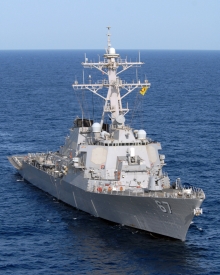
uss-cole.jpg28 and 29 February: the US parks the USS Cole off the shore of Lebanon. Uh-oh.

1 March: Israeli forces launch a major operation into Gaza, killing as many as 60 Palestinians, many of them civilians and children.

Senators Clinton, McCain, and Obama daily wage verbal slugfests on national security, the US’s proper role in the Middle East, and which of them will be best prepared to defend “our strong ally” Israel. OK, business as usual in an election year?

Er, . . . wait a minute.

The timing here ought to be raising antennae here in the US. You can bet that the Arab and Iranian “street” will be taking due note.

The arrival of a US Navy vessel off the coast of Lebanon had to send chills up the spines of many Lebanese. As Roger Morris recently reminded us in his chronicle of the life of Hezbollah “engineer” Imad Mugnieh, the US Navy has pumped shells into Lebanese villages on several occasions (even rolling out a World War II era battleship, the USS New Jersey, on one occasion to use its huge shells to get maximum killing and intimidation effect on the unfortunate villagers on whom they rained down ). That was in the context of the Lebanese civil war of 1975-1990, which featured ongoing deadly scrums involving the IDF, the PLO, and various Lebanese militias – Christian and Muslim, including the newly established Hezbollah. In the summer of 2006, Israel and Hezbollah got into it again, with horrific toll in life and infrastructure (especially on the Lebanese side) while US Secretary of State Condoleeza Rice, as a rather ghoulish birthing coach, urged on the IDF during what she then called the “birth pangs of a new Middle East.” Now, in March 2008, the Lebanese government is mired in a parliamentary impasse, unable to elect a new president. Not yet a full-fledged civil war in Lebanon, but the US Navy lies offshore again, this time, we’re told, to signal to Hezbollah (which is now a legitimately constituted, democratically elected political party in Lebanon’s political structure) that the US will tolerate no stronger interference from them (or from Syria or Hezbollah’s ally and patron, Iran) as Lebanon’s struggles continue.

Yet the very next day, the IDF launched its deadly raid into Gaza, knowing that Hamas forces would resist with whatever means they could muster but would be ultimately powerless to change the outcome. Might they assume (dare we say, hope?) that Hezbollah and Iran might find this an unacceptable provocation and wish to retaliate against Israel? Except that – gosh, wouldn’t you know it? – the US Navy is parked right offshore. And wouldn’t you know it? It’s the USS Cole, the same USS Cole in whose side an al-Qaeda suicide boat blew a hole in those distant days before 9-11. The irony is palpable – indeed, dare we say, intended? Certainly, from the US perspective, delicious.

So, with the US looming in the wings, Israel can do what it wants to in Gaza. And if Hezbollah (and, by implication, Iran) decide not to respond to Israel’s wanton holocaust of innocent Palestinians in Gaza (whose lives had already been made miserable by Israel’s US-approved blockade), they run the risk of accusations of cowardice in the face of the Zionist bullies. If they were to rise to the bait and retaliate, they run the risk of the bullies turning against them and trying to flatten them. Israeli prime minister Olmert will jump at the chance to atone for the disaster of the summer 2006 war, and George Bush may get the military confrontation with Iran that he well may have been hoping for all along.

And all the while, our senator-candidates must intone their often rehearsed mantra, “Israel has the right to defend itself against the terrorists.” The US Navy offshore, the US presidential candidates cowed by political realities in an election season — how much better cover could the bully have?

John Robertson is a professor of Middle East history at Central Michigan University and has his own blog, Chippshots.

Editor’s Comment — It’s worth recalling that less than two weeks before the beginning of the 2006 Lebanon War, Israel was in the middle of pounding Gaza in what Mahmoud Abbas described as an “unacceptable and barbaric collective punishment of civilians, including women, children and old people.”

Facebooktwittermail

CAMPAIGN 08 & EDITOR’S COMMENT: John McCain’s top surrogate – Hillary Clinton

Will Clinton or Obama protect your children?

If you vote for Barack Obama, your children are going to die in their beds. This is the message of the latest Clinton television ad running in Texas. The spot starts with a moonlit shot of a blond toddler in the warm tangle of her sheets and then cuts to a close-up of an infant also in deep REM sleep. For the next 15 seconds, the images shift from one cherubic sleeping face to another. You’d think you were watching a Baby Ambien ad if the narrator weren’t giving you nightmares: “It’s 3 a.m., and your children are safe and asleep. But there’s a phone in the White House, and it’s ringing. Something’s happening in the world. Your vote will decide who answers that call. Whether it’s someone who already knows the world’s leaders, knows the military—someone tested and ready to lead in a dangerous world.” At this point, we see our first adult, a concerned mother, opening the door and peering into her children’s bedroom. “It’s 3 a.m. and your children are safe and asleep,” the narrator repeats. “Who do you want answering the phone?” [complete article]

Editor’s Comment — Is this Hillary’s last ditch attempt to save her campaign, or has she already thrown the towel in and decided that as a McCain surrogate she has a long shot of being chosen as his VP? I jest of course, but it’s hardly surprising that National Review would say “it is awfully nice of Hillary to test out John McCain’s key theme against Obama,” and that Red State would have come up with a very modestly revised version of the ad.

Facebooktwittermail

REVIEW: Jabotinsky, Weizmann, and the roots of the most contentious communal struggle on earth today

Zion story

In her last, powerful little book, The Question of Zion (reviewed in the TLS, April 21, 2006), Jacqueline Rose perceptively observed that, “while Israel barely leaves the front page of the daily papers, Zionism itself is hardly ever talked about”. That’s quite true, though not quite unique. Think of the column inches and radio and television time that have been devoted to the small island of Ireland and its smaller province of Ulster, and of the vehement polemic they have inspired, and then ask how often the origins or meaning of Irish Republicanism or of Ulster Unionism are ever talked about, or how many of those commentators could write so much as a paragraph each on Arthur Griffith, Colonel Saunderson or General O’Duffy.

But the conflict in the Holy Land is still more dissonant in this regard. It is the single most bitterly contentious communal struggle on earth today (something which itself casts an ironical light on the aspiration of the first Zionists to “answer the Jewish question” by “normalizing” the Jews and removing them from the pages of history); it must receive more media coverage than India, which has a population a hundred times greater; it inflames acute passions. And yet it sometimes seems that the more strongly people feel, the less they actually know about the story of Zionism. Maybe it should be a requirement for anyone who wishes to hold forth on the subject to write first a few lines each on Ahad Ha’am, Max Nordau, George Antonius – or Vladimir Jabotinsky.

If not many Europeans or Americans know who “Jabo” was, Israelis certainly do. He remains the most charismatic, fascinating and controversial figure in the history of Zionism, and in the state to whose creation he devoted his life, but which he never saw. Born in 1880 in Odessa, he was converted to the Zionist cause as a young man by tsarist persecution, became a tireless publicist and organizer, and helped to create the Jewish Legion which fought with the British against Turkey during the First World War. In the 1920s he broke away to found the uniformed youth group Betar, and then the militantly nationalistic right-wing brand of Zionism he called Revisionism, in opposition to Chaim Weizmann and the general Zionists, and to David Ben Gurion and the Labour Zionists of the Yishuv, the Jewish settlement in Palestine.

From Betar would grow the Irgun Zvei Leumi, which waged an armed campaign against the British and the Arabs – in British and Arab eyes, a terrorist campaign – in the ten years before Israel was born. When Jabotinsky died in American exile in 1940, he had not seen the murderous horror that engulfed the European Jews, the creation of the Jewish state, or the legacy of his own movement. The Irgun evolved into the right-wing Herut party, which was not merely excluded from office but veritably anathematized in Israel for the first quarter-century the state existed after 1948, but which, now in the guise of Likud, took power at last in 1977 under the old Irgun leader Menachem Begin – and which descends to the present administration.

Almost unremarked in the West, Israel today has the purest Jabotinskian government yet seen. Ehud Olmert, the Prime Minister, has been called “one of Likud’s princes from a prominent Revisionist family”, which makes his rather fetching Foreign Minister, Tzipi Livni, a princess. Both their fathers were militants in the Irgun; the governing party is now called Kadima or “eastward”, the telling motto that Jabotinsky chose for the Jewish Legion; a picture of Jabotinsky hangs at party meetings; and Livni likes to quote him regularly, as Olmert did in his first speech to the Knesset as Prime Minister. Jabotinsky has never cast a longer shadow. [complete article]

Facebooktwittermail

NEWS: Israel threatens to commit genocide in Gaza

Israel threatens to unleash ‘holocaust’ in Gaza

An Israeli minister gave warning today that the Gaza faces a “holocaust” if Islamist militants there do not end their daily barrages of home-made Qassam rockets, and their increasing use of Iranian-built Grad missiles.

“The more Qassam fire intensifies and the rockets reach a longer range, they will bring upon themselves a bigger holocaust because we will use all our might to defend ourselves,” Matan Vilnai, the Deputy Defence Minister said.

The use of the term “holocaust” is usually restricted to descriptions of the Nazi genocide of the Jews in Europe in the Second World War, and many Israelis resent its use in any other context. Mr Vilnai’s deployment of the word appeared to show Israel’s growing frustration that Hamas and other militant groups in Gaza refuse to curb their attacks, despite heavy tolls inflicted in Israeli air strikes and tank raids. [complete article]

Facebooktwittermail

CAMPAIGN 08: Hope versus Armageddon

Some hateful, radical ministers — white evangelicals — are acceptable

One of this week’s hysterical press scandals was that Minister Louis Farrakhan praised Barack Obama’s candidacy even though Obama had previously denounced numerous Farrakhan remarks and the Obama campaign did nothing to seek out the Farrakhan praise. Nonetheless, Tim Russert demanded that Obama jump through multiple hoops to prove that he has no connection to — and, in fact, “rejects” — the ideas espoused by Farrakhan deemed to be radical and hateful.

Yesterday, though, the equally fringe, radical and hateful (at least) Rev. John Hagee — a white evangelical who is the pastor of a sprawling “mega-church” in Texas — enthusiastically endorsed John McCain. Did McCain have to jump through the same hoops which Russert and others set up for Obama and “denounce” Hagee’s extremism and “reject” his support? No; quite the opposite. McCain said he was “very honored” to receive this endorsement and, when asked about some of Hagee’s more twisted views, responded: “all I can tell you is that I am very proud to have Pastor John Hagee’s support.” [complete article]

Obama and the ‘Jewish Vote’

The reason people around the world are excited about the possibility of an Obama presidency is that they see in him a person who appears to live by that credo “neither inferior, nor superior, to anyone.” And that’s in marked contrast to the arrogance with which every U.S. president of the past quarter century has addressed the world.

Hillary Clinton is so imprisoned in this haughty arrogance that she mocks Obama for even suggesting that the starting point in dealing with Iran, or Cuba is to talk to the adversary and understand his concerns. Nope, Hillary is very much part of the bark-into-a-megaphone school of international affairs, of which the Bush Administration has simply been the zenith. [complete article]

Facebooktwittermail

NEWS & VIEWS ROUNDUP: February 26

America’s ghost story

The unfolding political contest in the United States is a window into America’s soul. The nation is arguing with itself. The candidates embody separate impulses. As voters choose sides, a red state-blue state polarity again takes shape. Within the Democratic Party, the dispute is narrower, but still sharp. Yet in truth, each citizen carries within herself or himself the structure of the conflict: hard versus soft, experience versus change, programmed versus spontaneous, self-interest versus empathy, hope in an open future versus lessons from the past. Politics, by isolating these positions and attributing them to one candidate over against another, parodies the interior struggle of every American.

In this era, humans have been cut loose from ancient moorings of meaning and purpose. The context within which this condition is most manifest in the United States is the debate – or, more precisely, the lack thereof – over what is called “national security.” The phrase is potent because it promises something that is impossible, since the human condition is by definition insecure. When candidates vie with one another over who is most qualified to be “commander in chief,” and when they unanimously promise to strengthen military readiness, they together reinforce the dominant American myth – that an extravagant social investment of treasure and talent in armed power of the group offers members of the group escape from the existential dread that comes with life on a dangerous planet. That such investment only makes the planet more dangerous matters little, since the feeling of security, rather than actual security, is the goal of the entire project.

The most wanted list

On February 13, Imad Moughniyeh, a senior commander of Hizbollah, was assassinated in Damascus. “The world is a better place without this man in it,” State Department spokesperson Sean McCormack said: “one way or the other he was brought to justice.” Director of National Intelligence Mike McConnell added that Moughniyeh has been “responsible for more deaths of Americans and Israelis than any other terrorist with the exception of Osama bin Laden.”

Joy was unconstrained in Israel too, as “one of the U.S. and Israel’s most wanted men” was brought to justice, the London Financial Times reported. Under the heading, “A militant wanted the world over,” an accompanying story reported that he was “superseded on the most-wanted list by Osama bin Laden” after 9/11 and so ranked only second among “the most wanted militants in the world.”

The terminology is accurate enough, according to the rules of Anglo-American discourse, which defines “the world” as the political class in Washington and London (and whoever happens to agree with them on specific matters). It is common, for example, to read that “the world” fully supported George Bush when he ordered the bombing of Afghanistan. That may be true of “the world,” but hardly of the world, as revealed in an international Gallup Poll after the bombing was announced. Global support was slight. In Latin America, which has some experience with U.S. behavior, support ranged from 2% in Mexico to 16% in Panama, and that support was conditional upon the culprits being identified (they still weren’t eight months later, the FBI reported), and civilian targets being spared (they were attacked at once). There was an overwhelming preference in the world for diplomatic/judicial measures, rejected out of hand by “the world.”

Inside a failed Palestinian police state

The death of Hamas preacher Majed al-Barghouti in a prison cell last week — apparently after being tortured — momentarily shattered the surface calm of news reports from Ramallah. But neither the subsequent rioting nor the fact that the dead man came from one of the most prominent Palestinian families disrupted the ‘democracy versus terror’ agenda that has distorted most news reporting out of the West Bank since last June (when Hamas took control of Gaza).

Martin Luther King once described rioting as ‘the voice of the unheard,’ but despite al-Barghouti’s death, most Ramallans currently seem too depressed to riot. The only events to have lifted spirits in the city lately have been a freak snow storm, and a similarly rare suicide bombing in Dimona — the latter prompting local shopkeepers to cut prices for the morning and, in one case, to waive payment altogether.

More typical events in the last week have included a mysterious explosion, continued Israeli army raids, and a major downtown gunfight between PA ’security’ forces in balaclavas and youths from the city’s Amari refugee camp. The violence, unheard outside Ramallah, is at once cause, effect and byproduct of a pervasive gloom that has settled over ‘Fatahland’ like smog.

Panetta’s lament: they had no plan

The argument that the constant carping about Hillary Clinton’s campaign has been a function of an Obama-friendly, process-obsessed media is well and good. But how, then, to explain the deeply held dissatisfaction of an old Clinton loyalist like Leon Panetta?

In an interview with The Observer, Mr. Panetta compared Mrs. Clinton’s top strategist Mark Penn to Karl Rove, suggested that the Clinton campaign had totally underestimated Barack Obama’s appeal, and complained about the overall lack of planning that he said had characterized the former First Lady’s bid to return to the White House.

It’s OK to vote for Obama because he’s black

I admit it: I’m voting for Barack Obama because he’s black. Yes, I’m voting for him because he’s qualified, intelligent, charismatic and competent — and because unlike Hillary Clinton, he opposed the Iraq war from the beginning. But if he weren’t black, and Hillary had opposed the war, I’d probably vote for her because of her greater experience. In any case, it’s a moot point, because if Obama weren’t black, he would not be the Democratic front-runner.

I believe that most of Obama’s supporters are voting for him for the same reason. Like me, they’re drawn to his idealism, his youthful energy, his progressive politics. But it’s his blackness that seals the deal.

And that’s OK. In fact, it’s wonderful.

A war we must end

Despite the Democratic presidential candidates’ expressed commitment to ending the war in Iraq, there is unease among the party’s base. Some ardent activists have suggested that upon election, a new Democratic president will come under inordinate pressure to sustain the U.S. military commitment to Iraq, albeit with some modifications. This concern demonstrates both the difficulty of ending a controversial war and the necessity of doing so.

Even a cursory examination of American history reveals the complexity of concluding a war that has taken on such a stark partisan tint. The shadow of Vietnam looms, as it has become standard Republican narrative that back then it was the Democrats in Congress who stabbed America in the back by cutting off funding for a winning cause. The fact that the war was lost in Southeast Asia, as opposed to the halls of Congress, is no matter. The Republican machine will press this same theme should it lose the White House in November. A Democratic administration would be accused of surrendering to evildoers, as once more the dovish successors of George McGovern are wrongly said to have pulled defeat out of the jaws of victory.

Such self-serving claims do not diminish the need and justification for ending one of America’s longest and most misguided wars. Republicans will claim that after four years of disastrous mistakes, the Bush administration finally got it right with its troop “surge.” Yet even despite the loss of nearly 1,000 American lives and the expenditure of $150 billion, the surge has failed in its stated purpose: providing the Iraqi government with the breathing space to pass the 18 legislative benchmarks the Bush administration called vital to political reconciliation. To date it has passed only four. Moreover, as part of the surge, the administration has further undermined Iraq’s government by providing arms and money to Sunni insurgent groups even though they have not pledged loyalty to Baghdad.

Who’s got the power?

President George W. Bush could be forgiven for underestimating China: He had spent some months there in the mid-1970s, when his father was U.S. Ambassador to Beijing. His firsthand experience of a largely pre-industrial colossus could hardly have prepared him for dealing with the China of today — a China to which the U.S. owes some $1.5 trillion and counting, and to which America’s beleaguered banks turn for the multibillion dollar loans required to keep them afloat.

By the time Bush took office, of course America was well aware of China’s growing economic significance — its ability to produce quality goods at lower prices for U.S. corporations had already largely gutted the U.S. manufacturing sector, and American politicians routinely complained about Chinese currency policy and the ballooning the U.S. trade deficit. (Less is said, of course, about the Chinese credit that allows Americans to consume way beyond their means — by one estimate, Beijing has loaned an equivalent of $4,000 to every person in the U.S. over the past decade alone.)

Honey, I shrank the superpower

In a snide reference to Bill Clinton’s 1992 promise to “build a bridge into the 21st century,” Barack Obama recently quipped that what Hillary Clinton really offers is a bridge back into the 20th century. Yet, a bridge back into the last century may be what all the major candidates are offering when they promise to restore the American leadership and primacy. The Republicans promise to restore American power by staying the course in Iraq, threatening Iran, and staring down “radical Islamic terrorism,” which John McCain calls “the transcendent issue of the 21st century.” The Democrats envisage turning the clock back eight years, restoring post-Cold War American primacy simply by adopting a more sober and consensus-based style. The problem, of course, is that while Bush’s reckless forays into the Middle East have accelerated the decline of America’s strategic influence, there’s little reason to believe that this decline can be reversed either by more of the same, or by a less abrasive tenant in the Oval Office.

Rising inflation creates unease in Middle East

Even as it enriches Arab rulers, the recent oil-price boom is helping to fuel an extraordinary rise in the cost of food and other basic goods that is squeezing this region’s middle class and setting off strikes, demonstrations and occasional riots from Morocco to the Persian Gulf.

Here in Jordan, the cost of maintaining fuel subsidies amid the surge in prices forced the government to remove almost all the subsidies this month, sending the price of some fuels up 76 percent overnight. In a devastating domino effect, the cost of basic foods like eggs, potatoes and cucumbers doubled or more.

In Saudi Arabia, where inflation had been virtually zero for a decade, it recently reached an official level of 6.5 percent, though unofficial estimates put it much higher. Public protests and boycotts have followed, and 19 prominent clerics posted an unusual statement on the Internet in December warning of a crisis that would cause “theft, cheating, armed robbery and resentment between rich and poor.”

The inflation has many causes, from rising global demand for commodities to the monetary constraints of currencies pegged to the weakening American dollar. But one cause is the skyrocketing price of oil itself, which has quadrupled since 2002. It is helping push many ordinary people toward poverty even as it stimulates a new surge of economic growth in the gulf.

Gates’ good advice for Turkey ought to be applied across the Middle East

US Defense Secretary Bob Gates had something very sensible to say on Sunday, warning his NATO ally Turkey that military action alone is not a solution to the problem of Kurdistan Workers Party rebels based in neighboring Iraq. He stressed that “dialogue” was an under-used tool in the conflict, and specified that this should be an ongoing process rather than an ad-hoc one employed exclusively during crises. “These economic and political measures are really important because after a certain point people become inured to military attacks,” Gates said. “If you don’t blend them with these kinds of non-military initiatives then at a certain point the military efforts become less and less effective.” As for the current Turkish campaign in Iraq, he said, “the shorter the better.”

It is precisely this kind of blunt advice that America’s allies in the volatile Middle East need to receive from the lone remaining superpower, a reminder that many issues simply cannot be made to go away by killing people. Unfortunately, however, the US government has been inured against this kind of logic for years, at least insofar as it regards Israel. That country’s multi-faceted conflict with the Arab and Islamic worlds has long been the prime mover of regional instability, and its habit of resorting to violence only makes the issues at stake more and more complicated. Worse yet, it rarely receives the kind of counsel that Turkey did from Gates.

In Israel, some see no option but war

Aharon Peretz has spent most of his 51 years in this cactus-fringed, working-class town, and he would like to stay.

But his wife and six children feel differently: Daily retreats to the basement during rocket strikes from the nearby Gaza Strip have frayed their nerves, and an attack that cost an uncle both his legs has convinced them it’s time to go.

Peace will return for his family, Peretz has decided, only if Israel chooses to go to war with his neighbors.

Qatar willing to broker cease-fire agreement between Israel and Hamas

Qatar is willing to broker a cease-fire agreement between Israel and Hamas, the Qatari prime minister, Sheikh Hamed bin Jassem al-Thani, told MK Yossi Beilin (Meretz) in Doha on Sunday.

Beilin, a former deputy foreign minister, met the Qatari at a conference for retired foreign ministers. Al-Thani also acts as his country’s foreign minister.

“You are making a big mistake if you think you can reach an agreement with Palestinian President Mahmoud Abbas without including Hamas in the talks,” said the Qatari premier, according to a report of the conversation received by Haaretz. Hamas, continued al-Thani, “must be taken into account,” because even if talks do progress with Abbas, “he will not be able to sign an agreement without Hamas’s consent.”

Facebooktwittermail

CAMPAIGN 08 & EDITOR’S COMMENT: The power of language

Finding political strength in the power of words

The 2008 presidential campaign has witnessed the rise of a whole arsenal of new political weapons, including Internet fundraising and sophisticated microtargeting of voters. For Sen. Barack Obama, however, the most powerful weapon has been one of the oldest.

Not since the days of the whistle-stop tour and the radio addresses that Franklin D. Roosevelt used to hone his message while governor of New York has a presidential candidate been propelled so much by the force of words, according to historians and experts on rhetoric.

Obama’s emergence as the front-runner in the race for the Democratic nomination has become nearly as much a story of his speeches as of the candidate himself. He arrived on the national scene with his address to the 2004 Democratic National Convention, his campaign’s key turning points have nearly all involved speeches, and his supporters are eager for his election-night remarks nearly as much as for the vote totals. [complete article]

Obama and the power of words

Mr. Obama is simply campaigning for office in the same way he says he would operate if he were elected. “We’re not looking for a chief operating officer when we select a president,” he said during a question and answer session at Google headquarters back in December.

“What we’re looking for is somebody who will chart a course and say: Here is where America needs to go — here is how to solve our energy crisis, here’s how we need to revamp our education system — and then gather the talent together and then mobilize that talent to achieve that goal. And to inspire a sense of hope and possibility.”

Like Ronald Reagan did. [complete article]

Editor’s Comment — Language is the thread out of which the human experience is woven. We are not alone because we can speak and understand.

To play down the importance of Obama’s oratory is not only an insult to those who find him inspiring; it also exhibits a stunning blindness to the context. We’re coming to the end of eight years with a president whose communications skills were not simply below average for a president; they were below average, period.

Bush likes to pretend that when he’s giving a press conference, he’s doing it off-the-clock. The hard work of a president happens outside the earshot of those journalists with their pesky questions. But everyone knows this is a charade. Bush tries to make up for his communication deficit with humor and put-downs, but if the president doesn’t embarrass his audience as much as he used to, it’s not because he’s become much more adept; it’s simply that we’ve got used to his clumsiness.

Obama on the other hand, doesn’t merely inspire; he raises the hope that when the president of the United States steps on to the world stage in 2009, he will make Americans proud. He will be capable of being both a president and executive ambassador — never has America more dearly needed one.

As for what makes Obama such a powerful speaker, it seems misleading to me to view this in terms of oratory. It goes beyond rhetoric, cadence, delivery and the technical skills of effective speech-making. It comes, as Obama himself acknowledged when describing his first experience in front of a rally when “I knew that I had them, that the connection had been made.” This ability to connect with his audience — this is what’s driving Obama’s momentum. Those who lack the same ability might want to play down its value but it hardly seems like an optional extra among the assets we would hope to find in a future president.

Facebooktwittermail

CAMPAIGN 08 EDITORIAL: The Obama cult meme

The Obama cult meme

“I just have a very bad feeling about the way things are going,” says Paul Krugman in the New York Times as he anticipates the “backlash against Obamamania.”

“Barack Obama, the wunderkind of US politics, has long basked in adulatory press coverage for his historic White House bid — but a media backlash appears to be building,” reports Jitendra Joshi for AFP. “Some Obama supporters fret already that his campaign has the trappings of a messianic cult, as thousands upon thousands pack auditoriums to bask in his uplifting oratory.”

“Obama’s high-flown, inspirational rhetoric often feeds into the impression of a political campaign veering into the realms of religion – never more so than when he declared in a victory speech that ‘we are the ones we’ve been waiting for,'” writes Helen Kennedy in the New York Daily News. “The line is the title of a 2006 Alice Walker book, but some saw it as another sign of the emerging Cult of Obama.”

And in Slate, John Dickerson asks, “Isn’t the generation that Obama has so successfully courted usually the first to toss overhyped products, even the overhyped products with which they were at first so enthralled? More generally, shouldn’t Democrats who have complained that George Bush was elected on the strength of a popularity contest be nervous that this blossoming Obamadulation is getting out of hand?”

So what’s going on here? Charles Krauthammer notes that in his post-Super Tuesday string of wins, “Obama has been able to win these electoral victories and dazzle crowds in one new jurisdiction after another, even as his mesmeric power has begun to arouse skepticism and misgivings among the mainstream media.”

There’s a message in that for Mr Krauthammer et al: the opinion writers and the talking heads — the media sages whose knowledge of politics has so much greater depth than the average Joe — are actually wielding very little influence. Who’d’ve thunk it? Of course many of them would in false modesty dismiss any suggestion that they are attempting to exercise influence, but at the very least, these are the people who make a living on the claim they know how to take a political pulse.

The backlash — and it is clearly a media backlash — probably has much more to do with journalism than it has with what’s going on across America. Journalists like to play a game of political impartiality. It’s never particularly convincing, but anyone who’s getting paid to be a messenger doesn’t want to be accused of distorting the message. At the same time, journalists are people and if the story you’re covering involves large numbers of people being swept up by a wave of enthusiasm, it’s hard not to get infected by at least a smidgen of that enthusiasm. The media backlash is an effort through which the media is now trying to disinfect itself.

So now let’s turn to the cult question — though first I should spell out where I stand.

I didn’t pay too much attention to the presidential race until the beginning of the primaries. I haven’t signed up on the mailing lists of any of the campaigns. I haven’t attended any political rallies. I don’t find “Yes We Can” a particularly compelling or moving slogan. The will.i.am “Yes We Can” video didn’t make me want to chant along — I can only name three of the people in it and one them is Barak Obama. I see change as the one certainty in life and thus not a choice. But when it comes time to vote, unless something totally unexpected happens, I’ll be voting for Obama. I will not be acting under the influence of a higher power.

Since the word “cult” has now been used so widely, the first thing we need to do is get clear about the defining characteristics of a cult. Some social scientists like to run through a checklist to determine whether a social grouping should be called a cult, but anyone who has encountered one or been in one knows that they are actually quite easy to distinguish.

The single most important feature of a cult is that it involves the sublimation of individual will and judgment through surrender to an external authority. That authority may come in the form of a charismatic teacher or it may be suffused across a group. In either case a social order exists that undermines the validity, authenticity, and moral authority of the cult member’s personal autonomy and judgment. Let thy will — not my will — be done.

This is where cults and social movements intersect. Both attach a higher value to the social fabric than to its individual strands. Where they differ — and this is all-important — is that one attempts to be inclusive in a widening circle of solidarity, whereas the other sees itself located in a spiritually embattled world. On the inside are the chosen, the saved, the enlightened; on the outside are lost souls. Social movements are in the business of empowering individuals collectively, not saving them.

By this measure, there is no cult of Obama. At the same time, Obama obviously has a fan base and some Obama fans can be as goofy as any others. Where the cult-analysis gets the Obama phenomenon completely wrong is the implication that the mass rallies are a vanguard that somehow sucks in much wider support.

Charles Krauthammer wants his readers to believe that we are witnessing the greatest political scam of all time as a “silver-tongued freshman senator has found a way to sell hope,” that he doesn’t attempt to explain how Obama closes the sale. Everyone acknowledges that Obama is appealing, inspiring and a great speaker, but these observations don’t explain the Obama phenomenon.

If the product was all in the packaging, the Obama product has plenty of strong selling points: good looks, an easy smile, a golden baritone, a rousing orator. But that isn’t enough. He’s also a bit skinny, looks even more youthful than his mere 46 years, and his debating skills don’t match his speaking skills.

No, the Obama hook isn’t a silver tongue or a mysterious ability to provoke intemperate enthusiasm; it is that he is believable. He has pulled off a miracle that no one thought possible: in spite of his being a politician, people actually believe what he’s saying. What makes him believable is something anyone can recognize even if they don’t know its name: authenticity. This is more than sincerity. It isn’t simply that Obama means what he says but what he says resonates in who he is.

Whereas an election campaign can generally do more than prove or disprove the proposition of electability, Obama’s campaign is itself a demonstration of his ability to deliver what he promises in his presidency: that he can bring people together, bridge divisions, and inspire support. He isn’t just providing a foretaste of what an Obama presidency might look like and passing the litmus test of “looking presidential”; he’s exercising the closest thing to presidential leadership that anyone could have prior to entering office.

Facebooktwittermail

CAMPAIGN 08, NEWS & EDITOR’S COMMENT: Clinton’s attacks won’t work

Clinton camp splits on message

Before the Iowa caucuses, senior aides to Sen. Hillary Rodham Clinton fell into a heated argument during a 7:30 a.m. conference call about the basic message their candidate was delivering to voters.

Mark Penn, chief strategist and pollster, liked Clinton’s emphasis on her “strength and experience,” and he defended the idea of her running as a quasi-incumbent best suited for the presidency. Harold Ickes and other advisors said that message was not working. A more promising strategy, they argued, would be to focus on the historic prospect of electing the first woman president.

Today, as Clinton tries to revive her campaign after losing 10 straight primary contests to Sen. Barack Obama, some insiders look back and wish that argument had produced a different outcome. Penn won the debate, say two people aware of the conversation, and Clinton went on to present herself to voters as a steely figure so familiar with the workings of government that she could lead from Day One.

The Clinton campaign now seems in peril, its precarious situation acknowledged on Wednesday even by former President Bill Clinton, who suggested that his wife could not survive a loss in either of the next two major contests, in Texas and Ohio on March 4. [complete article]

See also, As crucial tests loom, Clinton hits harder (WP).

Editor’s Comment — According to in the New York Times:

When Senator Hillary Rodham Clinton meets Senator Barack Obama at a one-on-one debate in Austin on Thursday night, one of her final opportunities to change the course of the race for the Democratic presidential nomination, she will again face the challenge that has repeatedly stymied her: how to discredit her popular opponent without hurting herself.

But that isn’t just a challenge; it’s a false proposition. The only reason the strategy of cutting down your opponent ever has a chance of working is when support for both candidates is weak. The attacks need to highlight flaws that were already visible and occur in a context where a significant number of voters are struggling to decide between the lesser of two evils.

Clinton’s problem is that her attacks reflect much more on her than they do on her opponent. To the extent that the Clinton campaign becomes focused on what’s wrong with Obama, she looks more and more like a sour loser — someone incapable of showing the grace to acknowledge defeat. On top of that, an attack campaign has a subtext that’s likely to offend the people it’s trying to win over. It’s saying: Vote for me. Don’t be a naive sucker who gets taken in by Obama’s charm and oratory. That’s an insult wrapped up inside an invitation.

Clinton’s other huge problem is that instead of running a presidential campaign, she’s been running a nomination campaign. If she were ever up against McCain, her whole strength-and-experience argument falls flat — unless of course the New York Times is able to intercede on her behalf and torpedo the strong and experienced Republican.

Facebooktwittermail