Category Archives: Issues

EDITORIAL: Taking the blood out of killing

Taking the blood out of killing

“If America wants to see itself clean of terrorists we also want that our villages and towns should not be bombed.”

This was the modest request issued by Nawaz Sharif after Deputy Secretary of State John Negroponte and Assistant Secretary Richard Boucher went to Pakistan this week to secure the new government’s commitment on fighting terrorism. Negroponte and the rest of his State Department contingent might have received a slightly warmer response if they had not barged in on Pakistan’s celebrations at the restoration of democracy.

The New York Times reported:

The timing of the American visit was harshly criticized by the news media for creating the appearance that the United States was trying to dictate policy to a government that was not even hours old. The two American diplomats met Mr. Sharif as President Musharraf was administering the oath of office to Mr. Gillani.

“I don’t think it is a good idea for them to be here on this particular day,” said Zaffar Abbas, the editor of the respected English language newspaper Dawn, in Islamabad. “Here are the Americans, right here in Islamabad, meeting with senior politicians in the new government, trying to dictate terms.”

And the article continued:

An independent analyst on the Pakistani military, Shuja Nawaz, who lives in Washington, said he had been told by Pakistani officials that they discouraged the American diplomats from coming this week.

But the Pakistanis had been informed that Mr. Negroponte was on a trip that included other already arranged stops and Tuesday was the only possible day for him. Mr. Nawaz called the visit “ham-handed,” and said it could be interpreted as Washington wanting to continue to act as the “political godfather behind Musharraf.”

Ironically, it was the Pakistanis who needed to give the Americans a little instruction on the meaning of democracy: “We told them that since 9/11 until now the decisions were made by an individual and therefore these did not reflect the aspiration of the people. The situation has been changed now because an independent parliament has come into being and all the decisions will be made by it.”

That was how Sharif explained to Negroponte and Boucher that the US government needs to get used to dealing with a government instead of a dictator. Unfortunately, this administration like so many others before it still finds dictators easier to work with as a matter of convenience. It’s the boneheaded mafia approach to international relations: make a deal with “the man” and then let his and your minions take care of the details.

The false premise upon which Negroponte and Boucher’s unannounced visit was based was that Pakistan is not as serious as the United States when it comes to dealing with terrorism. But they would do well to consider the following remarks from an editorial in today’s edition of Pakistan’s leading English-language daily, The News:

What Washington still does not seem to have grasped is that almost everyone in Pakistan, including its political leaders, is at least as keen as they are to see an end to terror. It is, after all, Pakistani men, women and children who die when bombs explode; it is their blood that stains roadsides; their screams that fill hospital emergency rooms. The US-directed policies of the past seven years have led only to an expansion in militancy, to more violence and to more hatred. It is indeed a mystery why, in the face of these facts, Washington considers Musharraf to have been a success in battling terror. The White House and its team must now restrain themselves in further meddling in Pakistan’s affairs. Its new leaders must be allowed to devise their own strategies without attempts at long-distance dictation or remote-controlled operations. Such dictation has brought disaster in the past and is likely to do so in future as well. The people of Pakistan and their elected representatives must now be left alone to chalk out a brighter future for everyone in the country.

Unfortunately for the people of Pakistan, when it comes to confronting terrorism in the tribal areas, Democrats and Republicans are largely in agreement that the US needs to pursue a “tough” approach. Very few Americans are willing to question the idea that if an opportunity arises, then “high value targets” should be “taken out.”

But consider for a moment this frequently used phrase: take out.

Whenever a command is issued that someone or some people should be “taken out,” the words connote executive power, wielded by unbloodied hands. All the way down from the command to the deed, taking out requires a sense of detachment and a comfortable distance from the fatal event. Absent that distance, the nature of the act becomes inescapable.

When Brutus stabbed Julius Caesar, he didn’t take him out. Brutus and his fellow assassins killed Caesar. They had blood on their hands. Brutus says, “let no man abide this deed, but we the doers.” He knew what he had done and he accepted full responsibility.

When we talk about taking out terrorists, we prefer not to know what has been done and we try to disperse responsibility. We imagine that if a greater good (“defeating terrorism”) is being served, then the loss of innocent life, though regrettable will also most likely be unavoidable. What we can and do avoid considering is the carnage. We mask it with a casual phrase.

The message from the new government of Pakistan to America is quite simple: our people are worth as much as yours. Should that not be seen as an indisputable truism?


Facebooktwittermail

NEWS: Locals hold key in Pakistan

Moderates hold key in Pakistan

One of the most significant results of Pakistan’s elections in February was the defeat of the religious parties that ran this critical border province for the last five years. In their place, voters elected moderates from a small regional party that may now wield big influence over Pakistan’s changing strategy toward its militants.

The victory of the Awami National Party, or A.N.P., was welcomed by Western officials and Pakistanis as a clear rejection of the Taliban and the religious parties that backed them here in North-West Frontier Province. The party will now be part of the governing coalition in the national Parliament, and sees itself as critically placed to begin a dialogue with the militants, something the Bush administration has regarded warily.

Not only has this province suffered most from the militants, who are based in the adjacent tribal areas, but most of the militants are from the same Pashtun ethnic group as the A.N.P. Pashtuns populate this region, on both sides of the Afghan border. The A.N.P., a Pashtun nationalist party, and Pakistan’s militants speak the same language. [complete article]

U.S. steps up unilateral strikes in Pakistan

The United States has escalated its unilateral strikes against al-Qaeda members and fighters operating in Pakistan’s tribal areas, partly because of anxieties that Pakistan’s new leaders will insist on scaling back military operations in that country, according to U.S. officials.

Washington is worried that pro-Western President Pervez Musharraf, who has generally supported the U.S. strikes, will almost certainly have reduced powers in the months ahead, and so it wants to inflict as much damage as it can to al-Qaeda’s network now, the officials said.

Over the past two months, U.S.-controlled Predator aircraft are known to have struck at least three sites used by al-Qaeda operatives. The moves followed a tacit understanding with Musharraf and Army chief Gen. Ashfaq Kiyani that allows U.S. strikes on foreign fighters operating in Pakistan, but not against the Pakistani Taliban, the officials said. [complete article]

Facebooktwittermail

OPINION: Obama’s hidden asset

The strange case of Robert Malley

Of all the recent efforts to smear Barack Obama, none strikes me as stranger than the claims that one of his informal advisers on foreign affairs, Robert Malley, is anti-Israel. This, in turn, is supposed to prove that as president, Obama is liable to institute dangerous changes in U.S. policy toward Israel.

As a campaign trope, the calumny may have begun with Ed Lasky, news editor of the right-wing Web site The American Thinker, who posted a fervid attack on Malley in January. The Committee for Accuracy in Middle East Reporting in America has taken time off from its hawkish media-bashing to post a blast at Malley on its Web site. Journalists regularly speculate on whether the Malley connection will hurt Obama among Jewish voters, though there’s no evidence of that. Meanwhile, Malley’s diplomatic colleagues — including Sandy Berger, Dennis Ross, and Martin Indyk — have issued an open letter defending him.

There’s more at work here than the usual, nearly boring, attempts to slime a liberal candidate as anti-Israel for the “sin” of supporting what Israel needs most — determined diplomatic efforts to achieve peace. Lurking in the background is another of the battles over how Israel-Palestinian history is told. In that fight, the original furious critic of Barack Obama’s adviser is former Israeli prime minister Ehud Barak. There’s also a lesson about Israeli-Palestinian diplomacy: Besides settling the practical questions, it requires resolving the conflicting narratives about the past. To approach this task, the next president will need not just hard work but a gift with rhetoric, with words. [complete article]

Facebooktwittermail

FEATURE: Taking stock of the War on Terror

Taking stock of the War on Terror

To contemplate a prewar map of Baghdad — as I do the one before me, with sectarian neighborhoods traced out in blue and red and yellow — is to look back on a lost Baghdad, a Baghdad of our dreams. My map of 2003 is colored mostly a rather neutral yellow, indicating the “mixed” neighborhoods of the city, predominant just five years ago. To take up a contemporary map after this is to be confronted by a riot of bright color: Shia blue has moved in irrevocably from the East of the Tigris; Sunni red has fled before it, as Shia militias pushed the Sunnis inexorably west toward Abu Ghraib and Anbar province, and nearly out of the capital itself. And everywhere, it seems, the pale yellow of those mixed neighborhoods is gone, obliterated in the months and years of sectarian war.

I start with those maps out of a lust for something concrete, as I grope about in the abstract, struggling to quantify the unquantifiable. How indeed to “take stock” of the War on Terror? Such a strange beast it is, like one of those mythological creatures that is part goat, part lion, part man. Let us take a moment and identify each of these parts. For if we look closely at its misshapen contours, we can see in the War on Terror:

Part anti-guerrilla mountain struggle, as in Afghanistan;

Part shooting-war-cum-occupation-cum-counterinsurgency, as in Iraq;

Part intelligence, spy v. spy covert struggle, fought quietly — “on the dark side,” as Vice President Dick Cheney put it shortly after 9/11 — in a vast territory stretching from the southern Philippines to the Maghreb and the Straits of Gibraltar;

And finally the War on Terror is part, perhaps its largest part, Virtual War — an ongoing, permanent struggle, and in its ongoing political utility not wholly unlike Orwell’s famous world war between Eurasia, East Asia, and Oceania that is unbounded in space and in time, never ending, always expanding. [complete article]

Facebooktwittermail

NEWS: Success of the surge in jeopardy

Battles wrack Basra, threatening success of U.S. surge

With Iraq’s top leaders directing the battle, Iraq’s army and national police pressed a major operation Tuesday to wrest control of the southern port city of Basra from the Shiite Mahdi Army militia. Fighting between government forces and the militia quickly spread through Iraq’s south and into Baghdad.

Prime Minister Nouri al Maliki and his defense and interior ministers took charge of the 15,000 Iraqi army troops and police units, which were deployed for what aides said was to be a three-day operation against militias in the city.

The battle at the oil-rich port began before dawn Tuesday and lasted into the early evening before subsiding slightly as the Mahdi Army, headed by firebrand cleric Muqtada al Sadr, defended positions in several neighborhoods. In the dead of night, residents reported artillery shelling, mortar rounds and guns being fired outside their homes. [complete article]

Facebooktwittermail

OPINION: Ordinary evil

The ultimate casualty

You know him well. His nickname was Gilligan, and he was a prisoner at Abu Ghraib, Saddam Hussein’s vast prison transformed into a vast American one and then transformed again by the Bush administration into a vast national disgrace. Gilligan was deprived of sleep, forced to stand on a small box, hooded like some medieval apparition, wired like a makeshift lamp and told (falsely) that if he fell he would be electrocuted. He was later released. Wrong man. Sorry.

The story of Gilligan is recounted in a forthcoming book and movie, both titled “Standard Operating Procedure” because that is precisely what the abuse of prisoners was at Abu Ghraib. Much of the book, written by Philip Gourevitch and Errol Morris (he made the documentary) and excerpted in last week’s New Yorker, relies on the verbatim testimony of the Americans who staffed Abu Ghraib. Some of them were the very ones who took the revolting pictures — including the iconic photo of Gilligan — that stunned the world.

What the interviews make clear is how pervasive and public the abuse of prisoners had been. Physical and mental abuse was conducted in the open. Photos were taken and passed up the chain of command. “Sleep deprivation, sexual humiliation, sensory disorientation and the imposition of physical and psychological pain,” Gourevitch and Morris write, were all permitted under the makeshift rules of the camp.

“They couldn’t say that we broke the rules because there were no rules,” said an Army reservist named Megan Ambuhl. Others talked of something even more insidious: the growing tolerance for inflicting pain. This is the stuff of famous psychology experiments (Milgram, etc.), but it also reminds me — and I know this is the extreme case — of the willingness of ordinary German soldiers in World War II to spend whole days in the routine murder of civilians. [complete article]

Facebooktwittermail

CAMPAIGN 08 & EDITOR’S COMMENT: Dignity promotion

The Obama Doctrine

[An] ability to see the world from different perspectives informs what the Obama [foreign policy] team hopes will replace the Iraq War mind-set: something they call dignity promotion. “I don’t think anyone in the foreign-policy community has as much an appreciation of the value of dignity as Obama does,” says Samantha Power, a former key aide and author of the groundbreaking study of U.S. foreign policy and genocide, A Problem From Hell. “Dignity is a way to unite a lot of different strands [of foreign-policy thinking],” she says. “If you start with that, it explains why it’s not enough to spend $3 billion on refugee camps in Darfur, because the way those people are living is not the way they want to live. It’s not a human way to live. It’s graceless — an affront to your sense of dignity.” [complete article]

Editor’s Comment — Replacing democracy promotion with dignity promotion sounds good, but I would hope that an Obama administration would have the wisdom to get out the promotion business altogether — though in saying that, I’m not advocating isolationism.

America’s evangelical fervor is invariably a source of trouble. Among the most common explanation for why Americans spend extended periods overseas is either as soldiers or as missionaries. Americans have a habit of venturing into the rest of the world in order to change it.

But what many people from wealthy societies discover if they have the opportunity to delve into a Third World culture is that there is no correlation between wealth and dignity. Far from it: many of the most dignified people who grace this planet also happen to be the poorest. Their dignity invariably resides in pride in their own culture. Conversely, nothing more reliably strips people of their dignity than to feed the notion that their heritage is inferior to another.

If we want to consider dignity promotion, maybe we should focus on how to do it in our own society.

What is the impact of mass entertainment that creates a spectacle out of humiliation — the crux of so much reality TV? Does the promotion of product brands have a corrosive effect on self esteem? Who do you become when it matters so much what you wear or what you drive? Has social respect become inextricable from wealth acquisition? Have we demeaned ourselves by becoming a nation of material consumers while forgetting what it means to be a cultural producer?

A significant dimension of Obama’s appeal is that he carries himself with dignity — something sadly lacking in much of public life. While it will undoubtedly be a good thing if an appreciation of the importance of human dignity underpins American foreign policy, we would do well to consider what it takes to restore dignity to the American way of life.

Facebooktwittermail

CAMPAIGN 08 EDITORIAL: With attention to the unseen

Words in context

Suppose Thomas Jefferson and the other founding fathers of American democracy had been able to see into the future. As they looked forward to the America of 2008, what would have held their attention more firmly?

That the society they helped form was to make such significant advances towards equality that two people who once would not even have been able to vote would now be vying to become president?

Or, that a momentous democratic choice might hinge on the effect of a few emotive phrases uttered by a man not even running for office?

A couple of days ago in Time magazine, Joe Klein wrote:

Whether Obama survives now will depend on the most important and overlooked part of his speech [in Philadelphia] — the final section, in which he challenged the public and, especially, the media to stow the sensationalism: “We can play Reverend Wright’s sermons on every channel, every day … and make the only question in this campaign whether or not the American people think that I somehow believe or sympathize with his most offensive words,” he said. “But if we do, I can tell you that in the next election we’ll be talking about some other distraction … And nothing will change … Or, at this moment in this election, we can come together and say, ‘Not this time.'”

And that is the existential challenge of 2008: whether we will have a big election or a small one. Will we have a serious conversation about the enormous problems confronting the country — the wars, the economic crisis, the looming environmental cataclysm — or will we allow the same old carnival of swift boats and sound bites? The answer depends on the candidates, of course, and on the media — where cynicism too often passes for insight. But most of all, it depends on you.

Klein notes that Obama challenged the public “and especially the media” to turn away from the distractions that could prevent this from being “a big election,” yet he almost immediately lets the media off the hook. The existential challenge of 2008, he says, most of all “depends on you.”

Taken literally, that’s indisputable. We’re the ones who get to decide how we vote. Yet what Klein does — what everyone in the media does when their preeminent loyalty attaches to their paycheck — is to refuse to point a spotlight on the individuals who shape the news from the shadows.

In every single newsroom on every single day, commercial and political decisions are being made while cloaked under the pretense that events themselves are the overwhelming force that steers editorial judgment. But consider how little we actually know about the decision-making process that triggered what has become the most explosive story in the presidential campaign.

On Good Morning America on March 13, Brian Ross with the stealth of a terrorist who is just about to set off a bomb, uttered these seemingly innocent words: “… an ABC News review of more than a dozen sermons… ” — and we all know what followed.

What we don’t know, but what could be as illuminating as the DVDs themselves, is what led ABC News to be conducting a review of Rev Jeremiah Wright’s sermons in the first place.

For months, everyone who had been paying much attention knew that Wright’s connection with Obama had the potential to wreak political havoc. In an interview with the New York Times in March 2007, Rev Wright’s explanation for why he had been disinvited from Obama’s presidential announcement was that the senator had told him, “You can get kind of rough in the sermons, so what we’ve decided is that it’s best for you not to be out there in public.”

It was a decision that drew criticism from other black leaders because, as Al Sharpton put it, “the issue is standing by your own pastor.” A month earlier, a Rolling Stone article had identified Wright as an emblem of Obama’s “radical roots.” And a year later, Tim Russert as presidential debate moderator-cum-inquisitor had cited Wright in order to find out whether Obama was willing to denounce and reject Louis Farrakhan.

So, while every cable news channel has followed ABC News‘ lead and made Rev Wright campaign issue #1, no one has been pressing the ABC News investigative team to explain how exactly it came to set the political agenda.

Was the Good Morning America story the fruit of a tenacious piece of investigative journalism, or might it on the contrary have been an altogether lazy piece of journalism — a case of someone saying, “Here’s the ammo. All you need to do is load and fire”?

When news isn’t new then this issue of timing means that newsmaking is taking place inside the newsroom. The media has become manufacturer. Might we be allowed to become privy to the process?

For instance, it’s obvious why the ABC News editors would deem a line such as “America’s chickens are coming home to roost” as newsworthy. But how did they decide that most of what came immediately after that line was irrelevant. Would most Americans not have responded in a different way if they had then heard Wright say:

Violence begets violence. Hatred begets hatred. And terrorism begets terrorism. A white ambassador [Edward Peck] said that y’all, not a black militant. Not a reverend who preaches about racism. An ambassador whose eyes are wide open and who is trying to get us to wake up and move away from this dangerous precipice upon which we are now poised. The ambassador said the people we have wounded don’t have the military capability we have. But they do have individuals who are willing to die and take thousands with them. And we need to come to grips with that.

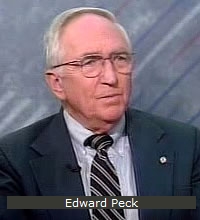
edward-peck.jpgRev Wright was telling his congregation, pay attention to this white man, Edward Peck. It’s worth listening to what he has to say. It’s worth taking into consideration the opinion of a man who had been the Deputy Director of the White House Task Force on Terrorism under President Ronald Reagan, former Deputy Coordinator, Covert Intelligence Programs at the State Department, U.S. Ambassador and Chief of Mission to Iraq (1977-1980), and a 32-year veteran of the Foreign Service. At least, as far as Rev Wright was concerned, Edward Peck was worth listening to and that’s what he told his congregation.

On October 8, 2001, on CNN, Peck was asked: “Wouldn’t this war against terrorism be a mistake if we stop at Osama bin Laden and don’t take out Saddam Hussein as well?”

Peck said it would not be a mistake because, “when you take out Saddam Hussein, the key question you have to ask then is, what happens after that? And we don’t have a clue. Nobody knows, but it’s probably going to be bad. And a lot of people are going to be very upset about that, because that really is not written into our role in this world is to decide who rules Iraq.”

Rev Wright suggested that “in the wake of the American tragedy” of 9/11, in a process of self-examination, it would really be in America’s interests to listen to people such as Edward Peck. ABC News and much of the rest of the media would rather that we pay attention to a few ill-chosen phrases.

Facebooktwittermail

OPINION: Getting out of Iraq

Thinking through withdrawal

What would be the effects on Iraqi domestic politics of an American announcement of a full withdrawal from Iraq over a 16-18 month period? For the purposes of this memo, I consider the precise timeline of the withdrawal less important than the firm, credible, public commitment to withdrawal.

First, any plausible withdrawal scenario must consider how the major actors will respond to a coming US departure and try to pre-empt most likely flashpoints. A US withdrawal should not seen exclusively as the removal of a barrier between otherwise unchanged Iraqi actors. A US withdrawal would change the identities, interests, expectations, and behavior of all actors. These transformative effects are a major reason why a firm and credible commitment to withdrawal on a clear timetable is necessary to achieve an acceptable outcome. Without such a commitment, Iraqi and regional actors alike will continue on their current course, while recent security gains will crumble as the political window closes. Without it, a Maliki-led or Maliki-like government will not be likely to deliver substantive political accommodation. Only faced with the loss of an open-ended U.S. commitment would its calculations would change. The same is true for every other actor in the Iraqi arena: Shia and Sunni, Green Zone and local, pro-US or insurgency. [complete article]

Have five years of war in Iraq achieved anything?

Imagine it’s early 2003, and President George W. Bush presents the following case for invading Iraq:

We’re about to go to war against Saddam Hussein. Victory on the battlefield will be swift and fairly clean. But then 100,000 U.S. troops will have to occupy Iraq for about 10 years. On average, nearly 1,000 of them will be killed and another 10,000 injured in each of the first 5 years. We’ll spend at least $1 trillion on the war and occupation, and possibly trillions more. Toppling Saddam will finish off a ghastly tyranny, but it will also uncork age-old sectarian tensions. More than 100,000 Iraqis will die, a few million will be displaced, and the best we can hope for will be a loosely federated Islamic republic that isn’t completely in Iran’s pocket. Finally, it will turn out that Saddam had neither weapons of mass destruction nor ties to the planners of 9/11. Our intervention and occupation will serve as the rallying cry for a new crop of terrorists.

It is extremely doubtful that Congress would have authorized such a war or that the American people would have shouted, “Bring it on!” [complete article]

Facebooktwittermail

CAMPAIGN 08 & EDITORIAL: When did betrayal become a duty?

When did betrayal become a duty?

According to the conventional wisdom among those who understand the way politics works, Barak Obama has for several days needed to do something with Rev Jeremiah Wright: “throw him under the bus.”

Obama refused to do so. He refused to treat his association with his pastor as a liability that political expediency would dictate he must disown. Some might see that as a foolish act of loyalty, yet if we were to pause for a moment there might be another and much more obvious explanation — an explanation that Obama himself has already provided: the YouTube clips of Rev Wright are not the definitive representation of who he is.

Consider for a second something that seems to have received very little if any attention. For a week we have been seeing the same clips over and over again. If these truly provide a well-rounded representation of Rev Wright’s character, why have we not seen more? We know these clips came from DVDs of sermons freely available. There must be hours of sermons from which other clips could be taken, so why just these few fleeting snippets?

The most obvious explanation is that so far, for no lack of effort, no one has been able to cull anything else that is particularly damning. Indeed, anything else might actually have the effect of diluting the impact of what has already been so widely disseminated. In other words, if people saw more of Rev Wright they might find him much less shocking.

It is presumably for that reason that Trinity Church has made other YouTube clips available. Critics will no doubt regard this as an effort at damage control, yet when the church says that they see their pastor as a victim of a “modern-day lynching,” it’s not hard to understand why — especially if you take the time to listen to some of the other things he has to say.

Here then are a couple of clips of Rev Wright (and one his successor, Rev Otis Moss III) that are unlikely to appear on Fox News, CNN or ABC any day soon:

Congregation defends Obama’s ex-pastor

The Rev. Jeremiah Wright spent 36 years teaching this congregation how to recognize injustice, and his parishioners sense it all around them now. On Sunday, more than 3,000 of them filled Trinity United Church of Christ on the city’s South Side to pray for their former pastor. They read a handout that described Wright’s newfound infamy as a “modern-day lynching.” They scrawled his name in tribute on the inside of their service programs and applauded as Wright’s protege, the Rev. Otis Moss III, stepped to the pulpit.

“No matter what they want,” Moss said, “we will not shut up.”

A simmering controversy over Wright’s provocative rhetoric and his connection to Sen. Barack Obama ignited last week after some of his old sermons were aired, prompting the Democratic presidential candidate to condemn them and severing Wright’s connection to the campaign. But inside this mega-church that Wright built up from financial ruin, his most loyal listeners offered a different interpretation: It is Wright, and black theology in its entirety, that is misunderstood. [complete article]

Facebooktwittermail

ANALYSIS: Talking to Hamas without talking to Hamas

Mideast players differ on approach to Hamas

During a trip to the Middle East this month, Secretary of State Condoleezza Rice served as an informal go-between for Hamas and its sworn enemy, the government of Israel, helping to arrange a tentative truce, according to U.S., Israeli and Arab officials.

The United States has long considered Hamas, the Palestinian militant group that seized the Gaza Strip last year, to be a terrorist group, and the Bush administration remains firmly opposed to direct talks until Hamas renounces violence and recognizes Israel. President Bush has decried Hamas’s “devotion to terrorism and murder” and said there cannot be peace until the group is dismantled.

Throughout her trip, Rice never publicly uttered the term “cease-fire.” But at the request of Egypt, Rice privately asked Israeli Prime Minister Ehud Olmert to issue a public statement that Israel would halt attacks if Hamas stopped firing crude rockets at Israeli towns and cities. One day later, Egyptian officials could point to the statement in talks with Hamas, and the daily barrage suddenly stopped.

Rice’s actions underscore the nuanced series of signals that are typical of Middle East diplomacy, but they also highlight the central role today of Hamas, formally called the Islamic Resistance Movement, in the Israeli-Palestinian conflict. Now some experts — and even Israelis — are questioning whether the isolation of Hamas continues to make sense. [complete article]

Facebooktwittermail

NEWS, OPINION & FEATURE: The cult of the suicide bomber

The cult of the suicide bomber

No one doubts that the road to Baghdad – or Tal Afar or Fallujah or Mosul – lies through Syria, and that the movement of suicide bombers from the Mediterranean coasts to the deserts of Iraq is a planned if not particularly sophisticated affair. What is astonishing – what is not mentioned by the Americans or the Iraqi “government” or the British authorities or indeed by many journalists – is the sheer scale of the suicide campaign, the vast numbers of young men (only occasionally women), who wilfully destroy themselves amid the American convoys, outside the Iraqi police stations, in markets and around mosques and in shopping streets and on lonely roads beside remote checkpoints across the huge cities and vast deserts of Iraq. Never have the true figures for this astonishing and unprecedented campaign of self-liquidation been calculated.

But a month-long investigation by The Independent, culling four Arabic-language newspapers, official Iraqi statistics, two Beirut news agencies and Western reports, shows that an incredible 1,121 Muslim suicide bombers have blown themselves up in Iraq. This is a very conservative figure and – given the propensity of the authorities (and of journalists) to report only those suicide bombings that kill dozens of people – the true estimate may be double this number. On several days, six – even nine – suicide bombers have exploded themselves in Iraq in a display of almost Wal-Mart availability. If life in Iraq is cheap, death is cheaper.

This is perhaps the most frightening and ghoulish legacy of George Bush’s invasion of Iraq five years ago. Suicide bombers in Iraq have killed at least 13,000 men, women and children – our most conservative estimate gives a total figure of 13,132 – and wounded a minimum of 16,112 people. If we include the dead and wounded in the mass stampede at the Baghdad Tigris river bridge in the summer of 2005 – caused by fear of suicide bombers – the figures rise to 14,132 and 16,612 respectively. Again, it must be emphasised that these statistics are minimums. For 529 of the suicide bombings in Iraq, no figures for wounded are available. Where wounded have been listed in news reports as “several”, we have made no addition to the figures. And the number of critically injured who later died remains unknown. Set against a possible death toll of half a million Iraqis since the March 2003 invasion, the suicide bombers’ victims may appear insignificant; but the killers’ ability to terrorise civilians, militiamen and Western troops and mercenaries is incalculable. [complete article]

Stuck in the Iraq loop

There is a paradox in the current situation in Iraq. We are told that the surge has worked brilliantly and violence is way down. And yet the plan to reduce troop levels—which was at the heart of the original surge strategy—must be postponed or all hell will once again break loose. Making sense of this paradox is critical. Because in certain crucial ways things are not improving in Iraq, and unless they start improving soon, the United States faces the awful prospect of an unending peacekeeping operation—with continuing if limited casualties—for years to come.

In a brilliant and much-circulated essay written in August 2007, “Anatomy of a Tribal Revolt,” David Kilcullen, a veteran Australian officer who advised Gen. David Petraeus during the early days of the surge, wrote, “Our dilemma in Iraq is, and always has been, finding a way to create a sustainable security architecture that does not require ‘Coalition-in-the-loop,’ thereby allowing Iraq to stabilize and the Coalition to disengage in favorable circumstances.” We have achieved some security in Iraq, though even this should not be overstated. (Violence is still at 2005 levels, which were pretty gruesome.) But we have not built a sustainable security architecture. [complete article]

Iraq’s insurgency runs on stolen oil profits

The Baiji refinery, with its distillation towers rising against the Hamrin Mountains, may be the most important industrial site in the Sunni Arab-dominated regions of Iraq. On a good day, 500 tanker trucks will leave the refinery filled with fuel with a street value of $10 million.

The sea of oil under Iraq is supposed to rebuild the nation, then make it prosper. But at least one-third, and possibly much more, of the fuel from Iraq’s largest refinery here is diverted to the black market, according to American military officials. Tankers are hijacked, drivers are bribed, papers are forged and meters are manipulated — and some of the earnings go to insurgents who are still killing more than 100 Iraqis a week.

“It’s the money pit of the insurgency,” said Capt. Joe Da Silva, who commands several platoons stationed at the refinery.

Five years after the war in Iraq began, the insurgency remains a lethal force. The steady flow of cash is one reason, even as the American troop buildup and the recruitment of former insurgents to American-backed militias have helped push the number of attacks down to 2005 levels. [complete article]

Facebooktwittermail

CAMPAIGN 08 & EDITOR’S COMMENT: ‘We have to come together’

Coming together

For those of us who’ve never seen ourselves as part of the political mainstream (or maybe anything mainstream), it’s sometimes easy to forget that when Barak Obama talks about bringing the country together, he really means it.

Unity in opposition is a groove that’s easy to slide into. Solidarity that comes through facing the other can only be sustained because we choose not to face ourselves; we define what we are by declaring what we are not.

So at a moment when division seems to have become the substance of the presidential race, it’s worth listening to what Obama had to say today in Indiana:

The text of this part of Obama’s speech:

Let me just close my initial remarks by talking about bringing this country together. You know, Bobby Kennedy gave one of his most — gave one of his most famous speeches on a dark night in Indianapolis. Right after Dr. King was shot. Some of you remember reading about this speech. Some of you were alive when this speech was given. He stood on top of a car. He was in a crowd mostly of African Americans. And he delivered the news that Dr. King had been shot and killed. And he said, at that moment of anguish, he said, we’ve got a choice. He said, we’ve got a choice in taking the rage and bitterness and disappointment and letting it fester and dividing us further so that we no longer see each other as Americans but we see each other as separate and apart and at odds with each other. Or we can take a different path that says we have different stories, but we have common dreams and common hopes. And we can decide to walk down this road together. And remake America once again. And, you know, I think about those words often, especially in the last several weeks – because this campaign started on the basis that we are one America. As I said in my speech at the convention in 2004, there is no Black America, or White America, or Asian America, or Latino America. There is the United States of America. But I noticed over the last several weeks that the forces of division have started to raise their ugly heads again. And I’m not here to cast blame or point fingers because everybody, you know, senses that there’s been this shift. You know, that you’ve been seeing in the reporting. You’ve been seeing some of the commentaries of supporters on all sides. Most recently, you heard some statements from my former pastor that were incendiary and that I completely reject, although I knew him and know him as somebody in my church who talked to me about Jesus and family and friendships, but clearly had — but if all I knew was those statements that I saw on television, I would be shocked. And it just reminds me that we’ve got a tragic history when it comes to race in this country. We’ve got a lot of pent-up anger and bitterness and misunderstanding. But what I continue to believe in is that this country wants to move beyond these kinds of divisions. That this country wants something different.

I just want to say to everybody here that as somebody who was born into a diverse family, as somebody who has little pieces of America all in me, I will not allow us to lose this moment, where we cannot forget about our past and not ignore the very real forces of racial inequality and gender inequality and the other things that divide us. I don’t want us to forget them. We have to acknowledge them and lift them up and when people say things like my former pastor said, you know, you have to speak out forcefully against them. But what you also have to do is remember what Bobby Kennedy said. That it is within our power to join together to truly make a United States of America. And that we have to do not just so that our children live in a more peaceful country and a more peaceful world, but that is the only way that we are going to deliver on the big issues that we’re facing in this country. We can’t solve health care divided. We cannot create an economy that works for everybody divided. We can’t fight terrorism divided. We can’t care for our veterans divided. We have to come together. That’s what this campaign is about. That’s why you are here. That’s why we’re going to win this election. That’s how we’re going to change the country.

Facebooktwittermail

CAMPAIGN 08, OPINION & EDITOR’S COMMENT: Seizing the initiative

Why McCain might win

Hillary Clinton and Barack Obama show few signs that they’re aware of it, but the general election campaign has already begun. And appropriately for the eve of St. Patrick’s Day, the pair have begun to destroy each other like the two crazy Irish cats of Kilkenny. The upshot is that both of them are already losing the general to John McCain. By the time the Democratic convention rolls around in August and the nomination is finally awarded, the battle may already be over.

Obama’s advisers point out, rightfully, that the Clinton campaign started this downward drift toward mutually assured destruction, Democratic-style, with its now infamous “red phone” ad before the critical Ohio and Texas primaries. Subtly but with devastating impact, the TV commercial raised questions about Obama’s preparedness to be commander in chief. The Obama campaign responded by effectively branding Hillary Clinton a liar about her own record. “As far as the record shows, Sen. Clinton never answered the phone either to make a decision on any pressing national security issue—not at 3 a.m. or at any other time of day,” top Obama adviser Greg Craig—a former close friend of Hillary’s—wrote this week in a widely circulated memo.

Winning elections is about setting the agenda and, while creating a positive image of oneself, negatively defining one’s opponent in the minds of the voters. This is happening for McCain—having Obama defined as unready and Hillary as lacking in integrity—without his having to lift a finger. If the current campaign keeps up—and there’s every sign it will—it’s likely that by summer irrepressible doubts about both Dems will have been lodged in the minds of the electorate. [complete article]

Editor’s Comment — Barak Obama — like most successful people — has been credited with possessing an excellent sense of timing. If there was ever a time when he desperately needed to seize the day, this is it. How can he do it?

Take the high road — no one should expect anything less from a candidate who presents himself as a unifier and natural leader — and call for a closed-door Democratic summit. He needs to reach out to Hillary Clinton and say, “I want to sit down with you and Howard Dean and for the three of us to arrive at a consensus about how we move forward in such a way that we ensure that when the party has a nominee, he or she will be able to lead a unified party.”

This isn’t about asking either campaign to accept defeat before they are ready to do so. It just means that they agree to pursue victory without doing so at the expense of the party.

Facebooktwittermail

NEWS: Talking to terrorists

Terror talks: would contacting al-Qaida be a step too far?

[Jonathan Powell was Tony Blair’s chief of staff for 12 years] Jonathan Powell’s candid reflections on talking to terrorists in his book revealing an insider’s view of the Northern Ireland peace process will ring true to anyone who has worked at the highest levels of government – in Britain dealing with Northern Ireland, in France with Algeria, in Israel with Palestinian Islamists. But is his call that we should be prepared to communicate with al-Qaida a step too far?

Experts make a clear distinction between territorial-based groups such as Hamas and Lebanon’s Hizbullah, the Taliban in Afghanistan and the jihadist movement inspired by Osama bin Laden, below. “Al-Qaida are what we call ‘incorrigible terrorists’,” said Peter Lehr of St Andrews University. “They have political demands but we cannot and should not meet them. We need oil so we can’t leave the Arabian peninsula and we can’t help them dismantle Israel. There’s nothing to discuss.”

Talking to Hamas and Hizbullah is a different matter, Lehr argues. “They are rational actors fighting for something negotiable, and with negotiations you start with maximum demands and whittle them down until you get agreement, or not.” [complete article]

Facebooktwittermail

CAMPAIGN 08: Clinton’s “experience”

Assessing Clinton’s “experience”

In her race to win the democratic nomination against a first-term Senator from Illinois, Hillary Clinton has put the criterion of experience front and center. She often references what she says is 35 years of work that qualifies her to run the country. And the most important achievements Clinton cites are the ones she claims from her years as First Lady — a job that carries no portfolio but can wield enormous influence.

The nature of Hillary Clinton’s involvement was always a matter of great sensitivity in her husband’s White House. After her disastrous 1994 foray into health-care reform, Bill Clinton’s aides went out of their way to downplay her role in Administration decision making. She rarely appeared at meetings in which officials hashed out important policy trade-offs, but when the discussion centered on issues that were among her priorities, she sent her aides — much the way Vice President Al Gore did. “There were certain issues they kind of owned,” recalls Gene Sperling, who headed economic policy in the Clinton White House. The First Lady’s top concerns, he says, were children’s issues, health care, and foster-care and adoption policies.

Now the former First Lady claims at least a share of the credit for a wide range of the Clinton Administration’s signature accomplishments, both domestic and overseas. Does she deserve it? [complete article]

Clinton role in health program disputed

Hillary Clinton, who has frequently described herself on the campaign trail as playing a pivotal role in forging a children’s health insurance plan, had little to do with crafting the landmark legislation or ushering it through Congress, according to several lawmakers, staffers, and healthcare advocates involved in the issue.
more stories like this

In campaign speeches, Clinton describes the State Children’s Health Insurance Program, or SCHIP, as an initiative “I helped to start.” Addressing Iowa voters in November, Clinton said, “in 1997, I joined forces with members of Congress and we passed the State Children’s Health Insurance Program.” Clinton regularly cites the number of children in each state who are covered by the program, and mothers of sick children have appeared at Clinton campaign rallies to thank her.

But the Clinton White House, while supportive of the idea of expanding children’s health, fought the first SCHIP effort, spearheaded by Senators Edward M. Kennedy, Democrat of Massachusetts, and Orrin G. Hatch, Republican of Utah, because of fears that it would derail a bigger budget bill. And several current and former lawmakers and staff said Hillary Clinton had no role in helping to write the congressional legislation, which grew out of a similar program approved in Massachusetts in 1996. [complete article]

Clinton’s foreign experience is more limited than she says

Sen. Hillary Clinton claims that her experience in dealing with foreign affairs qualifies her to handle a crisis call at 3 a.m. and be commander in chief.

Sen. Barack Obama’s presidential campaign accuses Clinton of exaggerating her foreign affairs experience. It says that nothing in her background shows that she’s more prepared to handle an international crisis than he is.

No question is more central just now to their rivalry for the Democratic presidential nomination. Clinton has said that Obama hasn’t passed the “commander-in-chief test,” but that both she and presumptive Republican presidential nominee John McCain have. [complete article]

Facebooktwittermail

CAMPAIGN 08 EDITORIAL: Rising to the Wright challenge

Rising to the Wright challenge

The “dirt” on Rev. Jeremiah Wright has been around for years, so why has ABC News chosen to highlight Obama’s controversial pastor now?

The race fire has been lit and those who believe it serves their political interests are happy to pour fuel on the flames.

How should Obama respond? It’s time for some jujitsu.

Let’s not confuse the package with the content.

In and of themselves, Wright’s statements are not totally outrageous. (I know. Some people will think it’s outrageous for me to say that.) What makes what he’s saying so inflammatory isn’t just what he’s saying but the way he’s saying it:

Wright is the scary, fiery, black preacher: the kind who might incite an insurrection. Contrast his tone, his body language, and his theatrical force with the calm, comforting, sensible message and sweet tone that comes from some of America’s favorite gentle men of God, Jerry Falwell and Pat Robertson:

Unless Wright’s passion — Wright’s unwhiteness — is really the issue, then instead of responding to his statements with some new formulation of reject-and-denounce, how about grabbing this bull by the horns and saying, OK, you want race to be a campaign issue? Let’s go for it!

“God damn America for treating our citizens as less than human,” says Rev Wright. Is this pure anti-American vitriol, or does Wright have a point?

One in a hundred Americans are behind bars.

That America, the land of the free, should have more people in prison than any other nation on earth is an issue that surely merits national attention.

If America’s prison population of 2.3 million was confined to one state, it would be a state bigger than New Mexico.

Among 20-34 year old black men, one in nine is incarcerated. This is a social disaster and it should be a national disgrace.

When it comes to issues such as this, the only people who can hold their hands on their hearts and say God Bless America are the shareholders of companies like Corrections Corporation of America who have seen their stock value and revenues steadily increase for the last eight years.

What should we be talking about? Rev Wright’s intemperate rhetoric? Or some of the things he’s calling attention to — even if he calls so loudly he might be hard to hear?

Facebooktwittermail