Category Archives: Issues

Trump threatens the rule of law

Yascha Mounk writes: After the days of mayhem that followed the firing of FBI Director James Comey last week, the biggest question now seems to be whom Donald Trump will pick as his successor. Will he nominate someone with a reputation as a consummate professional like Andrew McCabe, Comey’s erstwhile deputy? Or will he give the nod to a political loyalist like John Cornyn, the Republican senator from Texas?

If Trump nominates a political hack to replace Comey, the warning bells that political scientists have long been sounding about Trump would amp up to deafening levels. As Princeton political scientist Jan-Werner Müller explains in What Is Populism?, the first move taken by authoritarian populists who have successfully weakened democracy in countries like Poland and Hungary in recent years has been “to colonize or ‘occupy’ the state” by appointing their own cronies to head independent institutions: They have created new institutions they control. They have changed the rules governing existing institutions to bring them under the sway of the government. They have lowered the mandatory retirement age for civil servants to create vacancies. And, yes, were they could, they have fired politically inconvenient bureaucrats for spurious reasons.

If Trump hand-picks a docile FBI director who is likely to derail investigations against him, this would constitute a clear sign that he is starting to follow in their footsteps. At that point, anybody who votes for the nominee would rightly be remembered as a traitor to the republic for as long (or short) as the Constitution shall endure.

But while it would be outrageous if Trump nominates an obvious crony to head the FBI, I am not sure that the alternative is nearly as reassuring as many commentators seem to believe. Given the circumstances of Comey’s dismissal and the process governing his replacement, no successor picked by Trump can be trusted to oversee an investigation into Trump. That is why the only way to limit the immense damage that Comey’s firing has already done to basic democratic norms is to appoint an independent committee or special prosecutor with robust powers and a wide ambit. [Continue reading…]


Facebooktwittermail

Manafort’s real-estate deals said to be probed by N.Y.’s top cop

Bloomberg reports: New York State has opened an investigation into the real-estate dealings of President Donald Trump’s former campaign manager, Paul Manafort, deepening the already intense legal scrutiny of the young administration.

The probe by New York Attorney General Eric Schneiderman, one of the most outspoken critics of the president, is in a preliminary stage, according to a person familiar with the matter who asked not to be named because the investigation isn’t public. Manafort, who ran Trump’s campaign from April to August last year, has owned property in the Hamptons and Trump Tower in Manhattan.

Manhattan District Attorney Cyrus Vance Jr. is also in the early stages of an investigation into Manafort’s transactions, a person familiar with that probe said. Representatives for Schneiderman and Vance declined to comment.

The inquiries by the two Democrats could pose added legal peril for Manafort if investigators find evidence of a crime. Unlike a probe by the U.S. Justice Department and FBI, the president and Attorney General Jeff Sessions have no authority over New York state investigators scrutinizing whether Manafort broke state laws. Schneiderman is responsible for enforcing New York’s securities laws under the Martin Act, which gives him broad powers to pursue white-collar crime. [Continue reading…]

Facebooktwittermail

James Clapper: Democratic institutions are ‘under assault’ by Trump

The Guardian reports: Former director of national intelligence James Clapper has accused Donald Trump of placing American democratic institutions “under assault” following the sacking of James Comey and cautioned that the former FBI director’s removal is “another victory” for Russia.

The forceful criticism comes as the justice department began screening candidates for Comey’s replacement and Democrats renewed calls for a special prosecutor to oversee an investigation into Russia’s interference in the 2016 election.

“I think in many ways our institutions are under assault,” Clapper told CNN’s State of the Union on Sunday. “Both externally, and that’s the big news here, is Russian interference in our election system. And I think as well our institutions are under assault internally.”

When asked to clarify if the internal assault came from the president directly, the former spy chief added: “Exactly.” [Continue reading…]

Facebooktwittermail

Political chaos in Washington is a return on investment for Moscow

The Washington Post reports: Russia has yet to collect much of what it hoped for from the Trump administration, including the lifting of U.S. sanctions and recognition of its annexation of Crimea.

But the Kremlin has gotten a different return on its effort to help elect Trump in last year’s election: chaos in Washington.

The president’s decision to fire FBI Director James B. Comey was the latest destabilizing jolt to a core institution of the U.S. government. The nation’s top law enforcement agency joined a list of entities that Trump has targeted, including federal judges, U.S. spy services, news organizations and military alliances.

The instability, although driven by Trump, has in some ways extended and amplified the effect Russia sought to achieve with its unprecedented campaign to undermine the 2016 presidential race.

In a declassified report released this year, U.S. spy agencies described destabilization as one of the Russian President Vladi­mir Putin’s objectives. “The Kremlin sought to advance its longstanding desire to undermine the U.S.-led liberal democratic order,” it said. [Continue reading…]

Facebooktwittermail

A special prosecutor is not the answer

David Frum writes: Careful what you wish for.

In the wake of the firing of FBI Director James Comey, many are demanding a special prosecutor into the Trump-Russia connection. It’s not appreciated enough that such an appointment could well turn into a shield for wrongdoing. A special prosecutor could wrap the investigation of the Trump-Russia matter in secrecy for months and years—and ultimately fail to answer any of the important questions demanding answers.

Of all the types of independent investigation that have been suggested, a special prosecutor is the most likely to disappear down rabbit holes—the least likely answer the questions that needed to be answered. A select committee of Congress or an independent commission of nonpartisan experts established by Congress can ask the broad question: What happened? A select committee or an independent commission can organize its inquiry according to priority, leaving the secondary and tertiary issues to the historians. A select committee or an independent commission is not barred from looking at events in earlier years statutes of limitations. A select committee or an independent commission seeks truth.

A special prosecutor, by contrast, seeks crimes. The criminal law is a heavy tool, and for that reason it is thickly encased in protections for accused persons. The most important protection from the point of view of the Trump-Russia matter is the rule of silence. A prosecutor investigating a crime can often discover non-criminal bad actions by the people he is investigating. If those bad actions do not amount to crimes, the prosecutor is supposed to look away. [Continue reading…]

Facebooktwittermail

North Korea says missile test aimed at testing carrying large nuclear warhead

Reuters reports: North Korea said on Monday it had successfully conducted a newly developed mid-to-long range missile test on Sunday, supervised by leader Kim Jong Un and aimed at verifying the capability to carry a “large scale heavy nuclear warhead.”

Kim accused the United States of “browbeating” countries that “have no nukes” and warned Washington not to misjudge the reality that its mainland is in the North’s “sighting range for strike,” the North’s official KCNA news agency reported.

The North fired a ballistic missile that landed in the sea near Russia on Sunday in a launch that Washington called a message to South Korea, days after its new president took office pledging to engage Pyongyang in dialogue.

The missile was launched at the highest angle so as not to affect the security of neighboring countries and flew 787 kilometers (490 miles) reaching an altitude of 2,111.5 kilometers (1,312 miles), KCNA said.

Experts said the altitude reached by the missile tested on Sunday meant it was launched at a high trajectory, which would limit the lateral distance it traveled. But if it was fired at a standard trajectory, it would have a range of at least 4,000 km (2,500 miles), experts said. [Continue reading…]

Facebooktwittermail

Major U.S. investigation of Russian money laundering through NYC real estate gets shut down abruptly

CNN reports: A major US investigation into Russian money laundering has come to an abrupt end.

The case aimed to expose how Russian mobsters allegedly stole $230 million and hid some of the cash in New York City real estate. Also sure to come up was the suspicious death of the Russian lawyer who exposed the alleged fraud, though US prosecutors weren’t alleging that the defendants were behind it.

The trial was set to start on Monday, but late Friday night, federal prosecutors in New York announced they settled the case with Prevezon, the company accused of buying up “high-end commercial space and luxury apartments” with laundered money.

The abrupt conclusion has some involved in the trial wondering why this Russian investigation had been cut short.

“What most concerns me is: Has there been any political pressure applied in this?” asked Louise Shelley, an illicit finance expert who was set to testify in support of the US government on Tuesday. [Continue reading…]

Facebooktwittermail

Where are the Republicans who are willing to stand up for justice?

Nicholas Kristof writes: When George Washington was preparing to take office, everybody wondered what to call him. Senators proposed lofty titles like “Illustrious Highness” and “Sacred Majesty.”

But Washington expressed irritation at such fawning, so today we are led by a modest “Mr. President.” Later, Washington surrendered office after two terms, underscoring that institutions prevail over personalities and that, in the words of the biographer Ron Chernow, “the president was merely the servant of the people.”

That primacy of our country’s institutions over even the greatest of leaders has been a decisive thread in American history, and it’s one reason President Trump is so unnerving. His firing of James Comey can be seen as simply one element of a systematic campaign to undermine the rule of law and democratic norms.

The paradox is that Trump purports to be (like Richard Nixon) a law-and-order president. His administration has ordered a harsh crackdown on drug offenders, when we should be scaling up addiction treatment instead. Trump is focusing on chimerical fraud by noncitizen voters, even as he impinges on an investigation into what could be a monumental electoral fraud by Vladimir Putin. He favors tough law and order for the little guy.

Comey took the investigation into possible collusion between the Kremlin and the Trump campaign seriously enough that for his last three weeks leading the F.B.I. he was getting daily updates, according to The Wall Street Journal. The new acting director of the F.B.I. confirms that the inquiry is “highly significant.”

For months, as I’ve reported on the multiple investigations into Trump-Russia connections, I’ve heard that the F.B.I. investigation is by far the most important one, incomparably ahead of the congressional inquiries. I then usually asked: So will Trump fire Comey? And the response would be: Hard to imagine. The uproar would be staggering. Even Republicans would never stand for that.

Alas, my contacts underestimated the myopic partisanship of too many Republicans. Senator Charles Grassley, an Iowa Republican, spoke for many of his colleagues when he scoffed at the furor by saying, “Suck it up and move on.” [Continue reading…]

Facebooktwittermail

Issue of Russian influence on 2016 election much broader than question of Trump campaign collusion

Julian Sanchez writes: Public discussion of the FBI’s ongoing investigation into Russian influence on the 2016 election is dominated by the question of collusion: Were senior members of the Trump campaign knowing collaborators in the Russian government’s campaign to undermine Hillary Clinton’s candidacy? My own view is that we’re unlikely to get any truly conclusive evidence of this—but also that it’s a mistake to treat it as the only important question for an investigation to answer.

There are two main reasons I doubt we’re going to get any smoking gun proof of secret coordination between Russia and Trump’s campaign. The first is simply that, even if it had happened, there’s no reason to expect that unambiguous evidence of it would necessarily be available to the FBI. Collusion, after all, is ultimately a question of the conversations people had—and in this case you’d expect that at least on the Russian side there would be an acute understanding of the need to keep those conversations secret. If those conversations were conducted in person, there’s no real way to retroactively prove what was said unless one of the participants confess. If they were telephone conversations, the same applies unless one of the parties happened to be under electronic surveillance at the time (and using an actively monitored communications facility). Absent that, you might be able to show a suspicious volume of contacts, but on the critical question of what was said, you’d be out of luck. Conspiracy is just inherently a hard thing to prove unless one of the conspirators flips or is dim enough to leave a paper trail.

That’s actually secondary, however. The primary reason I doubt we’re going to see that smoking gun is that it’s hard to see why it would be in Russia’s interest to loop the Trump campaign in on their interference campaign. The risks would be significant, and the benefits hard to discern. As Lawfare observed last month, there is ample evidence of collusion and coordination between the Trump campaign and Russia—it’s just that all of it took place right out in the open. Russia’s efforts on Trump’s behalf were, for the most part, pretty open, even if Trump affected not to notice them. Trump’s praise of Vladimir Putin—grounded in an affection that long predates his political career—was public, as was his gleeful exploitation of the fruits of hacks against his opponents and encouragement of more of the same, as was his attempt to exculpate Russia long after the intelligence community had reached consensus about their responsibility, as was his use on the campaign trail of stories pushed out by Russian state media. Trump could see they were helping him, they could see he appreciated it and was reciprocating. What, exactly, would have been the marginal benefit of some further secret communication making this happy symbiosis a matter of explicit agreement? Collusion would have been redundant. [Continue reading…]

Facebooktwittermail

Don’t forget those smiling images of Trump and the Russians

Anne Applebaum writes: I know that investigations should continue, but let’s be clear: Russia would have needed no inducements or collusion to support Trump’s election campaign. His personality is the kind they understand, his cynicism and his dishonesty are familiar, his greed is the same as their greed. Above all, his lack of respect for the law is their lack of respect for the law. Trump fired the FBI director to get him off his television screen; Russian police lock up dissidents to get them out of public view. No, it’s not the same thing. But it’s not that different either. [Continue reading…]

Facebooktwittermail

4 things Western democracies need to understand to stop hostile Kremlin meddling

Jakub Janda writes: In 2015, I started the Kremlin Watch Program at a think-tank in Prague. My team analyzes Russian influence and disinformation operations, and we have helped the Czech government tailor a national strategy. We publish papers, propose strategies, and have been invited to consult in 16 countries—mostly European—so far. These are four lessons I have learned from my experience.

#1. Putin’s regime wants to call itself a superpower and to be respected as such. Apart from having nuclear weapons and large territory, Russia has nothing that makes it anything more than a regional dictatorship with living standards of a developing country. Freedom of speech in Russia is worse than in Zimbabwe, political opponents are shot or poisoned, journalists are assassinated, history is systematically falsified, and most major media outlets are controlled by the regime. Putin suppresses domestic opposition—from both political groups and independent media—because he has failed to deliver solid living standards for ordinary Russians over the course of the 17 years he has ruled. Russia has a lower GDP than Italy, and its average wages are lower than Romania’s.

On the international stage, there isn’t much to respect Russia for—apart from its status of a doping superpower; its occupation of Ukraine, Georgia and Moldova; and its covering up for bloody dictators like Syrian President Bashar al-Assad. Western leftists need to wake up from their naïve dream of Russia being a champion of socialist ideals, and Western rightists should recognize that Russia is not a champion of conservative values; it suppresses individual freedoms and has the highest abortion rate in the world. Putin’s regime kills and bullies to get respected. Democracies need to denounce this paradigm. It worked at the end of 1980s, and it will work again if we stop buying into the Soviet dictatorship’s fear game. [Continue reading…]

Facebooktwittermail

Will Trump’s spiraling constitutional crisis end up saving the Paris climate deal?

Joe Romm writes: Will President Donald Trump’s surprise move to fire FBI director James Comey this week change the dynamics that had appeared to be leading toward a decision by the Trump administration to exit the landmark Paris climate accord?

Some say yes. “Every president in the modern era who gets into trouble at home, looks to opportunities to engage other leaders on the world stage publicly and cooperatively to demonstrate their legitimacy,” Andrew Light, senior fellow at World Resources Institute and former U.S. State Department climate official, told me.

Exiting the Paris agreement would make it all but impossible for Trump to work with other world leaders on a global stage.

Backing up a couple of weeks, before the stunning Comey decision and constantly-shifting rationale behind it, things were looking very bad for global climate action. [Continue reading…]

Facebooktwittermail

Trump official: We ‘let the biggest perpetrator of fake news into the Oval Office’ (apart from Trump himself)

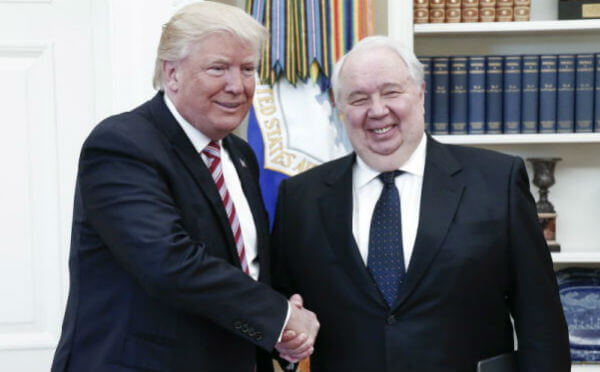
The Daily Beast reports: Senior members of the Trump administration are livid that the White House allowed the Russian government to steer the narrative of the president’s Wednesday meeting with top Russian diplomats by giving Kremlin-backed media exclusive access to the event.

The White House did not allow American press into the meeting between President Donald Trump, Russian foreign Minister Sergey Lavrov, and Russia’s ambassador to Washington, Sergey Kislyak. But it did admit a photographer from TASS, a state-owned Russian news service. Its photos were subsequently posted on TASS’s website, giving that outlet a monopoly on publishable visuals of the meeting.

Russian government Twitter accounts shared photos of the event shortly after its conclusion. They revealed Kislyak’s presence—a fact that was not even mentioned in the official White House readout of the meeting. Some U.S. officials suspect Kislyak, whose conversations with Trump’s former National Security Adviser have fed an FBI investigation of his campaign, is a Kremlin spy—or at least spy-adjacent.

Two senior administration officials, one an Obama holdover and the other a Trump appointee, told The Daily Beast that the resulting reliance of U.S. media on a propaganda arm of a foreign government let Russia set the public tone of the meeting and embarrassed the administration amid already contentious discussions with Russian diplomats.

Both officials spoke on condition of anonymity in order to candidly express their views. The White House did not immediately respond to a request for comment.

“This isn’t an ‘America First’ policy,” one of the officials fumed of the White House’s decision “to let the biggest perpetrator of fake news into the Oval Office.” Trump, the official added, is “either in bed with the Russians or too stupid to understand the severity of this mistake. Either way, the implications are truly terrifying.” [Continue reading…]

Facebooktwittermail

Europeans are less likely to share fake news. Here’s why

PRI reports: If you picked up a newspaper in the UK on Monday, you might have encountered an unusual advertisement offering tips on how to spot “false news.”

Facebook published the full-page ads in major newspapers — including the Guardian and the Times of Londn — ahead of the country’s general elections next month. Last month, it published the same ads in Germany and France, ahead of elections in those countries.

“People want to see accurate information on Facebook and so do we. That is why we are doing everything we can to tackle the problem of false news,” Simon Milner, Facebook’s Director of Policy for the UK, wrote in a statement.

Research indicates that Internet users in some European countries are less likely than Americans to share fake news online. Still, Facebook and other social media companies have been facing mounting pressure from European leaders to address fake news, as well as other hateful, racist and violent posts.

“I think Europe has within living memory much more understanding of the consequences of letting hateful propaganda spread,” said Zeynep Tufekci, an associate professor at the University of North Carolina who studies the effect of technology on politics and society. “They lived through World War I and World War II, and they have a deeper visceral reaction to the consequences of letting hate speech, incitement to violence, misinformation, propaganda — the whole range of things that we see online today — going unchecked.” [Continue reading…]

Facebooktwittermail

South Korea’s new president says his election completes the ‘candlelight revolution’

Tim Shorrock reports:  Moon Jae-in, a human rights and labor lawyer who came of age protesting authoritarian military governments backed by the United States, assumed South Korea’s presidency Wednesday after a snap election that repudiated 10 years of right-wing conservative rule.

Moon, 64, took office after securing about 41 percent of a total popular vote of 32.8 million, far ahead of his closest rival, the conservative Hong Joon-pyo, who ended up with 24 percent. It was the largest margin in Korean election history, the wire service Yonhap reported.

“I will restore a government based on principle and justice,” Moon declared Tuesday night in a nationally broadcast speech from Seoul’s Gwanghwamun district, which is famous for its political protests. “I will be the proud president of a proud nation.”

After being sworn in Wednesday, he startled the nation with a ringing declaration calling for a new foreign policy based on negotiations and dialogue. “I will do whatever it takes to help settle peace on the Korean Peninsula,” including visiting North Korea, Moon told the National Assembly. In a nod to Washington, he also declared he would “further strengthen the alliance between South Korea and the United States.”

Moon’s election was the direct result of the impeachment of his predecessor, Park Geun-hye, who had embraced Washington’s hard-line policies toward Pyongyang. She was brought down after millions of citizens angry about corruption, economic mismanagement, abuse of power, and the uncertain future of Korean youth flooded the streets of Seoul and other major cities in a peaceful movement now known as the “candlelight revolution.” [Continue reading…]

Facebooktwittermail

In win for environmentalists, Senate keeps an Obama-era climate change rule

The New York Times reports: In a surprising victory for President Barack Obama’s environmental legacy, the Senate voted on Wednesday to uphold an Obama-era climate change regulation to control the release of methane from oil and gas wells on public land.

Senators voted 51 to 49 to block consideration of a resolution to repeal the 2016 Interior Department rule to curb emissions of methane, a powerful planet-warming greenhouse gas. Senators John McCain of Arizona, Lindsey Graham of South Carolina and Susan Collins of Maine, all Republicans who have expressed concern about climate change and backed legislation to tackle the issue, broke with their party to join Democrats and defeat the resolution.

The vote also marked the first, and probably the only, defeat of a stream of resolutions over the last four months — pursued through the once-obscure Congressional Review Act — to unwind regulations approved late in the Obama administration.

In anticipation of Republican defections, President Trump sent Vice President Mike Pence to the Senate floor to break a tie vote. But with three members of his own party breaking away, Mr. Pence stood aside.

“We were surprised and thrilled to win on this,” said Tiernan Sittenfeld, senior vice president of the League of Conservation Voters, which, along with other environmental groups, has been lobbying Republicans for weeks to vote against the repeal of the methane rule. “This is clearly a huge win for our health and our climate.” [Continue reading…]

Facebooktwittermail

In Trump’s firing of James Comey, echoes of Watergate

The New York Times reports: In dramatically casting aside James B. Comey, President Trump fired the man who may have helped make him president — and the man who potentially most threatened the future of his presidency.

Not since Watergate has a president dismissed the person leading an investigation bearing on him, and Mr. Trump’s decision late Tuesday afternoon drew instant comparisons to the Saturday Night Massacre when President Richard M. Nixon ordered the firing of Archibald Cox, the special prosecutor looking into the so-called third-rate burglary that would eventually bring Nixon down.

In his letter informing Mr. Comey that he was terminated as F.B.I. director, Mr. Trump made a point of noting that Mr. Comey had three times told the president that he was not under investigation. But Mr. Comey has said publicly that the bureau is investigating Russia’s meddling in last year’s presidential election and whether any associates of Mr. Trump’s campaign were coordinating with Moscow.

While Mr. Trump said he acted on the recommendation of Attorney General Jeff Sessions, he had left little doubt about his personal feelings toward Mr. Comey or that Russia investigation in recent days. “Comey was the best thing that has ever happened to Hillary Clinton in that he gave her a free pass for her many bad deeds!” he wrote on Twitter a week ago.

“The Russia-Trump collusion story is a total hoax, when will this taxpayer funded charade end?” he added on Monday. [Continue reading…]

Facebooktwittermail