Category Archives: war in Afghanistan

Drone attacks may be expanded in Pakistan

Drone attacks may be expanded in Pakistan

Senior U.S. officials are pushing to expand CIA drone strikes beyond Pakistan’s tribal region and into a major city in an attempt to pressure the Pakistani government to pursue Taliban leaders based in Quetta.

The proposal has opened a contentious new front in the clandestine war. The prospect of Predator aircraft strikes in Quetta, a sprawling city, signals a new U.S. resolve to decapitate the Taliban. But it also risks rupturing Washington’s relationship with Islamabad.

The concern has created tension among Obama administration officials over whether unmanned aircraft strikes in a city of 850,000 are a realistic option. Proponents, including some military leaders, argue that attacking the Taliban in Quetta — or at least threatening to do so — is crucial to the success of the revised war strategy President Obama unveiled last week.

“If we don’t do this — at least have a real discussion of it — Pakistan might not think we are serious,” said a senior U.S. official involved in war planning. “What the Pakistanis have to do is tell the Taliban that there is too much pressure from the U.S.; we can’t allow you to have sanctuary inside Pakistan anymore.”

But others, including high-ranking U.S. intelligence officials, have been more skeptical of employing drone attacks in a place that Pakistanis see as part of their country’s core. Pakistani officials have warned that the fallout would be severe.

“We are not a banana republic,” said a senior Pakistani official involved in discussions of security issues with the Obama administration. If the United States follows through, the official said, “this might be the end of the road.” [continued…]

Pakistan rebuffs U.S. on Taliban crackdown

Demands by the United States for Pakistan to crack down on the strongest Taliban warrior in Afghanistan, Siraj Haqqani, whose fighters pose the biggest threat to American forces, have been rebuffed by the Pakistani military, according to Pakistani military officials and diplomats.

The Obama administration wants Pakistan to turn on Mr. Haqqani, a longtime asset of Pakistan’s spy agency who uses the tribal area of North Waziristan as his sanctuary. But, the officials said, Pakistan views the entreaties as contrary to its interests in Afghanistan beyond the timetable of President Obama’s surge, which envisions drawing down American forces beginning in mid-2011.

The demands, first made by senior American officials before President Obama’s Afghanistan speech and repeated many times since, were renewed in a written demarche delivered in recent days by the United States Embassy to the head of the Pakistani military, Gen. Ashfaq Parvez Kayani, according to American officials. Gen. David Petraeus followed up on Monday during a visit to Islamabad.

The demands have been accompanied by strong suggestions that if the Pakistanis cannot take care of the problem, including dismantling the Taliban leadership based in Quetta, Pakistan, then the Americans will by resorting to broader and more frequent drone strikes in Pakistan.

But the Pakistanis have greeted the refrain with official public silence and private anger, illustrating the widening gulf between the allies over the Afghan war.

Former Pakistani military officers voice irritation with the American insistence daily on television, part of a mounting grievance in Pakistan that the alliance with the United States is too costly to bear.

“It is really beginning to irk and anger us,” said a security official familiar with the deliberations at the senior levels of the Pakistani leadership.

The core reason for Pakistan’s imperviousness is its scant faith in the Obama surge, and what Pakistan sees as the need to position itself for a major regional realignment in Afghanistan once American forces begin to leave. [continued…]

Facebooktwittermail

To beat al Qaeda, look to the east

To beat al Qaeda, look to the east

Al Qaeda’s main focus is harming the United States and Europe, but there hasn’t been a successful attack in these places directly commanded by Osama bin Laden and company since 9/11. The American invasion of Afghanistan devastated Al Qaeda’s core of top personnel and its training camps. In a recent briefing to the Senate Foreign Relations Committee, Marc Sageman, a former C.I.A. case officer, said that recent history “refutes claims by some heads of the intelligence community that all Islamist plots in the West can be traced back to the Afghan-Pakistani border.” The real threat is homegrown youths who gain inspiration from Osama bin Laden but little else beyond an occasional self-financed spell at a degraded Qaeda-linked training facility.

The 2003 invasion of Iraq encouraged many of these local plots, including the train bombings in Madrid in 2004 and London in 2005. In their aftermaths, European law and security forces stopped plots from coming to fruition by stepping up coordination and tracking links among local extremists, their friends and friends of friends, while also improving relations with young Muslim immigrants through community outreach. Morocco, Saudi Arabia and Turkey have taken similar steps.

Now we need to bring this perspective to Afghanistan and Pakistan — one that is smart about cultures, customs and connections. The present policy of focusing on troop strength and drones, and trying to win over people by improving their lives with Western-style aid programs, only continues a long history of foreign involvement and failure. Reading a thousand years of Arab and Muslim history would show little in the way of patterns that would have helped to predict 9/11, but our predicament in Afghanistan rhymes with the past like a limerick.

A key factor helping the Taliban is the moral outrage of the Pashtun tribes against those who deny them autonomy, including a right to bear arms to defend their tribal code, known as Pashtunwali. Its sacred tenets include protecting women’s purity (namus), the right to personal revenge (badal), the sanctity of the guest (melmastia) and sanctuary (nanawateh). Among all Pashtun tribes, inheritance, wealth, social prestige and political status accrue through the father’s line.

This social structure means that there can be no suspicion that the male pedigree (often traceable in lineages spanning centuries) is “corrupted” by doubtful paternity. Thus, revenge for sexual misbehavior (rape, adultery, abduction) warrants killing seven members of the offending group and often the “offending” woman. Yet hospitality trumps vengeance: if a group accepts a guest, all must honor him, even if prior grounds justify revenge. That’s one reason American offers of millions for betraying Osama bin Laden fail.

Afghan hill societies have withstood centuries of would-be conquests by keeping order with Pashtunwali in the absence of central authority. When seemingly intractable conflicts arise, rival parties convene councils, or jirgas, of elders and third parties to seek solutions through consensus.
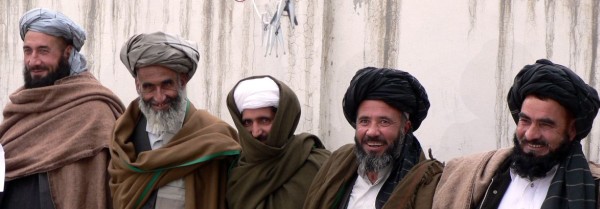
After 9/11, the Taliban leader, Mullah Omar, assembled a council of clerics to judge his claim that Mr. bin Laden was the country’s guest and could not be surrendered. The clerics countered that because a guest should not cause his host problems, Mr. bin Laden should leave. But instead of keeping pressure on the Taliban to resolve the issue in ways they could live with, the United States ridiculed their deliberation and bombed them into a closer alliance with Al Qaeda. Pakistani Pashtuns then offered to help out their Afghan brethren.

American-sponsored “reconciliation” efforts between the Afghan government and the Taliban may be fatally flawed if they include demands that Pashtun hill tribes give up their arms and support a Constitution that values Western-inspired rights and judicial institutions over traditions that have sustained the tribes against all enemies.

The secretary of state, Hillary Clinton, and the special envoy to the region, Richard Holbrooke, suggest that victory in Afghanistan is possible if the Taliban who pursue self-interest rather than ideology can be co-opted with material incentives. But as the veteran war reporter Jason Burke of The Observer of London told me: “Today, the logical thing for the Pashtun conservatives is to stop fighting and get rich through narcotics or Western aid, the latter being much lower risk. But many won’t sell out.”

Why? In part because outsiders who ignore local group dynamics tend to ride roughshod over values they don’t grasp. My research with colleagues on group conflict in India, Indonesia, Iran, Morocco, Pakistan and the Palestinian territories found that helping to improve lives materially does little to reduce support for violence, and can even increase it if people feel such help compromises their most cherished values.

The original alliance between the Taliban and Al Qaeda was largely one of convenience between a poverty-stricken national movement and a transnational cause that brought it material help. American pressure on Pakistan to attack the Taliban and Al Qaeda in their sanctuary gave birth to the Pakistani Taliban, who forged their own ties to Al Qaeda to fight the Pakistani state.

While some Taliban groups use the rhetoric of global jihad to inspire ranks or enlist foreign fighters, the Pakistani Taliban show no inclination to go after Western interests abroad. Their attacks, which have included at least three assaults near nuclear facilities, warrant concerted action — but in Pakistan, not in Afghanistan. As Mr. Sageman, the former C.I.A. officer, puts it: “There’s no Qaeda in Afghanistan and no Afghans in Qaeda.”

Pakistan has long preferred a policy of “respect for the independence and sentiment of the tribes” that was advised in 1908 by Lord Curzon, the British viceroy of India who established the North-West Frontier Province as a buffer zone to “conciliate and contain” the Pashtun hill tribes. In 1948, Pakistan’s founder, Muhammad Ali Jinnah, removed all troops from brigade level up in Waziristan and other tribal areas in a plan aptly called Operation Curzon.

The problem today is that Al Qaeda is prodding the Pakistani Taliban to hit state institutions in the hopes of provoking a full-scale invasion of the tribal areas by the Pakistani Army; the idea is that such an assault would rally the tribes to Al Qaeda’s cause and threaten the state. The United States has been pushing for exactly that sort of potentially disastrous action by Islamabad. [continued…]

Stretching out an ugly struggle

Many decades ago as a fledgling C.I.A. officer in the field, I was naïvely convinced that if the facts were reported back to Washington correctly, everything else would take care of itself in policymaking. The first loss of innocence comes with the harsh recognition that “all politics are local” and that overseas realities bear only a partial relationship to foreign-policy formulation back home.

So in looking at President Obama’s new policy directions for Afghanistan, what goes down in Washington politics far outweighs analyses of local conditions.

I had hoped that Obama would level with the American people that the war in Afghanistan is not being won, indeed is not winnable within any practicable framework. But such an admission — however accurate — would sign the political death warrant of a president to be portrayed as having snatched defeat out of the jaws of “victory.”

The “objective” situation in Afghanistan remains a mess. Senior commanders acknowledge that we are not now winning hearts and minds in Afghanistan; indeed, we never can, and certainly not at gunpoint. Most Pashtuns will never accept a U.S. plan for Afghanistan’s future. The non-Pashtuns — Tajiks, Uzbeks, Hazaras, etc. — naturally welcome any outside support in what is a virtual civil war.

America has inadvertently ended up choosing sides in this war. U.S. forces are perceived by large numbers of Afghans as an occupying army inflicting large civilian casualties. The struggle has now metastasized into Pakistan — with even higher stakes. [continued…]

Facebooktwittermail

Obama’s bloody re-election calculus

Obama’s bloody re-election calculus

Obama’s new “strategy” is no strategy at all. It is a cynical and politically motivated rehash of Iraq policy: Toss in a few more troops, throw together something resembling local security forces, buy off the enemies, and get the hell out before it all blows up. Even the dimmest bulb listening to the president’s speech could not have missed the obvious link between the withdrawal date for combat troops from Iraq (2010), the date for beginning troop reductions in Afghanistan (2011), and the domestic U.S. election cycle.

So we are faced with a conundrum. Obama is one of the most intelligent men ever to hold the U.S. presidency. But no intelligent person could really believe that adding 30,000 troops to Afghanistan, a country four times larger than Vietnam, for a year or two, following the same game plan that has resulted in dismal failure there for the past eight years, could possibly have any impact on the outcome of the conflict.

Arthur Conan Doyle’s character Sherlock Holmes used to say that “when you have eliminated the impossible, whatever remains, however improbable, must be the truth.” The only conclusion one can reach from the president’s speech, after eliminating the impossible, is that the administration has made a difficult but pragmatic decision: The war in Afghanistan is unwinnable, and the president’s second term and progressive domestic agenda cannot be sacrificed to a lost cause the way that President Lyndon B. Johnson’s was for Vietnam. The result of that calculation was what we heard on Dec. 1: platitudes about commitment and a just cause; historical amnesia; and a continuation of the exact same failed policies that got the United States into this mess back in 2001, concocted by the same ship of fools, many of whom are still providing remarkably bad advice to this administration. [continued…]

Facebooktwittermail

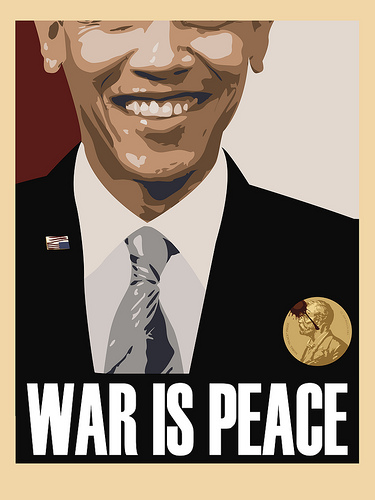
How America won the Nobel Peace Prize

How America won the Nobel Peace Prize

Having been nominated for the peace prize after only ten days in office; having spent the previous three weeks as a president-elect who silently monitored the slaughter in Gaza; and having just assumed the role of commander-in-chief in two wars, for Barack Obama to then craft a credible way to accept an accolade as this year’s most celebrated man of peace, was always going to demand some rhetorical creativity.
Still, this surely ranks as a first: to use the peace prize ceremony as an opportunity to justify war.

Speaking in Oslo last night, Obama said: “the instruments of war do have a role to play in preserving the peace.”

Only within a nation that has largely managed to insulate itself from the effects of war could such a statement be made.

Sixty-four years earlier, in the shadow of two world wars, Americans had a much greater interest in condemning war than in presenting arguments for its justification.

“… our position is that no grievances or policies will justify resort to aggressive war. It is utterly renounced and condemned as an instrument of policy,” wrote Supreme Court Justice Robert H Jackson, on August 12, 1945, when laying out the foundation for the Nuremberg Trials.

On that basis, every war that the United States has fought since World War Two has been branded as a war of necessity — not a war of aggression. Likewise the war that Obama has now made his own is one that he claims to be both necessary, just, and unavoidable. Yet its justness rests on a logical non sequitur: the war in Afghanistan is just because of 9/11.

To say “because of 9/11” is both to present a reason and to simultaneously seal that reason inside a locked box. The logical connection between 9/11 and the war in Afghanistan is apparently so direct and unswerving that even now, those who voice skepticism are generally viewed as either un-American, irrational or naive.

Even so, on September 11, 2001, few Americans had the conviction that this country, out of necessity, was about to go war. President Bush had to present a logical and moral argument and he did so by enunciating what became the first iteration of the Bush doctrine and the foundation for the war on terrorism: “we will make no distinction between the terrorists who committed these acts and those who harbor them.”

On that basis, the Bush administration constructed a legal argument for bombing Afghanistan and killing thousands of people who had nothing whatsoever to do with the attacks.

The unspoken truth was that the US government enacted and the American people supported a war of vengeance. Had the lust for reprisal been tempered with foresight of the carnage and chaos that the following eight years would bring, America’s war of necessity might have been seen then as no more necessary than it is widely seen now.

The “necessity” that took America to war in Afghanistan is no different than the choice Israel makes when it bulldozes the family home of a suicide bomber. This accords with the ancient principle of settling scores, rebalancing power, and reasserting a position of dominance. It’s about showing your enemies and showing the world that you remain top dog. And therein lies the intractability of this war. More troops have to sent in now to buy time for Obama to figure how, without loss of face to himself or this country, the troops can be pulled out later.

As the US president reflects on the principles of a just war, he’s sending young American men and women overseas on the promise that they’re heading out on a path that should bring them back home.

Remember when Obama talked about ending the mindset that took us to war?

I do, but apparently he doesn’t.

Facebooktwittermail

Hundreds of women lead protest in Afghanistan

Hundreds of women lead protest in Afghanistan

Several hundred women, many holding aloft pictures of relatives killed by drug lords or Taliban militants, held a loud but nonviolent street protest today, demanding that President Hamid Karzai purge from his government anyone connected to corruption, war crimes or the Taliban.

“These women are being very brave,” said the protest leader, her face hidden by a burka. “To be a woman in Afghanistan and an activist can mean death. We want justice for our loved ones!”

Afghan police, in riot gear, monitored the rally as it worked its way slowly through muddy streets to the United Nations building here, but they did nothing to disrupt the event.

The unusual display of political activism by women comes as Karzai is under increasing pressure to remove from his cabinet anyone connected to rampant corruption, including links to the flourishing drug trade. His own finance minister says corruption is the biggest threat to the future of Afghanistan. [continued…]

Facebooktwittermail

McChrystal’s stovepipe operation

McChrystal’s stovepipe operation

President Barack Obama’s national address last Tuesday not only detailed the United States’ strategy on Afghanistan, it laid bare his new administration’s strengths and weaknesses – and confirmed the growing suspicion that, eight years after September 11, 2001, meeting America’s global challenges with a military response remains the default position of the Washington policymaking establishment.

“Don’t underestimate the impact that eight years of the [George W] Bush administration has had in Washington,” a senior State Department official explained this last summer. “The Bush people set out the language of the war on terrorism, invented the vocabulary, defined the terms. People talk about the importance of ‘doing’ diplomacy, but no one really knows what that means or how tough it can really be.”

At least initially, this assessment seemed contradicted by the administration’s flurry of diplomatic activity. Its first months were taken up by Secretary of State Hillary Clinton’s globetrotting, special envoy George Mitchell’s high-profile Jerusalem meetings, AfPak specialist Richard Holbrooke’s repeated initiatives with Pakistan’s President Asif Ali Zardari – and Obama’s decision to engage Iran in direct talks about its nuclear program.

Suddenly, surprisingly, the military seemed relegated to playing a minor role in Washington: Bush’s hero David Petraeus, the US commander for the greater Middle East, was no longer in the headlines, the war in Iraq seemed well in hand and Defense Secretary Robert Gates was nowhere to be seen.

All of this changed in May, when a series of well-timed Taliban offensives led to a spike in US casualties and Gates decided to replace the US Afghan commander, David McKiernan, with Lieutenant General Stanley McChrystal. The change did not come as a surprise to Pentagon officers, who had watched Petraeus and McKiernan struggle through a difficult relationship: “The two couldn’t be in the same room together,” a McKiernan aide says. “We knew there’d be a fist fight if we left them alone.” The disagreement was personal: McKiernan resented answering to an officer whom he had once commanded and viewed as politically ambitious.

But the relationship was also scarred by a subtle disagreement over how to meet the Taliban challenge. Both McKiernan and Petraeus agreed that the Taliban posed a security challenge to the Afghan government, but McKiernan focused first on development – on building what he called “human capital”. Petraeus disagreed: you can’t build “human capital” without security, he argued, and the security situation in the country was deteriorating. Then too, Petraeus thought, what was needed in Afghanistan was an officer who could respond creatively to what Petraeus believed was turning into an asymmetric fight – and McKiernan was an officer with a deep background in running conventional wars.

McChrystal, a former Green Beret and a celebrated special operations commander, was the answer. Petraeus recommended a change to Gates, and Gates agreed. Within days of his May 11 appointment, McChrystal showed up in the Afghan capital, Kabul, with a team of counter-insurgency experts who commandeered McKiernan’s headquarters and fanned out throughout the country.

McChrystal’s teams were told to identify the problem and find a solution. “They absolutely flooded the zone,” a US development officer says. “There must have been hundreds of them. They were in every province, every village, talking to everyone. There were 10 of them for every one of us.” Not surprisingly, within weeks of their deployment, McChrystal’s team leaders had concluded that the US was facing was an escalating insurgency that could only be checked with an increase in US troops. In-country State Department officials rolled their eyes: “What a shock. If you deploy a gang squad, they’re going to find a gang,” a senior State Department official says with a tinge of bitterness. “They were looking for an insurgency and they found one.”

“From the minute that McChrystal showed up in Kabul, he drove the debate,” a White House official confirms. “You’ll notice – from May on it was no longer a question of whether we should follow a military strategy or deploy additional troops. It was always, ‘should we do 20,000 or 30,000 or 40,000, or even 80,000’? We weren’t searching for the right strategy; we were searching for the right number.”

A senior State Department official, watching McChrystal from her State Department perch in Washington, remembers the frustration among the department’s top policymakers: “We kept saying ‘we need to open up to the other side, like we did in Iraq with the Anbar insurgency,’ and the military kept saying, ‘well this isn’t Iraq.’ And so we’d answer: ‘fine, so if Afghanistan isn’t Iraq, then why do you keep talking about a surge?’ And we never got an answer.”

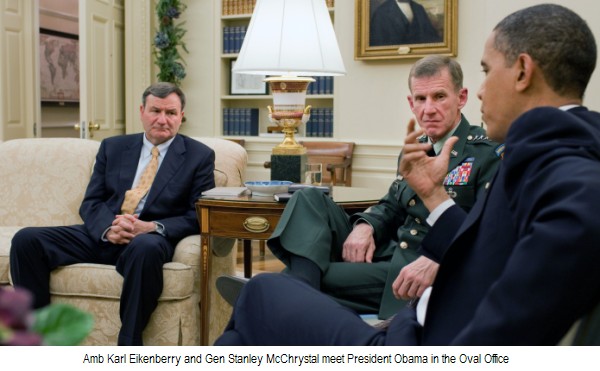
The State Department’s frustration extended into the embassy in Kabul, where the US ambassador, Karl Eikenberry, was having his own problems with McChrystal. The appointment of Eikenberry in March of 2009 had been greeted with skepticism in the State Department because of his background as a West Pointer, a retired lieutenant general and a US security coordinator in the country. But if anyone would be sympathetic to McChrystal, it was now thought, it would be Eikenberry.

But that’s not what happened: Eikenberry won friends among professional diplomats for his easygoing manner and quick understanding of their problems – and for his open irritation at McChrystal’s imperious manner. “McChrystal came in and he just thought he was some kind of Roman proconsul, a [Douglas] MacArthur,” an Eikenberry colleague notes. “He was going to run the whole thing. He didn’t need to consult with the State Department or civilians, let alone the ambassador. This was not only the military’s show, it was his show.”

But McChrystal was not only able to “flood the zone” in Afghanistan, he was able to do so in Washington. As the director of the Joint Staff, a position he held just prior to arriving in Kabul, McChrystal established the Pakistan-Afghanistan Coordinating Cell (PACC), a 70-person military-civilian operations group housed in the Pentagon’s National Command Center, one of the most secure offices in the world. “This isn’t a place you just wander in and out of,” a senior Pentagon official says. The “PACC” bypassed the normal command structure – and the State Department. It reported to McChrystal, who rotated its officers in and out of Kabul every three to four months.

The PACC is “a stovepipe operation”, this senior Pentagon official notes. “It’s beautiful. It’s headed up by McChrystal acolytes, former special operations officers who view him [McChrystal] as their patron. So they follow his lead. And there is no requirement for them to share any of the information they get from Kabul with the State Department or anyone else – let alone with Eikenberry. This is McChrystal’s game. The PACC people in Washington pass information to McChrystal without going through any channels and they take the best information from Kabul and they brief [JCS chairman Admiral Mike] Mullen – and he briefs the president. So during the run-up to the Afghanistan decision, the military always looked current. They had the best information. Everyone else looked like a bunch of amateurs. Eikenberry was out of the loop. He had no chop [influence] on any of it. They just ran circles around him.” [continued…]

Facebooktwittermail

Taliban prepare to return to power

Taliban shadow officials offer concrete alternative

Like nearly all provinces in Afghanistan, this one has two governors.

The first was appointed by President Hamid Karzai and is backed by thousands of U.S. troops. He governs this mountainous eastern Afghan province by day, cutting the ribbons on new development projects and, according to fellow officials with knowledge of his dealings, taking a generous personal cut of the province’s foreign assistance budget.

The second governor was chosen by Taliban leader Mohammad Omar and, hunted by American soldiers, sneaks in only at night. He issues edicts on “Islamic Emirate of Afghanistan” stationery, plots attacks against government forces and fires any lower-ranking Taliban official tainted by even the whiff of corruption.

As the United States prepares to send 30,000 additional troops to Afghanistan to bolster Karzai’s beleaguered government, Taliban leaders are quietly pushing ahead with preparations for a moment they believe is inevitable: their return to power. The Taliban has done so by establishing an elaborate shadow government of governors, police chiefs, district administrators and judges that in many cases already has more bearing on the lives of Afghans than the real government. [continued…]

US surge will only prolong Afghan war

American and British exponents of a military escalation or “the surge” in Afghanistan opportunistically expound two wholly contradictory views of Taliban strength. At one moment they are a movement of immense power on the verge of seizing power in Afghanistan and Pakistan with the possibility that they might soon have control of Pakistan’s nuclear weapons. But the next moment Mr Brown is claiming that the Taliban have almost no support among Afghans. In the US, Mr Obama and Mr Gates imply that the insurgents have such shallow roots that they can be largely defeated in 18 months so US troops can start to withdraw. [continued…]

The surrealism of the Afghan surge

President Barack Obama risks leading the US deeper into the same kind of nightmare as Vietnam, with the same profound misconceptions and arrogance of the US military and the CIA. It just requires a glance at the picture on p. A29 of Sunday’s New York Times to see how absurd the US decision-making process really is. Among the people in the room briefing the president, there isn’t a single person with deep non-military knowledge of either Afghanistan or Pakistan. We see plenty of generals and politicians but nobody who knows about the people, culture, economy, climate, agronomy, extreme poverty, and traditions of the people themselves. [continued…]

US leaves in Iraq equipment that it may need in Afghanistan

Even as the U.S. military scrambles to support a troop surge in Afghanistan, it is donating passenger vehicles, generators and other equipment worth tens of millions of dollars to the Iraqi government.

Under new authority granted by the Pentagon, U.S. commanders in Iraq may now donate to the Iraqis up to $30 million worth of equipment from each facility they leave, up from the $2 million cap established when the guidelines were first set in 2005. The new cap applies at scores of posts that the U.S. military is expected to leave in coming months as it scales back its presence from about 280 facilities to six large bases and a few small ones by the end of next summer.

Some of the items that commanders may now leave behind, including passenger vehicles and generators, are among what commanders in Afghanistan need most urgently, according to Pentagon memos. [continued…]

Facebooktwittermail

Obama wanted a surge, he’s getting a surge, and it feels good

Obama wanted a surge, he’s getting a surge, and it feels good

Mine might not be a headline the New York Times would choose, but that’s the story they tell under their flatly descriptive: “How Obama Came to Plan for ‘Surge’ in Afghanistan.”

The narrative reads like a script for NBC’s “West Wing” as it dramatises Obama’s deliberative process and that seems to have been the object of the exercise for this stellar team of reporters: paint a picture of presidential solemnity that will inspire confidence in how Obama makes decisions and thereby drum up a bit of good old-fashioned blind-faith in the presidency.

If there is no inescapable logic to the idea that a faster surge will enable a swifter withdrawal, then — the Times would have its readers believe — we shouldn’t worry our little heads about that because our fabulously diligent president has performed an operation of executive intelligence that renders all further consideration superfluous.

In a similar vein I’ll spare readers here the tedium of wading through a 4,660-word article and pick out some of the highlights. Actually, to my eye there is really only one point of substance:

Mr. Obama and his advisers … considered options for stepping up the pursuit of extremists in Pakistan’s border areas. He eventually approved a C.I.A. request to expand the areas where remotely piloted aircraft could strike, and other covert action. The trick would be getting Pakistani consent, which still has not been granted.

For “expand the areas” read: Baluchistan.

If getting Pakistani consent to open a new front in the war simply comes down to diplomatic finesse, then yes, you could call it a “trick” managing to get those instransigent Pakistanis to do the right thing.

In reality, it is merely the imperatives of fluent story-telling that compels the Times to glide over this important detail in the much larger and grimmer story of the war. Understanding why Baluchistan represents a red line that Pakistan refuses to abandon is something that Washington might grasp only when it’s too late.

The matter of most importance both for this administration and for the New York Times has less to do with people, places, history and geography, than it does with high-value words. Words like “surge”.

Obama wants to push in hard so he can pull out fast.

A three-month strategic review thus produced a choreographic solution:

The plan, called Option 2A, was presented to the president on Nov. 11. Mr. Obama complained that the bell curve would take 18 months to get all the troops in place.

He turned to General Petraeus and asked him how long it took to get the so-called surge troops he commanded in Iraq in 2007. That was six months.

“What I’m looking for is a surge,” Mr. Obama said. “This has to be a surge.”

That represented a contrast from when Mr. Obama, as a presidential candidate, staunchly opposed President Bush’s buildup in Iraq. But unlike Mr. Bush, Mr. Obama wanted from the start to speed up a withdrawal as well. The military was told to come up with a plan to send troops quickly and then begin bringing them home quickly.

On November 29, after winning the approval of all his immediate advisers, the president moved into action:

Mr. Obama then went to the Situation Room to call General McChrystal and Ambassador Eikenberry. The president made it clear that in the next assessment in December 2010 he would not contemplate more troops. “It will only be about the flexibility in how we draw down, not if we draw down,” he said.

Two days later, Mr. Obama flew to West Point to give his speech. After three months of agonizing review, he seemed surprisingly serene. “He was,” said one adviser, “totally at peace.”

Obama wanted a surge, he’s getting a surge, and it feels good — at least for now.

Facebooktwittermail

Separatists, Islamists and Islamabad struggle for control of Pakistani Balochistan

Separatists, Islamists and Islamabad struggle for control of Pakistani Balochistan

To say that the U.S.-led invasion and occupation of Afghanistan in October 2001 shook Pakistan to its core would be an understatement. Since then, the war in Afghanistan has spilled over into Pakistan on multiple levels. The escalating cycle of violence between Pakistani security forces and a patchwork of tribal militants, particularly the Tehrik-e-Taliban Pakistan (TTP) and foreign fighters aligned with the Taliban and al-Qaeda in the Federally Administered Tribal Areas (FATA) and the North-West Frontier Province (NWFP) is a case in point. Many observers of Pakistani affairs have used the deteriorating situation in the tribal agencies along the Afghanistan-Pakistan frontier as a bellwether of future trends in Pakistan. In this context, it is no surprise that events in Pakistan’s tribal areas seem to draw the most attention. Yet Pakistan’s Balochistan province is also beginning to draw interest as a center of Taliban and al-Qaeda activity.

Reports that the U.S. is seeking Pakistan’s approval for expanding its controversial drone campaign against targets in Balochistan – a clear red line for Pakistan – have raised serious concerns in Islamabad about Washington’s ultimate intentions (The News, [Islamabad], September 29). As the Obama administration escalates its military campaign in Afghanistan, Pakistani leaders have expressed deep concerns about the potential destabilization of Balochistan resulting from the intensified fighting expected in Afghanistan in the coming months (The Nation [Lahore], November 27). As if these concerns were not enough, Balochistan remains a hotbed of ethno-nationalist militancy, drug smuggling, and organized crime. Balochistan is also in the throes of a refugee crisis that has been largely ignored. The confluence of these trends – which indirectly or directly reinforce each other – is making an already dangerous situation worse with severe implications for Pakistan and the wider region. [continued…]

Facebooktwittermail

Obama’s ideal partner: Turkey

Obama’s ideal partner: Turkey

U.S. President Barack Obama laid out his new Afghanistan strategy on Tuesday night by ordering an additional 30,000 US forces to the country.

While the majority of the analysis and discussion in Washington has centered on the levels of US forces or the president’s reasoning for it, the president emphasized that the “burden [in Afghanistan] is not ours alone to bear.” Declaring that not only is NATO’s credibility on the line, but that the security of the US and all of its allies are at stake, the president invoked the international consensus on Afghanistan that led to a 43-nation coalition that has operated in the country since the attacks on Sept. 11, 2001, to sell his new strategy. Yet the reality is that this international coalition is waning, not surging, and is in desperate need of a regional champion that can serve as a model partner for the US in Afghanistan. Obama’s ideal partner is Turkey.

Consider the facts: Turkey boasts the second largest military in NATO after only the US and the largest in Europe. Turkey has been a close American bilateral and NATO ally for more than 60 years. In addition to being a member of almost every European organization, Turkey is a UN Security Council member, a member of the G-20, has successfully pushed Ekmeleddin İhsanoğlu as the secretary-general of the Organization of the Islamic Conference (OIC) and is one of the few examples of a fully functioning Muslim-majority democracy in the Middle East. On top of all of this, Ankara has close historic ties with Afghanistan that date back to the 1920s when the founder of the modern republic, Atatürk, served as a model for modernization that collapsed only after great power interference in Kabul carved up the country. Often referred to as Afghanistan’s “closest neighbor without borders,” Turkey also shares considerable cultural, ethnic and linguistic links that make it an ideal partner for the US to work with. [continued…]

Facebooktwittermail

Our timeline, and the Taliban’s

Our timeline, and the Taliban’s

It is hard to be optimistic about the outcome of President Obama’s troop “surge” in Afghanistan. The additional forces sound large in headlines, but shrink small in the mountains. The commitment is intended as an earnest indication of America’s will. But neither the number of troops nor the timeline that mandates a drawdown in less than two years is likely to impress the Taliban, who think in decades, or for that matter the Afghan people.

Most decision-makers on both sides of the Atlantic now privately believe we are in the business of managing failure, and that is how the surge looks. The president allowed himself to be convinced that a refusal to reinforce NATO’s mission in Afghanistan would fatally weaken the resolve of Pakistan in resisting Islamic militancy. Meanwhile at home, refusal to meet the American generals’ demands threatened to brand him as the man who lost the Afghan war. Thus the surge lies in the realm of politics, not warfare. [continued…]

Editor’s Comment — “July 2011 is not a withdrawal date, but a specific target date for beginning to transition security responsibility to Afghan forces, the chairman of the Joint Chiefs of Staff said on several morning talk shows today,” the Pentagon says.

“The withdrawal of U.S. forces from Afghanistan, scheduled to begin in July 2011, will ‘probably’ take two or three years, Defense Secretary Robert M. Gates said Thursday, although he added that ‘there are no deadlines in terms of when our troops will all be out’,” the Washington Post reports.

So, on the one hand we have defense chiefs emphasizing the caveats but on the other a White House has that date “etched in stone” — the date is “locked in,” and, as the Los Angeles Times notes, the proposed date “would make it such that the withdrawal of troops would begin just as the campaign for the 2012 presidential election was heating up.”

Hmmm. Sounds like a campaign theme: “the troops are coming home” — “no more re-deployments”. The war itself might not be over, but for each American soldier heading home the war will be over.

Still, there are those who haven’t let go of the idea that this war can be won.

Seth Jones, author of In the Graveyard of Empires: America’s War in Afghanistan and a civilian adviser to the US military sees victory (or failure) hinging on Baluchistan:

The United States and Pakistan must target Taliban leaders in Baluchistan. There are several ways to do it, and none requires military forces.

The first is to conduct raids to capture Taliban leaders in Baluchistan. Most Taliban are in or near Baluchi cities like Quetta. These should be police and intelligence operations, much like American-Pakistani efforts to capture Khalid Shaikh Mohammed and other Qaeda operatives after 9/11. The second is to hit Taliban leaders with drone strikes, as the United States and Pakistan have done so effectively in the tribal areas.

The cost of failing to act in Baluchistan will be enormous. As one Russian diplomat who served in the Soviet Army in Afghanistan recently told me: “You are running out of time. You must balance counterinsurgency efforts in Afghanistan by targeting the leadership nodes in Pakistan. Don’t make the same mistake we did.”

The Cold War ensured that Baluchistan remained a safe haven in the ’80’s and there are compelling reasons why Pakistan will want it to remain off limits now.

Jones’ suggestion that Taliban leaders in Baluchistan can be hit with drone strikes seems a bit fanciful and it’s also odd that he doesn’t regard the use of drones as use of military forces.

Among the many good reasons for taking refuge in a city rather than an isolated tribal compound is that there really is safety in numbers. The death toll from any missile strike would be intolerably high in the eyes of Pakistanis and their government. As for policing operations, I suspect that the sympathies of the local population would likewise make that option unfeasible.

Meanwhile, the Pakistan government will depend on maintaining a certain level of goodwill among the Baluchis if Pakistan is to ever succeed in building the Iran-Pakistan-India pipeline — a pipeline destined to run right through Baluchistan.

But irrespective of whether the Pakistani government gives its consent to the US opening a new front in its clandestine war, it appears that preparations are being made to expand the campaign of drone attacks and the New York Times is playing its part to create a permissive environment here if not in Baluchistan itself.

Scott Shane refers to CIA drone operators in Virginia as “sharpshooters” who killed eight Taliban and al Qaeda suspects two weeks ago. He goes on to quote a government official who claims that as a result of approximately 80 missile strikes over two years, “We believe the number of civilian casualties is just over 20, and those were people who were either at the side of major terrorists or were at facilities used by terrorists.”

While Shane acknowledges that that number is “strikingly lower than many unofficial counts,” he does not mention the reporting by Jane Mayer in The New Yorker who provided this characterization of the drone attacks:

…the recent campaign to kill Baitullah Mehsud offers a sobering case study of the hazards of robotic warfare. It appears to have taken sixteen missile strikes, and fourteen months, before the C.I.A. succeeded in killing him. During this hunt, between two hundred and seven and three hundred and twenty-one additional people were killed, depending on which news accounts you rely upon.

If in the coming months there are even larger death tolls in Baluchistan, Americans might yet again later realize that it’s worth knowing a bit of history about a people before you start killing them.

Chris Zambelis, an analyst for the Jamestown Foundation, provides a useful background report:

Reports that the U.S. is seeking Pakistan’s approval for expanding its controversial drone campaign against targets in Balochistan – a clear red line for Pakistan – have raised serious concerns in Islamabad about Washington’s ultimate intentions. As the Obama administration escalates its military campaign in Afghanistan, Pakistani leaders have expressed deep concerns about the potential destabilization of Balochistan resulting from the intensified fighting expected in Afghanistan in the coming months. As if these concerns were not enough, Balochistan remains a hotbed of ethno-nationalist militancy, drug smuggling, and organized crime. Balochistan is also in the throes of a refugee crisis that has been largely ignored. The confluence of these trends – which indirectly or directly reinforce each other – is making an already dangerous situation worse with severe implications for Pakistan and the wider region.

Facebooktwittermail

Meet the commanded-in-chief

Meet the commanded-in-chief

Let others deal with the details of President Obama’s Afghan speech, with the on-ramps and off-ramps, those 30,000 U.S. troops going in and just where they will be deployed, the benchmarks for what’s called “good governance” in Afghanistan, the corruption of the Karzai regime, the viability of counterinsurgency warfare, the reliability of NATO allies, and so on. Let’s just skip to the most essential point which, in a nutshell, is this: Victory at Last!

It’s been a long time coming, but finally American war commanders have effectively marshaled their forces, netcentrically outmaneuvering and outflanking the enemy. They have shocked-and-awed their opponents, won the necessary hearts-and-minds, and so, for the first time in at least two decades, stand at the heights of success, triumphant at last.

And no, I’m not talking about post-surge Iraq and certainly not about devolving Afghanistan. I’m talking about what’s happening in Washington.

You may not think so, but on Tuesday night from the U.S. Military Academy at West Point, in his first prime-time presidential address to the nation, Barack Obama surrendered. It may not have looked like that: there were no surrender documents; he wasn’t on the deck of the USS Missouri; he never bowed his head. Still, from today on, think of him not as the commander-in-chief, but as the commanded-in-chief. [continued…]

Facebooktwittermail

Obama’s war of necessity

Obama’s war of necessity

Among the many unanswered questions about President Obama’s approach to the war in Afghanistan, there is at this point one thing about which we can be certain: He does indeed regard this as a war of necessity.
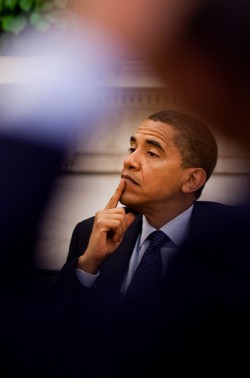
But necessary for what?

Necessary for defeating al Qaeda?

Nah. Much as Americans have been indoctrinated to believe that eradicating terrorism might be akin to eradicating smallpox — an endeavor which if engaged with sufficient thoroughness could actually have an end — it should by now be clear to all but the most simple-minded that the kernel of the episodic terrorist threat to America is contained in dangerous and highly contagious ideas. It is not confined to a particular group of people confined to a particular location. The war in Afghanistan is doing more to cultivate the conditions for a continuation of that threat rather than being an instrument for its removal.

Necessary for ending the war in Iraq?

In part, yes — at least this was the presidential campaign logic. The war in Iraq needed to be wrapped up as quickly as possible because that war was a distraction and the war in Afghanistan was a necessity.

Obama’s opposition to the war in Iraq could only be sold in a campaign against hawkish Republicans if he could prove he was not an opponent of war per se — just an opponent of that particular one. “I am not opposed to all wars. I’m opposed to dumb wars,” Obama said in 2002 when laying out his credentials as an un-antiwar Illinois State Senator.

In the 2008 campaign, Obama’s proof that he possessed an adequate level of war-zest was to pronounce that he was a true believer when it came to the war in Afghanistan — the righteous war; the necessary war; the real war; the war the George Bush had neglected to win.

Necessary for re-election?

Maybe. The answer to that question might well be contained in the genesis of July 2011 as the date US troops will start pulling out of Afghanistan. As CBS News reports, that date is “locked in”. “The president told [press secretary Robert Gibbs, the date — contrary to assertions from US senators] IS locked in — there is no flexibility. Troops WILL start coming home in July 2011. Period. It’s etched in stone. Gibbs said he even had the chisel.”

The Pentagon doesn’t like firm dates. It cleaves firmly to the line that everything is provisional, depending on the current conditions. So it’s hard to believe that General McChrystal or General Petraeus would have volunteered this timetable.

Did it come from David Axelrod? Does July 2011 fit as a “necessity” into a 2012 campaign calender?

Facebooktwittermail

The Afghanistan parenthesis

The Afghanistan parenthesis

… who exactly are Al Qaeda now, and where are they located? In many ways the Vietnam War, though of an atrociousness the Afghanistan War has not yet approached, was pursued by the U.S. obedient to a much sounder theory than any offered for the present war. The theory was that World Communism was all one thing and its spread to a single country would lead inevitably to its spread to a continent. The theory turned out to be false; and its falseness was perceived as early as 1964 by critics of the war such as Hans J. Morgenthau. But what are we doing in Afghanistan but following an inferior and less persuasive version of a similar theory: namely that World Terrorism is all one thing, that its heart is in Afghanistan (because that is where we found it), and that if we don’t “defeat” it soon by “completing the mission,” the terror will stay and spread.

Omitted is the fact that Afghanistan is not our country. Admittedly, this is a truth that comes hard to Americans. “The very idea of the fabrication of a new government,” wrote Edmund Burke, “is enough to fill us with disgust and horror.” But David Brooks disagrees: “aside from killing bad guys,” he wrote in the spring, American troops are “also trying to figure out how to reweave Afghan society.” By what right do we engage in the reweaving and refabrication of a society that has thrown out conquerors for thousands of years? The effect of the self-conceit can only be to unite the society in hostility against us. For America to look on the native resistance to an occupying army as proof of terrorism will surely increase the obduracy of the resistance itself, and serve to recruit more terrorists.

Our war in the border regions is being fought by drone assassinations. A man at the control sits in front of a screen in Las Vegas, and fires when he has a certain shot. To a primitive mind (but not only to a primitive mind), this experiment on a country not our own has the trappings a video game played in hell. But the procedure was here embraced by the president in the antiseptic idiom of a practiced technocrat. He gave no sign of the effects of such killings by a foreign power out of reach in the sky. To assassinate one major operative, Baitullah Mehsud, as Jane Mayer showed in a recent article in the New Yorker, 16 strikes were necessary, over 14 months, killing a total of as many as 538 persons, of whom 200-300 were bystanders. What comes of the reputation of policemen in a crime-ridden neighborhood when they conduct themselves like that? And what makes anyone suppose the reaction will be less extreme when the policeman comes from another country? And yet, from the president’s West Point speech, one would not guess that he has reflected what our mere presence in West Asia does to increase the enchantment of violent resistance and to heat the anger that turns into terrorists people who have lost parents, children, cousins, clansmen, and friends to the Americans. The total number of Muslims killed by Americans in revenge for the attacks of September 11th now numbers more than a hundred thousand. Of those, few were members of Al Qaeda, and few harbored any intention, for good or ill, toward the United States before we crossed the ocean as an occupying power. [continued…]

Facebooktwittermail

Obama’s folly

Obama’s folly

Through war, Bush set out to transform the greater Middle East. Despite immense expenditures of blood and treasure, that effort failed. In choosing Obama rather than John McCain to succeed Bush, the American people acknowledged that failure as definitive. Obama’s election was to mark a new beginning, an opportunity to “reset” America’s approach to the world.

The president’s chosen course of action for Afghanistan suggests he may well squander that opportunity. Rather than renouncing Bush’s legacy, Obama apparently aims to salvage something of value. In Afghanistan, he will expend yet more blood and more treasure hoping to attenuate or at least paper over the wreckage left over from the Bush era.

However improbable, Obama thereby finds himself following in the footsteps of Richard Nixon. Running for president in 1968, Nixon promised to end the Vietnam War. Once elected, he balked at doing so. Obsessed with projecting an image of toughness and resolve — U.S. credibility was supposedly on the line — Nixon chose to extend and even to expand that war. Apart from driving up the costs that Americans were called on to pay, this accomplished nothing. [continued…]

President Obama’s secret: only 100 al Qaeda now in Afghanistan

As he justified sending 30,000 more troops to Afghanistan at a cost of $30 billion a year, President Barack Obama’s description Tuesday of the al Qaeda “cancer” in that country left out one key fact: U.S. intelligence officials have concluded there are only about 100 al Qaeda fighters in the entire country.

A senior U.S. intelligence official told ABCNews.com the approximate estimate of 100 al Qaeda members left in Afghanistan reflects the conclusion of American intelligence agencies and the Defense Department. The relatively small number was part of the intelligence passed on to the White House as President Obama conducted his deliberations. [continued…]

Brzezinski calls anti-corruption crusade in Afghanistan hypocritical

One of the most respected foreign policy voices in Democratic circles expressed “serious reservations” with components of a U.S. troop escalation in Afghanistan during an interview on Tuesday.

Former national security adviser Zbigniew Brzezinski, who was an early skeptic about increasing troops in Afghanistan, said he was not necessarily opposed to Obama’s decision to send an additional 30,000 troops there. But he stressed that the mission had to be defined properly.

For starters, he argued that if America’s military efforts lack a sufficient multilateral component, “it will in fact help to feed the insurgency.” Brzezinski also cautioned that it would be hypocritical and counterproductive for America to stress that Afghan President Hamid Karzai’s government be purged of corruption. [continued…]

Facebooktwittermail

US strategy in Afghanistan

Something from nothing

McChrystal’s announcements of new rules of engagement were part of a larger change of strategy in the eight-year-old war: a move to counterinsurgency (COIN).

In March 2009 the Obama administration gave itself one year to “shift the momentum” in the war—meaning, to stop losing. Three months later, Defense Secretary Robert Gates asked for McKiernan’s resignation. He was replaced by McChrystal, who, in late August, recommended increasing U.S.-troop deployment by 40,000 and implementing a COIN strategy. In his December 1 speech at West Point, Obama did not give McChrystal everything he asked for, but he largely embraced McChrystal’s analysis and fully accepted his COIN recommendations.

More than a specific code of action, COIN is about priorities. In a population-centric counterinsurgency campaign, the chief priority is protecting the population, not killing the enemy. The idea is to win over the people with security and services attentive to local needs, thereby depriving insurgents of popular support, dividing them from the people, and eventually affording an opportunity to kill or “reconcile” them.

In a near-fanatical fight for influence, proponents of COIN spent much of the past decade exhorting the U.S. military and government to embrace the strategy in the global war on terrorism. COIN shaped the “Surge” in Iraq in 2007, and its alleged success in reducing violence earned its military proponents a dominant role in strategic thinking. COIN’s biggest proponent is General David Petraeus, who is credited with designing the Surge and now oversees the wars in Iraq and Afghanistan as head of Central Command. Petraeus coauthored the latest edition of The U.S. Army/Marine Corps Counterinsurgency Field Manual, a seminal book in the COIN community. The Field Manual cites the view of “General Chang Ting-chen of Mao Zedong’s central committee . . . that revolutionary war was 80 percent political action and only 20 percent military.” According to the Field Manual, “such an assertion is arguable and certainly depends on the insurgency’s stage of development; it does, however, capture the fact that political factors have primacy in COIN” (emphasis added).

The team of ‘experts’ who advised McChrystal on his report—only one was expert on Afghanistan—included many celebrity pundits.

Opponents in the defense establishment warn that this emphasis on “political factors” undermines conventional war-fighting ability. They point to the Israeli military, bogged down as an occupying army for years and defeated by Hezbollah in conventional warfare in 2006. Some of these skeptics acknowledge COIN’s successes in the Iraq Surge. But Afghanistan, they argue, is a different case.

One circumstantial difference is that while General Petraeus conducted his Iraq review with people who knew the country well, McChrystal, a “hunter-killer” whose background in counterterrorism worried some supporters of COIN, called in advisors already committed to a population-centric COIN strategy. The team of “experts” who advised McChrystal on his August report—only one was expert on Afghanistan—included many celebrity pundits from both sides of the political divide in Washington, including Frederick Kagan, Stephen Biddle, Anthony Cordesman, and Michael O’Hanlon. It was a savvy move, sure to help win political support in Congress, but it had little to do with realities on the ground.

More fundamentally, COIN helped to control violence in Iraq because sectarian bloodshed—which changed the conflict from an anti-occupation struggle to a civil war, displaced millions, and resulted in the deaths of hundreds of thousands—was already exhausting itself when the Surge started in 2007. The Sunnis were willing to cooperate with the Americans because the Sunnis knew they had been defeated by the time the “Sunni Awakening” began in Anbar Province in September 2006; the victorious Shias were divided, and militias degenerated into gangsterism. In comparison with al Qaeda in Iraq and Shia gangs, the Americans looked good. They could step into the void without escalating the conflict, even as casualties rose temporarily. Moreover, with more than two-thirds of Iraqis in cities, the U.S. efforts could focus on large urban centers, especially Baghdad, the epicenter of the civil war.

In Afghanistan, there is no comparable exhaustion of the population, more than two-thirds of which lives in hard-to-reach rural areas. In addition, population protection—the core of COIN—is more complicated in Afghanistan. The Taliban only attack Afghan civilians who collaborate with the Americans and their puppet government or who are suspected of violating the extremely harsh interpretation of Islamic law that many Afghans accept. And unlike in Iraq, where innocent civilians were targeted only by predatory militias, civilians in Afghanistan are as likely to be targeted by their “own” government as by paramilitary groups. Afghanistan has not fallen into civil war—although tension between Pashtuns and Tajiks is increasing—so the United States cannot be its savior. You can’t build walls around thousands of remote Afghan villages; you can’t punish the entire Pashtun population, the largest group in the country, the way the minority Sunnis of Iraq were punished. [continued…]

Facebooktwittermail

Between the lines, an expansion in Pakistan

Between the lines, an expansion in Pakistan

President Obama focused his speech on Afghanistan. He left much unsaid about Pakistan, where the main terrorists he is targeting are located, but where he can send no troops.

Mr. Obama could not be very specific about his Pakistan strategy, his advisers conceded on Monday evening. American operations there are classified, most run by the Central Intelligence Agency. Any overt American presence would only fuel anti-Americanism in a country that reacts sharply to every missile strike against extremists that kills civilians as well, and that fears the United States is plotting to run its government and seize its nuclear weapons.

Yet quietly, Mr. Obama has authorized an expansion of the war in Pakistan as well — if only he can get a weak, divided, suspicious Pakistani government to agree to the terms. [continued…]

Pakistan at odds with Obama’s vision

Pakistan, increasingly driven by the military establishment, is bent on looking after its own interests, regardless of the damage it might cause to the US’s plans. Pakistan is most worried of a spillover of the Afghan war into its territory – it is already fighting militants in the tribal areas.

In a recent letter to Pakistani President Asif Ali Zardari, Obama offered Pakistan an expanded strategic partnership, including the carrot of additional military and economic cooperation, along with the stick of a warning with unusual bluntness that Pakistan’s use of insurgent groups to pursue its policy goals would not be tolerated.

The two-page letter, which included an offer to help reduce tensions between Pakistan and India, was delivered to Zardari by National Security Adviser James Jones. It was accompanied by assurances from Jones that the US would increase its military and civilian efforts in Afghanistan and that it planned no early withdrawal.

Pakistan’s present focus is squarely on cleaning up the mess in the tribal areas through military operations against anti-establishment militants. At the same time, it wants to limit its role in the US-led “war on terror”, in which it has played a part since 2001, by striking peace deals with those groups which do not harm its national security. [continued…]

Facebooktwittermail

America’s Afghan can-do folly

Going beyond necessity

Over the course of eight years in Afghanistan, the United States has failed to demonstrate an ability to make a clear distinction between what it wants to do and what it can do. In many ways this represents a failing embedded in the American can-do spirit.
Will should never be confused with skill.

As Rory Stewart has pointed out:

The language of modern policy does not help us to declare the limits to our power and capacity; to concede that we can do less than we pretend or that our enemies can do less than we pretend; to confess how little we know about a country like Afghanistan or how little we can predict about its future; or to acknowledge that we might be unwelcome or that our presence might be perceived as illegitimate or that it might make things worse.

As President Obama finally rolls out his long-awaited war strategy today, it’s fair to assume that it will be carefully studied by the Taliban’s leading commanders, but has Obama given as close attention to their pronouncements?

Ahmed Rashid notes:

Mullah Mohammed Omar, the Taliban leader, has already issued a long message to the world, pre-empting Mr. Obama’s speech and pouring detailed scorn on many of the points that the President is likely to make. He called upon his fighters to continue the jihad and drive out foreign forces from Afghanistan, as “the arrogant enemy is facing both defeat and disgrace.”

Mullah Omar’s 10-page message, delivered by e-mail to journalists in English and two Afghan languages on the eve of Eid, the major religious festival in the Muslim calendar that celebrates the end of the hajj, is an unprecedented propaganda blitz.

His cleverly worded text mixes Koranic injunctions to continue the jihad and appeals to Afghan patriotism and nationalism, which had helped previous Afghan generations defeat the British Empire and the Soviet Union.

Here are just a couple of noteworthy segments:

Afghanistan is our home and nobody negotiates with anyone about the ownership of their home and about how to share sovereignty and management responsibilities of their home. Nobody will give up their right to be the owner of their home and nobody will wilfully lose their authority in their own home. The foreigners have taken over the home of the Afghans by force and cruelty. If they want a solution to the problem, they should first end their occupation of Afghanistan.

Addressing his own fighters he says:

Pay special attention to targeting occupiers, their mercenaries and important targets only while launching martyrdom (self-sacrificing) operations. It is a religious duty of every Muslim to avoid harming ordinary people. There is no Islamic justification for killing and injuring ordinary people nor is there any space in our holy religion for such an act.

The cunning enemy wants to defame mojahedin by launching bloody attacks among the people (in religious centres, mosques and similar places) and then call their attacks martyrdom attacks. Mojahedin should be vigilant about enemy tactics and never engage in this kind of activity.

You should prioritize pleasure of Allah and wellbeing of your oppressed nation. You should respect elders and prominent figures and be kind to youngsters. Ensure justice in social affairs and make sure that everyone’s rights are upheld.

America’s foreign misadventures now, as so often in the past, are spurred by a missionary zeal. However cynical many a policymaker’s motives might be, there are plenty of young Americans on the ground who sincerely believe that they are in Afghanistan to help. But as Nick Mills wisely observes:

… the great conundrum of our efforts in Afghanistan is, the more we try to fight for the Afghans, the more we seem to fight against them. There are ways to help the Afghans, but occupying their country with an army isn’t one of them.

Ever since the Pottery Barn Rule was invoked to underline America’s moral responsibility for the fate of Iraq, we have been burdened by a false sense of duty — a duty to set right what we have fractured.

What we should instead keep in mind is what might be called the Rear End Rule: if you slam in to the back of someone else’s car, don’t expect the owner of the other car to be grateful when you solemnly promise to repair the damage yourself. Where there’s a will there isn’t always a way.

Facebooktwittermail