Category Archives: war in Afghanistan

How many Muslims has the U.S. killed in the past 30 years?

How many Muslims has the U.S. killed in the past 30 years?

Contrary to what Friedman thinks, our real problem isn’t a fictitious Muslim “narrative” about America’s role in the region; it is mostly the actual things we have been doing in recent years. To say that in no way justifies anti-American terrorism or absolves other societies of responsibility for their own mistakes or misdeeds. But the self-righteousness on display in Friedman’s op-ed isn’t just simplistic; it is actively harmful. Why? Because whitewashing our own misconduct makes it harder for Americans to figure out why their country is so unpopular and makes us less likely to consider different (and more effective) approaches.

Some degree of anti-Americanism may reflect ideology, distorted history, or a foreign government’s attempt to shift blame onto others (a practice that all governments indulge in), but a lot of it is the inevitable result of policies that the American people have supported in the past. When you kill tens of thousands of people in other countries — and sometimes for no good reason — you shouldn’t be surprised when people in those countries are enraged by this behavior and interested in revenge. After all, how did we react after September 11? [continued…]

Editor’s Comment — After 3,000 Americans died on 9/11, the event was universally described as “an attack on America”.

After several hundred thousand Muslims have been killed, it should cause no dismay that many of the survivors would likewise call this “a war on Islam”.

Except — and this is where the Friedmans jump in — they weren’t killed for being Muslims. They were mostly killed because they happened to be in the wrong place at the wrong time.

This is how we attempt to shed the moral burden of our actions. We tell the survivors that their loved ones strayed into the periphery of our intentions. They were not killed by mistake but because they came within what we deemed to be an acceptable margin of imprecision.

This is how we sweep lives away.

And we should ask: Is there any less callous disregard in the casual indifference of a drone-operator for whom human beings are ant-like figures scurrying across a colorless monitor screen, than there is in the murderous intent of a suicide bomber?

Facebooktwittermail

Secret jails and torture under Obama’s watch

2 Afghans allege abuse at U.S. site

Two Afghan teenagers held in U.S. detention north of Kabul this year said they were beaten by American guards, photographed naked, deprived of sleep and held in solitary confinement in concrete cells for at least two weeks while undergoing daily interrogation about their alleged links to the Taliban.

The accounts could not be independently substantiated. But in successive, on-the-record interviews, the teenagers presented a detailed, consistent portrait suggesting that the abusive treatment of suspected insurgents has in some cases continued under the Obama administration, despite steps that President Obama has said would put an end to the harsh interrogation practices authorized by the Bush administration after the Sept. 11, 2001, attacks.

The two teenagers — Issa Mohammad, 17, and Abdul Rashid, who said he is younger than 16 — said in interviews this week that they were punched and slapped in the face by their captors during their time at Bagram air base, where they were held in individual cells. Rashid said his interrogator forced him to look at pornography alongside a photograph of his mother. [continued…]

Afghans detail detention in ‘black jail’ at U.S. base

An American military detention camp in Afghanistan is still holding inmates, sometimes for weeks at a time, without access to the International Committee of the Red Cross, according to human rights researchers and former detainees held at the site on the Bagram Air Base.

The site, known to detainees as the black jail, consists of individual windowless concrete cells, each illuminated by a single light bulb glowing 24 hours a day. In interviews, former detainees said that their only human contact was at twice-daily interrogation sessions.

“The black jail was the most dangerous and fearful place,” said Hamidullah, a spare-parts dealer in Kandahar who said he was detained there in June. “They don’t let the I.C.R.C. officials or any other civilians see or communicate with the people they keep there. Because I did not know what time it was, I did not know when to pray.”

The jail’s operation highlights a tension between President Obama’s goal to improve detention conditions that had drawn condemnation under the Bush administration and his stated desire to give military commanders leeway to operate. While Mr. Obama signed an order to eliminate so-called black sites run by the Central Intelligence Agency in January, it did not also close this jail, which is run by military Special Operations forces. [continued…]

Matthew Hoh speaks grim truth to power

The rare resignation on principle is always telling in American government. When Matthew Hoh recently left the State Department — a Marine Captain in Iraq who became a diplomat in Afghanistan — his act was significant far beyond the first reports.

Hoh speaks grim truth to power. His message is that to pursue the Afghan war policy in any guise — regardless of the troop level President Obama now chooses — will be utter folly, trapping America in an unwinnable civil war in the Hindu Kush, and only fueling terrorism. [continued…]

Senate report explores 2001 escape by bin Laden from Afghan mountains

As President Obama vows to “finish the job” in Afghanistan by sending more troops, the Senate Foreign Relations Committee has completed a detailed look back at a crucial failure early in the battle against Al Qaeda: the escape of Osama bin Laden from American forces in the Afghan mountains of Tora Bora in December 2001.

“Removing the Al Qaeda leader from the battlefield eight years ago would not have eliminated the worldwide extremist threat,” the committee’s report concludes. “But the decisions that opened the door for his escape to Pakistan allowed bin Laden to emerge as a potent symbolic figure who continues to attract a steady flow of money and inspire fanatics worldwide.”

The report, based in part on a little-noticed 2007 history of the Tora Bora episode by the military’s Special Operations Command, asserts that the consequences of not sending American troops in 2001 to block Mr. bin Laden’s escape into Pakistan are still being felt.

The report blames the lapse for “laying the foundation for today’s protracted Afghan insurgency and inflaming the internal strife now endangering Pakistan.”

Its release comes just as the Obama administration is preparing to announce an increase in forces in Afghanistan. [continued…]

Facebooktwittermail

Approval of Obama on Afghan war dives

Approval of Obama on Afghan war dives

Public approval of President Obama’s handling of the war in Afghanistan has plummeted, a USA TODAY/Gallup Poll finds, amid rising pessimism about the course of the conflict.

The nation is divided over what to do next: Nearly half of those surveyed endorse deploying thousands of additional U.S. troops, while four in 10 say it’s time to begin withdrawing forces. [continued…]

Two sides of the Coin

The proponents of Coin – or “Coinistas”, as they have come to be known – point to the success of the 2007 US military “surge” in troop numbers in Iraq under the leadership of General David Petraeus, which they credit with reducing the levels of violence and insurgency across the country.

It is this “surge narrative” that has emboldened the Coinistas, but traditionalists, such as Colonel Gian Gentile, director of the military history programme at the US Military Academy at West Point, remain unconvinced.

The dramatic drop in violence in Iraq was the result of “a decision by senior American leaders in 2007 to pay large amounts of money to Sunni insurgents to stop attacking Americans and join the fight against al-Qaeda”, says Gentile, who remains an outspoken critic of Coin despite being an active-duty officer. “Coupled with this was the decision by the Shia militia leader Moqtada al-Sadr to refrain from attacking coalition forces.”

Gentile, who commanded a cavalry squad­ron in west Baghdad before the surge, says his “fundamental mission was to protect the people” and the “overall methods that the US army employed at the small-unit level where [he] operated were no different from the so-called new counter-insurgency methods used today”.

Aside from the Iraq surge, Coinistas also point to earlier examples from history where counter-insurgency methods seem to have succeeded – in particular, the British colonial experience in Malaya (now Malaysia) between 1948 and 1960.

“Malaya is the ‘gold standard’ for Coin,” says the historian Michael Vlahos, a member of the national security assessment team at Johns Hopkins University. But, he argues, this is a mistaken view: the Chinese Communist insurgents were a tiny and unpopular outside movement removed from the population, the British had a close and credible relationship with the ruling princes, and the local people were politically passive. And, it should be noted, it still took the British a dozen years to prevail. [continued…]

Merkel under fire as general resigns over Kunduz massacre

The head of Germany’s armed forces has resigned over allegations of a military cover-up following a Nato air strike in Afghanistan that killed dozens of civilians. General Wolfgang Schneiderhan’s resignation caps a deeply embarrassing episode for Chancellor Angela Merkel and her government over the country’s policy in Afghanistan.

The 4 September bombing of two oil tankers in the northern Afghan town of Kunduz caused carnage, and was the deadliest incident involving German troops since the Second World War. At first the German Nato forces, which had ordered the attack, claimed that all those killed in the incident were insurgents, although later the government in Berlin expressed regrets if innocent people had been among the victims.

Yesterday General Schneiderhan, the highest ranking official in the Germany armed forces, asked to be relieved of his duties for failing to pass on crucial information to ministers. Peter Wichert, a deputy defence minister who was in office at the time of the attack also stepped down. The resignations came after Bild newspaper published photographs from a secret army video indicating that civilian deaths were known about even as the then defence minister, Franz Josef Jung, was insisting that there was no evidence to show anyone but Taliban fighters had died. [continued…]

Taliban leader says U.S. faces defeat in Afghanistan

As President Obama prepares to unveil his long-deliberated war strategy, the Taliban’s supreme commander declared Wednesday that U.S.-led forces would find only defeat, dishonor and “a bed of thorns” in Afghanistan.

The statement came as the White House announced that Obama will deliver a televised speech about the war Tuesday from the U.S. Military Academy at West Point. He is expected to announce higher troop levels for Afghanistan and detail a plan for ultimately withdrawing U.S. forces. [continued…]

Pakistan Taliban regrouping outside Waziristan

Since the Pakistani army launched a long-awaited offensive last month to destroy the Taliban in South Waziristan, many militants have fled to nearby districts and begun to establish new strongholds, a strategy that suggests they will regroup and remain a potent threat to the country’s weak, U.S.-backed government.

Pakistani Taliban militants have escaped primarily to Kurram and Orakzai, districts outside the battle zone but still within Pakistan’s largely ungoverned tribal areas along the Afghan border, villagers there say. The military lacks a significant presence in much of these areas, making them an ideal environment for the Islamic militants to regroup.

Newly arrived militants have terrorized Pashtun residents and replenished their coffers through kidnappings and robberies, villagers said during interviews in the Kurram and Orakzai districts. With AK-47s and rocket launchers slung over their shoulders, the militants have begun patrols through the new territory and have set up checkpoints. [continued…]

Facebooktwittermail

America’s undying faith in war

Why more favor war in Iran while support for the Afghan effort is dropping

Recent polls reveal a curious contrast between the public’s current feelings about America’s ongoing war in Afghanistan and the possibility of the nation adding another front to its list of military engagements, this one in Iran.

Though most Americans aren’t ready to cut and run, an increasing number are having second thoughts about U.S. involvement in Afghanistan. A Pew Research Center November poll finds 56 percent endorsing the initial decision to use force, down 8 percentage points since January. Similarly, a late September Pew poll found support among Americans for keeping troops in Afghanistan until the country is stable stood at 50 percent—a hefty seven-point drop since June. This despite the fact that fully three-in-four Americans see a Taliban takeover in Afghanistan as a major threat to U.S. well-being.

Yet even as enthusiasm for involvement in Afghanistan faded, an October Pew Research survey, found that by a substantial 61 percent to 24 percent margin, Americans said that it is more important to prevent Iran from developing nuclear weapons than to avoid a military conflict with that country. True, the survey also found hefty support for direct negotiations—but most Americans just don’t think they’ll work. And when faced with the choice between a nuclear-armed Iran and military action, most Americans choose conflict. [continued…]

Editor’s Comment — In one of the well-known Sufi stories about Mullah Nasruddin, the mullah has just returned from the market with a basket of red hot chili peppers. He is sitting in a room eating one after another and his mouth swells and his lips bleed and a student finds him and asks in bewilderment why the mullah is punishing himself. Nasruddin replies: “I keep on thinking that the next pepper will be sweet.”

Such is America’s triumph of hope over experience when it comes to contemplating the next war — the war which will vindicate this nation for all its earlier misadventures. This is the pathological shadow of the American can-do, optimistic spirit: faith in a future uncolored by the past.

Happy Thanksgiving!

Facebooktwittermail

The mystery of Dr Aafia Siddiqui

The mystery of Dr Aafia Siddiqui

In a hot summer morning 18 months ago a team of four Americans – two FBI agents and two army officers – rolled into Ghazni, a dusty town 50 miles south of Kabul. They had come to interview two unusual prisoners: a woman in a burka and her 11-year-old son, arrested the day before.

Afghan police accused the mysterious pair of being suicide bombers. What interested the Americans, though, was what they were carrying: notes about a “mass casualty attack” in the US on targets including the Statue of Liberty and a collection of jars and bottles containing “chemical and gel substances”.

At the town police station the Americans were directed into a room where, unknown to them, the woman was waiting behind a long yellow curtain. One soldier sat down, laying his M-4 rifle by his foot, next to the curtain. Moments later it twitched back.

The woman was standing there, pointing the officer’s gun at his head. A translator lunged at her, but too late. She fired twice, shouting “Get the fuck out of here!” and “Allahu Akbar!” Nobody was hit. As the translator wrestled with the woman, the second soldier drew his pistol and fired, hitting her in the abdomen. She went down, still kicking and shouting that she wanted “to kill Americans”. Then she passed out.

Whether this extraordinary scene is fiction or reality will soon be decided thousands of miles from Ghazni in a Manhattan courtroom. The woman is Dr Aafia Siddiqui, a Pakistani neuroscientist and mother of three. The description of the shooting, in July 2008, comes from the prosecution case, which Siddiqui disputes. What isn’t in doubt is that there was an incident, and that she was shot, after which she was helicoptered to Bagram air field where medics cut her open from breastplate to bellybutton, searching for bullets. Medical records show she barely survived. Seventeen days later, still recovering, she was bundled on to an FBI jet and flown to New York where she now faces seven counts of assault and attempted murder. If convicted, the maximum sentence is life in prison. [continued…]

Facebooktwittermail

Obama plans to send 34,000 more troops to Afghanistan

Obama plans to send 34,000 more troops to Afghanistan

President Barack Obama met Monday evening with his national security team to finalize a plan to dispatch some 34,000 additional U.S. troops over the next year to what he’s called “a war of necessity” in Afghanistan, U.S. officials told McClatchy.

Obama is expected to announce his long-awaited decision on Dec. 1, followed by meetings on Capitol Hill aimed at winning congressional support amid opposition by some Democrats who are worried about the strain on the U.S. Treasury and whether Afghanistan has become a quagmire, the officials said.

The U.S. officials all spoke on condition of anonymity because they weren’t authorized to discuss the issue publicly and because, one official said, the White House is incensed by leaks on its Afghanistan policy that didn’t originate in the White House. [continued…]

We can’t buy peace in Afghanistan

So now we know the secret weapon of the the new western plan to pacify Afghanistan: cash. As President Obama prepares to announce the expected dispatch of tens of thousands more troops to America’s eight-year-old war and occupation, US and British commanders on the ground have already begun to fund and equip Afghan militias to help fight the Taliban.

The idea behind the homely sounding Community Defence Initiative is to buy off disaffected fighters and create loyal tribal auxiliaries to support Nato occupation forces and the Afghan government. It’s the other leg of US General McChrystal’s plan for a military surge to turn round the deepening crisis of the Afghan war – and is directly modelled on the US surge of 2007 in Iraq.

That combined a large increase in US troop numbers with the creation of American-funded “awakening councils” out of parts of Iraq’s Sunni-based resistance who had come into conflict with al-Qaida. It led to an initial increase in violence and American deaths, followed by a sharp decrease in both thereafter. [continued…]

Why they hate us (I): on military occupation

One of the many barriers to developing a saner U.S. foreign policy is our collective failure to appreciate why military occupations generate so much hatred, resentment, and resistance, and why we should therefore go to enormous lengths to avoid getting mired in them. Costly occupations are an activity you hope your adversaries undertake, especially in areas of little intrinsic strategic value. We blundered into Somalia in the early 1990s without realizing that we weren’t welcome; we invaded Iraq thinking we would be greeted as liberators, and we still don’t fully understand why many Afghans resent our presence and why some are driven to take up arms against us.

The American experience is hardly unique: Britain’s occupation of Iraq after World War I triggered fierce opposition, and British forces in Mandate Palestine eventually faced armed resistance from both Arab and Zionist groups. French rule in Algeria, Syria, Lebanon, and Indochina spawned several violent resistance movements, and Russia has fought Chechen insurgents in the 19th, 20th and 21st centuries. The Shiite population of southern Lebanon initially welcomed Israel’s invasion in 1982, but the IDF behaved badly and stayed too long, which led directly to the formation of Hezbollah. Israelis were also surprised by the first intifida in 1987, having mistakenly assumed that their occupation of the West Bank was benevolent and that the Palestinians there would be content to be governed by the IDF forever. [continued…]

Facebooktwittermail

US pours millions into anti-Taliban militias in Afghanistan

US pours millions into anti-Taliban militias in Afghanistan

U.S. special forces are supporting anti-Taliban militias in at least 14 areas of Afghanistan as part of a secretive programme that experts warn could fuel long-term instability in the country.

The Community Defence Initiative (CDI) is enthusiastically backed by Stanley McChrystal, the US general commanding Nato forces in Afghanistan, but details about the programme have been held back from non-US alliance members who are likely to strongly protest.

The attempt to create what one official described as “pockets of tribal resistance” to the Taliban involves US special forces embedding themselves with armed groups and even disgruntled insurgents who are then given training and support.

In return for stabilising their local area the militia helps to win development aid for their local communities, although they will not receive arms, a US official said.

Special forces will be able to access money from a US military fund to pay for the projects. The hope is that the militias supplement the Nato and Afghan forces fighting the Taliban. But the prospect of re-empowering militias after billions of international dollars were spent after the US-led invasion in 2001 to disarm illegally armed groups alarms many experts. [continued…]

Obama’s Afghanistan dilemma

The sum we are already spending annually on Afghanistan is greater than its gross domestic product. Are there nonmilitary ways we could deploy that sum which would advance our goals as efficaciously? Would even forty thousand additional troops suffice for anything resembling the ambitious nation-building program that General Stanley McChrystal, the top military commander in Afghanistan, has proposed? (Counterinsurgency theory suggests that it would take more than ten times that many; would forty—or ten, or twenty—thousand be only a first installment?) Any counterinsurgency campaign, we’re told, requires a very long commitment. Is the voluntary association of democracies called NATO, organized to deter war more than to wage it, capable of sustaining a twenty or thirty years’ war? For that matter, does the United States—a decentralized populist democracy struggling with economic decline and political gridlock—have that capacity? And what about Pakistan?

The President has come under heavy criticism for taking the time to ponder the imponderables. “The urgent necessity,” a respected Washington columnist wrote the other day, “is to make a decision—whether or not it is right.” Really? Does the columnist suppose that a country unable to find the patience for weeks (even months) of thinking could summon the stamina for years (even decades) of killing and dying? What Obama seems to have discovered is that this is no longer the war that began eight years ago. That war was an act of retribution and prevention. But now who are we punishing? What are we preventing? The old narrative is broken. [continued…]

Militants could be invited to Afghan “Jirga”

Afghan President Hamid Karzai could invite militants to attend a “Loya Jirga,” or grand council meeting, aiming to seek peace and reconciliation with the Taliban, a spokesman said on Sunday.

The plans signal a more public effort to engage with militants during Karzai’s second term as leader, measures that Washington has encouraged in its counter-insurgency strategy.

Afghanistan’s constitution recognizes the Loya Jirga — Pashtu for grand assembly — as “the highest manifestation of the will of the people of Afghanistan.” [continued…]

Escaping Taliban may widen war as Pakistan pays cost

Taliban fleeing a Pakistani offensive are regrouping in the country’s northwest, threatening to spread and prolong a conflict that has strained the nation’s economy and may hamper efforts to attract foreign investment.

While Pakistan says its month-old offensive in South Waziristan has destroyed the largest Taliban sanctuary, some militants are falling back to Orakzai, a mountain region less than 16 kilometers (10 miles) south of Peshawar, the capital of North West Frontier Province, said Talat Masood, an independent military analyst in Islamabad.

Rising violence in the region last year prompted London- based Tullow Oil Plc to give up operational control of drilling operations near Orakzai. A wider conflict may make it harder to attract companies like Mol Nyrt., Hungary’s largest oil refiner, which this month started natural gas production in the province. [continued…]

Facebooktwittermail

To succeed in Afghanistan, we must fail

To succeed in Afghanistan, we must fail

… what is depressing about the situation in Afghanistan is not that it has suddenly gotten much worse but that it steadily fails to get better. By the time U.S. forces left Vietnam, the South Vietnamese army had at least proved itself capable of holding ground against its enemy, albeit with massive U.S. air support. In Afghanistan, by contrast, district after district in the country’s troubled south is falling, in effect, under Taliban control. Meanwhile, in the Western nations with troops here, public support for the war is waning.

Would 40,000 more troops turn this around? They would buy time, provided the time is well used. But the real currency of counterinsurgency is not military strength but durability. A person will be more eager to be friends with a neighbor who will still be around in 20 years to repay any favor or grudge. The Taliban offers this. The U.S. does not. The Afghan government might.

The struggle in Afghanistan is all about Afghans sizing each other up; foreigners are mainly just bystanders. [continued…]

Afghanistan is not making Americans safer

In the light of several incidents or alleged plots that have been in the news in recent months — the Fort Hood shootings and the break-up of a terrorist ring in Colorado — it is appropriate to be re-examine the terrorist threat to the U.S. homeland, and how the debate over troop levels in Afghanistan might affect it.

The most important patterns in international terrorism, with particular reference to threats to the U.S. homeland, in the eight years since the 9/11 attacks can be summarized in two trends pointing in different directions. The first is that the group that accomplished 9/11, al Qaeda, is — although still a threat — less capable of pulling off something of that magnitude than it was in 2001. This is possible in large part because of a variety of measures that the outrage of the American public made politically possible in a way that was not possible before 9/11. These include enhanced defensive security measures at home as well as expanded offensive efforts overseas that have eroded al Qaeda’s organizational infrastructure.

The other major pattern or trend is that the broader violent jihadist movement of which al Qaeda is a part is probably at least as large and strong as it was eight years ago. Here again, some of our own actions have been major contributors. The war in Iraq was one such action. It provided a jihadists’ training ground and networking opportunity similar to what the war against the Soviets in Afghanistan had provided two decades earlier. And in the words of the U.S. intelligence community, the war in Iraq became a cause célèbre for radical Islamists. [continued…]

Facebooktwittermail

The Afghan speech Obama should give (but won’t)

‘This administration ended, rather than extended, two wars’… The Afghan speech Obama should give (but won’t)

Sure, the quote in the over-title is only my fantasy. No one in Washington — no less President Obama — ever said, “This administration ended, rather than extended, two wars,” and right now, it looks as if no one in an official capacity is likely to do so any time soon. It’s common knowledge that a president — but above all a Democratic president — who tried to de-escalate a war like the one now expanding in Afghanistan and parts of Pakistan, and withdraw American troops, would be so much domestic political dead meat.

This everyday bit of engrained Washington wisdom is, in fact, based on not a shred of evidence in the historical record. We do, however, know something about what could happen to a president who escalated a counterinsurgency war: Lyndon Johnson comes to mind for expanding his inherited war in Vietnam out of fear that he would be labeled the president who “lost” that country to the communists (as Harry Truman had supposedly “lost” China). And then there was Vice President Hubert Humphrey who — incapable of rejecting Johnson’s war policy — lost the 1968 election to Richard Nixon, a candidate pushing a fraudulent “peace with honor” formula for downsizing the war.

Still, we have no evidence about how American voters would deal with a president who didn’t take the Johnson approach to a losing war. The only example might be John F. Kennedy, who reputedly pushed back against escalatory advice over Vietnam, and certainly did so against his military high command during the Cuban Missile Crisis. In both cases, however, he acted in private, offering quite a different face to the world. [continued…]

Facebooktwittermail

Obama’s Afghan dilemma: missing security forces

Obama’s Afghan dilemma: missing security forces

The simple answer to the Administration’s dilemma, in the minds of many in Washington, is to train and equip Afghans to do the job themselves. Obama reportedly rejected all four options offered by his national-security staff on Nov. 11 — ranging from a relatively light increase of some 10,000 troops, mostly for training purposes, to the 40,000 reinforcements requested by McChrystal to wage a counterinsurgency fight — because they failed to make clear how and when responsibility for the war would be transferred to Afghan forces. By doing so, Obama may have pointed to the elephant in the room. On present indications, the Afghan forces are unlikely anytime in the near future to be ready and willing to take over the fight against the Taliban.

The Afghan National Army (ANA) comprises some 94,000 troops, although even by the official numbers, only half of those are combat-ready. The reality of the recent U.S. and British operations in Helmand province, however, suggests that a lot fewer may be capable of being deployed to fight effectively alongside NATO forces, much less on their own. The desertion rate of troops trained in the ANA stands at 20% — and is reportedly even higher among forces deployed in combat. Afghan field officers are in short supply, and the top echelon of the officer corps is dominated by ethnic Tajiks who are often viewed with suspicion by Pashtuns, the country’s largest ethnic group and the one in which the Taliban is based. And the recent killing of five British soldiers by an Afghan policeman they had been mentoring, who then ran off to join the Taliban, highlights the risk of infiltration in efforts to expand the Afghan security forces.

The Karzai government’s poor standing among the Afghan people is generally acknowledged as a problem in that not many Afghans are going to be willing to risk their lives to defend it. [continued…]

Anatomy of an Afghan culture of corruption

Every morning, dozens of trucks laden with diesel from Turkmenistan lumber out of the northern Afghan border town of Hairaton on a two-day trek across the Hindu Kush down to Afghanistan’s capital, Kabul. Among the dozens of businesses dispatching these trucks are two extremely well connected companies — Ghazanfar and Zahid Walid — that helped to swell the election coffers of President Hamid Karzai as well as the family business of his running mate, the country’s new vice president, warlord Mohammed Qasim Fahim.

Some of the trucks are on their way to two power stations in the northern part of the capital: a recently refurbished, if inefficient, plant that has served Kabul for a little more than a quarter of a century, and a brand new facility scheduled for completion next year and built with money from the U.S. Agency for International Development (USAID).

Afghan political analysts observe that Ghazanfar and Zahid Walid are striking examples of the multimillion-dollar business conglomerates, financed by American as well as Afghan tax dollars and connected to powerful political figures, that have, since the fall of the Taliban in 2001, emerged as part of a pervasive culture of corruption here. Nasrullah Stanikzai, a professor of law and political science at Kabul University, says of the companies in the pocket of the vice-president: “Everybody knows who is Ghazanfar. Everybody knows who is Zahid Walid. The [government elite] directly or indirectly have companies, licenses, and sign contracts. But corruption is not confined just to the Afghans. The international community bears a share of this blame.” [continued…]

Taliban make gains in Afghanistan’s forgotten north

The insurgents’ tactics are familiar. Night letters warn village elders to cooperate or face death. Religious “taxes” must be paid, and fiery sermons in mosques attack the Karzai government and international forces.

The locale is startling, however: Afghanistan’s northern Balkh province, which in the years after the fall of the Taliban emerged as one of the most stable – and in its urban hub of Mazar-i-Sharif – most prosperous places in Afghanistan. [continued…]

The big impact of small footprint

A growing number of people, led by Vice President Joe Biden, are advocating a so-called “small footprint” approach to the U.S. military mission in Afghanistan. They propose a significantly reduced military presence that focuses more on destroying al Qaeda than on building Afghanistan, and relies more on airstrikes and special forces than on conventional tactics. America will get about as much security as before, the argument goes, but at a much lower price. A return of the Taliban to power is not necessarily a problem, small footprint proponents argue, because the regime can be deterred from hosting al Qaeda by the threat of U.S. airstrikes or another invasion.

One of the many assumptions behind this tempting argument is that there is a certain level of proportionality between the amount of force we use and the level of resistance we encounter. If we stop occupying Afghanistan and limit violence to the really bad guys, al Qaeda will be unable, and other radicalized Muslims unwilling, to attack the United States.

This may be true for local insurgencies such as the Taliban, but not for small transnational movements such as al Qaeda. In fact, a significantly smaller U.S. presence in Afghanistan may paradoxically generate more anti-Americanism outside Afghanistan and ultimately more anti-Western terrorism than a more conventional military approach. This is because jihadi propaganda today relies on visually powerful symbols to mobilize people, and intermittent “surgical” strikes, and the casualties they cause, may create more such symbols than continuous conventional warfare. [continued…]

Editor’s Comment — Among the administration’s many considerations in revising its Afghan strategy, the one that has nothing to do with the internal logic of “success” or “failure” is the one the ultimately probably concerns Americans more than any other: how much this war is costing.

Upon learning that 25% of American children are now struggling to get enough to eat, President Obama is reported to have found that number “unsettling”. But knowing that the US government is spending a million dollars a year for every single soldier it sends to Afghanistan, Obama should be more than unsettled by the spectacle of poverty in this country. He should realize that his administration currently has its priorities upside down.

Facebooktwittermail

Officials: Major Hasan sought ‘war crimes’ prosecution of U.S. soldiers

Officials: Major Hasan sought ‘war crimes’ prosecution of U.S. soldiers

Major Nidal Malik Hasan’s military superiors repeatedly ignored or rebuffed his efforts to open criminal prosecutions of soldiers he claimed had confessed to “war crimes” during psychiatric counseling, according to investigative reports circulated among federal law enforcement officials.

On Nov. 4, the day after his last attempt to raise the issue, he took extra target practice at Stan’s shooting range in nearby Florence, Texas and then closed a safe deposit box he had at a Bank of America branch in Killeen, according to the reports. A bank employee told investigators Hasan appeared nervous and said, “You’ll never see me again.”

Diane Wagner, Bank of America’s senior vice president of media relations, said that her company does not “comment or discuss customer relationships” but is “cooperating fully with law enforcement officials.”

Investigators believe Hasan’s frustration over the failure of the Army to pursue what he regarded as criminal acts by U.S. soldiers in Iraq and Afghanistan may have helped to trigger the shootings. [continued…]

Editor’s Comment — At this point, were it not for one fact, the verdict in the court of public opinion would already be in: Hasan snapped. Had he been a non-Muslim psychiatrist and expressed the same concerns, the assumption that would now widely be made would be that under the stress of feeling like his concerns were being ignored, he became unhinged. But instead, the single most important fact in this case remains in many people’s minds, the fact that Hasan was a Muslim.

Camp Lejeune whistle-blower fired

Last April, two Marines at Camp Lejeune predicted to a psychiatrist that some Marine back from war was going to “lose it.” Concerned, the psychiatrist asked what that meant. One of the Marines responded, “One of these guys is liable to come back with a loaded weapon and open fire.”

They weren’t talking about Marines suffering from a tangle of mental and religious angst, like news reports suggest haunted the alleged Fort Hood shooter, Maj. Nidal Malik Hasan. The risk they reported at Camp Lejeune was broader and systemic. Upon returning home, troops suffering mental health problems were getting dumped into an overwhelmed healthcare system that responded ineptly to their crises, the men reported, and they also faced harassment from Marine Corps superiors ignorant of the severity of their problems and disdainful of those who sought psychiatric help.

As Dr. Kernan Manion investigated the two Marines’ claims about conditions at the North Carolina military base, the largest Marine base on the East Coast, he found they were true. Manion, a psychiatrist hired last January to treat Marines coming home from war with acute mental problems, warned his superiors of looming trouble at Camp Lejeune in a series of increasingly urgent memos.

But instead of being praised for preventing what might have been another Fort Hood massacre, Manion was fired by the contractor that hired him, NiteLines Kuhana LLC. A spokeswoman for the firm says it let Manion go at the Navy’s behest. The Navy declined to comment on this story. [continued…]

Facebooktwittermail

High costs weigh on troop debate for Afghan war

High costs weigh on troop debate for Afghan war

While President Obama’s decision about sending more troops to Afghanistan is primarily a military one, it also has substantial budget implications that are adding pressure to limit the commitment, senior administration officials say.

The latest internal government estimates place the cost of adding 40,000 American troops and sharply expanding the Afghan security forces, as favored by Gen. Stanley A. McChrystal, the top American and allied commander in Afghanistan, at $40 billion to $54 billion a year, the officials said.

Even if fewer troops are sent, or their mission is modified, the rough formula used by the White House, of about $1 million per soldier a year, appears almost constant.

So even if Mr. Obama opts for a lower troop commitment, Afghanistan’s new costs could wash out the projected $26 billion expected to be saved in 2010 from withdrawing troops from Iraq. And the overall military budget could rise to as much as $734 billion, or 10 percent more than the peak of $667 billion under the Bush administration. [continued…]

Facebooktwittermail

U.S. Army sends infant to protective services, mom to Afghanistan

U.S. Army sends infant to protective services, mom to Afghanistan

U.S. Army Specialist Alexis Hutchinson, a single mother, is being threatened with a military court-martial if she does not agree to deploy to Afghanistan, despite having been told she would be granted extra time to find someone to care for her 11-month-old son while she is overseas.

Hutchinson, of Oakland, California, is currently being confined at Hunter Army Airfield near Savannah, Georgia, after being arrested. Her son was placed into a county foster care system.

Hutchinson has been threatened with a court martial if she does not agree to deploy to Afghanistan on Sunday, Nov. 15. She has been attempting to find someone to take care of her child, Kamani, while she is deployed overseas, but to no avail. [continued…]

Facebooktwittermail

Newly-released Taliban video of the battle of Wanat

The battle of Wanat

On July 13, 2008, Taliban fighters launched a major assault on a small U.S. Army outpost in Afghanistan, killing nine soldiers and wounding 27. This timeline chronicles the battle from the perspective of a lieutenant killed in the fight, Jonathan Brostrom, and his father, who has sought answers to what went wrong. It was researched partly in collaboration with CBS News. [continued…]

Facebooktwittermail

U.S. envoy resists increase in troops

U.S. envoy resists increase in troops

The U.S. ambassador in Kabul sent two classified cables to Washington in the past week expressing deep concerns about sending more U.S. troops to Afghanistan until President Hamid Karzai’s government demonstrates that it is willing to tackle the corruption and mismanagement that has fueled the Taliban’s rise, senior U.S. officials said.

Karl W. Eikenberry’s memos, sent as President Obama enters the final stages of his deliberations over a new Afghanistan strategy, illustrated both the difficulty of the decision and the deepening divisions within the administration’s national security team. After a top-level meeting on the issue Wednesday afternoon — Obama’s eighth since early last month — the White House issued a statement that appeared to reflect Eikenberry’s concerns.

“The President believes that we need to make clear to the Afghan government that our commitment is not open-ended,” the statement said. “After years of substantial investments by the American people, governance in Afghanistan must improve in a reasonable period of time.”

On the eve of his nine-day trip to Asia, Obama was given a series of options laid out laid out by military planners with differing numbers of new U.S. deployments, ranging from 10,000 to 40,000 troops. None of the scenarios calls for scaling back the U.S. presence in Afghanistan or delaying the dispatch of additional troops.

But Eikenberry’s last-minute interventions have highlighted the nagging undercurrent of the policy discussion: the U.S. dependence on a partnership with a Karzai government whose incompetence and corruption is a universal concern within the administration. After months of political upheaval, in the wake of widespread fraud during the August presidential election, Karzai was installed last week for a second five-year term. [continued…]

Editor’s Comment — Many years ago I had a conversation — seemingly trivial at the time — yet it contained an observation as true now as it was then.

I was in Bamyan Valley in central Afghanistan (this was when the Buddha statues were still intact) talking to one of the English-speaking residents. A policeman sat on a curb nearby, well within earshot but neither I nor my interlocutor had any reason to imagine the man in his dusty uniform could understand a word we were saying.

“He’s a bit stupid,” the Afghan volunteered bluntly. “He works for the government. They don’t pay well and they don’t pay often. This is the only type of man who would take such a job.”

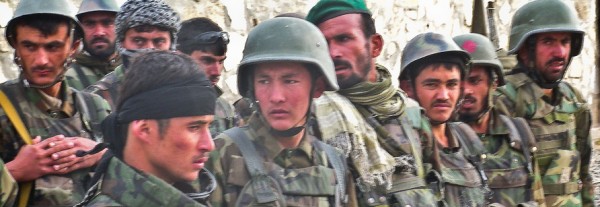
I’m reminded of that sorry-looking policeman when I look at this ragtag collection of Afghan National Army soldiers. It certainly doesn’t help that even when uniformed they are so visibly lacking in uniformity, but their collective look of bewilderment conveys better than any Congressional testimony that they are part of an ill-conceived enterprise.
President seeks clarity on turnover to Afghan government, official says

President Barack Obama does not plan to accept any of the Afghanistan war options presented by his national security team, pushing instead for revisions to clarify how and when U.S. troops would turn over responsibility to the Afghan government, a senior administration official said Wednesday.

Obama still is close to announcing his revamped war strategy, most likely shortly after he returns from a trip to Asia that ends on Nov. 19.

The president raised questions at a war council meeting on Wednesday, however, that could alter the dynamic of both how many additional troops are sent to Afghanistan and what the timeline would be for their presence in the war zone, according to the official, who spoke on condition of anonymity to discuss Obama’s thinking. [continued…]
In Afghanistan, Taliban surpasses al-Qaeda

This year, Omar’s military committee published a rule book for followers, calling on them to protect the population and avoid civilian casualties — much like U.S. counterinsurgency principles. He has railed against the corruption of President Hamid Karzai’s government, an issue that resonates with Afghans. He has also solicited support from other Muslim countries. But al-Qaeda’s agenda of global holy war and taste for mass-casualty attacks, no matter how many Muslim civilians are killed, complicate that goal.

In a February interview with al-Samoud magazine, Taliban political committee leader Agha Jan Mutassim praised the Saudi Arabian government, called for Muslim unity and said the Taliban “respects all different Islamic schools and branches without any discrimination” in Afghanistan.

Such positions may put Omar’s Taliban at odds with al-Qaeda’s extremist Sunni agenda of overthrowing what it sees as corrupt Muslim governments and targeting Shiites. Analysts said that Omar, who leads a council of Taliban commanders based in or around the Pakistani city of Quetta, wants such countries as Saudi Arabia, the United Arab Emirates and Pakistan to recognize the Taliban as a legitimate government if it regains power and that he has little interest in fomenting war elsewhere.

“We assure all countries that the Islamic Emirate of Afghanistan, as a responsible force, will not extend its hand to cause jeopardy to others,” Omar said in a written statement in September.

The messages from the Taliban leadership since the spring amount to something of a “revolution,” said Wahid Mujda, a political analyst who was a Foreign Ministry official under the Taliban government. “Al-Qaeda’s path is now different from the Taliban’s path, and they are growing more separated.” [continued…]

How the US funds the Taliban

Welcome to the wartime contracting bazaar in Afghanistan. It is a virtual carnival of improbable characters and shady connections, with former CIA officials and ex-military officers joining hands with former Taliban and mujahedeen to collect US government funds in the name of the war effort.

In this grotesque carnival, the US military’s contractors are forced to pay suspected insurgents to protect American supply routes. It is an accepted fact of the military logistics operation in Afghanistan that the US government funds the very forces American troops are fighting. And it is a deadly irony, because these funds add up to a huge amount of money for the Taliban. “It’s a big part of their income,” one of the top Afghan government security officials told The Nation in an interview. In fact, US military officials in Kabul estimate that a minimum of 10 percent of the Pentagon’s logistics contracts–hundreds of millions of dollars–consists of payments to insurgents. [continued…]

Afghanistan is neither Vietnam nor Iraq

As President Obama contemplates a new strategy in Afghanistan, Washington is obsessed with whether the best analogy to the conflict lies in Vietnam or Iraq, with attendant and obvious implications for policy. Of course, Afghanistan has little in common with either Vietnam or Iraq in terms of history, geography, culture, or politics. There is, however, a more apt analogy, and it involves the very area in dispute.

Driven by radical Islam, Pashtun nationalism, and armed opportunism, some of the clans in Waziristan — a pair of currently militant-ridden tribal regions in Pakistan and the site of the recent anti-Taliban Pakistani military offensive — rose against British rule in 1936. The rebels improvised roadside bombs, ambushed convoys, and launched hit and run attacks on isolated outposts to drive out alien forces. They kidnapped and beheaded British soldiers and civilians. In unprotected villages, they massacred civilians who did not support them. When troops chased the rebels, they crossed the border with Afghanistan to seek refuge. (Much of this is happening today on either side of Waziristan’s border with Afghanistan.)

Chasing down rebels, patrolling roads, and keeping supply lines open was — and remains — hazardous duty. Soldiers in Waziristan learned to vary their activities or paid with their lives. D. S. Richards in The Savage Frontier quotes a British soldier on “the cardinal Frontier principle of never doing the same thing in the same way twice running,” because “[s]omeone was always watching — someone with an inborn tactical sense, someone who missed nothing.” [continued…]

Facebooktwittermail

90,000 casualties, but who’s counting?

90,000 casualties, but who’s counting?

Veterans Day arrives tomorrow, and with it, the anticipated harvest of heartbreaking anecdotes driving the press coverage and our ever wandering attention back to less desirable realities: the disfigured but persevering hero, the homeless warrior, the unemployable sergeant, the father or son or daughter who came home a stranger and cannot be reached.

Usually, there is nothing more powerful than a personal story to pound home the cost of eight years of war overseas, but I think today there is something even more disturbing to bear.

It’s the number 89,457.

As of Nov. 9, that’s how many American casualties there were in Iraq and Afghanistan since Oct. 7, 2001, when the Afghan war officially began. That includes a tire-screeching 75,134 dead, wounded-in-action, and medically evacuated due to illness, disease, or injury in Operation Iraqi Freedom (OIF), and 14,323 and counting in Afghanistan, or Operation Enduring Freedom (OEF). [continued…]

Facebooktwittermail

The Taliban solution

The Taliban solution

A powerful grassroots movement has blossomed in Afghanistan, giving its people new hope, self-esteem and a sense of belonging. The problem is that this movement is the Taliban.

As President Obama and his advisers ponder a new Afghan strategy, the conventional wisdom is that this bottom-up insurgency must be attacked with top-down solutions: a stronger central government, a decline in regional warlordism, a more loyal national army.

But research we recently completed for the World Bank shows that what Afghanistan needs is not solutions from the top down but from the bottom up. It needs a good Taliban — a dispersed people’s movement, spanning thousands of villages, through which the Afghan people can regain a sense of control over their government.

Is this utopian fantasy, or is it possible in a country bloodied by its own past?

It may seem utopian under the myths that have become commonplace in the American understanding of Afghanistan. But our findings suggest that those myths need revision. [continued…]

Facebooktwittermail

Ft. Hood and the Clash of Civilizations: Security vs political correctness revisited

Ft. Hood and the Clash of Civilizations: Security vs political correctness revisited

Since the Ft Hood atrocity, I’ve seen a meme going around that it somehow exposed a contradiction between “political correctness” and “security.” The avoidance of Nidal Hassan’s religion out of fear of offending anyone, goes the argument, created the conditions which allowed him to go undetected and unsanctioned in the months and years leading up to his rampage. American security, therefore, demands dropping the “political correctness” of avoiding a confrontation with Islamist ideas and asking the “tough questions” about Islam as a religion and the loyalty of Muslim-Americans.

This framing of the issue is almost 100% wrong. There is a connection between what these critics are calling “political correctness” and national security, but it runs in the opposite direction. The real linkage is that there is a strong security imperative to prevent the consolidation of a narrative in which America is engaged in a clash of civilizations with Islam, and instead to nurture a narrative in which al-Qaeda and its affiliates represent a marginal fringe to be jointly combatted. Fortunately, American leaders — from the Obama administration through General George Casey and top counter-terrorism officials — understand this and have been acting appropriately. [continued…]

Facebooktwittermail