Category Archives: war in Afghanistan

Karzai rules out sharing power

Karzai rules out sharing power

President Hamid Karzai’s team shifted aggressively into campaign mode Saturday and ruled out any possibility of a power-sharing deal with challenger Abdullah Abdullah ahead of a runoff election in two weeks…

Snow and freezing weather could make voting impossible in some parts of the country. And many people say there is not enough time to replace and vet election officials to prevent fraud. Karzai initially received 54 percent of the vote, but nearly one-third of his votes were considered rigged and he finished with 49 percent.

“When you have a million-odd votes thrown out, you’ve got to ask yourself, what was the IEC doing and who is going to be held accountable?” said Saad Mohseni, an owner of a prominent media company in Afghanistan.

Election officials plan to reduce the number of polling places from about 6,300 to about 5,800 in an attempt to prevent fraud in volatile areas where votes were recorded at stations that never opened.

One senior Western diplomat, speaking on the condition of anonymity because he was not authorized to speak to the media by name, said there was “way over a 50-50 chance” that the runoff would be held despite the potential problems. [continued…]

If this is progress, what would an Afghan disaster look like?

U.S. commanders on the ground are not setting nearly as much store by the election saga as are their political overlords in Washington. Gen McChrystal is making clear that Mr Obama can no longer afford to delay the issue of reinforcements, stressing that simply stopping the Taliban from extending its control over much of the countryside in the south and east will require 40,000 more troops – and he would prefer 80,000. Moreover, logistical constraints mean they can be introduced only at a rate of around 4,000 a month.

The war may look unwinnable to any student of history, but Americans often imagine themselves immune to history’s rules, and Mr Obama doesn’t want to go into the next election being pilloried for “losing” Afghanistan (not that the Taliban will necessarily sweep back into Kabul, but they could do a pretty good job of surrounding the cities and choking Nato supply lines).

So it’s a safe bet that Mr Obama will escalate US military involvement, even as he promises increasingly sceptical Democrats that the Afghan security forces are being “trained” to take over security in the near future. This, too, is something of a fiction: when 4,000 US Marines deployed in Helmand shortly before the election, they took with them 400 Afghan troops who showed little appetite for getting out among the people. Close to 100,000 Afghan troops have been trained, but how effective they are in fighting the Taliban is anybody’s guess. [continued…]

How they convinced Karzai

What perhaps finally brought Karzai into the real world was [Rahm] Emanuel going public with a statement on October 18—which Kerry had been privately drumming into Karzai for days—that Obama would not commit to sending any more US troops to Afghanistan until there was a “legitimate” and “new” government in Kabul.

The underlying message was that if Karzai still refused to listen he could be held responsible for allowing Afghanistan to go down the tubes or be taken over by the Taliban. Even though Karzai has a gigantic ego and was still in a state of denial, he could not get around that one.

Kerry, Eikenberry, and Emanuel had one thing going for them that others working the Afghan shift in the White House—Richard Holbrooke, Joe Biden, James Jones, General David Petraeus, and even Obama himself—did not have. These three had never criticized Karzai in public before. Karzai intensely dislikes the other White House players because they have hurt his ego by dishonoring him and criticizing him in public. Over such knowledge and niceties does the world turn and turn again. [continued…]

Facebooktwittermail

The myth of the runoff

The myth of the runoff

iven the deeply disingenuous press conference on Tuesday in which world leaders congratulated Hamid Karzai for agreeing to obey the law he has sworn to uphold, the question of whether a second round of elections will be more credible than the first is largely irrelevant.

Chances are there will not be a second round; weather and logistics could easily combine to torpedo the effort, and the challenger Dr. Abdullah Abdullah has already hinted that he is open to talks “if winter should make a second round impossible.”

A runoff is in no one’s interests. The Afghan people are tired and disgusted, and no second round is going to redeem the democratic process in their eyes. The turnout is likely be miniscule – under 20 percent – making any talk of government legitimacy more than a little absurd. [continued…]

Facebooktwittermail

Afghanistan seen through the Wakhan Corridor

Afghanistan seen through the Wakhan Corridor

The Afghanistan that Lindsey Graham, Joseph Lieberman, John McCain and seemingly countless other politicians have been visiting at taxpayer expense recently might as well be on Mars, so different is it, apparently, from the Afghanistan that Jean-Claude Muller, special councilor for international cultural matters to Luxemburg’s prime minister, Jean-Claude Juncker, and I visited just this past month.

As professional linguists, we were ostensively doing linguistic field work in Afghanistan’s Wakhan Corridor (we are researching a book provisionally entitled “The Tongues of the Taliban: How They Get Their Intelligence”). We funded the expenditure ourselves, and as linguistic researchers have no particular political axes to grind.

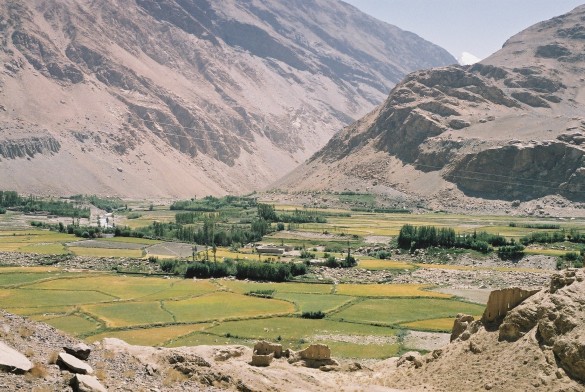
The Wakhan Corridor is that strange-looking panhandle in far northeastern Afghanistan that is strategically sandwiched between Tajikistan to the north and Pakistan’s awesomely snow-bound Hindu Kush to the south and that also abuts briefly and precariously on China. It is a demilitarized-zone creation of the 19th century Great Game that was viciously played out between Imperial Russia and the British Empire. It is an arbitrary creation and therefore geographically reflects the roots of many of modern Afghanistan’s current ills.
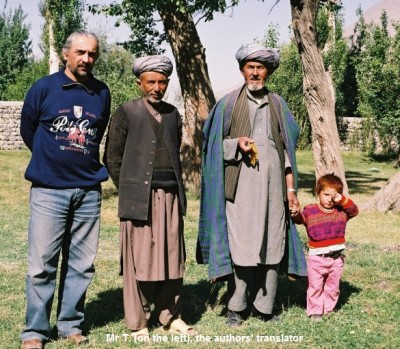
We entered Afghanistan from Tajikistan by walking unescorted across the no-man’s land at the Oxus River border station at Eshkashem. We were dressed as civilians and carried our own packs: no vehicles, no flak jackets, no body guards, just plain folks. We were, however, accompanied by our impressive guide and translator, whom we shall simply call Mr. T., a Tajik native of Khorug and a speaker of Tajik and Russian (he spent four years studying film at the academy in Moscow and, like all other Tajiks in his age group, served in the Russian army), as well as Dard; but his native language is Shugni, which is also widely spoken across the Oxus from Khorug in Afghanistan, as is Tajik: there are as many Tajiks (four and a half million) in Afghanistan as in Tajikistan. Then, too, Mr. T. had spent eleven years in Afghanistan working for Focus.

We were following the same route through the corridor that Marco Polo took just over seven centuries ago. We stayed with locals (so-called ‘homestays’); sometimes with major landholders, once with a highly respected local “pasha” and once in a hostel supported by the Aga Khan Foundation, but also often enough with people of very, very modest circumstances (the country’s per capita GDP is currently about $60.00). In every situation, the boundless hospitality and cordiality were overwhelming. Just as you initially begin to think the US ought to have left this godforsaken place yesterday, it’s finally the people that bind your heartstrings to it.

Clearly, we had all the advantages over “official” visitors pointed out by Joseph Kearns Goodwin in his “Afghanistan’s Other Front” and then some: not only could we move about freely as civilians in an ordinary van with an Afghan driver and thus be far less “likely to intimidate and more likely to elicit candor” than highly marked official visitors, the very advantages Goodwin stresses, but we also had one-on-one conversational access and abilities, something our military and politicians have woefully lacked for decades.

The Wakhan Corridor is a heady ethnic and linguistic mix coupled with profound religious differences: Ismailis fervently loyal to the Aga Khan, the 49th Imam, who saved them from certain starvation during the civil war in Tajikistan; Shiites; covert Buddhists; remnants of pre-Islamic paganism reminiscent of that in Ladakh and Nepal; and even vestiges of Zoroastrianism. And this corridor is what all of Afghanistan might have been and might still hope to be: safe and pleasant, even if initially dirt poor, with no evidence of a Taliban or al Qaeda and devoid of the corruption and rampant system of bribes that plagues the rest of the country. Then, too, we saw no poppies in the Wakhan Corridor, and we walked many fields.
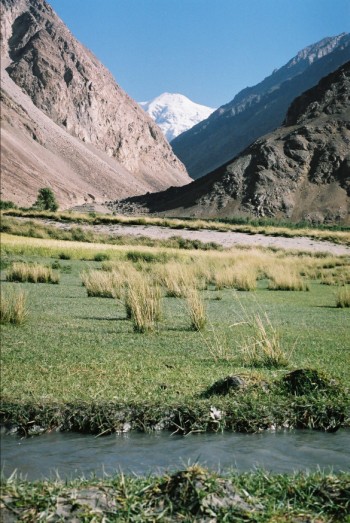
Despite such diversity in the Wakhan Corridor, there was a unanimous belief that the Afghan government is simply an outrageous band of crooks on the take and that Hamid Karzai is chief among them. This disgust cut across all linguistic, age and belief groups. It was barely below the surface of any discussion, as was the question of when the “foreigners” would leave. There was no blaming the Russians, nor even our guide, Mr. T., who, as a Tajik, was clearly from the “wrong” side when talk turned to the Soviet era. The wreckage of that period is plain to see: discarded tank turrets decorate many of Eshkashem’s street corners. Most significantly, while there was a firm awareness of local pride of place, there was no patriotic fervor for an Afghanistan, seemingly a very alien concept for many.

The answer to the the questions of what to do about the rampant corruption on the one hand and the Taliban/al Qaeda on the other hand that plague Afghanistan … and the answer to these questions is clearly not more boots on the ground (just ask the Russians about that one … with an estimated cost of some $82 billion and the loss of their empire; though you can’t very well ask the 16,500 British troops slaughtered at the Khyber Pass in just one engagement in 1842, and the Brits didn’t get the message until the disastrous Third Anglo-Afghan War in 1919) or elaborate training programs (Anti-bribing 101?) or monitoring all those police checkpoints where palms are greased, lies within the Wakhan Corridor itself and just across the Oxus River in Tajikistan’s Autonomous Gorno-Badakhshan Region, still known by its Soviet abbreviation GBAO.

The GBAO is just as culturally and linguistically heterogeneous as the Wakhan Corridor, if not more so. But once you leave the bribe-free GBAO, for which a separate visa is required in addition to that for entering Tajikistan, the police checkpoints and corruption start all over again: drivers from the GBAO are routinely racially profiled by Dushanbe’s traffic cops and required to hand over bribes. Once I convinced our Kyrgyz driver to trade his skull cap for my baseball cap, we started being waved past Dushanbe’s checkpoints.

In the end, it was Tajikistan’s disastrous civil war that raged for five years from 1992 until 1997 and that claimed more than 60,000 lives and uprooted more than a million refugees that left the GBAO independent, proud, united and with a clear and collective vision for a future, a vision that finally sees prosperity within its grasp from increased tourism and from providing a trade corridor for neighboring China; the Pamirs are set to become the hub of a new Silk Road, and, get this, it is the Chinese who are building the road system (lamentably with their prisoners, of which they have millions, who receive only food and lodging for their efforts).

For us as a nation, it should be abundantly clear that once people gain their independence and couple that independence with a sense of collective purpose and goals, then peace and (bribeless) prosperity usually follow.

Afghanistan per se is a fictitious socio-political unit that, by and large, was engendered in the wake of the 19th century’s Great Game; any resemblance to Iraq is real. As we see it, given the successes of the Wakhan Corridor and the GBAO, an effective solution to current woes would be to convert Afghanistan into a federation of largely autonomous “cantons” divided along ethno-linguistic lines (and even those of religious persuasion) and then encourage cross-border communication and cooperation between and among related groups; so, for example, between Tajiks on both sides of the Oxus River divide, between Belochis on both sides of the Afghan-Iran border, and so on.

We should also look for creative and novel non-military solutions such as replacing poppy cultivation with saffron cultivation (virtually economically equivalent crops), encouraging local handicraft co-operatives, whether operated by women or not (as has been successfully done in the GBAO), building rural schools along the lines of Greg Mortenson, engaging a variety of non-military players such as His Highness the Aga Khan in socio-political decision making, and so on. And we should largely absent ourselves to let Afghan diversity flourish once again. Going blindly down the same paths of militant aggression as did the Russians and British will surely once again end in ever greater disasters, even more so when we have so clearly failed at cultural understanding and linguistic communication.

Dr. Thomas L. Markey, Tucson, Arizona
Dr. Jean-Claude Muller, Institut archéologique du Luxembourg

Facebooktwittermail

War fever at the New York Times: a five-day log

War fever at the New York Times: a five-day log

When five days pour forth a lead story on the way “a coordinated assault” of the Taliban and Al Qaeda in Pakistan has caused a grave risk to American interests; a lead about the serious counter-offensive mounted by Pakistan; a flash suitable for any date but run as a lead concerning the heroin trade of the Taliban (“Vast Network Reaps Millions from Drugs”); the launching of a serial memoir by a reporter “Held Captive by the Taliban,” which will extend to five parts; a flattering stoic-soldier profile of General McChrystal in the Times Magazine; a Pakistan follow-up suggesting that Pakistan’s army’s now fights well but is “meeting strong resistance” from the Taliban and cannot win without help; a sequence of three stories by different hands, tracing with approval the acquiescence of President Hamid Karzai in calls for a run-off (the very agreement the administration made a precondition for expanded American commitment); two op-eds over three days by military men not of the highest rank, urging escalation; and a reckless “scoop,” filled sparsely with random and often anonymous interviews regarding the supposed discontents within the armed forces at the length of the administration’s pause — when all this is the fruit of five days’ harvest at the Times, the conclusion draws itself. The New York Times wants a large escalation in Afghanistan. The paper has been made nervous by signs that the president may not make the big push for a bigger war; and they are showing what the rest of his time in office will be like if he does not cooperate. [continued…]

Obama’s war logic

The White House logic that a decision on sending further troops would have to wait for the election debacle to be resolved is faulty, however. And Defense Secretary Robert Gates was among those willing to point that out. “We’re not just going to sit on our hands, waiting for the outcome of this election and for the emergence of a government in Kabul,” Gates said Tuesday. “The outcome of the elections and the problems with the elections have complicated the situation for us. But the reality is, it’s not going to be complicated one day and simple the next.”

Indeed, for purposes of creating a representative government as the foundation of U.S. counterinsurgency strategy, the key flaw of Afghanistan’s August election was not the widespread ballot fraud; it was the fact that almost 3 out of 4 voters didn’t show up at the polls because of the Taliban security threat. So, while a runoff election might satisfy the fraud complaints, it won’t make the resulting government much more representative unless millions more voters show up at the polls this time. But the deteriorating security situation and limits of the appeal of both candidates give little reason to expect that the rerun would see a voter surge; turnout in a runoff, if anything, could be even lower.

What’s more, despite the findings of the electoral commission, there’s widespread doubt in Kabul over whether a runoff vote will actually proceed. A power-sharing deal between Karzai and Abdullah is considered the much more likely outcome. But in reality, the manner in which the electoral stalemate is resolved doesn’t substantially alter the basic choice facing Obama: either send tens of thousands more U.S. troops, which U.S. commander General Stan McChrystal says are necessary simply to halt the Taliban’s advance, or draw down to a policing operation against al-Qaeda and abandon the goal of defeating the Taliban. [continued…]

Everything you have been told about Afghanistan is wrong: the three great falacies

Every military counter-insurgency strategy hits up against the probability that it will, in time, create more enemies than it kills. So you blow up a suspected Taliban site and kill two of their commanders – but you also kill 98 women and children, whose families are from that day determined to kill your men and drive them out of their country. Those aren’t hypothetical numbers. They come from Lt. Col. David Kilcullen, who was General Petraeus’ counter-insurgency advisor in Iraq. He says that US aerial attacks on the Afghan-Pakistan border have killed 14 al-Qa’ida leaders, at the expense of more than 700 civilian lives. He says: “That’s a hit rate of 2 per cent on 98 per cent collateral. It’s not moral.” It explains the apparent paradox that broke the US in Vietnam: the more “bad guys” you kill, the more you have to kill.

There is an even bigger danger than this. General Petraeus’s strategy is to drive the Taliban out of Afghanistan. When he succeeds, they run to Pakistan – where the nuclear bombs are.

To justify these risks, the proponents of the escalation need highly persuasive arguments to show how their strategy slashed other risks so dramatically that it outweighed these dangers. It’s not inconceivable – but I found that, in fact, the case they give for escalating the war, or for continuing the occupation, is based on three premises that turn to Afghan dust on inspection. [continued…]

Facebooktwittermail

Karzai agrees to Nov. 7 runoff in Afghanistan

Karzai agrees to Nov. 7 runoff in Afghanistan

Under heavy international pressure, President Hamid Karzai conceded Tuesday that he fell short of a first-round victory in the nation’s disputed presidential election, and agreed to hold a runoff election with his top challenger on Nov. 7.

Flanked at a news conference in Kabul by Senator John Kerry, the head of the powerful Senate Foreign Relations Committee, and Kai Eide, the top United Nations official in Afghanistan, Mr. Karzai said he would accept the findings of an international audit that stripped him of nearly one-third of his votes in the first round, leaving him below the 50 percent threshold that would have allowed him to avoid a runoff and declare victory over his main rival, Abdullah Abdullah.

“I call upon this country to take this as an opportunity to move this country forward and participate in this new round of elections,” Mr. Karzai said, according to the English translation of his remarks, adding that he was grateful to the international community for its help. [continued…]

Afghanistan: anatomy of an election disaster

For a couple of days last month at a cavernous warehouse in the bleak industrial zone of western Kabul, diplomats, UN officials and election monitors gathered to watch hundreds of ballot boxes being opened and turned out on to the floor.

The colleagues from Kabul’s western missions rolled their eyes at each other as they witnessed not a chaotic assortment of marked and folded voting forms tumble out, but entire blocks of ballot papers that had not even been torn off from their book stubs. Others contained surprisingly uniform numbers of ballots all signed in the same hand and with the same pen, and overwhelmingly in favour of a single candidate.

One box did not contain any ballot papers at all; just a results slip with the final vote score showing a massive win for Hamid Karzai, the Afghan president many believe was all too aware of attempts to steal the country’s second ever democratic attempt to choose a leader.

Everyone present could see a huge amount of cheating had taken place on 20 August, albeit rather ineptly. “Some of us joked with each other whether the Afghans, after all the billions that have gone in to trying to create a functioning government, also need to be taught how to rig an election properly,” said one of the officials present, deeply cynical after weeks of revelations about Afghanistan’s disastrous election.

It was a tawdry end to what had at times been an exciting, even uplifting, election campaign. [continued…]

Facebooktwittermail

Decision on Afghan troops may wait

Decision on Afghan troops may wait

The White House signaled Sunday that President Obama would postpone any decision on sending more troops to Afghanistan until the disputed election there had been settled and resulted in a government that could work with the United States.

As an audit of Afghanistan’s Aug. 20 election ground toward a conclusion, American officials pressed President Hamid Karzai to accept a runoff vote or share power with his main rival, Abdullah Abdullah, a former foreign minister. Although Mr. Karzai’s support appeared likely to fall below 50 percent in the final count, together he and Mr. Abdullah received 70 percent, in theory enough to forge a unity government with national credibility.

The question at the heart of the matter, said President Obama’s chief of staff, Rahm Emanuel, is not “how many troops you send, but do you have a credible Afghan partner for this process that can provide the security and the type of services that the Afghan people need?” He appeared on CNN’s “State of the Union” and CBS’s “Face the Nation.” [continued…]

Karzai backers take harder line on recount

Supporters of incumbent President Hamid Karzai demonstrated to protest “foreign interference” in Afghanistan’s drawn-out election process, as results of a vote recount were postponed and Karzai campaign officials suggested his camp may not accept the official results.

As they await the recount, which aims to throw out fraudulent votes, officials from the Karzai campaign cast aspersions on the process, centering their criticism on the United Nations-backed Electoral Complaints Commission, which is re-tallying the numbers.

Although the ECC finished its audit Thursday, it said it was reviewing the results to ensure there were no mistakes before releasing it to the Independent Electoral Commission in coming days; the ECC didn’t give a precise date. The Independent Electoral Commission will then subtract from the total count the votes disqualified by the ECC. [continued…]

Facebooktwittermail

Yes, the Taleban are being thumped but . . .

Yes, the Taleban are being thumped but . . .

The Pakistani Government and Army have finally decided to heed the words of a former ruler: “No patchwork scheme — and all our recent schemes, blockades, allowances etc are mere patchwork — will settle the Waziristan problem. Not until the military steamroller has passed over the country from end to end will here be peace.”

Did Pervez Musharraf, the former President, say that? No, it was Lord Curzon, Viceroy of India, more than 100 years ago. And for both strategic and humanitarian reasons Curzon added: “I do not want to be the person to start the machine.”

The inhabitants of Waziristan have resisted outside conquest since time immemorial. That is why Pakistan continued the British tradition of indirect rule, and kept only minimal forces in the region.

So crushing the local Taleban and establishing Pakistani authority in South Waziristan is going to be a long, bloody business in the face of bitter opposition backed by much of the local population — a population motivated as much by old tribal traditions of resistance as by support for the Taleban. This operation will cause great suffering to civilians and lead to deep unhappiness among many Pashtun troops in the Pakistani Army. That is why, like Curzon’s government of India, Pakistan has hesitated for so long before “starting the machine”. [continued…]

Facebooktwittermail

Kerry: Obama would be ‘irresponsible’ to send more troops to Afghanistan now

Kerry: Obama would be ‘irresponsible’ to send more troops to Afghanistan now

Sen. John Kerry cautioned President Obama Saturday against raising troop levels in Afghanistan, saying it would be “entirely irresponsible” to do so while the Afghan government remains in turmoil following national elections.

“It would be entirely irresponsible for the president of the United States to commit more troops to this country, when we don’t even have an election finished and know who the president is and what kind of government we’re working in, with,” Kerry told CNN’s John King in an interview set to air Sunday at 9 a.m. on State of The Union. [continued…]

‘Brick wall’ feared in Afghan election

There is a growing fear among Western officials in Afghanistan that President Hamid Karzai and the nation’s Independent Election Commission will not accept the findings of a United Nations-backed fraud investigation that is expected to call for a runoff to settle Afghanistan’s disputed presidential election.

Such a decision by Karzai would deepen Afghanistan’s political crisis and leave no clear method for resolving the allegations of massive fraud that have undermined the credibility of the election, which was held nearly two months ago. It would also be a setback for the Obama administration, which has urged the candidates to follow the electoral process to yield a legitimate winner.

“That’s the brick wall,” said one Western official in Kabul familiar with the process. “It’s going to be quite chaotic and confusing.” [continued…]

Allies press Karzai to accept election audit results

There were also reports that foreign envoys were pressing both sides to work out a power-sharing deal. A senior American official noted that Mr. Karzai and Mr. Abdullah together won more than 70 percent of the votes cast in the first round, enough to give a unity government credibility.

But the Obama administration is adamant that it is not pushing for a deal.

“We’re not trying to prevent a second round,” said the official, who spoke on the condition of anonymity because of the delicacy of the matter. “The issue is not about a runoff. The issue is getting a legitimate president.”

It was unclear how seriously either candidate was taking the idea of a unity government. Neither candidate has completely ruled it out, but each insists that the current process play out first.

Meanwhile, preparations for a second round of voting are well under way. Ballots for a second round were printed in London and shipped to Kabul, the American official said. [continued…]

Facebooktwittermail

7 months, 10 days held by the Taliban

7 months, 10 days in captivity

Over those months, I came to a simple realization. After seven years of reporting in the region, I did not fully understand how extreme many of the Taliban had become. Before the kidnapping, I viewed the organization as a form of “Al Qaeda lite,” a religiously motivated movement primarily focused on controlling Afghanistan.

Living side by side with the Haqqanis’ followers, I learned that the goal of the hard-line Taliban was far more ambitious. Contact with foreign militants in the tribal areas appeared to have deeply affected many young Taliban fighters. They wanted to create a fundamentalist Islamic emirate with Al Qaeda that spanned the Muslim world.

I had written about the ties between Pakistan’s intelligence services and the Taliban while covering the region for The New York Times. I knew Pakistan turned a blind eye to many of their activities. But I was astonished by what I encountered firsthand: a Taliban mini-state that flourished openly and with impunity.

The Taliban government that had supposedly been eliminated by the 2001 invasion of Afghanistan was alive and thriving.

All along the main roads in North and South Waziristan, Pakistani government outposts had been abandoned, replaced by Taliban checkpoints where young militants detained anyone lacking a Kalashnikov rifle and the right Taliban password. We heard explosions echo across North Waziristan as my guards and other Taliban fighters learned how to make roadside bombs that killed American and NATO troops.

And I found the tribal areas — widely perceived as impoverished and isolated — to have superior roads, electricity and infrastructure compared with what exists in much of Afghanistan. [continued…]

Facebooktwittermail

Karzai aide says Afghan runoff vote is likely

Karzai aide says Afghan runoff vote is likely

The government of President Hamid Karzai is preparing for the likelihood that he will have to face an election runoff with his main challenger, Afghanistan’s ambassador here said Thursday, acknowledging an outcome that Western diplomats had been pushing for but that could complicate the debate over whether to send more American troops.

The comments by the ambassador in Washington, Said Tayeb Jawad, were the first in which Mr. Karzai’s government conceded that a runoff was likely, after weeks of investigation into stark cases of election fraud.

In an interview on Wednesday and in a follow-up telephone conversation on Thursday, Mr. Jawad said that although he had no direct contact with the commission auditing the vote, the Karzai government was preparing for the commission to announce Saturday that a runoff was necessary. [continued…]

$400 per gallon gas to drive debate over cost of war in Afghanistan

The Pentagon pays an average of $400 to put a gallon of fuel into a combat vehicle or aircraft in Afghanistan.

The statistic is likely to play into the escalating debate in Congress over the cost of a war that entered its ninth year last week.

Pentagon officials have told the House Appropriations Defense Subcommittee a gallon of fuel costs the military about $400 by the time it arrives in the remote locations in Afghanistan where U.S. troops operate. [continued…]

Facebooktwittermail

Stanley McChrystal’s long war

Stanley McChrystal’s long war

In his initial assessment of the country, sent to President Obama early last month, McChrystal described an Afghanistan on the brink of collapse and an America at the edge of defeat. To reverse the course of the war, McChrystal presented President Obama with what could be the most momentous foreign-policy decision of his presidency: escalate or fail. McChrystal has reportedly asked for 40,000 additional American troops — there are 65,000 already here — and an accelerated effort to train Afghan troops and police and build an Afghan state. If President Obama can’t bring himself to step up the fight, McChrystal suggested, then he might as well give up.

“Inadequate resources,” McChrystal wrote, “will likely result in failure.”

The magnitude of the choice presented by McChrystal, and now facing President Obama, is difficult to overstate. For what McChrystal is proposing is not a temporary, Iraq-style surge — a rapid influx of American troops followed by a withdrawal. McChrystal’s plan is a blueprint for an extensive American commitment to build a modern state in Afghanistan, where one has never existed, and to bring order to a place famous for the empires it has exhausted. Even under the best of circumstances, this effort would most likely last many more years, cost hundreds of billions of dollars and entail the deaths of many more American women and men.

And that’s if it succeeds. [continued…]

An inconvenient truth teller

Joe Biden had a question. During a long Sunday meeting with President Obama and top national-security advisers on Sept. 13, the VP interjected, “Can I just clarify a factual point? How much will we spend this year on Afghanistan?” Someone provided the figure: $65 billion. “And how much will we spend on Pakistan?” Another figure was supplied: $2.25 billion. “Well, by my calculations that’s a 30-to-1 ratio in favor of Afghanistan. So I have a question. Al Qaeda is almost all in Pakistan, and Pakistan has nuclear weapons. And yet for every dollar we’re spending in Pakistan, we’re spending $30 in Afghanistan. Does that make strategic sense?” The White House Situation Room fell silent. But the questions had their desired effect: those gathered began putting more thought into Pakistan as the key theater in the region. [continued…]

Why Joe Biden should resign

It’s been known for a while that Biden has been on the other side of McChrystal’s desire for a big escalation of our forces there — the New York Times reported last month that he has “deep reservations” about it. So if the president does decide to escalate, Biden, for the good of the country, should escalate his willingness to act on those reservations.

What he must not do is follow the same weak and worn-out pattern of “opposition” we’ve become all-too-accustomed to, first with Vietnam and then with Iraq. You know the drill: after the dust settles, and the country begins to look back and not-so-charitably wonder, “what were they thinking?” the mea-culpa-laden books start to come out. On page after regret-filled page, we suddenly hear how forceful this or that official was behind closed doors, arguing against the war, taking a principled stand, expressing “strong concern” and, yes, “deep reservations” to the president, and then going home each night distraught at the unnecessary loss of life.

Well, how about making the mea culpa unnecessary? Instead of saving it for the book, how about future author Biden unfetter his conscience in real time — when it can actually do some good? If Biden truly believes that what we’re doing in Afghanistan is not in the best interests of our national security — and what issue is more important than that? — it’s simply not enough to claim retroactive righteousness in his memoirs. [continued…]

Facebooktwittermail

In Kabul, little hope that a runoff will be fair

In Kabul, little hope that a runoff will be fair

As experts pore over ballots to determine whether the fraud in this country’s presidential election was so big that a runoff vote was required, many Afghans interviewed here on Tuesday shared the same view: Why bother?

In shops, offices and bakeries around the capital, many Afghans said holding a second round of voting to designate a winner simply did not make sense.

It was not that they did not want a final result. Or that they thought the Aug. 20 election had been fraud-free. But years of disappointment in their government has hardened into cynicism, and many said a second round would only lead to another flawed result.

“It’s a waste of time and money,” said Muhammad Hashem Haideri, a 52-year-old movie theater manager. “It would be useless.” [continued…]

Not good enough

If President Obama can find a way to balance the precise number of troops that will stabilize Afghanistan and Pakistan, without tipping America into a Vietnam there, then he indeed deserves a Nobel Prize — for physics.

I have no problem with the president taking his time to figure this out. He and we are going to have to live with this decision for a long time. For my money, though, I wish there was less talk today about how many more troops to send and more focus on what kind of Afghan government we have as our partner.

Because when you are mounting a counterinsurgency campaign, the local government is the critical bridge between your troops and your goals. If that government is rotten, your whole enterprise is doomed. [continued…]

Facebooktwittermail

More US troops deployed overseas under Obama than Bush

More US troops deployed overseas under Obama than Bush

President Obama announced in March that he would be sending 21,000 additional troops to Afghanistan. But in an unannounced move, the White House has also authorized — and the Pentagon is deploying — at least 13,000 troops beyond that number, according to defense officials.

The additional troops are primarily support forces, including engineers, medical personnel, intelligence experts and military police. Their deployment has received little mention by officials at the Pentagon and the White House, who have spoken more publicly about the combat troops who have been sent to Afghanistan.

The deployment of the support troops to Afghanistan brings the total increase approved by Obama to 34,000. The buildup has raised the number of U.S. troops deployed to the war zones of Iraq and Afghanistan above the peak during the Iraq “surge” that President George W. Bush ordered, officials said. [continued…]

Rushed training ‘risks turning Afghan troops into cannon fodder’

Recruits to the Afghan Army are being rushed into combat with a barely acceptable level of training, according to senior British officers closely involved in the programme.

With US and Nato leaders pressing for a rapid expansion of the army to relieve pressure on their own forces and facilitate their eventual departure, the recruits are becoming “cannon fodder”, another coalition official said.

Courses are being shortened, class sizes are swelling and there is a serious shortage of Afghan instructors and Western mentors. [continued…]

Resignation of Afghan election official raises anxiety level

The disarray surrounding Afghanistan’s presidential election deepened Monday when an Afghan member of the vote-reviewing commission quit, citing “foreign interference.”

The resignation of Mustafa Barakzai from the Electoral Complaints Commission was not expected to affect the panel’s work of sifting through allegations of massive vote-rigging in the Aug. 20 balloting, officials said. But it added an acrimonious new element to a vote that has already become an exercise in recrimination — and has left Afghanistan in political limbo at a time when crucial decisions about the course of the conflict are being made in Washington. [continued…]

Facebooktwittermail

Afghanistan – the proxy war

Afghanistan – the proxy war

Obama ran for the presidency promising change. The doves sense correctly that Obama’s decision on Afghanistan may well determine how much – if any – substantive change is in the offing.

If the president assents to McChrystal’s request, he will void his promise of change at least so far as national security policy is concerned. The Afghanistan war will continue until the end of his first term and probably beyond. It will consume hundreds of billions of dollars. It will result in hundreds or perhaps thousands more American combat deaths – costs that the hawks are loath to acknowledge.

As the fighting drags on from one year to the next, the engagement of US forces in armed nation-building projects in distant lands will become the new normalcy. Americans of all ages will come to accept war as a perpetual condition, as young Americans already do. That “keeping Americans safe’’ obliges the United States to seek, maintain, and exploit unambiguous military supremacy will become utterly uncontroversial.

If the Afghan war then becomes the consuming issue of Obama’s presidency – as Iraq became for his predecessor, as Vietnam did for Lyndon Johnson, and as Korea did for Harry Truman – the inevitable effect will be to compromise the prospects of reform more broadly.

At home and abroad, the president who advertised himself as an agent of change will instead have inadvertently erected barriers to change. [continued…]

Civilian goals largely unmet in Afghanistan

Even as President Obama leads an intense debate over whether to send more troops to Afghanistan, administration officials say the United States is falling far short of his goals to fight the country’s endemic corruption, create a functioning government and legal system and train a police force currently riddled with incompetence.

Interviews with senior administration and military officials and recent reports assessing Afghanistan’s progress show that nearly seven months after Mr. Obama announced a stepped-up civilian effort to bolster his deployment of 17,000 additional American troops, many civil institutions are deteriorating as much as the country’s security.

Afghanistan is now so dangerous, administration officials said, that many aid workers cannot travel outside the capital, Kabul, to advise farmers on crops, a key part of Mr. Obama’s announcement in March that he was deploying hundreds of additional civilians to work in the country. The judiciary is so weak that Afghans increasingly turn to a shadow Taliban court system because, a senior military official said, “a lot of the rural people see the Taliban justice as at least something.” [continued…]

How to rig an election

No one will ever know how Afghans voted in their country’s presidential elections on Aug. 20, 2009. Seven weeks after the polling, the U.N.-backed Electoral Complaints Commission (ECC) is still trying to separate fraudulent tallies from ballots. In some provinces, many more votes were counted than were cast. E.U. election monitors characterize 1.5 million votes as suspect, which would include up to one-third of the votes cast for incumbent President Hamid Karzai. Once fraud occurs on the scale of what took place in Afghanistan, it is impossible to untangle.

Afghanistan’s fraudulent elections complicate President Obama’s job as he weighs a recommendation from General Stanley McChrystal, his top commander there, to send as many as 40,000 additional troops to support a beefed-up counterinsurgency strategy. But for that strategy to work, the U.S. needs a credible Afghan partner, which Afghanistan’s elections now seem unlikely to produce. [continued…]

U.N. official acknowledges ‘widespread fraud’ in Afghan election

A top United Nations official acknowledged publicly for the first time on Sunday that the country’s presidential election had been marred by “widespread fraud,” but said he has worked to ensure that the irregularities get documented.

Flanked by the ambassadors to the United States, Britain, France and Germany at a news conference, Kai Eide, the top United Nations official here, affirmed that the Aug. 20 election was tainted but insisted that he had pursued all claims of fraud that he was able to verify

“There was widespread fraud, but any specific figure would be pure speculation,” he said.

His remarks were intended to rebuff allegations by his former deputy that he was covering up fraud to benefit President Hamid Karzai. The deputy, the American diplomat Peter Galbraith, was fired this month after making his accusation public. [continued…]

Pakistani police had warned army about a raid

The mastermind of the militant assault on Saturday that shook the heart of the Pakistani military was behind two other major attacks in the last two years, and the police had specifically warned the military in July that such an audacious raid was being planned, police and intelligence officials said Sunday.

The revelation of prior warning was sure to intensify scrutiny of Pakistan’s ability to fight militants, after nine men wearing army uniforms breached the military headquarters complex in Rawalpindi and held dozens hostage for 20 hours until a commando raid ended the siege. In all, 16 people were killed, including eight of the attackers, the military said.

The surviving militant, who was captured early Sunday morning, was identified as Muhammad Aqeel, who officials said was a former soldier and the planner of this attack and others. Mr. Aqeel, who is also known as Dr. Usman because he had once worked with the Army Medical Corps before dropping out about four years ago, is believed to be a member of Lashkar-e-Jhangvi, a militant group affiliated with Al Qaeda and the Pakistani Taliban. [continued…]

Facebooktwittermail

A dogged Taliban chief rebounds, vexing U.S.

A dogged Taliban chief rebounds, vexing U.S.

In late 2001, Mullah Muhammad Omar’s prospects seemed utterly bleak. The ill-educated, one-eyed leader of the Taliban had fled on a motorbike after his fighters were swiftly routed by the Americans invading Afghanistan.

Much of the world celebrated his ouster, and Afghans cheered the return of girls’ education, music and ordinary pleasures outlawed by the grim fundamentalist government.

Eight years later, Mullah Omar leads an insurgency that has gained steady ground in much of Afghanistan against much better equipped American and NATO forces. Far from a historical footnote, he represents a vexing security challenge for the Obama administration, one that has consumed the president’s advisers, divided Democrats and left many Americans frustrated.

“This is an amazing story,” said Bruce Riedel, a former Central Intelligence Agency officer who coordinated the Obama administration’s initial review of Afghanistan policy in the spring. “He’s a semiliterate individual who has met with no more than a handful of non-Muslims in his entire life. And he’s staged one of the most remarkable military comebacks in modern history.” [continued…]

Facebooktwittermail

Barack Obama to follow in Shimon Peres’ footsteps

Barack Obama to follow in Shimon Peres’ footsteps

“Very few leaders if at all were able to change the mood of the entire world in such a short while with such profound impact. You provided the entire humanity with fresh hope, with intellectual determination, and a feeling that there is a lord in heaven and believers on earth.

“Under your leadership, peace became a real and original agenda. And from Jerusalem, I am sure all the bells of engagement and understanding will ring again. You gave us a license to dream and act in a noble direction.” Nobel Peace Prize laureate and President of Israel, Shimon Peres.

_____

It’s important not to rush to judgment on Obama — unless the judgment is glowing, then it’s full steam ahead.

If the so-called “reality-based community” still existed, then the very same people who have been suggesting that Obama critics hold their fire should now be insisting the Nobel committee jumped the gun.

Unfortunately that isn’t happening as much as it should. Why? Obama loyalists feel personally embattled. The impulse to grasp on to this fleeting object of relief is for some, irresistible. It’s a quick salve to those whose own unflinching loyalties portend humiliations that lurk down the road.

Realists can’t indefinitely remain true believers. True believers eventually abandon realism.

European Commission President Jose Manuel Barroso said: “The award of the prize to President Obama, leader of the most significant military power in the world, at the beginning of his mandate, is a reflection of the hopes he has raised globally with his vision of a world without nuclear weapons.”

There’s a note of realism there — this is about hopes raised, not accomplishments. The problem is, hope can only be raised so far and for so long. It’s power and durability depends on a strengthening conviction that hope is on a trajectory that leads to actuality. The longer that trajectory remains unclear, the more likely it will be that hope has instead provided the foundation for disappointment, cynicism and bitterness.

Obama traded on hope as a path to power but now he has the power he has to dispense with a large measure of hope. Governance is about deliverables.

It’s not surprising that the Nobel Peace Prize committee have chosen to endorse Obama’s nuclear disarmament initiative. But whether that goal has actually raised hopes globally is something I’m skeptical about. Disarmament is on Obama’s wish-list, but since — in the name of realism — he warned that this might not be accomplished in his lifetime, and since a goal is a dream with a deadline, thus far Obama has merely inspired hope in a dream. Ronald Reagan had that dream too.

Is there a sliver of a silver lining here? Maybe. It’s possible that the Nobel Peace-Prize winning president might feel inhibited from using the Pentagon’s newly-ordered 30,000lb Massive Ordnance Penetrator for destroying nuclear facilities in Iran. On the other hand, he might be persuaded that the destruction of Iran’s nuclear program is a necessary step on the path to nuclear disarmament.

* * *

A few other responses.

Mickey Kraus:

Turn it down! Politely decline. Say he’s honored but he hasn’t had the time yet to accomplish what he wants to accomplish. Result: He gets at least the same amount of glory–and helps solve his narcissism problem and his Fred Armisen (‘What’s he done?’) problem, demonstrating that he’s uncomfortable with his reputation as a man overcelebrated for his potential long before he’s started to realize it. … Plus he doesn’t have to waste time, during a fairly crucial period, working on yet another grand speech. … And the downside is … what? That the Nobel Committee feels dissed? … P.S.: It’s not as if Congress is going to think, well, he’s won the Nobel Peace Prize so let’s pass health care reform. But the possibility for a Nobel backlash seems non-farfetched.

The Taliban:

Taliban spokesman Zabihullah Mujahid said it was absurd to give a peace award to a man who had sent 21,000 extra troops to Afghanistan to escalate a war.

“The Nobel prize for peace? Obama should have won the ‘Nobel Prize for escalating violence and killing civilians’,” he told Reuters by telephone from an undisclosed location.

“When Obama replaced President Bush, the Afghan people thought that he would not follow in Bush’s footsteps. Unfortunately, Obama actually even went one step further.”

Gideon Rachman:

The prize is clearly an award of huge significance, awarded after only the deepest reflection, and won only by demi-Gods.

Maria Farrell:

President Obama has changed how the world feels about America. He’s lifted the planet’s mood. This guy is global Prozac.

Facebooktwittermail

Afghan war debate now leans to focus on Al Qaeda

Afghan war debate now leans to focus on Al Qaeda

President Obama’s national security team is moving to reframe its war strategy by emphasizing the campaign against Al Qaeda in Pakistan while arguing that the Taliban in Afghanistan do not pose a direct threat to the United States, officials said Wednesday.

As Mr. Obama met with advisers for three hours to discuss Pakistan, the White House said he had not decided whether to approve a proposed troop buildup in Afghanistan. But the shift in thinking, outlined by senior administration officials on Wednesday, suggests that the president has been presented with an approach that would not require all of the additional troops that his commanding general in the region has requested.

It remains unclear whether everyone in Mr. Obama’s war cabinet fully accepts this view. While Vice President Joseph R. Biden Jr. has argued for months against increasing troops in Afghanistan because Pakistan was the greater priority, Secretary of State Hillary Rodham Clinton and Defense Secretary Robert M. Gates have both warned that the Taliban remain linked to Al Qaeda and would give their fighters havens again if the Taliban regained control of all or large parts of Afghanistan, making it a mistake to think of them as separate problems. [continued…]

Afghan Taliban say they pose no threat to the West

The Afghan Taliban pose no threat to the West but will continue their fight against occupying foreign forces, they said on Wednesday, the eighth anniversary of the U.S.-led invasion that removed them from power.

U.S.-led forces with the help of Afghan groups overthrew the Taliban government during a five week battle which started on October 7, 2001, after the militants refused to hand over al Qaeda leaders wanted by Washington for the September 11 attacks on America.

“We had and have no plan of harming countries of the world, including those in Europe … our goal is the independence of the country and the building of an Islamic state,” the Taliban said in a statement on the group’s website www.shahamat.org. [continued…]

War of the worlds

An unremarkable paragraph in a piece in my hometown paper recently caught my eye. It was headlined “White House Believes Karzai Will Be Re-elected,” but in mid-report Helene Cooper and Mark Landler of the New York Times turned to Afghan War commander General Stanley McChrystal’s “redeployment option.” Here’s the humdrum paragraph in question: “The redeployment option calls for moving troops from sparsely populated and lawless areas of the countryside to urban areas, including Kandahar and Kabul. Many rural areas ‘would be better left to Predators,’ said an administration official, referring to drone aircraft.”

In other words, the United States may now be represented in the Afghan countryside, as it already is in the tribal areas on the Pakistani side of the border, mainly by Predators and their even more powerful cousins, Reapers, unmanned aerial vehicles with names straight out of a sci-fi film about implacable aliens. If you happen to be an Afghan villager in some underpopulated part of that country where the U.S. has set up small bases — two of which were almost overrun recently — they will be gone and “America” will instead be soaring overhead. We’re talking about planes without human beings in them tirelessly scanning the ground with their cameras for up to 22 hours at a stretch. Launched from Afghanistan but flown by pilots thousands of miles away in the American West, they are armed with two to four Hellfire missiles or the equivalent in 500-pound bombs. [continued…]

Facebooktwittermail

Rory Stewart on Obama’s approach to the war in Afghanistan

Rory Stewart interviewed on Bill Moyers Journal

LYNN SHERR: You’ve met with Secretary Clinton?

RORY STEWART: Sure.

LYNN SHERR: You’ve met with Special Envoy Richard Holbrooke?

RORY STEWART: Sure.

LYNN SHERR: What do you tell them?

RORY STEWART: Again, my message is: focus on what we can do. We don’t have a moral obligation to do what we can’t. People can get very fixed by saying, “But surely you’re not saying we ought to do nothing? Surely you’re not saying we ought to allow the Taliban to do this or that?” And I just keep saying “ought” implies “can”– you don’t have a moral obligation to do what you can’t do.

LYNN SHERR: How is your advice taken?

RORY STEWART: I think what I see at the moment is that people are polite, because they imagine maybe I have some experience with Afghanistan. But I’m one of a broad community of people — we have nine people working in my center at Harvard who’ve worked there for 20 or 30 years and the problem we all have is that if the Administration has for some reason already decided that they’re going to increase troops, they’re going to do a counterinsurgency campaign, it’s very difficult for them to take on board people coming back and saying, “Look, actually, I don’t think this is going to work. It’s a great idea. I can see why you want to do it. But by trying to do the impossible, you may end up doing nothing. I’d like to present an alternative strategy, which is lighter, more intelligent, and may end up actually achieving something.”

LYNN SHERR: And again, their reaction? They listen politely, you say?

RORY STEWART: They listen politely, but in the end, of course, basically the policy decision is made. What they would like is little advice on some small bit. I mean, the analogy that one of my colleagues used recently is this: it’s as though they come to you and they say, “We’re planning to drive our car off a cliff. Do we wear a seatbelt or not?” And we say, “Don’t drive your car off the cliff.” And they say, “No, no, no. That decision’s already made. The question is should we wear our seatbelts?” And you say, “Why by all means wear a seatbelt.” And they say, “Okay, we consulted with policy expert, Rory Stewart,” et cetera. [continued…]

Facebooktwittermail