Category Archives: War on Terrorism

FBI broke law for years in phone record searches

FBI broke law for years in phone record searches

The FBI illegally collected more than 2,000 U.S. telephone call records between 2002 and 2006 by invoking terrorism emergencies that did not exist or simply persuading phone companies to provide records, according to internal bureau memos and interviews. FBI officials issued approvals after the fact to justify their actions.

E-mails obtained by The Washington Post detail how counterterrorism officials inside FBI headquarters did not follow their own procedures that were put in place to protect civil liberties. The stream of urgent requests for phone records also overwhelmed the FBI communications analysis unit with work that ultimately was not connected to imminent threats.

A Justice Department inspector general’s report due out this month is expected to conclude that the FBI frequently violated the law with its emergency requests, bureau officials confirmed. [continued…]

Facebooktwittermail

Dr Aafia Siddiqui goes on trial

Dr Aafia Siddiqui goes on trial

As Dr Aafia Siddiqui goes on trial in a federal court in New York City her case is unknown to most Americans yet in her native Pakistan the frail neuroscientist, mother of three and reputed al Qa’eda associate has become a cause célèbre.

Last week Pakistan’s Prime Minister Yousuf Raza Gilani said that he had been in direct communication with Pakistan’s mission in the United States for the provision of all possible assistance and cooperation for her release, News International reported. He said that the government had also engaged lawyers to defend her in the court.

At a pre-trial hearing last week the defence team rejected the charge of shooting at FBI agents since there were no fingerprints or other forensic evidence that she even picked up the gun, the Associated Press of Pakistan reported. “We’re not saying she did it in self-defence. We’re not saying it was an accident. We’re saying she simply did not do it,’ defence attorney Linda Moreno told US District Judge Richard Berman.

In The Guardian, Decan Walsh told the story whose plausibility will be weighed in the Manhattan courtroom. [continued…]

Facebooktwittermail

George W. Obama

George W. Obama

Before President Obama, it was grimly accurate to write, as I often did in the Voice, that George W. Bush came into the presidency with no discernible background in constitutional civil liberties or any acquaintance with the Constitution itself. Accordingly, he turned the “war on terror” over to Dick Cheney and Donald Rumsfeld—ardent believers that the Constitution presents grave obstacles in a time of global jihad.

But now, Bush’s successor—who actually taught constitutional law at the University of Chicago—is continuing much of the Bush-Cheney parallel government and, in some cases, is going much further in disregarding our laws and the international treaties we’ve signed.

On January 22, 2009, the apostle of “change we can believe in” proclaimed: “Transparency and the rule of law will be the touchstones of my presidency.” But four months into his first year in command, Obama instructed his attorney general, Eric Holder, to present in a case, Jewel v. National Security Agency, a claim of presidential “sovereign immunity” that not even Dick Cheney had the arrant chutzpah to propose. [continued…]

Poll: Most Americans would trim liberties to be safer

After a recent attempted terrorist attack set off a debate about full-body X-rays at airports, a new McClatchy-Ipsos poll finds that Americans lean more toward giving up some of their liberty in exchange for more safety.

The survey found 51 percent of Americans agreeing that “it is necessary to give up some civil liberties in order to make the country safe from terrorism.”

At the same time, 36 percent agreed that “some of the government’s proposals will go too far in restricting the public’s civil liberties.” [continued…]

The U.S. military, al-Qaeda, and a war of futility

In his book on World War II in the Pacific, War Without Mercy, John Dower tells an extraordinary tale about the changing American image of the Japanese fighting man. In the period before the surprise attack on Pearl Harbor, it was well accepted in military and political circles that the Japanese were inferior fighters on the land, in the air, and at sea — “little men,” in the phrase of the moment. It was a commonplace of “expert” opinion, for instance, that the Japanese had supposedly congenital nearsightedness and certain inner-ear defects, while lacking individualism, making it hard to show initiative. In battle, the result was poor pilots in Japanese-made (and so inferior) planes, who could not fly effectively at night or launch successful attacks.

In the wake of their precision assault on Pearl Harbor, their wiping out of U.S. air power in the Philippines in the first moments of the war, and a sweeping set of other victories, the Japanese suddenly went from “little men” to supermen in the American imagination (without ever passing through a human phase). They became “invincible” — natural-born jungle- and night-fighters, as well as “utterly ruthless, utterly cruel and utterly blind to any of the values which make up our civilization.”

Sound familiar? It should. Following September 11, 2001, news headlines screamed “A NEW DAY OF INFAMY,” and the attacks were instantly labeled “the Pearl Harbor of the twenty-first century.” Soon enough, al-Qaeda, like the Japanese in 1941, went from a distant threat — the Bush administration, on coming into office, paid next to no attention to al-Qaeda’s possible plans — to a team of arch-villains with little short of superpowers. After all, they had already destroyed some of the mightiest buildings on the planet, were known to be on the verge of seizing weapons of mass destruction, and, if nothing was done, might soon enough turn the Muslim world into their “caliphate.” [continued…]

Facebooktwittermail

Al Qaeda’s strategic advantage

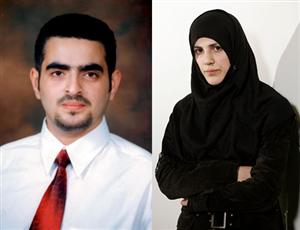
The bomber’s wife

Soft-spoken and composed, but unmistakably angry, the wife of the suicide bomber who killed himself and seven employees of the CIA in Afghanistan on Dec. 30 says flatly, “My husband was anti-American; so am I.” About that, there are no regrets. In an exclusive interview Thursday, Defne Bayrak, 31, spent more than an hour at the offices of Newsweek Türkiye in Istanbul talking about her husband, Dr. Humam Khalil Abu-Mulal al-Balawi; his beliefs; what he may have been offered by the CIA to work as a double agent on the trail of Al Qaeda’s top leadership; and what she heard from those apostles of jihad who ultimately inspired him to kill and die.

Al-Balawi’s case is a study in the radicalization of someone who is well-educated, economically well-off, devout, and disciplined. Such people may not fit into the public’s stereotypical idea of a terrorist, but the profile is increasingly familiar to police and intelligence officers involved with counterterrorism. Many of Al Qaeda’s most successful attacks, from 9/11 to the London transit-system bombings in 2005, were directed and executed by such intelligent, articulate, religious, and suicidally violent men. [continued…]

Editor’s Comment — Reuel Marc Gerecht, a former CIA officer and prominent neoconservative, writes in the Wall Street Journal:

Professionally, one has to admire the skill of suicide bomber Humam Khalil Abu-Mulal al-Balawi’s handlers. This operation could well have been months — if not longer — in the making, and neither the Jordanian intelligence service (GID), which supplied the double agent to the CIA, nor Langley apparently had any serious suspicion that al-Balawi still had the soul and will of a jihadist.

That is an impressive feat. The Hashemite monarchy imprisons lots of Islamic militants, and the GID has the responsibility to interrogate them. The dead Jordanian official, Sharif Ali bin Zeid, reportedly a member of the royal family, may not have been a down-and-dirty case officer with considerable hands-on contact with militants, but al-Balawi surely passed through some kind of intensive screening process with the GID. Yet the GID and the CIA got played, and al Qaeda has revealed that it is capable of running sophisticated clandestine operations with sustained deception.

When asked if she could confirm what other sources had told Newsweek — that Balawi was offered as much as $500,000 by the CIA and $100,000 by the Jordanians to track down al Qaeda’s leadership — Balawi’s wife said only, “It might be true.”

In both these instances — Gerecht’s admiration of al Qaeda’s tradecraft and the likelihood that the CIA believed Balawi could be turned for the right price — the crucial asymmetry between the CIA and its adversary is left unstated: the disparity in the strength of each side’s convictions. On one side are individuals who have transcended their own fear of death, and on the other side individuals whose concerns are unfocused and defuse – a swirl of patriotism, egotism, and ambition.

A former senior CIA officer while explaining what might have drawn so many operatives into Balawi’s trap, told the New York Times: “Everyone would have wanted to be on the team that caught Zawahri. That’s the kind of thing that makes careers.”

Setting aside questions about whose outlook might be more delusional and whether either has a moral footing, the jihadist’s fearlessness and conviction is a force that neither soldier nor spy can truly match.

US drone attacks ‘undermine support for war’: Zardari

Pakistan warned US senators Thursday that American drone attacks against militants on its territory undermined “the national consensus” that supported the war against militancy.

President Asif Ali Zardari made the warning to a US delegation led by former US presidential candidate and Republican Senator John McCain one day after US missile attacks killed at least 13 militants on the Afghan border.

McCain said Thursday in Kabul, the capital of neighbouring Afghanistan, that the use of such drone strikes against suspected Islamist militants in Pakistan was an effective part of US strategy and should continue. [continued…]

Facebooktwittermail

What’s the difference between Obama’s anti-terrorism policies and Bush’s?

What’s the difference between Obama’s anti-terrorism policies and Bush’s?

If Obama is pretending we are not at war, he is not doing a very good job of it. “Our nation is at war against a far-reaching network of violence and hatred,” he declared in his inaugural address. “I don’t think there’s any question but that we are at war” with terrorists, his attorney general, Eric Holder, said at his confirmation hearing that same month. “We are indeed at war with Al Qaeda and its affiliates,” Obama said in May. “As the president has made clear,” his chief counterterrorism adviser, John Brennan, said in August, “we are at war with Al Qaeda.”

It’s true that Obama prefers to say we are at war with terrorists rather than terrorism, because, as Brennan put it, “you can never fully defeat a tactic like terrorism any more than you can defeat the tactic of war itself.” But since Al Qaeda and its allies won’t be signing an instrument of surrender anytime in the foreseeable future, the implications are similar.

Nor does there seem to be much difference between Bush and Obama in terms of the policies said to be justified by this permanent war. The closing of Guantanamo, which was supposed to happen this month but has been delayed until next year at the earliest, is by the Obama administration’s own account a symbolic move, aimed at removing a conspicuous “recruiting tool” for Al Qaeda. But the policy that Guantanamo represents will continue. [continued…]

America has an impressive record of starting wars but a dismal one of ending them well

Since 1945, the United States military has devoted itself to the proposition that, Hiroshima notwithstanding, war still works—that, despite the advent of nuclear weapons, organized violence directed by a professional military elite remains politically purposeful. From the time U.S. forces entered Korea in 1950 to the time they entered Iraq in 2003, the officer corps attempted repeatedly to demonstrate the validity of this hypothesis.

The results have been disappointing. [continued…]

Facebooktwittermail

President Obama orders a ban on fly-swatting in the Ministry of Information

President Obama orders a ban on fly-swatting in the Ministry of Information

The buck stops here; the president’s responsible; everyone’s accountable; no one gets the blame; the system’s not broken – just needs a tune up.

The problem with a war on terrorism – at least where it takes place on the communication’s front – is that the terrorists often end up coming out with the more credible statements.

In 1984, after the Brighton bombing which targeted the leadership of the British government then led by Margaret Thatcher, the IRA said:

Mrs. Thatcher will now realise that Britain cannot occupy our country and torture our prisoners and shoot our people in their own streets and get away with it. Today we were unlucky, but remember we only have to be lucky once. You will have to be lucky always. Give Ireland peace and there will be no more war.

Yesterday, Agence France-Presse reported:

Al-Qaeda hailed the suicide bombing that killed seven CIA agents in Afghanistan as “revenge” for the deaths of top militants in US drone strikes in Pakistan, Islamist websites said on Thursday.

Treat terrorism as bereft of political content then the issue will perpetually be framed as one of national security and we’ll get reports like this:

In a briefing after the President’s remarks, counterterrorism advisor John Brennan said he had personally let the president down.

Brennan said that the intelligence and law enforcement community had done a “stellar” job over the past year. “It was in this one instance that we did not rise to that same level of competence and success.”

Brennan said the president had told him he must do better. Said Brennan, “I told him that I will do better and we will do better as a team.”

Must do better… Indeed.

No more fly-swatting at the Ministry of Information — that should fix the problem.

(Anyone who’s seen Brazil will know what I mean. Anyone who hasn’t seen the movie, should — it’s as relevant now as it was when it came out in 1985.)

Facebooktwittermail

The $30bn pair of underpants

The $30bn pair of underpants

Almost immediately after it was learned that Umar Farouk Abdulmutallab, the Nigerian accused of trying to blow up a US airliner using explosives concealed in his underpants, received training in Yemen, US politicians called for Barack Obama, the US president, to expand the ‘war on terror’ – which remains very much a war despite the administration’s official ban of such vocabulary – to that country.

The president obliged, declaring that the US would strike anywhere to prevent another attack.

Such calls were in fact unnecessary, as the US is already involved in Yemen, supervising attacks on militants that have been credited by analysts with helping to further inflame anti-Americanism and support for al-Qaeda in the country.

Indeed, far from heralding a more successful US effort to stamp out Islamist terrorism, the soon to be deepening footprint in Yemen is a sure sign of America’s defeat in the war against violent extremism in the Muslim world. [continued…]

Foreigners in Yemen see terrorism worries as overblown

Elena Rezneac’s lavender eye shadow shimmered in the sun outside a crowded Internet cafe in Yemen’s capital city. The 21-year-old Moldovan student giggled as she pushed her sunglasses up above her blond ponytail.

“If you read about Yemen in the news lately, you think there are terrorists running around and bombs in all the streets,” she said. “But when you are here, it’s calm. I have to go online to remember there’s a war going on.”

Others among the thousands of foreign aid workers and students of Arabic who live in this impoverished nation expressed a similar view. [continued…]

Facebooktwittermail

Behind Afghan bombing, an agent with many loyalties

Behind Afghan bombing, an agent with many loyalties

The former official said that the fact that militants could carry out a successful attack using a double agent showed their strength even after a steady barrage of missile strikes fired by C.I.A. drone aircraft.

“Double agent operations are really complex,” he said. “The fact that they can pull this off shows that they are not really on the run. They have the ability to kick back and think about these things.”

The death of the Jordanian intelligence officer, Capt. Sharif Ali bin Zeid, was reported in recent days by Jordanian officials, but they did not confirm exactly where he was killed or what he was doing in Afghanistan.

Jordanian intelligence officials were deeply embarrassed by the attacks because they had taken the informant to the Americans, said one American government official briefed on the events.

The official said that the Jordanians had such a good reputation with American intelligence officials that the informant was not screened before entering the compound.

Jarret Brachman, author of “Global Jihadism: Theory and Practice” and a consultant to the United States government about terrorism, said in a telephone interview that Mr. Mohammed had used the online persona Abu Dujana al-Khorasani and was an influential jihadi voice on the Web.

“He’s one of the most revered authors on the jihadists’ forums,” Mr. Brachman said.

“He’s in the top five jihadists. He’s one of the biggest guns out there.” [continued…]

Bomber who hit CIA base was triple agent: militants

He ran a blog, http://abudujanakharasani.maktoobblog.com/, on which he posted calls for jihad — holy war — and martyrdom, that the Jordanian authorities presumably regarded as cover for the role of double agent.

The blog was still available on Monday but was inaccessible on Tuesday.

“He spent months travelling between Afghanistan and Pakistan and fed the Americans the information that the Mujahedeen (jihadists) wanted them to receive,” the Ana Muslim (“I am a Muslim” in Arabic) website boasted.

“Every time that the reports which he gave proved accurate, their confidence in Abu Dujana rose.”

Balawi was taken to the CIA base in Khost because he claimed to have urgent information about Zawahiri, the website said.

He was not searched as he went in because a CIA agent boasted: “He is our man, so there is no need,” the website claimed.

The bomber then pretended to detail plans for a mooted operation on a piece of paper and asked the intelligence agents to gather round to look before blowing himself up, the website said. [continued…]

Facebooktwittermail

War in the Age of Terrorism

War in the Age of Terrorism

This is change: we’ve gone from change we can believe in, to a change in the mood music.

If Dick Cheney was the éminence grise behind George Bush, one could now be forgiven for thinking that George Bush himself has quietly taken on the same role for Barack Obama. And if this administration — like the one before — can be accused of losing touch with reality, there is no more compelling piece of evidence than this: Obama regards his speech in Cairo last summer as one of the most important things he’s done in the fight against terrorism.

The New York Times — reporting as always from “inside” the administration, reveals in, “Inside Obama’s War on Terrorism”:

perhaps the biggest change Obama has made is what one former adviser calls the “mood music” — choice of language, outreach to Muslims, rhetorical fidelity to the rule of law and a shift in tone from the all-or-nothing days of the Bush administration. He is committed to taking aggressive actions to disrupt terrorist cells, aides said, but he also considers his speech in Cairo to the Islamic world in June central to his efforts to combat terrorism. “If you asked him what are the most important things he’s done to fight terrorism in his first year, he would put Cairo in the top three,” Rahm Emanuel, his chief of staff, told me.

Really? There might have been good reason for Obama to have thought that at the time and for a few weeks afterwards, but by the time Washington caved under Israeli pressure by supporting a bogus settlement freeze, it became clear that the Cairo speech would be remembered across the Middle East as a bitter harbinger of disappointment.

As for Obama’s campaign promise that he would not only end the war in Iraq but end the mindset that took the US to war, it now turns out that as president he is quite content to follow in the footsteps of his predecessor:

A half-dozen former senior Bush officials involved in counterterrorism told me before the Christmas Day incident that for the most part, they were comfortable with Obama’s policies, although they were reluctant to say so on the record. Some worried they would draw the ire of Cheney’s circle if they did, while others calculated that calling attention to the similarities to Bush would only make it harder for Obama to stay the course. And they generally resent Obama’s anti-Bush rhetoric and are unwilling to give him political cover by defending him.

Michael Hayden, the last C.I.A. director under Bush, was willing to say publicly what others would not. “There is a continuum from the Bush administration, particularly as it changed in the second administration as circumstances changed, and the Obama administration,” Hayden told me. James Jay Carafano, a homeland-security expert at the Heritage Foundation, was blunter. “I don’t think it’s even fair to call it Bush Lite,” he said. “It’s Bush. It’s really, really hard to find a difference that’s meaningful and not atmospheric. You see a lot of straining on things trying to make things look repackaged, but they’re really not that different.”

Facebooktwittermail

The nameless years

Decade in review: the nameless years

In a sign that this was a decade that many people would sooner forget, the 2000s came to an end without finding a name.

For Alan Philips, writing in The National: “The defining characteristic of the past 10 years is how much we have been deceived – by political leaders, economic gurus and indeed by ourselves. It has been a decade of deception.”

Time magazine declared under a headline reading Goodbye (at last) to the Decade from Hell: “Bookended by 9/11 at the start and a financial wipeout at the end, the first 10 years of this century will very likely go down as the most dispiriting and disillusioning decade Americans have lived through in the post-World War II era.” [continued…]

Facebooktwittermail

Why war will take no holiday in 2010

Why war will take no holiday in 2010

Our endless wars are nightmares. Few enough would disagree with that, even, I suspect, among the supportive 58% in that poll or the 54% who “approve of the president’s performance as commander-in-chief.” If only we could wake up.

I was reminded of our strange dream-state recently when I reread the article that sparked the creation of what became TomDispatch. I first stumbled across it in the fall of 2001, after the Towers came down in my hometown, after that acrid smell of burning made its way to my neighborhood and into everything, after I traveled to “Ground Zero” (as it was already being called) to view those vast otherworldly shards of destruction via nearby side streets, after I spent weeks reading the ever narrower, ever more war-oriented news coverage in this country, and after I watched George W. Bush and Company mainlining fear directly into the American bloodstream, selling the eternal terror of terror and the president’s Global War on Terror that so conveniently went with it.

It was obvious that war was on the way, and that the men (and woman) who were leading us into it had expansive dreams and gargantuan plans. Somewhere in that period, probably in late October 2001, a friend sent me a piece by an Afghan-American living in California that spurred me to modest action. [continued…]

Facebooktwittermail

Somalia is greatest victim of President Bush’s War on Terror

Somalia is greatest victim of President Bush’s War on Terror

AQfghanistan and Iraq have monopolised the headlines but Somalia is arguably an even greater victim of George W. Bush’s ill-conceived and lamentably executed War on Terror. America’s interventions have proved so catastrophic that its best hope of salvaging something from the wreckage is a president it chased from power three years ago, who controls a few square miles of a country three times the size of Britain.

It has delivered a people that practised a moderate form of Islam into the hands of religious extremists. Its efforts to combat terrorism have turned Somalia into a launchpad for global jihad. Somalia is now the ultimate failed state whose mayhem threatens to destabilise the region and whose pirates maraud the vital shipping lanes off its shores. Its people endure Africa’s worst humanitarian crisis.

During the Cold War, the US pumped arms into Somalia to counter Soviet support for neighbouring Ethiopia. In 1991 clan warlords ousted the dictator Siad Barre and turned that arsenal on each other. In 1992 President Bush Snr sent in the Marines to help its suffering people — a venture that ended in the Black Hawk Down debacle, a humiliating US withdrawal and a dozen more years of anarchy as the feuding warlords ran amok. [continued…]

Facebooktwittermail

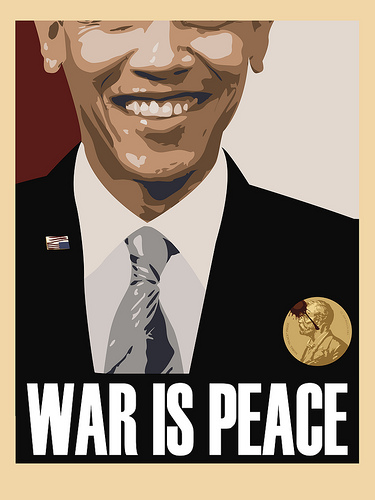
How America won the Nobel Peace Prize

How America won the Nobel Peace Prize

Having been nominated for the peace prize after only ten days in office; having spent the previous three weeks as a president-elect who silently monitored the slaughter in Gaza; and having just assumed the role of commander-in-chief in two wars, for Barack Obama to then craft a credible way to accept an accolade as this year’s most celebrated man of peace, was always going to demand some rhetorical creativity.

Still, this surely ranks as a first: to use the peace prize ceremony as an opportunity to justify war.

Speaking in Oslo last night, Obama said: “the instruments of war do have a role to play in preserving the peace.”

Only within a nation that has largely managed to insulate itself from the effects of war could such a statement be made.

Sixty-four years earlier, in the shadow of two world wars, Americans had a much greater interest in condemning war than in presenting arguments for its justification.

“… our position is that no grievances or policies will justify resort to aggressive war. It is utterly renounced and condemned as an instrument of policy,” wrote Supreme Court Justice Robert H Jackson, on August 12, 1945, when laying out the foundation for the Nuremberg Trials.

On that basis, every war that the United States has fought since World War Two has been branded as a war of necessity — not a war of aggression. Likewise the war that Obama has now made his own is one that he claims to be both necessary, just, and unavoidable. Yet its justness rests on a logical non sequitur: the war in Afghanistan is just because of 9/11.

To say “because of 9/11” is both to present a reason and to simultaneously seal that reason inside a locked box. The logical connection between 9/11 and the war in Afghanistan is apparently so direct and unswerving that even now, those who voice skepticism are generally viewed as either un-American, irrational or naive.

Even so, on September 11, 2001, few Americans had the conviction that this country, out of necessity, was about to go war. President Bush had to present a logical and moral argument and he did so by enunciating what became the first iteration of the Bush doctrine and the foundation for the war on terrorism: “we will make no distinction between the terrorists who committed these acts and those who harbor them.”

On that basis, the Bush administration constructed a legal argument for bombing Afghanistan and killing thousands of people who had nothing whatsoever to do with the attacks.

The unspoken truth was that the US government enacted and the American people supported a war of vengeance. Had the lust for reprisal been tempered with foresight of the carnage and chaos that the following eight years would bring, America’s war of necessity might have been seen then as no more necessary than it is widely seen now.

The “necessity” that took America to war in Afghanistan is no different than the choice Israel makes when it bulldozes the family home of a suicide bomber. This accords with the ancient principle of settling scores, rebalancing power, and reasserting a position of dominance. It’s about showing your enemies and showing the world that you remain top dog. And therein lies the intractability of this war. More troops have to sent in now to buy time for Obama to figure how, without loss of face to himself or this country, the troops can be pulled out later.

As the US president reflects on the principles of a just war, he’s sending young American men and women overseas on the promise that they’re heading out on a path that should bring them back home.

Remember when Obama talked about ending the mindset that took us to war?

I do, but apparently he doesn’t.

Facebooktwittermail

The Afghanistan parenthesis

The Afghanistan parenthesis

… who exactly are Al Qaeda now, and where are they located? In many ways the Vietnam War, though of an atrociousness the Afghanistan War has not yet approached, was pursued by the U.S. obedient to a much sounder theory than any offered for the present war. The theory was that World Communism was all one thing and its spread to a single country would lead inevitably to its spread to a continent. The theory turned out to be false; and its falseness was perceived as early as 1964 by critics of the war such as Hans J. Morgenthau. But what are we doing in Afghanistan but following an inferior and less persuasive version of a similar theory: namely that World Terrorism is all one thing, that its heart is in Afghanistan (because that is where we found it), and that if we don’t “defeat” it soon by “completing the mission,” the terror will stay and spread.

Omitted is the fact that Afghanistan is not our country. Admittedly, this is a truth that comes hard to Americans. “The very idea of the fabrication of a new government,” wrote Edmund Burke, “is enough to fill us with disgust and horror.” But David Brooks disagrees: “aside from killing bad guys,” he wrote in the spring, American troops are “also trying to figure out how to reweave Afghan society.” By what right do we engage in the reweaving and refabrication of a society that has thrown out conquerors for thousands of years? The effect of the self-conceit can only be to unite the society in hostility against us. For America to look on the native resistance to an occupying army as proof of terrorism will surely increase the obduracy of the resistance itself, and serve to recruit more terrorists.

Our war in the border regions is being fought by drone assassinations. A man at the control sits in front of a screen in Las Vegas, and fires when he has a certain shot. To a primitive mind (but not only to a primitive mind), this experiment on a country not our own has the trappings a video game played in hell. But the procedure was here embraced by the president in the antiseptic idiom of a practiced technocrat. He gave no sign of the effects of such killings by a foreign power out of reach in the sky. To assassinate one major operative, Baitullah Mehsud, as Jane Mayer showed in a recent article in the New Yorker, 16 strikes were necessary, over 14 months, killing a total of as many as 538 persons, of whom 200-300 were bystanders. What comes of the reputation of policemen in a crime-ridden neighborhood when they conduct themselves like that? And what makes anyone suppose the reaction will be less extreme when the policeman comes from another country? And yet, from the president’s West Point speech, one would not guess that he has reflected what our mere presence in West Asia does to increase the enchantment of violent resistance and to heat the anger that turns into terrorists people who have lost parents, children, cousins, clansmen, and friends to the Americans. The total number of Muslims killed by Americans in revenge for the attacks of September 11th now numbers more than a hundred thousand. Of those, few were members of Al Qaeda, and few harbored any intention, for good or ill, toward the United States before we crossed the ocean as an occupying power. [continued…]

Facebooktwittermail

Obama’s folly

Obama’s folly

Through war, Bush set out to transform the greater Middle East. Despite immense expenditures of blood and treasure, that effort failed. In choosing Obama rather than John McCain to succeed Bush, the American people acknowledged that failure as definitive. Obama’s election was to mark a new beginning, an opportunity to “reset” America’s approach to the world.

The president’s chosen course of action for Afghanistan suggests he may well squander that opportunity. Rather than renouncing Bush’s legacy, Obama apparently aims to salvage something of value. In Afghanistan, he will expend yet more blood and more treasure hoping to attenuate or at least paper over the wreckage left over from the Bush era.

However improbable, Obama thereby finds himself following in the footsteps of Richard Nixon. Running for president in 1968, Nixon promised to end the Vietnam War. Once elected, he balked at doing so. Obsessed with projecting an image of toughness and resolve — U.S. credibility was supposedly on the line — Nixon chose to extend and even to expand that war. Apart from driving up the costs that Americans were called on to pay, this accomplished nothing. [continued…]

President Obama’s secret: only 100 al Qaeda now in Afghanistan

As he justified sending 30,000 more troops to Afghanistan at a cost of $30 billion a year, President Barack Obama’s description Tuesday of the al Qaeda “cancer” in that country left out one key fact: U.S. intelligence officials have concluded there are only about 100 al Qaeda fighters in the entire country.

A senior U.S. intelligence official told ABCNews.com the approximate estimate of 100 al Qaeda members left in Afghanistan reflects the conclusion of American intelligence agencies and the Defense Department. The relatively small number was part of the intelligence passed on to the White House as President Obama conducted his deliberations. [continued…]

Brzezinski calls anti-corruption crusade in Afghanistan hypocritical

One of the most respected foreign policy voices in Democratic circles expressed “serious reservations” with components of a U.S. troop escalation in Afghanistan during an interview on Tuesday.

Former national security adviser Zbigniew Brzezinski, who was an early skeptic about increasing troops in Afghanistan, said he was not necessarily opposed to Obama’s decision to send an additional 30,000 troops there. But he stressed that the mission had to be defined properly.

For starters, he argued that if America’s military efforts lack a sufficient multilateral component, “it will in fact help to feed the insurgency.” Brzezinski also cautioned that it would be hypocritical and counterproductive for America to stress that Afghan President Hamid Karzai’s government be purged of corruption. [continued…]

Facebooktwittermail

How many Muslims has the U.S. killed in the past 30 years?

How many Muslims has the U.S. killed in the past 30 years?

Contrary to what Friedman thinks, our real problem isn’t a fictitious Muslim “narrative” about America’s role in the region; it is mostly the actual things we have been doing in recent years. To say that in no way justifies anti-American terrorism or absolves other societies of responsibility for their own mistakes or misdeeds. But the self-righteousness on display in Friedman’s op-ed isn’t just simplistic; it is actively harmful. Why? Because whitewashing our own misconduct makes it harder for Americans to figure out why their country is so unpopular and makes us less likely to consider different (and more effective) approaches.

Some degree of anti-Americanism may reflect ideology, distorted history, or a foreign government’s attempt to shift blame onto others (a practice that all governments indulge in), but a lot of it is the inevitable result of policies that the American people have supported in the past. When you kill tens of thousands of people in other countries — and sometimes for no good reason — you shouldn’t be surprised when people in those countries are enraged by this behavior and interested in revenge. After all, how did we react after September 11? [continued…]

Editor’s Comment — After 3,000 Americans died on 9/11, the event was universally described as “an attack on America”.

After several hundred thousand Muslims have been killed, it should cause no dismay that many of the survivors would likewise call this “a war on Islam”.

Except — and this is where the Friedmans jump in — they weren’t killed for being Muslims. They were mostly killed because they happened to be in the wrong place at the wrong time.

This is how we attempt to shed the moral burden of our actions. We tell the survivors that their loved ones strayed into the periphery of our intentions. They were not killed by mistake but because they came within what we deemed to be an acceptable margin of imprecision.

This is how we sweep lives away.

And we should ask: Is there any less callous disregard in the casual indifference of a drone-operator for whom human beings are ant-like figures scurrying across a colorless monitor screen, than there is in the murderous intent of a suicide bomber?

Facebooktwittermail

Secret jails and torture under Obama’s watch

2 Afghans allege abuse at U.S. site

Two Afghan teenagers held in U.S. detention north of Kabul this year said they were beaten by American guards, photographed naked, deprived of sleep and held in solitary confinement in concrete cells for at least two weeks while undergoing daily interrogation about their alleged links to the Taliban.

The accounts could not be independently substantiated. But in successive, on-the-record interviews, the teenagers presented a detailed, consistent portrait suggesting that the abusive treatment of suspected insurgents has in some cases continued under the Obama administration, despite steps that President Obama has said would put an end to the harsh interrogation practices authorized by the Bush administration after the Sept. 11, 2001, attacks.

The two teenagers — Issa Mohammad, 17, and Abdul Rashid, who said he is younger than 16 — said in interviews this week that they were punched and slapped in the face by their captors during their time at Bagram air base, where they were held in individual cells. Rashid said his interrogator forced him to look at pornography alongside a photograph of his mother. [continued…]

Afghans detail detention in ‘black jail’ at U.S. base

An American military detention camp in Afghanistan is still holding inmates, sometimes for weeks at a time, without access to the International Committee of the Red Cross, according to human rights researchers and former detainees held at the site on the Bagram Air Base.

The site, known to detainees as the black jail, consists of individual windowless concrete cells, each illuminated by a single light bulb glowing 24 hours a day. In interviews, former detainees said that their only human contact was at twice-daily interrogation sessions.

“The black jail was the most dangerous and fearful place,” said Hamidullah, a spare-parts dealer in Kandahar who said he was detained there in June. “They don’t let the I.C.R.C. officials or any other civilians see or communicate with the people they keep there. Because I did not know what time it was, I did not know when to pray.”

The jail’s operation highlights a tension between President Obama’s goal to improve detention conditions that had drawn condemnation under the Bush administration and his stated desire to give military commanders leeway to operate. While Mr. Obama signed an order to eliminate so-called black sites run by the Central Intelligence Agency in January, it did not also close this jail, which is run by military Special Operations forces. [continued…]

Matthew Hoh speaks grim truth to power

The rare resignation on principle is always telling in American government. When Matthew Hoh recently left the State Department — a Marine Captain in Iraq who became a diplomat in Afghanistan — his act was significant far beyond the first reports.

Hoh speaks grim truth to power. His message is that to pursue the Afghan war policy in any guise — regardless of the troop level President Obama now chooses — will be utter folly, trapping America in an unwinnable civil war in the Hindu Kush, and only fueling terrorism. [continued…]

Senate report explores 2001 escape by bin Laden from Afghan mountains

As President Obama vows to “finish the job” in Afghanistan by sending more troops, the Senate Foreign Relations Committee has completed a detailed look back at a crucial failure early in the battle against Al Qaeda: the escape of Osama bin Laden from American forces in the Afghan mountains of Tora Bora in December 2001.

“Removing the Al Qaeda leader from the battlefield eight years ago would not have eliminated the worldwide extremist threat,” the committee’s report concludes. “But the decisions that opened the door for his escape to Pakistan allowed bin Laden to emerge as a potent symbolic figure who continues to attract a steady flow of money and inspire fanatics worldwide.”

The report, based in part on a little-noticed 2007 history of the Tora Bora episode by the military’s Special Operations Command, asserts that the consequences of not sending American troops in 2001 to block Mr. bin Laden’s escape into Pakistan are still being felt.

The report blames the lapse for “laying the foundation for today’s protracted Afghan insurgency and inflaming the internal strife now endangering Pakistan.”

Its release comes just as the Obama administration is preparing to announce an increase in forces in Afghanistan. [continued…]

Facebooktwittermail

The mystery of Dr Aafia Siddiqui

The mystery of Dr Aafia Siddiqui

In a hot summer morning 18 months ago a team of four Americans – two FBI agents and two army officers – rolled into Ghazni, a dusty town 50 miles south of Kabul. They had come to interview two unusual prisoners: a woman in a burka and her 11-year-old son, arrested the day before.

Afghan police accused the mysterious pair of being suicide bombers. What interested the Americans, though, was what they were carrying: notes about a “mass casualty attack” in the US on targets including the Statue of Liberty and a collection of jars and bottles containing “chemical and gel substances”.

At the town police station the Americans were directed into a room where, unknown to them, the woman was waiting behind a long yellow curtain. One soldier sat down, laying his M-4 rifle by his foot, next to the curtain. Moments later it twitched back.

The woman was standing there, pointing the officer’s gun at his head. A translator lunged at her, but too late. She fired twice, shouting “Get the fuck out of here!” and “Allahu Akbar!” Nobody was hit. As the translator wrestled with the woman, the second soldier drew his pistol and fired, hitting her in the abdomen. She went down, still kicking and shouting that she wanted “to kill Americans”. Then she passed out.

Whether this extraordinary scene is fiction or reality will soon be decided thousands of miles from Ghazni in a Manhattan courtroom. The woman is Dr Aafia Siddiqui, a Pakistani neuroscientist and mother of three. The description of the shooting, in July 2008, comes from the prosecution case, which Siddiqui disputes. What isn’t in doubt is that there was an incident, and that she was shot, after which she was helicoptered to Bagram air field where medics cut her open from breastplate to bellybutton, searching for bullets. Medical records show she barely survived. Seventeen days later, still recovering, she was bundled on to an FBI jet and flown to New York where she now faces seven counts of assault and attempted murder. If convicted, the maximum sentence is life in prison. [continued…]

Facebooktwittermail