Category Archives: War on Terrorism

UK role in torture of British citizens in Pakistan condemned

UK role in torture of British citizens in Pakistan condemned

Britain’s role in the torture of its own citizens in Pakistan is condemned today by one of the world’s leading human rights organisations as being cruel, counter-productive and in clear breach of international law.

In a damning report, published after an investigation spanning more than a year, Human Rights Watch (HRW) says the government finds itself in a “legally, morally and politically invidious position” through complicity in torture, and warns its moral legitimacy could be undermined.

The report by the New York-based NGO – entitled Cruel Britannia: British Complicity in the Torture and Ill-treatment of Terror Suspects in Pakistan – corroborates many of the findings of the Guardian’s own investigation into the mistreatment of people held during British-led counter-terrorism operations. [continued…]

Will Miliband address torture evidence?

Today sees the release by Human Rights Watch (HRW) of a searing exposé of the evidence against the British government of its complicity in the torture of people held in Pakistan suspected of terrorism. The report, Cruel Britannia, is based on evidence collected by Ali Dayan Hasan, a senior HRW researcher who interviewed not only suspects and their lawyers but also members of the Pakistani ISI agency who were involved in the torture. It corroborates and provides further detail for the investigative reporting on torture of the Guardian’s Ian Cobain, who recently won the Paul Foot award.

Human Rights Watch, a US-based organisation, has an excellent reputation for independence and fair-minded monitoring. The allegations that British security services knew about torture in Pakistan, took advantage of it and even encouraged it, must be taken very seriously.

The report analyses in some detail the “far from decisive” response of the UK government so far to these and other allegations. Foreign secretary David Miliband and others repeat a mantra that the UK government does not condone torture, but they have refused to investigate the allegations or to publish guidance to officials. Written instructions to security services interrogating suspects in Afghanistan after 9/11 disclosed earlier this year – while saying they should not be seen to “condone” torture – also made it clear that the UK government sanctions a blind eye. The instructions claimed (with dubious legality, let alone morality) that there was no obligation to intervene even when interrogators are aware of torture. [continued…]


Facebooktwittermail

Charges detail road to terror for 20 in U.S.

Charges detail road to terror for 20 in U.S.

Federal officials on Monday unsealed terrorism-related charges against men they say were key actors in a recruitment effort that led roughly 20 young Americans to join a violent insurgent group in Somalia with ties to Al Qaeda.

With eight new suspects charged Monday, the authorities have implicated 14 people in the case, one of the most extensive domestic terrorism investigations since the Sept. 11 attacks. Some of them have been arrested; others are at large, including several believed to be still fighting with the Somali group, Al Shabab.

The case represents the largest group of American citizens suspected of joining an extremist movement affiliated with Al Qaeda, senior officials said. Many of the recruits had come to America as young refugees fleeing a brutal civil war, only to settle in a gang-ridden enclave of Minneapolis. [continued…]

Editor’s Comment“one of the most extensive domestic terrorism investigations since the Sept. 11 attacks” — “the largest group of American citizens suspected of joining an extremist movement affiliated with Al Qaeda”…

Wow! This has to be a landmark event in the war on terrorism! The high-fives must really have been thrown around at the FBI after cracking open a major operation like this. Not another embarrassing headline like this one from a few months ago: “FBI ‘lured dimwits’ into terror plot.”

Except… “Domestic terrorism investigations” seems like a bit of a stretch. The closest this report gets to suggesting that any of these young Somali Americans were intent on engaging in an act of domestic terrorism is to say: “Law enforcement officials are concerned that the recruits, who hold American passports, could be commissioned to return to the United States to carry out attacks here, though so far there is no evidence of such plots.”

Al Shabab might be labeled a terrorist organization and it might have ties to al Qaeda, but make no mistake: it is fighting a real war with conventional war-ambitions — the conquest of territory. Al Shabab wants to control Somalia. It’s hard to imagine how sponsoring acts of terrorism elsewhere would further that strategic goal.

Should we be concerned that American kids are being enticed into a desperate and bloody conflict far away? Certainly.

But maybe that concern should not be restricted to the fate of kids at risk in Minneapolis. Maybe it should also include kids in New York and elsewhere who are being recruited to serve in the Israeli Defense Force.

Facebooktwittermail

To succeed in Afghanistan, we must fail

To succeed in Afghanistan, we must fail

… what is depressing about the situation in Afghanistan is not that it has suddenly gotten much worse but that it steadily fails to get better. By the time U.S. forces left Vietnam, the South Vietnamese army had at least proved itself capable of holding ground against its enemy, albeit with massive U.S. air support. In Afghanistan, by contrast, district after district in the country’s troubled south is falling, in effect, under Taliban control. Meanwhile, in the Western nations with troops here, public support for the war is waning.

Would 40,000 more troops turn this around? They would buy time, provided the time is well used. But the real currency of counterinsurgency is not military strength but durability. A person will be more eager to be friends with a neighbor who will still be around in 20 years to repay any favor or grudge. The Taliban offers this. The U.S. does not. The Afghan government might.

The struggle in Afghanistan is all about Afghans sizing each other up; foreigners are mainly just bystanders. [continued…]

Afghanistan is not making Americans safer

In the light of several incidents or alleged plots that have been in the news in recent months — the Fort Hood shootings and the break-up of a terrorist ring in Colorado — it is appropriate to be re-examine the terrorist threat to the U.S. homeland, and how the debate over troop levels in Afghanistan might affect it.

The most important patterns in international terrorism, with particular reference to threats to the U.S. homeland, in the eight years since the 9/11 attacks can be summarized in two trends pointing in different directions. The first is that the group that accomplished 9/11, al Qaeda, is — although still a threat — less capable of pulling off something of that magnitude than it was in 2001. This is possible in large part because of a variety of measures that the outrage of the American public made politically possible in a way that was not possible before 9/11. These include enhanced defensive security measures at home as well as expanded offensive efforts overseas that have eroded al Qaeda’s organizational infrastructure.

The other major pattern or trend is that the broader violent jihadist movement of which al Qaeda is a part is probably at least as large and strong as it was eight years ago. Here again, some of our own actions have been major contributors. The war in Iraq was one such action. It provided a jihadists’ training ground and networking opportunity similar to what the war against the Soviets in Afghanistan had provided two decades earlier. And in the words of the U.S. intelligence community, the war in Iraq became a cause célèbre for radical Islamists. [continued…]

Facebooktwittermail

CIA secret ‘torture’ prison found at fancy horseback riding academy

CIA secret ‘torture’ prison found at fancy horseback riding academy

The CIA built one of its secret European prisons inside an exclusive riding academy outside Vilnius, Lithuania, a current Lithuanian government official and a former U.S. intelligence official told ABC News this week.

Where affluent Lithuanians once rode show horses and sipped coffee at a café, the CIA installed a concrete structure where it could use harsh tactics to interrogate up to eight suspected al-Qaeda terrorists at a time.

“The activities in that prison were illegal,” said human rights researcher John Sifton. “They included various forms of torture, including sleep deprivation, forced standing, painful stress positions.”

Lithuanian officials provided ABC News with the documents of what they called a CIA front company, Elite, LLC, which purchased the property and built the “black site” in 2004. [continued…]

Facebooktwittermail

The Jihadi Code

The Jihadi Code

New jihad code threatens al Qaeda

From within Libya’s most secure jail a new challenge to al Qaeda is emerging.

Leaders of one of the world’s most effective jihadist organizations, the Libyan Islamic Fighting Group (LIFG), have written a new “code” for jihad. The LIFG says it now views the armed struggle it waged against Col. Moammar Gadhafi’s regime for two decades as illegal under Islamic law.

The new code, a 417-page religious document entitled “Corrective Studies” is the result of more than two years of intense and secret talks between the leaders of the LIFG and Libyan security officials.

The code’s most direct challenge to al Qaeda is this: “Jihad has ethics and morals because it is for God. That means it is forbidden to kill women, children, elderly people, priests, messengers, traders and the like. Betrayal is prohibited and it is vital to keep promises and treat prisoners of war in a good way. Standing by those ethics is what distinguishes Muslims’ jihad from the wars of other nations.”

The code has been circulated among some of the most respected religious scholars in the Middle East and has been given widespread backing. It is being debated by politicians in the U.S. and studied by western intelligence agencies. [continued…]

Terrorist suspects released from house arrest after peace deal

Four terrorism suspects have had their control orders revoked after a peace deal was struck with their al-Qaeda-linked group, it has emerged.

The men have been released from house arrest as a result of the deal with the Libyan Islamic Fighting Group.

The Home Office refuses to give a commentary on the number under control orders – currently 13 – but an update by the Home Secretary in September revealed that five individuals had their orders revoked between June and September. [continued…]

Infamous Islamist imam forswears terror

Muslims should make peace with Germany, argues former hate preacher Mohammed El Fazazi, the man who once provided religious instruction to the men behind the 9/11 terror attacks. SPIEGEL ONLINE has published an abridged version of his open letter to Muslims.

In 2001, imam Mohammed El Fazazi of Morocco preached that it it is a Muslim obligation to “slit the throats of non-believers” in a Hamburg mosque. Among his listeners and star pupils were Mohammed Atta, Ramzi Binalshibh and Marwan al-Shehhi, three of the men who participated in the Sept. 11, 2001 terrorist attacks in New York and Washington.

Today, eight years later, Mohammed El Fazazi has foresworn acts of terrorism against Western targets. “I admit that I went too far and overshot the target,” he wrote in an open letter to his daughter, who lives in Hamburg, and Muslims living in Germany. [continued…]

Mohammed El Fazazi’s letter

… a Muslim immigrant, no matter where he comes from, has generally come to Germany because he wants to learn something there or he wants to work, seek medical treatment or any number of things. Germany accepted him under certain conditions.

‘Germany Is Not a Battle Zone’

In order for these conditions to be formulated, certain forms have been filled out and certain contracts have been concluded. In these cases we are talking about real contracts that have to be adhered to. In reality this is what you would call an Ahd Amam, a security contract for both sides and Allah says in his beloved book: “You who have given security, keep the contracts.”

So it follows that anything that breaks these contracts — e.g. by declaring theft to be halal (editor’s note: something which is permitted under Islam) (…) or by allowing the killing of the population in the name of jihad (…) or by trying to build cells who put people into a state of fear and horror and so on (…) — in my eyes constitutes a breach of contract and betrayal in regard to what one has signed in the embassy, in the consulate or in the immigration office.

Germany is not a battle zone. Germany is a field for work, a school for learning, workshops for investments, hospitals for treatment and a market for the sale of goods. Put in another way, Germany is a place for peaceful coexistence and a good life — not least of which because German judges and police (…) protect foreigners and take care of them. [continued…]

Facebooktwittermail

Detainees to get the “state-always-wins” system of “justice”

Detainees to get the “state-always-wins” system of “justice”

… what we have here is not an announcement that all terrorism suspects are entitled to real trials in a real American court. Instead, what we have is a multi-tiered justice system, where only certain individuals are entitled to real trials: namely, those whom the Government is convinced ahead of time it can convict. Others for whom conviction is less certain will be accorded lesser due process: put in military commissions, to which most leading Democrats vehemently objected when created under Bush. Presumably, others still — those who the Government believes cannot be convicted in either forum, will simply be held indefinitely with no charges, a power the administration recently announced it intends to preserve based on the same theories used by Bush/Cheney to claim that power.

A system of justice which accords you varying levels of due process based on the certainty that you’ll get just enough to be convicted isn’t a justice system at all. It’s a rigged game of show trials. This is a point I’ve been emphasizing since May, when Obama gave his speech in front of the Constitution at the National Archives and explained how there were five different “categories” of terrorism suspects who would be treated differently based on the category into which they fell: [continued…]

Facebooktwittermail

9/11 trial poses unparalleled legal obstacles

9/11 trial poses unparalleled legal obstacles

How do you defend one of the most notorious terrorist figures in history?

One step, legal analysts say, may be to ask for a change of venue.

Khalid Shaikh Mohammed’s lawyers, whoever they are, will no doubt question whether he can get a fair trial from a jury sitting, as Attorney General Eric H. Holder Jr. noted, in a Manhattan courthouse “just blocks away from where the Twin Towers once stood.”

Then will come the inevitable challenges to interrogation methods used on Mr. Mohammed during more than six years in detention. The government has acknowledged waterboarding him 183 times to extract information about the Sept. 11 attacks, which he eventually admitted planning.

Finally, if Mr. Mohammed is convicted, defense lawyers will most likely plead for jurors in New York, historically more cautious about capital punishment than much of the rest of country, to spare the sentence of execution and send him to prison for the rest of his life instead. [continued…]

Facebooktwittermail

How America’s wars are systematically destroying our liberties

How America’s wars are systematically destroying our liberties

In his approach to National Security Agency surveillance, as well as CIA renditions, drone assassinations, and military detention, President Obama has to a surprising extent embraced the expanded executive powers championed by his conservative predecessor, George W. Bush. This bipartisan affirmation of the imperial executive could “reverberate for generations,” warns Jack Balkin, a specialist on First Amendment freedoms at Yale Law School. And consider these but some of the early fruits from the hybrid seeds that the Global War on Terror has planted on American soil. Yet surprisingly few Americans seem aware of the toll that this already endless war has taken on our civil liberties.

Don’t be too surprised, then, when, in the midst of some future crisis, advanced surveillance methods and other techniques developed in our recent counterinsurgency wars migrate from Baghdad, Falluja, and Kandahar to your hometown or urban neighborhood. And don’t ever claim that nobody told you this could happen — at least not if you care to read on.

Think of our counterinsurgency wars abroad as so many living laboratories for the undermining of a democratic society at home, a process historians of such American wars can tell you has been going on for a long, long time. Counterintelligence innovations like centralized data, covert penetration, and disinformation developed during the Army’s first protracted pacification campaign in a foreign land — the Philippines from 1898 to 1913 — were repatriated to the United States during World War I, becoming the blueprint for an invasive internal security apparatus that persisted for the next half century. [continued…]

Facebooktwittermail

Ft. Hood and the Clash of Civilizations: Security vs political correctness revisited

Ft. Hood and the Clash of Civilizations: Security vs political correctness revisited

Since the Ft Hood atrocity, I’ve seen a meme going around that it somehow exposed a contradiction between “political correctness” and “security.” The avoidance of Nidal Hassan’s religion out of fear of offending anyone, goes the argument, created the conditions which allowed him to go undetected and unsanctioned in the months and years leading up to his rampage. American security, therefore, demands dropping the “political correctness” of avoiding a confrontation with Islamist ideas and asking the “tough questions” about Islam as a religion and the loyalty of Muslim-Americans.

This framing of the issue is almost 100% wrong. There is a connection between what these critics are calling “political correctness” and national security, but it runs in the opposite direction. The real linkage is that there is a strong security imperative to prevent the consolidation of a narrative in which America is engaged in a clash of civilizations with Islam, and instead to nurture a narrative in which al-Qaeda and its affiliates represent a marginal fringe to be jointly combatted. Fortunately, American leaders — from the Obama administration through General George Casey and top counter-terrorism officials — understand this and have been acting appropriately. [continued…]

Facebooktwittermail

Muslim US Army psychiatrist displayed suspicious interest in how Muslim soldiers might think and feel

Fort Hood suspect warned of threats within the ranks

The Army psychiatrist believed to have killed 13 people at Fort Hood warned a roomful of senior Army physicians a year and a half ago that to avoid “adverse events,” the military should allow Muslim soldiers to be released as conscientious objectors instead of fighting in wars against other Muslims.

As a senior-year psychiatric resident at Walter Reed Army Medical Center, Maj. Nidal M. Hasan was supposed to make a presentation on a medical topic of his choosing as a culminating exercise of the residency program.

Instead, in late June 2007, he stood before his supervisors and about 25 other mental health staff members and lectured on Islam, suicide bombers and threats the military could encounter from Muslims conflicted about fighting in the Muslim countries of Iraq and Afghanistan, according to a copy of the presentation obtained by The Washington Post.

“It’s getting harder and harder for Muslims in the service to morally justify being in a military that seems constantly engaged against fellow Muslims,” he said in the presentation.

“It was really strange,” said one staff member who attended the presentation and spoke on the condition of anonymity because of the investigation of Hasan. “The senior doctors looked really upset” at the end. These medical presentations occurred each Wednesday afternoon, and other students had lectured on new medications and treatment of specific mental illnesses. [continued…]

Editor’s Comment — Repeat after me: “the struggle against Islam is the central feature of American foreign policy,” said David Brooks as he swung a pendulum before Dana Priest’s sleepy eyes, mesmerizing and helping her settle into the appropriate mindset before she sat down to write this report.

I jest, but truly this is a despicable piece of “reporting”.

Hasan was supposed to make a presentation on a medical topic of his choosing but instead he lectured on Islam, suicide bombers and threats the military could encounter from Muslims conflicted about fighting in the Muslim countries of Iraq and Afghanistan.

What kind of audacity and burgeoning violent extremism would lead an American Muslim training as a military psychiatrist to talk about the moral and spiritual anguish that other American Muslim soldiers might face in wars where they would likely end up killing fellow Muslims or destroying their homes?

Surely the only concern of such a doctor must be that he be well-versed in the diagnostic criteria laid out in the DSM-IV — the bible of modern psychiatry — and that he knows how to prescribe drugs appropriately.

A young confused Muslim American soldier comes in for counseling, troubled about the prospect or reality of killing fellow Muslims.

What’s a well-trained psychiatrist going to say?

“Look son, you’re in an all-volunteer army. Next please.”

Facebooktwittermail

The Fort Hood massacre and questions of terrorism

Fort Hood gunman gave signals before his rampage

In late July, Major Hasan moved into a second-floor apartment on the north side of Killeen, paying $2,050 for his six-month lease up front, said the apartment manager, Alice Thompson. The two-story faded brick complex, Casa del Norte Apartments, has an open courtyard with exterior stairs and advertises move-in specials.

A few days later, Major Hasan bought an FN Herstal 5.7-millimeter pistol at a popular weapons store, Guns Galore, just off the highway that runs between the mosque that Major Hasan attended and the base, federal law enforcement officials said.

The tenants generally saw him leave early and come home late in the afternoon, usually in his fatigues. He never had visitors, they said, but he was friendly with his neighbors.

“The first day he moved in, he offered to give me a ride to work,” said Willie Bell, 51, who lived next door. “He’d give you the shoes and shirt and pants off him if you need it. Nicest guy you’d want to meet.

“The very first day I seen him, he hugged me like, ‘My brother, how you doing?’ ”

In mid-August, another tenant, a soldier who had served in Iraq, was angered by a bumper sticker on Major Hasan’s car proclaiming “Allah is Love” and ran his key the length of Major Hasan’s car. Ms. Thompson learned of it and told Major Hasan about it that night, and though he called the police, Major Hasan did not appear to be angered by it. [continued…]

Officials: U.S. aware of Hasan efforts to contact al Qaeda

US intelligence agencies were aware months ago that Army Major Nidal Hasan was attempting to make contact with people associated with al Qaeda, two American officials briefed on classified material in the case told ABC News.

It is not known whether the intelligence agencies informed the Army that one of its officers was seeking to connect with suspected al Qaeda figures, the officials said.

One senior lawmaker said the CIA had, so far, refused to brief the intelligence committees on what, if any, knowledge they had about Hasan’s efforts.

CIA director Leon Panetta and the Director of National Intelligence, Dennis Blair, have been asked by Congress “to preserve” all documents and intelligence files that relate to Hasan, according to the lawmaker.

On Sunday, Senator Joseph Lieberman (D-CT) called for an investigation into whether the Army missed signs as to whether Hasan was an Islamic extremist.

“If Hasan was showing signs, saying to people that he had become an Islamist extremist, the U.S. Army has to have a zero tolerance,” Lieberman told Fox News Sunday. [continued…]

Editor’s Comment — If an investigation and Hasan’s own testimony eventually lead to the determination that the Fort Hood massacre was an act of terrorism — meaning, it was a premeditated attack whose victims were selected for political rather than personal reasons — then there already appears to be enough evidence to draw one conclusion: Hasan was a US Army major who became a terrorist and not a terrorist who joined the army.

If it is determined that this was an act of terrorism, then the next question will be: at what point did Hasan make the transition from being someone with profound misgivings about the wars; someone who suffered the indignities of being a target of anti-Muslim bigotry; to someone who wanted to use violence not merely to vent stored up rage but in order to send a message.

At this point, in spite of mounting anecdotal evidence that the killings were an act of terrorism, there is no unambiguous signature — a fact that suggests that not only in this particular case far more remains unknown than known, but that the linguistic clarity through which we are now so used to applying these terms “terrorist” and “terrorism”, point to something far more complex and far more difficult to define than the glib use of these words imply.

As a psychiatrist, one might expect that Hasan’s understanding of the workings of the human mind will make his own testimony unusually illuminating.

Unfortunately, we live in an era where the treatment of tortured psyches has been reduced to an often perfunctory practice in dispensing brain-numbing drugs. This was a physician who appears to have had no inkling how to treat himself. His case may ultimately present more questions than answers.

Facebooktwittermail

Fears of anti-Muslim backlash after Fort Hood massacre

Fears of anti-Muslim backlash after Fort Hood massacre

The shooting rampage by a US army psychiatrist, Major Nidal Malik Hasan, at Fort Hood in Texas, came almost six months after the Camp Liberty killings in Iraq where an American army sergeant killed five fellow soldiers at a combat stress centre.

Maj Hasan, one of only 408 psychiatrists serving 553,000 active-duty US troops around the world, was likely to have worked in such a centre when sent to Iraq or Afghanistan. Among the 13 killed on Thursday at the Fort Hood Readiness Centre, a soldier’s last stop before deployment, five were fellow therapists, the army said. [continued…]

Little evidence of terror plot in base killings

After two days of inquiry into the mass shooting at Fort Hood, investigators have tentatively concluded that it was not part of a terrorist plot.

Rather, they have come to believe that Maj. Nidal Malik Hasan, the Army psychiatrist accused in the shootings, acted out under a welter of emotional, ideological and religious pressures, according to interviews with federal officials who have been briefed on the inquiry.

Investigators have not ruled out the possibility that Major Hasan believed he was carrying out an extremist’s suicide mission. [continued…]

Facebooktwittermail

The predator war

What are the risks of the CIA’s covert drone program?

On August 5th, officials at the Central Intelligence Agency, in Langley, Virginia, watched a live video feed relaying closeup footage of one of the most wanted terrorists in Pakistan. Baitullah Mehsud, the leader of the Taliban in Pakistan, could be seen reclining on the rooftop of his father-in-law’s house, in Zanghara, a hamlet in South Waziristan. It was a hot summer night, and he was joined outside by his wife and his uncle, a medic; at one point, the remarkably crisp images showed that Mehsud, who suffered from diabetes and a kidney ailment, was receiving an intravenous drip.

The video was being captured by the infrared camera of a Predator drone, a remotely controlled, unmanned plane that had been hovering, undetected, two miles or so above the house. Pakistan’s Interior Minister, A. Rehman Malik, told me recently that Mehsud was resting on his back. Malik, using his hands to make a picture frame, explained that the Predator’s targeters could see Mehsud’s entire body, not just the top of his head. “It was a perfect picture,” Malik, who watched the videotape later, said. “We used to see James Bond movies where he talked into his shoe or his watch. We thought it was a fairy tale. But this was fact!” The image remained just as stable when the C.I.A. remotely launched two Hellfire missiles from the Predator. Authorities watched the fiery blast in real time. After the dust cloud dissipated, all that remained of Mehsud was a detached torso. Eleven others died: his wife, his father-in-law, his mother-in-law, a lieutenant, and seven bodyguards.

Pakistan’s government considered Mehsud its top enemy, holding him responsible for the vast majority of recent terrorist attacks inside the country, including the assassination of former Prime Minister Benazir Bhutto, in December, 2007, and the bombing, last September, of the Marriott Hotel in Islamabad, which killed more than fifty people. Mehsud was also thought to have helped his Afghan confederates attack American and coalition troops across the border. Roger Cressey, a former counterterrorism official on the National Security Council, who is now a partner at Good Harbor, a consulting firm, told me, “Mehsud was someone both we and Pakistan were happy to see go up in smoke.” Indeed, there was no controversy when, a few days after the missile strike, CNN reported that President Barack Obama had authorized it.

However, at about the same time, there was widespread anger after the Wall Street Journal revealed that during the Bush Administration the C.I.A. had considered setting up hit squads to capture or kill Al Qaeda operatives around the world. The furor grew when the Times reported that the C.I.A. had turned to a private contractor to help with this highly sensitive operation: the controversial firm Blackwater, now known as Xe Services. Members of the Senate and House intelligence committees demanded investigations of the program, which, they said, had been hidden from them. And many legal experts argued that, had the program become fully operational, it would have violated a 1976 executive order, signed by President Gerald R. Ford, banning American intelligence forces from engaging in assassination.

Hina Shamsi, a human-rights lawyer at the New York University School of Law, was struck by the inconsistency of the public’s responses. “We got so upset about a targeted-killing program that didn’t happen,” she told me. “But the drone program exists. ” She said of the Predator program, “These are targeted international killings by the state.” The program, as it happens, also uses private contractors for a variety of tasks, including flying the drones. Employees of Xe Services maintain and load the Hellfire missiles on the aircraft. Vicki Divoll, a former C.I.A. lawyer, who now teaches at the U.S. Naval Academy, in Annapolis, observed, “People are a lot more comfortable with a Predator strike that kills many people than with a throat-slitting that kills one.” But, she added, “mechanized killing is still killing.” [continued…]

Facebooktwittermail

Military refines a ‘constant stare against our enemy’

Military refines a ‘constant stare against our enemy’

The Pentagon plans to dramatically increase the surveillance capabilities of its most advanced unmanned aircraft next year, adding so many video feeds that a drone which now stares down at a single house or vehicle could keep constant watch on nearly everything that moves within an area of 1.5 square miles.

The year after that, the capability will double to 3 square miles.

Military officials predict that the impact on counter-terrorism operations in Afghanistan will be impressive.

“Predators and other unmanned aircraft have just revolutionized our ability to provide a constant stare against our enemy,” said a senior military official. “The next sensors, mark my words, are going to be equally revolutionary.”

Unmanned MQ-9 Reaper aircraft now produce a single video feed as they fly continuously over surveillance routes, and the area they can cover largely depends on altitude. The new technology initially will increase the number of video feeds to 12 and eventually to 65.

Like the Reaper and its earlier counterpart, the Predator, the newest technology program has been given a fearsome name: the Gorgon Stare, named for the mythological creature whose gaze turns victims to stone.

Unmanned aircraft, used both for surveillance and for offensive strikes, are considered the most significant advance in military technology in a generation. [continued…]

Editor’s Comment — This “advance” promotes and rests upon the core delusion of the modern era: that what can be seen is more real and more significant than what cannot be seen.

Yet consider how much inevitably eludes the “constant stare” of a drone: names, relationships, intentions, history — everything that transforms the gray shapes of human figures appearing on a drone controller’s monitor, into living breathing human beings. And here’s a prediction: one advance that’s unlikely to be made will be that these images are improved from black and white to color. In color, operatives would have to deal with the sight of blood.

And this leads to the other key dimension of high-tech killing: “The technology allows us to project power without vulnerability,” said a senior Defense official.

In other words, America’s most highly evolved warriors are able to kill without the slightest risk of being killed.

Callousness will soon be worth more to the Pentagon than courage.

Facebooktwittermail

1,600 are suggested daily for FBI’s list

1,600 are suggested daily for FBI’s list

Newly released FBI data offer evidence of the broad scope and complexity of the nation’s terrorist watch list, documenting a daily flood of names nominated for inclusion to the controversial list.

During a 12-month period ended in March this year, for example, the U.S. intelligence community suggested on a daily basis that 1,600 people qualified for the list because they presented a “reasonable suspicion,” according to data provided to the Senate Judiciary Committee by the FBI in September and made public last week.

FBI officials cautioned that each nomination “does not necessarily represent a new individual, but may instead involve an alias or name variant for a previously watchlisted person.”

The ever-churning list is said to contain more than 400,000 unique names and over 1 million entries. The committee was told that over that same period, officials asked each day that 600 names be removed and 4,800 records be modified. Fewer than 5 percent of the people on the list are U.S. citizens or legal permanent residents. Nine percent of those on the terrorism list, the FBI said, are also on the government’s “no fly” list. [continued…]

Facebooktwittermail

U.S. sees Saudi program as an option for detainees

U.S. sees Saudi program as an option for detainees

Four years after Khalid al-Jehani’s release from the U.S. prison camp at Guantanamo Bay, Cuba, the 34-year-old Saudi lives a peaceful life in this sprawling coastal city. He has a car, a job and a well-furnished apartment — courtesy of the Saudi government.

The rehabilitation of militants such as Jehani has convinced the Obama administration that Saudi Arabia is the ideal place to send dozens of Yemenis being held at Guantanamo. For months, U.S. officials have applied pressure on Riyadh. But Saudi officials say their success with former detainees such as Jehani lies in members of his family and tribe, who keep constant watch over him, and cannot be duplicated with those whose social networks and roots lie outside Saudi Arabia.

“If I try to do something bad, my family will tell the government about me,” said Jehani, who joined a radical Islamist movement in the Philippines and trained al-Qaeda fighters in Afghanistan. “How can you trust that will happen with a family living in Yemen?” [continued…]

Facebooktwittermail

Muslims in U.S. feel unfairly implicated in the war on terror

Muslims in U.S. feel unfairly implicated in the war on terror

As the FBI pursues one alleged terrorist plot after another, Muslim Americans are grappling with a widespread sense that the government thinks they all could be terrorists.

In dozens of interviews across the country, McClatchy has found that the government’s search for the enemy within is threatening to divide and destroy America’s Muslim communities.

“It’s not a guilty complex; it’s the stigma of being a Muslim and constantly having to defend religion,” said Edina Lekovic, the communications director for the Muslim Public Affairs Council. “It causes people to give up and say, ‘Why should I bother? No one likes me. Why should I keep trying?’ ”

Americans of all faiths support the government’s efforts to keep them safe, but the war on terrorism looks different to those who find themselves under constant scrutiny because of their religion, ethnicity or both. [continued…]

Facebooktwittermail

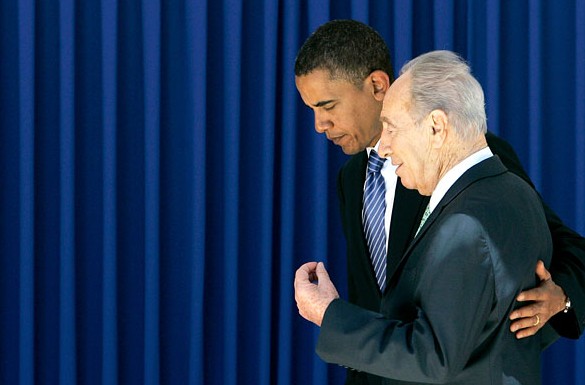
Barack Obama to follow in Shimon Peres’ footsteps

Barack Obama to follow in Shimon Peres’ footsteps

“Very few leaders if at all were able to change the mood of the entire world in such a short while with such profound impact. You provided the entire humanity with fresh hope, with intellectual determination, and a feeling that there is a lord in heaven and believers on earth.

“Under your leadership, peace became a real and original agenda. And from Jerusalem, I am sure all the bells of engagement and understanding will ring again. You gave us a license to dream and act in a noble direction.” Nobel Peace Prize laureate and President of Israel, Shimon Peres.

_____

It’s important not to rush to judgment on Obama — unless the judgment is glowing, then it’s full steam ahead.

If the so-called “reality-based community” still existed, then the very same people who have been suggesting that Obama critics hold their fire should now be insisting the Nobel committee jumped the gun.

Unfortunately that isn’t happening as much as it should. Why? Obama loyalists feel personally embattled. The impulse to grasp on to this fleeting object of relief is for some, irresistible. It’s a quick salve to those whose own unflinching loyalties portend humiliations that lurk down the road.

Realists can’t indefinitely remain true believers. True believers eventually abandon realism.

European Commission President Jose Manuel Barroso said: “The award of the prize to President Obama, leader of the most significant military power in the world, at the beginning of his mandate, is a reflection of the hopes he has raised globally with his vision of a world without nuclear weapons.”

There’s a note of realism there — this is about hopes raised, not accomplishments. The problem is, hope can only be raised so far and for so long. It’s power and durability depends on a strengthening conviction that hope is on a trajectory that leads to actuality. The longer that trajectory remains unclear, the more likely it will be that hope has instead provided the foundation for disappointment, cynicism and bitterness.

Obama traded on hope as a path to power but now he has the power he has to dispense with a large measure of hope. Governance is about deliverables.

It’s not surprising that the Nobel Peace Prize committee have chosen to endorse Obama’s nuclear disarmament initiative. But whether that goal has actually raised hopes globally is something I’m skeptical about. Disarmament is on Obama’s wish-list, but since — in the name of realism — he warned that this might not be accomplished in his lifetime, and since a goal is a dream with a deadline, thus far Obama has merely inspired hope in a dream. Ronald Reagan had that dream too.

Is there a sliver of a silver lining here? Maybe. It’s possible that the Nobel Peace-Prize winning president might feel inhibited from using the Pentagon’s newly-ordered 30,000lb Massive Ordnance Penetrator for destroying nuclear facilities in Iran. On the other hand, he might be persuaded that the destruction of Iran’s nuclear program is a necessary step on the path to nuclear disarmament.

* * *

A few other responses.

Mickey Kraus:

Turn it down! Politely decline. Say he’s honored but he hasn’t had the time yet to accomplish what he wants to accomplish. Result: He gets at least the same amount of glory–and helps solve his narcissism problem and his Fred Armisen (‘What’s he done?’) problem, demonstrating that he’s uncomfortable with his reputation as a man overcelebrated for his potential long before he’s started to realize it. … Plus he doesn’t have to waste time, during a fairly crucial period, working on yet another grand speech. … And the downside is … what? That the Nobel Committee feels dissed? … P.S.: It’s not as if Congress is going to think, well, he’s won the Nobel Peace Prize so let’s pass health care reform. But the possibility for a Nobel backlash seems non-farfetched.

The Taliban:

Taliban spokesman Zabihullah Mujahid said it was absurd to give a peace award to a man who had sent 21,000 extra troops to Afghanistan to escalate a war.

“The Nobel prize for peace? Obama should have won the ‘Nobel Prize for escalating violence and killing civilians’,” he told Reuters by telephone from an undisclosed location.

“When Obama replaced President Bush, the Afghan people thought that he would not follow in Bush’s footsteps. Unfortunately, Obama actually even went one step further.”

Gideon Rachman:

The prize is clearly an award of huge significance, awarded after only the deepest reflection, and won only by demi-Gods.

Maria Farrell:

President Obama has changed how the world feels about America. He’s lifted the planet’s mood. This guy is global Prozac.

Facebooktwittermail