Adam Shatz writes: During the long, bewildering week in which Egyptians waited for the results of their presidential election to be announced, I took a train from Cairo to Alexandria. The Muslim Brotherhood had declared that its candidate, Mohamed Morsi, had defeated Ahmed Shafiq, Mubarak’s last prime minister, by a million votes. The Brothers had collected signed tallies from all 16,000 polling stations, and their counts were said to be meticulous. (It turned out they were off by only 0.06 per cent.) But Shafiq had declared victory too, and in the last week of the campaign looked eerily confident, as if he knew the elections had been rigged in his favour. The longer people were forced to wait, the more they began to worry – or hope – that the Supreme Council of the Armed Forces would try to pass Shafiq off as the winner. Until 24 June, when Morsi’s victory was announced by the electoral commission, nothing was certain, even whether the former president was alive or dead. As the train reached the station at Alexandria, my fixer, Magdy, got a call from his boss, a reporter for the Telegraph, to say that Mubarak had died. ‘I guess he couldn’t bear to see Mohamed Morsi sitting in his chair,’ Magdy said. By the time we got to the hotel, CNN was reporting that Mubarak was in a critical condition, maybe on life support. ‘They’re playing with us,’ Magdy said.
On 14 June, two days before the election, the revolution’s most concrete achievement – a freely elected parliament, dominated by Islamists – had been dissolved by the Supreme Constitutional Court, a body of judges appointed by Mubarak. The court’s argument was that because members of political parties had run for the third of the seats reserved for independents, the entire parliament was illegal. With parliament dissolved, the SCAF was ruling by decree. The timing of the decision and the speed with which it was implemented led many Egyptians to see it as another power grab by the army. This perception was reinforced when, on the last day of voting, the SCAF – advised by the same judges who had dissolved parliament – passed a series of constitutional amendments, as if it were taking out an insurance policy in the event of a Morsi victory. Thanks to these amendments, the SCAF now has the right to dissolve the constituent assembly which was formed to draft a new constitution, and whose future is already uncertain since it was chosen by an ‘illegal’ parliament. It also has the right to veto any article in the new constitution that is held to violate the revolution’s goals. The presidency meanwhile has been stripped of many of its powers, including the power to declare war.
This wasn’t a military coup, as some claimed: the coup had already taken place on 11 February 2011, when the SCAF took control and the revolutionaries agreed to give it a chance, a decision many came to regret. But this ‘judicial coup’, as some had it, hardly inspired confidence that a handover to a civilian government would take place by 1 July, as the SCAF had promised. ‘We’d be outraged if we weren’t so exhausted,’ the human rights activist Hossam Bahgat tweeted. Some of my friends warned that the army, with the support of the feloul – remnants of the old regime – might try to put an end to the democratic process, as the Algerian generals did in 1992, sparking a decade-long war. The Egyptians were too tired to fight a civil war, but they already seemed to be choosing sides on the basis of whom they feared more, the army or the Brothers. [Continue reading…]
Category Archives: Egypt
Egypt’s legislature convenes despite court ruling
The Associated Press reports: Egypt’s Islamist-dominated parliament convened Tuesday in defiance of a ruling by the country’s highest court and swiftly voted to seek a legal opinion on the decision that invalidated the chamber over apparent election irregularities.
The lawmakers’ session was brief – it lasted just five minutes – but it pushed Egypt deeper into a potential power struggle between new President Mohammed Morsi and the powerful military, which has vowed to uphold the judicial ruling that led to parliament being dissolved.
The crisis atmosphere has grown steadily since Morsi issued an order Sunday to reconvene the 508-seat legislature. His executive order said it was revoking the military’s June 15 order to disband the chamber based on the previous ruling by the Supreme Constitutional Court.
The court said a third of the chamber’s members were elected illegally by allowing candidates from political parties to contest seats set aside for independent candidates.
Parliament Speaker Saad El-Katatni told lawmakers that the legislature met to find ways to implement the court ruling rather than debate it out of respect for the principles of “the supremacy of the law and separation of authorities.”
But he put forward a plan to seek what amounts to a “second opinion” from an appeals court on the ruling. It was not immediately clear, however, whether the appeals court would accept the legislature’s request.
Egypt’s military and president escalate their power struggle
The New York Times reports: Egypt’s highest court and its most senior generals on Monday dismissed President Mohamed Morsi’s order to restore the dissolved Parliament as an affront to the rule of law, escalating a raw contest for supremacy between the competing camps.
The power struggle reflected dueling claims to Egypt’s emerging politics, with each side trying to frame the debate as a contest for ideals, legitimacy and democracy. The generals, backed by the court, argue that the new president must respect legal precedents and the institutions of the state. The new president, in turn, is calling on the generals to respect a popular will that was expressed through free elections.
But at its core, the fate of this Parliament is another chapter in the long-running battle between the Muslim Brotherhood and the military that intensified when the generals dissolved the legislature last month based on a court order and seized all lawmaking and executive authority.
The response by the military and the court on Monday threw Egypt into a new phase of political turmoil, with the prospect of a presidency weakened even further, a legislative vacuum and a bitter split at the highest levels of government. And it revived ideological rifts that many people hoped would quiet with the election of a new president.
Mr. Morsi, who was the Brotherhood’s candidate, called on Sunday for the Islamist-led Parliament to return, staking his new presidency on the outcome of the conflict. The body’s speaker scheduled a session for Tuesday, but it was unclear how many lawmakers would appear, or whether the security forces would try to block them, as they did once before. And Parliament’s ability to pass laws is already in doubt, given the court ruling that led to its dissolution.
Mr. Morsi, hemmed in by the generals’ near monopoly on power, moved after just nine days in office. His bold decree was a gamble that he could wrest legislative authority from the military and enhance his popular credibility.
Egypt parliament set to meet, defying army
Reuters reports: Egypt’s parliamentary speaker said the chamber would reconvene on Tuesday after the new, Islamist president risked a showdown with the generals by quashing their decision to dissolve the assembly last month.
Quoted by the state news agency on Monday, Saad al-Katatni, who like President Mohamed Mursi hails from the long-suppressed Muslim Brotherhood, said the lower house would sit from noon (0600 EDT) on Tuesday, defying the army’s order to dismiss parliament a month ago, based on a court ruling.
Mursi issued his decree to recall parliament on Sunday barely a week after he took office. That threatened fresh uncertainty for a nation whose economy is on the ropes and where many are anxious for calm after 17 turbulent months since the fall of Hosni Mubarak.
“Early confrontation,” wrote Al-Akhbar newspaper, summing up Mursi’s decision which could end a brief honeymoon with the military council, led by Field Marshal Hussein Tantawi.
Yet Mursi and Tantawi showed no hint of discord on Monday when the president, as he did last week, attended a military parade. Seated next to each other, Mursi and Tantawi turned to each other in a brief jovial exchange, television images showed.
The military council which had run Egypt since Mubarak was toppled in February 2011 sought to trim the president’s authority before handing over to Mursi on June 30. It had dissolved parliament and taken legislative power for itself.
Mursi’s decision hands those powers back to a parliament packed with his Islamist allies. He also ordered new elections for parliament – once a constitution is passed by referendum.
Al-Masry Al-Youm reports: The Supreme Constitutional Court declared that all its verdicts are final and immune against appeals, stressing that it will not be a party to any political dispute.
The announcement came in the wake of a decision by President Mohamed Morsy to reinstate the People’s Assembly, which the court dissolved in mid-June because parts of the electoral law were unconstitutional.
The court, in a statement published by state news agency MENA, stressed that its sole mission is to defend the constitution against any encroachment and practice judicial scrutiny of the constitutionality of laws and regulations.
While hailed by Muslim Brotherhood supporters, Morsy’s move stirred controversy among other political groups that considered it a coup against the rule of law.
Egypt President Mohammed Mursi reverses parliament ban
BBC News reports: Egypt’s President Mohammed Mursi has ordered parliament to reconvene, a month after it was dissolved by court order amid a row over voting systems.
The Supreme Court had ruled parliament unconstitutional because two voting systems had been used in the election.
The military, which was then running the country, enforced the dissolution.
But Mr Mursi, whose Muslim Brotherhood won most parliamentary seats, said the chamber should reconvene until a new election could be held.
Judge helped Egypt’s military to cement power
The New York Times reports: Even as they promised to hand authority to elected leaders, Egypt’s ruling generals were planning with one of the nation’s top judges to preserve their political power and block the rise of the Islamists, the judge said.
Tahani el-Gebali, deputy president of the Supreme Constitutional Court, said she advised the generals not to cede authority to civilians until a Constitution was written. The Supreme Court then issued a decision that allowed the military to dissolve the first fairly elected Parliament in Egypt’s history and assure that the generals could oversee drafting of a Constitution.
The behind-the-scenes discussions, never publicly disclosed, shed new light on what some have called a judicial coup. From the moment the military seized control from President Hosni Mubarak, the generals “certainly” never intended to relinquish authority before supervising a new Constitution, Judge Gebali said.
The military council’s plan to cede authority was premised on first establishing the Constitution, the judge said, so the generals “knew who they were handing power to and on what basis. That was the point.”
When the military first seized power, it positioned itself as a guardian of the peaceful revolution, a force that was aimed at helping achieve the goals of a democratic Egypt. Demonstrators in Tahrir Square chanted that the people and the military were one, and there were promises of a quick transition to civilian control.
But the evidence since then has piled up demonstrating that the military had never intended to fully submit to democratically elected authority.
Now as Egypt’s new, popularly elected president, Mohamed Morsi of the Muslim Brotherhood, tries to fashion a role for himself as head of state, he is facing a military council that retains virtually all executive and legislative authority. The generals have again pledged to transfer power after a new Parliament is elected and a Constitution drafted. [Continue reading…]
Egyptian apathy on human rights
Tim Sebastian writes: I doubt very much if Mohamed Morsi knows the name Natasha Smith — still less what happened to her in Cairo’s Tahrir Square as tens of thousands of his supporters cheered his victory last week as president.
A 21-year-old student journalist from Britain, she had gone into the square to document the celebrations. She was modestly dressed and with a male companion.
Confronted by a jeering mob, the two became separated. She was attacked, subjected to repeated sexual abuse and stripped naked in front of hundreds of people. Eventually a group of Egyptians came to her aid — but the damage had already been done.
At almost exactly the same time, across the Nile, a 42-year-old Egyptian woman left a hotel — again modestly dressed in long-sleeved shirt and trousers — and headed through the hooting, drum-thumping streets to her car. She had not gone far before a middle-aged man appeared out of the darkness and spoke to her.
“You will not be allowed to dress like that in the New Egypt,” he warned. “Times have changed.”
I mention these incidents not because abuse and harassment are rare in Egypt, but because they now — for the first time — fall under the purview of an Islamist president, committed to ruling with a moral and religious compass.
The extent, therefore, to which the Morsi administration is ready to protect the rights of individuals, will go a long way toward determining what kind of Egypt emerges under his aegis over the months and, maybe, years to come. [Continue reading…]
Sebastian’s op-ed ends with these comments from an Egyptian election observer: “I do not fear the Muslim Brotherhood,” she says softly. “I do not fear the army. I fear my own people — their mentality. They will not defend my rights.”
As much as this might present a bleak image of Egypt, I have to wonder whether or not the same concern might be expressed about any population around the world. Universally, the defense of human rights seems to be a minority concern.
Egypt: Morsi, SCAF and the revolutionary left
Hossam el-Hamalawy writes: As soon as the news broke last Sunday that Mohamed Morsi was officially declared Egypt’s first elected civilian president, I could hear loud happy chants and cheers in my street. The janitors in my neighborhood gathered around the corner in their galabiyas, jumping up and down, in the same fashion I usually see them when the Egyptian national football team scores a goal in some match. Their children, in bare feet, were running up and down the street, chasing posh cars that passed by, chanting “Morsi! Morsi!”. While, fellow citizens in “working class districts in Cairo celebrate[d]… with fireworks, marches, dancing and sweets amid hopes of a brighter future,” reported my friend Lina el-Wardani of Ahram Online.
For many, including those who boycotted the elections or nullified their votes, for sure there was a sigh of relief. I, as well as millions of other Egyptians, were certain the ruling military junta will rig the vote in favor of General Ahmad Shafiq, who was to be crowned as Egypt’s next president. I am happy we turned out to be wrong.
Although SCAF mobilized Mubarak’s National Democratic Party network in favor of Shafiq, and attempted to directly intervene to rig the final count, their efforts failed. Some activists are circulating conspiracy theories along the lines of Morsi being the “real SCAF candidate” or that he won by a deal–which I disagree with. The blunt fact is, although SCAF is in still in control, they might not be as confident and powerful as most revolutionaries think.
The majority of those who are cheering the electoral results are not necessarily happy about Morsi’s victory, as much as they are relieved that Shafiq, the representative of the SCAF-backed counterrevolution is not in office.
Shafiq’s victory could have meant a wide level of demoralization among section of the people to see the regime’s loyal man coming back in power, with full force and vengeance. For example, a comrade in Assuit spoke to me in details before the second round about how former State Security officers in his town were sending messages to activists: “Wait till Shafiq gets inaugurated you sons of X#$%, you’ll disappear the following day.” Similar threats were made against activists in other provinces. Remnants of the old regime had felt confident to reappear once again. Shafiq’s loss caused mass demoralization and disarray among their ranks.
The Muslim Brothers have put themselves in a critical position now. Some on the left and in the liberal circles are more than happy to label the Brotherhood as a “fascist” organization and “just another face of Mubarak’s regime.” This social analysis of the movement is incorrect and will entail, in my view, wrong political positions to be taken vis a vis the Islamists. [Continue reading…]
Egypt’s weak president poses no problem — yet — for the U.S.
Tony Karon writes: If Mohammed Morsi were really going to be the president of Egypt, Barack Obama’s administration might be a tad more alarmed than it actually is over the changes in Cairo.
The cruel truth, however, is that while the Supreme Council of the Armed Forces (Scaf) will allow Mr Morsi the title and symbolic accoutrements of the presidency, the executive powers of that office have been usurped by the generals.
Mr Morsi will have no control of the budget, foreign policy, the armed forces, defence matters or national security. Not only has the junta claimed those powers for itself, it has also dissolved the democratically elected parliament and, effectively, the assembly tasked with writing a new constitution, claiming their powers.
The generals could opt to curtail Mr Morsi’s term once a new constitution has been tabled, while their allies in the judiciary might even pull the rug out from under him by reviving the old regime’s ban on the Muslim Brotherhood. In any case, Mr Morsi’s authority will be largely restricted to domestic matters, such as the economy, education and social policy – the subjects usually overseen, in a presidential system, by a prime minister.
The Obama administration publicly presses the generals to hand power to elected civilians, but that may be a largely pro-forma objection to the arrangements put in place by Scaf. Consider, after all, that the US response to the uprising that saw Hosni Mubarak forced out in February 2011 was to back a transfer of authority to General Omar Suleiman, the intelligence chief. What they have with Scaf is not that different, at least not on core US concerns: that Egypt maintain the Camp David peace deal with Israel, and that it support, or at least not obstruct, US regional policy. [Continue reading…]
Egypt’s Tantawi to remain defense minister — general
Reuters reports: Egypt’s armed forces chief will keep his post as defense minister in a new cabinet to be formed by President-elect Mohamed Mursi, a member of the military council said.
Field Marshal Hussein Tantawi, 76, who served as defense minister for two decades under ousted leader Hosni Mubarak, will keep his post after Egypt’s first Islamist president takes over, Major-General Mohamed Assar said in a rare appearance on a talk show on privately-owned CBC television on Wednesday night.
“The (new) government will have a defense minister who is head of the Supreme Council of the Armed Forces,” he said.
Asked if this meant Tantawi would keep his defense portfolio, Assar said: “Exactly. What is wrong with that? He is the head of the Supreme Council of the Armed Forces, the defense minister and the commander of the armed forces.”
Egyptian activists meet Morsi, discuss goals of revolution
Al-Masry Al-Youm reports: A number of activists met with President-elect Mohamed Morsy on Wednesday to work toward implementing the partnership document that was launched at the National Front conference as a platform for achieving the goals of the revolution.
Activist Wael Ghonim said the meeting discussed transparency with the people in all decisions made by the government, while activist Wael Khalil said the meeting was to express support for Morsy.
Activist Asmaa Mahfouz said Morsy’s promises are calculated but he seems to mean well for Egypt.
The National Front issued a statement after the meeting, saying that it was agreed power should be handed over on 30 June and that the president should be sworn in before the Egyptian people and not behind closed doors.
Egypt to sue Iran news agency over ‘fabricated’ Morsi interview
Al Ahram reports: Egypt plans to sue an Iranian news agency for having allegedly fabricated an interview with President-elect Mohamed Morsi, Egypt’s official MENA news agency reported on Wednesday.
MENA quoted the Islamist leader’s spokesman, Yassir Ali, as saying that Iran’s Fars news agency had “made up” a widely quoted interview in which Morsi said he planned to improve ties with Iran and revise Egypt’s 1979 peace treaty with Israel.
“Legal action will be taken against the Iranian Fars news agency, which fabricated the interview,” Ali said.
The Egyptian presidency on Monday denied that Morsi had given an interview to Iran’s Fars news agency, in which he reportedly pledged to strengthen ties with the Islamic republic.
“Mr. Morsi did not give any interview to Fars; everything that this agency has published is without foundation,” a spokesman for the Egyptian presidency told MENA.
Earlier this week, Fars published what it said was an interview with Morsi in which Egypt’s first democratically-elected civilian president said he wanted to build ties with Iran, severed in 1980.
It’s hard to imagine that anyone at Fars or any of their friends in the Revolutionary Guards thought they could fake an interview and get away with it. My guess is that Fars was itself duped into believing they were conducting a phone interview with Morsi while in fact they were speaking to someone else. Note that it was the state-controlled Islamic Republic News Agency which was swift to report a denial of the authenticity of the interview. So, if Fars was led into a trap, the question is: who set the trap?
Mohamed Morsi to pick woman and Christian as Egypt’s vice-presidents
The Guardian reports: Mohamed Morsi’s first appointments as president-elect of Egypt will be a woman and a Coptic Christian, his spokesman has told the Guardian, as he moves to allay fears of the Muslim Brotherhood.
Sameh el-Essawy said that although the names of the two choices had not been finalised, they would be Morsi’s two vice-presidents.
When the appointments go through, they will constitute the first time in Egypt’s history that either a woman or a Coptic Christian has occupied such an elevated position in the executive branch.
The Muslim Brotherhood is at pains to calm fears of what an Islamist president might mean for Egypt and the region at large. Appointing both a woman and a Coptic Christian is an attempt at a show of unity, and a rule by consensus.
Meanwhile, defeated presidential candidate Ahmed Shafik – Mubarak’s last prime minister and Morsi’s rival in the runoff election – flew to Abu Dhabi on Tuesday morning with his two daughters. His camp denied that he had fled as investigations begin into allegations of corruption against him while minister of civil aviation. He was in Abu Dhabi for “tourism” purposes, they said. [Continue reading…]
Morsi’s Fars News Agency interview
Iran’s Fars News Agency reports on an interview with Egypt’s newly-elected president. (Note: The Guardian reports “Fars is linked to the revolutionary guards controlled by Supreme Leader Ali Khamenei. But now the Islamic Republic News Agency, linked to President Mahmoud Ahmadinejad, is reporting a denial of the story from Morsi’s spokesman.)
Part 1: Egypt’s newly-elected President Mohammed Mursi underlined his enthusiasm for the further expansion of ties with Iran, and said relations between Tehran and Cairo will create a strategic balance in the region.
“The issue will create a strategic balance in the region,” Mursi told FNA on Sunday, hours before the final results of the presidential election was announced.
Part 2: Mursi voiced strong protest at the [ruling military] council’s forced dissolution and closure of the parliament, and said the move was aimed at hitting a blow to the Islamist candidate in the presidential election.
“The dissolution of Majlis al-Sha’b (parliament) targeted me,” Mursi said in an interview with FNA, adding, “When the generals saw that I have come close to the presidential post, they attempted to take away certain authorities in their own interest.”
He also dismissed the SCAF’s decision to issue a supplement to the Constitution, and said, “The military council is not entitled to issue an amendment to the Constitution and we reject the Constitutional declaration which disclaims the elected president’s authorities.”
His remarks came after Egypt’s military told parliament earlier this month that it has been dissolved and banned its members from entering the house.
Part 3: Mursi rejected rumors claiming that the country’s Supreme Council of the Armed Forces (SCAF) seeks to decrease his presidency term to one year.
“Such comments are not correct since the new Constitution will be compiled by the elected Constituent Assembly which was formed one day before the parliament’s dissolution and no one can ever cancel the presidential election,” Mursi said…
Part 4: Mursi rejected rumors and media news about paying his first foreign trip to Saudi Arabia, stressing that no such visit is on his agenda.
“I have said nothing so and my first international trips after victory in presidential election have not yet been specified,” Mursi said in an exclusive interview with FNA on Sunday.
“My visit to Saudi Arabia was an issue proposed by a number of young people and not an official plan,” he added.
Asked about his future plan for relations with the regional countries, Mursi said, “(My plan) is establishment of relations with all countries of the region to revive Egypt’s identity in the region through economic cooperation among the Arab countries and making certain reforms in the Arab League to activate its role on the international scene and beside that, supporting the Palestinian nation in its legitimate campaign for materializing its rights.”
Muslim Brotherhood tallies and keeping Egypt honest
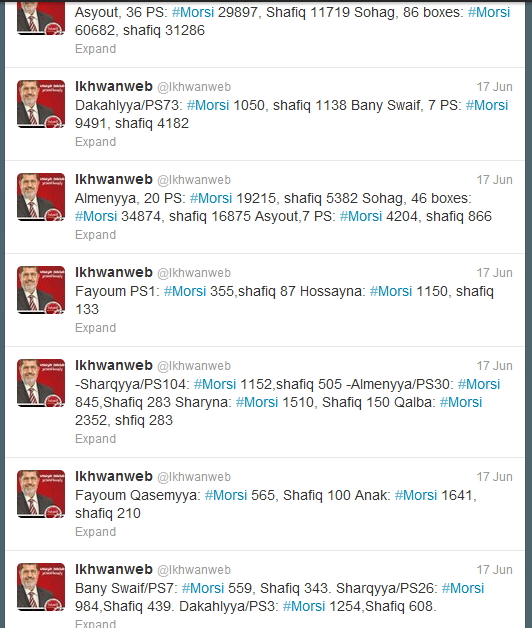
At The Arabist, Bilal Ahmed writes: The most striking thing about these elections, and probably one of its most important lasting effects, is the accuracy of the independent tallies conducted by the Muslim Brotherhood and its political faction the Freedom and Justice Party. There is no other organized political force in Egypt with the resources to accurately conduct polling at all of Egypt’s 16,000 polling stations, and the MB has not squandered its opportunity to occupy this role.
The MB results for the Egyptian revolutionary parliament seven months ago and the first round of presidential elections at the end of May were more or less in line with the final election results. The results that were announced for the Morsi/Shafiq contest this morning only differed from the MB figures by about 0.06%, which ranks this election among the least manipulated in Egyptian history. Through this successful organizing, the MB has successfully implanted an idea in the media and political consciousness where its results can be trusted as accurate figures. This makes it difficult for manipulation to occur on a state level, as defying the Muslim Brotherhood figures now makes voter fraud much more evident.
Given the thousands of people who flocked into Tahrir Square and staged sit-ins when voting results were delayed last week, this is a severe political risk for institutions attempting to preserve their Mubarak-era privilege.
Last week’s announcement of victory at Morsi’s campaign headquarters put massive pressure on senior officials to not consider tampering with election results and cause a Shafik presidency. This pressure was felt in Tahrir Square as equally as it was in the Obama Administration, which announced that it would reconsider its lucrative military assistance package to Egypt if power was not handed to a civilian government. It is true that in all likelihood, the Supreme Council of the Armed Forces is satisfied with a Morsi executive that is stripped of its power, but its obvious preference for Ahmed Shafiq was made much more difficult the moment that the MB’s independent exit polls announced this morning’s results.
It may seem odd to state in a political climate where many revolutionaries don’t trust the MB and its FJP candidates, but the Muslim Brotherhood electoral results are trustworthy. It may, in fact, be the most trustworthy part of the entire organization and its most positive contribution to the ongoing Egyptian revolution. The Muslim Brotherhood now officially has a reputation of offering a source of accurate electoral information that minimizes the chance of voter fraud.
Zeynep Tufekci adds: [T]he Muslim Brotherhood (or Ikhwan as Egyptians refer to them) made it harder for the election to be stolen because they combined a superior ground game with active and sophisticated online presence to control the narrative and force a level of transparency. (In other words, they forced it such that if the elections were going to be stolen, it was going to be “in-your-face” stolen which is a very different method with greatly different political implications than “under-the-rug” stolen).
Here’s how.
First, Muslim Brotherhood has a fairly active presence online, and especially in Twitter (although only their English feed is interactive at the moment). Throughout the election night, they kept tweeting out updated results:
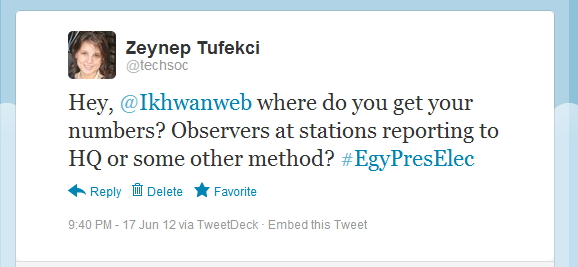
I was curious about where they got their numbers so I asked them:
About 10 minutes later, I had a reply that they had people at polling stations who updated them regularly. [Full disclosure: I do personally know at least one of the young woman who runs their English feed; in fact, most of my contacts with Muslim Brotherhood have been with young women as they happen to be quite active on their new media operations]. Other people I knew confirmed that MB had people on the ground at polling stations and were feeding results to the central headquarters as they became available. [Continue reading…]
Video: Is this the end of Egypt’s revolution?
Egypt: a landmark victory
In an editorial, The Guardian says: A period of 84 years, most of them spent as a proscribed secret society languishing in prison or in exile, is a long time to wait. Egypt’s Muslim Brotherhood had to spend one hour more. That was the time it took Farouq Sultan, the head of the election commission, to read out a statement dealing with, it seemed, every one of the 456 objections made as a result of the presidential runoff. When he finally came to the point, Sultan could not get to the end of his sentence before the press conference, Tahrir Square and the country erupted. Mohamed Morsi had become the first Islamist to be elected head of an Arab state.
This is a historic moment for Egypt. Another nail has been hammered into the coffin of the old regime. The reaction of Tahrir Square on Sunday night was every bit as ecstatic as the toppling of Hosni Mubarak himself. Yet power itself has not changed hands, and the conflict with an ageing group of generals in the Supreme Council of the Armed Forces (Scaf) might yet drag on for weeks or months. Scaf thinks it owns the country, and by some reckoning it does. Its corrupt business empire could account for as much as 40% of Egypt’s GNP. Like all CEOs, they will not depart swiftly or cheaply. Theirs will be a slow and bitter rearguard action.
But after Sunday’s events few can doubt the direction of travel. The generals face a bald choice: declare a military coup or beat the retreat. How long that decision will take, no one knows. The generals now face an incomparably larger and more emboldened foe. The secular leftist and Islamic forces that comprise the revolution are still mutually distrustful and represent an unwieldy spectrum of political forces, many still half-formed.
However, from now on their torchbearer will not just be a crowd hundreds of thousands strong. It will be a president who represents the democratic and constitutional will of the Egyptian people. As Scaf represents neither, it will be hard put to keep the legislative, constitutional and executive powers it grabbed in the dying days of the presidential count.
Much will depend on the character of Egypt’s new president. Derided as a spare tyre by the Egyptian press – because he was not the Brotherhood’s first choice as presidential candidate – Morsi may be an accidental president, but he may also turn out to be a powerful one. Dismissed as a boring and unquotable technocrat, he produced his best speech on the very night, 11 days ago, the military council issued its constitutional decree.
He is a dogged negotiator and, supporters say, a man of courage. Although the election result was announced on Sunday, it was known on Thursday afternoon. By then it became clear that the number of ballot papers ruled ineligible had not been enough to dent the one million strong lead Morsi had over the army’s candidate, Ahmed Shafiq.
The Brotherhood then met the military council and made its three principal demands – that parliament be reinstated, the military’s right of arrest of civilians be rescinded, and a new constitutional assembly formed. The Brotherhood offered to put the military’s constitutional decree to a referendum. The military refused, and the Brotherhood returned to Tahrir Square.
The three days that followed were a battle of wills that Morsi won. His first act as president-elect was to resign his membership of the Brotherhood. His vice-presidents will all come from other groups, including Egypt’s Coptic Christians. All these moves are vital if a government of national unity is to be created.
The battle of wills between Morsi and the generals will continue. And as reaction poured in from the region – notably, Binyamin Netanyahu, Israel’s prime minister, said he respected the outcome – the US, Britain and Europe were all notably silent in the hours immediately after the victory, considering this is a triumph not just of one candidate but of democracy. Not for the first time in the Middle East, western powers could have found themselves on the wrong side of history.
Note that the White House had several days to fine tune statements in anticipation of either a Morsi or Shafiq victory. By the time Washington did actually speak, its congratulations were muted and couched in the lecturing tones reserved for non-Western leaders who, from America’s point of view, need tuition even when it’s unsolicited.
The Los Angeles Times reports: A statement from White House spokesman Jay Carney called the election a “milestone in their transition to democracy.”
“We look forward to working together with President-elect Morsi and the government he forms, on the basis of mutual respect, to advance the many shared interests between Egypt and the United States,” Carney said. “We believe that it is important for President-elect Morsi to take steps at this historic time to advance national unity by reaching out to all parties and constituencies in consultations about the formation of a new government.
“We believe in the importance of the new Egyptian government upholding universal values, and respecting the rights of all Egyptian citizens — including women and religious minorities such as Coptic Christians.”
The statement said the U.S. intends to work with all parties in Egypt and praised election monitors for supporting “a free and fair election.”
“We believe it is essential for the Egyptian government to continue to fulfill Egypt’s role as a pillar of regional peace, security and stability,” Carney said. “And we will stand with the Egyptian people as they pursue their aspirations for democracy, dignity, and opportunity, and fulfill the promise of their revolution.”
Muslim Brotherhood’s Mohamed Morsi declared new president of Egypt
The Guardian reports: The Muslim Brotherhood’s Mohamed Morsi has been declared Egypt’s first post-revolutionary president, bringing an end to days of feverish speculation amid increased divisions and polarisation.
Morsi won with 51% of the vote. Second-placed Ahmed Shafiq, Mubarak’s final prime minister, took 48%.
The incoming president assumes office after a turbulent few weeks that have left Egypt’s wrenching transition in disarray, with parliament being dissolved by the supreme court and a military-issued constitutional declaration that severely limits presidential powers.
Both sides quarrelled over tactics in the wake of the polls closing. The Muslim Brotherhood announced Morsi as the winner six hours after voting ended, having tabulated the results from the 13,000 poll stations.
The Shafiq campaign responded angrily, claiming its candidate was actually the one leading the race. The supreme council of the armed forces (Scaf), Egypt’s ruling military leadership, waded in, criticising the Brotherhood for its “unjustifiable” premature announcement.
Meanwhile, talk of backroom negotiations between the Muslim Brotherhood and Scaf was confirmed by the group’s deputy head, Khairat Al-Shater, as the two sides traded barbs over the country’s political future. The Muslim Brotherhood held a press conference on Friday in conjunction with liberal forces, during which it attempted to mollify its critics.
Morsi will have much to occupy his first few days of office, encumbered by the overreach of the generals and the divisive nature of Egyptian politics.
“The symbolism of a presidential election victory, particularly for Morsi, will be an achievement in and of itself,” said Mike Hanna, fellow at the Century foundation. “But after that initial euphoria has evaporated, he will be faced with difficult circumstances, a tired and impatient nation, and an ongoing power for political power.”