A letter to The Guardian: We, a group of Syrian civil society organisations and actors, both men and women, from multiple sects and ethnic and minority backgrounds, write this following Russia’s recent airstrikes (Russia sends in bombers and raises stakes in Syria, 1 October). It has become eminently clear that the international community has little political will to stop the bloodshed in Syria. Indeed, the international community’s collective failure to help end the conflict created the vacuum for the de facto occupation of our country by Iran and now Russia. While the United Nations has repeatedly expressed “deep concern” and “regret” at the tremendous loss of life and the mass displacement of Syrians, the international community has done next to nothing to deter the main perpetrator of the conflict in Syria: the Assad regime.
The dire situation in Syria is no mystery. After four years of conflict, half the country has been killed, displaced or exiled. Indeed, airstrikes by the Syrian regime are the foremost driver of the Syrian refugee crisis and the leading cause of death in Syria (66% of civilian deaths by May 2015); 95% of all deaths caused by regime airstrikes are civilians – not members of Isis or armed opposition groups. While UN resolution after resolution has condemned the use of indiscriminate weapons against civilians, there has been no international action to stop regime aerial attacks. And now Russia has joined in the slaughter of Syrians with nothing more than feigned concern by the international community. [Continue reading…]
Category Archives: Iran
Iraq: How Iranian-backed militias have become stronger than the government
Reuters reports: The Shi’ite militias, which dominate most frontlines, say they support the government and pose no threat to Iraq’s minority Sunni sect. The Popular Mobilisation Committee, or Hashid Shaabi, as the militias are collectively known, belongs “to the Iraqi government,” said Naim al-Aboudi, a spokesman for the Asaib Ahl al-Haq militia. “The Hashid doesn’t represent a sect. It represents all Iraqis.”
But the militias make no secret of their independence from Baghdad. Militia leader Amiri warned in a televised interview last month that if the Shi’ite groups did not approve of U.S. military operations in Iraq, “We can go to Abadi and the government and … pressure them: ‘Either you will do this, or we will do that.’” Amiri did not specify what action his group would take.
A senior Iraqi government official close to the prime minister said the militias operate independently. He said their objectives only sometimes align with Abadi’s: They concentrate on defending areas that are strategically important for their sect.
“If they are not paid by the prime minister,” this official said, “they can do what they want.” [Continue reading…]
Russian-led offensive in Syria triggers new wave of refugees fleeing to Turkey
VOA reports: Turkish officials say 50,000 refugees have left the Syrian city of Aleppo and are heading to the border, but it remains unclear whether they will be allowed to enter Turkey after a hazardous journey dodging airstrikes and negotiating checkpoints manned by disparate rebel militias, including al-Qaida’s affiliate in Syria.
For months now border gates have been officially closed to new refugees, and those fleeing are forced to pay smugglers to enter illegally – sometimes using tunnels to escape the killing fields.
The rich can bribe border-gate guards — the going rate is $700 per person — the poor may get across after paying smugglers $50 to $100 per person to sneak past Turkish border guards patrolling farm-fields and olive-tree orchards adjacent to the border.
Russian airstrikes and a Syrian army ground offensive mainly in the countryside to the south and east of the city of Aleppo have triggered the surge in Syrians heading for the border. Syria Turkmen Council President Abdurrahman Mustafa said he also estimates about 50,000 people have left the city and are picking their way down pot-holed roads, through checkpoints and past ruined villages to Turkey. [Continue reading…]
Iran backs Assad in battle for Aleppo with proxies, ground troops
The Washington Post reports: In a striking sign of Iran’s growing regional influence, a major assault on Syria’s most populous city is being coordinated by an Iranian military commander using Shiite forces from three countries to back President Bashar al-Assad’s beleaguered troops, militia officials said.
Maj. Gen. Qasem Soleimani, the leader of Iran’s elite Quds Force, has ordered thousands of Iraqi Shiite militia allies into Syria for the operation to recapture Aleppo, according to officials from three of the militias. The militiamen are to join Iranian troops and forces from Hezbollah, the Iranian-backed Lebanese militia, the officials said.
Soleimani has been a frequent sight on the battlefields in neighboring Iraq, where he has been advising Iraqi forces fighting Islamic State militants. But the war there has stagnated, and the shift of the commander along with Iraqi militiamen and Quds Force members to Syria appears to signal a change in Iranian priorities. [Continue reading…]
Syria’s overlords
وعده دادند و راست گفتند #سوریه #پوتین #حزب_الله
Billboard in #Syria: They promised & remain truthful
#Russia pic.twitter.com/Scnx5GeKF4
— H.Soleimani (@MashreghNews_ir) October 19, 2015
Iran’s General Qasem Soleimani is conspicuous by his absence on this billboard, but with a group of four it would be that much harder to make Assad look like the man at the top.
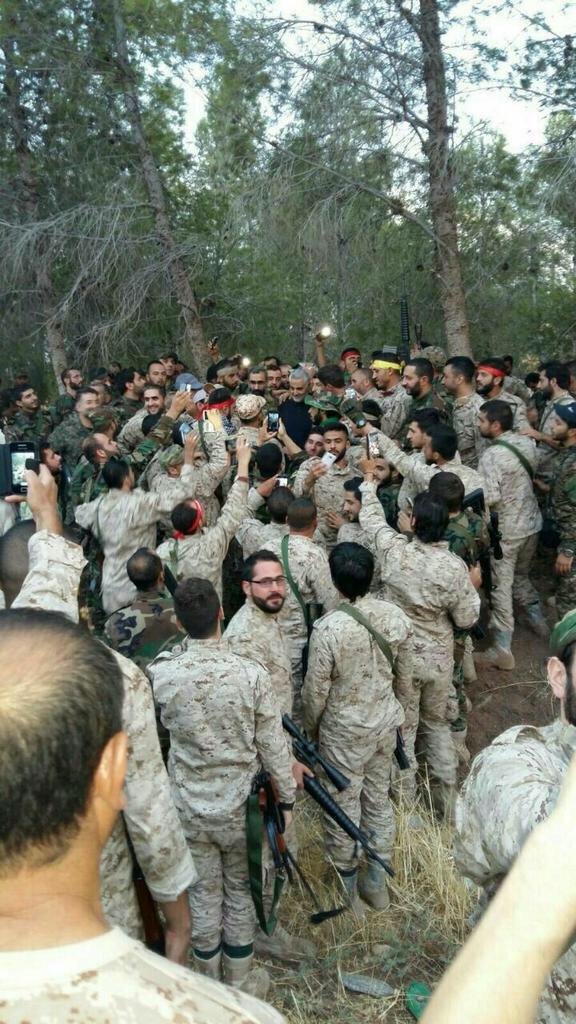
#Syria #Aleppo #Iraqi Militia Soldiers posing with Qasem Soleimani pic.twitter.com/merWYx8wNs
— Ivan Sidorenko (@IvanSidorenko1) October 16, 2015
Across the Middle East, national and religious leaders fuel sectarianism
The New York Times reports: The Shiite leaders of Iran and the Sunni rulers of Saudi Arabia traded insults over the deaths of hundreds of Iranian pilgrims near Mecca. The government of Bahrain, long criticized for repressing the country’s Shiite majority, expelled the Iranian ambassador, after accusing Iran of shipping arms to Bahrain and trying to foment “sectarian strife.”
And a group of hard-line Sunni clerics in Saudi Arabia, fired up by Russia’s intervention in Syria, issued a scathing sectarian call for holy war.
Events over the last few weeks have raised fears of an accelerating confrontation between the region’s Shiite and Sunni Muslims, with Saudi Arabia and Iran escalating their power struggle, extremists attacking Shiite mosques in the Persian Gulf and armed conflict aggravating religious differences in Iraq, Syria and now Yemen.
But as the violence flares and crosses borders, national and religious leaders seem as eager as ever to stoke the fires, mobilizing followers using implicit or naked sectarian appeals that are transforming political conflicts into religious struggles and making the bloodshed in the region harder to contain, scholars and analysts say.
“This is unprecedented, and we don’t have a road map,” said Rami Khouri, a senior fellow at the Issam Fares Institute at the American University of Beirut. “When political dynamics fail, people turn back to religion. We are in this terrible moment of transition where sect is very high in people’s minds.” [Continue reading…]
Russia paves way for Assad regime’s Iranian-backed advance on Aleppo
The Observer reports: After many scares and several false starts, the crucial battle for Syria’s second biggest city has begun.
For more than a year the southern edges of rebel-held Aleppo have been a wasteland. Regime soldiers have been fixed in their positions several kilometres from the battered city limits, while rebels have shored up defences on their side of the ruins.
Now, three weeks into Russia’s intervention in the Syrian war, there is movement on one of the conflict’s most static fronts. And weary opposition forces don’t like what they are seeing.
“The regime advanced six kilometres [on Friday] and they took three villages,” said Zakaria Malafji, a member of the Free Syrian Army inside Aleppo. “The Russians showered us with bombs even in the civilian areas. They want to clear everything so the regime tanks and even the soldiers on foot can advance.”
Pitched against the mix of Islamists and non-ideological rebels in the rubble is the strongest force that Bashar al-Assad has been able to call on at any point during the four-and-a-half-year war. An Iranian military brigade is stationed around 20km south, along with hundreds of Hezbollah fighters, Shia militias from Iraq and the Syrian Army.
A senior US official on Friday said the Pentagon estimated the Iranian strength at 2,000 officers and soldiers – Tehran’s largest contribution to a battle and a signal that it is no longer shy to acknowledge the fact that its troops are actively defending the regime.
Straight from a grinding battle in the mountains near Damascus, Lebanon’s Hezbollah has also travelled to Aleppo en masse. “Every one of the brothers I know has gone there,” said one resident of the Beirut suburb of Dahiyeh, a Hezbollah stronghold. “This is the first time they’ve all disappeared like that. They’re even shortening their vacation times.”
Rebels inside Aleppo say they have the weapons and the stamina to keep their enemies from seizing the eastern half of the city they have controlled since July 2012. They say that large numbers of anti-tank missiles supplied by their allies – Turkey, Saudi Arabia, Qatar and the US – have reached them in recent days and warn that they have had three years to prepare their defences. [Continue reading…]
Oil nations feel the strain of OPEC’s continuing price war
The Telegraph reports: Oil is arguably Saudi Arabia’s best weapon against both Russia and Iran. Although the kingdom’s finances are under severe strain from the collapse in export revenues it can still fall back on its $655bn (£423bn) of foreign assets while Russia and Iran will feel the impact of another year of weak oil prices more acutely.
After a year of carnage in the oil industry, it is now clear that it will take more time for Al-Naimi’s strategy of allowing weaker prices to do the job of totally shutting down higher cost producers.
A 60pc slump in oil prices since last November has caused havoc but the main target of Opec ‘s campaign, shale oil in the US, has so far proved to be remarkably resilient.
Hardest hit have been the high cost producers in areas such as the North Sea where prices below $50 per barrel have placed the entire offshore industry at risk.
Energy consultant Wood Mackenzie now fears that 140 fields in the waters off north-east Scotland, where oil has been pumped since the 1970s, could be closed down over the next five years if oil prices remain so low. [Continue reading…]
Syrian army launches Aleppo offensive with Iranian support
Reuters reports: Syrian troops backed by Hezbollah and Iranian fighters launched an offensive south of Aleppo province on Friday, expanding the army’s counter-attack against rebels across western Syria with support from Russian air strikes.
The assault means the army is now pressing insurgents on several fronts near Syria’s main cities in the west, control of which would secure President Bashar al-Assad’s hold on power even if the east of the country is still held by Islamic State.
Aleppo, a commercial and industrial hub near the border with Turkey, was Syria’s largest city before its four-year civil war, which grew out of protests against Assad’s rule.
Control of the city, still home to two million people, is divided between the government and rebels.
“This is the promised battle,” a senior military source in Syria said of the offensive backed by hundreds of Hezbollah and Iranian forces which he said had made some gains on the ground.
It was the first time Iranian fighters had taken part on such a scale in the Syrian conflict, he said, although their numbers were modest compared to the army force. “The main core is the Syrian army,” the source said. [Continue reading…]
Why Russia’s intervention in Syria is unlikely to lead to a major shift in the balance of power
Iran and Hezbollah losing senior commanders in Syria at a rapid rate
The Daily Beast reports: With the aid of Russian airstrikes, Iranian-backed foreign fighters, and a combination of Syrian dictator Bashar al-Assad’s regular and militia forces are on the march. Yet Iran and its proxies have taken some significant high-ranking casualties since the start of their recruitment and deployment drives to Syria.
These losses all serve to map out the current offensive being launched in the northwest of the country, including Idlib, Hama, and Aleppo. While other significant losses had been suffered in past engagements, deaths of key members were often more sporadic or concentrated on one group during a specific battle. If the goal is to secure an Assad-led coastal Syrian rump-state, it is coming at high cost to Assad’s Iranian ally.
The most well known of Tehran’s casualties was the 67 year old Islamic Revolutionary Guard Corps (IRGC) Brigadier General, Hossein Hamedani. Announced as having been killed on October 9th, Hamedi was reportedly killed in Aleppo. Officially, he was described by the Iranians as a, “high-ranking military advisor” to Assad. But to write Hamedani off as merely an “advisor” would be the equivalent of referring to Napoleon as just, “a French general.” [Continue reading…]
In what appears to have been a morale-boosting effort, General Qassem Soleimani, the commander of Iran’s elite Qods Forces, has made an appearance in a location open to question, where soldiers took the opportunity to take selfies with the man widely viewed as the architect of the current Russian-led campaign.

Russia's sending its only aircraft carrier Admiral Kuznetsov to Syria, it carries many more planes for potential strikes.
— Joshua Landis (@joshua_landis) October 14, 2015
Iran sends thousands of troops to Syria to bolster the planned ground offensive in Aleppo
Reuters reports: A delegation of Iranian lawmakers arrived in Damascus on Wednesday in the build-up to a joint operation against insurgents in northwest Syria, and said U.S.-led efforts to fight rebels had failed.
The visit, led by the chairman of the Iranian parliament’s National Security and Foreign Policy Commission, Alaeddin Boroujerdi, came as Iranian troops prepared to bolster a Syrian army offensive that two senior officials told Reuters would target rebels in Aleppo.
The attack, which the officials said would be backed by Russian air strikes, underlined the growing involvement in the civil war of Syrian President Bashar al-Assad’s two main allies, which has alarmed a U.S.-led coalition opposed to the president that is bombing Islamic State militants.
“The international coalition led by America has failed in the fight against terrorism. The cooperation between Syria, Iraq, Iran and Russia has been positive and successful,” Boroujerdi was quoted as saying by Iran’s state broadcaster IRIB as he arrived at Damascus airport.
The delegation was due to meet Assad, said officials.
Iran has sent thousands of troops into Syria in recent days to bolster the planned ground offensive in Aleppo, the two officials told Reuters. [Continue reading…]
Russia’s intervention in Syria may help ISIS advance in Iraq
Hassan Hassan writes: Nearly two weeks after the Russian intervention began in Syria, one could say it has not got off to a good start. Last week, the Syrian regime launched its first ground offensive against the rebels under Russian air support.
The assault, in Hama’s northern countryside, failed spectacularly – rebels affiliated to the Free Syrian Army destroyed at least 18 tanks and held their ground. The anti-government forces had advanced last month towards Al Masasnah, where the battles took place on Monday, and one of the villages that would lead the rebels further into the regime’s heartlands. The offensive was thus an important operation for the government and at the heart of the Russian forces’ role in Syria.
The following day, US officials claimed cruise missiles fired by Russian warships in the Caspian Sea crashed in Iran. And over the weekend, the Syrian army also lost control of “the UN hill” in Quneitra.
But the most significant development happened on Wednesday, when ISIL swept through several rebel-held villages and reached the doorsteps of Aleppo. The advances, made possible by the disruptive targeting of opposition forces committed to fighting ISIL, were the most important gains for the organisation in Aleppo since the rebels expelled it from much of the north in early 2014.
Of course, it is hard to judge the Russian intervention based on last week’s performance. But the developments so far serve as a reality check for early speculation about the scope of the Russian role, such as a ground offensive to expel ISIL from Palmyra. Moscow will be forced to focus its mission on the daunting task of securing the regime’s vital areas. [Continue reading…]
Iran lawmakers vote to implement nuclear deal
The New York Times reports: Iran’s parliament voted Tuesday to support implementing a landmark nuclear deal struck with world powers despite hard-line attempts to derail the bill, suggesting the historic accord will be carried out.
The bill will be reviewed by Iran’s 12-member Guardian Council, a group of senior clerics who could return it to lawmakers for further discussion. However, Iran’s Supreme Leader Ayatollah Ali Khamenei, who has the final say on key policies, has said it is up to the 290-seat parliament to approve or reject the deal.
Signaling the nuclear deal’s likely success, a spokesman for moderate President Hassan Rouhani’s administration welcomed the parliament’s vote and called it a “historic decision.”
“Members of parliament made a well-considered decision today showing they have a good understanding of the country’s situation,” Mohammad Bagher Nobakht said. “We hope to see acceleration in progress and development of the country from now on.”
The European Union’s foreign policy chief Federica Mogherini, who helped facilitate the nuclear talks, also praised the vote as “good news” in a message on Twitter.
In the parliamentary session carried live by state radio, 161 lawmakers voted for implementing the nuclear deal, while 59 voted against it and 13 abstained. Another 17 did not vote at all, while 40 lawmakers did not attend the session.
A preliminary parliamentary vote Sunday saw 139 lawmakers out of the 253 present support the outline of the bill. But despite getting more support Tuesday, hard-liners still tried to disrupt the parliament’s session, shouting that Khamenei himself did not support the bill while trying to raise numerous proposals on its details. [Continue reading…]
The Wall Street Journal reports: Tensions between the U.S. and Iran, rather than easing as a result of July’s nuclear accord, are increasing over a wide spectrum of issues tied to the broader Middle East security landscape and to domestic Iranian politics, current and former U.S. officials say.
Just in the past two days, Iran has test-fired a ballistic missile and announced the conviction of American journalist Jason Rezaian, fueling suspicions the historic nuclear agreement has allowed Tehran’s Islamist clerics to step up their long-held anti-U.S. agenda.
Washington’s closest Mideast allies, particularly Israel and Saudi Arabia, are more broadly concerned about Iran’s ability to use the diplomatic cover provided by the nuclear accord—and the promised release of tens of billions of dollars of frozen oil revenues—to strengthen its regional position and that of its allies. [Continue reading…]
Reuters reports: Iran’s Supreme Leader Ayatollah Ali Khamenei on Wednesday banned any further negotiations between Iran and the United States, putting the brakes on moderates hoping to end Iran’s isolation after reaching a nuclear deal with world powers in July.
Khamenei, the highest authority in the Islamic Republic, already said last month there would be no more talks with the United States after the nuclear deal, but has not previously declared an outright ban. [Continue reading…]
The New York Times reports: The Washington Post said on Monday that its correspondent Jason Rezaian, who has been jailed for 14 months in Iran on espionage charges, had been convicted after a trial that ended two months ago.
While the conviction could not be independently confirmed — a spokesman for the Iranian judiciary said on Sunday that a verdict had been handed down, but he did not disclose specifics — Iran appeared to be moving on Monday to position Mr. Rezaian’s case as part of a broader effort to get the release of Iranians detained in the United States.
On Monday, a state television news channel accused Mr. Rezaian, a dual American-Iranian citizen, of providing information to the United States about individuals and companies who were helping Iran circumvent international economic sanctions.
Iranian leaders, including President Hassan Rouhani, have raised the idea of a prisoner swap, suggesting that Mr. Rezaian, 39, could be exchanged for people who Tehran says are being held by or on the orders of the United States for violating sanctions. [Continue reading…]
Iranian general killed in Syria by ISIS
The Wall Street Journal reports: A top Iranian military commander who played a crucial role in Tehran’s efforts to defend the Syrian regime was killed in the outskirts of the northern Syrian city of Aleppo, Iran’s state media said Friday.
Brig. Gen. Hossein Hamedani died at the hands of “Daesh terrorists” on Thursday while conducting advisory duties, Iranian state media said, quoting a statement by the Islamic Revolutionary Guard Corps, or IRGC.
Although the statement used the Arab acronym for the extremist group Islamic State to describe those responsible for Gen. Hamedani’s death, the circumstances of his demise weren’t disclosed. The Iranian government, like the Syrian regime, tends to use “Daesh” and “terrorists” as catchall terms for all opponents of President Bashar al-Assad.
Gen. Hamedani, a longtime commander in the elite military unit of the IRGC, is believed to have directly overseen the organization of pro-Assad forces into groups such as the Popular Committees, which were later folded into the so-called National Defense Force.These local militias are now estimated to number anywhere between 150,000 and 190,000 people. They are mainly members of Mr. Assad’s Shiite Muslim-linked Alawite sect, while some belong to Syria’s own small Shiite community. The majority of those fighting Mr. Assad are Sunni.
Before he was dispatched to Syria to provide know-how and training to the Assad regime, Gen. Hamedani was a commander in the IRGC’s elite military unit that led crackdowns on Iranian protesters in 2009. [Continue reading…]
The ‘Iranian project’ is making Assad trust Moscow more than Tehran
Christoph Reuter writes: Just as in Damascus, Latakia and Jabla, increasing numbers of hosseiniehs — Shiite religious teaching centers — are opening. The centers are aimed at converting Sunnis, and even the Alawites, the denomination to which the Assads belong, to “correct” Shiite Islam by way of sermons and stipends. In addition, the government decreed one year ago that state-run religion schools were to teach Shiite material.
All of this is taking place to the consternation of the Alawites, who have begun to voice their displeasure. “They are throwing us back a thousand years. We don’t even wear headscarves and we aren’t Shiites,” Alawites complained on the Jableh News Facebook page. There were also grumblings when a Shiite mosque opened in Latakia and an imam there announced: “We don’t need you. We need your children and grandchildren.”
In addition, Iranian emissaries, either directly or via middlemen, have been buying land and buildings in Damascus, including almost the entire former Jewish quarter, and trying to settle Shiites from other countries there.
Talib Ibrahim, an Alawite communist from Masyaf who fled to the Netherlands many years ago, summarizes the mood as follows: “Assad wants the Iranians as fighters, but increasingly they are interfering ideologically with domestic affairs. The Russians don’t do that.” [Continue reading…]
How Iranian general plotted out Syrian assault in Moscow
Reuters reports: At a meeting in Moscow in July, a top Iranian general unfurled a map of Syria to explain to his Russian hosts how a series of defeats for President Bashar al-Assad could be turned into victory – with Russia’s help.
Major General Qassem Soleimani’s visit to Moscow was the first step in planning for a Russian military intervention that has reshaped the Syrian war and forged a new Iranian-Russian alliance in support of Assad.
As Russian warplanes bomb rebels from above, the arrival of Iranian special forces for ground operations underscores several months of planning between Assad’s two most important allies, driven by panic at rapid insurgent gains.
Soleimani is the commander of the Quds Force, the elite extra-territorial special forces arm of Iran’s Revolutionary Guards, and reports directly to Iran’s Supreme Leader, Ayatollah Ali Khamenei.
Senior regional sources say he has already been overseeing ground operations against insurgents in Syria and is now at the heart of planning for the new Russian- and Iranian-backed offensive. [Continue reading…]
Putin promotes Russia’s ‘military-industrial complex’ with cruise-missile strikes on Syria
The Washington Post reports: Russian missiles fired from Caspian Sea warships traveled more than 900 miles to strike targets in Syria on Wednesday as Syrian government forces opened a ground offensive into areas that include Western-backed rebel factions, officials said.
The bombardment marked the first naval salvos in Russia’s week-old military intervention, and another sharp escalation of Moscow’s firepower in Syria’s multi-faction civil war.
It also adds another layer of complexity to efforts at restarting talks between the Pentagon and Russian commanders on their separate military operations in Syria.
A map from Russia’s Defense Ministry showed the path of the cruise missiles crossing Iran and Iraq — which would apparently require coordination from both nations and draw them indirectly into the Russian military intervention as gateways for attacks.
Like Moscow, Iran is a key backer of Syria’s embattled President Bashar al-Assad. Iraq’s leadership has close ties with Iran, but also depends on support from the United States and Western allies.
Such a route bypasses NATO-member Turkey, where previous violations of Turkish airspace by Russian warplanes brought stern warnings from the Western military alliance.
In Moscow, Russian Defense Minister Sergei Shoigu said four Russian warships carried out 26 missile strikes against 11 targets, but gave no other details.
Russian President Vladimir Putin, in a television meeting with Shoigu, said the missiles were fired from “the water of the Caspian Sea from 1,500 kilometers away.”
Putin added that the strikes “destroyed all the planned targets,” which he attributed to “the good preparation and the enterprises of the military-industrial complex and the good training of the personnel.” [Continue reading…]