The Wall Street Journal reports: On Thursday, Thomas Shannon, President Barack Obama’s nominee to be undersecretary of state, said Mr. Kerry is seeking to ascertain whether Russia and Iran are prepared “to convince Mr. Assad that during a political transition process, he will have to go.”
During his confirmation hearing, Mr. Shannon said Mr. Kerry “thought it was time to bring everybody together and effectively call their bluff.”
The U.S. diplomacy is placing the Arab states and Turkey in a bind, as many of them have provided significant arms and funding to the largely Sunni rebel forces seeking to overthrow Mr. Assad.
Saudi Arabia, in particular, has publicly criticized Russia’s military intervention in Syria, arguing it could strengthen Mr. Assad and Shiite-dominated Iran, his closest Middle East ally.
Still, Saudi Arabia is finding it difficult to oppose the new round of diplomacy because of Russian President Vladimir Putin’s heavy military investment in Syria. Saudi officials have been holding their own direct talks with the Kremlin and have also pressed for a clear time line for when Mr. Assad would be forced to stand down, senior Arab officials said.
Mr. Obama’s position in the early days of Syria’s civil war was that Mr. Assad had to step down immediately as part of any resolution to the conflict, but that position shifted as the regime held together and the spread of Islamic State has become a higher priority.
The administration’s primary aim now is to get warring parties to abide by a cease-fire, so the U.S. can more effectively zero in on Islamic State and give new momentum to the stalled fight.
As a result, the administration’s view is Mr. Assad’s future can be dealt with later.
Current and former U.S. officials say the White House’s acceptance of Russian and Iranian demands on keeping Mr. Assad in power at least temporarily will make it hard — if not impossible — for the administration to get the different rebel factions fighting the regime to sign on to a cease-fire. [Continue reading…]
Category Archives: Iran
After a U.S. shift, Iran has a seat at talks on war in Syria
The New York Times reports: Just a few weeks ago, Ayatollah Ali Khamenei said any new talks with the United States were forbidden. He described the United States as a persistent enemy of the Islamic revolution, and said that despite the nuclear agreement, it needed to be kept at a distance.
But participating in the multination Syria talks does not contradict Mr. Khamenei’s dictums, some Iranian analysts say.
“Our leader has banned the bilateral relations between Iran and America or any negotiation aimed at resuming relations,” said Hamidreza Taraghi, a political analyst in Tehran considered close to the ayatollah. “Case-by-case negotiations or finding solutions for regional problems on a multilateral basis is all right.”
So, while publicly siding with the hard-liners, the Supreme Leader may well be giving more negotiating room to President Hassan Rouhani, who has advocated more open engagements with the rest of the world. There has already been an unspoken cooperation between Iran and the United States in Iraq, where both are fighting the Islamic State.
“We should thank President Rouhani for his efforts in reaching out to the international community, and the nuclear deal,” said Farshad Ghorbanpour, a political analyst close to the government in Tehran. “Now we are seeing the rewards: We are playing an increasing active role in the international arena.”
That role is something that Iran has desperately sought: Diplomatic weight and respect that bolsters its claim that it, not Saudi Arabia, is the most influential power in the region. “It’s very important because it shows that, following the nuclear agreement, Iran is now ready to cooperate on crisis management in the Middle East,” Seyed Hossein Mousavian, a former Iranian diplomat and nuclear negotiator who now teaches at Princeton, said in a telephone interview. “I’m not surprised, because the leader had said that if the deal were done fairly, with face-saving for all parties, Iran would agree to next steps on other issues. This is a big step forward.”
Cliff Kupchan, an Iran specialist and chairman of the Eurasia Group, a Washington political consultancy, said that given Russia’s recent intervention in Syria to support Mr. Assad, it was clear he would remain in charge for a while, which meant Iran would be attending the Vienna talks from a position of strength.
Still, Mr. Kupchan said in an email, “as U.S.-Iran contacts spread to a broader array of issues, it will be harder and harder for Iranian conservatives to quarantine cooperation.” [Continue reading…]
Why are so many Iranian generals getting killed in Syria?
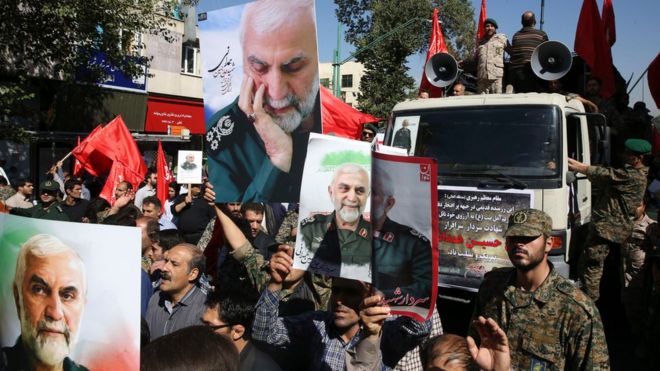
McClatchy reports: At least six generals from the elite Islamic Revolutionary Guards Corps have been killed in Syria since 2013, according to an official of the U.S. Defense Intelligence Agency, who requested anonymity because of the sensitivity of the issue. Three of those, including Hamadani, who was killed Oct.9 in the embattled northern city of Aleppo, have died since the beginning of the month.
A seventh Revolutionary Guard general was killed by an Islamic State sniper in Iraq last year.
Experts say the deaths of so many senior officers in Syria underscore the Iranian commitment to preserving Assad’s government in a “rump” Syria that includes most of the country’s major cities and the coastal province of Latakia, the traditional center of Assad’s religious sect, the Alawites.
It also is a reflection of the difference between Iran’s fighting tactics and those of Western militaries, whose senior officers usually direct operations from heavily protected command centers far in the rear.
Just one U.S. general has been killed in a conflict zone since the Vietnam War ended more than 40 years ago. That officer, Army Maj. Gen. Harold Greene, was shot by an Afghan soldier during a visit to a Kabul military academy in August 2014.
The need for close battlefield supervision by senior commanders has grown as the pro-Assad force has become a diverse amalgam of fighters from Lebanon, Iraq and Iran as well as Syria, cobbled together to compensate for the Syrian army’s serious manpower shortages. In addition to coordinating with one another, the units must be synchronized with airstrikes from Russian and Syrian jet fighters and helicopter gunships.
“When you need as many bodies on the ground to do the fighting . . . they need better coordination,” said Philip Smyth, a University of Maryland researcher who tracks Iranian-backed Shiite militias. “You need guys who are hard core and can really provide the stiff style of leadership and command, people who are not going to flinch under fire.” [Continue reading…]
Do Tehran and Moscow still believe Assad’s political survival depends on mass murder?
Frederic C. Hof writes: In Syria consent for the country to be used as a supply and training base for Hezbollah is limited to Assad-Makhluf family and its enablers. Popular consent in Syria is the last thing Tehran wishes to facilitate.
What Iran might be willing to consider, however, is — with the support of Moscow — obliging its client to suspend indefinitely the worst aspects of his mass homicide political survival strategy. Assad will not conduct mass casualty events — barrel bombing, artillery barrages, aircraft strafing, or Scud missile assaults on apartment blocks — if Iran and Russia instruct him not to do so. If so ordered, Assad will direct the lifting of sieges and the unrestricted passage of United Nations humanitarian assistance convoys to people desperately in need of food and medical treatment.
The key question here is whether Tehran and Moscow will persist in believing that mass terror is essential to their client’s political survival. For some four years they have believed so. To the extent that the Supreme Leader and Russian President Vladimir Putin have had reputations worth preserving, they have jeopardized them by facilitating the ability of the Assad regime to conduct war crimes and crimes against humanity with absolute impunity. As they evaluate the Syrian situation now, in October 2015, do they still believe that Assad’s political survival must rest on mass homicide?
This is the question that could conceivably produce a new answer from Tehran. Speaking privately in track two settings, senior non-governmental Iranians have expressed regret over and disgust with Assad regime behavior toward defenseless civilians. Can Tehran reconcile the protection of civilians in Syria with its own national security interests? This — rather than some manner of political grand bargain over Syria — would be worth a serious discussion in Vienna. [Continue reading…]
Iran to attend Syria talks in Vienna
BBC News reports: Iranian Foreign Minister Mohammad Javad Zarif will attend multilateral talks on finding a political solution to the conflict in Syria in Vienna this week, a government spokeswoman has said.
It will be the first time Iran – an ally of President Bashar al-Assad – has attended such a summit with the US.
Representatives of Russia, Saudi Arabia and Turkey will also attend the talks. [Continue reading…]
Diplomatic opening has not led to any improvement in Iran’s human rights record
Foreign Policy reports: It has been a bumper year for capital punishment in Iran.
Tehran hanged at least 694 people between Jan. 1 and Sept. 15, the highest rate of executions in the Islamic Republic in some 25 years, according to a report released Tuesday by a U.N. human rights monitor.
The pace of executions is likely driven by a surge in drug crimes, which accounted for 69 percent of the executions in the first half of 2015, according to the 26-page report.
The report’s findings present a decidedly harsh image of the country at a time when Iranian President Hassan Rouhani and his American-educated foreign minister, Mohammad Javad Zarif, have been promoting a more moderate vision of Iran to the outside world.
Since signing a landmark nuclear deal with the United States and other world powers in July, Tehran has been hosting a procession of Western officials and business leaders looking to do business with a newly sanctions-free Iran. But even if the country has seen a diplomatic opening of sorts since Rouhani came to power in the summer of 2013, that hasn’t translated into any improvement in other sensitive areas.
“In terms of human rights, there has been no sign of improvement in the country,” Ahmed Shaheed, the U.N. special rapporteur for human rights in Iran, told reporters at a press conference Tuesday at U.N. headquarters. [Continue reading…]
Tehran and Moscow: a shaky alliance
Hanin Ghaddar writes: Fundamentally, Iran wants in Syria what is has in Lebanon — weak, ineffective state institutions incapable of making decisions without the approval of their patrons. As in Lebanon, Iran wants to indirectly control Syria’s state institutions and have access to the Golan in the same way it has access to South Lebanon through Hezbollah.
Of course Putin mainly wants to empower himself, but he needs the Syrian institutions to do so. Russia wants to preserve the Syrian state. Putin wants to prop Assad up simply because the state institutions — including the army and the security apparatus — are still linked to his regime. Putin is not investing in Assad per se, but rather in Syria’s institutions. That’s why Russia has only supplied weapons to the Syrian Army and wants all militias united under it.
Unlike Tehran, Moscow is not interested in changing demography or in maintaining the Shiite/Alawite corridor. Moscow does not want to see Assad go and then be implicitly replaced by Soleimani. Assad must go eventually, but only after a stable political solution is secured. That’s why Russia went with Geneva I. [Continue reading…]
Iran invited to participate in international talks on Syria’s future
On Friday, the Wall Street Journal reported: “European Union foreign policy chief Federica Mogherini spoke in favor of including Iran. ‘All relevant actors, regionally and internationally should be involved,’ she said. ‘I hope that Iran can be part of this common effort.’ ”
But US Secretary of State John Kerry said: “For the moment Iran is not at the table. And there will come a time perhaps where we will talk to Iran but we are not at the moment at this point of time.”
That was Friday, now it’s Tuesday.
The Associated Press reports: Iran has been invited to participate for the first time in international talks over Syria’s future, U.S. officials said Tuesday, a shift in strategy for the United States and its allies as they seek to halt the four-year civil war and eventually ease President Bashar Assad out of power.
Iran has yet to reply, the officials said.
The next diplomatic round starts Thursday in Vienna, with Secretary of State John Kerry, Russian Foreign Minister Sergey Lavrov and several top European and Arab diplomats attending.
Washington had held out the possibility of Iran joining the discussions in future, but is only now offering Tehran a seat after days of behind-the-scenes negotiation, particularly with its regional rival Saudi Arabia. Russia extended the invitation. [Continue reading…]
will #Iran go to #Syria talks? 'Not to my knowledge," Iranian official tells me.
— Laura Rozen (@lrozen) October 27, 2015
Iran’s generals are dying in Syria
Robin Wright writes: The Islamic Republic described the first men to die as a few young “volunteers” deployed to protect symbols of the faith. The numbers have escalated since then. In June, the Islamic Republic News Agency reported that more than four hundred volunteers from Iran, including Afghan refugees living in the country, had died in Syria so far. Iranian news agencies and social media are now rife with stories about senior officers killed in Syria on the war’s toughest front lines. Last week, Iran’s Fars News Agency reported that the death toll hit eight in just two days. The funerals have become major events, sometimes drawing thousands onto Tehran’s streets to escort the coffins to Zahra’s Paradise.
Iran has increasingly been forced to acknowledge its losses—including at least four generals in the past year—with some reports suggesting that twice that number have been killed since the intervention began. Brigadier General Hossein Hamedani, who was killed on October 8th, was given a state funeral. Iran’s Supreme Leader, Ayatollah Ali Khamenei, personally called on Hamedani’s family to convey his condolences. Khamenei’s official Twitter account, in English, lauded the general for fulfilling his “martyrdom wish.”
Hamedani’s death was a setback for Iran—and possibly for Syria, too. According to Jane’s Defense Weekly, Syria’s regular Army has been halved since the war began, in 2011. Assad has increasingly relied on leaders in Iran to develop strategy, and counted on Hezbollah, Iran’s proxy force in Lebanon, to provide new fighters. Hamedani was the senior Iranian tactician in northern Syria, where the regime is simultaneously fighting Western-backed rebels, the Islamic State, a local Al Qaeda franchise, and smaller militias. Hamedani was a hero of the war with Iraq—the deadliest modern conflict in the Middle East—and his death was the most notable Iranian military loss since that war ended. [Continue reading…]
Who of the great journalists covering Syria has nailed, or will, why so many high-level pro-Assad officers/operatives are dying in Syria?
— Hassan Hassan (@hxhassan) October 26, 2015
Pro-Assad pages confirm the death of Major General Izzadin Ibrahim in Deir Ezzor pic.twitter.com/whLPGYqZxS
— Hassan Hassan (@hxhassan) October 26, 2015
Poets are the latest target in crackdown by Iranian hardliners
The Associated Press reports: Two Iranian poets jailed for their work and sentenced to 99 lashes apiece for shaking hands with members of the opposite sex are the latest targets in a crackdown that analysts say pits hard-liners against those offering new glimpses of life in the Islamic Republic.
The sentences follow a pattern of arrests and convictions targeting activists, journalists and artists that has served as a grim backdrop to President Hassan Rouhani’s efforts to soften the country’s image and improve relations with the West, including through the landmark nuclear agreement reached last summer.
Hard-liners in the police, judiciary and military view any rapprochement with the West as a threat to the Islamic Republic and a sign of moral decay. Rights groups and analysts say those targeted in the ongoing crackdown on expression in Iran also serve as pawns in the hard-liners’ struggle with moderates ahead of February’s parliamentary elections.
“I think people thought with the nuclear deal, there would be sort of a bit of a thaw as well or a bit of an opening up,” said Karin Deutsch Karlekar, the director of Free Expression Programs at PEN America, an organization promoting literature and freedom of speech. “I think the judiciary is sort of pushing back and trying to make clear that there isn’t going to be that opening people were hoping for.” [Continue reading…]
In Golan, a battle looms between Iran and Israel
Jean-Loup Samaan writes: More than four years into the Syrian conflict, the Golan Heights have become the centre of gravity for an indirect war between Iran and Israel. This was not an inevitable turn of events, as the area had been home to one of the quietest borders in the Middle East for decades. Although Israel seized the plateau in 1967 and unilaterally annexed it in 1981, the Golan had not witnessed clashes like South Lebanon or the Sinai Peninsula. This dramatically changed with the worsening of the war in Syria.
By the end of 2012, Iran and Hizbollah had sent hundreds of fighters to support the Bashar Al Assad regime. Fights with Syrian rebels, in particular Jabhat Al Nusra, increased on the Syrian side of the Golan and its vicinity. In April 2013, the Qusayr battle saw Hizbollah deploying a contingent of more than 1,200 men. In the following months, a war of attrition emerged in Quneitra and the Qalamoun mountains, with a new major battle flaring in Yabroud in February 2014.
But progressively it appeared that Hizbollah and the Iranians were not solely fighting Syrian rebels, but turning the Golan into a new forward base to target Israel. Various reports claim that tunnels and bunkers are being built to prepare for the next conflict with the Israeli military.
Soon the Israelis reacted by playing a rather ambiguous game with Syrian rebels on the other side of the border. Although it was common knowledge that medical care had been provided to Syrian civilians in Israeli hospitals, the United Nations Disengagement Observation Force based in the Golan were, by 2014, describing something bigger. [Continue reading…]
Extreme heatwaves could push Gulf climate beyond human endurance, study shows
The Guardian reports: The Gulf in the Middle East, the heartland of the global oil industry, will suffer heatwaves beyond the limit of human survival if climate change is unchecked, according to a new scientific study.
The extreme heatwaves will affect Abu Dhabi, Dubai, Doha and coastal cities in Iran as well as posing a deadly threat to millions of Hajj pilgrims in Saudi Arabia, when the religious festival falls in the summer. The study shows the extreme heatwaves, more intense than anything ever experienced on Earth, would kick in after 2070 and that the hottest days of today would by then be a near-daily occurrence.
“Our results expose a specific regional hotspot where climate change, in the absence of significant [carbon cuts], is likely to severely impact human habitability in the future,” said Prof Jeremy Pal and Prof Elfatih Eltahir, both at the Massachusetts Institute of Technology, writing in the journal Nature Climate Change.
They said the future climate for many locations in the Gulf would be like today’s extreme climate in the desert of Northern Afar, on the African side of the Red Sea, where there are no permanent human settlements at all. But the research also showed that cutting greenhouse gas emissions now could avoid this fate. [Continue reading…]
The foundations of ISIS: How secular tyranny fostered religious zealotry in the Middle East
In a review of Wendell Steavenson’s The Weight of a Mustard Seed, Kyle W. Orton writes: Kamel Sachet [one of Saddam Hussein’s favourite and most senior generals] came to religion in prison. In 1983, for no given reason, Sachet was thrown in Ar-Rashid Number One prison, where the only thing detainees were allowed to read was the Qur’an. While State radio was permitted, even State newspapers were banned. Sachet learned the Qur’an by rote, expressing regret he had not done so when he was young.
Sachet showed signs of a more Salafist view of Islam even at this early stage. Sachet told a prisoner he befriended that he wished his friend was not a Shi’a because the shrines were Islamically wrong. Sachet was deeply, personally offended by alcohol and the mixing of the sexes. Perhaps above all, Sachet was given to Islamic fatalism. “If I die … then it means that is the time for me to die,” Sachet said. This apolitical piety also counselled loyalty to the ruler.
In prison, under threat of death and daily torture, men began to take solace in the faith. This pattern of prisons as Islamist production facilities is repeated all throughout the region, notoriously in Syria.
In pondering why the monstrous apparatus of Saddam’s regime functioned — — why didn’t the population just rise as one and refuse any longer to be ruled in this way? — Steavenson mentions the Zimbardo prison experiment. It is a good analogy and it can be pushed further.
During the war with Iran, most Iraqi officers — with the straight choice of continuing to throw young men into an inferno or be tortured and murdered — resorted to a fatalism of their own: “What could I do?” (a phrase that recurs as Steavenson meets the old Ba’athists). At all levels, some Iraqis found solace in Dutch courage, some found solace in the promise of a life to follow this one.
Anyone can see why, during the horror of the Iran-Iraq War or one of Saddam’s prisons, Islam, with its calming rituals and promise of paradise, would have an appeal. But just look at Saddam’s Iraq. From 1980 through Kuwait 1990–91, then the “armed truce” and siege of the 1990s, Iraq was at war for very nearly twenty-five years. The conditions of political terror that went along with this in Saddam’s Iraq are notorious, and the breakdown of provisions and order in the 1990s was heaped on top. In short, Iraq under Saddam was one big prison with wartime conditions. Is it any wonder religion’s appeal increased in Iraq during Saddam’s rule? Or that the aftermath should resemble the disorder and brutality of a prison riot?
The “modern” ideologies — — pan-Arabism, Communism, Ba’athism — failed; nobody could be convinced that the period of trauma was going to give way to a brighter tomorrow. People gave up on the promise of this life and instead sought to compensate the misery endured in the here-and-now with the promise of a blissful life to come. [Continue reading…]
Russian intervention has unintended effect of unifying Syrian rebel forces
The Daily Beast reports: As Charles Lister, an analyst of Syria’s multifarious insurgency at the Brookings Institution, calculated, the use of the TOW missile has increased a staggering 850% since the Russians started bombing, a metric that bolstered by press accounts featuring rebels attest to sudden bonanza of the tank-killer. Also reappearing on the battlefield is the RBG-6 multiple grenade launcher, a munition purchased by the Saudis from Croatia and imported into southern Syria via Jordan in 2013. (That supply line was abandoned after the launcher was found in the hands of jihadists not long after its import.)
Evidence of rebel victories is everywhere on social media. Here’s a video of Liwa Suquour al-Jabal destroying an artillery gun with a TOW missile in Khirbat al Naqus, near Latakia. Here’s one of a BMP being wiped out with a TOW near al-Qarassi, Aleppo, a town the rebels appear to have sacked, along with Tel Qurha, which lies just hundreds of meters south of a regime army base. According to the opposition-run Local Coordination Committees, Jaysh al-Fateh seized the village of Mansoura in Hama today after intense combat with pro-regime forces. The FSA participated in that operation, too, because the same anti-tank missile system was put to use in Mansoura.
Mohammed Rasheed, a fighter with Suqur al-Ghab, one of the CIA-backed militias fighting in Hama, told The Daily Beast, “We have managed to liberate two towns; Mea’ar Kabi in the northern [suburb] of Hama and Lahaya. We have been planning for this operation since the start of the Russian invasion. We wanted to reverse the situation and attack them instead of just defending ourselves.” Rasheed said that his brigade destroyed 23 regime tanks and killed 15 Syrian soliders — in the last 24 hours. “What helped us in this operation is that we all got united and fought as one army.” [Continue reading…]
Israel sent aircraft into Iranian airspace in 2012, raising fears of regional war
The Wall Street Journal reports: The U.S. closely monitored Israel’s military bases and eavesdropped on secret communications in 2012, fearing its longtime ally might try to carry out a strike on Fordow, Iran’s most heavily fortified nuclear facility.
Nerves frayed at the White House after senior officials learned Israeli aircraft had flown in and out of Iran in what some believed was a dry run for a commando raid on the site. Worried that Israel might ignite a regional war, the White House sent a second aircraft carrier to the region and readied attack aircraft, a senior U.S. official said, “in case all hell broke loose.”
The two countries, nursing a mutual distrust, each had something to hide. U.S. officials hoped to restrain Israel long enough to advance negotiations on a nuclear deal with Iran that the U.S. had launched in secret. U.S. officials saw Israel’s strike preparations as an attempt to usurp American foreign policy.
Instead of talking to each other, the allies kept their intentions secret. To figure out what they weren’t being told, they turned to their spy agencies to fill gaps. They employed deception, not only against Iran, but against each other. After working in concert for nearly a decade to keep Iran from an atomic bomb, the U.S. and Israel split over the best means: diplomacy, covert action or military strikes.
Personal strains between President Barack Obama and Israeli Prime Minister Benjamin Netanyahu erupted at their first Oval Office meeting in 2009, and an accumulation of grievances in the years since plunged relations between the two countries into crisis.
This Wall Street Journal account of the souring of U.S.-Israel relations over Iran is based on interviews with nearly two dozen current and former senior U.S. and Israeli officials.
U.S. and Israeli officials say they want to rebuild trust but acknowledge it won’t be easy. Mr. Netanyahu reserves the right to continue covert action against Iran’s nuclear program, said current and former Israeli officials, which could put the spy services of the U.S. and Israel on a collision course.
In early 2012, U.S. spy agencies told the White House about a flurry of meetings that Mr. Netanyahu convened with top security advisers. The meetings covered everything from mission logistics to the political implications of a military strike, Israeli officials said.
U.S. spy agencies stepped up satellite surveillance of Israeli aircraft movements. They detected when Israeli pilots were put on alert and identified moonless nights, which would give the Israelis better cover for an attack. They watched the Israelis practice strike missions and learned they were probing Iran’s air defenses, looking for ways to fly in undetected, U.S. officials said.
New intelligence poured in every day, much of it fragmentary or so highly classified that few U.S. officials had a complete picture. Officials now say many jumped to the mistaken conclusion that the Israelis had made a dry run.
The U.S. Air Force analyzed the arms and aircraft needed to destroy Iran’s nuclear facilities and concluded Israel didn’t have the right equipment. The U.S. shared the findings, in part, to steer the Israelis from a military strike.
The Israelis weren’t persuaded and briefed the U.S. on an attack plan: Cargo planes would land in Iran with Israeli commandos on board who would “blow the doors, and go in through the porch entrance” of Fordow, a senior U.S. official said. The Israelis planned to sabotage the nuclear facility from inside.
Pentagon officials thought it was a suicide mission. They pressed the Israelis to give the U.S. advance warning. The Israelis were noncommittal.
Israeli officials approached their U.S. counterparts over the summer about obtaining military hardware useful for a strike, U.S. officials said.
At the top of the list were V-22 Ospreys, aircraft that take off and land like helicopters but fly like fixed-wing planes. Ospreys don’t need runways, making them ideal for dropping commandos behind enemy lines.
The Israelis also sounded out officials about obtaining the Massive Ordnance Penetrator, the U.S. military’s 30,000-pound bunker-busting bomb, which was designed to destroy Fordow.
White House officials decided not to provide the equipment.
Messrs. Obama and Netanyahu spoke in September 2012, and Mr. Obama emerged convinced Israel wouldn’t strike on the eve of the U.S. presidential election.
By the following spring, senior U.S. officials concluded the Israelis weren’t serious about a commando raid on Fordow and may have been bluffing. When the U.S. offered to sell the Ospreys, Israel said it didn’t have the money.
Former Israeli Defense Minister Ehud Barak, who championed a strike, said Mr. Netanyahu had come close to approving a military operation against Iran. But Israel’s military chiefs and cabinet members were reluctant, according to Israeli officials. [Continue reading…]

How far Russia will go to support one man?
The Daily Beast reports: U.S. intelligence officials have previously assessed that the Assad regime is getting significant backing from Iranian ground forces, and that the support continues to grow, but that it’s not necessarily translating into victories. They think that while some tactical swings along the frontline might favor Assad’s regime in the near term, many provincial capitals occupied by his army remain under threat.
That may help explain Assad’s decision to be seen publicly aligning with Putin, who has supplied essential air cover to forces on the ground. The official characterized Assad’s Moscow visit as a publicity stunt that doesn’t bode well for the dictator’s future. “It only reinforces the notion that Assad has lost control of his country, and is now firmly under Putin’s thumb,” the official said.
“Should the regime’s offensive fail to dislodge opposition elements or suffer major setbacks, the blame will land on Assad’s shoulders,” the official added. “Putin is not one to bet on a losing horse, and Assad’s track record in Syria suggests the regime faces long odds of a military victory. At some point, Putin will have to decide on how far Russia will go to support one man.” [Continue reading…]
The Putin-Assad approach to diplomacy: Win the war, then talk
The New York Times reports: In brief remarks in Moscow, released on Wednesday after Mr. Assad’s departure, the two leaders promised to pursue “a long-term settlement, based on a political process that involves all political forces,” as Mr. Putin put it.
At the same time, they emphasized their united front against terrorists, which is how both characterize not just the Islamic State but all armed opponents of Mr. Assad’s government. And they said that a political solution was only possible after success on the battlefield, which neither defined, leaving the timing of any negotiations entirely unclear.
The question now is whether Mr. Putin can press Mr. Assad to accept a negotiated end to his rule. “Putin’s influence over Assad is like Obama’s over Netanyahu,” a diplomat based in Syria told a group of colleagues several months ago, before the Russian military intervention began, referring to the often truculent relationship between the American and Israeli leaders.
Mr. Assad has, in fact, proved at times to be a reluctant partner in Russia’s efforts to end the conflict. He has stood up on many occasions to the Kremlin, to the extent that diplomats and analysts say it has irritated Mr. Putin.
“I think they know how confused the Assad regime is, and they’re frustrated by it,” said Andrew J. Tabler, an expert on Syria at the Washington Institute for Near East Policy who has followed the conflict closely, referring to the Russians.
He and others noted Russia’s efforts in January and April to broker talks in Moscow between Mr. Assad’s government and some of the armed groups rebelling against it. Those were coordinated by the Ministry of Foreign Affairs and headed by Vitaly V. Naumkin, director of the Institute of Oriental Studies of the Russian Academy of Sciences.
Mr. Assad’s representative, Bashar al-Jaafari, showed little flexibility in those talks, refusing to agree to confidence-building measures Moscow wanted, such as releasing political prisoners who might take part in a political solution.
The talks suggested the limits of Russia’s influence — even Mr. Putin’s. In 2012, Abdelaziz al-Khayer, a Syrian dissident, disappeared immediately upon returning to the country from China to participate in talks that were endorsed by Moscow. Diplomats and opposition figures have long said he was arrested by Mr. Assad’s security forces.
A Western diplomat recalled approaching his Russian counterpart to ask if Russia could pressure the Syrians to release him. “What do you think I’ve been doing?” the Russian diplomat responded.
Last year, another dissident, Louay Hussein, was arrested just before he was preparing to attend talks the Russians had organized in Moscow. He remained in prison for months, and came out declaring that he would no longer remain inside Syria trying to change the system from within. He had learned, he said, that Russia was unable, and Iran unwilling, to push Mr. Assad to any meaningful negotiations. [Continue reading…]
Despite Russian air support, pro-Assad forces only make small advances on the ground
Charles Lister writes: Thus far, after two weeks of operations, pro-regime forces have made small territorial gains north of Homs, south of Aleppo, and in Hama’s Sahl al-Ghab region. But despite Russia’s efforts, ground forces — composed of the Syrian Army, the paramilitary National Defense Force, Hezbollah, Shia militias and increasing numbers of Iranian military personnel — aren’t achieving the victories one might have expected.
One pro-Assad source recently lamented the loss of “24 tanks and 250 men” in Hama, all for “50cm.” While Iran’s infamous Quds Force commander Qasem Soleimani has now arrived openly in Syria, Russia has shown no sign of deploying its own ground forces. Its new military facility in Latakia, however, contains the necessary infrastructure for at least 2,000 personnel, leaving the potential for a Russian ground component open to question.
One key reason for the minimal territorial shifts so far is the use of American BGM-71 TOW anti-tank guided missiles by CIA-backed Free Syrian Army rebels. The missiles, which first appeared in rebel hands in April 2014, have been used far more (a nearly 850% rise) since the Russian intervention: there were 82 recorded uses from October 1 to 20, compared to only 13 in all of September. With each missile valued at least $50,000, that equates to over $4.1 million of expenditure in three weeks.
Having initially had an effective, but strategically subdued effect on the conflict, the CIA coordinated provision of TOW missiles has suddenly shown its true potential. Combatants on the ground — including 13th Division leader Lieutenant Colonel Ahmed Saoud and the leaders of three other CIA-backed FSA groups — all told me that they have received more TOWs than normal recently and stressed how useful they have been. “TOWs will destroy the Russians and their objectives, and we’ve received many more recently,” Saoud said. [Continue reading…]