Category Archives: Iran

United States condemns latest murder of an Iranian nuclear scientist

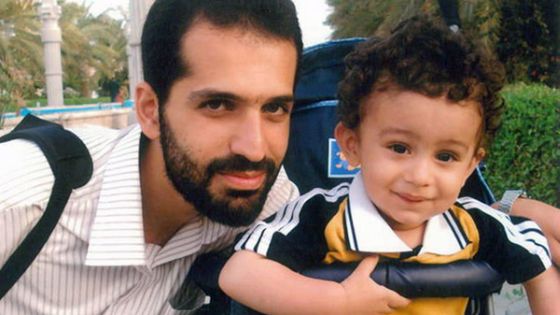
Mostafa Ahmadi Roshan with his son. Roshan is the fifth Iranian nuclear scientist whose murder is being linked to Israel.

The New York Times reports: As arguments flare in Israel and the United States about a possible military strike to set back Iran’s nuclear program, an accelerating covert campaign of assassinations, bombings, cyberattacks and defections appears intended to make that debate irrelevant, according to current and former American officials and specialists on Iran.

The campaign, which experts believe is being carried out mainly by Israel, apparently claimed its latest victim on Wednesday when a bomb killed a 32-year-old nuclear scientist in Tehran’s morning rush hour.

The scientist, Mostafa Ahmadi Roshan, was a department supervisor at the Natanz uranium enrichment plant, a participant in what Western leaders believe is Iran’s halting but determined progress toward a nuclear weapon. He was at least the fifth scientist with nuclear connections to be killed since 2007; a sixth scientist, Fereydoon Abbasi, survived a 2010 attack and was put in charge of Iran’s Atomic Energy Organization.

Iranian officials immediately blamed both Israel and the United States for the latest death, which came less than two months after a suspicious explosion at an Iranian missile base that killed a top general and 16 other people. While American officials deny a role in lethal activities, the United States is believed to engage in other covert efforts against the Iranian nuclear program.

The assassination drew an unusually strong condemnation from the White House and the State Department, which disavowed any American complicity. The statements by the United States appeared to reflect serious concern about the growing number of lethal attacks, which some experts believe could backfire by undercutting future negotiations and prompting Iran to redouble what the West suspects is a quest for a nuclear capacity.

“The United States had absolutely nothing to do with this,” said Tommy Vietor, a spokesman for the National Security Council. Secretary of State Hillary Rodham Clinton appeared to expand the denial beyond Wednesday’s killing, “categorically” denying “any United States involvement in any kind of act of violence inside Iran.”

Facebooktwittermail

Does Washington really prefer ‘proxies’ like Israel?

In the war of nerves between Washington and Tehran, the U.S. enjoyed a couple of moves this week that reinforced America’s preferred image as homeland of the good guys. The U.S. Navy rescued Iranian fisherman not once but twice, while Iran sentenced an American to death.

Is it likely that anyone in Washington would want to spoil this good guys/bad guys story by exploding a bomb in its midst?

An Associated Press report suggests that when it comes to Iran the U.S. now prefers to outsource the dirty work to “proxies like Israel.”

Since when did Israel serve as a proxy for the United States?

When the Obama administration meekly requested the Israelis to promise that they would not unilaterally launch an attack on Iran, the Israelis declined. That’s not how a proxy operates.

Indeed, since the threat that Iran supposedly poses is much more to Israel than the United States, it’s pretty clear that it is the U.S. that serves as a proxy for Israel — not the other way around.

With that in mind, this passage from the AP report is worth noting:

Current and former U.S. officials say Washington prefers proxies like Israel to carry out operations inside Iran, and that up until two years ago, the U.S. and Israel coordinated actions against Iran closely. But the officials say the White House halted such cooperation after Israeli Prime Minister Benjamin Netanyahu took power.

The officials, past and present, spoke on condition of anonymity to discuss sensitive strategic negotiations.

In the event that a military intervention might be needed to halt Iran’s progress toward nuclear weapons capability, they said counterterrorist officials had considered allowing Israel to use the U.S.-Afghan Shindand Airbase, in western Afghanistan, to launch an air strike against Iranian weapons facilities.

The White House won’t cooperate with Netanyahu — now there’s a story ready-made for GOP presidential candidates to jump all over.

Officials considered (note the past tense) allowing Israeli jets to operate out of Afghanistan — however implausible that might be, it’s certainly an idea the Israelis would welcome getting spread around.

Again, enter Republican candidates solemnly pledging that under their administration, Israel will have the right to use U.S. military bases in Afghanistan (or probably anywhere else on the planet for that matter).

There’s a theme here and it’s about who controls the narrative.

Perhaps the clearest indication of who is not in control of the narrative came out of the State Department this morning.

Spokesperson Victoria Nuland responded to questions:

QUESTION: You probably have seen the news that an Iranian nuclear scientist was killed. I wonder what your reaction is. Would you condemn this killing?

MS. NULAND: We’ve seen the reports of the death of the Iranian scientist as a result of an apparent bombing. We condemn any assassination or attack on an innocent person, and we express our sympathies to the family.

QUESTION: The Iranians have accused Israel and the United States of carrying out this killing. Any truth to that?

MS. NULAND: I don’t have any information to share one way or the other on that.

QUESTION: You don’t want to deny killing him?

MS. NULAND: Obviously, we – as I said, we condemn the loss of innocent life.

QUESTION: That’s not a denial as such.

MS. NULAND: I’m not prepared to speak one way or the other. I, frankly —

QUESTION: You didn’t want to deny it.

QUESTION: Would the scientist come under innocent life?

MS. NULAND: Say again?

QUESTION: Would the scientist come under your definition of innocent life?

MS. NULAND: Again, I don’t think I have anything further to say on this, that we condemn violence of any kind.

QUESTION: Don’t you think he’d be a logical target, given the pressure from Israel and the U.S. against —

MS. NULAND: I’m not going to speak to who may or may not have done this, one way or the other.

QUESTION: Why are you not willing to rule out that the United – I mean, the United States did not – they’ve alleged this. Why are you unwilling to say, “Of course we didn’t do this. We don’t —

MS. NULAND: Well, first of all, I don’t think this Department has any information further to what I’ve already said, which we condemn the loss of innocent life.

At this point a footnote has been added to the transcript: “The United States strongly condemns this act of violence and categorically denies any involvement in the killing.” No attribution is given for this sentence, though it echoes Secretary of State Hillary Rodham Clinton who told reporters today: “I want to categorically deny any United States involvement in any kind of act of violence inside Iran.”

Assuming that Clinton’s denial was not a bald-faced lie, it seems reasonable to infer that as is widely believed, this assassination (and previous ones) have been conducted under Israeli direction. Nuland’s unwillingness to say anything probably reflects a number of things:

  • That administration officials do not want to create the impression that the U.S. is the junior and less informed partner in the indivisible relationship with Israel;
  • that administration officials do not want to reveal any lack of enthusiasm for Israel’s covert operations in Iran;
  • and that silence is sometimes the only way of fabricating the illusion of unity.

Israel on the other hand, enjoys the fact that even while its international image whithers, it has no shortage of proxies available in the U.S. to help push its own narrative on Iran — through the press and through the presidential election.

Facebooktwittermail

Assassination in Tehran: An act of war?

M.J. Rosenberg writes: I rarely learn anything meaningful from reading The Atlantic‘s Jeffrey Goldberg. In my opinion, his tight relationship with the Israeli government and its lobby here greatly influences his take on both foreign and domestic events. Although he occasionally deviates from the Israeli line, he not only appears very uncomfortable doing so, he tends to correct course fairly rapidly.

Nonetheless, in a Goldberg column about Iran this week, there was one paragraph that was dead-on and which he will have a hard time taking back (should he be so inclined).

Writing about a piece in the current edition of Foreign Affairs that endorses bombing Iran as a neat and cost-free way to address its nuclear program, Goldberg explains why he thinks the author, Council on Foreign Relations fellow Matthew Kroenig, is wrong. Goldberg says he now believes:

…that advocates of an attack on Iran today would be exchanging a theoretical nightmare — an Iran with nukes — for an actual nightmare, a potentially out-of-control conventional war raging across the Middle East that could cost the lives of thousands Iranians, Israelis, Gulf Arabs and even American servicemen.

Think about that for a minute. Uber-hawk Jeffrey Goldberg is saying that the threat posed by Iran is a “theoretical nightmare” while a war ostensibly to neutralize that threat would present an “actual nightmare.”

No critic of U.S. policy toward Iran could say it better or would say it differently. And why would we?

According to the International Atomic Energy Agency, Iran has not yet made the decision to go nuclear. Speaking to CBS’ Face the Nation last Sunday, Defense Secretary Leon Panetta made the same point. Iran is not working on the bomb.

We do know, as Goldberg says, that a “potentially out-of-control conventional war raging across the Middle East” could “cost the lives of thousands of Iranians, Israelis, Gulf Arabs and even American servicemen.”

And that makes the decision against war a no-brainer. As Goldberg puts it:

Now that sanctions seem to be biting — in other words, now that Iran’s leaders understand the President’s seriousness on the issue — the Iranians just might be willing to pay more attention to proposals about an alternative course.

That alternative course would be an attempt “to try one more time to reach out to the Iranian leadership in order to avoid a military confrontation over Tehran’s nuclear program.”

In short, dialogue.

The United States, to this day, has never attempted a true dialogue with the Tehran. Even under President Obama, all we have done is issue demands about its nuclear program and offer to meet to discuss precisely how they comply with those demands.

That is not dialogue and it’s not negotiation; it’s an ultimatum.

Facebooktwittermail

Another nuclear scientist assassinated in Tehran

Mostafa Ahmadi-Roshan

An Iranian university professor and deputy director at Natanz enrichment facility was killed in a terrorist bomb blast in a Northern Tehran neighborhood on Wednesday morning, the Fars News Agency reports.

Some guy says this was a joint operation carried out by Mossad and the Iranian terrorist group, Mujahideen-e Khalq (MEK) — though when I say “some guy,” if that’s taken to imply that the source of this information is a man, I am perhaps being too specific.

Richard Silverstein heard about the Mossad-MEK connection from his “own confidential Israeli source.” This attribution of responsibility for the attack may indeed be accurate, but to describe a source no more specifically than to say that this source is an “Israeli” tells us next to nothing. It does however allow newspaper journalists to repeat this “information” as though it was news. Hence the Fars News Agency itself repeats Silverstein’s claim and tries to boost his credibility by describing him as “a senior Jewish American journalist.” Israel’s Ynet plays the same game, though with the embellishment that Silverstein’s source has been elevated to a “senior Israeli source.”

Having said all that, it seems reasonable to assume that this attack — an attack that were it to take place anywhere outside Iran would widely be described as a terrorist attack — was conducted with the direct or indirect involvement of the Israeli and/or United States governments.

One of the strange ethical anomalies of the era in which we live is that an American president willingly accepts responsibility for authorizing assassinations conducted by special forces or drone-launched Hellfire missiles, even though in both types of operation the target may be mistaken and innocent bystanders frequently get killed, yet no government official is willing to claim responsibility for a cold-blooded murder. For the killing to be legitimized it has to given the legal pretext that it is being conducted on a “battlefield” during a “war.”

For as long as the streets of Tehran are not regarded as a battlefield and neither the United States nor Israel is officially at war with Iran, no one will acknowledge that a campaign of state terrorism is indeed being waged, since to do so would be offer an open invitation for Iran to respond in kind.

Bloomberg reports:

Today’s attack “comes in the middle of heightened tensions and it helps Iran to play on a sense of threat that it is under a lot of pressure,” Gala Riani, a Middle East analyst at London-based forecaster IHS Global Insight, said by telephone. “It can also be beneficial to more extremist elements in the government who are supporting further military drills in the Strait of Hormuz.”

Iran conducted naval exercises near the Strait of Hormuz for 10 days that ended early this month.

Previous attacks against Iranian nuclear scientists include the assassination of Massoud Ali-Mohammadi, killed by a bomb outside his Tehran home in January 2010, and an explosion in November of that year that took the life of Majid Shahriari and wounded Fereydoun Abbasi-Davani, who is now the head of Iran’s Atomic Energy Organization.

Oil pared losses of as much as 0.6 percent after the report on Roshan’s death. Crude for February delivery was at $102.25 a barrel, up 1 cent, in electronic trading on the New York Mercantile Exchange at 4:06 p.m. Singapore time.

“While it is difficult to gauge the impact of the scientists’ deaths on the country’s nuclear development, Iranian officials have already acknowledged they have a human-resources problem in the program largely because of the sharp political differences within the country,” Meir Javedanfar, lecturer on Iranian politics at the Herzliya Interdisciplinary Center in Israel, said in a telephone interview.

The explosion follows an Iranian court’s Jan. 9 decision to sentence an American of Iranian descent, Amir Mirzaei Hekmati, to death for spying. U.S. State Department spokesperson Victoria Nuland said allegations that Hekmati worked for the CIA were “simply untrue.”

Facebooktwittermail

Obama administration’s mixed message on regime change in Iran

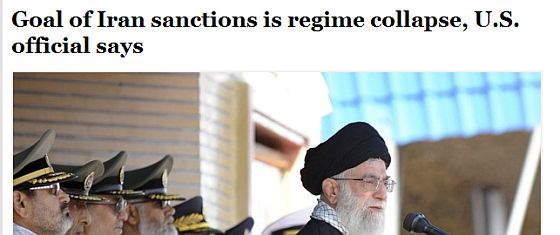
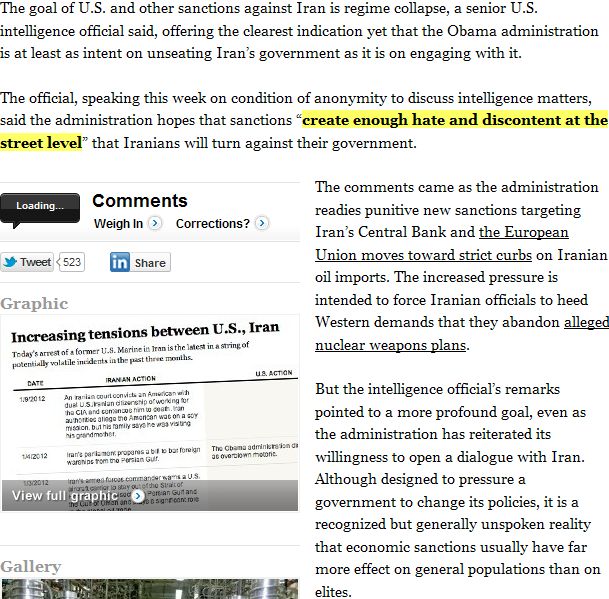
How does a senior U.S. intelligence official tell a Washington Post reporter that the administration’s goal in imposing sanctions on Iran is to bring about regime change, if that is not in fact the goal?

Washington Post -- By Karen DeYoung and Scott Wilson, Tuesday, January 10, 4:22 PM

The article (cached version) with this headline (which was later substantially re-written) begins:

The revised version of the article, under a revised headline, “Public ire one goal of Iran sanctions, U.S. official says”, begins:

The Obama administration sees economic sanctions against Iran as building public discontent that will help compel the government to abandon an alleged nuclear weapons program, according to a senior U.S. intelligence official.

In addition to influencing Iranian leaders directly, the official said, “another option here is that [sanctions] will create hate and discontent at the street level so that the Iranian leaders realize that they need to change their ways.”

The intelligence official’s remarks pointed to what has long been an unstated reality of sanctions: Although designed to pressure a government to change its policies, they often impose broad hardships on a population.

So who would this senior intelligence official be? CIA director David Petraeus? And was he misquoted? Or was he being too candid? Or is the Washington Post colluding with the administration in sending out a mixed message?

Facebooktwittermail

Israel prepares for nuclear-armed Iran

The Times reports: Israel has begun thinking the unthinkable: that it will have to deal with a nuclear-armed Iran within a year.

In documents seen by The Times, Israeli officials have begun preparing scenarios for the day after a nuclear weapons test.

The move is a tacit recognition that Israel is backing away from its long-held position that it would do everything in its power – including mounting a military strike – to stop Iran acquiring nuclear capabilities.

Details of the war game, which was enacted by former ambassadors, intelligence officials and ex-military chiefs, emerged as the United Nations’ nuclear watchdog confirmed yesterday that Iran has begun producing enriched uranium in an underground bunker designed to withstand airstrikes.

The International Atomic Energy Agency said that it was monitoring the work at the Fordow facility, which is concealed in a mountain near the holy city of Qom.

The simulation exercise was conducted in Tel Aviv last week by the Institute for National Security Studies (INSS), a think-tank. Its conclusions suggest that a nuclear test would radically shift the whole power balance of the Middle East.

Facebooktwittermail

U.S. citizen’s death sentence heightens tensions with Iran

The New York Times reports: Iran’s judiciary yesterday sentenced to death an imprisoned American convicted of espionage for the CIA, a punishment that shocked his family and was imposed against a backdrop of increasingly bellicose relations with the United States over the disputed Iranian nuclear program.

The sentence against the American, Amir Mirzaei Hekmati, 28, a retired Marine, was likely to become a new point of contention, and possible bargaining leverage, in Iran’s struggle against the West over its nuclear program. A tightening vise of sanctions, which threaten vital oil sales and with them Iran’s economy, has left Tehran feeling besieged and has pushed relations with the United States and its allies to the lowest ebb since the 1979 Islamic Revolution.

In retaliation, Tehran announced on Sunday that it had begun to enrich uranium at a second site, after having threatened to close the Strait of Hormuz to shipping, a measure that would severely curtail oil shipments.

The details of the case against Hekmati have been cloaked in secrecy since he was detained in August in Iran, to which his family said he had traveled to visit his grandparents. Official confirmation that he was even in Iranian custody was not provided until last month. The White House and the State Department, noting that Iranian prosecutors have a history of coercing confessions, denied that Hekmati was a spy and called for his immediate release. The CIA declined to comment.

Facebooktwittermail

Iran starts uranium enrichment at Fordo mountain facility, Kayhan reports

Bloomberg reports: Iran has started to enrich uranium at its Fordo production facility, the official Kayhan newspaper reported without saying where it got the information.

Iran will soon have a ceremony to open the site officially, the newspaper reported, citing the head of the Iranian Atomic Energy Organization, Fereydoun Abbasi. The Iranian nuclear chief was cited yesterday by Mehr News as saying that the underground facility “will start operating in the near future.”

The existence of the Fordo plant, built into the side of a mountain near the Muslim holy city of Qom, south of Tehran, was disclosed in September 2009, heightening concern among the U.S. and its allies who say Iran’s activities may be a cover for the development of atomic weapons. The Persian Gulf country has rejected the allegation, saying it needs nuclear technology to secure energy for its growing population.

The Associated Press reports: Defense Secretary Leon Panetta says Iran is laying the groundwork for making nuclear weapons someday, but is not yet building a bomb and called for continued diplomatic and economic pressure to persuade Tehran not to take that step.

As he has previously, Panetta cautioned against a unilateral strike by Israel against Iran’s nuclear facilities, saying the action could trigger Iranian retaliation against U.S. forces in the region.

“We have common cause here” with Israel, he said. “And the better approach is for us to work together.”

Panetta’s remarks on CBS’ Face the Nation, which were taped Friday and aired Sunday, reflect the long-held view of the Obama administration that Iran is not yet committed to building a nuclear arsenal, only to creating the industrial and scientific capacity to allow one if its leaders to decide to take that final step.

Facebooktwittermail

Iran could be bluffing in the strait of Hormuz — but can U.S. risk calling it?

Simon Tisdall writes: Tehran’s vow to stop US warships crossing international waters in the strait of Hormuz, following 10 days of provocative Iranian missile tests and naval exercises, is seen in Washington as evidence that ramped-up western sanctions are finally beginning to bite.

While this conclusion may be correct, there is always the danger of a disastrous miscalculation. Iran could be merely sabre rattling, as American analysts suggest. But what if it is not?

Seen from Tehran, the most serious threat to the survival of the regime led by supreme leader Ayatollah Ali Khamenei comes from within, not without – a consideration not sufficiently understood in the west. The political establishment is riven by deep divisions, principally between economic reformers loyal to President Mahmoud Ahmadinejad, and clerical arch-conservatives backed by the Revolutionary Guards and a wealthy, corrupt merchant class that has grown fat on the 1979 revolution.

Khamenei appears to be trying to hold the line between the two factions. What worries him more than the movements of the USS John C Stennis aircraft carrier group in the Gulf, or even US and EU oil sanctions, is the thought that crucial parliamentary elections due in March could produce a permanent rupture within the Islamic Republic. Such a split could open the way to a second Iranian revolution.

Memories of the mass demonstrations that shook Tehran and other cities in 2009 after rigged presidential elections have not faded. The Green movement’s leaders are dispersed, in jail or under house arrest. But their demands for transparent democracy, freedom of expression and an end to misrule by mullahs have not been forgotten. Millions of young Iranians have been watching the Arab spring unfold and they believe Iran’s turn will come.

Khamenei is running scared. As Yasmin Alem noted in a recent commentary, the supreme leader views the coming election as a potential “security challenge”. The minister of intelligence, Heydar Moslehi, says the polls will be the “most sensitive elections in the history of the Islamic Republic”.

Facebooktwittermail

Tehran ‘welcomes’ U.S. navy rescue of Iranian fishermen

RFE/RL reports: Iran has broken its official silence over the U.S. Navy’s rescue of 13 Iranian fishermen from the hands of pirates by calling the January 5 operation a “welcome and humanitarian act.”

Foreign Ministry spokesman Ramin Mehmanparast told Iran’s Arabic-language broadcaster, Al-Alam, that “all nations should display such behavior.”

“We consider the actions of the U.S. forces in saving the lives of the Iranian seamen to be a humanitarian and positive act and we welcome such behavior,” Mehmanparast was quoted as saying.

The U.S. Navy said it had provided food, water, and medical assistance to the shaken sailors before returning them to their refueled dhow and taking the suspected Somalian pirates into custody for possible prosecution.

The Iranians are thought to have spent around a month and a half in captivity after the pirates stormed their Iranian-flagged vessel in the northern Arabian Sea.

Facebooktwittermail

Iranians fear war, deprived of life-saving medicines — Washington satisfied

The Obama administration’s definition of diplomacy with Iran is that it does not talk about “regime change.” Instead it talks about “tightening the noose.”

As the rial collapses and Iranians die because they can’t afford life-saving medicines, no doubt they feel deeply grateful for America’s kind attention.

The Washington Post reports: At a time when U.S. officials are increasingly confident that economic and political pressure alone may succeed in curbing Iran’s nuclear ambitions, the mood here has turned bleak and belligerent as Iranians prepare grimly for a period of prolonged hardship and, they fear, war.

This stark contrast has been evident in the Iranian capital this week as a top military commander declared a “critical point” in the country’s long feud with the West and ordinary Iranians stocked up on essential supplies. Merchants watched helplessly as the Iranian currency, the rial, shed more than a third of its value, triggering huge increases in the prices of imported goods.

“I will tell you what this is leading to: war,” said a merchant in Tehran’s popular Paytakht bazaar who gave his name only as Milad. “My family, friends and I — we are all desperate.”

The sense of impending confrontation is not shared in Washington and other Western capitals, where government officials and analysts expressed cautious satisfaction that their policies are working.

Former and current U.S. government officials did not dismiss the possibility of a military confrontation but said they saw recent threats by Iranian leaders — including warning a U.S. aircraft carrier this week not to return to the crucial Strait of Hormuz — mainly as signs of rising frustration. U.S. officials say this amounts to vindication of a years-long policy of increasing pressure, including through clandestine operations, on Iran’s clerical rulers without provoking war.

“The reasons you’re seeing the bluster now is because they’re feeling it,” said Dennis Ross, who was one of the White House’s chief advisers on Iran before stepping down late last year. With even tougher sanctions poised to take effect in weeks, the White House had succeeded in dramatically raising the costs of Iran’s nuclear program, he said.

“The measure, in the end, is, ‘Do they change their behavior?’ ” Ross said.

The Obama administration is readying new punitive measures targeting the Central Bank of Iran, while leaders of the European Union took a step this week toward approving strict curbs on imports of Iranian petroleum in hopes of pressuring the nation to abandon what they say is a drive to develop nuclear weapons. Iran says its nuclear program is for peaceful energy production.

State Department spokes­woman Victoria Nuland deemed as “very good news” the E.U.’s commitment to shutting off the flow of Iranian oil to Europe.

“This is consistent with tightening the noose on Iran economically,” Nuland told reporters Wednesday. “We think that the place to get Iran’s attention is with regard to its oil sector.”

In Tehran, that tightening is being felt by millions of people. Economists and independent analysts say the sanctions have aggravated the country’s chronic economic problems and fueled a currency crisis that is limiting the availability of a broad array of goods, including illegally imported iPhones and life-saving medicines.

Facebooktwittermail

U.S. sending thousands of troops to Israel

The Associated Press reports: The Israeli military is gearing up together with U.S. forces for a major missile defense exercise, the Israeli military announced Thursday, as tension between Iran and the international community escalates.

The drill is called “Austere Challenge 12” and is designed to improve defense systems and cooperation between the U.S. and Israeli forces. It follows a 10-day Iranian naval exercise near the strategic Strait of Hormuz.

Israel’s military said the drill with the U.S. was planned long ago and is not tied to recent events.

Both Israeli and U.S. officials said the exercise would be the largest-ever joint drill by the two countries.
[…]
Martin Van Creveld, a military historian at the Hebrew University of Jerusalem, said Thursday that the drill was intended not only to practice military maneuvers but also to pressure Iran.

“Defending against an attack is not something that you improvise from today to tomorrow. It’s something you have to prepare, you have to rehearse, you have to prepare for,” Van Creveld said. “This, among other things, is an exercise to show Iran, the people in Tehran, that Israel and the United States are ready to counterattack,” he said.

Just before Christmas, the Jerusalem Post reported: Last week, Lt.-Gen. Frank Gorenc, commander of the US’s Third Air Force based in Germany, visited Israel to finalize plans for the upcoming drill, expected to see the deployment of several thousand American soldiers in Israel.

The drill, which is unprecedented in its size, will include the establishment of US command posts in Israel and IDF command posts at EUCOM headquarters in Germany – with the ultimate goal of establishing joint task forces in the event of a large-scale conflict in the Middle East.

The US will also bring its THAAD (Terminal High Altitude Area Defense) and shipbased Aegis ballistic missile defense systems to Israel to simulate the interception of missile salvos against Israel.

Israel’s Infolive.tv broadcast a report on the upcoming exercise last July.

Last August the Jewish Institute for National Security Affairs (JINSA) — one of the pillars of the Israel lobby in Washington — reported:

The Israel Defense Force’s two premier training bases recently saw some 200 U.S. Marines spend a month improving their counter-terror and urban combat skills alongside Israeli troops. At nearly the same time, the U.S. Army announced that in May 2012 it intends to hold Austere Challenge, one of the largest joint exercises in the history of the two countries that will take place in Israel. Just as significant, the annual U.S.-Israel Juniper Cobra missile defense exercises will take place just before the joint IDF-U.S. Army exercise.

As part of the ongoing cooperation between IDF ground forces and the U.S. Marine Corps, a company from the U.S. Marine Corps’ Security Force Regiment, a dedicated security and anti-/counter-terrorism unit, came to Israel in July for a month of intensive training alongside IDF soldiers at IDF facilities.

Facebooktwittermail

Oil price would skyrocket if Iran closed the Strait of Hormuz

The New York Times reports: If Iran were to follow through with its threat to blockade the Strait of Hormuz, a vital transit route for almost one-fifth of the oil traded globally, the impact would be immediate: Energy analysts say the price of oil would start to soar and could rise 50 percent or more within days.

An Iranian blockade by means of mining, airstrikes or sabotage is logistically well within Tehran’s military capabilities. But despite rising tensions with the West, including a tentative ban on European imports of Iranian oil announced Wednesday, Iran is unlikely to take such hostile action, according to most Middle East political experts.

United States officials say the Navy’s Fifth Fleet, based in nearby Bahrain, stands ready to defend the shipping route and, if necessary, retaliate militarily against Iran.

Iran’s own shaky economy relies on exporting at least two million barrels of oil a day through the strait, which is the only sea route from the Persian Gulf and “the world’s most important oil choke point,” according to Energy Department analysts.

A blockade would also punish China, Iran’s most important oil customer and a major recipient of Persian Gulf oil. China has invested heavily in Iranian oil fields and has opposed Western efforts to sanction Iran over its nuclear program.

Despite such deterrents to armed confrontation, oil and foreign policy analysts say a miscalculation is possible that could cause an overreaction from one side or the other.

“I fear we may be blundering toward a crisis nobody wants,” said Helima Croft, senior geopolitical strategist at Barclays Capital. “There is a peril of engaging in brinksmanship from all sides.”

Reuters reports: Some sanctions experts argue that, paradoxically, growing evidence of the restrictions’ impact may complicate the diplomacy that will eventually be needed to resolve the West’s long-running standoff with Tehran.

Following years of patient statecraft, the tightened curbs represent a step-change in efforts by Western governments to hold back activities they suspect are aimed at building an atomic bomb. Iran insists its work is strictly non-military.

In large part, the curbs’ new clout stems from a U.S. measure signed into law on December 31 in effect targeting Iran’s central bank, the OPEC member state’s payment conduit for its lifeline oil exports.

On Wednesday European Union diplomats said European governments had agreed in principle to ban imports of Iranian oil, further raising pressure on the world’s Number 5 crude exporter.

The resort to heavier coercion must be balanced by a corresponding increase in diplomatic attention so as to avert deeper Iranian inflexibility and exploit any new openings the sanctions might deliver, some sanctions skeptics say.

Yet to some, it’s not clear whether the West will be as adroit in engaging with Iran as it has been in sanctioning it.

“The West needs a flexible and imaginative approach to enable the Iranians eventually to climb down,” Richard Dalton, Britain’s ambassador to Tehran from 2002 to 2006, told Reuters.

Dalton fears Washington could stumble into a war with Iran through mischance or miscalculation by either side, as tension rises.

George Lopez, a political scientist at the University of Notre Dame, Indiana, who has long monitored sanctions policy against Iran, North Korea and Iraq, said Obama’s targeting of the central bank was a turning point in which Tehran in effect was now being treated as “an outcast regime.”

“The U.S. is moving from essentially non-proliferation sanctions to condemnation of the system,” he told Reuters.

Lopez added the onus was going to be on the Obama administration to reemphasize the possibility of the diplomatic track and the goal of denuclearization rather than regime change.

Michael Cembalest, the global head of investment strategy for J.P. Morgan Asset Management, in an appendix to his 2012 Outlook titled “Learning to live with a nuclear Iran,” points out:

After the NATO intervention in Libya, Ayatollah Khamenei gave a speech saying that Ghaddafi’s mistake was giving up his nuclear program, as it made him vulnerable to outside intervention. This reduces the chances of a deal whereby Iran agrees to meaningful compromises.

Why indeed would Tehran trust an American president who came into office promising diplomatic engagement yet who now appears willing to pander to those in Washington who seek regime change? The only thing that Washington and Tehran now share is mutual distrust. In the absence of diplomacy that mistrust will only deepen and as it does so, create new hazards.

Facebooktwittermail

Hard-line U.S. policy tips Iran toward belligerence

Vali Nasr writes: The latest warning by Iran, that a U.S. aircraft carrier that recently transited through the Strait of Hormuz should not do so again, is a sign to the West that should be well-observed. It tells us the regime in Tehran is ready for a fight.

Tensions between Iran and the U.S. are so high, a conflagration could be tripped off without either country intending it. This latest spiral of hostility began after the U.S. and its European allies responded to the International Atomic Energy Agency’s report on Iran’s nuclear activities by imposing and threatening additional, tougher sanctions. New U.S. measures may drastically cut Iran’s oil revenue.

That, in turn, may threaten the Iranian regime’s hold on power. Predictably, then, the ruling clerics are responding with shows of strength to boost solidarity at home. And they can be counted on to accelerate Iran’s nuclear program, which they see as a deterrent to foreign intervention.

To escape this self-defeating outcome, the Western powers should imagine how the situation looks from Tehran.

In recent months, Iranian protesters have brazenly attacked the U.K. Embassy in Tehran. Iran has claimed to have downed a U.S. drone, put on 10-day war games simulating attacks on U.S. ships, and threatened to push oil prices to $250 a barrel and to close the Strait of Hormuz, through which about 20 percent of all oil trade passes.

This defiance marks a change. Until recently, Iran had absorbed economic pressure from abroad. It had remained silent in the face of covert operations aimed at slowing the progress of its nuclear program, brushing off the destructive Stuxnet computer worm, apparently a joint U.S.-Israeli project. But the government has been embarrassed and unnerved by multiple assassinations of its scientists and by suspicious explosions at its military facilities. One blast killed the general charged with developing Iran’s missile program. The attacks have shaken the country’s security forces.

The ruling clerics are also worried about the impact of economic sanctions, which have greatly reduced Iran’s access to global financial markets, created shortages of imported items, and increased inflation and unemployment. The rial has fallen to its lowest point against the dollar, and capital is fleeing the country at an alarming rate. The government has been forced to scrap numerous infrastructure projects, especially in the oil- and-gas sector.

These hardships have caused popular discontent. The next set of sanctions may bring street protests. Iran’s rulers fear a repeat of the demonstrations of 2009. They now see the U.S. policy on Iran — of toughening sanctions and also, at the United Nations, addressing Iran’s human-rights record and support for terrorism — as one aimed at regime change.

Meanwhile, The Guardian reports: European governments have agreed in principle to impose a ban on imports of oil from Iran, a potentially serious blow to the already unsteady Iranian economy and a significant escalation in the international pressure on the Tehran government.

Negotiations on a European oil embargo on Iran have been under way since an EU foreign ministers meeting last month. On Wednesday night a European diplomat said there was now a consensus that the ban on crude imports would be applied, but that there was still debate on the timing and duration of the measures.

“There is agreement in principle on Iranian oil imports,” the diplomat said. “What is now being discussed is what exceptions there would be for existing contracts and what kind of review clause there will be.”

The formal agreement on the measures is due to be finalised by the next EU foreign ministers meeting on 30 January, but the sanctions will probably not take effect immediately. One diplomat said they could come into force at the same time as US financial sanctions aimed at international banks financing Iranian crude oil sales.

Facebooktwittermail

Panetta’s indirect message to Iran

A shift in the Pentagon’s military doctrine also seems to be signalling an indirect message to Iran: the U.S. won’t go to war but it will “spoil” the Islamic state’s nuclear ambitions. The question is, how can the U.S. continue with its efforts to spoil Iran’s ambitions without sliding into war?

The New York Times reports: Defense Secretary Leon E. Panetta is set this week to reveal his strategy that will guide the Pentagon in cutting hundreds of billions of dollars from its budget, and with it the Obama administration’s vision of the military that the United States needs to meet 21st-century threats, according to senior officials.

In a shift of doctrine driven by fiscal reality and a deal last summer that kept the United States from defaulting on its debts, Mr. Panetta is expected to outline plans for carefully shrinking the military — and in so doing make it clear that the Pentagon will not maintain the ability to fight two sustained ground wars at once.

Instead, he will say that the military will be large enough to fight and win one major conflict, while also being able to “spoil” a second adversary’s ambitions in another part of the world while conducting a number of other smaller operations, like providing disaster relief or enforcing a no-flight zone.

Pentagon officials, in the meantime, are in final deliberations about potential cuts to virtually every important area of military spending: the nuclear arsenal, warships, combat aircraft, salaries, and retirement and health benefits. With the war in Iraq over and the one in Afghanistan winding down, Mr. Panetta is weighing how significantly to shrink America’s ground forces.

Facebooktwittermail

Iran-U.S. tensions over Gulf send oil prices soaring

The Guardian reports: The price of oil jumped by $4 a barrel on Tuesday as tension between Iran and the US fuelled fears of disruptions to supply.

Brent crude spot prices rose from $107 to $111 after Iran threatened to take action if the US navy moves an aircraft carrier into the Gulf.

US light crude, which dropped below $100 a barrel before Christmas, hit $102.23 a barrel – a rise of $3.40 on the day.

Analysts said the jump in prices was likely to continue as long as Tehran appeared ready to use force against US warships patrolling the strategically vital strait of Hormuz at the mouth of the Gulf.

Iran’s army chief, General Ataollah Salehi, warned a US aircraft carrier not to return to the Gulf or risk attack by new surface-to-sea missiles tested by the military in recent days.

Tehran’s latest tough rhetoric over the waterway is part of a feud with the US over new sanctions designed to discourage the Iranian state from developing nuclear weapons.

Salehi spoke as a 10-day Iranian naval exercise ended near the strait of Hormuz. Iranian officials have said the drill aimed to show that Iran could close the shipping route, as it has threatened to do if the US brings into force strong new sanctions over Iran’s nuclear programme.

Facebooktwittermail