Category Archives: Iran

What would happen if Iran had the bomb?

Christian Science Monitor reports: Analysts say Iran is not an irrational, suicidal actor that can’t be deterred. Nor do they believe it is determined to destroy Israel at all costs. A recent Israeli think tank simulation of “the day after” an Iranian nuclear test came to the same conclusion: that nuclear annihilation will not automatically result.

Yet a nuclearized Iran would precipitate some profound changes across a chronically unstable region. Military balances would shift. Political relations among antagonists – and allies – would become more complicated. Israel would lose its nuclear hegemony in the Middle East.

Underlying it all loom major questions. Would Iran, implacable foe of the US and Israel, suddenly become beyond attack, like North Korea? Would Iran and Israel settle into a decades-long regional cold war, like that between India and Pakistan? Would Iran’s jittery Persian Gulf neighbors rush to become nuclear powers themselves, setting off a dangerous and irreversible new arms race?

The questions swirled as Iran signaled on Feb. 16 that it was ready with “new initiatives” to resume long-stalled talks over its nuclear program with the US and other big powers. But the Iranians were nebulous about any possible concessions to previous Western demands – demands that diplomats say have only risen higher in a US election year. Renewed chances of talks came during a week when Tehran also proclaimed new advances in nuclear technology. As a result of all this, the possibility of any political breakthrough is far from certain.

It is not a fait accompli, of course, that Iran will build a bomb, even though it sometimes seems as if it is – and many Americans believe the country already has. As recently as 2010, for instance, a CNN poll found that 71 percent of Americans believed Iran has a nuclear arsenal.

Yet American intelligence agencies agree that Tehran hasn’t yet decided to go for a nuclear bomb – and that even if it chose to, it would take years to create one and the means to deliver it. Israeli intelligence is also reported to have reached the same conclusion.

In testimony before Congress in late January, the US director of national intelligence, James Clapper, said Iran is “keeping open the option” to develop nuclear weapons. But, he added, “we do not know” if it will. The United Nations’ nuclear watchdog agency, the International Atomic Energy Agency (IAEA), in its latest report last November, detailed alleged weapons-related work for the first time, but said “systematic” work was halted in 2003.

Tehran has long claimed it wants only to make nuclear power peacefully, and in Iran, embracing “nuclear rights” enjoys wide, popular support because it blends national pride and scientific prowess. Publicly, Iranian rulers profess to reject atomic weapons, and at the highest levels they evoke Islamic religious reasons to oppose all weapons of mass destruction.

Yet analysts and diplomats note that Iran does have many reasons to develop at least a “breakout” capability – the ability to assemble a bomb quickly should it want to. Tehran has watched modern history unfold around it and no doubt has drawn its own conclusions. Acquiring nuclear weapons helped preserve regimes in North Korea and Pakistan, for instance. But in Iraq and Libya, two nonnuclear countries, Saddam Hussein and Muammar Qaddafi were deposed. The Iranian media, in fact, tut-tutted last year that Mr. Qaddafi’s fatal error was relinquishing his secret nuclear weapons program in 2004.

“If I was an Iranian national security planner, I would want nuclear weapons,” Bruce Riedel, a 30-year veteran of the CIA now at the Brookings Institution in Washington, said in January.

“Look at the neighborhood that I live in: Everyone else has nuclear weapons who matters; and those who don’t, don’t matter, and get invaded by the United States of America,” Mr. Riedel said on a panel hosted by the Atlantic Council, a Washington think tank.

In other words, the reason Tehran might pursue a bomb is the same one that has propelled every nuclear state in history: self-protection. [Continue reading…]

The New York Times reports: The United States and the European Union signaled on Friday that negotiations with Iran over its nuclear program could soon resume for the first time in more than a year, even as a telecommunications network vital to the global banking industry prepared to expel Iranian banks.

While senior American and European officials stopped short of declaring a diplomatic breakthrough, Iran dropped previously unacceptable preconditions for talks in a letter this week from its senior nuclear negotiator, Saeed Jalili, who declared his country’s “readiness for dialogue” at “the earliest possibility.”

After weeks of official bluster, ominous threats of military action in the Persian Gulf, and assassination attempts on Israelis in India, Thailand and Georgia that Iranian agents have been blamed for, the offer appeared to be a genuine concession by Iran, the officials said, though one made under the duress of tightening economic sanctions against the country.


Facebooktwittermail

Iran seems an unlikely culprit for the attacks on Israeli diplomats

Arshin Adib-Moghaddam writes: Let’s assume that sections of the military and security apparatus in Iran are responsible for the string of bombings in Georgia, Thailand and India. What would be the motive? The argument that Iran is retaliating for the murder of five civilian nuclear scientists in Iran is not plausible. If Iran wanted to target Israeli interests, it has other means at its disposal. It is hard to imagine that the Iranian government would send Iranian operatives to friendly countries, completely equipped with Iranian money and passports – making the case against them as obvious as possible.

If the Iranian Revolutionary Guards are as professional, highly trained and politically savvy as we have been told repeatedly by Israeli politicians themselves, if they have successfully trained and equipped the cadres of Hezbollah and other movements with paramilitary wings in the region, then why would they launch such a clumsy and self-defeating operation?

And why India, Georgia and Thailand, three countries that Iran has had cordial relations with during a period when Iran is facing increasing sanctions spearheaded by the United States? A few days ago, India agreed a rupee-based oil and gas deal with Iran and resisted US pressures to join the western boycott of the Iranian energy sector. As a net importer of 12% of Iranian oil, India’s total trade with Iran amounted to $13.67bn in 2010-2011. What would be the motive for damaging relations with one of Iran’s major trading partners and regional heavyweights?

For Iran it doesn’t make sense to risk alienating India by launching an assassination attempt in the capital of the country. Similarly, Iran has good economic and political relations with Georgia and Thailand. Why would the leadership in Tehran risk a major crisis with these countries during this sensitive period when IAEA inspectors are moving in and out of Iran to investigate the country’s nuclear programme?

Facebooktwittermail

Unfazed by U.S. sanctions, India to step up ties with Iran

The Times of India reports: Unfazed by US sanctions and Israel linking Tehran to the attack on an Israeli embassy car here, India is set to ramp up its energy and business ties with Iran, with a commerce ministry team heading to Tehran to explore fresh business opportunities.

The team is expected to go to Tehran later this month to discuss steps to expand India’s trade with Iran, part of a larger strategy to pay for Iranian oil, said highly-placed sources.

Despite the US and European Union sanctions on Iran, India recently sealed a payment mechanism under which Indian companies will pay for 45 percent of their crude oil imports from Iran in rupees.

Not just oil, India is also stepping up the refurbishing of the Chabahar Port in Iran and a strategic railway link that will offer it direct access to Afghanistan and the energy-rich Central Asia.

Facebooktwittermail

How to engage Iran

Hossein Mousavian writes: Since the 1979 Islamic Revolution, two major schools of thought have influenced Iran’s foreign policy toward the United States. The first maintains that Iran and the United States can reach a compromise based on mutual respect, noninterference in domestic affairs, and the advancement of shared interests. Those who hold this view acknowledge the animosity and historical grievances between the two countries but argue that it is possible to normalize their relations. The second school is more pessimistic. It deeply distrusts the United States and believes that Washington is neither ready nor committed to solving the disputes between the two countries.

Having worked within the Iranian government for nearly 30 years, and having sat on the secretariat of Iran’s Supreme National Security Council for much of the decade before 2005, I was involved in discussions about both of these two approaches. My first personal experience in these matters dates to the late 1980s, when the critical issue facing the United States and Europe was the release of Western hostages in Lebanon. During that period, Iran received dozens of messages from Washington proposing that each side, echoing U.S. President George H. W. Bush’s 1989 inaugural address, show “goodwill for goodwill.”

That year, Bush offered then Iranian President Ali Akbar Hashemi Rafsanjani a deal: If Iran assisted in securing the release of U.S. and Western hostages in Lebanon, the United States would respond with a gesture of its own. In response, Tehran emphasized its expectation that the United States would unfreeze and return billions of dollars in Iranian assets that were being held in the United States. The Iranian leadership also came away from discussions believing that Israel would reciprocate by releasing some Lebanese hostages, specifically Sheikh Abdul Karim Obeid, the leader of Hezbollah.

Then the two schools of thought came into play. Rafsanjani believed that this deal could be a confidence-building measure that would lead to rapprochement with the United States. Ayatollah Ali Khamenei, Iran’s supreme leader, warned against trusting the United States and thought it naive to expect Washington to repay Tehran’s efforts in kind. Then, as now, he believes that the United States is after nothing less in Iran than regime change. Ultimately, Iran decided to play a key role in securing the release of all Western hostages in Lebanon. But the United States neither released Iranian assets nor facilitated the release of Lebanese hostages.

Facebooktwittermail

Tehran can limp along under sanctions, but ordinary Iranians are bearing the brunt

Michael Theodoulou reports: International sanctions targeting Iran’s oil exports are inflicting economic pain but may well fail to force Tehran to compromise on its nuclear ambitions and could even make the regime more intransigent, analysts said.

The unprecedented measures could also boomerang by driving up oil prices, hitting the jittery global economy, they said.

“In the process of hunting for alternative sources to Iranian oil, it’s virtually certain that the price of oil is going to rise,” said Gary Sick, an Iran expert and former White House policy adviser at Columbia University in New York.

Ordinary Iranians complain that they, rather than their defiant and resilient regime, are bearing the brunt of sanctions that are compounding problems caused by the government’s economic mismanagement.

US financial sanctions imposed at the beginning of this year are playing havoc with Iran’s ability to receive payments for its oil exports. But they are also causing serious disruption to Tehran’s imports, with a real effect on the Iranian street where prices for basic foodstuffs are soaring. Malaysian exporters of palm oil, critical to Iran’s food industry, have halted sales to Tehran because they could not get paid.

A margarine factory owner in Iran told Reuters: “The way things are going, I predict that over the next three to four months our edible oil will run out because of sanctions.”

A default by Iranian buyers on purchases of 200,000 tonnes of Indian rice is potentially more crippling, and imports of tea from India, Iran’s favourite beverage, are facing similar payment hurdles. Iran, meanwhile, is reportedly seeking to close grain purchases using gold and oil as payment.

The Iranian rial has lost half its value against the dollar in recent weeks. The official inflation rate stands at 20 per cent but it is thought to be much higher, and the same applies to the official unemployment rate of 14.6 per cent.

With the rial plummeting, the price of rice, a main dietary staple of Iran’s 74 million people, has more than doubled in a year to $5 a kilo. The cost of meat has almost tripled to about $30 a kilo, beyond the budget of many middle-class families.

Facebooktwittermail

Mahmoud Ahmadinejad called to account before Iranian parliament

The Guardian reports: The Iranian parliament has summoned the president, Mahmoud Ahmadinejad, to answer a series of questions over the government’s handling of the economy and his personal judgments.

The move is unprecedented in the history of the Islamic republic.

After a year of internal debate and unsuccessful attempts to question or impeach the president, MPs secured enough signatures for an attempt to summon Ahmadinejad. They succeeded in persuading the parliament’s presiding board to read the motion during Tuesday’s open session.

The move comes at a time of discontent at home owing to western economic sanctions and growing international isolation over Iran’s nuclear programme. In recent weeks, fears of a major confrontation between Iran and the west have grown.

Within a month of receiving the summons, Ahmadinejad is required by law to appear in the parliament. Otherwise, MPs may impeach him. However, such a decision does not follow automatically either from his failing to attend the session or from his failing to give answers that satisfy parliament.

Facebooktwittermail

For the U.S., sanctions have become an alternative to policy on Iran

M.J. Rosenberg writes: News on the Iran front is getting more and more complicated. I am not referring to the situation at Iran’s nuclear facilities but to the one here in Washington, where Congress, deep into election-year fundraising and thinking about the March AIPAC policy conference, is crafting yet another sanctions bill. There is no reason to go into the details. But suffice it to say, this new set of sanctions, like the rest, will primarily hurt ordinary Iranians, not the government. As one Iranian citizen, writing under a pseudonym, described the situation this week in the New York Daily News:

These days, ordinary Iranians like my mother are becoming increasingly aware of a new economic reality in their lives. Sanctions already in place have plunged the country’s economy into a crisis; more robust sanctions that will be enacted come spring on our financial system and oil trade will cause even more pain for an already-suffering populace.

Isn’t life in Iran difficult enough under the regime of Supreme Leader Ayatollah Ali Khamenei? Why punish ordinary people more?

Did we punish the Poles or the Bulgarians for living under communism? Did we punish the people of the Soviet Union because their government had a nuclear arsenal primed to destroy us? No. In fact, we gave the people of those countries food. As President Richard Nixon (like President Ronald Reagan later) liked to remind us, our adversary was the leadership of the Soviet Union, not the average citizens in the different Soviet republics.

But that is not how we have been approaching the Iran. Not by a long shot.

In A Single Roll of the Dice, a comprehensive new book about U.S.-Iran relations since President Obama came to office, Iran expert Trita Parsi examines the effect that the purely punitive approach (i.e., sanctions) can have on changing the Iranian government’s behavior.

Specifically, Parsi points out that “sanctions have become an alternative to policy” rather than an instrument of policy. He explains that “if diplomacy is pursued again” it must be “for the sake of resolving the conflict, not for the sake of creating an impetus for more sanctions.”

Abandoning a sole reliance on sanctions is Parsi’s first of six recommendations for establishing a diplomacy track with Iran that will succeed. [Continue reading…]

Facebooktwittermail

Oil industry sees China winning, West losing from Iran sanctions

Reuters reports: As the European Union prepares to ban Iranian oil and the United States turns the screw on payments, oil executives and policymakers say China and Russia stand to gain the most and Western oil firms and consumers may emerge the biggest losers.

Iran will continue to sell much the same volume of oil – 2.6 million barrels per day or around 3 percent of world supply – but almost all of it will flow to China, they reason. And being pretty much Iran’s only remaining customer, Beijing will be able to negotiate a much reduced price.

The EU will ban Iranian oil from July. The United States plans sanctions on Iran’s central bank and possibly its shipping firm. European headquartered oil firms such as France’s Total and Royal Dutch Shell have already abandoned Iranian oil purchases or are in the process of doing so.

Japan and South Korea have signaled they may reduce purchases of Iranian oil to comply with U.S. sanctions designed to put pressure on Tehran over its nuclear program.

That leaves a growing number of buyers competing for alternative supplies. Inevitably attention has turned to Saudi Arabia, the world’s biggest exporter and the only country that can quickly increase oil output and help the West avoid a price spike that would deal a severe economic blow.

Meanwhile, the Financial Times reports that “Iran’s parliament could ban oil exports to Europe as early as next week, in a move that could hit economically weak southern European countries.” The EU recognizes that Greece, Spain and Italy need several months to secure alternative supplies to the ones they now rely on from Iran.

Facebooktwittermail

Iraq makes sanctions against Iran ineffective

Nima Khorrami Assl writes: The US and EU have announced new sanctions in the hope of persuading Iran to abandon its alleged nuclear weapons programme, though how effective these will be is questionable. China, India, Russia, Turkey, Japan, and South Korea have already refused to go along with the new measures. Iran also has the means to evade the sanctions – through its proximity to Iraq.

Iran has often been singled out as the main beneficiary of the US-led invasion of Iraq, as well as the biggest threat to Iraq’s stability in the post-Saddam era. Iran’s uninterrupted support for Shia militia groups in southern Iraq, particularly the Mahdi army, is seen as one indication of its involvement in Iraqi politics and its ability to cause problems for adversaries.

And yet Iran’s key interest in Iraq is less about realpolitik than about trade. Iran is one of Iraq’s most important regional economic partners, with an annual trade volume between the two sides standing at $8bn to $10bn (£5bn to £6.4bn). However, it is Iraq’s 910-mile border with Iran, and therefore its geographical suitability as a smuggling hub for sanctioned goods, which is of paramount importance to Iran at present.

Until 2010, most of the sanctioned goods smuggled into Iran came through the UAE and Oman. Backed by the Iranian government and the Revolutionary Guards (IRGC), “small-size” strategic goods, including aircraft components and sophisticated electronic equipment, were smuggled into the Iranian islands of Kish and Qeshm from Dubai, Ras al-Khaimah and Madha. Since the beginning of 2010, however, the US government has put immense pressure on the Emirati and Omani governments to curb smuggling, threatening that failure to do so would cost them access to US markets and technology.

Wary of this, the UAE and Oman have both made the obvious choice and cracked down on smuggling between the southern and northern edges of the Gulf. In response, the Iranian government has turned its attention to Iraq in order to bypass western sanctions, and has imposed restrictions on Iranian businesses in the Gulf.

So far, most of the smuggling through Iraq has taken place in the mountainous Kurdish regions. For instance, since June 2010, when the US and EU imposed tougher sanctions on Iran’s gasoline imports, hundreds of millions of dollars in crude oil and refined products from the Kurdish region, Kirkuk, and Baiji have been smuggled to Iran on a daily basis.

Facebooktwittermail

Iran to restart IAEA nuclear talks

The Guardian reports: Iran is due to open talks with UN nuclear inspectors on Sunday in an attempt to allay their suspicions of a covert Iranian weapons programme, the first such discussions in more than three years.

The three days of meetings in Tehran between Iranian nuclear officials and a team from the International Atomic Energy Agency (IAEA) represent the only diplomatic progress in more than a year, as tensions mount over Iran’s nuclear programme and western attempts to cut off the country’s oil trade.

Diplomats familiar with the visit said that the IAEA team would seek assurances that they will be able to interview key Iranian scientists suspected of past involvement in weapons research, visit sensitive sites and see documents concerning the procurement of dual-use technology. The Iranian government denies it is seeking to make nuclear weapons, insisting its research is for scientific or civil power-generating purposes.

Diplomats and analysts have played down prospects of a quick breakthrough.

If the talks were to collapse, the pressure on Iran could intensify. The IAEA has warned that Tehran could be referred to the UN security council for possible further punitive measures if it fails to cooperate.

Facebooktwittermail

Iran’s nuclear program has yet to violate international law

Yousaf Butt writes: Olli Heinonen is alarmed that Iran has begun producing 20 percent enriched uranium at a new, deeply buried site, and calculates that Iranian scientists could further purify the material to the 90 percent enrichment needed for a bomb in about six months’ time. This prediction, however, is based on unsubstantiated assumptions regarding Iranian intentions, and only serves to provide ammunition for hawks in Washington that would rush the United States into another destructive war in the Middle East.

If Tehran enriched uranium to 90 percent, it would be forced to break its four decade-long adherence to the Nuclear Non-Proliferation Treaty (NPT) — a momentous step that would likely prompt swift military action from the United States or Israel. Furthermore, Heinonen fails to mention that, according to the International Atomic Energy Agency, “All nuclear material in the facility remains under the Agency’s containment and surveillance.” The IAEA considers 20 percent enriched uranium to be low-enriched uranium and “a fully adequate isotopic barrier” to weaponization.

This isn’t the first time that hawks have raised the alarm about Iran’s nuclear program, claiming that the sky is falling. Breathless, hypothetical timelines to an Iranian bomb have continued almost unabated since the time of the shah. For instance, in 1992, Israeli Foreign Minister Shimon Peres said that Iran would have nuclear warheads by 1999. By casting the worst-case scenario as a realistic possibility, such timelines invite overly tough policies that may, in turn, actually provoke a hard-line Iranian response — creating a self-fulfilling cycle of escalation.

In reality, however, Iran is not doing anything that violates its legal right to develop nuclear technology. Under the NPT, it is not illegal for a member state to have a nuclear weapons capability — or a “nuclear option.” If a nation has a fully developed civilian nuclear sector — which the NPT actually encourages — it, by default, already has a fairly solid nuclear weapons capability. For example, like Iran, Argentina, Brazil, and Japan also maintain a “nuclear option” — they, too, could break out of the NPT and make a nuclear device in a few months, if not less. And like Iran, Argentina and Brazil also do not permit full “Additional Protocol” IAEA inspections.

Facebooktwittermail

Israel: Iran still mulling whether to build nuclear bomb

Haaretz reports: Iran has not yet decided whether to make a nuclear bomb, according to the intelligence assessment Israeli officials will present later this week to Gen. Martin Dempsey, chairman of the U.S. Joint Chiefs of Staff.

Dempsey will be arriving on his first visit here since being appointed chairman of the Joint Chiefs of Staff in September. He will meet with various senior defense officials, including Defense Minister Ehud Barak and Israel Defense Forces Chief of Staff Benny Gantz.

The Israeli view is that while Iran continues to improve its nuclear capabilities, it has not yet decided whether to translate these capabilities into a nuclear weapon – or, more specifically, a nuclear warhead mounted atop a missile. Nor is it clear when Iran might make such a decision.

Israel also believes the Iranian regime now faces an unprecedented threat to its stability, which for the first time combines both external and internal pressure: from abroad, increasingly harsh sanctions and threats of military action, and at home, economic distress and worries about the results of the parliamentary election scheduled for March.

Israeli intelligence sees signs that the regime in Tehran is genuinely worried about the possibility of an opposition victory in March. Should that happen, the regime will have to choose between conceding the loss or falsifying results – as it apparently did in the 2009 presidential election – which could incite anti-regime protests thanks to the tailwind provided by the Arab Spring, which toppled the regimes in Egypt, Tunisia and Libya.

Moreover, the country’s economic woes are already hitting ordinary Iranians in their pockets. Tighter sanctions have caused the Iranian currency to depreciate by dozens of percent; the regime is having trouble amassing as much foreign currency as it needs; and now, it faces the prospect of new sanctions by the United States and the European Union against its central bank and its oil industry.

The regime is also being confronted by two distinct ideological challenges. On one hand, a growing camp that includes supporters of Iranian President Mahmoud Ahmadinejad is challenging the authority of the ruling clerics, and especially that of the supreme leader, Ayatollah Ali Khamenei. On the other, the Iranian model of a strict Islamic regime run by clerics is being called into question by Islamist ruling parties in Turkey, Tunisia and perhaps also Egypt, which either are or will soon be offering more democratic, modern and moderate models of Islamic governance.

Lastly, Tehran’s chief ally, Syrian President Bashar Assad, is in real danger of being toppled as well.

Altogether, therefore, “2011 was a very bad year for the regime in Tehran,” a senior defense official told Haaretz. Israeli analysts believe 2012 will promise more of the same: more pressure, including the tougher public line now being taken by U.S. President Barack Obama, and also more uncertainty and instability, in both the region as a whole and Iran in particular.

All this makes it increasingly hard to predict what Iran will do.

Facebooktwittermail

How Obama should talk to Iran

Trita Parsi writes: Just 13 minutes into his presidency, Barack Obama indirectly reached out to Iran in his inaugural address, offering America’s hand of friendship if Tehran would unclench its fist. After eight years of the George W. Bush administration’s ideological contempt for diplomacy with America’s foes, it was a bold move born out of necessity, not desire.

But Obama’s diplomacy has fallen short. After two rounds of talks in October 2009, in which Tehran refused to accept a U.S. confidence-building measure to exchange its low-enriched uranium in return for fuel for a medical research reactor, the sanctions track was activated. Ever since, Iran and the United States have been on a confrontational path. Washington has imposed unprecedented economic sanctions and isolated Iran politically. In turn, the Iranians have threatened to close the Strait of Hormuz, amassed more low-enriched uranium and begun enrichment at a facility deep underground.

Rather than resolving the nuclear issue, Iran and the United States are inching closer to a military confrontation. But war is not inevitable. Diplomacy, which the Obama administration prematurely abandoned, can still succeed.

“Our Iran diplomacy was a gamble on a single roll of the dice,” a senior State Department official told me in 2010. In short, it either had to work right away or not at all. In fact, six months after the U.S. talks collapsed, Turkey and Brazil secured a version of the fuel swap that Obama had sought.

Fearing that the failure of the U.S. talks would eventually lead to war, Turkey and Brazil stepped in to persuade Iran to accept the American benchmarks for the fuel swap. To the surprise of many in the White House, Turkey and Brazil succeeded.

But by then, it was too late. The Obama administration was already on the path to sanctions. Brazil and Turkey felt snubbed, temporarily chilling their relations with Washington. (Brazil has since turned its focus to other issues, but Turkey is still involved as an occasional mediator with Iran.)

Instead of continuing toward a war the U.S. military doesn’t want, we should double down on diplomacy, in part by emulating Turkey and Brazil’s efforts. In light of news reports this past week that Iran would be open to talks later this month with the P5+1 negotiating group — China, France, Germany, Russia, Britain and the United States — here are five ways we can learn from Turkey and Brazil’s interactions with Iran.

Facebooktwittermail

Iran to let in U.N. atomic inspectors

The Wall Street Journal reports: Iran agreed to host a high-level team of United Nation’s nuclear inspectors later this month, Western diplomats said, a surprise development that could help to curb building tensions with the West.

The diplomats on Thursday said Iran had tentatively agreed to receive a delegation from the United Nation’s International Atomic Energy Agency headed by the agency’s chief weapons inspector, Herman Nackaerts. The diplomats, who are based in Vienna, said the visit was tentatively set for Jan. 28.

Unclear, said the diplomats, was whether Tehran would let the inspectors visit key nuclear sites and interview the Iranian official the U.S. and the U.N. agency believe may head a nuclear-weapons program.

Facebooktwittermail

Nuclear scientists are not terrorists

In an op-ed for the New Scientist, Debora MacKenzie writes: Attempts to derail a country’s nuclear programme by killing its scientists “are products of desperation”, says [William] Tobey [of the Belfer Center for Science and International Affairs at Harvard University] – citing a US effort to kill legendary physicist Werner Heisenberg during the second world war, abandoned at the last minute only when the would-be assassin decided Heisenberg was not involved in a Nazi nuclear effort after all.

“Nuclear scientists are not terrorists,” says Tobey in the BAS this week. Killing them at best delays bomb development, by removing key people and perhaps deterring young scientists from careers in nuclear science. But it will not stop bomb development.

These slim advantages are far outweighed, Tobey says, by the downsides: possible retaliation, reduced chances for diplomacy, tighter security around nuclear installations and a pretext for Iran to hamper IAEA monitoring.

Iran has already accused the IAEA of abetting the assassinations by publicising confidential Iranian lists of key nuclear scientists and engineers.

The IAEA needs such information, as talks with nuclear personnel are considered essential for verifying safeguards against diverting uranium to bombs, says Tobey. Making this process harder only makes sense if the people behind the assassinations think it is too late for safeguards and that slowing bomb R&D by killing scientists is therefore more expedient.

The Israeli columnist Ron Ben-Yishai writes: The most curious question in the face of these incidents is why Iran, which does not shy away from threatening the world with closure of the Hormuz Straits, has failed to retaliate for the painful blows to its nuclear and missile program? After all, the Revolutionary Guards have a special arm, Quds, whose aim (among others) is to carry out terror attacks and secret assassinations against enemies of the regime overseas.

Moreover, if the Iranians do not wish to directly target Western or Israeli interests, they can prompt their agents, that is, Hezbollah, Islamic Jihad and other groups, to do the job. In the past, Iran did not shy away from carrying out terror attacks in Europe (in Paris and Berlin) and in South America (in Buenos Aires,) so why is it showing restraint now?

The reason is apparently Iran’s fear of Western retaliation. Any terror attack against Israel or another Western target – whether it is carried out directly by the Quds force or by Hezbollah – may prompt a Western response. Under such circumstances, Israel or a Western coalition (or both) will have an excellent pretext to strike and destroy Iran’s nuclear and missile sites.

This sounds like a confirmation that Israel is indeed wanting to provoke Iran in order to start a war.

But here’s the paradox: if Iran is intent on developing nuclear weapons then it has ever incentive to continue keeping its powder dry. Why should it jeopardize its nuclear program by succumbing to provocation?

On the other hand if Israel’s covert war does indeed succeed in triggering a full-scale war, this may be an indication that Iran never intended to go further than develop a nuclear break-out capacity.

At the same time, the idea that Iran can only strike back through some form of violence, ignores the economic and psychological levers that it can pull much more easily.

The question may not be how much provocation Iran can withstand but rather how high can the price for oil rise before the global economy buckles?

Facebooktwittermail

Killing of Iranian scientist imperils former Marine

The Washington Post reports: The assassination Wednesday of an Iranian nuclear scientist in northern Tehran increases the peril for an Iranian American who was sentenced to death Monday, analysts said.

Iranian officials quickly blamed the scientist’s killing on the United States, ratcheting up tensions between the two countries and making it less likely that Amir Mirzaei Hekmati, a 28-year-old former U.S. Marine arrested in August and accused of spying for the CIA, will be released anytime soon.

“Unfortunately, the greater the escalation is, the greater the likelihood that the perceived costs of executing him decline,” said Trita Parsi, president of the National Iranian American Council and author of a new book about the Obama administration’s dealings with Iran.

In recent years, there has been an increase in mysterious explosions at military and industrial sites in Iran. Three scientists involved in Iran’s nuclear program have been assassinated, and a computer virus called Stuxnet wreaked havoc on the program.

As Tehran faces tighter international sanctions, a faltering economy and continued scrutiny of its nuclear program, the country’s justice system has turned its attention to Iranian Americans.

There has been a string of arrests of dual nationals in recent years. Typically, Iran charges them with espionage and sometimes shows them on state-run television making “confessions,” under what the detainees later say was duress. Negotiations have usually led to the detainees’ release after several months, sometimes after the announcement of a lengthy prison sentence.

But even analysts who believe Hekmati is being used as a bargaining chip say they were taken aback by the swiftness and harshness of his sentence.

The U.S. government, which does not have diplomatic relations with Iran, has said that Hekmati is not a spy. The CIA has declined to comment on the case, but Art Keller, a former CIA case officer, said Hekmati does not fit the profile of an undercover agent.

“I have a hard time believing that we would send someone over under his true name with his military affiliation well known,” he said. “That’s what you have alias documents for.”

Facebooktwittermail

The smell of war

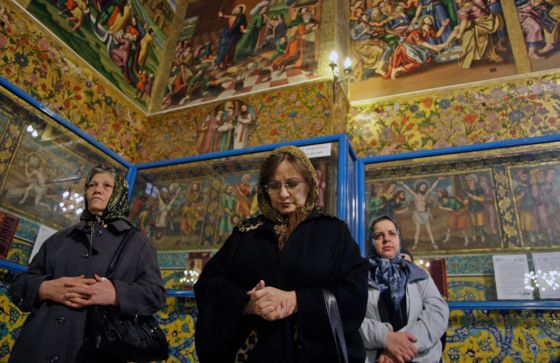
Iranian Christians pray during New Year Mass at the Vank church in the central city of Isfahan, Iran, on Sunday, January 1, 2012. (AP Photo/Vahid Salemi)

Hooman Majd writes: The ransacking of the British embassy capped an annus horribilis for the Iranian leadership. Throughout the year, the supreme leader, Ayatollah Ali Khamenei, Ahmadinejad, and every politician in between have seemingly been at odds with each other over just about every possible matter of state. The result is an uncertainty and nervousness among officials, and a kind of political paralysis in which it has become hard for people to know exactly who is in charge, or even whom to blame for policy gone bad. But it was also a terrible year for the Iranian people. They are baffled by the West’s approach to dealing with their country’s nuclear program — the stated aim is a change in policy, but the result is only general hardship. Big-city dwellers complain about rampant inflation, a strangled economy, and general inconvenience on a daily basis.

On the street, nowhere is the impact more evident than at any one of the many foreign exchange bureaus where Iranians gather to monitor the flat screens that show the almost minute-by-minute slide in the rial. Men and women gather at the kiosks to buy dollars as a hedge against crippling inflation; many think that the government will soon run out of greenbacks as international sanctions clinch Iranian banks. The country’s financial culture is cash — there are no credit cards — and the government routinely pumps hundred-dollar bills into circulation in an effort to keep the currency stable. The strategy has backfired. By the end of last year, confidence that the regime could withstand international financial pressure — particularly after the British government cut all financial ties with Tehran — had sunk to an all-time low.

By December, escalating talk of military strikes, promoted by respectable Western and Israeli politicians, analysts, and commentators — in the pages of this journal, too — raised anxieties in Tehran to a level not witnessed in many years. In years past, war over the nuclear program had always been the subject of chatter in Iran, but few took it very seriously. In fact, if war came up in ordinary conversation, it was mentioned jokingly. In December, however, my optician, an older Isfahani with a wry sense of humor who hosts a salon of sorts with locals every evening in his shop, captured the mood of the city when he said of the worry over a coming war, “You can smell it,” he said. “This time, you can smell it.”

If you live in Iran it is hard to imagine what the West, particularly the United States, is trying to accomplish. No one doubts that Israeli and Western operators are behind recent assassinations of nuclear scientists on the streets of Tehran. And the sudden frequency of “accidents” at various factories and Revolutionary Guards bases (which a majority — their government’s denial notwithstanding — also believe are the work of foreign agencies) has done nothing to change the minds of either government officials or the general public about the nuclear program.

Few in Iran believe that the nuclear program is a quest for a Shia bomb to obliterate Israel once and for all. No, the Iranian people, from my greengrocer to college students who resent their government, still consider the nuclear question in generally nationalistic terms. The particular regime in power is of passing relevance. So sanctioning Iran’s central bank and embargoing Iranian oil, tactics the White House may be using as a way to avoid having to make a decision for war, will neither change minds in Tehran nor do much of anything besides bring more pain to ordinary Iranians. And making life difficult for them has not, so far, resulted in their rising up to overthrow the autocratic regime, as some might have hoped in Washington or London.

Facebooktwittermail