Category Archives: Iran

Locating Iran’s secret nuclear facility (updated, update II)

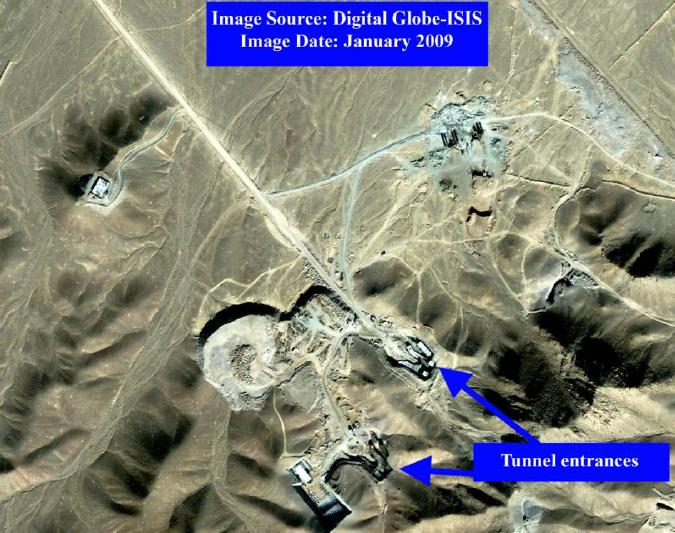
Update — Turns out ISIS already published a report [PDF] on this and suggest an alternative location NW of Qum in addition to the one described below. They also add dates to the imagery, the Google Earth images appearing below having been taken on March 25, 2005.

Locating Iran’s secret nuclear facility

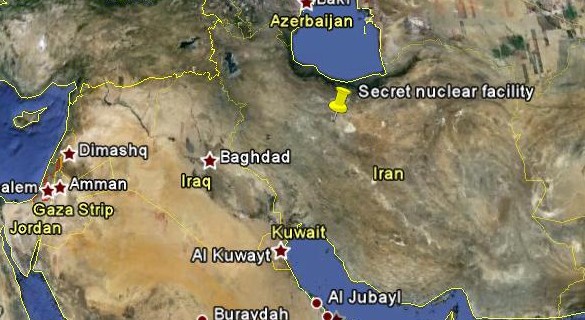
In numerous dispatches, Iran’s newly-reported and until a few days ago undeclared nuclear facility, is described as being built “inside a mountain“. In an Obama adminstration background briefing it was described as being located in “a very heavily protected, very heavily disguised facility”. Reports have also said that it is located north east of the city of Qum.

Understanding what “inside a mountain” and “very heavily protected” actually mean is important. It could mean that the facility is effectively invulnerable to any form of military strike.

Facilities buried more than 1000ft away from the earth’s surface are “essentially invulnerable to nuclear attack” says the Union of Concerned Scientists.

If it turns out the the Qum facility (and perhaps others) are in fact so heavily protected that they cannot be destroyed through a conventional or even an unconventional military strike, then the military threat that supposedly remains placed on that proverbial table would not really be a strike that could cripple of destroy Iran’s purported nuclear weapons program. It would simply mean that the threat of war remains on the table.

If that’s the case, then during the past couple of years (and remember, this facility has apparently been under observation since 2006), all the veiled and unveiled threats of an Israeli attack on Iran’s nuclear facilities have probably been made for purely political purposes.

So where is this newly announced facility and how heavily protected is it?

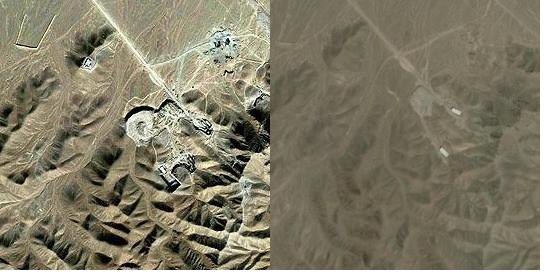
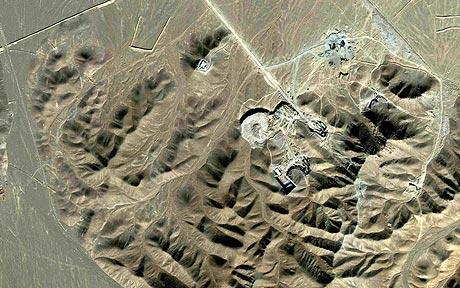
The Daily Telegraph has published this image from Reuters with the caption: “Satellite photo of what is believed to be a uranium-enrichment facility near Qom.”

I’m a novice at using Google Earth but I’ve got a good topographic eye, so with “inside a mountain, north east of Qum (alt spelling Qom)” as my starting point, I thought I’d take a look.

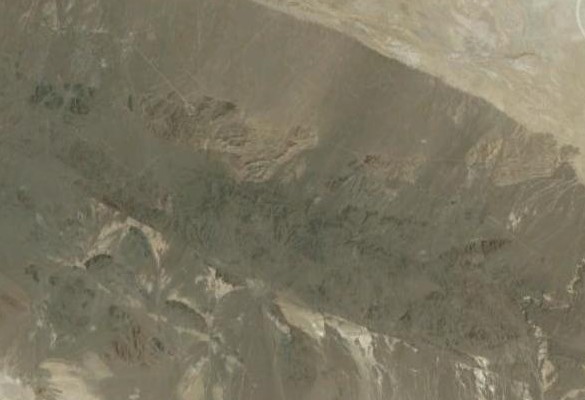
Here are some mountains north east of Qum:

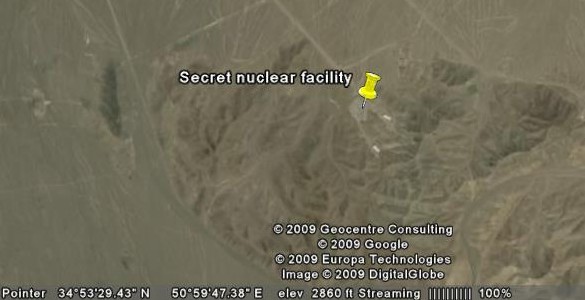
And what d’ya know? Here’s the location that appears in the Telegraph:

Of course, we don’t know for sure whether the Reuters-distributed image is actually a photograph of the facility in question, but let’s assume it is.

The Google Earth image is older and a comparison of the two reveals extensive earthworks that doubled in area during the (to me) unknown lapse between the two images. It looks like open-cast mining, suggesting that wherever in proximity to that these earthworks the facility might be buried, it probably isn’t under a 1000ft of granite.

The question remains (and it’s obviously one I can’t answer): is this facility invulnerable to a military attack?

(Update: The photos from ISIS identify two tunnel entrances to the east of the excavated area.

It seems quite possible that the tunnels do indeed extend deep enough into the mountains to provide strike invulnerability.)

If you want to examine the location more carefully, you can find it here on Google maps. And these are the coordinates: 34°53’8.74″N — 50°59’45.90″E

Second update: Upon further examination of the Google Earth information, I’m having second thoughts about the “buried in a mountain” description.

While the satellite image is suggestive of mountains, the range in elevation between the tunnel entrances and the highest surrounding ridges is little more than a hundred feet! These aren’t mountains: they are hillocks. Situated in a few undulations that protrude slightly from a vast salt basin area that is mostly at about 3,000ft in elevation, this “very heavily protected” facility might not in fact be quite as invulnerable as I suggested above.

Facebooktwittermail

Iran’s newly revealed nuclear facility

Paradox: Now is the time to deal

Iran has admitted that it has at least one (and there is no reason to believe that there are not more) secret enrichment facilities. More information will undoubtedly come out in the coming days but we can deal now with the most important issue: how to proceed from here. As President Obama has rightly said today, this is not the first time Iran has hidden nuclear facilities it should rightly declare to the IAEA.

Iran will undoubtedly claim that it has not introduced nuclear material into the centrifuges and therefore did not have the obligation to report it. In fact, when I was in Israel earlier this summer, everyone I spoke to was convinced that such a facility existed but that Iran had not introduced uranium into it. However, there is a lot that can be done to train personnel etc. with enriching other isotopes like xenon or silicon. And training personnel is the important aspect right now. When the history of these secret facilities is known, I suspect that we will discover that they were started during the enrichment “suspension” that ended in 2006. We will also discover, I firmly believe, that the Natanz facility has been used as a training center for workers for those covert facilities. That could explain why there has been a relatively slow start: they were constantly cycling new trainees through with the consequent inefficiencies new workers always introduce. [continued…]

The Iran nuclear revelation

… despite what I expect to see swarming the media in the next few days — wanna bet that John Bolton or John Bolton-equivalent oped is already in production over at the Washington Times Washington Post (sorry, it’s hard to tell the difference on foreign policy issues sometimes) — I actually think that this public revelation makes war less rather than more likely. The timing of the announcement, immediately following the consultations at the UN and the G-20 and just before the Geneva meetings, makes it seem extremely likely that the Obama administration has been waiting for just the right moment to play this card. Now they have. It strengthens the P5+1 bargaining position ahead of October 1, changes Iranian calculations, and lays the foundations for a more serious kind of engagement. So now let’s see how it changes the game. [continued…]

How to keep Iran in check without war

For the better part of two decades, there have been cries of alarm that the United States must “do something” or else Iran would have an operational nuclear weapon within a few years. If these warnings of a “ticking clock” had been heeded, there would have been ample reason for the United States or Israel to go to war with Iran at almost any time. In fact, there have been as many serious predictions that a war was imminent and unavoidable as there have been false predictions about the timing of an Iranian bomb. Seymour Hersh, writing in the New Yorker beginning in 2006, quoted many sources inside and outside the U.S. government who claimed that the Bush administration was preparing to attack Iran because of its nuclear policies. It now appears that Vice President Cheney, based on his own words in retirement, was in fact pressing for such an attack, but President Bush vetoed it.

In June 2008, former U.S. ambassador to the United Nations John Bolton predicted that Israel “will attack Iran” before January 2009 when the new U.S. president was sworn in, but apparently the Israeli leadership decided otherwise. Just a few weeks ago, retired Air Force general Chuck Wald on National Public Radio outlined a sustained bombing campaign against Iran that would last “weeks or months,” then added, “Now, does anybody in their right mind want to attack Iran? No, not a bit. But sometimes you’ve got to do things you don’t like to do.” From the tone of his voice, the prospect of an attack did not seem to dismay him, and he has gone on to write a series of op-eds pushing the military option.

These statements are admirably clear in recognizing that the end game in any concerted pressure campaign against Iran is war. Secretary of State Hillary Clinton threatened “crippling sanctions” to be imposed on Iran if it failed to cooperate with U.S. diplomatic efforts. That phrase was later echoed by Israeli prime minister Netanyahu during his visit to Germany, and it is expected to be a major focus of the U.S. Congress starting in September. Iran does not have sufficient refinery capacity to meet all its gasoline needs, and the Congress is expected to press for actions that would attempt to curtail or block such imports into Iran. A prohibition of Iranian petroleum imports—most likely restricted to the United States and perhaps some of its European allies since Russia, China and even many of Iran’s allies (think Venezuela) and immediate neighbors (think Iraq) are unwilling to cooperate—can only be truly enforced by a blockade, which is an act of war.

The perpetual plea for U.S. foreign policy to “do something” needs to be changed; we would be better served by adopting the physicians creed: “First, do no harm.” [continued…]

Iranian leader offers U.S. access to the country’s nuclear scientists

Iran is willing to have its nuclear experts meet with scientists from the United States and other world powers as a confidence-building measure aimed at resolving concerns about Tehran’s nuclear program, Iranian President Mahmoud Ahmadinejad said Wednesday.

At international talks next week on its nuclear ambitions, Iran also will seek to buy from the United States enriched uranium needed for medical purposes, Ahmadinejad told reporters and editors from The Washington Post and Newsweek. Agreement by the Americans, he suggested, would demonstrate that the Obama administration is serious about engagement, while rejection might give Iran an excuse to further enrich its stock of uranium.

“These nuclear materials we are seeking to purchase are for medicinal purposes. . . . It is a humanitarian issue,” Ahmadinejad said in the interview. “I think this is a very solid proposal which gives a good opportunity for a start” to build trust between the two countries and “engage in cooperation.” [continued…]

Russia’s president pledges to help U.S. nudge Iran on nuclear issue

Russian President Dmitry Medvedev offered closer cooperation with the United States in curbing Iran’s nuclear ambitions Wednesday, promising President Obama that Moscow would help the Islamic Republic make “a right decision” and hinting that sanctions might be necessary to achieve it.

U.S. officials said they regarded Medvedev’s comments, after meeting Obama on the sidelines of the United Nations General Assembly, as a major shift in Russia’s position just a week before six major powers are to meet with Iranian officials in Geneva.

Russia, which has extensive economic ties with Iran, has consistently opposed sanctions. And, as its relations with Washington deteriorated in recent years, it has tended to view the Islamic Republic as a useful counterweight. [continued…]

Russia can sway Iran’s nuclear ambitions

So far, US-led efforts to increase pressure on Iran have failed in large part because of Russia’s hostile stance in the UN security council. During Vladimir Putin’s presidency (2000-08), Russia repeatedly opposed more punitive measures against Iran. Fuelled by a combination of anti-Americanism and renewed geopolitical ambition, Moscow insisted that Tehran had a sovereign right to build nuclear power stations – with Russian technological support.

But now that the Obama administration is moving its anti-ballistic missile shield from land-based installations in eastern Europe to mobile vehicles closer to Iran, the Russian president, Dmitry Medvedev, declared on Wednesday at the UN in New York that “sanctions are seldom productive but they are sometimes inevitable”.

With the “reset” of US-Russian relations, the Kremlin has performed a spectacular “rethink” of its Iran policy. The “secret” Moscow visit by Binyamin Netanyahu on 7 September seemed to reassure the Russian leadership that Israel would not launch unilateral pre-emptive strikes against suspected Iranian nuclear installations – on the condition that Moscow promise not to equip Iran with the advanced S-300 system, an offensive missile capability that could deliver nuclear warheads. [continued…]

Green movement ‘understands world’s concerns’ over nuclear Iran

A spokesman for Iranian opposition leader Mir Hossein Mousavi is telling the “citizens of the world” and especially “the people and government of America” that the opposition shares international concerns about the possibility of a nuclear-armed Iran.

The statement by Mohsen Makhmalbaf — an Iranian film director — goes as far as to say that any agreement signed with President Mahmoud Ahmedinejad’s “coup-empowered illegitimate government” would not be honored by the opposition, known as the Green Movement. He added: “All such agreements will be subject to review in the future.” [continued…]

Facebooktwittermail

Ahmadinejad at the UN

The skunk at the party

There are those in the U.S. and in Israel who argue that Ahmadinejad’s views on the Holocaust are of utmost importance in understanding Iranian policy. I have heard more than one influential foreign-policy analyst argue that the Iranian president’s beliefs regarding the Holocaust are what drives Iran’s nuclear program, that Ahmadinejad wishes to finish what he refuses to believe the Nazis started.

This is absurd. First of all, Ahmadinejad has no say in Iran’s nuclear program. In fact, the security clearance of the president of Iran is not high enough to even look at the country’s nuclear dossier, let alone make decisions about it (that right rests in the hands of the Supreme National Security Council, of which Ahmadinejad is not a member).

But, more importantly, Ahmadinejad’s Holocaust comments must be understood as nothing more than the pandering of a politician (that is, pandering to the Arab street, not Iranians). It bears mentioning that every high-school student in Iran is taught about the events of World War II, including the Nazi extermination of Jews. In fact, I once asked an Iranian friend if he was embarrassed at Ahmadinejad’s ignorance of world events. He replied that he was no more embarrassed than I must be when President George W. Bush says that the world is 6,000 years old. [continued…]

Facebooktwittermail

Iranians favor diplomatic relations with US but have little trust in Obama

Iranians favor diplomatic relations with US but have little trust in Obama

A new WorldPublicOpinion.org poll of Iranians finds that six in 10 favor restoration of diplomatic relations between their country and the United States, a stance that is directly at odds with the position the Iranian government has held for three decades. A similar number favor direct talks.

However, Iranians do not appear to share the international infatuation with Barack Obama. Only 16 percent say that have confidence in him to do the right thing in world affairs. This is lower than any of the 20 countries polled by WPO on this question in the spring. Despite his recent speech in Cairo, where Obama stressed that he respects Islam, only a quarter of Iranians are convinced he does. And three in four (77%) continue to have an unfavorable view of the United States government.

“While the majority of Iranian people are ready to do business with Obama, they show little trust in him,” says Steven Kull, director of WPO. [continued…]

Editor’s Comment — Some of the other poll numbers are striking and indicate how little progress Obama has made in his efforts at public diplomacy aimed at the Middle East.

75% of the Iranians polled believe that the US definitely or probably has the goal of imposing American culture on Muslim society.

81% believe that the US definitely or probably has the goal of weakening and dividing the Islamic world.

85% believe that in the way the US behaves towards the Iranian government it abuses its great power to make Iran do what the US wants.

That last number is one that the US and its allies should keep clearly in mind when they sit down for talks with Iran’s leaders in Istanbul on October 1. The Iranians cannot afford to look like they are getting pushed around and this no doubt explains the source of much of what the West perceives as belligerence.

IAF chief: We must stop S-300 delivery

Israel needs to make every effort to stop the S-300 missile defense system from reaching countries where the air force may need to fly, IAF commander Maj.-Gen. Ido Nehushtan has told The Jerusalem Post in an exclusive interview.

“The S-300 is a Russian-made surface-to-air missile system that is very advanced, with long ranges and many capabilities,” Nehushtan told the Post in the interview, which appears in our Friday Magazine.

“We need to make every effort to stop this system from getting to places where the IAF needs to operate or may need to operate in the future,” he said.

The S-300 is one of the most advanced multi-target antiaircraft missile systems in the world and has a reported ability to track up to 100 targets simultaneously while engaging up to 12 at the same time. It has a range of about 200 km. and can hit targets at altitudes of 90,000 feet.

While Russia and Iran signed a deal for the sale of the system several years ago, according to latest assessments in Israel, it has yet to be delivered. [continued…]

The Grand Ayatollah unleashes his wrath

Small, frail and in his 80s, he looks no match for Iran’s tough regime. But Grand Ayatollah Hossein Ali Montazeri is made of steel. He wields considerable moral authority as the country’s highest-ranking and most fearless dissident cleric, representing a potent challenge to hardline authorities who have tried and failed to silence him for two decades.

He was once Ayatollah Khomeini’s designated successor but was unceremoniously cast aside by the founder of the Islamic Republic, just months before his death in 1989, because the Grand Ayatollah had criticised human rights abuses by the regime. Since then, despite official harassment of his aides and a six-year period of house arrest, Grand Ayatollah Montazeri has remained the outspoken conscience of Iran’s religious community, an advocate of democratic pluralism and foreign policy moderation.

“Montazeri has refused to go away and is today more vocal and explicit in his criticism than ever,” said Anoush Ehteshami, an Iran expert and professor of international relations at Durham University in England. “If anything, his claim that he stands for freedoms and justice are even more important today,” Prof Ehteshami said in an interview. [continued…]

Iran’s Ayatollah Khamenei says opposition protests failed

Supreme leader Ayatollah Ali Khamenei attempted to unify Iranians on Sunday by blaming foreign media for “poisoning the atmosphere” and urged his nation to resist the “killer cancer” of an Israel backed by Western powers.

Delivering a sermon at Tehran University before a crowd that included President Mahmoud Ahmadinejad and opposition cleric Ayatollah Ali Akbar Hashemi Rafsanjani, Khamenei said the West had failed in its attempts to undermine the government with large opposition protests during countrywide anti-Israel rallies Friday.

“It showed that their [Western politicians’] tricks, spending money and political evilness do not influence the Iranian nation,” said Khamenei, who was greeted with chants of “Leader, we offer our blood to you.” [continued…]

Facebooktwittermail

Medvedev: “Israel is not going to deliver any blows on Iran”

Medvedev: “Israel is not going to deliver any blows on Iran”

FAREED ZAKARIA: Let me ask you about some of the other issues that you face. Russia has said that it does not want Iran to develop nuclear weapons. Prime Minister Putin has said that, you have said that. Yet the IAEA says that Iran is not cooperating to give the world confidence that it has a purely civilian programme. Iran says it will no longer negotiate on this issue, and yet Russia says it will not support any further sanctions against Iran. So, is the policy of not wanting Iran to develop nuclear weapons on Russia’s part – are these empty words or do you have concrete steps you are willing to take to prevent Iran from developing nuclear weapons?

DMITRY MEDVEDEV: We have our fairly developed relations with Iran, that is why I can speak of Iran’s intentions not by hearsay, not on the basis of the information received from special services of other countries, but proceeding from the reality. Of course, I believe that Iran needs a set of motives to behave appropriately as far as its nuclear programme is concerned. There is no doubt about that.

Secondly, Iran must cooperate with the IAEA. It must be done, because it is its obligation.

Thirdly, we should create for Iran a system of positive motives, so that it wants such cooperation. On September 9, 2009 Iran submitted its proposals concerning these very complicated issues, and they are being analyzed now.

There have been voices that it is not enough, that those proposals are too general. You know, I believe, that it is obligation of all nations involved in this problem to study these proposals, at least. It took quite a long time for Iran to study the package of incentives that had been given to it through Solana’s mediation at that time. Now, we need to study its package.

As for the sanctions, I have just had a chance to talk about it during my meeting with political analysts, who attended a conference here. I told them one very simple thing: as a rule, sanctions result in nothing, though sometimes sanctions are necessary. But before speaking of applying additional sanctions, we should make full use of the existing possibilities. That would be a responsible behavior by the world community. Yes, of course, we should encourage Iran, but before taking any action we should be absolutely confident that we have no other options and that our Iranian colleagues do not hear us for some reason. This is, I believe, the simplest and most pragmatic position. By the way, I voiced this position during the consultations on this issue, which took place during the G8 summit in Italy, when we discussed this question. It was discussed by all G8 leaders.

FAREED ZAKARIA: But do I take you to be saying that Iran does have an obligation to cooperate with IAEA? And if it does not, is Russia willing to step up to its responsibilities as a world power and press in the UN and in other ways to ensure Iran does cooperate?

DMITRY MEDVEDEV: Iran must cooperate with the IAEA, this is an absolutely indubitable thing, if it wishes to develop its nuclear dimension, nuclear energy programme. This is its duty and not a matter of its choice, because otherwise a question will be raised all the time: what it is really doing? And this is as plain as a day.

FAREED ZAKARIA: And Russia is willing to exercise its responsibilities?

DMITRY MEDVEDEV: Certainly.

FAREED ZAKARIA: Let me ask you about another issue relating to this. Russia has agreed to sell Iran the S-300 antiaircraft and antimissile system. When you will deliver it to Iran?

DMITRY MEDVEDEV: Our relations with Iran really have a military component and we believe that this work should completely correspond to the international obligations both from the part of Iran and from the part of Russia. We have never supplied and will not supply to Iran anything that is beyond the valid system of the international law. What we have supplied and what we are going to supply, it has been and always will be the defense complexes and this is our firm position, and I will hold to it when making final decisions as to the all existing contracts with Iran.

FAREED ZAKARIA: You know that there are many people in Israel who say that if you deliver that system, the Israelis will feel they will have to strike Iran before that system is deployed because once that system is deployed, an Israeli attack on Iran becomes much more difficult. So by delivering that system you open up a window or a period of considerable tension.

DMITRY MEDVEDEV: In an hour I will have a conversation with President of Israel Mr. Peres, who, when he recently was visiting me in Sochi, said something that is very important for all of us, namely, that Israel is not going to deliver any blows on Iran, that Israel is a peaceful country and will not do it. Therefore any supplies of any weapons, all the more defensive weapons, can not increase tension; on the contrary they should ease it. But if there are people who have such plans, it seems to me that they have to think about it. For this reason, our task is not to strengthen Iran and weaken Israel or vise versa but our task is to ensure a normal, calm situation in the Middle East. I believe that is our task.

FAREED ZAKARIA: When Prime Minister Netanyahu was in Moscow, did you say that to him?

DMITRY MEDVEDEV: Prime Minister Netanyahu has visited Moscow. They did it in a close regime, it was their decision. I do not even understand very well the reasons for it, but our partners made such a decision and our reaction was absolutely normal and calm. I have had a conversation with him.

FAREED ZAKARIA: But did you feel like it was a positive meeting?

DMITRY MEDVEDEV: It was a good, normal meeting. We have discussed the most different problems. Before that I met with President Peres, after that I met with Prime Minister Netanyahu. This is normal, this is our dialogue. And Ahmadinejad visited us, but, to be true, earlier than that and it was not a bilateral meeting, he came to attend as an observer the session of the Shanghai Cooperation Organization. We communicate with everybody. I believe that this is our advantage.

FAREED ZAKARIA: If Israel were to attack Iran, would Russia support Iran in such a conflict?

DMITRY MEDVEDEV: Russia can not support anybody or act in such situation. We are a peaceful state and we have our own understanding of our defense strategy. This is the first point.

The second point. We have our allies with which we have concluded one or other agreements. In case of Iran we do not have obligations of this kind. But it does not mean that we would like to be or will be impassible before such developments. This is the worst thing that can be imagined. I have already commented on this issue. Let us try together to reason upon it. What will happen after that? Humanitarian disaster, a vast number of refugees, Iran’s wish to take revenge and not only upon Israel, to be honest, but upon other countries as well. And absolutely unpredictable development of the situation in the region. I believe that the magnitude of this disaster can be weighted against almost nothing. For this reason before making decision to deliver blows it is necessary to assess the situation. It would be the most unreasonable developments. But my Israeli colleagues told me that they were not planning to act in this way and I trust them.

FAREED ZAKARIA: So you expect no Israeli strike on Iran?

DMITRY MEDVEDEV: I hope that this decision will not be made. Iran should be pushed to cooperate. And indeed, Iran should not pronounce such things that it has stated, for example in relation to Israel, when it said that it did not recognize the existence of this state. It is unacceptable in the modern world, in the modern system of international relations. And this is the point Iran should start thinking about. [continued…]

Facebooktwittermail

Pro- and anti-government marchers face off in Tehran

Pro- and anti-government marchers face off in Tehran

Tens of thousands of demonstrators chanting, “Not Gaza, not Lebanon, I sacrifice my life for Iran,” swarmed the streets of the capital, turning a day in support of the Palestinian cause into a major opposition rally.

President Mahmoud Ahmadinejad, whose disputed reelection three months ago triggered Iran’s worst political domestic crisis in decades, delivered a blistering condemnation of Israel on the occasion of annual Quds Day.

In a fiery speech, he questioning the Holocaust and blamed “Zionists” for ongoing wars in the Middle East.

“If the Holocaust you claim is correct, why do you reject any research about it?” he said in a speech before Friday prayers. “The Zionists are behind the ongoing wars in Afghanistan, Iraq and Sudan.” [continued…]

Facebooktwittermail

To bomb, or to bunker? Israel’s Iran choices narrow

To bomb, or to bunker? Israel’s Iran choices narrow

The orchestrated roar of air force exercises designed to signal Israel’s readiness to attack Iranian nuclear facilities are belied, perhaps, by a far quieter project deep beneath the western Jerusalem hills.

Dubbed “Nation’s Tunnel” by the media and screened from view by government guards, it is a bunker network that would shelter Israeli leaders in an atomic war — earth-bound repudiation of the Jewish state’s vow to deny its foes the bomb at all costs.
[…]
Aerial and naval manoeuvres, leaked to the media, have told of plans to reach Iran, though this time the targets are so distant, dispersed, and fortified that even Israel’s top brass admit they could deliver a short-term, disruptive blow at most.

Hence Israel’s discreet arrangements for living with the possibility of a nuclear-armed arch-enemy — the bunkers, the missile interceptors, the talk of a U.S. strategic shield and of Cold War-style deterrence based on mutually-assured destruction.

One government intelligence analyst suggested that Israel had passed a psychological threshold by “allowing” Iran to manufacture enough low-enriched uranium (LEU) for a bomb.

“We keep fretting about whether they will have a ‘break-out capacity’, but really they’re already there,” the analyst said.

The U.N. national intelligence director has assessed Iran will not be technically capable of producing high-enriched uranium (HEU) for the fissile core of an atom bomb before 2013. [continued…]

Israel defense chief: Iran not an existential threat

Israeli Defense Minister Ehud Barak was quoted on Thursday as saying he does not view Iran as a threat to the existence of the Jewish state, a view that would seem to depart from Israeli statements of the recent past.

Israel’s mass-circulation Yedioth Ahronoth daily quoted Barak, the head of Israel’s center-left Labour party, as saying “Iran does not constitute an existential threat against Israel.”

In response to a question about Tehran’s nuclear programme which Israel has said it sees as destined to produce atomic weapons that could put its existence at risk, Barak said in an interview with the paper:

“I am not among those who believe Iran is an existential issue for Israel.” [continued…]

Intelligence agencies say no new nukes in Iran

The U.S. intelligence community is reporting to the White House that Iran has not restarted its nuclear-weapons development program, two counterproliferation officials tell Newsweek. U.S. agencies had previously said that Tehran halted the program in 2003.

The officials, who asked for anonymity when discussing sensitive information, said that U.S. intelligence agencies have informed policymakers at the White House and other agencies that the status of Iranian work on development and production of a nuclear bomb has not changed since the formal National Intelligence Estimate (NIE) on Iran’s “Nuclear Intentions and Capabilities” in November 2007. Public portions of that report stated that U.S. intelligence agencies had “high confidence” that, as of early 2003, Iranian military units were pursuing development of a nuclear bomb, but that in the fall of that year Iran “halted its nuclear weapons program.” The document said that while U.S. agencies believed the Iranian government “at a minimum is keeping open the option to develop nuclear weapons,” U.S. intelligence as of mid-2007 still had “moderate confidence” that it had not restarted weapons-development efforts. [continued…]

How to talk to Iran

The president is right [to enter talks with Iran] for many reasons. The 30-year American-Iranian psychosis is a dangerous, logic-lite hangover. When Obama gathered his Iran advisers after the June election to review intelligence, the slim pickings were slim enough to prompt a presidential “That all you got?” Ignorance breeds treacherous incomprehension.

The president is right because only creative diplomacy can head off the onrushing Iranian uranium enrichment (8,000 inefficient centrifuges and counting); because closer relations with the West represent the best long-term hope for reform in Iran; because Iran is negotiating from the relative weakness of post-June-12 revolutionary disunity; and because the strong U.S. interest lies in preventing an Israeli attack on Muslim Persia. (That’s also in Israel’s interest, by the way; the Arabs are already a handful.)

There’s a lot of verbiage — some that Orwell would have seized on — in the Iranian “package,” but that’s just the way of things in Iran. Like many much-conquered countries, not least Italy, Iran loves artifice, the dressing-up of truth in elaborate layers. It will always favor ambiguity over clarity. This is a nation whose conventions include the charming ceremonial insincerity known as “taarof” (hypocrisy dressed up as flattery), and one that is no stranger to “tagieh,” which amounts to the sacrifice of truth to higher religious imperative.

These traits are worth recalling. Gary Sick, the Carter administration official who negotiated the American hostages’ release, told me that immediately before the critical breakthrough he received a voluminous and preposterous Iranian “proposal” that almost led Carter to walk away. It proved a sideshow with a couple of useful nuggets buried in the outpourings. [continued…]

Iran bullish ahead of nuclear talks

Unless the US and its allies come up with new evidence to substantiate their allegations against Iran, their purported effort to pin on Iran the label of clandestine proliferator is destined to fall short. This is particularly so since there is as of yet no official US revision of the conclusions of its 2007 intelligence estimate. According to this, Iran halted its nuclear weapons program in 2003, shortly after the downfall of Iran’s chief nemesis, Saddam, who was also said to be aggressively pursuing a nuclear program.
Fourth, Iran’s confidence stems from Tehran’s reliance on a multi-faceted negotiation strategy, reflected in its recent “package” that states Iran’s preparedness to cooperate on the issues of “non-proliferation and disarmament” as well as on regional security, energy security, cultural and economic issues.

The advantage of this comprehensive linked approach is that it connects any US engagement with Iran to a host of issues that bind the two countries, such as drug trafficking and security in the region. This belies the contention of some US pundits that the “goal of engagement is not improved relations”, to paraphrase Chester Crocker, a former US diplomat, who in an opinion column in the New York Times under the title “Terms of Engagement” forgets that the Iranian side may also have its own ideas about engagement and that it takes two to have a diplomatic tango. [continued…]

Facebooktwittermail

Iran opposition leader sidelined from rally

Iran opposition leader sidelined from rally

A powerful former president in Iran who supports its opposition movement has been barred from speaking at a major commemorative rally there on Friday, in a striking break from precedent that suggests the country’s hard-line leaders fear the event could turn into an opposition rally.

The former president, Ali Akbar Hashemi Rafsanjani, has delivered the Friday Prayer sermon for almost 25 years on Quds Day, an annual occasion of Iranian solidarity with the Palestinian movement.

But this year he is being replaced by a hard-line cleric, Ahmad Khatami, and President Mahmoud Ahmadinejad will also speak, Iran’s state-run Press TV reported Wednesday, citing the prayers commission. [continued…]

Facebooktwittermail

‘Nuclear-free zone impossible in anti-Israel Mideast’

‘Nuclear-free zone impossible in anti-Israel Mideast’

[Shaul Chorev, chairman of Israel’s Atomic Energy Commission, in an address to the International Atomic Energy Association in Vienna] stressed that in order for the Middle East to function as a nuclear-free zone, the Arab states in the region needed to alter that approach to Israel.

“Progress toward realizing this vision cannot be made without a fundamental change in regional circumstances, including a significant transformation in the attitude of states in the region toward Israel,” he said.

“The constant efforts by member states in the region to single out the State of Israel in blatantly anti-Israel resolutions in this General Conference is a clear reflection of such hostile attitude. [continued…]

Editor’s Comment — Chorev made the proforma declaration that Israel would not be the first to introduce nuclear weapons into the region yet by voicing Israel’s reluctance to make the Middle East a nuclear-free zone implicity and unambiguously confirmed that such a goal would require Israel’s disarmament.

Clinton lays out Iran requirements

When the United States sits down with Iran early next month for face-to-face talks, the Iranian nuclear program will be at the top of the American agenda, even though Iranian officials insist it is off the table, Secretary of State Hillary Rodham Clinton said Tuesday.

“Iran says it has a number of issues it wishes to discuss with us,” Mrs. Clinton told reporters. “But what we are concerned about is discussing with them the questions surrounding their nuclear program and ambitions.”

She said the meeting, to be held Oct. 1, would fulfill President Obama’s pledge to engage with Iran. But she insisted that the United States would not be drawn into a lengthy and fruitless diplomatic dance with Iran, as some analysts have warned. [continued…]

Facebooktwittermail

Iran arrests children of dissident clerics

Iran arrests children of dissident clerics

Authorities in Iran have arrested at least seven children and grandchildren of senior clerics in the religious city of Qum and threatened to arrest the son of Ali Akbar Hashemi Rafsanjani, the powerful cleric and a former president, in what appeared to be fresh pressure on religious leaders who sympathize with the opposition.

The arrests, reported by several opposition Web sites on Tuesday but apparently carried out on Monday, coincided with a harsh rebuke of Iran’s supreme leader, Ayatollah Ali Khamenei, from a senior cleric who is an outspoken dissident, Grand Ayatollah Hossein Ali Montazeri, who urged colleagues to support the opposition movement.

Ayatollah Khamenei has the final say on state matters and has issued fierce warnings against Iranians who have challenged the June 12 election, which the incumbent, Mahmoud Ahmadinejad, officially won by a landslide. [continued…]

Facebooktwittermail

Iran agrees to meeting on nuclear program

Iran agrees to meeting on nuclear program

The Obama administration, hoping to persuade Tehran to curtail its nuclear program and initiate a dialogue that focuses on other issues, will have its first formal meeting since it took office with Iran on Oct. 1.

The four other United Nations Security Council permanent members — China, Russia, France, and the U.K. — along with Germany will participate in the meeting, which was brokered Monday in a call between Javier Solana, the European Union’s foreign-policy chief, and Saeed Jalili, Iran’s main nuclear negotiator.

The event, whose location hasn’t been decided, won’t be a “formal negotiation,” a spokeswoman for Mr. Solana said. There will be no set agenda or specific goals. Instead, she said, it will serve as an opportunity to question Iran on a proposal it released last week calling for a discussion with the international community on a range of security and development issues. [continued…]

Facebooktwittermail

Obama’s tough choice on Iran

Obama’s tough choice on Iran

The U.S. and its allies are not saying Iran is currently developing nuclear weapons; they’re warning that allowing Iran to assemble the full nuclear fuel cycle to which it is entitled as a signatory of the Non Proliferation Treaty — particularly uranium enrichment — gives it an infrastructure that could quickly be converted to produce bomb materiel. Stating Washington’s case at the International Atomic Energy Agency in Vienna this week, Ambassador Glyn Davies warned that Iran had already created enough low-enriched uranium that, if it kicked out nuclear inspectors and reconfigured its enrichment plant, could be re-enriched to provide materiel for a single bomb. “We have serious concerns that Iran is deliberately attempting, at a minimum, to preserve a nuclear option,” Davies said.

Moscow sees the problem in terms of strengthening the safeguards against Iran weaponizing nuclear materials, rather than trying to prevent it attaining “breakout” capacity by denying its right to enrich uranium.

President Mahmoud Ahmadinejad reiterated this week that Iran no intention of ending uranium enrichment, or of negotiating away its nuclear rights. That doesn’t necessarily preclude a diplomatic solution to the standoff, but it underscores the likelihood that the Western powers might have to compromise on their own demands in order to achieve one. In some previous rounds of negotiation, Iran has been more open to discussing strengthening of the IAEA monitoring regime and other safeguards against weaponization. Right now, however, it’s far from clear that Iran is in an accommodating mood, given its fierce and ongoing domestic power struggle. [continued…]

Secret Iranian missile memos

I have been given a series of what appear to be internal secret Iranian documents by sources I trust. If authentic, and I believe they are, they provide important insights into Iran’s missile development program and have important implications for North Korea’s as well. Unfortunately, to protect my sources and the Iranians who spirited these documents out to the West, I cannot be too explicit about their contents. The following examination of these memos contains both information from and my analysis of them. I have tried to explicitly point out what is my speculation.

The memos cover, in a somewhat sketchy way, a lot of ground. Perhaps the most important aspects are those that deal with how several countries collaborate in either developing missiles or selling missile technology to Iran. The memos use codes for the different collaborator countries but I think I know the meanings of the codes. If my understanding is correct, they indicate that representatives from North Korea and China have been present at all phases of production and flight testing. Iran has also gotten important help from Russia, though Russians do not appear to have been as ubiquitous as the Chinese and the North Koreans. The evidence from the memos indicates that this help is on the governmental level rather than “rogue” individuals. This includes Russian help though Russia has been particularly vocal in its denials of such assistance. Despite these denials, the evidence of foreign assistance, both images of engines and turbopumps that are obviously of Russian origin—either their actual production or at the very least their designs—and these internal Iranian memos, make the case overwhelmingly. [continued…]

Facebooktwittermail

Rethinking our Iran strategy

Rethinking our Iran strategy

Three decades of assumptions about Iran — including the premises behind Washington’s recent outreach to Tehran — have been transformed by its stunning uprising. It’s time for a policy rethink.

The Obama administration’s offer to engage was the right idea. But the theocracy’s brutal crackdown on the opposition since the June 12 presidential election, followed by the purge of senior politicians in show trials and an alarming increase in general executions, marks a turning point for Iran’s revolution. U.S. policy now needs a broader approach. Recent history offers relevant guidelines.

The three most important revolutions of the 20th century — for their political innovation and impact — happened in the Soviet Union, China and Iran. At the peak of revolutionary paranoia, the Soviet Union and China witnessed turmoil similar to what is happening today in Iran. Soon afterward, however, Moscow and Beijing altered course. Both began the move from defiant revolutionary regime to a normal state willing to work within the international order and mended relations with the United States. [continued…]

Facebooktwittermail

U.S. accepts offer from Tehran for broad talks

U.S. accepts offer from Tehran for broad talks

The United States has decided to ignore Iran’s refusal to discuss its nuclear program and instead accept a vague Iranian plan for talks on security issues as the opening gambit to draw Tehran into real negotiation.

The effort to “test” Iran’s intentions, announced on Friday, came after Russian Prime Minister Vladimir Putin said his country is skeptical of the need for new sanctions on Iran, giving the Americans little choice but to treat seriously Iran’s latest offer.

Iran this week ruled out talks on its program, instead offering a five-page plan that it said would lay the groundwork for peace and stability in the region. The document, first posted Thursday on the Web site of ProPublica news service, made no reference to international demands that Iran suspend its efforts to enrich uranium, but did mention ending proliferation in nuclear weapons as well as a broad offer of dialogue. [continued…]

Why Washington should welcome Iran’s broadening of the agenda

The Iranian proposal is best understood not from the prism of the West’s focus on the nuclear program, but from the vantage point of Iran’s long standing objective to be recognized as a regional power with a permanent seat at the table of regional decision making. Iran believes it suffers from severe role deficit — though it is one of the most powerful countries in the region, its neighbors view it by and large as a disruptive, anti-status quo power and have consequently refrained from giving it access to recognized and institutionalized avenues of influence.

After all, the reigning order in the Middle East is one defined and upheld by the United States, which for the past thirty years has sought Iran’s isolation and exclusion, not its inclusion and rehabilitation. Breaking out of this isolation and forcing Washington and the regional capitols to grant Iran the role it craves have been overarching strategic goals of Iranian foreign policy for several decades now.

Iran believes that the nuclear stand-off provides it with an opportunity to achieve this objective. By broadening the agenda for negotiations, Iran takes the opportunity to discuss with the great powers matters where the views of the Iranian government hardly have been taken into account in the past. The broader aim is to institutionalize the great power’s recognition of Iran’s role and seat at the table.

Perhaps more importantly, the Iranians refuse to permit the P5 plus 1 to single-handedly set the parameters of the talks. By presenting its own proposal, Iran is introducing its own parameters. The Iranians are in essence negotiating about the shape of the table before negotiating matters of substance. This is hardly surprising. During the EU-Iranian negotiations on the nuclear issue, Tehran was immensely frustrated by Europe’s dismissal of several Iranian proposals and its insistence on solely discussing its own set of ideas and demands. By now, Iran seems determined not to let that happen again. [continued…]

Facebooktwittermail

Iran’s Supreme Leader issues new warning

Iran’s Supreme Leader issues new warning

Iran’s supreme leader, Ayatollah Ali Khamenei, warned opposition leaders Friday of a “harsh response” if they continued speaking out against the government, a move that analysts said opened the way for their possible arrest.

Although analysts have warned that arrests seemed imminent before, several of them said Friday that they took this warning more seriously because it was issued at Friday Prayer — an important political platform — and because it followed the forced shutdown of the offices of two of the opposition’s leaders this week, as well as the arrests of their top aides.

Those leaders, Mehdi Karroubi and Mir Hussein Moussavi, have been leading a movement to try to invalidate the results of June’s presidential election, which they say was stolen. Both men ran in the election, and Mr. Moussavi, a former prime minister, was considered the chief rival to President Mahmoud Ahmadinejad, whose re-election was blessed by Ayatollah Khamenei despite massive street protests.

On Friday, a Web site linked to Mr. Moussavi, rahesabz.net, quoted Ali Akbar Hashemi Rafsanjani, an influential politician who sided with the opposition, as saying that Ayatollah Khamenei had already issued an order for Mr. Karroubi’s arrest. A person close to Mr. Rafsanjani, who spoke on condition of anonymity because of the delicacy of the subject, confirmed the report, but said the order was issued at least two weeks ago. [continued…]

Facebooktwittermail

Iran urges disposal of all nuclear arms

Iran urges disposal of all nuclear arms

Iran is not prepared to discuss halting its uranium enrichment program in response to Western demands but is proposing instead a worldwide control system aimed at eliminating nuclear weapons, President Mahmoud Ahmadinejad’s top political aide said in an interview Thursday.

In a set of proposals handed to the permanent members of the U.N. Security Council and Germany on Wednesday, Iran also offered to cooperate on solving problems in Afghanistan and fighting terrorism and to collaborate on oil and gas projects, Mojtaba Samareh Hashemi said. A longtime confidant of the president’s, Samareh Hashemi is reportedly being considered for the key post of first vice president in Ahmadinejad’s new government.

As described by Samareh Hashemi, Iran’s offer is similar to a call by President Obama in April to eliminate the world’s nuclear weapons. Later this month, Obama is scheduled to chair a special session of the U.N. General Assembly’s annual meeting aimed at seeking consensus on preventing the spread of nuclear weapons, rather than targeting individual nations such as Iran and North Korea. Ahmadinejad is also scheduled to attend the U.N. meeting and has said he is ready to debate Obama publicly.

“It’s not really responsive to our greatest concern, which is obviously Iran’s nuclear program,” State Department spokesman P.J. Crowley said of Tehran’s package of proposals. “Iran reiterated its view that as far as it is concerned, its nuclear file is closed. . . . That is certainly not the case. There are many outstanding issues.” [continued…]

Editor’s Comment — As usual, Iran’s position is portrayed as being one of intransigence, yet at the core of the conflict here is a dispute over whether one side can claim the “right” to dictate the parameters of engagement. The US and its allies are in effect saying: we are the ones who get to set the agenda.

Is 2009 a real change from 2008? I’m still waiting to spot the difference.

The specific nuclear clause in Iran’s proposal is this:

Promoting the universality of NPT mobilizing global resolve and putting into action real and fundamental programmes toward complete disarmament and preventing development and proliferation of nuclear, chemical and microbial weapons.

How serious a proposal is this?

In a way it’s clearly simply a rhetorical challenge. It’s a way of calling Obama’s bluff. Was his Prague declaration more than a piece of campaign-style fluff? A way of offering Europeans a feel-good moment that would make his tour Kennedyesque? Or was he serious?

If nuclear disarmament is ever going to reach the negotiating table then the Middle East’s sole nuclear power is first going to have to come out of the closet. And this goes to the heart of the current impasse: Iran’s opponents insist that the nuclear file cannot include discussion about Israel’s nuclear weapons. Iran must curtail its nuclear aspirations (even though we don’t actually know what they are) while Israel is at liberty to conceal its nuclear actualities.

“They’re baaaaack….”

When I started blogging back in January, one of my early posts questioned the belief that Obama’s election had ended talk of military action against Iran. I thought this view was “almost certainly premature,” because I didn’t think a rapid diplomatic breakthrough was likely and I knew that advocates of a more forceful approach would soon come out of the woodwork and start pushing the new administration to get tough with Tehran.

Well, I hate to say I told you so, but … Right on cue, Wednesday’s Wall Street Journal had an op-ed from former Senators Dan Coats and Chuck Robb and retired Air Force general Chuck Wald, recommending that Obama “begin preparations for the use of military options” against Iran’s nuclear facilities. They argue that keeping the threat of force “on the table” is the only way to achieve a diplomatic solution, but they also make it clear that they favor bombing Iran if diplomacy fails. In their words, “making preparations now will enable the president, should all other measures fail to bring Tehran to the negotiating table, to use military force to retard Iran’s nuclear program.” [continued…]

Russia says sanctions against Iran are unlikely

Foreign Minister Sergey V. Lavrov on Thursday all but ruled out imposing new sanctions against Iran over its nuclear program, brushing aside growing Western concerns that Iran had made significant progress in recent months in a bid for nuclear weapons.

Mr. Lavrov said he believed that a new set of proposals that Iran gave to European nations on Wednesday offered a viable basis for negotiations to end the dispute. He said he did not believe that the United Nations Security Council would approve new sanctions against Iran, which could ban Iran from exporting oil or importing gasoline.

“Based on a brief review of the Iranian papers, my impression is there is something there to use,” Mr. Lavrov said at a gathering of experts on Russia. “The most important thing is Iran is ready for a comprehensive discussion of the situation, what positive role it can play in Iraq, Afghanistan and the region.” [continued…]

Facebooktwittermail

Iran’s supreme leader warns opposition figures

Iran’s supreme leader warns opposition figures

Iran’s top spiritual and political authority urged opposition leaders to act within the rules of the Islamic Republic or face harsh scrutiny, and said his nation would withstand international pressure over its nuclear program.

Supreme leader Ayatollah Ali Khamenei also laid the groundwork for the possible arrest of key opposition leaders if they call for street protests or continue to allege massive vote-rigging in the June 12 reelection of President Mahmoud Ahmadinejad.

“The system will not take action against anyone as long as they perform within the framework of the system, do not resort to violence, do not disturb the calm in society and do not carry out unlawful actions such as spreading lies and rumors,” he said during Friday prayers before a crowd of Islamic Republic luminaries and supporters at Tehran University. [continued…]

IRGC commander acknowledges military involvement in election politics

Islamic Revolution’s Guard Corps (IRGC) Commander Major General Mohammad Ali Jafari’s speech on September 2, delivered in front of early military leaders of the Iran-Iraq War is significant for several reasons. First, it is noteworthy for his public acknowledgment of IRGC’s direct involvement in the elections and the crackdown. This acknowledgment came in reference to a February 2009 statement by former president Mohammad Khatami According to Jafari, Khatami said, “If in this election Ahmadinejad falls, then rahbari [office of the leader Ayatollah Ali Khamenei] will be effectively eliminated…through the defeat of principlists, we must contain the power of rahbari.” [continued…]

Facebooktwittermail

Netanyahu’s secret Moscow visit was part of campaign against missile sales to Iran

Netanyahu’s secret Moscow visit was part of campaign against missile sales to Iran

Prime Minister Benjamin Netanyahu’s trip to Moscow on Monday was part of quiet diplomacy between Russia and Israel over Russia’s plan to supply S-300 anti-aircraft missiles to Iran, Haaretz has learned.

A senior government source in Jerusalem confirmed yesterday that Netanyahu was in Russia for talks on security issues, particularly the sale of Russian weapons to Iran.

The missiles could help Iran protect its nuclear facilities from attack.

The purpose of the prime minister’s trip, disclosed to only a few government officials, was to persuade senior officials in Russia’s government and security establishment not to move ahead on a deal to give Iran the missiles.

The discussion also dealt with Russia’s refusal to back more sanctions against Iran over its nuclear program. Continue reading

Facebooktwittermail