Category Archives: Iran

Russian FM: Threats of Iran sanctions won’t work

Russian FM: Threats of Iran sanctions won’t work

Russia pushed back Tuesday at U.S. efforts to threaten tough new sanctions if Iran fails to prove its nuclear program is peaceful, a setback to the Obama administration’s desire to present a united front with Moscow.

After meeting with U.S. Secretary of State Hillary Rodham Clinton, Russian Foreign Minister Sergey Lavrov said Moscow believed that such threats would not persuade Iran to comply and that negotiations should continue to be pursued.

“At the current stage, all forces should be thrown at supporting the negotiating process,” he told reporters at a joint news conference with Clinton. “Threats, sanctions and threats of pressure in the current situation, we are convinced, would be counterproductive.” [continued…]

Iranian journalists flee, fearing retribution for covering protests

For two months Ehsan Maleki traveled around Iran with a backpack containing his cameras, a few pieces of clothing and his laptop computer, taking pictures of the reformist candidate Mir Hussein Moussavi during the presidential campaign. He did not know that his backpack and his cameras would soon become his only possessions, or that he would be forced to crawl out of the country hiding in a herd of sheep.

Mr. Maleki, 29, is one of dozens of reporters, photographers and bloggers who have either fled Iran or are trying to flee in the aftermath of the disputed June presidential election. Reporters Without Borders, a Paris-based organization that promotes press freedom and monitors the safety of journalists, said the number of journalists leaving Iran was the largest since the years after the 1979 Islamic Revolution.

The wave of departures reflects the journalists’ anxiety over the retribution many of them have faced for reporting on the government’s violent suppression of the post-election protests. As bloody clashes unfolded in the streets of Tehran, the government went to great lengths to restrict the flow of information to the outside world. Foreign journalists were banned, and local reporters and photographers were warned to stay at home. [continued…]

Facebooktwittermail

Diplomacy in the lead on Iran nuclear issue — for now

Diplomacy in the lead on Iran nuclear issue — for now

Agreement to open Iran’s hidden nuclear complex to inspection has reduced talk of military action and put diplomacy back on track — at least for a while. But even as the U.S. tries to build international pressure, emerging details suggest it might already be too late for an armed strike.

Everything about Iran’s newly disclosed site near the holy city of Qom complicates the task for the two most likely attackers, the U.S. and Israel. Iranian officials say that’s precisely why they built the facility on an elite military base, fortified with steel and concrete, and buried under a mountain.

Less than a week after President Obama revealed that the U.S. knew about the site, Iran agreed to open it to inspectors from the International Atomic Energy Agency. In a subsequent visit to Tehran, IAEA Director-General Mohamed ElBaradei said inspectors would visit Oct. 25. [continued…]

Facebooktwittermail

Iran: Can the U.S. take ‘yes, but’ for an answer?

Iran: Can the U.S. take ‘yes, but’ for an answer?

The U.S. and its allies had sought to prevent Iran from achieving a “breakout” capacity — i.e., assembling sufficient civilian nuclear infrastructure to allow it to move relatively quickly to build a bomb should it choose to break out of the NPT, in the manner that a country like Japan is capable of doing. That goal required Iran to give up exercising its right to enrich uranium. There’s no sign of Iran moving in that direction, but if it shows new flexibility in negotiating further safeguards against weaponization of its nuclear output, that will create a new dilemma for the Obama Administration: whether or not the U.S. and its allies, particularly Israel, can live with an outcome that leaves Iran with “threshold” capacity, even under greater safeguards.

While under attack in a Senate subcommittee from Republicans who are skeptical over the Geneva talks, Deputy Secretary of State Jim Steinberg suggested on Tuesday, according to CNN, that “one reason for the Obama Administration’s engagement toward Iran was to secure international support for sanctions if Iran continued to defy international demands.” The argument works if Iran stonewalls; but if it offers counterproposals deemed reasonable by China, Russia and some Europeans, winning support for further sanctions would become even harder. And that’s a game the Iranians may be ready to play, by refusing to give up uranium enrichment but at the same time showing new openness to measures aimed at strengthening international confidence in the peaceful intent of its nuclear program. Tehran is far more likely to tailor its positions to what will be acceptable to Russia, China and some of the Europeans than it is to heed the demands put forward by the U.S. and its key allies. [continued…]

CIA knew about Iran’s secret nuclear plant long before disclosure

In an interesting reversal of roles from the Bush era, the Europeans were pushing for the plant to be outed at once, while the U.S. was more cautious. “The Americans seem to have become more patient as their dossier on Iran has gotten fuller, while the Europeans are getting more anxious about taking care of this matter as they’ve learned more,” says Jacquard.

From then on, the challenge was to keep the information secret. Panetta said he ordered the presentation to be readied “in the event that that information leaked out or that [the Obama Administration] wanted to present it to the International Atomic Energy Agency.” British, French and Israeli intelligence agencies were involved in creating the presentation, he added.

U.S. officials believe that it was only when Iran found out that its cover had been blown that it chose to own up to the plant’s existence — although how it might have learned of Washington’s discovery remains unclear. On the eve of the U.N. General Assembly last month, the Iranians sent the IAEA a terse note, acknowledging the presence of the Qum facility. The next day, Panetta dispatched a team to the IAEA’s headquarters in Vienna to make the presentation. [continued…]

Is the U.S. preparing to bomb Iran?

The notification says simply, “The Department has an Urgent Operational Need (UON) for the capability to strike hard and deeply buried targets in high threat environments. The MOP is the weapon of choice to meet the requirements of the UON.” It further states that the request is endorsed by Pacific Command (which has responsibility over North Korea) and Central Command (which has responsibility over Iran).

The request was quietly approved. On Friday, McDonnell Douglas was awarded a $51.9 million contract to provide “Massive Penetrator Ordnance Integration” on B-2 aircraft.

This is not the kind of weapon that would be particularly useful in Iraq or Afghanistan, but it is ideally suited to hit deeply buried nuclear facilities such as Natanz or Qom in Iran. [continued…]

Iran blames U.S. in disappearance of scientist

Iran’s foreign minister on Wednesday accused the United States of being involved in the disappearance of an Iranian scientist with alleged links to Iran’s nuclear program.

The charge comes less than a week after Iran reached tentative accords with the United States and other major powers on addressing questions about its nuclear ambitions, including letting international inspectors visit its newly disclosed uranium-enrichment site near Qom. The charge also comes as the United States has raised questions about Americans being held in Iran.

The scientist, Shahram Amiri, vanished during a pilgrimage to Saudi Arabia four months ago; Iran previously called on Saudi Arabia to help locate him. He is a researcher at Malek Ashtar University, which is connected to Iran’s Revolutionary Guard Corps and was listed by the European Union last year as an entity linked to Iran’s nuclear activities or weapon delivery systems. [continued…]

Iran plans to cut subsidised gasoline quota

Iran plans to nearly halve the amount of gasoline that motorists can buy at a heavily subsidised price, state television reported on Thursday, in what could be a politically controversial proposal.

It quoted Oil Minister Massoud Mirkazemi as saying that under the plan, to be considered by parliament next week, the quota of subsidised gasoline would be reduced to 55 litres per month from 100 litres now.

The proposal comes as the United States and its European allies explore ways of targeting fuel imports into Iran if it continues to press on with its nuclear programme. [continued…]

Facebooktwittermail

Does Iran have data to build a nuclear bomb? No, says US

Does Iran have data to build a nuclear bomb? No, says US.

A senior US security official Sunday disagreed with the assessment that Iran now knows how to make a nuclear bomb.

According to the Sunday New York Times, a secret International Atomic Energy Agency (IAEA) report says that Iran has “sufficient information to be able to design and produce a workable” atom bomb.

US National Security Adviser James Jones, however, disputed the IAEA’s findings. Asked on CNN’s “State of the Union” if Iran has the data to make a nuclear bomb, he said: “No, we stand by the reports that we’ve put out.” [continued…]

Lawmakers vow swift action over Iran’s alleged nuclear inroads

US lawmakers on Sunday vowed quick action against Iran following a report that weapons experts believe Tehran has the know-how to build an atomic bomb — even as a senior US official downplayed the news article.

A chorus of congressional voices, both Republican and Democratic, urged tough action against Tehran following a New York Times report that the International Atomic Energy Agency (IAEA) has determined Iran now has “sufficient information” to build a nuclear weapon.

US lawmakers said the revelation warranted an immediate and severe response. [continued…]

Ahmadinejad has no Jewish roots

In June 2005, Mahmoud Ahmadinejad’s meteoric rise from mayor of Tehran to president of one of the most influential countries in the Middle East took everyone by surprise. One of the main reasons for the astonishment was that so little was known about him.

One recently published claim about his background comes from an article in the Daily Telegraph. Entitled “Mahmoud Ahmadinejad revealed to have Jewish past”, it claims that his family converted to Islam after his birth. The claim is based on a number of arguments, a key one being that his previous surname was Sabourjian which “derives from weaver of the sabour, the name for the Jewish tallit shawl in Persia”.

Professor David Yeroshalmi, author of The Jews of Iran in the 19th century and an expert on Iranian Jewish communities, disputes the validity of this argument. “There is no such meaning for the word ‘sabour’ in any of the Persian Jewish dialects, nor does it mean Jewish prayer shawl in Persian. Also, the name Sabourjian is not a well-known Jewish name,” he stated in a recent interview. In fact, Iranian Jews use the Hebrew word “tzitzit” to describe the Jewish prayer shawl. Yeroshalmi, a scholar at Tel Aviv University’s Center for Iranian Studies, also went on to dispute the article’s findings that the “-jian” ending to the name specifically showed the family had been practising Jews. “This ending is in no way sufficient to judge whether someone has a Jewish background. Many Muslim surnames have the same ending,” he stated. [continued…]

Facebooktwittermail

Iran’s diplomatic dexterity

Iran’s diplomatic dexterity

The Geneva talks with Iran have been presented as a diplomatic victory and vindication of President Obama’s commitment to engagement. As Juan Cole wrote: “Barack Obama pwned Bush-Cheney in one day, and got more concessions from Iran in 7 1/2 hours than the former administration got in 8 years of saber-rattling.”

But as many commentators have been quick to describe this as a success for the administration, the role Iran played in making this happen has been largely overlooked.

The breakthrough came during talks on Thursday — or so the narrative runs.

Except, the terms of a key portion of the agreement — a deal for replenishing the fuel supply for a reactor in Tehran that produces medical isotopes — were announced the day before by President Mahmoud Ahmadinejad.

“As I said in New York, we need 19.75 percent-enriched uranium. We said that, and we propose to buy it from anybody who is ready to sell it to us. We are ready to give 3.5 percent-enriched uranium and then they can enrich it more and deliver to us 19.75 percent-enriched uranium,” Ahamdinejad was quoted by ISNA news agency as saying.

In an interview with Newsweek during his trip to New York to attend the UN General Assembly in late September, Ahmadinejad said:

“We simply don’t have the capacity to enrich at 20 percent for medicinal purposes, of the sort that we have in mind, at this stage. It’s only at 3.5 percent. We had been buying this material in the past, but not from the U.S. government. We can buy it from the United States. It doesn’t really matter who we buy it from, so we are open to it. But this does not affect the fuel cycle. But still, it seems to me a nice opening, a nice window to look through.”

A State Department background briefing given on the day of the Geneva talks confirmed:

“Iran came to the IAEA a few months ago with the request to replace this supply [for the Tehran reactor]. The IAEA consulted us and some others, some other members, and to make a long story short the United States and Russia joined together in a proposal to the IAEA which the IAEA subsequently conveyed as a response to the Iranians, to use Iran’s own LEU stockpile as the basis, as the feedstock for the reactor fuel that’s required.”

The crucial component in this deal was obviously that Iran would provide the feedstock, but as Ahmadinejad made clear on Wednesday, Iran’s decision to do that had already been made before discussions began in Geneva.

Still, the perception remains that the earlier revelations about the Fordo facility outside Qom meant that the Iranians had been diplomatically cornered.

Maybe so. But whether that’s the case may hinge on questions that remain unanswered: How and when did Iran discover that the existence of the facility was no longer secret? For that matter, is it realistic to think that the Iranians would ever have thought that this or any other construction project of such a type could progress without receiving careful and virtually constant scrutiny by America’s ever-watchful eyes in the sky? This after all is the kind of intelligence in which the US retains unparalleled prowess.

Facebooktwittermail

Report says Iran has data to make a nuclear bomb

Report says Iran has data to make a nuclear bomb

Senior staff members of the United Nations nuclear agency have concluded in a confidential analysis that Iran has acquired “sufficient information to be able to design and produce a workable” atom bomb.

The report by experts in the International Atomic Energy Agency stresses in its introduction that its conclusions are tentative and subject to further confirmation of the evidence, which it says came from intelligence agencies and its own investigations.

But the report’s conclusions, described by senior European officials, go well beyond the public positions taken by several governments, including the United States.

Two years ago, American intelligence agencies published a detailed report concluding that Tehran halted its efforts to design a nuclear weapon in 2003. But in recent months, Britain has joined France, Germany and Israel in disputing that conclusion, saying the work has been resumed.

A senior American official said last week that the United States was now re-evaluating its 2007 conclusions. [continued…]

Editor’s Comment — The New York Times is at it again: putting on quite a convincing performance as a clandestine operation that acts at the behest of governments and intelligence agencies.

Ah, but the Times is simply a messenger, relaying important information provided by “a senior European official’ who wanted to make public the contents of a so-far unpublished and incomplete IAEA report.

The political agenda here seems transparent. A report whose existence has been debated for weeks now becomes front-page news, right at the moment that delicate negotiations have only just begun.

Is this coming out now in order to add an increased sense of urgency to the diplomatic effort? I don’t think so. On the contrary, it’s about undermining that effort and the work of the IAEA.

Comments by the IAEA’s director-general, Mohamed ElBaradei, published in an interview with The Hindu seem particularly relevant here:

I have been making it very clear that with regard to these alleged studies, we have not seen any use of nuclear material, we have not received any information that Iran has manufactured any part of a nuclear weapon or component. That’s why I say, to present the Iran threat as imminent is hype.

Q: In a sense, this one outstanding issue is far less serious than the issues which prompted Iran’s referral to the Security Council!

It is a serious concern but I am not going to panic, to say it is an imminent threat that we are going to wake up and see Iran with nuclear weapons. Our job is to make sure we do not overstate or understate a case. There are enough people around to use or abuse what we say. The judgment call is very difficult, but based on what we have seen so far — we are concerned, we need to clarify this issue, we need to build confidence in the peaceful nature of Iran’s programme, we need Iran to adhere to the Additional Protocol because that will help me build confidence. But I am not going to sound an alarm and say that Iran is on the verge of developing nuclear weapons.

Facebooktwittermail

Israel names Russians helping Iran build nuclear bomb

Israel names Russians helping Iran build nuclear bomb

The West says the plant [near Qom] is tailor-made for a secret weapons programme and proves Iran’s claim that its nuclear programme is intended only for peaceful purposes is a lie. The plant is designed to hold 3,000 centrifuges — enough to produce the material needed for one bomb a year.

Iran’s conduct over the next few weeks will determine whether the West continues its new dialogue or is compelled to increase pressure with tougher United Nations and other sanctions.

Ephraim Sneh, a former Israeli deputy defence minister, warned that time was running out for action to stop the programme. “If no crippling sanctions are introduced by Christmas, Israel will strike,” he said. “If we are left alone, we will act alone.” [continued…]

Editor’s CommentThe Sunday Times has amazing intelligence sources!

Not a single IAEA inspector has set foot in the Fordo facility or seen its plans and yet we know that it is “tailor-made for a secret weapons programme”.

Right! I suppose you can argue the fact that it’s a deeply concealed structure makes it “tailor-made” for such a purpose, but that would seem to be a case of inferring that something is certain because it is unknown.

That might be so in the mind of a Sunday Times reporter, but I for one, have yet to observe such a quasi-mystical correspondence between the known and the unknown.

As for yet another Israeli threat — I’m sorry, but the more often they are made, the more implausible they become, at least to me.

The military option: Could they do it?

The U.S. military is developing technologies, including a new generation of “bunker-busting” bombs, that could destroy facilities like the one near Qom.

But there are doubts about the effectiveness of those weapons, prompting current and former U.S. officials to say that a military effort aimed at crippling Iran’s nuclear program would require dozens of missile strikes and possibly even the insertion of U.S. troops.

“If you’re going to have an effective campaign to go in and throw [Iran’s nuclear program] back years, you’re talking about a massive, massive effort,” said a former senior U.S. intelligence official who was involved in examining such scenarios.

“This is not an Iraqi reactor or a Syrian reactor,” the official said, referring to Israel’s strikes in 1981 and 2007, respectively, on above-ground nuclear facilities in those countries. “This is a different game.”

The official and others spoke on condition of anonymity when discussing millitary planning.

President Obama said shortly after taking office that he was prepared to use “all elements of American power to prevent Iran from developing a nuclear weapon.” Last week, he reiterated that he would not “rule out any options when it comes to U.S. security interests.”

The increasingly difficult nature of upholding that pledge through military strikes, however, became clearer last week when U.S. officials described the newest Iranian site, believed to be a uranium enrichment which plant which could furnish fissile material for a bomb. [continued…]

Facebooktwittermail

Iran’s brilliant chessmanship

Brilliant chessmanship

ike back-winding in a sailing race, Iran has gotten ahead of the United States and its allies that met for the nuclear talks in Geneva Thursday. Iran pulled a rabbit out of the diplomatic hat in the form of a self-disclosure to the International Atomic Energy Agency about a second uranium-enrichment plant in Qom.

On the surface, President Obama and other leaders of the G-20 group of major economic countries meeting recently in Pittsburgh seized on this revelation to mount timely new pressure on Iran. Mr. Obama went so far as claiming that the Qom site’s “configuration” indicates it is for military purposes. Iran’s initiative seemed to have all but backfired on it, as manna from heaven for the “P5 + 1” nations – permanent U.N. Security Council members Britain, France, Russia, China and the U.S. plus Germany – that are pondering fresh sanctions on Iran in case the Geneva talk fails.

Yet Secretary of State Hillary Rodham Clinton’s air of certainty – that the disclosure about the “hidden site” will add to the pressure on Iranians at the talk to “come out clean” on their nuclear program – may prove premature. More than anything, this is leverage for Iran to the detriment of Western strategy, for several reasons. [continued…]

Facebooktwittermail

Real progress with Iran

Real progress with Iran

The Geneva nuclear talks were just baby steps along a long and perilous path. Still, this was a historic moment after 30 years of mutual recriminations and hyperbole.

If you have any doubt that the Geneva meetings with Iran were surprisingly productive, just go back and look at the commentary the day before they began. Even allowing for the fact that the United States and its negotiating partners (the five permanent members of the United Nations Security Council plus Germany–the P5+1–plus European Union negotiator Javier Solana) were trying to lower expectations to the political equivalent of absolute zero, it was still difficult to find anyone who anticipated anything like real progress. Yet that is what happened.

Iran had issued a bland five-page document that scarcely mentioned the nuclear issue. They insisted that the newly discovered Qom enrichment site was not only perfectly legal but utterly routine. They let it be known that they had no intention of discussing their own nuclear program in these talks. Yet, from the accounts we have so far, it appears that Iran came prepared to make concessions about Qom, permitting IAEA inspections to begin within the next two weeks or so. As for their nuclear program, almost nothing else seems to have been discussed. [continued…]

Facebooktwittermail

Mahmoud Ahmadinejad revealed to have Jewish past

Mahmoud Ahmadinejad revealed to have Jewish past

Mahmoud Ahmadinejad’s vitriolic attacks on the Jewish world hide an astonishing secret, evidence uncovered by The Daily Telegraph shows.

A photograph of the Iranian president holding up his identity card during elections in March 2008 clearly shows his family has Jewish roots.

A close-up of the document reveals he was previously known as Sabourjian – a Jewish name meaning cloth weaver.

The short note scrawled on the card suggests his family changed its name to Ahmadinejad when they converted to embrace Islam after his birth. [continued…]

Facebooktwittermail

Obama pwns Bush-Cheney on Iran

Obama pwns Bush-Cheney on Iran

For 8 years, Bush-Cheney practiced what I call “belligerent Ostrichism” toward Iran. They refused to talk to Tehran. They wanted to ratchet up sanctions on it. Bush sent 2 aircraft carriers to the Gulf to menace Iran. Bush’s spokesmen professed themselves afraid of Iran’s unarmed little speedboats in the Gulf. Aside from issuing threats to attack and destroy Iran the way they did Iraq, Bush-Cheney had nothing else to say on the matter. During the 8 years, Iran went from being able to enrich to .2% to being able to enrich to 3.8%, and increased its stock of centrifuges significantly. Bush-Cheney gesticulated and grimaced and fainted away at the horror of it all, but they accomplished diddly-squat.

Barack Obama pwned Bush-Cheney in one day, and got more concessions from Iran in 7 1/2 hours than the former administration got in 8 years of saber-rattling. [continued…]

Editor’s Comment — A State Department background briefing provides more details on the lead up to the agreement and how it will be implemented:

During the plenary and on the margins and during our sidebar discussion… we discussed the question of the Tehran research reactor. And maybe a little background would be helpful. This is a research reactor which has been in operation in Tehran for decades, producing medical isotopes under strict IAEA safeguards. The last supply of fuel for this reactor, which is at roughly 19.75 percent LEU, was supplied by the Argentine government in the early 1990s and it’s going to run out in roughly the next year, year and a half.

Iran came to the IAEA a few months ago with the request to replace this supply. The IAEA consulted us and some others, some other members, and to make a long story short the United States and Russia joined together in a proposal to the IAEA which the IAEA subsequently conveyed as a response to the Iranians, to use Iran’s own LEU stockpile as the basis, as the feedstock for the reactor fuel that’s required.

This would then entail taking its LEU, which is enriched to about 3.5 percent, enriching it up to 19.75 percent in Russia, which the Russians have now publicly confirmed that they’re prepared to do, and then fabricating that into fuel assemblies which can be used at this safeguarded reactor, and the French have now confirmed their willingness to play that last role. Those are the basic details involved in the proposal. The potential advantage of this, if it’s implemented, is that it would significantly reduce Iran’s LEU stockpile which itself is a source of anxiety in the Middle East and elsewhere.

During our talks today the Iranians agreed to accept this proposal in principle, and there’s to be a meeting in Vienna on the 18th of October, led by IAEA experts, to try to work out the details.

So again, at least in our view, the research reactor proposal made by the IAEA would be a positive interim step to help build confidence so that we’d have more diplomatic space to pursue Iran’s compliance with its obligations under the Security Council Resolutions, the NPT and the IAEA, and to tackle the more fundamental question of Iran’s nuclear program.

Facebooktwittermail

It’s bomb, bomb, bomb Iran time

It’s bomb, bomb, bomb Iran time

The United States and Western “bomb, bomb, bomb Iran” crowd – hysteria running at fever pitch ahead of Thursday’s multilateral nuclear talks in Geneva – could do worse than have a word with Brazilian President Luis Inacio Lula da Silva.

Lula actually talked to Iranian President Mahmud Ahmadinejad face-to-face for over an hour on the sidelines of the United Nations General Assembly last week. He invited Ahmadinejad to visit Brazil in November. About the meeting, he went straight to the point, “What I wish for Iran is what I always wanted for Brazil – a peaceful, civilian nuclear program.”

Lula is an island of common sense in an ocean of hysteria. French President Nicolas Sarkozy publicly gave a December deadline for Iran not to make a “tragic mistake”, as in provoking Armageddon. Italian Foreign Minister Franco Frattini reiterated the Group of Eight was giving Iran only three more months.

United States President Barack Obama – now running three wars (Iraq and the AfPak combo) – demanded that Iran (which is not at war with anybody) demonstrate “its peaceful intentions or be held accountable to international standards and international law”.

Israeli Prime Minister Benjamin “Bibi” Netanyahu announced to the UN, “the greatest threat facing the world today is the marriage between religious fundamentalism and the weapons of mass destruction”. Impervious to irony, Netanyahu obviously forgot that Iran – like Iraq in 2003 – has no weapons of mass destruction (WMDs), according to the International Atomic Energy Agency (IAEA). Israel not only has WMDs, but still refuses to sign the nuclear Non-Proliferation Treaty (NPT) or allow its weapons to be inspected, as Turkish Prime Minister Recep Tayyip Erdogan rushed to clarify. As for religious fundamentalism, Zionism is more than a match to Iran’s Shi’itism. [continued…]

Iranian opposition warns against stricter sanctions

As the United States and its allies consider further sanctions against Iran over its nuclear program, opponents of President Mahmoud Ahmadinejad fear that such punishment could have unintended consequences, strengthening the government’s hand against domestic dissent and triggering an even harsher crackdown on political foes.

On the eve of talks Thursday in Geneva between representatives of Iran and six world powers, Iranian opposition leaders, politicians and analysts warned that new financial or other penalties would hurt ordinary Iranians rather than change the government’s behavior.

Opposition leaders have denounced what they view as Ahmadinejad’s antagonistic foreign policy, but they are in no position to criticize the previously undisclosed construction near Qom of a second uranium-enrichment plant — the latest bone of contention between Iran and the West — for fear of being targeted as traitors to a national cause: the pursuit of nuclear energy and technological advancement. [continued…]

Poll: U.S. Jews back Iran strike, denominations split on Obama

A new survey shows that a majority of American Jews would support a U.S. military strike on Iran to prevent it from developing nuclear weapons — a significant increase from a year ago.

Fifty-six percent of American Jews would support the “United States taking military action against Iran to prevent it from developing nuclear weapons,” according to the American Jewish Committee’s 2009 Annual Survey of Jewish Opinion. That’s an increase of 14 percentage points from the AJC survey taken in the fall of 2008. In addition, 66 percent of those surveyed said they would back an Israeli strike on Iran.

The survey of 800 self-identifying Jewish respondents, interviewed between Aug. 30 and Sept. 17, comes as a wide swath of Jewish organizations are rallying support in the Jewish community and elsewhere for increased economic and diplomatic pressure on Iran — in particular tough sanctions targeting Iran’s importation and production of refined petroleum. With a margin of error of plus or minus three percent, the poll would appear to undercut the claims of some who charge that Jewish organizations are out of step with the Jewish public in pushing for pressure on Iran. [continued…]

Possibility of a Nuclear-Armed Iran Alarms Arabs Danger of regional instability alarms Iran’s neighbors

As the West raises the pressure on Iran over its nuclear program, Arab governments, especially the small, oil-rich nations in the Persian Gulf, are growing increasingly anxious. But they are concerned not only with the prospect of a nuclear-armed Iran but also with the more immediate threat that Iran will destabilize the region if the West presses too hard, according to diplomats, regional analysts and former government officials.

On Thursday, Iran will meet with six world powers to discuss a variety of issues in what will be the first direct talks between Washington and Tehran since the 1979 Iranian revolution. Iran would appear to enter the discussions weakened by a bitter political dispute at home and by the recent revelation of a second, secret, nuclear enrichment plant being built near Qum.

But instead of showing contrition, Iran test-fired missiles — an example of the kind of behavior that has caused apprehension among some of its Arab neighbors. The cause and effect of conflict between Iran and the West is never experienced in Washington or London but instead plays out here, in the Middle East, where Iran has committed allies like Hezbollah in Lebanon and Hamas in Gaza.

“If the West puts pressure on Iran, regardless of the means of this pressure, additional pressure, increased pressure, do you think the Iranians will retaliate or stand idly by and wait for their fate to fall on their head?” said Ambassador Hossam Zaki, spokesman for Egypt’s Foreign Ministry. “The most likely answer is they will retaliate. Where do you think they will retaliate?” [continued…]

U.S. opens door to bilateral talks with Iranians

The United States hopes to launch a process here Thursday that could rein in Tehran’s nuclear ambitions and possibly reorient Iran’s role in the world, though U.S. officials are skeptical that Tehran will act decisively when its diplomats sit down for long-awaited discussions with world powers.

U.S. officials signaled Wednesday that they will seek a rare bilateral meeting with Iranian diplomats during the discussions. The talks between Iran and major powers, expected to last through the day, have been structured to allow for both group meetings and informal, bilateral sessions with Iran; a senior administration official said the latter would be “an opportunity to reinforce the main concerns we will be emphasizing in the meeting.” He spoke on the condition of anonymity because of the diplomatic sensitivity ahead of the talks.

President Obama has sought to make engagement with the Islamic republic and other antagonistic nations a central part of his foreign policy, but until now Iran has spurned his efforts. Nevertheless, the talks could be the most substantial and in-depth conversation between the United States and Iran since relations were severed after the Iranian revolution 30 years ago. The chief U.S. negotiator, Undersecretary of State William J. Burns, is a career diplomat who joined in similar major-power talks in July of last year, in the final months of the Bush administration, but was barely permitted to speak under rules set by the White House. [continued…]

As U.S. plots Iran strategy, envoy’s visit hints at a thaw

As the United States and Iran prepared for critical talks over Tehran’s nuclear program, the Iranian foreign minister arrived quietly in Washington on Wednesday to visit the unofficial embassy here, the first visit to the capital by an Iranian of that rank in a decade.

While there were no plans for the minister, Manouchehr Mottaki, to meet with any American officials, his curiously timed visit, which was approved by the Obama administration, may help thaw the atmosphere as the administration puts its policy of engagement with Iran to the test.

The State Department said Mr. Mottaki asked for permission to visit the staff at Iran’s interest section, a diplomatic outpost Iran maintains in the Pakistani Embassy, since it does not have relations with the United States. The last time an Iranian foreign minister was permitted to make such a visit was in the late 1990s, during the Clinton administration. [continued…]

Facebooktwittermail

Iran and the pipelineistan opera

Iran and the pipelineistan opera

Oil and natural gas prices may be relatively low right now, but don’t be fooled. The New Great Game of the twenty-first century is always over energy and it’s taking place on an immense chessboard called Eurasia. Its squares are defined by the networks of pipelines being laid across the oil heartlands of the planet. Call it Pipelineistan. If, in Asia, the stakes in this game are already impossibly high, the same applies to the “Euro” part of the great Eurasian landmass — the richest industrial area on the planet. Think of this as the real political thriller of our time.

The movie of the week in Brussels is: When NATO Meets Pipelineistan. Though you won’t find it in any headlines, at virtually every recent NATO summit Washington has been maneuvering to involve reluctant Europeans ever more deeply in the business of protecting Pipelineistan. This is already happening, of course, in Afghanistan, where a promised pipeline from Turkmenistan to Pakistan and India, the TAPI pipeline, has not even been built. And it’s about to happen at the borders of Europe, again around pipelines that have not yet been built.

If you had to put that Euro part of Pipelineistan into a formula, you might do so this way: Nabucco (pushed by the U.S.) versus South Stream (pushed by Russia). Be patient. You’ll understand in a moment.

At the most basic level, it’s a matter of the West yet again trying, in the energy sphere, to bypass Russia. For this to happen, however — and it wouldn’t hurt if you opened the nearest atlas for a moment — Europe desperately needs to get a handle on Central Asian energy resources, which is easy to say but has proven surprisingly hard to do. No wonder the NATO Secretary General’s special representative, Robert Simmons, has been logging massive frequent-flyer miles to Central Asia over these last few years. [continued…]

Facebooktwittermail

A fugitive in Iran

A fugitive in Iran

Abdulrahman [David Belfield] shook his head in dismay and told me that, after thirty years in Iran, he was not surprised by much. He paraphrased Paulo Freire’s “Pedagogy of the Oppressed” (1968): “If you undertake a revolution and it is not taken for the sake of humanity, then you will end up imitating the people you succeed.” Abdulrahman said that, in his opinion, Khomeini had been uniquely gifted as a leader, but he does not think much of his successor, Supreme Leader Ali Khamenei. “Khomeini could get away with whatever he wanted, because he was something else, but his wilayat-e-faquih“—literally, “the guardianship of the jurisconsult,” the term for Khomeini’s theoretical argument for clerical rule, which is derived from a Shiite interpretation of Islamic law—”has evolved into the concept of King of Kings. This is something that is laid out in Plato’s Republic, but you won’t find it in the Koran.”

He went on, scathingly:

The mullahs have industrialized the religion and turned it into a money-making venture, and they are the main beneficiaries. The mullahs’ corruption is what has undermined people’s religious faith. This is unsustainable, but if the “Californian” Iranians of north Tehran think they’re going to replace it with something else, it’s a fairy tale. Demographics are what will change this. Time and demographics.

I asked Abdulrahman what he thought about the ongoing standoff between Iran and the United States. “I don’t personally like Ali Khamenei,” he said, “but I appreciate his anti-Americanism, and if Israel attacks Iran all bets are off.” Such an attack “would not be a local thing—it would be catastrophic. The thing is that the Iranians will treat an Israeli attack as an American attack, and they will hit them in the region—in Iraq, and in Afghanistan, too”—wherever they are.

Unsolicited, Abdulrahman told me that he was planning to leave Iran. I asked him where he intended to go. He shook his head, laughing: “The first law of a fugitive is not to tell anyone where you’re headed.” [continued…]

Facebooktwittermail

Iran ‘has secret nuclear arms plan’

Iran ‘has secret nuclear arms plan’

Britain’s intelligence services say that Iran has been secretly designing a nuclear warhead “since late 2004 or early 2005”, an assessment that suggests Tehran has embarked on the final steps towards acquiring nuclear weapons capability.

As world powers prepare to confront Iran on Thursday on its nuclear ambitions, the Financial Times has learnt that the UK now judges that Ayatollah Ali Khamenei, Iran’s supreme leader, ordered the resumption of the country’s weapons programme four years ago. [continued…]

Editor’s Comment — The American line is still, we’re all looking at the same intelligence but their are a variety of ways it can be interpreted. British intelligence is making an assertion which, if true, should be backed up by hard evidence. The US position implies that it regards this evidence as weak.

In dispute with Iran, path to Iraq is in spotlight

Gary Sick, an expert on Iran at Columbia University, said that ever since 1992, American officials had claimed that Iran was just a few years away from a nuclear bomb. Like Saddam Hussein, the clerical government in Iran is “despised,” he said, leading to worst-case assumptions.

“In 2002, it seemed utterly naïve to believe Saddam didn’t have a program,” Mr. Sick said. Now, the notion that Iran is not racing to build a bomb is similarly excluded from serious discussion, he said.

Mr. Sick, like some in the intelligence community, said he believed that Iran might intend to stop short of building a weapon while creating “breakout capability” — the ability to make a bomb in a matter of months in the future. That chain of events might allow room for later intervention.

Without actually constructing a bomb, Iran could gain the influence of being an almost nuclear power, without facing the repercussions that would ensue if it finished the job.

Greg Thielmann, an intelligence analyst in the State Department before the Iraq war, said he believed that the Iran intelligence assessments were far more balanced, in part because there was not the urgent pressure from the White House to reach a particular conclusion, as there was in 2002. But he said he was bothered by what he said was an exaggerated sense of crisis over the Iranian nuclear issue.

“Some people are saying time’s running out and we have to act by the end of the year,” said Mr. Thielmann, now a senior fellow at the Arms Control Association. “I’ve been arguing that we have years, not months. The facts argue for a calmer approach.” [continued…]

Iran offers conflicting messages

Tehran offers remarks by turns defiant and cooperative, leaving diplomats unsure if it will take seriously this week’s nuclear talks in Geneva. [continued…]

Iran is seeking a ‘two-way street’ at talks

The Iranian foreign minister, Manouchehr Mottaki, said Tuesday that talks between Iran and six major powers, which are to take place on Thursday, must be a “two-way street” and not just a long list of demands focused on his country’s nuclear program. [continued…]

Israel mutes its rhetoric against Iran as talks loom

Israeli leaders say they are willing to wait as President Obama plays out his strategy of negotiating with Iran while threatening stronger world sanctions if the talks fail. [continued…]

Iran plant could defer Israel strike

It may seem counterintuitive, but the news that Iran has a second, clandestine uranium enrichment plant, and has just test-fired long-range missiles, could actually put off any plans for a quick Israeli strike. [continued…]

China’s ties with Iran complicate diplomacy

Leaders of the House Foreign Affairs Committee swept into Beijing last month to meet with Chinese officials, carrying a plea from Washington: if Iran were to be kept from developing nuclear weapons, China would have to throw more diplomatic weight behind the cause.

In fact, the appeal had been largely answered even before the legislators arrived.

In June, China National Petroleum signed a $5 billion deal to develop the South Pars natural gas field in Iran. In July, Iran invited Chinese companies to join a $42.8 billion project to build seven oil refineries and a 1,019-mile trans-Iran pipeline. And in August, almost as the Americans arrived in China, Tehran and Beijing struck another deal, this time for $3 billion, that will pave the way for China to help Iran expand two more oil refineries. [continued…]

Iran Guards group buys 50 pct stake in telecoms firm

A consortium affiliated to the elite Revolutionary Guards bought 50 percent plus one share in Iran’s state telecommunications company for the equivalent of around $7.8 billion, Iranian media reported on Sunday. [continued…]

Facebooktwittermail

How to press the advantage with Iran

How to press the advantage with Iran

Absent some agreement with Washington on its long-term goals, Iran’s national security strategy will continue emphasizing “asymmetric” defense against perceived American encirclement. Over several years, officials in both the reformist government of Mohammad Khatami and the conservative Ahmadinejad administration have told us that this defensive strategy includes cultivating ties to political forces and militias in other states in the region, developing Iran’s missile capacity (as underscored by this weekend’s tests of medium-range missiles), and pushing the limits of Tehran’s nonproliferation obligations to the point where it would be seen as having the ability and ingredients to make fission weapons. It seems hardly a coincidence that Iran is accused of having started the Qum lab in 2005 — precisely when Tehran had concluded that suspending enrichment had failed to diminish American hostility.

American officials tend to play down Iranian concerns about American intentions, citing public messages from President Obama to Ayatollah Ali Khamenei, Iran’s supreme leader, as proof of the administration’s diplomatic seriousness. But Tehran saw these messages as attempts to circumvent Iran’s president — another iteration, in a pattern dating from Ronald Reagan’s Iran-Contra scandal, of American administrations trying to create channels to Iranian “moderates” rather than dealing with the Islamic Republic as a system. President Ahmadinejad underscored this point to us by noting that Mr. Obama never responded to his congratulatory letter after the 2008 United States election — which, he emphasized, was “unprecedented” and “not easy to get done” in Iran.

The Obama administration’s lack of diplomatic seriousness goes beyond clumsy tactics; it reflects an inadequate understanding of the strategic necessity of constructive American-Iranian relations. If an American president believed that such a relationship was profoundly in our national interests — as President Richard Nixon judged a diplomatic opening to China — he would demonstrate acceptance of the Islamic Republic, even as problematic Iranian behavior continued in the near term. [continued…]

IRGC air force commander: missile tests defensive;
pledges Iran to ‘no first strike’

he USG Open Source Center translated remarks to Iranian television of General Hoseyn Salami, commander of the Iranian Revolutionary Guards Air Force concerning Iran’s Monday missile tests (Islamic Republic of Iran News Network Television (IRINN), Monday, September 28, 2009):

Gen. Salami said, “as long as our enemies act within a political domain, our behavior will be completely political. However, if they want to leave the domain of political action and enter the domain of military threat, then our action will be exactly and completely military.” . . .

Many Western media reports implied that the missile tests were launched along with threats to wipe out Israel. But note that the commanding officer overseeing them explicitly restated Iran’s “no first strike” pledge. To my knowledge, no current high official in the Iranian executive has threatened war against Israel, which in any case would be foolhardy given Israel’s nuclear arsenal (see below). Iranian officials do say they hope the “Zionist regime” will collapse as the Soviet Union did. [continued…]

What else is Iran hiding?

Iran’s core obligation to the Nuclear Non-Proliferation Treaty, which it says it fully upholds, is to ensure that all its nuclear activities are exclusively for peaceful purposes — building an underground nuclear facility on a military base certainly raises questions about Iranian intentions. Finally, because it was a clandestine plant, the Qom facility was clearly much more suited to military ends than the facility at Natanz, which is subject to IAEA monitoring.

Although the military purpose of the Qom facility is compelling, Ahmadinejad’s legal arguments are not. “According to the IAEA rules, countries must inform the agency six months ahead of the gas injection in their uranium enrichment plants,” he said last week. “We have done it 18 months ahead and this should be appreciated, not condemned.”

But Ahmadinejad got the IAEA rules wrong. At issue is a seemingly obscure but crucially important provision known as “Code 3.1”. This is contained within Iran’s “subsidiary arrangements,” the detailed legal agreement with the IAEA specifying the nuts and bolts of safeguards. [continued…]

U.S. aims to isolate Iran if talks fail

The Obama administration is laying plans to cut Iran’s economic links to the rest of the world if talks this week over the country’s nuclear ambitions founder, according to officials and outside experts familiar with the plans.

While officials stress that they hope Iran will agree to open its nuclear program to inspection, they are prepared by year’s end to make it increasingly difficult for Iranian companies to ship goods around the world. The administration is targeting, in particular, the insurance and reinsurance companies that underwrite the risk of such transactions.

Officials are also looking at ways to keep goods from reaching Iran by targeting companies that get around trading restrictions by sending shipments there through third parties in Dubai, United Arab Emirates; Hong Kong; and other trading hubs. [continued…]

Facebooktwittermail

The U.S.-Iranian triangle

The U.S.-Iranian triangle

Sanctions won’t work. Ray Takeyh, who worked on Iran with Dennis Ross at the State Department before losing his job last month and returning to the Council on Foreign Relations, told me that “sanctions are the feel-good option.”

Yes, it feels good to do something, but it doesn’t necessarily help. In this case, sanctions won’t for four reasons.

One: Iran is inured to sanctions after years of living with them and has in Dubai a sure-fire conduit for goods at a manageable surtax. Two: Russia and China will never pay more than lip-service to sanctions. Three: You don’t bring down a quasi-holy symbol — nuclear power — by cutting off gasoline sales. Four: sanctions feed the persecution complex on which the Iranian regime thrives.

A senior German Foreign Ministry official last week told an American Council on Germany delegation: “The efficiency of sanctions is not really discussed because if you do, you are left with only two options — a military strike or living with a nuclear Iran — and nobody wants to go there. So the answer is: Let’s impose further sanctions! It’s a dishonest debate.” [continued…]

U.S. is seeking a range of sanctions against Iran

Iran has proved resilient to sanctions, having weathered them in one form or another since the Islamic Revolution in 1979. And the political upheaval there creates a new complication: Western countries do not want to impose measures that deepen the misery of ordinary people, because it could help the government and strangle the fragile protest movement.

Citing those fears, the French foreign minister, Bernard Kouchner, said last Monday he was opposed to an embargo of refined fuel products. Another senior Western diplomat said such a measure was not likely to be on the menu of options, even though sanctions experts say it is probably the most effective short-term cudgel.

At a dinner in New York last week, the night before he addressed the United Nations, Mr. Ahmadinejad told his guests he would “warmly welcome” additional sanctions because it would only make his country more self-sufficient, according to a person who was there.

“For sanctions to work, they not only have to be multilateral, but there has to be international solidarity over a prolonged period of time,” said Ray Takeyh, an Iran expert at the Council on Foreign Relations who was until last month a senior adviser to the Obama administration.

Mr. Takeyh said that he was skeptical that sanctions alone would alter Iran’s long-term behavior. But he said he would not be surprised if Iran came to the meeting on Thursday with an offer to allow inspectors to visit the secret uranium enrichment plant near the holy city of Qum.

That would fall well short of the administration’s demand that Iran hand over blueprints for the plant or produce key people involved in its design. But it might be enough to weaken solidarity, said Mr. Takeyh, who noted that the Iranians “tend to be tactically adroit.” [continued…]

The Iran attack plan

When the Israeli army’s then-Deputy Chief of Staff Dan Halutz was asked in 2004 how far Israel would go to stop Iran’s nuclear program, he replied: “2,000 kilometers,” roughly the distance been the two countries.

Israel’s political and military leaders have long made it clear that they are considering taking decisive military action if Iran continues to develop its nuclear program. Prime Minister Benjamin Netanyahu warned at the United Nations this week that “the most urgent challenge facing this body is to prevent the tyrants of Tehran from acquiring nuclear weapons.”

Reporting by the International Atomic Energy Agency and other sources has made it clear that whether or not Iran ties all of its efforts into a formal nuclear weapons program, it has acquired all of the elements necessary to make and deliver such weapons. [continued…]

Iran conducts new tests of mid-range missiles

Locked in a deepening dispute with the United States and its allies over its nuclear program, Iran said that its Revolutionary Guards test-fired missiles with sufficient range to strike Israel, parts of Europe and American bases in the Persian Gulf.

“Iranian missiles are able to target any place that threatens Iran,” a senior Revolutionary Guard official, Abdollah Araqi, was quoted as saying by the semi-official Fars news agency.

The reported tests of the liquid-fueled Shahab-3 and the solid-fueled Sejil-2 missiles were not the first, but they came only days after President Obama and the leaders of France and Britain used the disclosure of a previously secret nuclear plant in Iran to threaten Tehran with a stronger response to its efforts to enrich uranium, including harsher economic sanctions. [continued…]

Turkish PM to visit Iran over nuclear dispute

Turkish Prime Minister Recep Tayyip Erdogan said he plans to visit Iran next month to help resolve the dispute over Tehran’s nuclear programme, Anatolia news agency reported Sunday.

Erdogan also warned that any military attack against Iran would be an act of “insanity.”

The announcement of his planned trip came as Iran admitted this week the existence of a previously secret uranium enrichment plant, raising the stakes in its standoff with major powers ahead of talks in Geneva on Thursday. [continued…]

Facebooktwittermail

Thoughts on Iran, mountains and winning without war

On mountains and metaphors

A few random thoughts and observations on the latest developments with Iran:

How big’s a mountain? It’s a clandestine nuclear facility under construction “inside a mountain“.

The only adjective that got left out was “deep,” yet knowing that detail might be the key to knowing exactly what “very heavily protected” means.

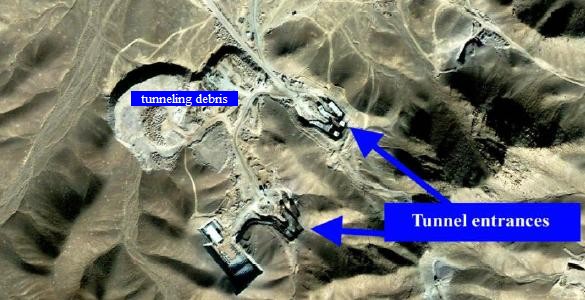
(This much we can already deduce about the extent of the tunneling: it has produced two very large adjoining flattened mounds of debris which are marked in the image above.)

Gary Sick seems to have been among the descriptively most precise in referring to “a small enrichment facility in an underground chamber on a Revolutionary Guards base.”

Inside an underground chamber it is; inside a mountain it is not — at least not unless one assumes a Lilliputian perspective and calls a 167ft tall hillock a mountain. That’s the difference in elevation between one of the tunnel entrances and the highest point along the ridge that the tunnel penetrates. (Use Google Earth to see specific elevations. For instance, the northern tunnel entrance is at 2,975ft. The adjacent ridge to the east is at 3,142ft.)


View Larger Map

Not so fast with the sanctions. When the president of a country sharing a 1,458km border with Iran says sanctions against Iran won’t work, there’s reason to think that he isn’t simply making a prediction; he might be making a promise.

Iraq’s President Jalal Talabani gave this warning on Saturday and no doubt it was warmly received in Tehran. China and Russia might be crucial when it comes to imposing sanctions. Iraq might turn out to be key when it comes to enforcing or being unable to enforce them.

Pity the IAEA. There it is — the world’s indispensable nuclear monitoring agency — but does anyone care to share their intelligence so that IAEA inspectors can do their work? Only when the powers that be deem it useful.

Bombs away. Maybe this isn’t the smoking gun Israel was waiting for. Evidence of a clandestine program may confirm some of Israel’s dire warnings, but how many other similarly well-concealed and hard-to-destroy facilities might there be? All that an Israeli attack might actually accomplish would be to legitimize Iran’s withdrawal from the NPT and a rush towards weaponization.

The meaning of a mountain. If “inside a mountain” might be a topographical stretch, it’s an image that serves multiple purposes:
1. It’s too good an image for any journalist to risk undermining with a skeptical question. (“And just how big is that mountain?”)
2. It tells the world that the Iranians are dastardly, sneaky fellows whose evil plans can only be hidden by something as big as a mountain.
3. It says the Americans are so smart that they can find anything, however well hidden.
4. It highlights the possibly insurmountable challenge Israel would face in launching an air strike against a target much harder to destroy than a reactor under construction in Syria, or a weapons convoy on the move in Sudan.
5. It says that Obama isn’t a daydream believer sending his representatives into a negotiating trap; he’s back in his superhero mode out to save the world.

What’s it all about? Once you get past the theatrics it comes down to the pursuit of national interests — it’s not (or at least should not be) about putting Iran in a box.

Every party has distinct national interests, but fruitful negotiations will hinge on identifying where these interests overlap — not simply the overlapping interests of the US and its allies, but also those that are shared by Iran.

Stepping off the war path requires that everyone, including the Iranians, can see a way of winning.

Facebooktwittermail