The Associated Press reports: Iraqi officials discovered 50 bodies, many of them blindfolded and with their hands bound, in an agricultural area outside a city south of Baghdad on Wednesday, raising concerns over a possible sectarian killing amid the battle against a Sunni insurgency.
The lightning sweep by the insurgents over much of northern and western Iraq the past month has dramatically hiked tensions between the country’s Shiite majority and Sunni minority. At the same time, splits have grown between the Shiite-led government in Baghdad and the Kurdish autonomy region in the north.
In an address on Wednesday, Prime Minister Nouri al-Maliki accused the Kurdish zone of being a haven for the Islamic extremists and other Sunni insurgents. He did not provide any evidence, and the claims are likely to only further strain Baghdad’s ties which the Kurds, whose fighters have been battling the militant advance in the north.
The bodies, all of them with gunshot wounds, were found in the predominantly Shiite village of Khamissiya outside the city of Hillah, located some 95 kilometers (60 miles) south of Baghdad, said military spokesman Brig. Gen. Saad Maan Ibrahim. He said an investigation was underway to determine the identities of the dead as well as the circumstances of the killings. [Continue reading…]
Category Archives: Iraq
Anbar tribal leader: Maliki is ‘more dangerous’ than ISIS
Rudaw reports: Sheikh Hatem al-Suleiman, 43, is one of Anbar province’s most influential tribal sheikhs and is chief of the powerful Dulaim tribe in Ramadi.
Suleiman is founding member of the Anbar Salvation Council, a key group in the Sunni Awakening that collapsed after Prime Minister Nouri al-Maliki refused to include the group in state and military institutions. As the leader of Anbar’s Tribes Revolutionary Council, he is a key leader in the Anbar insurgency and a sharp critic of Maliki. As early as 2006, he became a leader in mobilizing Sunni Arab rebels against Al-Qaeda.
In an exclusive interview with Rudaw, Suleiman claimed the Islamic State (formerly the Islamic State in Iraq and Syria, or ISIS) and Iraq’s Sunni Arab tribes have drastically different philosophies. He says that armed tribes can easily push out ISIS but that Maliki must first leave office. [Continue reading…]
Iraq parliament chaos deepens as MPs fail to agree on new speaker
AFP reports: A solution to the Iraq crisis appeared to slip away into the distance as a crucial parliament session aimed at kickstarting the formation of a government was delayed when MPs failed to agree on a new speaker.
They were reportedly bickering despite calls for unity to see off a jihadist offensive that has overrun swaths of the country.
The Iraqi security forces have struggled to repel the swift advance of fighters for the Islamic State in Iraq and the Levant, which has forced hundreds of thousands of people to flee their homes. The developments have also alarmed the international community and heaped pressure on Nouri al-Maliki, the prime minister, as he bids for a third term in office.
But the government formation process – which international leaders and top clerics have urged should be completed as quickly as possible – suffered a setback when the session set for Tuesday was postponed to 12 August because political leaders could not reach an agreement. [Continue reading…]
Could Chalabi replace Maliki?
Patrick Cockburn writes: The ablest candidate to be prime minister is Ahmed Chalabi on the grounds that he is intelligent, energetic, an excellent organiser and has a good understanding of what has gone wrong. Several times in the past couple of years he told me with complete accuracy that the Iraqi security services were so rotted by corruption that they would speedily disintegrate if they had to fight a real war.
The very fact that Chalabi would be good as prime minister of Iraq does not mean that he will get the job. Listening to conversations among politically active Iraqis about the next prime minister, I notice that they all focus on how many players each candidate gets on with – the different power centres in the Shia, Sunni and Kurdish communities and foreign states such as the US, Iran and the Sunni neighbours – and not whether a new PM could reorganise the army before the Islamic State of Iraq and the Levant (Isis) attacks Baghdad.
Commending Chalabi and his abilities invariably causes dismay in the West – though not in Iraq these days – because he has acquired an impressive array of enemies. At different moments Chalabi has been high up on the most-hated lists of the US State Department, the CIA, Saddam Hussein, the British Foreign Office, Democrats and all those, mostly but by no means exclusively on the left and centre, who opposed the invasion of Iraq by the US and Britain in 2003.
The Guardian reports: The son of an establishment Baghdad family, Chalabi left Iraq as a child in 1956, spending much of his time between the US and the UK, along with stints in academia in Lebanon and finance in Jordan from the early 1970s. Along the way, he received a doctorate in mathematics and founded Petra Bank in Amman, which failed more than a decade later.
“In all of Iraq, nobody knows how to punch above their weight or play the convoluted game of Iraqi politics better than Ahmad Chalabi,” said Ramzy Mardini, a Jordan-based political analyst for thinktank The Atlantic Council. “His enduring survival is beyond our comprehension. Unlike Ayad Allawi [another former exile], Ahmad Chalabi is close to Iran. This is the key relationship that makes Chalabi’s candidacy something of a realistic prospect should Maliki be ousted. If Iran has a redline against a candidate, [he doesn’t] have a shot in making it in the end.
“If Iraqi politics were Game of Thrones, Chalabi would play Lord Baelish, a consummate puppet master behind the scenes, constantly plotting his path to power. For him, chaos isn’t a pit, but a ladder and Chalabi knows the ways and means of exploiting a crisis to suit his interests and elevation in Iraq’s political circles. He apparently has good relations with everyone, except Maliki.”
The next month will determine how willing Chalabi’s patrons are to throw in their lot with him. Maliki, apparently emboldened after a private talk with the office of Iraq Shia Islam’s highest authority, Ayatollah Ali al-Sistani, said on Friday that he was not going anywhere.
Sadr urges Maliki’s bloc to choose new Iraq PM candidate
Reuters reports: Iraqi Prime Minister Nuri al-Maliki’s coalition should withdraw its support for his bid for a third term and pick another candidate, Shi’ite Muslim cleric Moqtada al-Sadr urged, amid parliamentary deadlock over the formation of a new government.
Maliki has come under mounting pressure since Islamic State militants took swathes of the north and west of Iraq last month and declared a caliphate on land they and other Sunni armed groups have captured in Iraq and Syria.
In a statement published on his website late on Saturday, Sadr said Maliki “has involved himself and us in long security quarrels and big political crises” and suggested that preventing Maliki from serving a third term would be a “welcome step”.
“It is necessary to demonstrate the national and paternal spirit by aiming for a higher, wider goal from individuals and blocs and by that I mean changing the candidates,” said Sadr, who gained political influence during the U.S. occupation.
Allawi warns risk of Iraq’s dismemberment unless Maliki goes
Reuters reports: Former Iraqi prime minister Iyad Allawi called on incumbent Nuri al-Maliki on Saturday to give up his bid for a third term in power or risk the dismemberment of Iraq.
Maliki on Friday rejected a chorus of such calls since militants of a group now calling itself the Islamic State rampaged through swathes of Iraq and declared a mediaeval-style caliphate in land they control in Iraq and neighbouring Syria.
“I think it is time for Mr Maliki to leave the scene,” Allawi told Reuters in an interview in Istanbul.
“If he stays on, I think there will be significant problems in the country and a lot of troubles. I believe that Iraq would go the route of dismemberment, ultimately, if this happens. [Continue reading…]
A Shiite family fleeing Tal Afar — among Iraq’s 1.2 million internally displaced citizens
McClatchy reports: The mortars rained down for 12 hours, an eternity for members of the Hassan family who huddled together in a single room, the children screaming and the adults praying to die in the shelling rather than be slaughtered by the Islamic State militants who rampaged into the northern Iraqi city of Tal Afar two weeks ago.
Unlike many of their neighbors, the Hassans survived, all 19 of them, and the next day they fled their hometown on the same road they’d used in two previous displacements — once when U.S. forces battled Sunni Muslim extremists in 2004, and again in 2005 during sectarian pogroms. But after a harrowing, five-day journey to this southern Shiite holy city, the family has given up on Tal Afar.
Qassim Hassan, 53, the patriarch of this clan of Shiite Muslim Turkmen, a minority that dates back to the 7th Century, said there hasn’t been a peaceful year since the U.S.-led invasion of Iraq in 2003. This third narrow escape will be their last, he declared, ending more than 200 years of his family’s presence in Tal Afar, which once was considered a showpiece of U.S. counterinsurgency successes.
“We’re desperate now,” Hassan said. “We can no longer live there because we are the targets every time, and the government cannot protect us. We’re starting from zero here. We’re building a new life.”
The sectarian cleansing of Tal Afar is now complete, according to accounts from the city that say not a single Shiite family remains. The Islamic State, an al Qaida splinter group that’s captured roughly a third of Iraq, views Shiites as heretics deserving of death.
Not that the Sunnis who stayed behind fared much better — witnesses reached by phone say the extremists demanded two women from each remaining tribe. Leaders refused and at least eight people were killed in a single night of clashes last week, creating another wave of fleeing families. [Continue reading…]
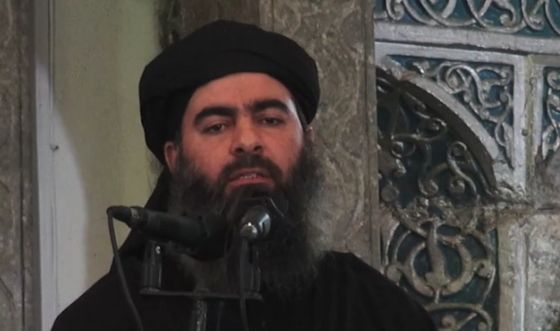
Has the leader of ISIS been killed?

Abu Bakr al-Baghdadi, the ISIS leader and recently self-declared Caliph Ibrahim, ruler of the so-called Islamic State, has until now kept a very low profile.
His first officially released video shows him delivering a sermon in Mosul.
Why the appearance now?
Perhaps in order to dispel rumors that he has been severely injured or might even be dead. Of course such reports might be a ruse to draw him out of hiding and thus make him an easier target to be killed. Either way, there’s no disputing al-Baghdadi’s vulnerability.
International Business Times reports: Abu Bakr al-Baghdadi, the leader of the Sunni militant outfit Islamic State of Iraq and the Levant (Isis), is said to have been severely injured in the raging battle forcing him to flee to neighbouring Syria.
According to a report in the Iraqi news network Al Sumaria, the insurgent leader was injured during a raid led by Iraq’s Shiite-led security forces in the west of Anbar.
“The Iraqi security forces carried out an operation in the city of Qaim on the border with Syria based on accurate intelligence and with the help of the Air Force where the leader of ISIL, Abu Bakr Al-Baghdadi was seriously injured,” said Haidar al-Shara, a representative of the international parliament in Iraq.
However, the report has so far not been independently verified. If confirmed, it will be a severe blow to the militant group which has been marching on several Iraqi cities.
The Iraqi official said: “After being hit, al-Baghdadi, with a range of elements of his organisation fled into Syrian territory because of its proximity to Qaim,” adding: “al-Baghdadi might be killed as a result of the severity of his injuries.”
If al-Baghdadi has indeed fled back to Syria, so much for ISIS’s claim that it has erased the boundary between Syria and Iraq. At this point in time, ISIS appears to recognize that one side of a supposedly non-existent border is safer than the other.
ISIS destroys mosques and shrines in Iraq
AFP reports: Jihadists who overran Mosul last month have demolished ancient shrines and mosques in and around the historic northern Iraqi city, residents and social media posts said Saturday.
At least four shrines to Sunni Arab or Sufi figures have been demolished, while six Shiite mosques, or husseiniyahs, have also been destroyed, across militant-held parts of northern Nineveh province, of which Mosul is the capital.
Pictures posted on the Internet by the Islamic State (IS) jihadist group showed the Sunni and Sufi shrines were demolished by bulldozers, while the Shiite mosques and shrines were all destroyed by explosives.
The photographs were part of an online statement titled “Demolishing shrines and idols in the state of Nineveh.”
Local residents confirmed that the buildings had been destroyed and that militants had occupied two cathedrals as well.
Photographs of ISIS destroying Shia mosques and shrines in "the State of Nineveh", Iraq, here: http://t.co/qS2eV9mg08 pic.twitter.com/lf5ZbPP2TX
— Mahmoud (@MahmoudRamsey) July 5, 2014
Maliki to run for a third term as Iraq’s prime minister
The New York Times reports: Despite sharp criticism from almost every political party in Iraq and pressure from friendly foreign powers to step down, Prime Minister Nuri Kamal al-Maliki announced Friday that he would seek a third term as prime minister.
He never suggested that he would step down. But the chorus of criticism over his sectarian policies, which helped create the conditions that led to a large portion of the country falling to Islamic extremists, had left many believing that lacking supporters, he might relinquish power.
They appear to have underestimated his desire to hold on to it.
“I will not give up my candidacy for a third term,” Mr. Maliki announced in a statement read on Iraqiya, the state television channel.
He noted that the bloc of lawmakers that supported his nomination was the largest in the Parliament and that they should not be asked to meet any conditions imposed by other legislative groups, such as supporting a different candidate. [Continue reading…]
Iranian pilot killed fighting in Iraq: Can Iran avoid ‘mission creep’?
The Wall Street Journal reports: Iran is pursuing a delicate strategy of supporting fellow Shiite Muslims and preserving its influence in neighboring Iraq—where the government is under siege by radical Sunni militants—without pushing the confrontation into outright sectarian warfare.
For the second straight week, influential clerics, who are appointed by the Islamic Republic’s Supreme Leader Ayatollah Ali Khamenei, used their Friday sermons to denounce the militant groups and support Iraq’s government. But their speeches steered clear of explicitly encouraging individual Shiites to act against the Sunni insurgents.
“We are ready to help Iraq as they ask for help,” Ayatollah Mohammad Saeedi told thousands of Iranians gathered for Friday prayers in Qom, Iran’s religious capital.
The country has openly sent top military advisers to help the Iraqi government, and blamed a collection of foreign enemies from Saudi Arabia to Israel and the U.S. for the violence. It deployed at least three battalions of elite Revolutionary Guards units to Iraq, according to Iranian security officials—an action Iran’s foreign ministry denied.
Yet it has stopped short of sending in large numbers of its own troops and discouraged ordinary Iranians from crossing the border to fight or defend holy sites in Iraq. [Continue reading…]
Al Jazeera reports: An Iranian pilot has been killed while fighting in Iraq, in what is thought to be the first military casualty that Tehran officially acknowledged during battles against Sunni fighters led by the Islamic State group.
Iran’s official IRNA news agency said on Saturday that Colonel Shoja’at Alamdari Mourjani was killed while “defending” the Shia Muslim holy sites in the city of Samarra, north of Baghdad.
Al Jazeera’s Imran Khan, reporting from Baghdad, said there were no reports of a plane being shot down in Iraq and the pilot probably died while fighting on the ground. [Continue reading…]
Iran and Saudi Arabia in secret talks to replace Maliki
The Times reports: Iran is sending officials to Saudi Arabia for secret talks about replacing Iraq’s embattled prime minister, Nouri al-Maliki, with a compromise candidate who might broker a political solution to the deepening crisis there.
The move towards co-operation by the two regional enemies reflects growing alarm at the situation in Iraq, where lightning gains by the al-Qaeda splinter group Islamic State of Iraq and al-Sham (Isis) threaten both countries. Saudi Arabia deployed 30,000 extra troops along its border with Iraq yesterday after Baghdad pulled its forces out of the area, leaving the world’s largest oil producer to defend its frontier alone.
The move by Iran’s President Rouhani to solicit Saudi backing for a compromise candidate is a remarkable step, given the enmity between the two powers, but reflects the desperation in both capitals. With Iraq’s semi-autonomous Kurdish government taking steps towards declaring full independence, it falls to Tehran and Riyadh to break the political deadlock in Baghdad.
Iran has been Mr al-Maliki’s principal backer since he took power in 2006, but has reluctantly conceded that he must step aside to save Iraq from implosion. After years of discrimination against Iraq’s Sunni and Kurdish minorities by his Shia-led government, Mr al-Maliki is considered too widely hated to lead the country out of crisis.
Tehran is therefore ready to ditch the prime minister and has drawn up a list of potential replacements. Saudi Arabia, the dominant Sunni power in the region, has said it will urge Iraqi groups it can influence to join a unity government, but only if Mr al-Maliki goes. [Continue reading…]
Maliki’s effort to suppress the Sunnis
A New York Times report reiterates earlier reports, saying: “To help the Iraqis repel ISIS, Mr. Obama has flooded Iraq with intelligence and surveillance equipment and said he would deploy up to 300 military advisers to assess the condition of the Iraqi military.”
Buried in a Washington Post story which details the inadequacies of Iraq’s air force, is a passage which conflicts with the overarching narrative of a fledgling state, unable to meet its own needs.
Under Maliki’s direction, the Iraqi government became less concerned about the risks presented by extremists than it was about holding the Sunnis down.
[E]ven before the U.S. military left the country, the Iraqi government purged many of its best intelligence officers and assets because they were either Sunnis or Kurds, vastly degrading its ability to locate important terrorist targets, according to a senior intelligence official who spoke anonymously so that he could speak freely. Killing terrorists was no longer the Shiite-dominated government’s top priority, the officials said. Instead, the goal became one of undermining Sunni influence and power.
To accomplish this, Maliki created a special military liaison office, the Office of the Commander in Chief (OCINC), as a work-around to the normal chain of command, the officials said. It was also meant to bypass prying American eyes.
Michael Pregent, a former Army intelligence officer working on contract as an embedded adviser to the Iraqi security forces in 2008, obtained evidence that showed how politicized the Iraqi targeting process had become.
Pregent was secretly passed a list of 3,000 targets that OCINC was giving to its ground commanders conducting raids, he said in a recent interview. A confidential analysis of the list by Americans in a targeting cell at the Baghdad Operations Center found that 95 percent of the targets were either Sunni men of military age, tribal leaders or other Sunnis listed simply as “the friend of a terrorist, father of a terrorist, grandfather of a terrorist,” Pregent said. No direct evidence of terrorist involvement was provided, he said.
Iraq chases Baghdad sleeper cells as ‘Zero Hour’ looms over capital
Reuters reports: Iraqi insurgents are preparing for an assault on Baghdad, with sleeper cells planted inside the capital to rise up at “Zero Hour” and aid fighters pushing in from the outskirts, according to senior Iraqi and U.S. security officials.
Sunni fighters have seized wide swathes of the north and west of the country in a three week lightning advance and say they are bearing down on the capital, a city of 7 million people still scarred by the intense street fighting between its Sunni and Shi’ite neighborhoods during U.S. occupation.
The government says it is rounding up members of sleeper cells to help safeguard the capital, and Shi’ite paramilitary groups say they are helping the authorities. Some Sunni residents say the crackdown is being used to intimidate them.
Iraqis speak of a “Zero Hour” as the moment a previously-prepared attack plan would start to unfold.
A high-level Iraqi security official estimated there were 1,500 sleeper cell members hibernating in western Baghdad and a further 1,000 in areas on the outskirts of the capital. [Continue reading…]
Iraqi Shiite militias enter battle against ISIS
AFP reports: Iraq’s government once battled entrenched Shiite militiamen but is now making common cause with them against a jihadist-led onslaught that Baghdad’s forces are struggling to contain on their own.
Shiite militiamen are fighting alongside Iraq’s flagging forces, bringing experience, morale and increased numbers to the government side, which has lost large areas of five provinces to the Sunni Arab militant offensive.
But even if it pushes back the offensive, the government may have traded that immediate threat for another it cannot control.
“The last time the militias became strong and Baghdad had to contend with them, it led to operation Charge of the Knights,” said John Drake, a security analyst with AKE Group, referring to a 2008 operation against Shiite cleric Moqtada al-Sadr’s Mahdi Army militia that only succeeded with American support.
“This involved heavy fighting in the south of the country,” said Drake. “The difference now is that the government won’t have the same US military support.”
The Shiite militia resurgence also risks further alienating the Sunni Arab minority, which populates most areas overrun in the offensive and was targeted by death squads during a Sunni-Shiite sectarian war, which peaked in 2006-2007 and killed thousands.
“The reinvigoration of Shiite militia groups will, at the very least, be of concern for the Sunni community, given that such groups were involved in widespread sectarian killing,” Drake said. [Continue reading…]
Why the U.S. stuck with Maliki — and lost Iraq
“The crisis now gripping Iraq and the Middle East was not only predictable but predicted — and preventable. By looking the other way and unconditionally supporting and arming Maliki, President Obama has only lengthened and expanded the conflict that President Bush unwisely initiated.”
This is the damning assessment of Ali Khedery who by 2009 had become the longest continuously serving American official in Iraq. He writes:
[I]n August 2010, I was shocked that much of the surge’s success had been squandered by Maliki and other Iraqi leaders. Kurds asked how they could justify remaining part of a dysfunctional Iraq that had killed hundreds of thousands of their people since the 1980s. Sunni Arabs — who had overcome internal divisions to form the secular Iraqiya coalition with like-minded Shiite Arabs, Kurds, Turkmen and Christians — were outraged at being asked to abdicate the premiership after pummeling al-Qaeda and winning the elections. Even Shiite Islamist leaders privately expressed discomfort with Iraq’s trajectory under Maliki, with Sadr openly calling him a “tyrant.” Worst of all, perhaps, the United States was no longer seen as an honest broker.
After helping to bring him to power in 2006, I argued in 2010 that Maliki had to go. I felt guilty lobbying against my friend Abu Isra [Maliki], but this was not personal. Vital U.S. interests were on the line. Thousands of American and Iraqi lives had been lost and trillions of dollars had been spent to help advance our national security, not the ambitions of one man or one party. The constitutional process had to be safeguarded, and we needed a sophisticated, unifying, economics-minded leader to rebuild the country after the security-focused Maliki crushed the militias and al-Qaeda.
In conversations with visiting White House senior staff members, the ambassador, the generals and other colleagues, I suggested Vice President Adel Abdul Mahdi as a successor. A former Baathist, moderate Shiite Islamist and French-educated economist who had served as finance minister, Abdul Mahdi maintained excellent relations with Shiites, Sunnis and Kurds as well as with Iran, Turkey and Saudi Arabia.
On Sept. 1, 2010, Vice President Biden was in Baghdad for the change-of-command ceremony that would see the departure of Gen. Ray Odierno and the arrival of Gen. Lloyd Austin as commander of U.S. forces. That night, at a dinner at the ambassador’s residence that included Biden, his staff, the generals and senior embassy officials, I made a brief but impassioned argument against Maliki and for the need to respect the constitutional process. But the vice president said Maliki was the only option. Indeed, the following month he would tell top U.S. officials, “I’ll bet you my vice presidency Maliki will extend the SOFA,” referring to the status-of-forces agreement that would allow U.S. troops to remain in Iraq past 2011.
I was not the only official who made a case against Abu Isra. Even before my return to Baghdad, officials including Deputy U.S. Ambassador Robert Ford, Odierno, British Ambassador Sir John Jenkins and Turkish Ambassador Murat Özçelik each lobbied strenuously against Maliki, locking horns with the White House, U.S. Ambassador Christopher Hill and Maliki’s most ardent supporter, future deputy assistant secretary of state Brett McGurk. Now, with Austin in the Maliki camp as well, we remained at an impasse, principally because the Iraqi leaders were divided, unable to agree on Maliki or, maddeningly, on an alternative.
Our debates mattered little, however, because the most powerful man in Iraq and the Middle East, Gen. Qassim Soleimani, the head of the Quds Force unit of Iran’s Revolutionary Guard Corps, was about to resolve the crisis for us. Within days of Biden’s visit to Baghdad, Soleimani summoned Iraq’s leaders to Tehran. Beholden to him after decades of receiving Iran’s cash and support, the Iraqis recognized that U.S. influence in Iraq was waning as Iranian influence was surging. The Americans will leave you one day, but we will always remain your neighbors, Soleimani said, according to a former Iraqi official briefed on the meeting.
After admonishing the feuding Iraqis to work together, Soleimani dictated the outcome on behalf of Iran’s supreme leader: Maliki would remain premier; Jalal Talabani, a legendary Kurdish guerilla with decades-long ties to Iran, would remain president; and, most important, the American military would be made to leave at the end of 2011. Those Iraqi leaders who cooperated, Soleimani said, would continue to benefit from Iran’s political cover and cash payments, but those who defied the will of the Islamic Republic would suffer the most dire of consequences.
I was determined not to let an Iranian general who had murdered countless American troops dictate the endgame for the United States in Iraq. By October, I was pleading with Ambassador Jeffrey to take steps to avert this outcome. I said that Iran was intent on forcing the United States out of Iraq in humiliation and that a divisive, sectarian government in Baghdad headed by Maliki would almost certainly lead to another civil war and then an all-out regional conflict. This might be averted if we rebuffed Iran by forming a unity government around a nationalist alternative such as Abdul Mahdi. It would be extremely difficult, I acknowledged, but with 50,000 troops still on the ground, the United States remained a powerful player. The alternative was strategic defeat in Iraq and the Middle East writ large. To my surprise, the ambassador shared my concerns with the White House senior staff, asking that they be relayed to the president and vice president, as well as the administration’s top national security officials.
Desperate to avert calamity, I used every bit of my political capital to arrange a meeting for Jeffrey and Antony Blinken, Biden’s national security adviser and senior Iraq aide, with one of Iraq’s top grand ayatollahs. Using uncharacteristically blunt language, the Shiite cleric said he believed that Ayad Allawi, who had served as an interim prime minister in 2004-05, and Abdul Mahdi were the only Shiite leaders capable of uniting Iraq. Maliki, he said, was the prime minister of the Dawa party, not of Iraq, and would drive the country to ruin.
But all the lobbying was for naught. By November, the White House had settled on its disastrous Iraq strategy. The Iraqi constitutional process and election results would be ignored, and America would throw its full support behind Maliki. Washington would try to move Talabani aside and install Allawi as a consolation prize to the Iraqiya coalition.
The next day, I appealed again to Blinken, Jeffrey, Austin, my embassy colleagues and my bosses at Central Command, Gen. Jim Mattis and Gen. John Allen, and warned that we were making a mistake of historic proportions. I argued that Maliki would continue to consolidate power with political purges against his rivals; Talabani would never step aside after fighting Hussein for decades and taking his chair; and the Sunnis would revolt again if they saw that we betrayed our promises to stand by them after the Awakening’s defeat of al-Qaeda. [Continue reading…]

Obama’s emerging de facto alliance with Assad
The Daily Beast reports: There’s a battle raging inside the Obama administration about whether the United States ought to push away from its goal of toppling Syrian dictator Bashar al-Assad and into a de facto alliance with the Damascus regime to fight ISIS and other Sunni extremists in the region.
As President Obama slowly but surely increases the U.S. military presence on the ground in Iraq, his administration is grappling with the immediate need to stop the ISIS advance and push for a political solution in Baghdad. The 3 1/2-year grinding civil war is Syria has been put on a back burner for now. Some officials inside the administration are proposing that the drive to remove Assad from power, which Obama announced as U.S. policy in 2012, be set aside, too. The focus, these officials argue, should instead be on the region’s security and stability. Governments fighting for survival against extremists should be shored up, not undermined.
“Anyone calling for regime change in Syria is frankly blind to the past decade; and the collapse of eastern Syria, and growth of Jihadistan, leading to 30 to 50 suicide attacks a month in Iraq,” one senior Obama administration official who works on Iraq policy told The Daily Beast.
In effect, the American government has been in a limited partnership with the Assad regime for almost a year. The U.S., Russian, and Syrian governments made a deal last September to destroy Assad’s stockpile of chemical weapons—and relied on Damascus to account for and transport those weapons, in effect legitimizing his claim to continued power.
As far back as last December, top White House officials, including Deputy National Security Advisor Tony Blinken, have suggested that the rising threat of extremism was creating a “convergence of interests” between the U.S., Russia, and its allies in the Iranian and the Syrian governments to come to a political deal before the Islamists became too powerful.
“The Russians have a profound interest in avoiding the emergence of an extremist Syria, a haven for extremist groups,” Blinken said at the time. “Many of Syria’s neighbors have the same incentive, and of course we have a strong reason to want to avoid that future.”
But the view that Assad can somehow be a partner of any kind is vigorously disputed by other senior U.S. officials, especially those who work or have worked on Syria policy. They say the problem of extremism in the region can only be solved by removing Assad from power. Not only is the Assad regime a magnet for terrorism, they argue, but Assad and the extremists inside Syria are working together.
“The people who think Bashar al Assad’s regime is the answer to containing and eventually eliminating the Islamic-based threat do not understand the historic relationship between the regime and ISIS. [They] don’t understand the current relationship between Assad and ISIS and how they are working on the ground together directly and indirectly inside Syria,” Robert Ford, the recently departed U.S. ambassador to Syria, told The Daily Beast. “The people who think Assad’s regime survival is essential have not explained how his survival would solve the problem of extremism in Syria.” [Continue reading…]
ISIS and the strategy of managed savagery
Management of Savagery, by Abu Bakr Naji has been described as “al-Qaeda’s playbook.” Although ISIS (often referred to by its adversaries as Da’ish) has ideological differences with al Qaeda and should not be viewed as an affiliate of the older jihadist group, Alastair Crooke believes that Naji’s text outlines the strategy which ISIS is now following in Iraq.
In 2006, in a review of jihadist theorists, Lawrence Wright wrote:
Naji writes in the dry, oddly temperate style that characterizes many Al Qaeda strategy studies. And, like all jihadi theorists, he embeds his analysis in the tradition of Ibn Taymiyya, the thirteenth-century Arab theologian whose ideas undergird the Salafi, or Wahhabi, tradition; bin Laden frequently refers to Ibn Taymiyya in his speeches. The remarks of bin Laden and Zawahiri play only a modest part in Naji’s work. Indeed, Naji is a more attentive reader of Western thinkers: the thesis of “The Management of Savagery” is drawn from the observation of the Yale historian Paul Kennedy, in his book “Rise and Fall of the Great Powers” (1987), that imperial overreach leads to the downfall of empires.
The term “management or administration of savagery,” a term detailed in Abu Bakr Naji’s treatise, in fact refers to that hiatus which occurs between the waning of one power and the consolidation of power of another. What is being assumed here is that a certain chaos will pertain, and that the disputed territory will be ravaged by violence as power oscillates back and forth between the “old” power and its incoming successor (the Islamic State).
In this period, according to its literature, the ISIS will have limited aims: achieving internal security and preserving it; fixing its frontiers; feeding the population; establishing Shariah and Islamic justice — and most importantly fixing the establishment of a “fighting society,” at all levels within the community.
According to The Management of Savagery, in this stage, security will require the elimination of spies and “deterring the hypocrites with proof and other means and forcing them to repress and conceal their hypocrisy, to hide their discouraged opinions, and to comply with those in authority, until their evil is put in check.” In short, we might expect that this will comprise ISIS’ aims for the coming period.
In other words, any move on Baghdad, which Da’ish insists will come, is unlikely to be imminent, but will have to wait until the area already seized is ‘secured’, and its frontiers controlled.
This phase also marks the “plundering the financial resources” for the purposes of the “project.” The implication here is that ISIS has as its aim eventually to become financially self-sufficient. Indeed, it clearly has been pursuing this objective in Syria (taking oil fields, seizing the arms warehouses of the SNC, and selling to Turks much of the industrial infrastructure of Aleppo and northern Syria).
This also suggests that, whilst ISIS is not presently contesting militarily the Peshmerga takeover in Kirkuk (with its substantial oil resources), it is only a matter of time before Da’ish seeks to acquire such an obvious source of funding – just as it has fought other jihadist groups in Syria for control of Raqa’a’s oil revenue.
But this second phase (administering the violent hiatus until the State is consolidated) — more ominously — signals the start of “massacring the enemy and making him frightened.” The literature underlines that anyone who has actually experienced conflict (in contrast to those who simply theorize about it) understands that slaughter and striking fear into the hearts of the enemy is in the nature of war.
The point is made by citing the Companions (of the Prophet) who “burned (people) with fire, even though it is odious, because they knew the effect of rough violence in times of need.”
The author of The Management of Savagery treatise bluntly states that there is no room for “softness”: “Softness” is the ingredient for failure: “our enemies will not be merciful to us, so it compels us to make them think one thousand times, before they dare attack us.”
It is here that we see the second key Zarqawrist notion: the reading given by ISIS to the military campaigns conducted by first Caliph. This “reading” highlights (and seeks to legitimize) the need to use “rough violence” during this period of hiatus, when Islamic power was not yet fully consolidated. It was a moment, following the death of the Prophet that several Arab tribes refused to pay Zakat to Abu Bakr (as they had earlier to the Prophet when he was alive), and held (in accordance with the prevailing Arab tradition) that their tribal allegiance to the Prophet naturally expired with the leader’s death. There followed the brutal Wars of the Ridda (or the Wars of Apostasy).
What is significant here, too, is the narrow construction placed on apostasy — a definition to which Da’ish adheres closely.
In sum, the beheadings and other violence practiced by ISIS are not some whimsical, crazed fanaticism, but a very deliberate, considered strategy. The military strategy pursued by ISIS in Iraq, too, is neither spontaneous nor some populist adventure, but rather reflects very professional well-prepared military planning. [Continue reading…]
While the re-creation of the caliphate is ISIS’s stated goal, its desire to establish an Islamic state and its declaration that it has already succeeded in accomplishing this goal, begs the question of how it envisions governance. If Naji serves as a reliable guide, it sounds as though the jihadists want to assert ideological control while handing over administrative responsibilities to hired employees.
Lawrence Wright writes:
Alone among Al Qaeda theorists, Naji briefly addresses whether jihadis are prepared to run a state should they succeed in toppling one. He quotes a colleague who posed the question “Assuming that we get rid of the apostate regimes today, who will take over the ministry of agriculture, trade, economics, etc.?” Beyond the simplistic notion of imposing a caliphate and establishing the rule of Islamic law, the leaders of the organization appear never to have thought about the most basic facts of government. What kind of economic model would they follow? How would they cope with unemployment, so rampant in the Muslim world? Where do they stand on the environment? Health care? The truth, as Naji essentially concedes, is that the radical Islamists have no interest in government; they are interested only in jihad. In his book, Naji breezily answers his friend as follows: “It is not a prerequisite that the mujahid movement has to be prepared especially for agriculture, trade, and industry. . . . As for the one who manages the techniques in each ministry, he can be a paid employee who has no interest in policy and is not a member of the movement or the party. There are many examples of that and a proper explanation would take a long time.”