Zvi Bar’el writes: It’s not important what’s said at the United Nations, what the superpowers are busy with or even what strategic issues are guiding the powers that be. When Israel speaks the world stands at attention. The Iranian threat? If it weren’t for the revelations by Israeli intelligence and the fears of a vicious response by Jerusalem, it’s doubtful whether the United States or the rest of the world would get excited about Iran’s nuclear program.
Syria’s chemical weapons? Only the public statements by Military Intelligence research chief Itai Brun forced the U.S. administration to admit that chemical weapons had been used. Al-Qaida in Sinai? A few rockets fired from Sinai and the deadly incident on the border turned Egypt into a threat, forced Mohammed Morsi’s regime to clash with armed Salafist groups and dragged the United States into the arena.
The wrong impression is that only Israel has precise intelligence in the region, and without it the world wouldn’t know about the dangers. The right impression is that Israel knows how to turn its intelligence into an international panic. This should be a proud achievement for such a small and strategically unimportant country. It’s an enormous success to harness the world’s strongest power to help the country that always says it doesn’t need foreign armies’ help.
But this same country that notices distant threats before anyone else has become deaf, dumb and blind when the threat is lying at its doorstep. When was the last time the prime minister spoke about the Israeli-Palestinian conflict? What happened to the polished finance minister who promised to launch talks with the Palestinians? What has the defense minister done except for closing and opening the Kerem Shalom crossing after every mortar shell falls on Israel?
True, the conflict with the Palestinians is dwarfed by the Iranian threat, Syria’s chemicals and the missiles from Sinai. It’s not a “strategic threat,” it’s like an annoyance that produces an expression of sympathy, or hand waving that expresses insignificance or boredom.
This isn’t a conflict that requires us to call up reserves, launch planes or locate weapons so they can be bombed. This is a conflict without the beef that has almost no Jewish casualties, doesn’t provoke demonstrations in Israel, and the media is sick of. It’s a conflict that’s unconvincing in its conflictedness, that doesn’t need the world’s participation or wrangling over red lines. It has no red lines – or Green Line. [Continue reading…]
Category Archives: Israel
Israel extends apartheid law preventing Palestinians citizens living with their spouses
Haaretz reports: Prime Minister Benjamin Netanyahu’s cabinet decided unanimously on Sunday to extend the Citizenship Law restricting the “family reunification” of Israeli citizens with certain foreign partners for an additional year.
The law denies entry or living permits to partners who are considered a security threat, among them Palestinians from the West Bank and Gaza, and citizens of enemy countries or from areas involved in long-term conflict with Israel. The law affects mainly Israeli Arab citizens and their families from the West Bank and Gaza.
The proposal brought before the cabinet on Sunday was submitted by Interior Minister Gideon Sa’ar, and was formulated based on a Shin Bet opinion regarding the volatility of partners from the Gaza Strip.
Meretz party head Zahava Gal-On slammed the decision as placing “draconian restrictions on Israeli Arab citizens’ right to marry,” calling the designation of all Palestinians as a security threat “racist” and discriminatory.
Gal-On, who petitioned the High Court against the Citizenship Law, said that “the only correct way is to individually evaluate everyone asking for family unification.” She added that the government’s approach was preventing thousands of people who live in Israel from attaining citizenship and achieving social rights.
Palestinian official Saeb Erekat called the law “racist” and an attempt to “distort the Palestinian social fabric and force the displacement of Palestinian families.” He called on the international community to “seriously examine the pattern of Israeli policies contributing to a situation of apartheid and to look into the wider effects and implications of the Israeli government’s precondition of being recognized as a Jewish State.”
Israel generally grants citizenship to spouses of Israelis in a gradual process. In the spirit of this process, a similar process was instituted for the naturalization of spouses of permanent residents, though the process is a little longer. A 2002 temporary order excluded Palestinian spouses from these processes and barred them from becoming Israeli citizens.
In May 2006, the High Court rejected numerous petitions asking to overturn the Citizenship Law. However, most of the justices wrote that the law constitutes a violation of basic rights, mainly the right to a family life.
In March 2007, in a hearing surrounding later petitions against the law, the state said that an amended version of the temporary order was expected to be approved by the Knesset, and the court consequently ruled that the petitioners would have to revise their petitions in accordance with the amended orders after they were made public. After the hearing, the amended law was made public, and the petitioners maintained that the new version not only extended the validity of the law until July 2008, it also expanded the geographic jurisdiction of the law, making it applicable to spouses from Iran, Lebanon, Syria and Iraq as well as other areas on which the government was free to decide.
Arabs make up about 20 percent of Israel’s population of 7 million. About 3 million Palestinians live in the West Bank and Gaza Strip. Many families were divided by cease-fire lines after wars, and over the years, marriage between the two groups has been common.
Since 1993, more than 100,000 Palestinians have obtained Israeli permits in this manner and some Israelis see this as a security threat.
The ‘Great Game’ in the Levant
Al-Monitor: With billions of cubic meters in estimated gas reserves, the Eastern Mediterranean, or the “Levant Basin” by another name, is turning into the stage for a contemporary version of the 19th Century “Great Game,” which has as much potential for catalyzing peace, as it does for contributing to new tensions in a region already rife with conflict.
The key event this respect came on March 30, the historic date when natural gas from the Tamar field, off the coast of Israel, started flowing to the Israeli mainland, thus kicking off a process that will not only make the Jewish state largely energy independent, but also turn it into a key supplier for European markets.
The Tamar field, discovered as recently as 2009, is said to hold 250 billion cubic meters [427 billion square feet] of gas, and is the smaller of Israel’s two offshore fields, the bigger one being the Leviathan field with its estimated 425 billion cubic meters of gas, but which has yet to be developed.
Texas-based Noble Energy and the Israeli Delek Energy, the two largest shareholders in the Israel gas fields are said to be looking for a go-ahead now from the Israel government to export the larger portion of the gas, since demand in Israel is insufficient to cover the cost of developing the Leviathan field.
This is the point at which Turkey, which has already become an important energy hub for Caspian and Iraqi oil, and which consolidated its position further through recent energy deals with the Kurdistan Regional Government in northern Iraq, enters the “Game” as a major player. Turkey is clearly a country that Israel cannot overlook while trying to work out the most profitable route to export its gas.
With one of the fastest growing economies in the world, Turkey has increasing energy needs and therefore also provides a stable market for Israel gas. It is not surprising therefore that there is a lot of talk in diplomatic circles suggesting that “the energy factor” also contributed to Israel’s recent apology to Turkey for its deadly raid on the Turkish Mavi Marmara aid ship in 2010. [Continue reading…]
Israel and Turkey restore ties with energy as a motivator
Joseph Dana writes: During President Barack Obama’s final hour in Israel on March 22, he was able to broker an unlikely apology from Israeli Prime Minister Benjamin Netanyahu to his counterpart in Turkey, Recep Tayyip Erdogan.
Over the past several years, diplomatic relations soured between the two traditional allies over Israel’s stubborn refusal to apologise for the deaths of eight Turkish activists and one Turkish-American aboard an aid convoy en route to the Gaza strip in 2010.
Analysts quickly pegged the apology to instability in Syria and even the Iranian nuclear crisis. But there is another possibility that could be fuelling this rapprochement: a potential stake in the lucrative export of Israeli natural gas.
After years of fruitless exploration in the eastern Mediterranean, in 2009 Israel discovered some of the largest offshore reserves of natural gas in the last decade. The exact size of the gasfields are unknown but they are rumoured to contain upwards of 150 years’ worth of production.
According to Eytan Sheshinski, an economist at the Hebrew University and the head of an Israeli parliamentary fact-finding commission on the gas, Israel will have a sovereign wealth fund worth roughly $80 billion (Dh293.6 billion) by the year 2030. That amount corresponds only to the revenue from a super-profits tax levied on the sought-after resource.
Israel’s Central Bank forecasts the natural gas will account for nearly a third of Israel’s economic growth this year. That could soften the impact of Israel’s growing international isolation.
Natural gas from one deepwater field started flowing on Saturday for internal consumption, prompting Israeli Energy Minister Sivan Shalom to declare Israel’s economic independence for the first time in history.
Which begs the question: with Israel’s growing sovereign wealth fund, how will the Israel lobby in Washington have the gall to keep on insisting that U.S. taxpayers have an obligation to pay for 20% of Israel’s defense budget?
Video: On the road to Israeli apartheid
How the EU subsidises Israel’s military-industrial complex
Ben Hayes writes: Regardless of where you stand on Israel-Palestine, things have surely gone awry in Brussels for the EU to be providing generous R&D (research and development) subsidies to Israel Aerospace Industries (IAI), the state-owned manufacturer of Israeli ‘drones’ and other ‘battlefield solutions’. Some of the grants are for IAI to adapt its killer robots for use within the EU. It’s a wonder David Cameron didn’t mention it in his crusade against the EU budget. Perhaps not: but how does EU tax-payers hard-earned cash end up in the hands of the Israeli war machine?
The EU’s framework research programme is the biggest single R&D budget in the world. The current “FP7” programme (2007-2013) has a budget of €51 billion; the next programme, “Horizon 2020” (2014-2020), will have somewhere between €70 and €80 billion. Israel joined the European Research Area in 1995 under the terms of a remarkably generous EC “association agreement” and participates in the framework programmes on the same footing as EU member states. This means it puts up some of the money (each participating state pays a proportion based on its GDP) and is eligible to apply for the funds on offer. With its buoyant R&D sector, few states have been as successful in landing EU grants as Israel (which is thus a net recipient of EU research funds) and the EU is now second only to the Israeli Science Foundation in Jerusalem as a source of domestic research funding.
Israel Aerospace Industries has been a principle beneficiary of the EU’s largesse. Established in 1957 upon recommendation of Shimon Perez, then Director-General of the Israeli Ministry of Defence, IAI is now a world leader in the booming drone market, producing the Heron, Hunter and Ghost, among many others – in 2010 its total annual revenues topped the $3 billion mark. Since Israel joined the European Research Area, IAI has landed at least 69 EU research grants. Because the European Commission is ostensibly prohibited from funding military R&D, most of these grants have come from the transport and aerospace budgets, where military and defence contractors play a leading role in developing new materials for aircraft and more efficient engines as part of the EU’s “clean skies” programme. The EU has also ploughed money into unmanned aerial vehicles (UAVs/drones), which it wants to see introduced into commercial airspace as soon as practicably possible. [Continue reading…]
Still not sure whether Israel practices apartheid?
Ynet reports: The Transportation Ministry announced that starting Sunday it will begin operating designated lines for Palestinians in the West Bank.
The bus lines in question are meant, according to the ministry, to transport Palestinian workers from the West Bank to central Israel. The ministry alleges that the move is meant to ease the congestion felt on bus lines used by Jews in the same areas, but several bus drivers told Ynet that Palestinians who will choose to travel on the so-called “mixed” lines, will be asked to leave them.
While officially the new lines are considered “general bus lines,” Ynet learned Saturday that their existence has been made public only in Palestinian villages in the West Bank, via flyers in Arabic urging Palestinians to arrive at Eyal crossing and use the designated lines.
The Transportation Ministry defended the plan, saying it was the result of reports and complaints saying that the buses traveling in the area were overcrowded and rife with tensions between the Jewish and Arab passengers.
Barak says reported Syria strike shows Israel is serious
Reuters reports: Defense Minister Ehud Barak said on Sunday an attack on a Syrian arms complex showed Israel was serious about preventing the flow of heavy weapons into Lebanon, appearing to acknowledge for the first time that Israel carried out the strike.
Israel has maintained official silence over Wednesday’s raid, which Syria said targeted a military research center north-west of Damascus.
“I cannot add anything to what you have read in the newspapers about what happened in Syria several days ago,” Barak told a security conference in Munich on Sunday.
“But I keep telling frankly that we said, and that is another proof that when we say something we mean it. We say that we don’t think it should be allowable to bring advanced weapons systems into Lebanon.”
Diplomats, Syrian rebels and security sources said Israeli jets bombed a convoy near the Lebanese border on Wednesday, apparently hitting weapons destined for the Lebanese militant group Hezbollah, which fought a 34-day war with Israel in 2006.
Syria denied the assertions, saying the target was the Jamraya complex on the northwestern fringes of Damascus and 8 miles from the border.
Video: Mossad’s bungled assassination attempt on Hamas leader Khaled Meshaal
In Israel, advocates of peace are viewed as extremists
Outside Israel, Shlomi Eldar is best known as the TV broadcaster who spoke to Gaza doctor, Ezzeldeen Abu al-Aish, moments after al-Aish’s three daughters had been killed in an Israeli strike during Operation Cast Lead in 2009.
In an interview with Haaretz, Eldar says:
A few days after the end of Operation Pillar of Defense [November, 2012], I gave a talk at a Herzliya high school. The children, who said they came from good homes, told me we have to kill all the Arabs, including the Israeli Arabs, because where do they get off thinking they will get control of the country. Their ideal is to go into the army and kill as many Arabs as possible. That’s one side of the picture, Israeli youth, the new generation, living in an atmosphere of demonizing the Palestinians − which is something the Israeli media are responsible for in no small measure. The other side of the picture is the young generation in Gaza, a child of five or nine. Let’s say he is not wounded, but a four-ton bomb landed next to his house. Do you know that in Operation Pillar of Defense, not one pane of glass remained intact in the whole of Gaza? It’s a tactic of creating sonic booms to frighten people without hurting them. A child who has a bomb like that land next to him can’t hear anything for the next three days. What does he think about the Jews afterward? And where will we end up, if this is how Jewish youngsters think about Arabs?
Nowhere good.
We are on a nothing-to-lose track. Which is why I say there is no future. When I told the high school class that we have to look at them as human beings, one boy jumped up and said, “Who do you vote for? You’re extreme left, no?” I replied, “It would surprise you to know who I vote for.” But that’s not the point. The point is that we in Israel have reached a situation in which if someone says we have to talk peace, he’s considered extreme left.
Israeli eugenics program halted

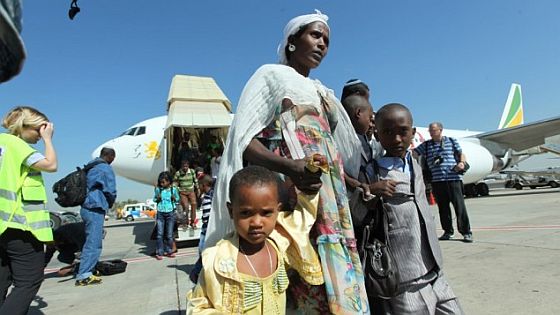
Ethiopian immigrants arriving in Israel, October 2012.
Haaretz reports: A government official has for the first time acknowledged the practice of injecting women of Ethiopian origin with the long-acting contraceptive Depo-Provera.
Health Ministry Director General Prof. Ron Gamzu has instructed the four health maintenance organizations to stop the practice as a matter of course.
The ministry and other state agencies had previously denied knowledge or responsibility for the practice, which was first reported five years ago.
Gamzu’s letter instructs all gynecologists in the HMOs “not to renew prescriptions for Depo-Provera for women of Ethiopian origin if for any reason there is concern that they might not understand the ramifications of the treatment.”
He also instructed physicians to avail themselves of translators if need be.
Gamzu’s letter came in response to a letter from Sharona Eliahu-Chai of the Association of Civil Rights in Israel, representing several women’s rights and Ethiopian immigrants’ groups. The letter demanded the injections cease immediately and that an investigation be launched into the practice.
On December 9, the Times of Israel reported: Ethiopian women who moved to Israel eight years ago claimed Israeli officials coerced them to receive injections of Depo-Provera, a long-acting birth control drug, as a prerequisite to immigration.
Speaking to reporters on an episode of Israel Educational Television’s investigative show “Vacuum” that aired on Saturday, several immigrants described the intense pressure placed on them to keep their families small. The women claimed Israeli representatives from the Joint Distribution Committee (JDC) and the Health Ministry told them that raising large families is especially difficult, that it is for hard people with many children to find work and support their families, and that many landlords would not be willing to rent apartments to large families.
Gal Gabbai, the show’s anchor, reported that in the past decade, approximately 50,000 Ethiopian Jews have immigrated to Israel. During that period, the birth rate among this community, which has traditionally favored very large families, has plummeted by nearly 50 percent.
Several women interviewed by Gabbai said that they were told at the transit camps in Ethiopia that they had to receive the shots if they wanted to immigrate to Israel and continue receiving medical treatment from the JDC. Furthermore, many of the women claimed they were never told that the shots were to prevent pregnancy. Rather, they were under the impression that the shots were vaccinations.
Some women reportedly refused to tell their husbands about the shots, fearing the men would be furious.
The report said many women continued to receive Depo-Provera after arriving in Israel, despite suffering such side effects as severe headaches and abdominal pains.
One woman who suffered from osteoporosis said she has been receiving shots for four years without ever being warned that Depo-Provera was dangerous to women in her condition.
A hidden camera in a local health clinic recorded a Ethiopian woman being told by a nurse that this shot is given “primarily to Ethiopian women because they forget, they don’t understand, and it’s hard to explain to them, so it’s best that they receive a shot once every three months… basically they don’t understand anything.”
Israeli authorities denied all of the allegations.
“In with the New Year, out with the Africans,” a video report by David Sheen showed one of the most recent and bluntest expressions of racism in Israel, as residents of South Tel Aviv demanded that the government round up, jail and deport all non-Jewish African asylum-seekers.
Apologists for the Jewish state might have responded in one or two ways: to argue that the demonstrators are marginal (even though the included a member of the Knesset), or that even if their actions are ill-conceived, these Israelis are driven by the desire to protect Israel’s Jewish identity.
What the government policy designed to limit the size of Israel’s Ethiopian population makes indisputable is that racism is institutionally based in the workings of the state.
Why the Israeli elections were a victory for the Right
Max Blumenthal writes: The story of the Israeli elections is not, as was expected, the dominance of Prime Minister Benjamin Netanyahu and his right-wing Likud-Beiteinu coalition with former foreign minister Avigdor Lieberman. Instead, it is the unlikely triumph of Yair Lapid, a media celebrity who managed to secure nineteen seats in the next Knesset, making his newly formed Yesh Atid, or There Is a Future, the second-largest party in Israel. In the coming days, Lapid will play a pivotal role in the formation of the next governing coalition, and he is certain to receive a ministerial role in any future administration.
The results were a stinging rebuke to Netanyahu, who had expected over forty seats and wound up with only thirty-one. But what do they mean for the status quo of the Israeli occupation and the slow-motion dispossession of the Palestinians? Lapid has been cast in mainstream US media accounts as a “centrist,” a label that carries moderate connotations. According to the Washington Post, his success could “signal more flexibility in peace negotiations with the Palestinians.” But Lapid is, in fact, a politically vague media celebrity presiding over a party comprising random figures he personally selected — “as much a mystery as the future the party claims to be fighting for,” as the Times of Israel described him. As a potential coalition partner, the vapid broadcast personality seems like a perfect tool for Netanyahu; he is far more refined than Lieberman, who has consistently verged on bellicose incitement, but has no clear ideological core.
What’s more, Lapid has offered scant evidence that he views the Palestinian issue any differently than Netanyahu does. When he unveiled his foreign policy platform last year, Lapid chose to do so at a university inside the illegal mega-settlement of Ariel. Israel “must at last get rid of the Palestinians and put a fence between us,” he declared, explaining that he chose to launch his campaign at the settlement because “there is no map on which Ariel isn’t a part of the state of Israel.” Like Netanyahu, he says he strongly opposes the division of Jerusalem, an implicit rejection of the international consensus for a Palestinian state with East Jerusalem as its capital. (The Labor Party, which won fifteen seats and is generally labeled center-left, also supports annexing the major settlement blocs.)
In a 2007 column for the Israeli daily Yediot Aharonoth, Lapid insisted that ending the occupation would mean certain death for himself and fellow Israeli Jews. He wrote, “It may be true that the humane thing is to remove the roadblocks and checkpoints, to stop the occupation immediately, to enable the Palestinians freedom of movement in the territories, to tear down the bloody inhumane wall, to promise them the basic rights ensured to every individual. It’s just that I will end up paying for this with my life.… Call me a weakling; call me thickheaded — I don’t want to die.” [Continue reading…]
Israelis prefer to imagine they live somewhere else
Aluf Benn says Yair Lapid’s success in yesterday’s election sprang from his ability to define the Israeli mainstream and become its voice. What the 2011 middle-class revolt demonstrated, in Lapid’s analysis was that “Israelis couldn’t care less about the Palestinian issue and the settlements. Instead they crave economic security and better education.”
The key question in the wake of Tuesday’s result, Benn writes, is:
can you really live in Tel Aviv and feel like it’s Berlin, with no occupation and settlements barely 20 minutes away? Can Israel isolate itself behind wire and concrete and fix its education and welfare, as if the Palestinians don’t exist? It sounds good in a campaign, but disconnected from real life. And therefore Lapid’s test will be in his ability to pull Netanyahu towards a moderate foreign policy, and not to accept empty pledges of constitutional and social reform in return for sustaining Likud.
Coalition talks are the endgame of Israeli elections, and the political rookie Lapid now awaits a tough poker game with the master of survival, Netanyahu.
Michael J. Koplow writes: When Netanyahu decided to call early elections, he did it because the political timing seemed favorable for him rather than because he was forced to. Despite his term being marked by no significant policy accomplishments or remarkable stances, Netanyahu has achieved a nearly unprecedented degree of governmental stability.
In contrast, the next Netanyahu government, which will almost certainly be the result of today’s election, is not only going to be less stable on a daily basis than the previous one, but will also be likely to fall well before Netanyahu’s term is up and before he is ready to call another round of elections. The new Israeli government is going to be facing enormous cross-cutting pressures from within its own ranks and from outside the country, and no matter how hard he tries to construct a stable coalition, there will be nothing Netanyahu can do to mitigate this problem. Rather, the coalition choices that Netanyahu makes are going to determine which set of pressures will ultimately bring him down. In essence, Netanyahu will be picking his poison rather than coming up with a cure.
Netanyahu’s election setback
Patrick Martin reports: Prime Minister Benjamin Netanyahu earned the right in Tuesday’s Israeli election to be asked to try to form the country’s next government, but whether he will succeed or not is up to a neophyte politician named Yair Lapid, whose party’s second-place finish has stunned the country.
Riding a wave of protest over such issues as the cost of housing and the privilege given Israel’s ultra-Orthodox Haredim to avoid the military draft, Mr. Lapid, a popular former broadcast journalist, made these two concerns the centrepiece of his campaign.
Another first-time politician, Naftali Bennett, argued for much the same things, but Mr. Bennett, leader of a national religious party known as the Jewish Home, also championed the expansion of Israeli settlements in the West Bank and the abandonment of the idea of a Palestinian state – a position too extreme, perhaps, for many Israelis.
Whatever this election was about, it wasn’t about making peace with the Palestinians, nor about Israel’s relations with Arab states in the region. It was about what Israelis wanted in their daily lives.
The outcome of Tuesday’s vote, however, leaves Mr. Netanyahu with one of two choices, both with broader, regional implications. Either he tries to govern with a paper-thin majority of right wing and ultra-Orthodox parties (in which case he will have to adopt an even more confrontational approach to Palestinian statehood as demanded by Mr. Bennett), or he will reach out to the centrist Mr. Lapid to form a broader coalition.
Based on the phone call he made to Mr. Lapid late Tuesday night, he appears to have chosen the latter approach.
What remains to be seen now is whether the Prime Minister will jettison the ultra-Orthodox and their privileges from his coalition – or leave Mr. Bennett and his pro-settlement views out of a new government. The choice may be made for him by Mr. Lapid.
In either scenario, as long as Mr. Netanyahu is Prime Minister, Israel’s policy toward Iran won’t change.
For Mr. Netanyahu, the man who was assumed to be the once and future prime minister, the results are a stunning setback.
An editorial in Haaretz said: Israelis awaken this morning to a day of uncertainty. The voting is over, but the election is not. The soldiers’ votes, disqualified votes, the electoral threshold − all of these will still move the numbers this way or that. But to learn some lessons, no waiting is necessary.
Israel on Tuesday expressed no confidence in Prime Minister Benjamin Netanyahu. After four years at the country’s helm, together with his natural partner, MK Avigdor Lieberman, Netanyahu lost about a quarter of his strength despite − or perhaps because of − the merger with Lieberman. Netanyahu, Israelis said on Tuesday, has failed. He has failed in the political sphere, the foreign policy sphere and the socioeconomic sphere.
His failure is a failure of leadership, which will continue to cast a pall over us if he survives in power. Netanyahu plunged from Likud and Yisrael Beiteinu’s 42 MKs to about 30 because the Israeli public felt that his government had not understood the deeper significance of the protests of the summer of 2011.
Reuters reports: Palestinians reacted warily to the outcome of the poll, voicing doubts it would produce a government more willing to compromise for peace, even if it included centrist parties.
An editorial in the Ramallah-based Al-Quds daily said such parties would provide a “cosmetic decoration” for a Netanyahu-led government that would mislead world public opinion without halting a drive to expand Jewish settlement on occupied land.
Jeffrey Goldberg writes: A Netanyahu-Bennett-Lapid coalition would be far more likely to take bold action against another of Israel’s threats, the rise of the ultra-Orthodox, than to take on the peace process. Thousands of ultra-Orthodox Haredi men don’t serve in the army and are on the public dole so that they can pursue full-time religious studies. And Haredi political parties are becoming more radical (ayatollah-like, in some ways), demanding sex segregation on public buses and generally trying to erase the line dividing synagogue from state. Lapid’s popularity is derived in large part from his stalwart stance against the privileges accrued by the ultra-Orthodox.
Lev Grinberg says: this election revolved around whiteness.
That was precisely the criticism leveled at the leadership of the Rothschild Boulevard protesters in the summer of 2011: its whiteness, its dominance, its failure to represent the periphery and its desire to preserve the power of the middle class — that is, the secular Ashkenazim.
Israel: Rise of the annexers
Larry Derfner writes: The top story in the Israeli media right now is Barack Obama’s blunt warning, transmitted through American journalist Jeffrey Goldberg, to the Israeli political class. “Israel doesn’t know what its own best interests are,” the U.S. president has said repeatedly, warning that Prime Minister Benjamin Netanyahu’s unyielding stance toward the Palestinians was leading the country toward suicidal isolation.
With an election less than a week away, it’s safe to say that Israelis disagree. The most ubiquitous campaign banners on billboards and highways are Netanyahu’s “A strong prime minister means a strong Israel” and rising star Naftali Bennett’s “No to a Palestinian state, yes to The Jewish Home,” which is the name of Bennett’s extreme right-wing party.
This Israeli campaign has thrown into stark relief the growing rift between how the world and how Israelis view the Israeli-Palestinian conflict. To the world, Israel faces a clear choice — either go on ruling the Palestinians or meet their demand for independence. Israelis used to agree that this was indeed the dilemma — in years past, it’s what elections were fought over. Not anymore, though.
In the Israeli election campaign that culminates on Jan. 22, the idea of uprooting West Bank settlements, ending the 45-year military occupation, and making way for a Palestinian state has been pushed off center stage. It’s now the preserve of marginal candidates in the multiparty electoral system, artist and intellectual types, and the octogenarian figurehead president, Shimon Peres. A new idea has risen to take its place: More than ever, popular voices are calling for Israel to annex the bulk of the West Bank, which is the primary territory of a would-be Palestinian state. [Continue reading…]
Israel’s own behavior poses a threat to its survival
“[I]f Israel, a small state in an inhospitable region, becomes more of a pariah — one that alienates even the affections of the U.S., its last steadfast friend — it won’t survive. Iran poses a short-term threat to Israel’s survival; Israel’s own behavior poses a long-term one.”
That’s a paragraph from Jeffrey Goldberg’s latest column — a column credited with causing Likud to take a hit in the polls with the Israeli election coming up on Tuesday.
Jerusalem Post columnist Michael Freund writes:
According to Goldberg, in the period following the unilateral Palestinian move at the United Nations late last year, Obama said in private conversations that “Israel does not know what its own best interests are.”
He added that Obama believes that “Iran poses a short-term threat to Israel’s survival; Israel’s own behavior poses a long-term one.”
This crude condescension is breathtakingly offensive on so many levels.
Freund goes on to say:
It is essential that American Jewry speak out loudly and clearly against Obama’s insulting tone and aggressive rancor.
But read what Goldberg writes. It’s not unambiguous, but the assertion that Israel’s behavior poses a long-term threat to its survival, is not attributed to Obama. It seems to be coming just as much from Goldberg himself — arguably the most influential voice of American Jewry.
What Freund’s bluster is designed to conceal is a danger to Israel much greater than lack of love from one particular president; it is the opening of a rift much harder to repair as American Jews become resigned to the idea that Israel is sealing its own fate — that if Israel can’t save itself, it can’t be saved by its American friends.
Israel’s upcoming tribal census
Daniel Levy writes: Israelis will go to the polls on Jan. 22 to elect a new parliament and, by extension, government — an event that has so far attracted relatively little international attention. Understandably so: Benjamin Netanyahu just came closer than any Israeli prime minister in more than two decades to serving out a full parliamentary term, and nobody expects him to lose. His putative challengers from the center have been unable to find, coalesce around, or attract enough support for a credible alternative candidate.
If this election does have a headline, it is the coming of age of Israel’s new right, encapsulated by the candidacy of Naftali Bennett, 40, the new leader of Habayit Hayehudi, the “Jewish Home” Party, which is storming to third place in the polls, having shared the honor of being the smallest party in the outgoing Knesset. Bennett, a former advisor to Netanyahu, is an interesting character: A dot-com millionaire of American parentage, he served in the military’s elite Sayeret Matkal unit, wears a kippa, and is deeply rooted in the national religious movement. Bennett’s soft-spoken style often obscures his hard-line views: He is radically pro-settler and even annexationist in his position on the territories. Israel’s most popular political satire show, Eretz Nehederet (“A Wonderful Country”), has caricatured him as a new software app: the iBennett, a modern version of the old settler model — “no beard, no crazy-mystical gaze, smaller kippa” — but with occasional glitches (the spoof iBennett character recognizes there are other nations in God’s promised land, sounding reasonable, but then reverts to type by claiming “God will strike them with a plague of frogs”).
Alongside Bennett’s rapid rise, Jan. 22 is best understood as a “Tribes of Israel” election — taking identity politics to a new level. Floating votes may exist within the tribes of Israel, but movement between tribes, or political blocs, is almost unheard of. Israelis seem to relate their political choices almost exclusively to embedded social codes rather than contesting policies. [Continue reading…]
Racism in Israel: In with the New Year, out with the Africans
At Electronic Intifada, David Sheen describes the latest rally and also provides background on Israel’s racist ringleaders.