Category Archives: Israel

Israel hopes to strengthen ties with Gulf rulers in anti-Iran alliance

The Times of Israel reports: Israel has held a series of meetings with prominent figures from a number of Gulf and other Arab states in recent weeks in an attempt to muster a new alliance capable of blocking Iran’s drive toward nuclear weapons, Israel’s Channel 2 reported Wednesday.

According to the report, Prime Minister Benjamin Netanyahu has been supervising a series of “intensive meetings” with representatives of these other countries. One “high ranking official” even came on a secret visit to Israel, the report said.

The report came a day after Netanyahu, in an overlooked passage of his UN speech, noted that shared concerns over Iran’s nuclear program “have led many of our Arab neighbors to recognize… that Israel is not their enemy” and created an opportunity to “build new relationships.”

The Arab and Gulf states involved in the new talks have no diplomatic ties with Jerusalem, the report noted. What they share with Israel, it said, is the concern that President Hasan Rouhani’s new diplomatic outreach will fool the US and lead to a US-Iran diplomatic agreement which provides for “less than the dismantling of the Iranian nuclear program.” [Continue reading…]

Facebooktwittermail

Israel’s increasing sense of isolation

Joanna Paraszczuk reports: A sense of isolation prevails in Israel’s media on Wednesday — reflected in both news reporting and opinion pieces — following Prime Minister Binyamin Netanyahu’s Tuesday speech to the UN General Assembly.

Populist outlet Ynet and Channel 2 focus on comments made by Defense Minister Moshe Ya’alon on Wednesday morning. Ya’alon spoke out in support of Netanyahu’s stance on Iran, saying that the Prime Minister had “drawn an accurate picture” of Israel’s stance on Iran and President Hassan Rouhani.

“In the UN, the Prime Minister described an accurate reality about how we see the Iranian threat, which is ongoing, even though President Rouhani spoke sweetly and Western officials prefer not to face reality with open eyes,” Ya’alon told reporters during a tour of the Golan Heights.

The Defense Minister echoed Netanyahu’s words, saying that Iran posed a terror threat in the region and beyond, “Iran carries out terror in Afghanistan, it trains and arms Hezbollah, it tries to smuggle weapons into Gaza, it is investing in infrastructure of terrorism in South America and Asia and its centrifuges continue to turn. That is why we say you have to stop the Iranian nuclear program by all means.”

Channel 2 also carries comments from Security Cabinet member and Minister Silvan Shalom, who warned that Israel stands alone.

“We are quite alone in facing the Iranian threat to destroy us,” Shalom said, adding that Rouhani is no different from his predecessor, Mahmoud Ahmadinejad:

“Israel is trying to remove the mask from Rouhani’s face, he speaks sweetly and in a different way from Ahmadinejad, but he did not really no different from him. His aim is to gain more time to build a nuclear bomb, which would be an eternal insurance certificate for the ayatollahs’ regime,” Shalom added. [Continue reading…]

Setting aside for now the fact that Iran’s leaders persist in denying that the Islamic republic’s nuclear program is geared towards weapons production, Shalom’s characterization of the implications of a nuclear-armed Iran is quite revealing.

Having referred to “the Iranian threat to destroy us,” he then suggests that nuclear weapons would serve as an “eternal insurance certificate for the ayatollahs’ regime” — acknowledging that such weapons would serve Iran in exactly the same way that they serve all other nuclear powers: as the ultimate deterrent. Shalom clearly doesn’t share the view promoted by Alan Dershowitz and other members of the rabid wing of the Israel lobby: that Iran is a “suicide nation” willing to see itself destroyed by a retaliatory nuclear strike from Israel.

Moreover, to suggest that Iran’s rulers would want or need nuclear insurance is to acknowledge that an ad hoc coalition of regional powers — preeminently Israel and Saudi Arabia — remain reluctant to abandon their dreams of bringing about regime change in Tehran.

At the same time as engaging in last week’s whirlwind of diplomatic outreach, Hassan Rouhani made it very clear that he has a relatively small window of opportunity to make real progress as he faces pressure from a new axis of extremism revealing the common interests of Israel, Saudi Arabia, Iran’s Revolutionary Guard, and the Assad regime, all of whom for their own reasons feel deeply threatened by the possibility of Iranian-U.S. rapprochement.

Facebooktwittermail

Netanyahu’s ‘The Speech that Never Was’

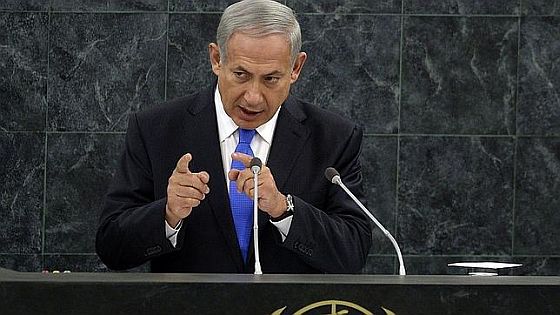
netanyahu-un

After Benjamin Netanyahu had delivered a speech at the U.N. which surprised no one, Chemi Shalev wrote:

In the streets and avenues leading up to the UN building on the East River, it was already clear the ball has long been over: the barricades were gone, the policemen were relaxed, the satellite trucks had moved elsewhere, the tension and anticipation of the first few days, when Rohani was in town, had all but dissipated. Inside the hall only a fraction of the fatigued foreign diplomats remained to hear Netanyahu, the last head of the state on the agenda, and even they seemed mainly anxious to go home and get back to their normal lives.

The situation in the media, where Netanyahu hopes to make an impact, wasn’t much better. A few hours after the US government had shut down many of its operations, with news networks anxiously breaking to their reporters in the Rose Garden where President Obama was set to make a statement; it was hard to drum up too much interest, not to mention excitement and buzz, over Netanyahu’s strident speech at the UN.

Because in the end, the Israeli prime minister gave the speech that everyone expected him to make, and, much to the media’s disappointment, he didn’t even bother this time to come up with an eye-catching gimmick for visuals.

Barak Ravid writes: One by one, Netanyahu’s donors, associates and supporters flocked in to watch. Casino magnate and owner of the Hebrew daily Yisrael Hayom, Sheldon Adelson, was followed by American-Jewish attorney Alan Dershowitz, former advisor Dore Gold, family friend Zeev Rubinstein and others. Last to enter was Sara Netanyahu, who took her place near the podium. When Netanyahu made his entrance, in front of a half-empty, drowsy hall, his friends, advisors, supporters and entourage all rose to their feet and applauded for several minutes.

Still, the fans the in stands hardly helped. The prime minister’s address resembled a game of the Israeli national soccer team. After weeks of aggressive marketing, spins, headlines and high expectations, the result was disappointing. We hoped to make it to the World Cup, but will have to do with the League Cup.

Netanyahu’s speech was tired, bothersome and boring. In contrast to the Iranian President Hassan Rohani’s sophisticated PR campaign, which led to his taking the UN by storm, Netanyahu sounded like an old, scratchy vinyl record. Not only did he fail to come up with a new effect that would call world attention to the Iranian nuclear threat, such as last year’s cartoon, the prime minister failed to offer any new pertinent information.

The New York Times reported: Mr. Netanyahu dismissed any thought of allowing Iran to enrich uranium to even a low level, insisting that the only way to assure it would never build a nuclear weapon was a complete dismantlement of its capability to enrich nuclear fuel. He exhorted the West to intensify economic sanctions on Iran instead of easing them, as Mr. Rouhani has demanded.

“I wish I could believe Rouhani, but I don’t,” Mr. Netanyahu told the General Assembly, where Iran’s seats were vacant. “Because facts are stubborn things.”

He said the international response to Iran’s entreaties for sanctions relief should be “distrust, dismantle and verify,” and he repeated his warnings that Israel reserved the right to preemptively strike Iran’s nuclear facilities if it deemed the Iranians were close to producing nuclear weapons.

Mohammad Khazaee, Iran’s ambassador to the United Nations, said afterward that his country had found Mr. Netanyahu’s speech inflammatory, rejected the notion that Iran was building a nuclear arsenal, and asserted its right to self-defense.

“The Israeli Prime Minister better not even think about attacking Iran let alone planning for that,” the Iranian ambassador said. He capped his remarks by saying that Iran’s “smile policy” was better than “lying.”

Hours before Mr. Netanyahu spoke, Iranian diplomats sought to make a pre-emptive strike of their own, calling him a persistent liar and warning President Obama not to allow the Israelis to subvert the positive spirit cultivated by Mr. Rouhani in his visit to the United Nations.

Facebooktwittermail

Israel puts ‘Iranian spy’ on display but has yet to charge him after 20 days of detention

Ali Mansouri, an Iranian-born Belgian citizen also known as Alex Mans, was arrested by Israel’s internal security services Shin Bet on September 11. His possession of a couple of nondescript photographs in which the U.S. embassy in Tel Aviv can be seen, has been presented as evidence that he was engaged in espionage. (Anyone who wants to find better photos of the embassy just has to use Google.)

The fact that after 20 days in detention (during the first nine of which Mansouri was prevented from consulting a lawyer) investigators don’t appear to have found sufficient evidence to put him on trial, might explain why he has yet to be charged.

At the same time, Israeli authorities were shameless in trying to exploit the political value of holding an Iranian in handcuffs as he was put on display for the press today.

Reuters reports: A man arrested on suspicion of being an Iranian spy appeared in an Israeli court on Monday and some Israeli analysts questioned the timing of the affair, suggesting it was being showcased as part of efforts to discredit Tehran’s new opening to Washington.

As Prime Minister Benjamin Netanyahu flew on Sunday to the United States for a visit focused on Iran’s nuclear program, Israel’s Shin Bet security service announced that Ali Mansouri had been arrested on September 11 on suspicion of spying for the Iranian Revolutionary Guards.

It said Mansouri, a 55-year-old Iranian-Belgian national, had photographed the U.S. Embassy in Tel Aviv and intended to establish business ties in Israel as a cover for espionage.

An Israeli official told reporters on Netanyahu’s flight that Mansouri’s picture-taking outside the embassy – whose exterior can be seen in numerous images on the Internet – was an attempt “to collect intelligence for a possible terror attack”.

That allegation was challenged by Mansouri’s lawyer, Michal Okabi, after a hearing on Monday in a court in the Tel Aviv suburb of Petah Tikva in which the suspect, who did not speak, was ordered held for eight more days.

“The apocalyptic picture that the Shin Bet is painting is a lot more complicated and the attempt to claim that our client came here in order to carry out attacks in Israel is far from reality and without foundation,” Okabi told reporters.

Some Israeli media commentators questioned the timing of the news, released in a Shin Bet statement that included photographs it said he had taken outside the beachfront mission and at Tel Aviv’s Ben-Gurion airport. No formal charges have been filed.

Asked by Reuters whether the decision to publicize Mansouri’s arrest was influenced by Netanyahu’s U.S. trip, the Shin Bet declined to comment.

Facebooktwittermail

Let’s be honest about Israel’s nukes

Victor Gilinsky and Henry D. Sokolski write: The recent agreement between the United States and Russia on Syria’s chemical weapons made clear what should have been obvious long ago: President Obama’s effort to uphold international norms against weapons of mass destruction in the Middle East will entangle the United States in a diplomatic and strategic maze that is about much more than Syria’s chemical arsenal.

President Bashar al-Assad of Syria insists that the purpose of his chemical arsenal was always to deter Israel’s nuclear weapons. If Syria actually disarms, what about Egypt and Israel? Egypt (about whose chemical weapons the United States has been strangely silent) points to Israel. And Israel of course has its own chemical weapons to deter Syria’s and Egypt’s, and it is not about to give them up. A headline in the Israeli daily Haaretz a few days ago stated: “Israel adamant it won’t ratify chemical arms treaty before hostile neighbors.”

These three countries have not adhered to the Biological Weapons Convention either. And Israel is not a member of the Nuclear Nonproliferation Treaty, despite having developed a formidable nuclear arsenal of its own, which will soon become the central fact in this drama, whether the United States likes it or not.

An obstacle of America’s own making has long prevented comprehensive negotiations over weapons of mass destruction in the Middle East. While the world endlessly discusses Iran’s nuclear capabilities and the likelihood that it will succeed in developing an atomic arsenal, hardly anyone in the United States ever mentions Israel’s nuclear weapons.

Mr. Obama, like his predecessors, pretends that he doesn’t know anything about them. This taboo impedes discussions within Washington and internationally. It has kept America from pressing Egypt and Syria to ratify the chemical and biological weapons conventions. Doing so would have brought immediate objections about American acceptance of Israel’s nuclear weapons. [Continue reading…]

Facebooktwittermail

Israel has 80 nuclear warheads, can make 115 to 190 more, report says

The Los Angeles Times reports: Israel has 80 nuclear warheads and the potential to double that number, according to a new report by U.S. experts.

In the Global Nuclear Weapons Inventories, recently published in the Bulletin of the Atomic Scientists, proliferation experts Hans M. Kristensen and Robert S. Norris write that Israel stopped production of nuclear warheads in 2004.

But the country has enough fissile material for an additional 115 to 190 warheads, according to the report, meaning it could as much as double its arsenal.

Previous estimates have been higher but the new figures agree with the 2013 Stockholm International Peace Research Institute yearbook on armament and international security. The yearbook estimated 50 of Israel’s nuclear warheads were for medium-range ballistic missiles and 30 were for for bombs carried by aircraft, according to a report in the Guardian.

Although widely assumed a nuclear power, Israel has never acknowledged possessing nuclear weapons or capabilities and continues to maintain its decades-old “strategic ambiguity” policy on the matter, neither confirming nor denying foreign reports on the issue.

nuclear-inventory

Hans M. Kristensen and Robert S. Norris write: Excessive secrecy prevents the public from knowing the exact number of nuclear weapons in the world. Although the United States, Russia, Britain, and France have taken steps to increase the transparency of their nuclear stockpiles—both past and present—China, Pakistan, India, Israel, and North Korea continue to refuse to provide basic information about their arsenals. Moreover, an unfortunate new trend is emerging, in that countries that previously provided estimates of the other nations’ nuclear forces have curtailed their release of such information. Secrecy creates uncertainty, mistrust, and misunderstandings. Increased transparency would alleviate this potentially dangerous situation.

We estimate that, combined, the nine nations with nuclear weapons possess more than 10,000 nuclear warheads in their military stockpiles. In addition, several thousand US and Russian retired (but still intact) warheads are in storage, awaiting dismantlement. If the military stockpiles and the retired warheads are counted together, we estimate that the worldwide inventory includes more than 17,000 warheads. The overwhelming portion of that inventory consists of US and Russian warheads, which account for more than 90 percent of all warheads in the world.

Approximately 4,400 warheads—nearly half of all stockpiled warheads—are deployed on missiles or at bases with operational launchers. Of these, we estimate that roughly 1,800 US and Russian warheads are on high alert atop long-range ballistic missiles that are ready to launch 5 to 15 minutes after receiving an order.

Overall, today’s warhead inventories are considerably lower than the Cold War peak of more than 70,000 warheads in the mid-1980s, but the level is still high, considering that the Cold War ended more than 20 years ago. The United States and Russia continue to retain nuclear arsenals that are 10 to 20 times greater than any other state’s. If the trend over time is followed, the US and Russian arsenals (and to a lesser extent those of France and Britain) will continue to decline, but at a slower pace than during the past two decades.

As for China, Pakistan, India, Israel, and North Korea, these nations have nuclear stockpiles that are minuscule in comparison with those of Russia and the United States, but more difficult to estimate. Even so, all of these countries (with the possible exception of North Korea) have sufficient numbers of warheads and delivery systems to inflict enormous destruction over significant ranges with catastrophic humanitarian and climatic consequences in their regions and beyond.

Moreover, in contrast with the United States, Russia, France, and Great Britain, the stockpiles of China, Pakistan, India, and possibly of Israel and North Korea, are likely to increase, although at a much slower pace than prevailed during the US–Soviet arms race of the Cold War. [Continue reading…]

Facebooktwittermail

Does Israel have chemical weapons too?

Matthew Aid writes: Syria’s reported use of chemical weapons is threatening to turn the civil war there into a wider conflict. But the Bashar al-Assad government may not be the only one in the region with a nerve gas stockpile. A newly discovered CIA document indicates that Israel likely built up a chemical arsenal of its own.

It is almost universally believed in intelligence circles here in Washington that Israel possesses a stockpile of several hundred fission nuclear weapons, and perhaps even some high-yield thermonuclear weapons. Analysts believe the Israeli government built the nuclear stockpile in the 1960s and 1970s as a hedge against the remote possibility that the armies of its Arab neighbors could someday overwhelm the Israeli military. But nuclear weapons are not the only weapon of mass destruction that Israel has constructed.

Reports have circulated in arms control circles for almost 20 years that Israel secretly manufactured a stockpile of chemical and biological weapons to complement its nuclear arsenal. Much of the attention has been focused on the research and development work being conducted at the Israeli government’s secretive Israel Institute for Biological Research at Ness Ziona, located 20 kilometers south of Tel Aviv.

But little, if any, hard evidence has ever been published to indicate that Israel possesses a stockpile of chemical or biological weapons. This secret 1983 CIA intelligence estimate may be the strongest indication yet.

According to the document, American spy satellites uncovered in 1982 “a probable CW [chemical weapon] nerve agent production facility and a storage facility… at the Dimona Sensitive Storage Area in the Negev Desert. Other CW production is believed to exist within a well-developed Israeli chemical industry.”

“While we cannot confirm whether the Israelis possess lethal chemical agents,” the document adds, “several indicators lead us to believe that they have available to them at least persistent and nonpersistent nerve agents, a mustard agent, and several riot-control agents, marched with suitable delivery systems.”

Whether Israel still maintains this alleged stockpile is unknown. In 1992, the Israeli government signed but never ratified the Chemical Weapons Convention, which bans such arms. (The Israeli embassy in Washington did not respond to requests to comment on this article.) The CIA estimate, a copy of which was sent to the White House, also shows that the U.S. intelligence community had suspicions about this stockpile for decades, and that the U.S. government kept mum about Israel’s suspected possession of chemical weapons just as long. [Continue reading…]

Facebooktwittermail

Israel, the world’s largest arms exporter per capita, seeks increase in U.S. military aid

While the United States exports more than tens times the volume of weapons that Israel exports, when the value of each countries arms exports are measured per capita, Israel’s amount to more than treble those from the U.S..

Aviation Week reports: In the competition to market weapons internationally, Israel ranks among the world’s top exporters.

In 2012, Israeli defense exports soared to a record of $7.47 billion, making it the world’s sixth-largest exporter of arms. The 30% increase in global arms sales—compared with 2011 levels—positions Israel’s total weapons exports behind the U.S., U.K., Russia, China and Germany and ahead of France and Italy.

“I wouldn’t speculate on our exact position,” said Shmaya Avieli, head of Israel’s defense exports agency Sibat, “but I could safely say that we’re well among the top 10 exporters.”

Meanwhile, Defense News reports: Israel is seeking a surge in future US Foreign Military Financing (FMF) grants not only to support its growing security requirements, but to offset the impact of increasingly advanced US arms sales to other counries in the volatile region.

In interviews here, US and Israeli officials said initial work toward a new 10-year military aid package, which would extend through 2027, is focusing on a full spectrum of Israeli concerns, including military modernization needs, new threats from regional instability and the erosion of Israel’s so-called qualitative military edge (QME) due to US arms sales in the Mideast.

Under the existing US $30 billion aid agreement signed in 2007, negotiators from both sides did not specifically address or attempt to calculate Israel’s QME security concerns in annual FMF funding levels prescribed by the 10-year package.

Those concerns — supported by US commitments to preserve Israel’s edge over regional adversaries — were dealt with in separate bilateral forums, with significant input by key congressional commit­tees charged with reviewing the regional impact of proposed sales, sources here said.

“QME, which pertains to Israel’s ability to defend itself by itself against any combination of Mideast adversaries, was always implied but never explicitly linked to long-term FMF agreements or security assistance planning,” said Dov Zakheim, a former Pentagon comptroller and undersecretary of defense.

Since then, however, Washington’s decades-long, de facto commitment to Israel’s QME has been codified into US law, and bilateral working groups tasked with laying the foundation for the new accord are taking a more “holistic” view of Israeli security concerns, said Michael Oren, Israel’s ambassador to the US.

“I don’t know how big of a role, if at all, QME played in the previous round of negotiations. But the nexus between QME and FMF has become stronger,” Oren said.

Oren mentioned “very large [US] contracts to the Middle East” that “raise the question of armies having capabilities similar to our own and how we make sure we can maintain our QME.”

Nevertheless, the Israeli envoy said Israel is not raising objections to such sales.

Facebooktwittermail

Israel worried by any signs of wavering in U.S. support for Egypt’s military

Reuters reports: Israel has looked on at upheaval in Egypt largely in silence, keen to avoid disrupting strategic security cooperation with a military it sees as critical to curbing attacks by Islamist militants in neighboring Sinai, officials and analysts said.

Prime Minister Benjamin Netanyahu had aides instruct cabinet ministers to avoid public comment about Egypt, according to an official who spoke on condition of anonymity.

“Israel and the United States see the situation in Egypt very, very differently and justifiably the prime minister wouldn’t want Israeli cabinet ministers to publicly criticize American policy,” Giora Eiland, a former national security adviser, said on Channel 2 television.

In private, one senior Israeli official expressed alarm at U.S. President Barack Obama’s condemnation of the bloodshed in Egypt and cancellation of a joint military exercise with Cairo.

“Eyebrows have been raised,” the official said.

Israel worries that any sign of wavering U.S. support for Egypt’s military may embolden Islamist militants sympathetic with the Muslim Brotherhood, ousted by the Egyptian army after a year in power.

Eiland backed the crackdown by Egyptian army chief General Abdel Fattah al-Sisi on the Brotherhood this week.

“Sisi in the situation he faced, had no choice but to do what he did,” said Eiland, adding he thought Western outrage at the scale of the bloodshed was understandable. Almost 800 people have been killed so far.

Facebooktwittermail

Senior Israeli diplomat ordered to stop making offensive statements

The Guardian reports: A senior government official responsible for promoting positive images of Israel on social media networks has been ordered to stop posting offensive statements on his Facebook page.

Daniel Seaman

The gagging order followed a series of trenchant comments made by Daniel Seaman, who recently took up the post of head of Israeli public diplomacy on the internet, over the past few months.

They included a response to a demand by the Palestinian chief negotiator, Saeb Erekat, for an end to new settlement expansion that read: “Is there a diplomatic way of saying ‘Go F*** yourself’?”

At the start of the Muslim holy month of Ramadan, when Muslims fast between sunrise and sunset, Seaman posted: “Does the commencement of the fast of the Ramadan means that Muslims will stop eating each other during the daytime?”

In response to a Church of Scotland report that argued that Jews do not have a divine right to the land, he wrote: “Why do they think we give a flying F*** what you have to say?”

Japanese diplomats complained about comments Seaman made on commemorations for the victims of the 1945 atomic bombs. “I am sick of the Japanese, ‘Human Rights’ and ‘Peace’ groups the world over holding their annual self-righteous commemorations for the Hiroshima and Nagasaki victims,” he wrote. “Hiroshima and Nagasaki were the consequence of Japanese aggression. You reap what you sow…”

Facebooktwittermail

Profiting off war: A look into the world of Israeli arms dealing

Eilat Maoz writes (translated from Hebrew by Guy Eliav and edited by Ami Asher): A laboratory is a site where scientists conduct experiments under controlled conditions – a space where large-scale phenomena such as hurricanes are miniaturized and tiny objects such as microbes are magnified to observe complex processes and learn how to control them. A laboratory is where the world is divided into predictable phenomena and observable objects. Where knowledge is created and later disseminated, making the world better understandable and better organized, through the lens of the knowledge we have accumulated about it.

Yotam Feldman’s new film, “The Lab,” introduces us to the men who made the Occupied Palestinian Territories the largest and most advanced weapon-testing laboratory: arms dealers and developers, defense experts and industry leaders. Despite the urge to compare it to other Israeli documentaries which have recently exposed the secret lives of the people running the occupation (such as “The Law in These Parts” and “The Gatekeepers”), “The Lab” is above all a film about knowledge. Security knowledge created in the flexible zone between two dimensions separated by a very blurred line: the military and the market.

On the first plot level, “The Lab” follows Naomi Klein’s claim that the main reason for Israel’s economic prosperity at a time of political instability and global crisis lies not in its outstanding human capital that enables it to smoothly escape the negative economic repercussions, but rather the continuation of regional conflicts. In The Shock Doctrine, she shows that most of Israel’s economic growth can be attributed to the huge defense industry, which has become Israel’s main export industry, particularly following 9/11 (In 2012, Israel was ranked the world’s sixth largest arms exporter). She also claims that the West Bank and Gaza Strip are not only the world’s largest open-air prisons, but also the world’s largest test-labs, where “Palestinians are no longer just targets. They are guinea pigs.” [Continue reading…]

Facebooktwittermail

How apartheid operates inside Israel’s ‘democracy’: Non-Jews can vote but their votes mustn’t count

The Jerusalem Post reports: Minister Silvan Shalom said Friday that no Israeli prime minister would be able to implement a peace agreement with the Palestinians if a referendum on the issue showed that a majority of Israelis supported such a deal and that outcome had been decided by non-Jewish citizens of the state.

Speaking to Israel Radio, the former foreign and finance minister said that the definition of what constitutes a majority in such a referendum should be determined in advance, as it would complicate matters if the outcome of the vote ran contrary to the wishes of the majority of Israel’s Jewish citizens.

Meanwhile, the New York Times reports: The United Nations human rights chief, Navi Pillay, urged Israel to reconsider legislation that could lead to the demolition of Bedouin villages in the Negev desert, asserting that Israel was actively pursuing discriminatory policies by forcibly displacing its Arab citizens.

“I am alarmed that this bill, which seeks to legitimize forcible displacement and dispossession of indigenous Bedouin communities in the Negev, is being pushed through the Knesset,” Ms. Pillay, the United Nations high commissioner for human rights, said in a statement released in Geneva on Thursday. The measure would likely result in the demolition of up to 35 Bedouin villages and the eviction of 30,000 to 40,000 Bedouin Arabs from ancestral lands and homes, she said.

Facebooktwittermail

How Gaza and the West Bank became Israel’s weapons testing lab

Jonathan Cook writes: Over the past decade, Israel has surged up the arms trade’s international rankings. Despite having a population smaller than New York City, Israel has emerged as one of the world’s largest exporters of armaments.

Last month, defence analysts Jane’s put Israel in sixth place, ahead of China and Italy, both major weapons producers. Surveys that include Israel’s growing covert trade put it even higher, in fourth place, ahead of Britain and Germany, and beaten only by the United States, Russia and France.

The extent of Israel’s success in this market can be gauged by a simple mathematical calculation. With record sales last year of $7 billion (Dh25.7 billion), Israel earned nearly $1,000 from the arms trade per capita – up to 10 times the per capita income the US derives from its manufacture of weapons.

The Israeli economy’s reliance on arms dealing was highlighted this month when local courts forced officials to reveal data showing that some 6,800 Israelis are actively engaged in the business of arms exports. Separately, Ehud Barak, the defence minister in the last government, has revealed that 150,000 Israeli households – or about one in 10 of the population – depend economically on the weapons industry.

These disclosures aside, Israel has been loath to lift the shroud of secrecy that envelopes much of its arms trade, arguing further revelations would harm “national security and foreign relations”.

But a new documentary lifts the lid on the nature and scope of its arms business.

The Lab, which won a recent award at DocAviv, Israel’s documentary Oscars, is due to premiere in the US early next month. Directed by Yotam Feldman, the film presents the first close-up view of Israel’s arms industry and the dealers who have enriched themselves. The title relates to the film’s central argument that Israel has rapidly come to rely on the continuing captivity of Palestinians, in what are effectively the world’s largest open-air prisons. Massive profits are made from testing innovations on the more than four million Palestinians in Gaza and the West Bank.

Attacks such as Operation Cast Lead of winter 2008-09 or last year’s Operation Pillar of Defence, the film argues, serve as little more than laboratory-style experiments to evaluate and refine the effectiveness of new military approaches, both strategies and weaponry. Gaza, in particular, has become the shop window for Israel’s military industries, allowing them to develop and market systems for long-term surveillance, control and subjugation of an “enemy” population. [Continue reading…]

Facebooktwittermail

Israel more eager to please China than the U.S.

Ynet reports: Israeli Ambassador to the US Michael Oren was called back to Israel to take part in an emergency meeting convened this weekend by Prime Minister Benjamin Netanyahu so that Oren could pass on messages sent by the US administration and Congress in the wake of tensions between the two countries.

The tensions and lightening visit stem from the US’s outrage at Israel’s decision to back out of their commitment to a terror prosecution involving a Chinese bank allegedly laundering monies for Hamas so that Netanyahu and his family could embark on their State visit to the country last May.

This weekend Nahum Barnea and Shimon Shiffer from Yedioth Ahronoth broke the story and revealed that the Chinese government threatened to cancel Netanyahu’s visit if Israel refused to promise that senior Israeli defense officials would refrain from testifying against the Bank of China in a federal court trial currently underway in New York.

According to the report, China conditioned Netanyahu’s visit on the demand the officials retract their promise to testify in the trial being led by the family of terror victim.

The case itself is a civil suit filed by Sheryl and Yekutiel Wultz from Florida, whose son Daniel was killed in terror attack in Tel Aviv in 2006 when he was only 16 years old.

According to the suit, the money used by Hamas to undertake the terror attack reached the terrorist group through a money laundering scheme run the Chinese bank in which some $6 million were laundered through trade.

The story has invoked the rage of the White House, a number of US congressmen and Jewish organizations active in the US who were flabbergasted by the decision to back out of a legal battle against the funding of international terror only in an attempt to prevent harm from coming to Netanyahu’s visit.

On Sunday, during the meeting called by Netanyahu, Oren was meant to stress to the additional participants – among them ambassador designate Ron Dermer – that the Americans view with severity Israel’s decision to cave into China’s pressure and prevent testimonies which would legally link Hamas and the Islamic Jihad to the Bank of China.

Facebooktwittermail

Is Israel a legitimate state?

Gideon Levy writes: The provocative (and challenging) question in this headline is irrelevant. With the exception of Israel, such an accusation hasn’t been hurled at any state, and to be honest, Israel isn’t seriously considered illegitimate either – at least not in the sense the nationalist right in the country would have us believe in order to scare the public. When discussing the topic the question is not whether certain states are legitimate or not, but whether certain regimes are. The regimes of Iran, North Korea, Burma and others are considered illegitimate due to their conduct, but no one questions the legitimacy of Iran as a state. Of course there are states that were born in sin – the United States leading the pack – but no one questions the legitimacy of the U.S. That is true concerning Israel as well. It is an existing state, whose existence isn’t in doubt.

When the right screams ‘delegitimization,’ it purposely exaggerates. Even the most heated criticism of Israel is directed at the regime: most of it deals with Israel being a regime of occupation – an overtly illegitimate reality – and some of it is directed at its definition as an ethnic-national state, the Jewish state.

There is no other state that carries out such an occupation, nor another state that defines itself according to its ethnic, religious or national purity. France is not the state of the French, nor is Germany the state of the Germans. They’re both the states of their citizens. Germans and French aren’t defined only by the blood in the veins – whether one’s grandfather had French blood or an Aryan grandmother – but rather by the naturalization processes in these countries. [Continue reading…]

Facebooktwittermail

Unpromised land: Eritrean refugees in Israel

P.J. Tobia writes: In 2006, 1,348 Eritreans who fled their government crossed the border from Egypt’s Sinai into Israel. By 2011, that number had grown to 17,175, with nearly a thousand crossing the Sinai to Israel every month, according to the office of the United Nations High Commissioner for Refugees (UNHCR) and the Israeli government. Today, there are roughly 35,895 Eritreans living in Israel, as well as 15,210 Sudanese. Since 2006, some 60,000 African refugees from these countries and others have come to Israel in this way.

Rhuba arrived in Israel as many migrants do, after having fled Eritrea because of its despotic leadership, universal conscription and endemic poverty. The journey is a perilous gamble. Eritrean migrants travel hundreds of miles over land, some on foot. The threat of kidnap and torture at the hands of Bedouins who control the Sinai — which most refugees cross to get to Israel from Africa — is ever present.

According to the U.N., many do not survive the journey. Those who do are not always looking to reside permanently in the Jewish state, according to Israeli NGOs and the refugees themselves. But upon arrival in Israel, instead of refuge, many face antagonism, bitterness and a government policy that makes life closer to prison than the promised land.

They are rarely granted work permits. They have little access to health care, and few can afford decent housing. There are few schools for their children. And now, due to an immigration law effective on June 3, 2012, every migrant who crosses the border is imprisoned for a minimum of three years. Some may be held indefinitely.

Many of the migrants say they mistrust the police, while the lack of work visas forces residents such as Rhuba into unfortunate arrangements with landlords who gouge, and employers who sometimes take advantage.

“We are free,” one Eritrean in Tel Aviv told me, “but only to breathe.”

Those who arrived here before last summer believe that it is only a matter of time before they, too, are imprisoned under the new law. For a time, the government offered those who voluntarily turn themselves into immigration authorities 1,000 Euros and a plane ticket out of Israel.

Those who don’t want to leave, are worried.

“We don’t know what will happen tomorrow for us,” says Zebib Sultan, 30. “We are at risk. We are suspended like oil on the water.”

At a protest rally last May, Miri Regev, a member of Israel’s parliament, the Knesset, said that the immigrants were “a cancer” on Israeli society. Another parliament member called them “a plague.” Protesters waved signs reading “Tel Aviv — a Refugee camp,” while yelling “Blacks out!” [Continue reading…]

Facebooktwittermail

Does Israel have a terminal disease?

One of the strange things about a terminal disease is that people often receive a diagnosis that amounts to a death sentence at a time when — as far as they can tell — they are in perfect health. To be told that death is lurking just over the horizon might lead one person to reflect on the meaning of mortality, while another presses forward and lives like there is no tomorrow.

In a strongly secular and death-denying culture, the latter response is less likely to be seen as an expression of denial and more as a life-affirming form of optimism.

You just discovered you have cancer and now you’re about to do a triathlon. Good for you!

Ethan Bronner writes: Israel today offers a set of paradoxes: Jewish Israelis seem in some ways happier and more united than in the past, as if choosing not to solve their most difficult challenge has opened up a space for shalom bayit — peace at home. Yes, all those internal tensions still exist, but the shared belief that there is no solution to their biggest problem has forged an odd kind of solidarity.

Indeed, Israel has never been richer, safer, more culturally productive or more dynamic. Terrorism is on the wane. Yet the occupation grinds on next door with little attention to its consequences. Moreover, as the power balance has shifted from the European elite, Israel has never felt more Middle Eastern in its popular culture, music and public displays of religion. Yet it is increasingly cut off from its region, which despises it perhaps more than ever. Finally, while the secular bourgeoisie, represented by Yair Lapid’s Yesh Atid Party, has forged an unexpected alliance with West Bank settlers, represented by Naftali Bennett’s Habayit Hayehudi Party, aimed at reducing the political power of the ultra-Orthodox, alarm over the failure to address the Palestinian problem has grown in a surprising place — among some of the former princes of the Zionist right wing.

At a Jerusalem cafe one noon, Dan Meridor, the former Likud minister and son of right-wing Zionist aristocracy, could not stop talking about the Palestinians.

“It is a sword of Damocles hanging over our heads,” he said. “We are living on illusions. We must do everything we can on the ground to increase the separation between us and the Palestinians so that the idea of one state will go away. But we are doing nothing.”

Mr. Meridor, nursing an American coffee at the cafe near the house his parents bought many decades ago in the upscale Rehavia neighborhood, sounded like two other public figures from famous right-wing families — Ehud Olmert, the former prime minister, and Tzipi Livni, the justice minister and chief peace negotiator. Both have made a series of emotional speeches begging Israelis to take the Palestinian issue seriously. They are getting little traction.

The Israeli left is still there, of course, but in increasingly insignificant knots. Two Israeli friends in Jaffa, from which tens of thousands of Palestinians left or were driven out in 1948, have beautifully renovated a house, even preserving a pre-state lemon tree in the courtyard. They are friendly with the Arabs who live nearby. Their children refused military service in protest over the West Bank occupation. And on the outside of their house they have put up a plaque noting that until 1948 the structure was the home of the Khader family, a tiny homage to a destroyed world.

But the family is rare. Mr. Lapid, the rising star of Israeli politics, is a former television host who agrees that something must be done about the Palestinians. But in an interview he offers no specifics other than hoping Mr. Kerry will pressure them to return to the negotiating table under conditions they have long rejected. Mr. Lapid, who spoke in the outdoor section of his neighborhood cafe in north Tel Aviv on a fragrant spring afternoon, was relaxed and buff in his long-sleeved black T-shirt and black jeans. Well-off Tel Avivians at nearby tables argued into their iPhones. Mr. Lapid said Israel should not change its settlement policy to lure the Palestinians to negotiations, nor should any part of Jerusalem become the capital of the Palestinian state he says he longs for. He has not reached out to any Palestinian politicians nor spoken publicly on the issue. As finance minister, he is focused on closing the government’s deficit.

Mr. Lapid may be a political novice but he knows the public mood. A former senior aide to Prime Minister Benjamin Netanyahu agreed, over a Jerusalem lunch of toasted bagels and salad, that most Israelis considered the peace process irrelevant because they believed that the Palestinians had no interest in a deal, especially in the current Middle Eastern context of rising Islamism. “Debating the peace process to most Israelis is the equivalent of debating the color of the shirt you will wear when landing on Mars,” he said.

Facebooktwittermail

Israel has highest poverty rate in the developed world, OECD report shows

Haaretz reports: Israel is the most impoverished of the 34 economically developed countries, with a poverty rate of 20.9%, according to a report released by the Organization for Economic Cooperation and Development on Wednesday.

Israel’s poor population has grown more than in any other OECD nation, making it the country with the highest rate of poverty, having exceeding Mexico, whose poverty rate stands at 20.4%.

Israel also continues to be one of the countries with the largest income inequalities, ranking fifth, with the U.S., Mexico, Chile and Turkey having larger income gaps. Between 2007 and 2011, Israel experienced almost no changes in its social gaps – which saw a tiny decline of 0.1%. Between 2007 and 2010, poverty among children and young people in Israel grew at the fourth largest rate from among the OECD countries – although among senior citizens, it declined.

As opposed to the trend in most countries, where salaries among both the richest and poorest has decreased, Israel has seen a slight increase in both. In Spain and Greece, which are suffering from recession, poverty rates are lower, at 15.4% and 14.3% respectively. The OECD report also points to an increase in inequality throughout the world, due to the global economic crisis. In almost all OECD countries incomes are in decline, while inequality is on the rise. [Continue reading…]

Facebooktwittermail