Yossi Gurvitz writes: Our Foreign Ministry finds itself in a quandary. Israel brutally expels refugees from South Sudan, and runs a vicious and racist campaign against refugees from Sudan. Ministers and MKs are competing to see who can lead a more beastly campaign of hatred. The current winner is Madam MK and former IDF Spokeswomen Miri “I did not intend to compare the refugees to human beings” Regev, but the race is far from over.
This, reports activist Rotem Ilan (Hebrew), is how the Oz Unit (refugee headhunting unit, dregs of Israeli society so low they couldn’t even get in to the police) sounds in action: “Do you want me to fuck you in the ass? You like it, it shows” (Oz officer to an activist); “The father said he does not love you anymore, and you can fly for all he cares” (Oz officer to a mother and daughter held in custody, asking to say their goodbyes to the child’s father); “If you need to go to the bathroom, just piss in your dress” (Oz officer to a priest in traditional African garb, who actually had a residency permit); “What am I, a bell boy? Do I have to carry your luggage? You don’t want to [carry it], see if I care” (Oz officer during an arrest of a family with three children, yesterday).
Veteran journalist Yael Gvirtz described (Hebrew) some of the deportees: “A girl with hideous burns (whose mother and brother are already detained), [to be deported] to a country with no medical infrastructure… A person seriously ill with diabetes, who knows deportation consigns him to death, because there is no insulin to be gotten there. Just two of the stories, because this night is so difficult as it is. And what would the next picture be? The disaster area (and then the Israeli government will surely send an IDF flying hospital, to show the world how humane we are…)”
Oz’s activity has been described by one of its officers, Asaf Khayoun – every criminal has a name – as follows (Hebrew): “Coming into a house, there’s excitement in that. You want to find them. I just love enforcement. A few weeks ago we went to a house in Savion to check information about an illegal nanny. The owner denied it, but we knew she was there, hiding. She was hiding behind a wall. Holding a little boy, three years old. The baby kept mum, but then she started crying. She knew she had to go home. For me, catching her is an achievement.”
What for Khayoun and the rest of the Oz Unit is “excitement,” is quickly becoming a headache for the Foreign Ministry. Its officials complain (Hebrew) that Eli Yishai, Danon, Regev and the rest are causing “irreparable damage” to the public image of Israel in the United States. They report that for the first time ever, the American media used the term “race riots” in order to describe what happens in South Tel Aviv. Israel’s image, complain the diplomats, suffered a heavy blow in the black community and among American liberals.
And if the diplomats are afraid of what will happen to the Hasbara campaign in the United States – to the glittering lie that claims that the only Jewish state in the Middle East is a democracy, not an ethnocracy with strong theo-fascist elements – this is nothing compared to what will happen to Israel’s image in Africa. Many Africans may remember how Israel connived to help two fading colonial powers in their last attack on Africa, that there never was a dictator that it didn’t like, that it sold weapons to all the darkest regimes, that it was about the only ally of the Apartheid regime, Zionism’s twin. The next time our diplomats bemoan a staunch African anti-Israel position in the UN, maybe they should remember Eli Yishai and his “land of the white man” comment. [Continue reading…]
Category Archives: Israel
White racism makes Black Israeli Jews scared to live in their own country
JTA reports: When violent riots against African migrant workers erupted in south Tel Aviv recently, a mob attacked Hanania Wanda, a Jew of Ethiopian origin, mistaking him for a Sudanese migrant worker.
“Wanda is my friend,” says Elias Inbram, a social activist in the Ethiopian community and a former member of the Israeli diplomatic corps who served as spokesman for the embassy in South Africa. “I knew I had to react somehow.”
He suddenly realized, says Inbram, 38, “that since to white people, all blacks look the same — I, an Israeli Jew who is black, or anyone in my family, or anyone in my community, could be attacked, too.”
That moved him to stencil “CAUTION: I am not an infiltrator from Africa” onto a bright yellow T-shirt. He then drew in by hand, in the upper left corner, the unmistakable yellow “Jude” patch from the Nazi era.
Last week, he posted a picture of himself wearing the shirt — the only one he has printed — on Facebook. It already has gained thousands of “likes.”
“I want to force people here to think of the racism and hatred in Israeli society,” Inbram, who holds a master’s degree in law and is interning before applying for the bar, told JTA.
The wave of violence in Israel against African migrant workers and asylum seekers, in which nearly a dozen Jews of Ethiopian origin also have been attacked in the past few weeks, has forced many Ethiopian Jews to deal with race in a way they have until now mostly avoided. Some said it has forced upon them a new consciousness and political awareness.
“I have a law degree and a master’s degree. I served in the army,” Inbram said. “Another friend of mine who was beaten up is a Ph.D. candidate. We’re Israeli citizens. But none of that matters. Ever since we came, the state has treated us as if we should say thank you for anything we receive, as if we have no rights as Jews and Israelis. But now we are afraid because in the eyes of whites, we are first of all blacks.”
Aliza, 23, a sociology student at Hebrew University who would give only her first name, told JTA, “At the beginning, when white friends would ask me how I feel about the migrants from Africa, I would get pretty angry. Why should I feel anything special? Just because we’re both black? I thought it was racist and patronizing. I’m Jewish and Israeli. Jewish history is much more relevant to me than African history. I relate more to Jews from Eastern Europe than to African Muslims or Christians. I was a baby when I came here.”
But the violence — and in particular, she said, the torching of an apartment where Eritrean migrants were living in Jerusalem early this week — have changed her mind.
“Now I’m scared to live in my own country — because I’m black,” she said.
Netanyahu — Israel’s editor-in-chief
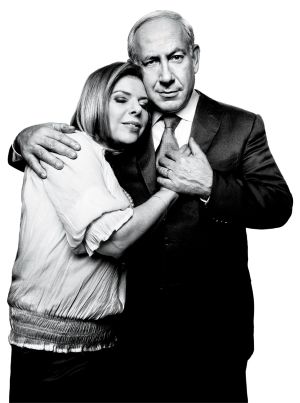
David Margolick writes: Seconds into any conversation about Netanyahu, the subject of Sara, whom he married in 1991, invariably comes up. It’s amazing how many otherwise sane Israelis see her Lady Macbeth–like hand in every corner of her husband’s life and work — whom he hires, what he does and doesn’t do, whom he can and cannot see. One hears constantly that Sara “has something” on her husband, stemming from her decision to stick by him after the highly publicized affair to which he admitted early in their marriage when his political career hung in the balance. One also hears of a supposed contract between the two of them, said to have been drafted by a former attorney general of Israel, squirreled away in some safe. Or of Bibi cowering in the bathroom, calling the childhood friends of his whom she has excommunicated.
Friend and foe alike have stories about Sara — about a tantrum or feud or some abuse of the household help — or some illustration of her vanity, like the time when, dissatisfied with the picture of her that Yediot Aharonot was about to run, she had her husband call the paper’s famously private owner, Noni Mozes, from Washington, demanding it be changed. People offer medical or psychological diagnoses, and speculate, without any apparent knowledge, about the medications she might be on. Her every misstep or peccadillo is covered minutely in the Israeli press (at least that portion Adelson doesn’t own), particularly her repeated run-ins with the help, several of which have led to lawsuits. Since ordering employees to call her “Ha Giveret” (“The Lady”) — an act of colossal hubris in a country rooted in unpretentious egalitarianism — it’s what she’s routinely and derisively called.
Numerous former staffers say her imbroglios periodically bring governance to a halt, forcing her husband to leave key meetings to tend to trivial matters or simply to calm her down. No one seriously contends that she will determine what happens with Iran. But many think she denies Netanyahu the serenity a man in his position needs. “She is a clear and present danger to the national security of the state of Israel,” one of Netanyahu’s prime critics, Ben Caspit, of the Israeli tabloid Maariv, told me. Just how, foreign minister Avigdor Lieberman is said to have asked, can a man control a government when he can’t control his wife? (Already hobbled by a pending corruption investigation, Lieberman, who heads the party of former Soviet immigrants, is considered a big loser in the recent political machinations. So too are Yair Lapid, a former anchorman who’d recently launched his own party, and Shelly Yachimovich, whose Labor Party stood to regain some seats — and at least some of its historic influence — in a new vote.)
For all his political pre-eminence, Netanyahu, still convinced Israeli liberal elites consider him a “usurper,” remains highly suspicious, even paranoid. “In every criticism, Bibi sees an attempt to bring him down,” Uzi Arad, his former national-security adviser and one of many people with whom he has had a falling-out, told Yediot Aharonot in March. So he’s insular: his principal lawyer — David Shimron, who handles the numerous lawsuits Bibi and Sara have brought against their household employees and the press — is his cousin; a cousin-in-law, Yitzhak Molcho, is his most important diplomat, marginalizing both Lieberman (at least as foreign minister) and Israel’s ambassador to Washington, Michael Oren; Netanyahu’s long-time chief of staff, Natan Eshel, forced to resign earlier this year in a sexual-harassment scandal, never really went away and handled the recent negotiations with Kadima. Shimon Shiffer of Yediot Aharonot says that Netanyahu once told him that he has no friends, something Netanyahu denies saying. One often hears — and not just from Netanyahu’s detractors — “Bibi has two types of friends: those he has betrayed, and those he will betray.”
Netanyahu was recently quoted by Steve Linde of The Jerusalem Post as saying that Israel’s most formidable foes were The New York Times and Haaretz, the newspaper of Israel’s intelligentsia. (He denies saying or believing this, and Linde subsequently published a clarification.) But Netanyahu has feuded with the Times and, one former aide tells me, considers Times columnist Thomas Friedman, a frequent critic, to be a mouthpiece of the Obama administration. That battle pales, though, next to Netanyahu’s wars with the Israeli press, which pilloried him during his first term. Like many Israelis on the left, it never forgave Netanyahu for Rabin’s assassination, which it believed his inflammatory language helped foment.
Netanyahu has expended vastly more energy — and enjoyed far greater success — reshaping the Israeli media than seeking peace with the Palestinians. As one observer puts it, he is less Israel’s prime minister than its editor in chief.
Netanyahu’s influence over the media comes in large part due to the financial support of his friend, American billionaire casino boss Sheldon Adelson.
Adelson, who reportedly first met Netanyahu in the 1990s, speaks no Hebrew and does not live in Israel, though his wife is Israeli. But, most likely with Netanyahu’s coaching, he came to believe that Israel’s three main newspapers did not represent the diverse Israeli public, and resolved to give Israelis what he called — borrowing Fox News’s slogan — a more “fair and balanced” alternative. At first he tried to buy Maariv. His pitch wasn’t subtle; he accused the paper’s owner, Ofer Nimrodi, of being a bad Zionist. (Nimrodi, his parents, and his two sons have all served in either Israeli intelligence or the Israeli Defense Forces.) Not surprisingly, a deal never happened. So, in 2007, Adelson launched a new paper, Israel Hayom (“Israel Today”). Instantly, understandably, it was dubbed “Bibiton”: “Bibi’s Newspaper” in Hebrew. Israeli journalists compare it half-facetiously to Pravda or Tishreen, the house organ of Syrian president Bashar al-Assad. Because its biases are so blatant, the conservative columnist Kalman Libeskind, of Maariv, recently wrote, he’d never thought it worth criticizing. But its “complete symbiosis” with Netanyahu and his interests, he complained, sometimes “really makes you want to puke.”
From its debut, Adelson’s paper — the tens or even hundreds of millions of dollars he has dumped into it dwarfs the comparative pittance he invested in Newt Gingrich’s failed presidential bid — enjoyed two advantages: it’s free (even with home delivery) and ubiquitous, handed out everywhere. By leaching away readers and advertisers, it posed a mortal threat to Yediot Aharonot and Maariv. Maariv has already fallen into new, more Bibi-friendly hands. And after a period of all-out war with Netanyahu — in which, for instance, it plastered details of a maid’s lawsuit against the First Couple over several pages — Yediot Aharonot has recently toned things down. Many see that as evidence of a hudna, or truce, between Netanyahu and the paper, though who has conceded what isn’t clear.
“Almost the whole Israeli media is dependent upon Bibi,” says a former editor of Maariv, Amnon Dankner, “and while I won’t say they’re not criticizing him, the music has changed — to quieter, less vociferous tones.” [Continue reading…]
Most Israeli Jews agree: African migrants are ‘a cancer’
The Times of Israel reports: Fifty-two percent of Jewish Israelis identify with the statement by MK Miri Regev last month that African migrants are “a cancer in the body” of the nation, and over a third condone anti-migrant violence, according to the Israel Democracy Institute (IDI) Peace Index for May 2012.
Broken down by political and religious affiliation, the monthly index’s findings reveal that among Jews there is a direct correlation between right-wing political affiliation and a racist attitude toward migrants. Thus, 86 percent of Shas voters and 66 percent of Likud voters polled expressed identification with Regev’s controversial statement, as opposed to 32 percent of Labor voters and four percent of Meretz voters.
The degree of religiosity attested to by respondents also accounted for a large disparity in the findings, with 81.5% and 66% of self-described ultra-Orthodox and Orthodox, respectively, agreeing with Regev’s statement, as opposed to 38% of secular Israelis.
Only 19% of Arab respondents agreed that the migrants were “a cancer.”
Israel’s deployment of nuclear missiles on subs from Germany
Der Spiegel reports: Research SPIEGEL has conducted in Germany, Israel and the United States, among current and past government ministers, military officials, defense engineers and intelligence agents, no longer leaves any room for doubt: With the help of German maritime technology, Israel has managed to create for itself a floating nuclear weapon arsenal: submarines equipped with nuclear capability.
Foreign journalists have never boarded one of the combat vessels before. In an unaccustomed display of openness, senior politicians and military officials with the Jewish state were, however, now willing to talk about the importance of German-Israeli military cooperation and Germany’s role, albeit usually under the condition of anonymity. “In the end, it’s very simple,” says Israeli Defense Minister Ehud Barak. “Germany is helping to defend Israel’s security. The Germans can be proud of the fact that they have secured the existence of the State of Israel for many years to come.”
On the other hand, any research that did take place in Israel was subject to censorship. Quotes by Israelis, as well as the photographer’s pictures, had to be submitted to the military. Questions about Israel’s nuclear capability, whether on land or on water, were taboo. And decks 2 and 3, where the weapons are kept, remained off-limits to the visitors.
In Germany, the government’s military assistance for Israel’s submarine program has been controversial for about 25 years, a topic of discussion for the media and the parliament. Chancellor Angela Merkel fears the kind of public debate that German Nobel literature laureate Günter Grass recently reignited with a poem critical of Israel. Merkel insists on secrecy and doesn’t want the details of the deal to be made public. To this day, the German government is sticking to its position that it does not know anything about an Israeli nuclear weapons program.
But now, former top German officials have admitted to the nuclear dimension for the first time. “I assumed from the very beginning that the submarines were supposed to be nuclear-capable,” says Hans Rühle, the head of the planning staff at the German Defense Ministry in the late 1980s. Lothar Rühl, a former state secretary in the Defense Ministry, says that he never doubted that “Israel stationed nuclear weapons on the ships.” And Wolfgang Ruppelt, the director of arms procurement at the Defense Ministry during the key phase, admits that it was immediately clear to him that the Israelis wanted the ships “as carriers for weapons of the sort that a small country like Israel cannot station on land.” Top German officials speaking under the protection of anonymity were even more forthcoming. “From the beginning, the boats were primarily used for the purposes of nuclear capability,” says one ministry official with knowledge of the matter.
Insiders say that the Israeli defense technology company Rafael built the missiles for the nuclear weapons option. Apparently it involves a further development of cruise missiles of the Popeye Turbo SLCM type, which are supposed to have a range of around 1,500 kilometers (940 miles) and which could reach Iran with a warhead weighing up to 200 kilograms (440 pounds).
[…]
Armed with nuclear weapons, the submarines are a signal to any enemy that the Jewish state itself would not be totally defenseless in the event of a nuclear attack, but could strike back with the ultimate weapon of retaliation. The submarines are “a way of guaranteeing that the enemy will not be tempted to strike pre-emptively with non-conventional weapons and get away scot-free,” as Israeli Admiral Avraham Botzer puts it.In this version of tit-for-tat, known as nuclear second-strike capability, hundreds of thousands of dead are avenged with an equally large number of casualties. It is a strategy the United States and Russia practiced during the Cold War by constantly keeping part of its nuclear arsenal ready on submarines. For Israel, a country about the size of the German state of Hesse, which could be wiped out with a nuclear strike, safeguarding this threat potential is vital to its very existence. At the same time, the nuclear arsenal causes countries like Iran, Syria and Saudi Arabia to regard Israel’s nuclear capacity with fear and envy and consider building their own nuclear weapons.
This makes the question of its global political responsibility all the more relevant for Germany. Should Germany, the country of the perpetrators, be allowed to assist Israel, the land of the victims, in the development of a nuclear weapons arsenal capable of extinguishing hundreds of thousands of human lives?
Is Berlin recklessly promoting an arms race in the Middle East? Or should Germany, as its historic obligation stemming from the crimes of the Nazis, assume a responsibility that has become “part of Germany’s reason of state,” as Chancellor Merkel said in a speech to the Israeli parliament, the Knesset, in March 2008? “It means that for me, as a German chancellor, Israel’s security is never negotiable,” Merkel told the lawmakers. [Continue reading…]
The BBC adds: The former German Chancellor Helmut Schmidt once said he was unhappy with Chancellor Angela Merkel’s statement in 2008 that Germany bore responsibility for the security of the state of Israel.
Rather, Mr Schmidt said, “Germany has a special responsibility to ensure that such crimes as occurred in the Holocaust never occur again. But Germany has no responsibility for Israel.”
Video: Incitement against refugees leads to racist attacks in Israel
Six days in Israel, 45 years ago
Miko Peled writes: In early June 1967, as I cowered with my mother and sisters in the “safest” room of our house near Jerusalem — the downstairs bathroom — we feared the worst. None of us imagined that the war that had just begun would end in six days. It was inconceivable that the Israeli army would destroy three Arab armies, kill upward of 15,000 Arab soldiers (at a cost of 700 Israeli casualties), triple the size of the state of Israel and, for the first time in two millenniums, give the Jewish people control over the entire land of Israel, including the crown jewel, the Old City of Jerusalem.
Many believe now, as they believed then, that Israel was forced to initiate a preemptive strike in 1967 because it faced an existential threat from Arab armies that were ready — and intending — to destroy it. As it happens, my father, Gen. Matti Peled, who was the Israel Defense Forces’ chief of logistics at the time, was one of the few who knew that was not so. In an article published six years later in the Israeli newspaper Maariv, he wrote of Egypt’s president, who commanded the biggest of the Arab armies: “I was surprised that Nasser decided to place his troops so close to our border because this allowed us to strike and destroy them at any time we wished to do so, and there was not a single knowledgeable person who did not see that. From a military standpoint, it was not the IDF that was in danger when the Egyptian army amassed troops on the Israeli border, but the Egyptian army.” In interviews over the years, other generals who served at that time confirmed this, including Ariel Sharon and Ezer Weitzman.
In 1967, as today, the two power centers in Israel were the IDF high command and the Cabinet. On June 2, 1967, the two groups met at IDF headquarters. The military hosts greeted the generally cautious and dovish prime minister, Levi Eshkol, with such a level of belligerence that the meeting was later commonly called “the Generals’ Coup.” [Continue reading…]
Israel asks Arab visitors to open emails to search
The Associated Press reports: When Sandra Tamari arrived at Israel’s international airport, she received an unusual request: A security agent pushed a computer screen in front of her, connected to Gmail and told her to “log in.”
The agent, suspecting Tamari was involved in pro-Palestinian activism, wanted to inspect her private email account for incriminating evidence. The 42-year-old American of Palestinian descent refused and was swiftly expelled from the country.
Tamari’s experience is not unique. In a cyber-age twist on Israel’s vaunted history of airport security, the country has begun to force incoming travelers deemed suspicious to open personal email accounts for inspection, visitors say.
Targeting mainly Muslims or Arabs, the practice appears to be aimed at rooting out visitors who have histories of pro-Palestinian activism, and in recent weeks, has led to the expulsion of at least three American women.
It remains unclear how widespread the practice is.
However, asked about Tamari’s claims, the Shin Bet security agency confirmed she had been interrogated and said its agents acted in accordance with the law.
Israel has a long history of using ethnic profiling, calling it a necessary evil resulting from its bitter experience with terrorist attacks. Arab travelers and anyone else seen as a risk are often subjected to intense questioning and invasive inspections, including strip searches.
Israeli journalist Uri Blau to stand trial for holding leaked documents
Dimi Reider writes: Attorney General Yehuda Weinstein announced on Wednesday his intention to indict Uri Blau, one of Israel’s top investigative reporters, for possession of classified materials without permission. The materials in question are documents given to Blau by whistleblower Anat Kamm; Kamm, then a conscript clerk in the office of GOC Central Command, copied them from the GOC’s computer, believing they constituted evidence of war crimes carried out in defiance of international law and Israel’s own Supreme Court, including summary executions of terrorism suspects who could have been detained.
Kamm is presently serving a four and a half-year prison sentence following a plea bargain in which she admitted to possession and transfer of classified documents.
The decision today marks a crucial milestone in a process that has been dragging on for more than two years, as prosecutors considered the implications of indicting a journalist for doing something well established in his trade. Almost every journalist with claims to be anything but a stenographer for the army spokesman has held onto classified information – written or otherwise – that was received outside official channels, without authorisation.
Although Blau, in the early days of the investigation into the leak, had already given over to the state all the documents he used to publish the story on summary executions, the state demanded the rest of the cache. During the investigation, Blau spent time in political exile in London, waiting while his lawyers negotiated with the state the terms of a deal under which he would not be prosecuted. Once the deal was struck and Blau did his part, however, the state got greedy, and demanded full access his entire archive, amassed over a decade of investigative work. Then it said it might prosecute him anyway. Blau remained in limbo, his ability to work severely curtailed: few sources would go out on a limb for a journalist likely to be tightly monitored by the security agencies. He only began writing regularly a few months ago, publishing a few stories on the behind the scenes workings of the Israeli right, mostly through deft use of freedom of information requests.
Obtaining and retaining classified information is the bread-and-butter of a civilian journalists monitoring the country’s most powerful and insulated institution – the military. Although Israel has no laws to protect journalists, in most cases (barring one prosecution concerning the revelation of cooperation between the Israeli and Morrocan intelligence agencies half a century ago, and an attempt to prosecute a senior military correspondent after the Gulf War for revealing the regrettable fact the much-lauded “Patriot” missiles failed to intercept a single SCUD), the state has not gone after journalists for doing something so essential to their work – until now. [Continue reading…]
Video: Israel accused of ill-treating African migrants
After calling African migrants a ‘cancer’, Israeli politician apologizes — to cancer patients
Haaretz reports: Likud MK Miri Regev, who came under fire last week after calling African migrants “a cancer” in Israeli society, apologized for the first time for her comments on Sunday, opting, however, to leave the migrants out of her apology.
Regev’s controversial comments came during a violent rally staged by residents of Tel Aviv’s south – where many African migrants live – to protest rising crime rates in the area. In the rally, the Likud MK said “the Sudanese are a cancer in our body.”
She was later criticized for inflaming the protesters, with angry demonstrators later going on to attack African passers-by and journalists, breaking into and looting shops associated with the African migrant community and shattering car windshields.
At the time, Regev condemned “any violence from any side, but I understand the rage and hurt of the residents, of the families that live there. They tell us: ‘Help us. We are being humiliated, look how we live, we are afraid to leave the house.'”
However, speaking to Israeli media outlets over the weekend and on Sunday, Regev chose to apologize for calling the Sudanese a cancer, opting however, to direct her apology to Holocaust survivors and cancer patients.
“When I compared the migrant worker phenomenon to cancer I was referring to the way the phenomenon had spread, and not anything else. If anyone took it otherwise and was consequently offended, I apologize and I surely did not intend to hurt either Holocaust survivors or cancer patients,” she said.
Video — Racism report: Africans in Israel
‘I prefer Sudanese refugees to proud Jews. I feel safer with them’
Yossi Gurvitz writes: I went to a demonstration led by MK Michael Ben-Ari two days ago (Tuesday), and was joined by my girlfriend, Galina. Ben-Ari, a Kahanist, was inciting the crowd against the African refugees in a distinctly anti-Semitic manner, peppering his talk with incessant references to excrement and urine. At some point, Galina couldn’t take it any longer, and shouted something back.
Within minutes we were surrounded by an angry mob of about 20 people, composed mostly of women, who hurled curses at her. Someone pulled out a tear gas canister and waved it at her face.
Racist and sexual slurs filled the air repeatedly. Time and time again, people expressed the wish she would be raped by Sudanese, and asked her if she was bedding them. A boy, between 10 and 11 years old, screamed at her point blank that what she needs is a “nigger’s cock.” David Sheen videotaped much of it.
For my part, I was busy trying to pull her out of there, and pushing away the hands in her way – there were plenty of them. There was also spitting. At a certain stage, when Ben-Ari and his travelling circus went on their way, a cop wended his way to Galina, and whispered to her that the police were pulling away, and she should, too.
We tried to get out of the market. The mob was screaming with glee that she was being arrested. More spitting and curses. A woman aimed a kick at Galina’s head from behind her, I blocked the kick with a snarl. She was smiling. On the way to the train station we were attacked, physically, by a hoodlum, and as I was trying to get in between him and Galina after he hit me in the back, I decided that if he attacks me again, I’d take the metal part of the camera and smash it into his jaw, and take my chances with the police later.
Luckily he pulled away, and we continued on fast towards the train station, with people swearing at Galina every few meters. A gang of teenagers waited for us near the train station. Plenty of sexual affront. One of them tried to knock David’s camera away. We fled to the security of the station.
So that’s what a proud Jewish mob looks like. Galina thought she could reason with them, and made a decent effort, but you can’t debate with 20 people screaming at you incessantly. When the demonstration began, there was a nutjub who, whenever she saw a refugee, would scream, “Here they are, here they are, why do you let them go?”
This was my first angry mob since the elections of 1988, and then I was young, stupid and unafraid. It is frightening, very much so. Argument is pointless with minds seeping with racism. With one exception, no one came to our aid. We were in the Hatikva Market, a public place, and no one came to our aid. I would like to think they wanted to but couldn’t overcome their fear.
Later, I thought we were lucky none of us stumbled. This may have served as a signal for an assault, and I’m not sure we would have been able to get up on our own. Let’s put it this way: after Tuesday, I prefer Sudanese refugees to proud Jews. I feel safer with them.
Racist mob violence in Tel Aviv
Ilan Lior, a reporter for Haaretz, describes how he found himself a target of mob violence incited by members of the Knesset in Tel Aviv last night. The hatred of the mob was primarily directed at African refugees, but MK Michael Ben Ari and others also pointed the finger at left-wingers. (The venom directed at anyone willing to stand up for the refugees can be seen in the video below Lior’s account.)
Just moments after Ben Ari’s speech, I found myself in a surreal situation. “You’re a left-winger that throws rocks at soldiers at checkpoints,” one protester called at me. “You’re a traitor, we’ll finish you,” threatened another. I tried to explain that I was a journalist, and not a left-wing activist, that I’ve never protested at checkpoints, nor thrown a rock at anyone. I told them that I came to give a voice to the residents’ calls, to their struggles, and to pass the message on to those who make decisions. No one listened.
The situation started to deteriorate very quickly. The threats became more intense, hands were thrown in the air, one of the protesters pushed me, another snatched my notepad and threw it in the air. “You’re making a mistake,” I said, desperately trying to stop the carnage. Border Patrol officers saved me, escorting me off to the side. “I recognize you. I’m a bus driver. I saw you throw rocks at soldiers at a checkpoint last week,” said one woman, running amok. “You’re mistaken, they’re deceiving you,” I answered. “I’ll get you,” she threatened, in front of the uniformed officers.
A short time after, she was joined by another protester, then another, then another. The officers decided they needed to get me out of there, and fast. They began to push me down Hahagana street. “Faster, they’ll murder you,” the frightened officers told me. I looked behind me. Hundreds of people had begun to chase me. It was clear to me that the small police presence would not be able to deal with the masses. Some of them caught up. One grabbed my shirt, and ripped it, while threatening to murder me. For the first time, I saw true hatred in the eyes of another person.
The officers pushed me into a patrol car, in an attempt to protect me. The patrol car became the center of the chaos. The masses surrounded it, protesters banged on the doors and windows, rocked the car from side to side. “Traitor,” they yelled.
The hardship of south Tel Aviv residents is real. No one denies that. These are weak neighborhoods, forced to take on a population with nothing, engaged in a daily struggle for survival. But that’s only part of the story. On Wednesday, everyone with black skin was labeled an enemy. These Knesset members are largely responsible for turning the words into acts. They cannot shake off that responsibility. The harsh violence against passersby that happened to have black skin is a direct result of their wild incitements. The incitements on Wednesday are the start of a slippery slope. It is best to stop it as early as possible. If the public leaders and neighborhood officials won’t take responsibility, someone could pay with their life. The writing is on the wall, in black and white.
In another report, a neighborhood resident told Haaretz: “In my opinion, what happened here [Wednesday night] was still minor. I hear what kind of mood people are in. It won’t end with this; it will get worse.”
Fear and loathing of all non-Jews
Israeli political lobby group “Fence For Life” chairman Ilan Tsion, speaking at the Ramle Conference on April 15, 2012. To Tsion’s right sits MK Michael Ben-Ari who helped incite mob violence attacking African refugees in Tel Aviv last night.
Israeli politicians incite mob violence targeting African refugees in Tel Aviv
Noam Sheizaf reports: More than 1,000 Israelis protested this evening (Wednesday) against the African refugees and asylum seekers who have settled in South Tel Aviv in recent years. According to eyewitnesses reports, the crowd grew angry and ultimately violent, following speeches from Knesset Members, including members of the government coalition.
It was one of the most violent protests Tel Aviv has known in recent years. Confrontations were continuing between police and Jewish citizens at around 10:30 p.m. local time.
Dozens of protesters tried to move from the Hatikva neighborhood, where the rally was held, towards Tel Aviv’s Shapira neighborhood, where most African refugees live. They were stopped by police. Protesters attacked a car passing by carrying African immigrants, smashing its windows. Shops associated with the African community were vandalized. [UPDATE: As of midnight, activists in Hatikva are still reporting looting and occasional attacks on Africans.]
In light of increasing violence and harassment in recent days, activists walked refugee children in Tel Aviv home from school on Wednesday in order to prevent them from potential attacks.
According to Maariv’s website, the mob chased a man from Eritrea, who took shelter in a storefront and was rescued by police. At least two journalists were attacked. One fled the area and the other, whose notepad was snatched by protesters, was sheltered by the cops.
Earlier, Knesset members spoke at the event. Some blamed government inaction for the “infiltration problem,” while others heaped attacks on human rights organizations helping the refugees. Knesset Member Miri Regev called the refugees “a cancer.” Regev, a member of Netanyahu’s Likud party, said that “leftists” are preventing the state from deporting the refugees back to Africa. Knesset Member Danny Danon (Likud), who also spoke at the event, wrote in a Facebook status tonight that “Israel is at war. An enemy state of infiltrators was established in Israel, and its capital is south Tel Aviv.”
Earlier this week, Haaretz reported: Prime Minister Benjamin Netanyahu said on Sunday that the “phenomenon of illegal infiltrators from Africa is extremely serious and threatens Israel’s social fabric and national security. He made the comments at a cabinet meeting, adding that “if we don’t stop the problem, 60,000 infiltrators are liable to become 600,000, and cause the negation of the State of Israel as a Jewish and democratic state.”
Netanyahu also praised the border fence that is being built in the south as a means of preventing infiltrations, but added that it is also important “to physically remove the infiltrators. We must crack down and mete out tougher punishments.”
Five groups that aid African migrants sent a letter to Netanyahu on Sunday, asking that he “immediately order the granting of work permits to asylum-seekers in Israel.” The letter stated that the current situation is forcing migrants to seek shelter in poorer neighborhoods, exacerbating the problems there. “The situation has become intolerable,” they wrote.
Interior Minister Eli Yishai echoed the sentiment expressed by the prime minister, and reiterated his own message last week, when he said that most African migrants are criminals and that all, “without exception,” should be arrested and deported.
On Sunday, Yishai said he is not responsible for asylum-seekers from war-torn countries whose lives might be at risk if deported back to those countries, because “as it is, there are millions more who might be murdered.
Video: Israeli police target activists as social protests restart
Freed Israeli brother of Rabin gunman ‘proud’
Reuters reports: Hagai Amir, the brother of the man who assassinated late Israeli Prime Minister Yitzhak Rabin in 1995, said he was proud of his own role in the murder plot after he was freed from prison on Friday.
Amir was released after serving 16 years for helping his brother murder Rabin, considering such plans as rigging his car with explosives and poisoning him before deciding to shoot him in a crime that shook the Jewish state.
Yigal Amir, his brother, killed Rabin at a peace rally in Tel Aviv in 1995 and is serving a life sentence. He said he shot the politician to stop him from handing parts of what he believed were the biblical land of Israel to the Palestinians in peace negotiations.
On his release, Hagai Amir, who was also found guilty of planning attacks against Palestinians in the West Bank and later handed an additional one year term in prison for threatening to kill the then Prime Minister Ariel Sharon, was defiant.
“I am not regretful. I am proud of what I did,” Amir, an Israeli Jew, told reporters as family members whisked him into a car and drove away.