Jon B. Alterman writes: Israel, by necessity, has developed one of the most able security and intelligence apparatus in the world. There has been no necessity to develop a world-class political apparatus, however, and it shows.
In a single week, the Israeli army’s chief of staff, the former head of internal security and the former head of external security have all publicly questioned Israeli Prime Minister Benjamin Netanyahu’s judgment on Iran. While the current army chief spoke narrowly about the Iranian government, the former security officials directed their fire at Israeli politicians. On Friday, the former internal security chief told an Israeli audience, “I don’t believe in a leadership that makes decisions based on messianic feelings” — and he was speaking not of Iran, but of Israel.
Last week was Israel’s independence day, traditionally an occasion of pride and celebration. Instead, Israelis are in a deep funk.
At its founding in 1948, Israel seemed an improbable state. An ingathering of Jews from Eastern Europe, the Arab world and beyond had no real economy, no common language and no common idea of what it was to be an Israeli. Tensions between religious Jews and secular Jews, European Jews and Oriental Jews, and Jews and Arabs simmered for decades. They made accommodations in the name of survival, but few conceded the fight for control of the state.
To hear many Israelis tell it now, their nation has become an impossible state. [Continue reading…]
Category Archives: Israel
Video: Israel and the walls that surround it
Video: The widening rift in Israeli politics
Israeli election talk drowns out Iran debate
Reuters reports: Israeli Prime Minister Benjamin Netanyahu dropped heavy hints on Sunday of an early election, shifting the national focus from a former spymaster’s accusations that he could start a rash war with Iran.
The next general election in Israel is not due until October 2013, but a new conscription law that might force ultra-Orthodox Jews to serve in the army and an upcoming budget debate could crack open his coalition of religious and nationalist parties.
With opinion polls showing the right-wing leader on track to win another term if an election was held now, speculation has been ripe that Netanyahu will opt to bring the ballot forward.
Meeting with cabinet ministers from his Likud party on Sunday, Netanyahu signaled he was considering an early vote, after having insisted publicly that he would wait until 2013.
Netanyahu ‘has no interest in negotiations’ with Palestinians, says former Israel security chief
Haaretz reports: The harsh criticism sounded by former Shin Bet head Yuval Diskin against Prime Minister Benjamin Netanyahu over the issue of Iran on Friday were only the tip of the iceberg.
During the same speech in the “Majdi Forum” in Kfar Saba, Diskin blamed Netanyahu, not Palestinian President Mahmoud Abbas, for the freeze in the peace process.
“Forget the stories they tell you about how Abbas is not interested in negotiation,” said Diskin, adding, “We are not talking to the Palestinians because this government has no interest in negotiations.”
The former Shin Bet chief added, “I was there up to a year ago and I know from up-close what is happening. This government is not interested in solving anything with the Palestinians, and I say this certainty,” he added.
Diskin pointed the finger at Netanyahu. “This prime minister knows that if he makes the slightest move forward, then his well-established rule and his coalition will fall apart.”
“It’s simple,” he said, “Thus, no one has any interest in changing the situation. Abbas made mistakes, but this is beside the point. We as a people have an interest in this, but not this government. The problem becomes more difficult with every passing day.”
Diskin’s criticism of Netanyahu over the Palestinian issue is even more significant than his declarations over the Iranian issue. The reason for this is that the Shin Bet is the body responsible for the Palestinian issue on both the political and security-related levels, whereas the issue of a nuclear Iran falls under the Mossad’s area of expertise as well as that of Israel Defense Forces’ intelligence unit.
Diskin also warned that a “feeling of hopelessness” was developing among the Palestinians. He further stated that he was in contact with senior officials in the Palestinian Authority who tell him about “the lack of faith that something will change, especially in the West Bank.”
“In this kind of situation, when the concentration of gas fumes in the air is so high, the question is only when the spark will come to light it,” he said, adding: “It won’t happen tomorrow morning… but all the basic elements to allow it are there.”
Diskin also referred to last summer’s wave of social protests, indicated that part of the unrest was prompted by the weakening of the Israeli government’s control, saying that “control over what is happening beyond Gedera and Hadera [Israel’s center] is weak” both in “the Jewish respect and in the Arab one.”
According to the former Shin Bet chief, the protest was prompted by real and just reasons, adding, however that those who led it weren’t ready to pay a personal price in order to achieve their goals.”
“What’s the difference between the, quote-unquote, revolutionists in Rothschild Boulevard and those in Tahrir Square?” he asked, answering that there was a “small, but significant difference – the people in Tahrir Square were willing to pay the price, and the people in Rothschild Boulevard didn’t really.”
Diskin added that as “soon as the festival season was over and all the singers were done, as soon as the people were done taking a dump in the backyards of their neighbors in Rothschild, the summer was over and they went back to university.”
“In Tahrir Square people paid a price for their principles. If that doesn’t happen here, all this social justice thing will be another summer festival in Israel. I think that the people who led it, most of them, aren’t really willing to pay a price for it,” he said.
Israel’s former security chief: I have no confidence in Netanyahu, Barak
Haaretz reports: Former Shin Bet chief Yuval Diskin expressed harsh criticism of Prime Minister Benjamin Netanyahu and Defense Minister Ehud Barak on Friday in a meeting with residents of the city of Kfar Sava, saying the pair is not worthy of leading the country.
“My major problem is that I have no faith in the current leadership, which must lead us into an event on the scale of war with Iran or regional war,” Diskin told the “Majdi Forum,” a group of local residents that meets to discuss political issues.
“I don’t believe in either the prime minister or the defense minister. I don’t believe in a leadership that makes decisions based on messianic feelings,” he added.
Diskin deemed Barak and Netanyahu “two messianics – the one from Akirov or the Assuta project and the other from Gaza Street or Caesarea,” he said, referring to the residences of the two politicians.
“Believe me, I have observed them from up close… They are not people who I, on a personal level, trust to lead Israel to an event on that scale and carry it off. These are not people that I would want to have holding the wheel in such an event,” Diskin said.
“They are misleading the public on the Iran issue. They tell the public that if Israel acts, Iran won’t have a nuclear bomb. This is a misrepresentation. Actually, many experts say that an Israeli attack would accelerate the Iranian nuclear race,” concluded the former security chief.
In March, former Mossad chief Meir Dagan also spoke out against a military option against Iran, telling CBS’ 60 Minutes that an Israeli attack would have “devastating” consequences for Israel and would be unlikely to put an end to the Iranian nuclear program.
Israelis are living in a fear society, not a free society
Larry Derfner writes: In his 2004 book The Case for Democracy, Natan Sharansky (with co-author Ron Dermer, head of Bibi Netanyahu’s brain trust) popularized his “town square test,” which he called the threshold test of whether a society is free or not. It went like this:
If a person cannot walk into the middle of the town square and express his or her views without fear of arrest, imprisonment, or physical harm, then that person is living in a fear society, not a free society. We cannot rest until every person living in a “fear society” has finally won their freedom.
The town square test was adopted by George W. Bush, Condoleezza Rice and the rest of the war-on-terror crowd; it flattered their self-delusion that they invaded Iraq for altruistic purposes. What always got me, though, was that Sharansky, a true-blue Jewish nationalist, didn’t notice that his test was an embarrassment to Israel because it proved that Israel was not a free society, but a fear society. Can an Arab or Jewish citizen enter a public square in this country, especially in Jerusalem, the capital, and denounce the occupation or one of our wars without being physically harmed by people in the crowd? Of course not. If Mohammed Bakri or Uri Avnery, let’s say, were crazy enough to take the town square test, they would be set upon by the rednecks present, mainly young ones, and if they didn’t shut up and get out of there ASAP, they’d be physically attacked. At best, the cops would come break it up and likewise tell Bakri or Avnery to get moving fast, and if they didn’t, they’d be arrested, and if they insisted on going back and taking the town square test again, they’d be imprisoned.
By the renowned standard of the chairman of the Jewish Agency and one of the great heroes of modern Jewish history, Israel is not a free society, but a fear society. [Continue reading…]
This is what ‘democracy’ looks like in Israel
Leehee Rothschild writes: The first text message I received around 22:30 read “The cops have surrounded the building. It’s quite likely that everybody will be arrested once we try to get out of the door. Alert everybody.” The message was sent by a friend of mine, who along with 14 other activists came to the offices of Zochrot (remembering), an Israeli NGO that focuses on commemorating and raising awareness to the Palestinian Nakba, on the eve of the Israeli independence day. They were planning to go out to the street and remind the celebrators the horrible price that was paid and is still being paid by Palestinians for this so called independence. [Continue reading…]
On the Zochrot website, Norma Musih writes:
The Jewish people in Israel, or at least most of them, live in complete ignorance or even denial of the Palestinian disaster that took place in 1948, the Nakba. The Nakba has no place in the language, the landscape, the environment, and the memory of the Jewish collective in Israel.
Traveling in Israel, one may find signposts, landmarks and memorials that create and sustain the Jewish-Israeli narrative. Jewish-Israeli events that took place more than 2,000 years ago are celebrated through these memorials while Palestinian memorials are nowhere to be seen. Moreover, there is an attempt to erase this memory from the collective consciousness and from the landscape. We, the Israelis, study in our schools that the Jews came to Israel to transform the desert into a blooming country, because we were a “people without a land” returning to a “land without a people.”
Zochrot is an NGO whose goal is to introduce the Palestinian Nakba to the Israeli-Jewish public, to express the Nakba in Hebrew, to enable a place for the Nakba in the language and in the environment. This is in order to promote an alternative memory to the hegemonic Zionist memory. The Nakba is the disaster of the Palestinian people: the destruction of the villages and cities, the killing, the expulsion, the erasure of Palestinian culture. But the Nakba, I believe, is also our story, the story of the Jews who live in Israel, who enjoy the privileges of being the ‘winners.’
Zochrot was founded in early 2002 and its main goal is to bring knowledge of the Palestinian Nakba to Jewish-Israeli people. One of the basic assumptions of our work is that the Nakba is the ‘ground zero’ of the Israeli-Palestine conflict. Awareness and recognition of the Nakba by Jewish-Israeli people, and taking responsibility for this tragedy, are essential to ending the struggle and starting a process of reconciliation between the people of Palestine-Israel.
Racism in Israel: Molotov cocktails thrown at African immigrants in Tel Aviv — police say incident is not ‘serious’
Wikipedia: A pogrom (Russian: погро́м) is a form of violent riot, a mob attack directed against a minority group, and characterized by killings and destruction of their homes and properties, businesses, and religious centers. It originally and still typically refers to 19th- and 20th-century attacks on Jews, particularly in the Russian Empire.
The Jerusalem Post reports: Unidentified attackers on Friday threw Molotov cocktails at four houses and one kindergarten connected to a community of African asylum seekers in the Shapira neighborhood of Tel Aviv.
No one was injured, but there was property damage, and neighbors believed that the attack was organized and specifically directed against the refugees. Police arrived in the neighborhood to investigate the case after the incident.
Police would not comment in detail on what they referred to as the “attempted arson.” Specifically, they refused to comment on whether the crime had been racially-motivated and on reports that additional Molotov cocktails were found nearby.
Police admitted to The Jerusalem Post that they had not sent out an announcement to the press regarding the incident. When asked by the Post why they had not followed standard protocol of sending out a press announcement, the police said that while there was no conscious decision not to, that typically announcements were only made for “serious” incidents and not “every little incident.” The police did not explain why the throwing of several Molotov cocktails was not considered serious.
The attackers threw one of the Molotov cocktails near a courtyard where five Eritreans regularly sleep. The residents were awoken by the fires and extinguished them, but did not see who threw the bottles.
Requesting anonymity, one neighbor claimed that the only reason for the attack would be if someone was trying to scare away the refugees. The neighbor added that the Molotov cocktail had almost burned his car and was thrown into a house where a little girl lived.
Shortly afterwards, two Molotov cocktails were thrown into another two houses of asylum seekers. One resident described waking up from a fire right next to the bed.
Many residents asked rhetorically who could do such a thing, with no answer expected to be immediately forthcoming from police.
While the asylum seekers were circumspect about claiming that these sorts of incidents were racially-motivated, Israeli residents were more outspoken on the issue.
Some neighborhood activists plan to respond to the incident with a protest vigil on Friday afternoon. “There is racial incitement trickling down from the government, coming from several city council members, and it impacts the situation on the street,” stated Nir Nader. “People who incite racism should go to jail, and if the state does not stop them, we will stop them with our bodies.”
As Haggai Matar reports, whoever conducted the attacks, Israelis in the neighborhood supported the attackers goals if not their methods.
“Somebody is trying to get rid of these damn Sudanese,” said an Israeli resident of Shapira neighborhood in south Tel Aviv this morning. The term “Sudanese” is commonly used by Israelis to describe all African asylum seekers. The house adjacent to the house of this Israeli was hit at around 1:30 a.m. by three Molotov cocktails: two were thrown through the window, and one into the entry hall. No one was hurt, as residents and neighbors quickly awoke and extinguished the fire. Another fire bomb was thrown into a neighboring yard, where five asylum seekers sleep outdoors. Furniture was badly burned, but none of the residents were hurt. All of the cases are probably linked, as Mya has noted.
“Whoever did this is right, but he’s doing it the wrong way,” says the neighbor. “This fire almost burned my car, and also – there is a small girl in that house. He should have waited until nobody was home, and then blown the place up to send them a message”.
Mya Guarnieri reports:
The African community in Israel has been the target of numerous acts of violence in the past. In January of 2011, for example, a burning tire was thrown into the apartment five Sudanese refugees shared in Ashdod. The men suffered from smoke inhalation and two were hospitalized.
Also in January of 2011, three teenage girls – the Israeli-born, Hebrew-speaking daughters of African migrant workers – were beaten by a group of Jewish teenagers. The attackers, one of whom was armed with a knife, allegedly called them “dirty niggers.” One of the girls needed medical treatment for her injuries.
Speaking in the aftermath of the 2011 attack on the girls, Poriya Gal, spokeswoman for the Hotline of Migrant Workers, told me, “It’s worth noting that the girls had already experienced such violence in the neighbourhood. But they chose not to report it to the police out of the fear that they would be attacked again.”
Being spat at remains part of life for Christians in Jerusalem — the story 60 Minutes left out
I published the post below last November. While a CBS 60 Minutes segment on “Christians of the Holy Land” which aired last night focused on Palestinian Christians living under Israeli occupation, it’s noteworthy that no mention was made of near daily assaults on Christians in Jerusalem.
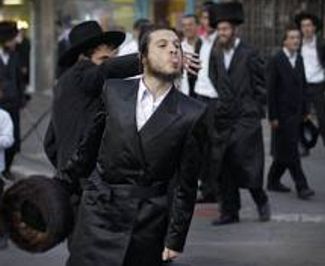
On November 4, 2011, Haaretz reported: Ultra-Orthodox young men curse and spit at Christian clergymen in the streets of Jerusalem’s Old City as a matter of routine. In most cases the clergymen ignore the attacks, but sometimes they strike back. Last week the Jerusalem Magistrate’s Court quashed the indictment against an Armenian priesthood student who had punched the man who spat at him.
Johannes Martarsian was walking in the Old City in May 2008 when an young ultra-Orthodox Jew spat at him. Maratersian punched the spitter in the face, making him bleed, and was charged for assault. But Judge Dov Pollock, who unexpectedly annulled the indictment, wrote in his verdict that “putting the defendant on trial for a single blow at a man who spat at his face, after suffering the degradation of being spat on for years while walking around in his church robes is a fundamental contravention of the principles of justice and decency.”
“Needless to say, spitting toward the defendant when he was wearing the robe is a criminal offense,” the judge said.
In 2009, the Jerusalem Post reported: News stories about young Jewish bigots in the Old City spitting on Christian clergy – who make conspicuous targets in their long dark robes and crucifix symbols around their necks – surface in the media every few years or so. It’s natural, then, to conclude that such incidents are rare, but in fact they are habitual. Anti-Christian Orthodox Jews, overwhelmingly boys and young men, have been spitting with regularity on priests and nuns in the Old City for about 20 years, and the problem is only getting worse.
“My impression is that Christian clergymen are being spat at in the Old City virtually every day. This has been constantly increasing over the last decade,” said Daniel Rossing. An observant, kippa-wearing Jew, Rossing heads the Jerusalem Center for Jewish-Christian Relations and was liaison to Israel’s Christian communities for the Ministry of Religious Affairs in the ’70s and ’80s.
For Christian clergy in the Old City, being spat at by Jewish fanatics “is a part of life,” said the American Jewish Committee’s Rabbi David Rosen, Israel’s most prominent Jewish interfaith activist.
“I hate to say it, but we’ve grown accustomed to this. Jewish religious fanatics spitting at Christian priests and nuns has become a tradition,” said Roman Catholic Father Massimo Pazzini, sitting inside the Church of the Flagellation on the Via Dolorosa.
These are the very opposite of isolated incidents. Father Athanasius of the Christian Information Center called them a “phenomenon.” George Hintlian, the unofficial spokesman for the local Armenian community and former secretary of the Armenian Patriarchate, said it was “like a campaign.”
Christians in Israel are a small, weak community known for “turning the other cheek,” so these Jewish xenophobes feel free to spit on them; they don’t spit on Muslims in the Old City because they’re afraid to, the clerics noted.
In 2004, Eric J Greenberg, wrote in The Forward: It has been Jerusalem’s dirty little secret for decades: Orthodox yeshiva students and other Jewish residents vandalizing churches and spitting on Christian clergyman as they walk along the narrow, ancient stone streets of the Old City.
Now, however, following a highly publicized fracas last week between a yeshiva student and the archbishop of Jerusalem’s Armenian Church, the issue is generating unprecedented media attention in Israel. The fight started after a yeshiva student at the respected Har Hamor yeshiva spat on Archbishop Nourhan Manougian during a Christian holy procession in the Old City.
In the wake of the incident, a top Armenian Church official told the Forward that his church is calling on the Israeli government and on rabbis around the world to help put a stop to the offensive, decades-long abuse.
“These ultra-Orthodox Jews are the ones causing this scandal, those that live here in our neighborhood and the ones that come visit the Western Wall,” said the church official, Aris Shirvanian, in a phone interview Monday. He spoke from the patriarchate’s world headquarters in the Armenian Quarter, one of the famed four quarters of the Old City of Jerusalem.
“We would like to see the authorities… become more strict with the offenders,” said Shirvanian, director of ecumenical and foreign relations of the Armenian Patriarchate. “We would also ask rabbis to get involved in educating this one sector of the Jewish society.”
Har Hamor is one of the leading institutions of religious Zionism, Israel’s equivalent of Modern Orthodoxy. Most sources interviewed for this article suggested that the abusive practices were more common in the ultra-Orthodox or Haredi community, which is characterized by greater insularity… But sources told the Forward that the practice has recently been picked up by other segments of the Orthodox world, including visiting American yeshiva students.
The controversy comes as the Israeli government and Diaspora Jewish organizations have been attempting to focus international attention on what they describe as a surge in antisemitism across the globe. Beyond potentially undermining these efforts, the reports of anti-Christian harassment could weaken Israel’s claim to be an effective guardian of Christian and Muslim rights in Jerusalem.
“Protection of everything sacred to other religions is one of the justifications for Israel’s sovereignty in Jerusalem, whose legitimacy will be undermined if this spitting becomes prevalent,” said a former Israeli chief rabbi, Israel Meir Lau. Lau condemned the harassment, and warned that such incidents could fuel antisemitism outside of Israel.
Besides the Armenian rite, clergy of other Christian churches have been targeted, Shirvanian said. “This is not happening only to Armenian clergy, but also to the Catholics, Syrians, Romanians and Greek Orthodox.”
Following the incident involving Manougian, numerous Israeli government officials and Jewish religious and organizational leaders have stepped forward to condemn the acts.
Interior Minister Avraham Poraz called the yeshiva students’ behavior “intolerable,” and asked Internal Security Minister Gideon Ezra to “take all the necessary steps to prevent these incidents in the future.”
At the end of 2009, Beth Din Tzedek, the tribunal justice of the Orthodox Jewish community in Jerusalem, issued the following statement:
Recently, repeated complaints have been made by gentiles regarding recurring harassment and insults directed at them by irresponsible youths in various places in the city, especially in the vicinity of Shivtei Yisrael Street and adjacent to the grave of Shimon the Just.
Besides desecrating the Holy Name, which in itself represents a very grave sin, provoking gentiles, according to our sages — blessed be their holy and righteous memory — is forbidden and is liable to bring tragic consequences upon our own community, may God have mercy.
We hereby call upon anyone who has the power to end these shameful incidents through persuasion, to take action as soon as possible to remove these hazard, so that our community may live in peace.
The tribunal in issuing this appeal apparently did not see itself as possessing the power to reign in its own community. Neither did it see fit to offer an apology to Jerusalem’s Christians. It’s primary concern was what kind of backlash the behavior of its own youth might eventually provoke.
The robed Christian clergy are not the only gentiles who have been subjected to spitting attacks. A year ago, Anne Barker, Middle East correspondent for Australia’s ABC News, described the humiliation and degradation she experienced when a mob of angry Orthodox men spat on her while she was reporting on street protests in Jerusalem.
I was aware that earlier protests had erupted into violence on previous weekends — Orthodox Jews throwing rocks at police, or setting rubbish bins alight, even throwing dirty nappies or rotting rubbish at anyone they perceive to be desecrating the Shabbat.
But I never expected their anger would be directed at me.
I was mindful I would need to dress conservatively and keep out of harm’s way. But I made my mistake when I parked the car and started walking towards the protest, not fully sure which street was which.
By the time I realised I’d come up the wrong street it was too late.
I suddenly found myself in the thick of the protest – in the midst of hundreds of ultra-Orthodox Jews in their long coats and sable-fur hats.
They might be supremely religious, but their behaviour — to me — was far from charitable or benevolent.
As the protest became noisier and the crowd began yelling, I took my recorder and microphone out of my bag to record the sound.
Suddenly the crowd turned on me, screaming in my face. Dozens of angry men began spitting on me.
I found myself herded against a brick wall as they kept on spitting — on my face, my hair, my clothes, my arms.
It was like rain, coming at me from all directions — hitting my recorder, my bag, my shoes, even my glasses.
Big gobs of spit landed on me like heavy raindrops. I could even smell it as it fell on my face.
Somewhere behind me — I didn’t see him — a man on a stairway either kicked me in the head or knocked something heavy against me.
I wasn’t even sure why the mob was angry with me. Was it because I was a journalist? Or a woman? Because I wasn’t Jewish in an Orthodox area? Was I not dressed conservatively enough?
In fact, I was later told, it was because using a tape-recorder is itself a desecration of the Shabbat even though I’m not Jewish and don’t observe the Sabbath.
It was lucky that I don’t speak Yiddish. At least I was spared the knowledge of whatever filth they were screaming at me.
How the Holocaust led to a life of exile in the new Jewish homeland
Gideon Levy writes: Dr. Heinz Loewy was not your classic Holocaust survivor. He did not go through any of the camps, and so did not have a number tattooed on his arm. He was a refugee, and he was my father. It seems to me that he lived most of his life as a refugee, even though he would have vehemently denied it. He lived in Israel for 60 years, but never arrived here, not really.
It’s true that on Independence Day he made sure to take out the folded flag and hang it on the balcony. It’s true that he had a good life here. But looking back, it seems to me that he never really found his place here. It wasn’t that he was trying to relive the Europe he had left behind but it’s doubtful that he found a replacement for it here. He stored his suits and ties in the closet, his Bermuda shorts replacing them in the hot summer. He also left behind the Latin he had learned, save for one proverb that he would repeat to us. Even his doctorate in law from the University of Prague was unused here.
When he arrived here, alone, after being flung about at sea for a couple of long months on an illegal immigrant ship and being jailed in Beirut, he was forced to become a door-to-door salesman, going by bicycle from house to house in Herzliya, offering the Central European pastries that he made in the bakery he owned with his sister. He looked good, baked well, and had a doctorate to boot, but surely that life was not the life he’d dreamed of as a youth.
Today, as we remember the Holocaust, we must also remember those who may not have experienced all its horrors but still had their lives changed beyond recognition, or even destroyed. The Holocaust led to the establishment of the State of Israel and the ingathering of a great many survivors to it, but not all of them felt at home. They were doomed to a life of exile in their new homeland. My father was one of them.
My father was born in Saaz, in the Sudeten region, a Yekke in every way. He left Europe, his parents and his fiancee behind, along with a promising future as a district attorney, or landes gericht rat, as he would write on the pension forms he received from Germany years after he came here.
From his parents’ house he managed to salvage one Persian rug, which became tattered over the years, and an oil painting of a vase of flowers, which hangs in my home to this day.
Here they gave him the Hebrew name “Zvi,” and after a few years of delivering cakes as well as newspapers, he became a clerk at Herut, a Histadrut labor federation-owned company, where he worked until retirement. There they called him “Dr. Levy,” with a mixture of admiration, distance and a chuckle. All his colleagues were Eastern Europeans, with whom he had difficulty connecting.
After several years of poverty, the German reparations arrived, and our lives became relatively comfortable. At age 53, my father drove his first car, which, naturally, was German-made, and he took care of it the way you take care of a child.
He never returned to his hometown. He absolutely refused to do so, which at the time I didn’t understand. He always explained it by saying that nothing remained, and there was nothing and no one to go back to – the German town had become Czech. He didn’t speak much about what he had left or what he went through, and I never asked. Today, when I so yearn to know (and I really know almost nothing ), it’s too late.
My father arrived here already pretty assimilated and he didn’t connect much to Judaism in Israel, either. I doubt he knew the difference between Shavuot and Sukkot. He also never really connected with Israeliness. I doubt he knew the difference between hummus and tehina, since he never touched either. He even wrote his family name as “Loewy,” differently than most. He read The Jerusalem Post, voted for Labor’s forerunner, Mapai, and remained a foreigner. Once a year he would go off with my mother on vacation – to Germany, of course.
What’s left in me of his foreignness? To what degree was I fashioned by his refugee-ness, and how did being a refugee’s son influence my worldview? That’s material for a different article.
Today I will merely remember Dr. Heinz Loewy, who was my beloved father, and whose life was turned upside down by the Holocaust, or perhaps even utterly destroyed.
Video — Israel: for the fear of a ‘flytilla’
At Israel’s behest, woman removed from Air France flight for not being Jewish
Ali Abunimah writes: Air France demanded to know the religion of a passenger on a flight from Nice to Tel Aviv and removed her because she is not a Jew.
The 15 April incident, confirmed by an Air France official, may violate international and European law by subjecting prospective passengers to illegal religious discrimination.
Over the past few days, Israeli authorities have reacted to an effort by hundreds of European travelers to visit the occupied West Bank at the invitation of Palestinians, by stationing hundreds of armed police and soldiers at the main international airport at Lydd, detaining and expelling travelers, and ordering European airlines to prevent boarding of travelers that Israel has placed on a political blacklist.
Several European airlines meekly complied with these Israeli orders, canceling tickets of those arbitrarily blacklisted by Israel.
The revelation that passengers are being subjected to religious tests takes this complicity with Israel’s apartheid policies to shocking new levels. [Continue reading…]
What Lt. Col. Shalom Eisner reveals about the IDF and the occupation
A soldier is on the battlefield, face-to-face with the enemy — but he’s run out of ammunition. How’s he going to engage in what could be the final fight for his life?
If he’s an Israeli soldier he’ll most likely employ the no-holds-barred Krav Maga, one of the world’s deadliest hand-to-hand combat styles. This technique derived from street-fighting skills developed by Imi Lichtenfeld, who made use of his training as a boxer and wrestler, as a means of defending Bratislava’s Jewish quarter against attacks by fascist groups in the 1930s.
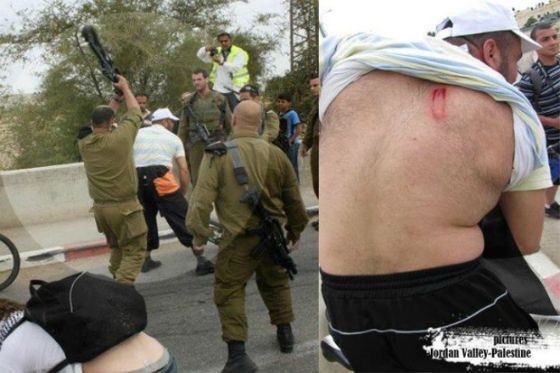
This is what Lt. Col. Shalom Eisner, deputy commander of the IDF’s Jordan Valley brigade, resorted to when faced with the “threat” posed by a bunch of kids on bicycles on Saturday afternoon.
Eisner might have appeared to have lost control but his was what might be called measured brutality — restrained enough not to kill or to fracture a peaceful protester’s skull.
The following video shows Israelis training in the technique the lieutenant colonel employed.
Amir Mizroch is the editor of the English Newsletter Edition of Israel Hayom, Israel’s most widely-read Hebrew daily newspaper. He says the blow that Eisner delivered to Andreas Ias, an ISM activist participating in the Jordan Valley cycle tour, is a Krav Maga blow that IDF recruits are taught in their first week of basic training.
Eisner’s blow is just one of a sequence of Krav Maga blows that recruits learn. The blow that Eisner delivered, textbook style, could have been followed by at least 4 others in the sequence, which are designed to completely demobilize an enemy, perhaps even kill him. The fact that Eisner lost his cool and ‘reverted to type’ and his training, is an indication that the soldier was not mentally prepared for his mission against the ISM. He shouldn’t have been there in the first place. Eisner is a man the IDF wants in the field to face his opposite numbers in the Syrian army, the Iranian army, or Hezbollah. He is a soldier, a killer if he needs to be. The IDF does not want Eisner in a lose-lose situation where the battle is against peaceful protestors armed with cameras.
Until the army learns this lesson, no amount of sensitivity training, media awareness training, or damage control, is going to fix the problem.
The issue that Mizroch fails to address is the nature of military occupation.
The only reason policing works in a free society is through the support and consent of the wider population. Military occupation like martial law is rule without consent — it is imposed against the will of the people.
Eisner didn’t just lose his cool — he illustrated the very nature of Israel’s rule over the Palestinians: rule by force in which violence is not exceptional; it is the method of government.
Israel: Lt. Col. Shalom Eisner and his supporters

Lt. Col. Shalom Eisner
“Such behavior does not characterize IDF soldiers and officers and has no place in the Israel Defense Forces and in the State of Israel,” Netanyahu said.
Indeed. But the problem for Israel is that not only was Eisner’s behavior not an aberration — it has been widely praised.
In less than 24 hours a Facebook page, “We Support Lt Colonel Shalom Eisner,” has received several hundred “likes.” (The French-speaking creator of the page also happens to like the extremist Jewish Defense League and the English Defense League.)
Former Chief IDF Rabbi Avihai Ronski criticized the swift decision to suspend Eisner, who he described as “a highly ethical individual.”
“How can you say this was ‘a serious event’ after only a few seconds of footage? These kinds of incidents are why today’s commanders feel they have no backing.”
Danny Dayan, the chairman of the Yesha Council for Jewish settlers in the West Bank on Monday condemned the “overwhelming hysteria” in Israel over Eisner’s attack. He said there was no reason for the prime minister, the defense minister, and other high-ranking political authorities to be involved.
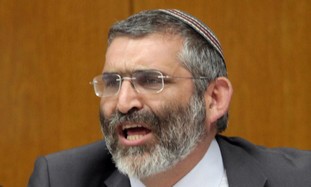
Michael Ben Ari, a National Union member of the Knesset responded by congratulating Eisner.
“Well done to the IDF officer who did what Bibi [Netanyahu] and [Yitzhak] Aharonovich [minister of internal security] have no brain or courage to do,” Ben Ari said. “Radical leftists must be handled with a heavy hand. There was a tangible threat to the lives of the soldiers and the officer had no other choice.”
Along with politicians, fellow soldiers have now voiced their support for Eisner. Ynet reports:
Eighty-three reservist officers and soldiers who served under the lieutenant colonel who was videotaped striking a Danish pro-Palestinian activist with an M-16 rifle, sent a letter addressed to IDF Chief of Staff Lt.-Gen. Benny Gantz and Defense Minister Ehud Barak in which they expressed “support and appreciation” for their “moral and ethical commander.”
Amidst so much sympathy for the lieutenant colonel, Ziv Lenchner, a Ynet columnist, expresses a deeper concern: that Eisner’s behavior accurately reflects Israel’s moral decline.
The easiest thing we can do is jump to conclusions and make accusations before clarifying the circumstances of the incident where Lt. Colonel Shalom Eisner struck a leftist activist. Yet on second thought, this is not the easiest thing we can do.
The truly easiest thing is to hide behind the details that may emerge or the arguments that may be presented – a pacifist provocation, a difficult day in the area, warm weather that inflamed the spirits – in order to justify the epitome of brutality.
One regrettable fact will not be going anywhere: A thug wearing a lieutenant colonel uniform forcefully striking the jaw of a protestor using an IDF rifle. This is a moral nadir that a moral society cannot tolerate and certainly should not accept. It must not.
With one gesture, Lieutenant Colonel Eisner provided a new and appalling interpretation to the term “purity of arms.” The disturbing thought that won’t let go wonders how many such cases take place in our country and in the territories, right under our noses and not in front of our cameras.
Many sneers must accompany the above words, and this is no coincidence. An interesting historical study to be undertaken one of these days will aim to figure out when exactly did morality turn into “self-righteousness” and “being a bleeding heart” in Israel.
Most public responses to Eisner’s act, as expressed in the talkbacks among other things, are sympathetic to his actions. The reactions range from “the Danish scumbag deserved it” to “Eisner is a real man.” The prevalent argument among the handful of objectors has to do with the PR angle: How foolish it was for the senior officer to act this way in front of the cameras, thereby undermining Israel’s image (which is otherwise superior, as we know.)
There is no doubt that the images from the Jericho area will cause Israel PR damage, and rightfully so. Yet the fact this is the main issue that concerns Israel’s decent citizens is odd, not to mention twisted – not the fact that an IDF lieutenant colonel behaves like a Syrian thug in Homs, but rather, the fear that the world will see it on television and think bad things about us.
This is actually an excellent opportunity for us to think about ourselves. How did we reach a state where a protestor on a bicycle, even if he’s naïve, eccentric and annoying, is received by the Israel Defense Force with a bone-shattering gesture, and only a few of us view it as a crime?
This may be a natural development in a country that is so scared that it undertakes a mass deportation of foreign protestors instead of allowing them to demonstrate as much as they wish in the West Bank. After all, said the man at the top, we are the only democracy in the Middle East. Aren’t we?
The blow delivered by Lieutenant Colonel Eisner is particularly painful because it was delivered by a senior officer, rather than a young, inexperienced soldier who lost his head. It’s even more difficult and painful because of the target of the blow, and it wasn’t only the Danish protestor’s face. It was the face of all of us. Look in the mirror for a second and see what our face looks like this morning.
Prominent rabbis rally to aid of Lt. Col. Shalom Eisner
Ynet reports: Several prominent rabbis expressed their support for Lieutenant-Colonel Shalom Eisner, who was suspended after assaulting a Danish pro-Palestinian activist with an M-16 rifle, saying that the military’s decision to suspend him was impetuous.
Eisner expressed remorse over his action, saying that while he should not have flung his weapon at the activist, the video footage released depicted only “60 seconds out of a two-hour event.”
Rabbi Haim Drukman, who was Eisner’s mentor, described his former pupil as “a fine man, an idealist. He didn’t choose a military career because he needed a job – he is there to give his life for the security of Israel,” he told Ynet Monday.
“Seeing such images is naturally disturbing, he continued, “But that’s just a few seconds that do not depict the entire incident. This is not someone who likes violence. He found himself in an unusual situation and this is what happened.”
Rabbi Drukman further said that he was sure the IDF inquiry into the incident will “get to the bottom of things.”
Former Chief IDF Rabbi Avihai Ronski slammed the decision to suspend Eisner, who he described as “a highly ethical individual.”
The reaction, he said, “most likely stemmed from the fact that the activist had just assaulted him and broke his hand. It was instinctual.”
Ronski also questioned what he called the rash decision to suspend the officer: “What’s the rush? Conduct your inquiry first and impose discipline only if the result warrants it.
“How can you say this was ‘a serious event’ after only a few seconds of footage? These kinds of incidents are why today’s commanders feel they have no backing.”
Military Judge Advocate General Brigadier-General Avi Mandelblit ordered a criminal investigation against Eisner.
IDF Chief of Staff Lt.-Gen Benny Gantz condemned the incident, and Prime Minister Benjamin Netanyahu said that “Such conduct does not represent the IDF, its officers and soldiers and is utterly unacceptable.”
The Jerusalem Post reports: Chairman of the Yesha Council Danny Dayan on Monday condemned the “overwhelming hysteria” in Israel over an IDF officer’s attack on a pro-Palestinian activist Sunday.
Speaking to Israel Radio, Dayan said that the officer who struck the activist should not have been judged by a 7-second video from an incident that lasted two hours. Moreover, the fact that the IDF had already condemned the officer just hours after the incident displays a loss of control on the part of the IDF and an irresponsible course of action taken by Israeli political institutions.
Dayan called the pro-Palestinian activist an enemy of Israel and implied that the Jewish State is more concerned with its image abroad than protecting its soldiers.
Dayan also condemned the Israeli political and military establishment for its “hysteria” over the incident, saying there was no reason for the prime minister, the defense minister, and other high-ranking political authorities to be involved.
Unwelcome to Israel — operation barred foreigners for no reason
In the grip of hysteria and a desperate effort to prevent peaceful protesters setting foot in Israel, a no-fly list that was designed to thwart the Welcome to Palestine campaign included a French diplomat and his wife who were coming to find an apartment in Jerusalem, an Italian government official who had been scheduled to meet her Israeli counterparts, and a member of the board of directors of German pharmaceutical giant Merck which is making a significant investment in an Israeli research institute. Several Israelis were also blacklisted.
Haaretz reports: Forty percent of the non-Israeli citizens who were blacklisted and not permitted entry into Israel on Sunday were kept out even though the Shin Bet security service had no concrete information showing they were connected with so-called fly-in protest. This information comes from a high-ranking Israeli source with knowledge of the blacklist, who added that the Shin Bet also had no solid grounds for believing that 470 of the 1,200 people whom Israel labeled as “pro-Palestinian activists” intended to do anything illegal.
“We put people on the list who are as far removed from anti-Israel political activity as east is from west,” one Foreign Ministry official said. “We have insulted hundreds of foreign citizens because of suspicions, and have given the other side a victory on a silver platter.”
“Direct damage has been done to tourism and to Israel’s good name,” the official said.
Organizers said on Sunday that their “Welcome to Palestine” protest, in which hundreds of pro-Palestinian activists were planning to participate in demonstrations in the West Bank, was a success that still advanced the Palestinian narrative even though many of the protesters were forced to stay home.
“It doesn’t matter if eight people came or 800,” said Lubna Masarwa, one of the organizers of the event. “What’s clear is that there is a popular struggle that is gaining momentum and has the international support of thousands of activists. The Palestinians are not alone in their struggle.”
A 23-year-old French woman who made it into Israel to take part in the protest said about half her group of 50 was detained.
“The security forces in France and Israel treated us like criminals,” she said. “It’s very frustrating and surprising that the authorities cooperated with the Israeli claims and propaganda.”
The list of banned passengers was inflated over the weekend in what one Foreign Ministry official called “overexertion.”
“The net was spread too wide, bringing down innocent people,” he said.
That net did not spare holders of diplomatic passports, like a French diplomat and his wife who are due to begin working at the French consulate in Jerusalem this summer. They were planning to look for an apartment in Jerusalem, but the night before their flight they received an e-mail from their airline, Lufthansa, saying their tickets were canceled because they had been banned from entering Israel.
“The Population Registry people told us their flight route was suspicious because they were coming in on a connecting flight from Munich, not direct from Paris,” said a European diplomat who was trying to help the couple get into the country. “Only after we explained that the ticket from Munich was bought because it was cheaper did they take them off the list.”
Lufthansa was one of about 20 airlines, mostly European, that Israel threatened with sanctions if they did not cancel the tickets of the passengers who appeared on the lists Israel sent them. Other airlines that canceled tickets included Air France, Alitalia, Easyjet and Turkish Airlines.
Other passengers who appeared on the blacklist despite having no connection to the protest include an employee of Italy’s Communications Ministry who was supposed to meet with her Israeli counterparts here, and a Dutch member of the board of directors of German pharmaceutical giant Merck, who was part of a company delegation taking part in the dedication of a biotechnology hothouse at the Weizmann Institute of Science, in which Merck is investing 10 million euros.
Both were eventually allowed into the country.
It wasn’t only foreign citizens who were banned from entering Israel, though: An Israeli woman from Kfar Vradim was informed the night before her flight home that she wouldn’t be allowed to board the plane. There were other instances of Israelis being put on the blacklist.
The Shin Bet, which compiled the list along with the intelligence division of the Israel Police, did not respond to a request for comment. For its part, the Population Registry was also involved in keeping out certain passengers, but said it was following the Shin Bet’s orders.
The 730 people on the initial blacklist were all foreign citizens who were banned either because they were determined by Israeli intelligence to be flying in for the express purpose of taking part in the protest, or because they had arrived here for that purpose during a previous fly-in in July.
The 270 people who took part in the previous protest have been banned from entering the country for 10 years.
Police sources said many of the passengers on the list had been arrested for protests in the West Bank, or their names appeared online in connection with pro-Palestinian groups.
Lt. Col. Shalom Eisner and Israel’s image problem
As Israeli authorities detained the few pro-Palestinian activists on the ‘flytilla’ who got as far as Ben-Gurion International Airport, perhaps they should have claimed they were being prevented from visiting the West Bank for their own safety. Had they been allowed to complete their journey they would have been at risk of encountering thugs like Lt. Col. Shalom Eisner, the deputy commander of the Jordan Valley brigade, seen here slamming his American-made rifle into the face of a young Danish activist on Saturday.
Another image appears to show Eisner striking another activist with his rifle.

Ami Kaufman reports that praise for Eisner is flooding the Israeli social media and that this senior officer is in line for a promotion.
A source who approached me and wishes to remain anonymous at this point has informed me that Lt. Col. Eisner is set to be the next deputy commander of Bahad 1 – the IDF’s training base for all of its officers. This piece of info could not be confirmed.
The IDF spokesperson in response: “We do not discuss IDF appointments in the media until they are signed and sealed. When appointments are confirmed, the media is notified.”
Leading Bahad 1 is considered to be one of the most prestigious jobs in the IDF. Some of its former commanders were Shaul Mofaz, Giora Eyland, Matan Vilnai, Elazar Stern and others who later became high-ranking generals or Chiefs of Staff.
Haaretz reported:
National Union MK Michael Ben Ari issued a response to the incident and congratulated the IDF officer who hit the leftist activists.
“Well done to the IDF officer who did what Bibi [Benjamin Netanyahu] and [Yitzhak] Aharonovich [minister of internal security] have no brain or courage to do,” Ben Ari said. “Radical leftists must be handled with a heavy hand. There was a tangible threat to the lives of the soldiers and the officer had no other choice.”


National Union MK Michael Ben Ari issued a response to the incident and congratulated the IDF officer who hit the leftist activists.