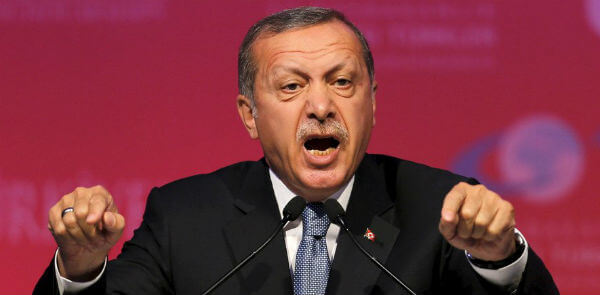
Reuters reports: Turkey said it had dismissed a further 10,000 civil servants and closed 15 more media outlets over suspected links with terrorist organizations and U.S.-based cleric Fethullah Gulen, blamed by Ankara for orchestrating a failed coup in July.
More than 100,000 people had already been sacked or suspended and 37,000 arrested since the failed coup, in an unprecedented crackdown the government says is necessary to root out all supporters of Gulen from the state apparatus.
Thousands more academics, teachers, health workers, prison guards and forensics experts were among the latest to be removed from their posts through two new executive decrees published on the Official Gazette late on Saturday.
Opposition parties described the move as a coup in itself. The continued crackdown has also raised concerns over the functioning of state. [Continue reading…]
Category Archives: Lands
Rashida Jones: The only scary thing about Syria’s refugees is that they’re just like us
Rashida Jones writes: Immigration has become an unavoidable part of our global conversation. In part, because since 2011, the war in Syria has perpetuated a devastating refugee crisis, many fleeing the country by any means possible, putting a strain on many countries all over the world. We’ve all seen the pictures: a child trying to flee war, washing ashore in Turkey, dead. Rescued children who survived an air strike in Aleppo, covered in ash and blood. Babies rescued from the rubble. Unfortunately, as long as the war continues, heartbreaking photos of people enduring and escaping war will permeate our media.
Like a lot of us, I have been confused but concerned by the present discussion surrounding refugees. Here’s what I knew, probably similar to what you all know: we are witnessing the largest global refugee crisis in history. There is an ongoing civil war in Syria that has displaced 13.5 million people. All over the world, there is philosophical and practical conflict over borders: Do we close them, do we open them, how much, how many, etc.? And the U.S. has recently welcomed the last of its promised 10,000 Syrian refugees to our soil. Oh, yeah, and there is pretty dangerous propaganda floating around that all refugees are terrorists. Perpetuated by many unnamed international politicians, including a presidential candidate whose name rhymes with Cronald Blump.
What else did I know? I knew that the passing of the Brexit was partially inspired by the false promise of blocking entry for refugees, immigrants, and anyone who falls into the “other” category. I knew that the European countries that opened their borders have struggled with the influx of refugees. I knew that the European countries that closed their borders have struggled with bad international P.R. for being inhumane.
As a descendant of black slaves and Jewish immigrants, it’s inherently hard for me to understand why it’s acceptable for a closed-borders, anti-foreigners viewpoint to be influencing policy and popular opinion. But I try to understand. If I’m being generous, I guess I could speculate that people worldwide are scared? Scared of what they don’t know, scared of what’s next, scared of losing their comfortable lives, of having to find a way to cohabit with people whose culture, language, and religious orientation is unfamiliar. And, yes, they are irrationally scared of inviting in violent extremism. Of course we all understand the instinct to protect what is ours, but at what cost to our humanity? [Continue reading…]
Why is Trump suddenly talking about World War III?
Anne Applebaum writes: Back in March 2014, just after the Russian invasion of Crimea, Russia’s most famous state television broadcaster presented the international situation in stark terms. “Russia,” Dimitry Kiselyov told his millions of viewers, “is the only country in the world that really can turn [the] USA into radioactive ash.” Against a backdrop of mushroom clouds and throbbing nuclear targets, he spoke ominously of how President Obama’s hair was turning gray — “I admit this can be a coincidence” — and the increasing desperation of a White House that truly feared that nuclear war might break out at any moment.
Now it’s October 2016, and Kiselyov, who also heads Russia’s state-owned news agency, is at it again. “Impudent behavior toward Russia” has a “nuclear dimension,” he warned ominously on Oct. 9. In the same program, he again featured photographs of Obama. Kiselyov said that there had been a “radical change” in the U.S.-Russian relationship, and he added a threat: “Moscow would react with nerves of steel” to any U.S. intervention in Syria — up to and including a nuclear response. “If it should one day happen, every one of you should know where the nearest bomb shelter is. It’s best to find out now,” another television channel has advised.
What a difference two years makes: The U.S. government, and the U.S. public, brushed off Russia’s nuclear narrative the first time it was presented. But this time around, the language sounds different. We are in the middle of an ugly presidential election. More important, we have a Republican presidential nominee who regularly repeats propaganda lines lifted directly from Russian state media. Donald Trump has declared that Hillary Clinton and Obama “founded ISIS,” a statement that comes directly from Russia’s Sputnik news agency. He spouted another debunked conspiracy theory — “the Google search engine is suppressing the bad news about Hillary Clinton” — soon after Sputnik resurrected it.
Now Trump is repeating Kiselyov’s threat, too. “You’re going to end up in World War III over Syria if we listen to Hillary Clinton,” he said this week. Just like Kiselyov, he has also noted that Russia has nukes and — perhaps if Clinton is elected — will use them: “Russia is a nuclear country, but a country where the nukes work as opposed to other countries that talk.”
Why is Russian state media using such extreme language? And why is Trump repeating it? The Russian regime’s motives aren’t hard to understand: It wants to scare Russians. The economy is much weaker than it was, living standards are dropping and with it support for President Vladimir Putin. A ruling clique that stays in power thanks to violence and corruption is by definition nervous, and so it is using its media monopoly to frighten people: Only Putin’s regime can protect you from U.S. aggression. [Continue reading…]
Treatment of Sunnis in areas liberated from ISIS is laying the groundwork for more hatred, violence, and terror
The Daily Beast reports: “This is payback for the Speicher massacre,” a Shia soldier said to a Sunni as he stomped all over him and some other helpless Sunni prisoners, his colleagues hitting them with whatever came to hand: metal rods, shovels, pipes, cables. He was referring to a notorious mass execution of Shia military cadets by ISIS in June 2014. In August this year, the Baghdad government executed dozens of people for the atrocities at Speicher. But that was not enough for these Shias seeking their own revenge.
With Iraqi forces inexorably advancing on Mosul, more and more villages are being liberated from the rule of ISIS. Ever more Sunnis are fleeing into other areas of Iraq (if they are not first killed by ISIS snipers or mines). The opportunities for such revenge are growing every day, and they are being taken not just by the Shia militias operating in this war but by the state apparatus, too, fuelling a cycle of violence which can only lead to the next insurgency, whatever form that will take.
A recent report from Amnesty International details this and many other atrocities: cases of torture and extra-judicial executions with hundreds upon hundreds of Sunni men still missing; 643 from one tribe following the liberation of Saqliwa in June, with a further 49 definitely killed. What the report implicitly shows is that Iraq after ISIS promises to be more, not less, unstable, even after this global battle for Mosul and the inevitable military defeat of ISIS. [Continue reading…]
UN hires Assad’s friends and relatives for Syria relief operation
The Guardian reports: The UN has hired scores of friends and political associates of Syria’s president, Bashar al-Assad, as part of its relief operation in the country, according to documents leaked to the Guardian.
The staff lists show that relatives of high-ranking ministers have been on the Damascus payroll of UN agencies, including the refugee agency UNHCR and the World Health Organisation (WHO).
One former UN manager told the Guardian that every UN agency had at least “one person who is a direct relative of a Syrian official”.
The UN asked the Guardian not to identify any individuals on the staff lists to protect their safety.
A spokesman said “family connections are not taken into consideration nor investigated” when hiring staff, and the UN did not question prospective workers about their political affiliations. [Continue reading…]
NATO and Russia playing dangerous game with military build-up
The Guardian reports: It has been billed as Nato’s biggest military build-up on Russia’s borders since the cold war. Britain is sending fighter jets next year to Romania. The US is dispatching troops, tanks and artillery to Poland. Germany, Canada and other Nato countries also pledged forces at a meeting on Wednesday of defence chiefs in Brussels.
The move comes after Russia has been busy deploying hardware of its own. Earlier this month, Moscow said it was stationing nuclear-capable missiles in Kaliningrad, Russia’s Baltic exclave. This week, two Russian warships armed with cruise missiles slipped into the Baltic sea.
Meanwhile, the hulking Russian aircraft carrier Admiral Kuznetsov has been belching its way through the Channel en route to Syria. Spain said Moscow had withdrawn a request to refuel on Spain’s north African coast, amid western suspicions the Russian fleet will be used to flatten civilians in Aleppo.
Nato’s apparent goal here is to deter future acts of aggression on European territory by Vladimir Putin’s revanchist Russia. After a period in which Nato has seemed slow to react, and lacking in backbone, the alliance is now sending out a robust message. As the US defence secretary, Ash Carter, put it this week, these deployments are all about deterrence. [Continue reading…]
Images of starving children in Yemen help show the horrors of U.S.-backed war
ABC News reports: The emaciated frame of 18-year-old Saida Ahmad Baghili lies on a hospital bed in the Red Sea port city of Hodaida, her suffering stark evidence of the malnutrition spread by Yemen’s 19-month civil war.
Baghili arrived at al-Thawra hospital on Saturday. She is bedridden and unable to eat, surviving on a diet of juice, milk and tea, medical staffers and a relative said.
“The problem is malnutrition due to [her] financial situation and the current (war) situation at this time,” said Asma al-Bhaiji, a nurse at the hospital.
Baghili is one of more than 14 million people, over half of Yemen’s population, who are short of food, with much of the country on the brink of famine, according to the United Nations.
The U.N.’s World Food Program notes that the conflict in Yemen “has left thousands of civilians dead and 2.5 million internally displaced” over the past year.
President Barack Obama has received criticism for not cutting back on U.S. support for the government of Saudi Arabia, which has been bombing Houthi rebels in Yemen since March 2015 in an effort to strengthen its foothold in the region. [Continue reading…]
Khalid Al-Karimi writes: Yemen’s economy has been severely crippled by the conflict. Many of its businesses have shuttered, and many people have lost their job. Today, the labour force has one field in which work is guaranteed: on the battleground.
Funds allocated to the war are available in abundance. Instead of dying of hunger, these men die on mountains, hills, plains, valleys or on their armored vehicles with full stomachs and pockets. Poverty in Yemen is chronic, and it has grown to alarming levels over the 19-month long conflict.
According to the UN World Food Programme, almost 14.4 million people in Yemen are food insecure, of whom seven million people in desperate need of food assistance. The agency points out that one in five people are “severely food insecure” and in urgent need of food assistance.
This state of food crisis pushes thousands of men to the precipice of war. While financial gain is not everyone’s motive, a considerable number have joined the combat for financial gains that can help them and their families survive in the face of lethal poverty. [Continue reading…]
ISIS abducts 8,000 families from around Mosul and take them into city to use as human shields
The Telegraph reports: Islamic State of Iraq and the Levant has abducted tens of thousands of men, women and children from around Mosul to use as human shields in the imminent battle for the city, the UN has said.
The militants forced more than 8,000 families to leave their homes before marching them into Iraq’s second city, which they are defending from advancing troops.
“Isil’s depraved, cowardly strategy is to attempt to use the presence of civilian hostages to render certain points, areas or military forces immune from military operations,” said Ravina Shamdasani, a spokesman for the UN rights office. [Continue reading…]
In Lebanon deal, Iran wins and Saudi retreats
Reuters reports: A veteran Christian leader is set to fill Lebanon’s long-vacant presidency in a deal that underlines the ascendancy of the Iranian-backed Hezbollah movement and the diminished role of Saudi Arabia in the country.
It appears all but certain that Michel Aoun will become president next week under an unlikely proposal tabled by Sunni leader Saad al-Hariri, whose Saudi-backed coalition opposed Hezbollah for years.
Parliament will likely elect Aoun on Oct. 31. This will end one element of a paralyzing political crisis: the 29-month-long presidential vacuum. But it is also creating new tensions that may disrupt the formation of a new government expected to be led by Hariri under a deal with Aoun.
Aoun’s election will also raise questions over Western policy toward Lebanon. Lebanon’s army, guarantor of the country’s internal peace, depends on aid from the United States, which deems Hezbollah a terrorist group.
Hariri’s proposal, unthinkable a few weeks ago, appears to have been forced on him by problems at his Saudi-based construction firm, Saudi Oger, the financial backbone of his political network in Lebanon.
It marks the death throes of the Hariri-led alliance that struggled with Hezbollah for more than a decade, only to see the heavily armed Shi’ite group go from strength to strength in Lebanon and the wider region. [Continue reading…]
Syria’s ‘voice of conscience’ has a message for the West
Murtaza Hussain and Marwan Hisham report: Yassin Al-Haj Saleh has lived a life of struggle for his country. Under the Syrian regime of Hafez al-Assad, he was a student activist organizing against the government. In 1980, Saleh and hundreds of others were arrested and accused of membership in a left-wing political group. He was just 19 years old when a closed court found him guilty of crimes against the state. Saleh spent the next 16 years of his life behind bars.
“I have a degree in medicine, but I am a graduate of prison, and I am indebted to this experience,” Saleh said, sitting with us in a restaurant near Istanbul’s Taksim Square. Now in his 50s, with white hair and a dignified, somewhat world-weary demeanor, Saleh, called Syria’s “voice of conscience” by many, has the appearance and bearing of a university professor. But he speaks with passionate indignation about what he calls the Assad dynasty’s “enslavement” of the Syrian people.
Saleh was living in Damascus in 2011 when Syrian civilians rose up to demand political reform. That protest movement soon turned into open revolution after government forces met the protestors with gunfire, bombardment, mass arrests, and torture.
From painful firsthand experience, Saleh knew the cost of challenging the Assad regime. But when the uprising started, he did not hesitate to join it. He left home and spent the next two years in hiding, helping Syrian activists organize their struggle.
By late 2013, Syria had descended into anarchy. The conflict between the government and a range of opposition forces had become increasingly militarized. Like many other activists for the revolution, Saleh was forced to flee across the border to Turkey. That same year, armed groups in the Damascus suburbs kidnapped his wife, along with three other activists. ISIS kidnapped his brother in 2013. Neither has been heard from since. [Continue reading…]
UN chief calls security council’s failure on Aleppo ‘our generation’s shame’
The Guardian reports: In a blistering indictment, UN humanitarian chief Stephen O’Brien called the failure of the UN security council, and Russia in particular, to stop the bombing of eastern Aleppo as “our generation’s shame”.
The Russian ambassador, Vitaly Churkin, reacted by denouncing O’Brien’s vivid account of the humanitarian toll in the besieged city as “unfair and dishonest”. In one of the most pointed attacks against a top UN official by a permanent council member in recent times, he told O’Brien to leave his comments “for the novel you’re going to write some day”.
Envoys from the US, UK and France came to the UN’s defence and heaped blame for the mass killing of civilians in Aleppo on Russia and its ally, the Syrian regime, as the Syrian conflict drove ever deeper divisions in the paralysed security council, and alienated Russia, currently president of the council, further from the UN relief and human rights agencies.
O’Brien, the under-secretary general for humanitarian affairs, invited the envoys at the security council to imagine themselves among the 275,000 people trapped in eastern Aleppo and under bombardment by Syrian regime and Russian planes.
“Let me take you to east Aleppo this afternoon,” O’Brien said. “In a deep basement, huddled with your children and elderly parents the stench of urine and the vomit caused by unrelieved fear never leaving your nostrils, waiting for the bunker-busting bomb you know may kill you in this, the only sanctuary left to you but like the one that took your neighbour and their house out last night; or scrabbling with your bare hands in the street above to reach under concrete rubble, lethal steel reinforcing bars jutting at you as you hysterically try to reach your young child screaming unseen in the dust and dirt below your feet, you choking to catch your breath in the toxic dust and the smell of gas ever-ready to ignite and explode over you.”
“These are people just like you and me – not sitting around a table in New York but forced into desperate, pitiless suffering, their future wiped out,” O’Brien said, describing himself as “incandescent with rage” over the security council’s passivity, said. “Peoples’ lives [have been] destroyed and Syria itself destroyed. And it is under our collective watch. And it need not be like this – this is not inevitable; it is not an accident … Never has the phrase by poet Robert Burns, of ‘man’s inhumanity to man’ been as apt. It can be stopped but you the security council have to choose to make it stop.” [Continue reading…]
Trump adviser says Israeli settlements are ‘not illegal’
Middle East Eye and agencies reports: Donald Trump’s adviser on Israel said on Wednesday that Jewish settlements in the occupied West Bank are not illegal, adding that he believes the candidate agrees with him, putting the pair at odds with much of the world.
Speaking to AFP at a rooftop restaurant on Jerusalem’s Mount Zion after a pro-Trump rally, David Friedman also said the US presidential candidate was “tremendously sceptical” about the prospects for a two-state solution to the Israeli-Palestinian conflict.
About 150 people, including right-wing Israelis and evangelical Christians, attended Wednesday’s Trump rally outside the walls of Jerusalem’s Old City, near the flashpoint Al-Aqsa mosque compound.
The compound is holy to both Muslims and Jews, who refer to it as the Temple Mount. Located in East Jerusalem, it was occupied by Israel in 1967 and later annexed in a move never recognised by the international community.
Asked whether Trump viewed the West Bank as part of Israel, as many far-right Israelis do, Friedman did not answer directly.
“I don’t think he believes that the settlements are illegal,” Friedman said. [Continue reading…]
Hacked emails reveal ties between Kremlin and Ukraine rebels

The Associated Press reports: A group of Ukrainian hackers has released thousands of emails from an account used by a senior Kremlin official that appear to show close financial and political ties between Moscow and separatist rebels in Eastern Ukraine.
The cache published by the Ukrainian group CyberHunta reveals contacts between President Vladimir Putin’s adviser Vladislav Surkov and the pro-Russia rebels fighting Ukrainian forces.
Ukraine’s National Security Service said Wednesday the emails were real, although they added the files may have been tampered with. Putin’s spokesman Dmitry Peskov dismissed the published emails as a sham, saying Wednesday that Surkov doesn’t use email.
Russian journalist Svetlana Babaeva told The Associated Press emails from her in the cache were genuine. “I sent those emails,” Babaeva said, referring to three emails in the leak discussing arrangements for an off-the-record meeting between Surkov and editors at her publication.
Russian businessmen Evgeny Chichivarkin, who lives in London, said in a Facebook post Wednesday that emails attributed to him in the cache were genuine too. [Continue reading…]
The Guardian reports: Sanctioned and thus banned from travel to the EU for his role in the Kremlin’s Ukraine policy, the 52-year-old Surkov nevertheless popped up at recent four-way negotiations in Berlin over Ukraine, sitting at the round table next to Putin, and just one seat across from Angela Merkel. It was a very visible signal of Surkov’s importance to the Kremlin’s controversial Ukraine policy.
Several sources have told the Guardian that Surkov has on occasion made secret trips to Donetsk, technically still part of Ukraine, to bring local separatist politicians into line and tell them what is expected of them if they are to continue to receive Russian funding and support. More regularly, emissaries from east Ukraine come to Moscow to meet with Surkov. [Continue reading…]
Chris Zappone writes: The timing of the hack and the target, Vladislav Surkov, suggest that this could be a form of retaliation for the purported Russian hacking of the US election.
The group, called Kiberkhunta (or Cyber Junta) posted 2000 emails from Surkov dating from between September 2013 and November 2014.
Coming against the backdrop of the Russian cyber campaign against the US during the current presidential election year, at least one analyst sees the possibility of a connection to those events.
“It is possible that we are seeing the first example of mutually assured doxing,” said Kenneth Geers, Kiev-based Senior Research Scientist at COMODO, referring to the practice of hacking and publishing private emails.
‘Mutually assured doxing’ is a play on the Cold War concept of Mutually Assured Destruction – the permanent nuclear stand-off between Russia and the US which dissuaded either side from starting a war.
“We should usually assume there is some political goal behind every leak,” he said.
Geers, who is also an ambassador for the NATO Cyber Centre, said the Surkov leak may hint at an emerging behavioural norm between nation states.
“We may see a doxing escalation ladder materialise: how far do you want me to go, all the way to the top?” said Geers.
“As painful as it is today, doxing serves a long-term historical role in reducing corruption.” [Continue reading…]
Britain, U.S. sending planes, troops to deter Russia in the east
Reuters reports: Britain said on Wednesday it will send fighter jets to Romania next year and the United States promised troops, tanks and artillery to Poland in NATO’s biggest military build-up on Russia’s borders since the Cold War.
Germany, Canada and other NATO allies also pledged forces at a defense ministers meeting in Brussels on the same day two Russian warships armed with cruise missiles entered the Baltic Sea between Sweden and Denmark, underscoring East-West tensions.
In Madrid, the foreign ministry said Russia had withdrawn a request to refuel three warships in Spain’s North African enclave of Ceuta after NATO allies said they could be used to target civilians in Syria.
The ships were part of an eight-ship carrier battle group – including Russia’s sole aircraft carrier Admiral Kuznetsov – that is expected to join around 10 other Russian vessels already off the Syrian coast, diplomats said.
NATO Secretary-General Jens Stoltenberg said the troop contributions to a new 4,000-strong force in the Baltics and eastern Europe were a measured response to what the alliance believes are some 330,000 Russian troops stationed on Russia’s western flank near Moscow. [Continue reading…]
Ultranationalist Aleksandr Dugin calls for a Russian ‘Conservative Revolution’
Paul Goble reports: Russia is engaged in an ideological struggle with liberalism at home and abroad, the influential Russian Eurasianist Aleksandr Dugin says. Moscow has clearly articulated what it is against, but having failed to develop an ideology of its own, it remains incapable to saying what it is for and thus risks losing this competition.
In a TV interview, Dugin says “the West criticizes Russia and each of our actions be they in Crimea, Novorossiya or Syria from the position of liberalism.” And because of that, Russians in general and Vladimir Putin in particular have come to view liberalism as hostile to Russia.
To defeat it, the Eurasianist says, Russia must do two things, the first of which it is on its way to doing – rooting out all the liberalism which “put down deep roots” in Russian life beginning in the 1990s – and the second, articulating its own ideology to put in place of liberalism, something it has not yet done.
Ultimately, he suggests, “these two things are closely connected” because “we cannot pull out liberalism by the roots, if we do not find something to replace it.” And unfortunately, “the bearers of the liberal virus do everything … to sabotage from the inside any effort to advance a consistent alternative ideology” based on Russian identity and exceptionalism. [Continue reading…]
Erdoğan pursues his plan for even greater power

Politico reports: If you’ve been listening to Recep Tayyip Erdoğan this past month, you’d be forgiven for thinking the Turkish president was intent on redrawing his country’s borders.
In a series of provocative speeches, he has lamented the loss of Ottoman territories, complained that Turkey “gave away” islands to Greece, and invoked a century-old plan that included the Iraqi cities of Mosul and Kirkuk in Turkey’s boundaries.
“We did not accept the borders of our country voluntarily,” Erdoğan said in one of his speeches. Yet while he has used this expansionist rhetoric to argue that Turkey has a say in the ongoing battle for Mosul, his target audience are not Greek or Iraqi officials. Rather, it’s intended for potential voters back home — election talk ahead of a looming referendum on the nature of his presidency.
Erdoğan’s long-standing ambition to replace Turkey’s parliamentary system with an executive presidency — a constitutional change that would grant him significantly greater powers — is inching closer to becoming reality. This month, ministers and officials began floating a timeline, suggesting that a parliamentary vote could be held early next year with a subsequent referendum in April.
After this summer’s attempted coup, Erdoğan’s popularity has soared; a popular vote may well succeed. Yet it remains uncertain whether his ruling Justice and Development Party (AKP) will be able to shore up enough support from other parties to reach the necessary parliamentary majority to call a referendum.
Politicians across the otherwise deeply divided opposition parties object that the introduction of a presidential system would allow the increasingly authoritarian Erdoğan to rule Turkey unchecked.
The president’s best bet is the nationalist opposition: Their leader, Devlet Bahceli, signaled he would not challenge a plebiscite in recent weeks. If his parliamentary group follows suit, the AKP could take their proposal to a referendum.
Hence the belligerent rhetoric. The talk of Turkey’s rights regarding parts of Iraq and the Aegean islands plays well with the nationalists, who often bemoan the territorial concessions made in the 1920s by the crumbling Ottoman Empire.
“Erdoğan is a savvy politician who understands very well the sort of emotional chords of the Turkish public,” said Sinan Ülgen, a former Turkish diplomat and visiting scholar at Carnegie Europe. “This is part of an overall strategy to shore up national support that started in the wake of the elections last June.” [Continue reading…]
In pop culture, there are no bad police shootings
Alyssa Rosenberg writes: Movies, television and novels have trained audiences to excuse almost any police shooting, including the deaths of children — until now, when the emergence and near-ubiquity of real-life videos have made the gap between fiction and reality undeniable.
Whether a shooting is legal is determined in part by an officer’s fear. But when the Los Angeles Police Department cleared scripts for television series such as “Dragnet” or “Adam-12,” “any shooting that was done on the shows was squeaky clean,” explained former detective sergeant Joseph Wambaugh, who worked briefly in the LAPD’s public information office, where the scripts were reviewed. “Any officer would have to be in total control.”
If this standard had nothing to do with how officers actually reacted after shooting someone, it was intended to bolster the audience’s confidence in police officers.
In fact, officers on early cop shows such as “Dragnet” and “Naked City” were often presented as so decent that they questioned their own decisions to shoot and had to be convinced that they’d done the right thing. Often, the person doing the convincing was a parent or relative of the dead person.
The first time Joe Friday (Jack Webb), the archetypal stoic police officer, killed a person in the “Dragnet” episode “The Big Thief,” he was so distressed that his partner had to help him fill out his incident report. “I kind of wonder if there was another way,” Friday declared glumly, unconvinced that he was right to shoot even though the other man had a gun. Friday was ultimately reassured by the law itself, when the shooting was ruled a justifiable homicide.
Friday’s question hangs in the air, but it both casts and dispels doubt in a single sentence. If someone who cares as much as Joe Friday does couldn’t find a better solution when confronted with a dangerous criminal, then maybe one doesn’t exist. Friday’s concerns are themselves the proof that he would never do the wrong thing. [Continue reading…]
Remain means remain: Nicola Sturgeon cannot be ignored on Brexit
By Andrew Scott Crines, University of Liverpool
The meeting between Prime Minister Theresa May and the leaders of the United Kingdom’s devolved administrations was a significant moment in setting the tone for the Brexit negotiations ahead.
May has pledged to advance a single UK position when negotiations with the EU begin next year. This pledge could be interpreted in either of two ways. She could be attempting to compel the nations of the UK to conform to the Westminster government’s Brexit position, or she could be opening the door to other positions in the hope of destabilising the moves towards leaving the EU. The former is the most likely, however May cannot be seen to be overtly imposing the will of the Brexiteers on the devolved institutions without risking political consequences.
In the case of Scotland such consequences are well advertised. First Minister Nicola Sturgeon wants to at least keep Scotland in the single market and, really, her ultimate goal is to stay in the EU. The Scottish people voted to remain, which Sturgeon is interpreting as a solid mandate to oppose moves in London to take Scotland out.
Similarly, Northern Ireland voted to remain. The deputy first minister, Martin McGuinness, warned of dire consequences if it is also taken out of the EU, both economically and constitutionally. Only Wales and England voted to leave, which was enough to deliver a Brexit vote.