Category Archives: Lands

Good time for a bloodbath in Aleppo? Putin thinks so

David Hearst writes: It is nearly a year since Vladimir Putin sprung one of his little surprises on Washington by entering the civil war in Syria as an active combatant on Bashar al-Assad’s side.

In that time, Russian bombing can claim to have saved Damascus and the regime itself from falling, to have re-opened the coastal road to Latakia, and liberated Palmyra. Putin has already declared mission accomplished once and flew home most of his bombers. He is now flying them all back in an assault on east Aleppo.

In that time, Sergei Lavrov and John Kerry lulled each other into thinking that they could waltz their way to the Geneva conference table, when neither the Russian Ministry of Foreign Affairs, nor the State Department were running things. The deal breaker was the US bombing of Syrian regime positions in Deir Ezzor on 17 September, an act for which the US have apologised but which the Russians believe was a deliberate act.

Just as he did in Ukraine (a separatist war for which Moscow, Ukrainian nationalists and EU negotiators all have blood on their hands), the arch regional opportunist Putin saw an opportunity: to finish off Aleppo, and with it a war that has lasted the five and a half years. Or so he thinks.

Russian generals also think they have done Aleppo before. For anyone who witnessed the bombardment of Grozny – in 1994 and 2000 – the pictures coming out of east Aleppo are nothing new.

The use of thermobaric or vacuum bombs (bursts which suck the oxygen out of the air within a 500-metre radius), phosphorus, “double tap” strikes, deniable militias, the targeting of hospitals, market places, mosques, anywhere where civilians gather in war time – all this Russia has tried before in Chechnya.

The brutality of the Russian counter insurgency in Chechnya had one effect. It split a nationalist Sufi separatist movement, which had been running on and off since Tsarist days, into two factions. One went into exile and is inert. The other became the hard core of the Islamic State (IS) in the North Caucasus, and provides one source of foreign fighters for IS in Raqqa.

Russia has never put this fire out. It continues to burn away in Muslim-majority Russian republics like Dagestan and Ingushetia and will burst out again the moment Moscow takes its foot off the throat of the North Caucasus. In one sense, Putin is right to think that he is fighting the same enemy now in east Aleppo, as he did 16 years ago in Grozny. It is one that he himself created. [Continue reading…]

Facebooktwittermail

Russia aims to redraw map in Syria before next U.S. president takes office

The New York Times reports: Russia is using the waning days of the Obama administration to strengthen President Bashar al-Assad’s hold on power, expand the territory he controls in Syria and constrain the options of the next American president in responding to the civil war, according to a number of American officials and Russian analysts.

The strategy of President Vladimir V. Putin of Russia, they say, is to move aggressively in what he sees as a prime window of opportunity — the four months between now and the 2017 presidential inauguration — when Mr. Putin calculates that the departing President Obama will be unlikely to intervene in the escalating Syrian conflict and a new American president who might consider a tougher policy will not yet be in office.

“Putin is in a hurry before the American elections,” said Nikolai V. Petrov, a political scientist in Moscow. “The next American president will face a new reality and will be forced to accept it.” [Continue reading…]

Facebooktwittermail

Obama views Aleppo’s destruction as preferable to risky U.S. intervention

Josh Rogin writes: U.S. military strikes against the Assad regime will be back on the table Wednesday at the White House, when top national security officials in the Obama administration are set to discuss options for the way forward in Syria. But there’s little prospect President Obama will ultimately approve them.

Inside the national security agencies, meetings have been going on for weeks to consider new options to recommend to the president to address the ongoing crisis in Aleppo, where Syrian and Russian aircraft continue to perpetrate the deadliest bombing campaign the city has seen since the five-year-old civil war began. A meeting of the Principals Committee, which includes Cabinet-level officials, is scheduled for Wednesday. A meeting of the National Security Council, which could include the president, could come as early as this weekend.

Last Wednesday, at a Deputies Committee meeting at the White House, officials from the State Department, the CIA and the Joint Chiefs of Staff discussed limited military strikes against the regime as a means of forcing Syrian dictator Bashar al-Assad to pay a cost for his violations of the cease-fire, disrupt his ability to continue committing war crimes against civilians in Aleppo, and raise the pressure on the regime to come back to the negotiating table in a serious way. [Continue reading…]

The New York Times reports: Secretary of State John Kerry criticized Russia on Tuesday for pointedly ignoring the Syrian government’s use of chlorine gas and barrel bombs against its own citizens, and he left little hope for an early resumption of talks with Russia about a cease-fire.

Speaking here before the opening of a conference on Afghanistan organized by the European Union, Mr. Kerry said that the United States would continue efforts to end the fighting in Syria through the United Nations, but that Washington had little hope of persuading Russia to give up its unqualified support of the government of President Bashar al-Assad of Syria.

The Obama administration announced on Monday that it was suspending bilateral talks with Russia on a cease-fire. [Continue reading…]

Facebooktwittermail

The mirage of U.S.-Russian shared interests in Syria

Fred Hof writes: Secretary of State John Kerry’s tireless, frenetic drive to short-circuit mass homicide in Syria by finding common ground with Russia has come to naught. It has gone up in the flames with the smoke now rising above Aleppo. It has died with defenseless, terrified civilians in their homes, hospitals, markets, and mosques: a population top-heavy with children targeted mercilessly by Russian pilots and their Assad regime counterparts. Where Kerry’s superbly intentioned diplomacy went wrong was its failure to distinguish between the arguably objective interests of the Russian Federation and the personal desires of its current leader, President Vladimir Putin.

No Russian diplomat with whom I interacted while serving in the State Department ever failed to say something unkindly accurate about Moscow’s Syrian client, Bashar al-Assad. The highlight came during the pivotal Geneva negotiations of June 2012. The American, French, and British delegates argued forcefully for language that would exclude “anyone with blood on his hands” from Syria’s to-be-negotiated transitional governing body. The objection of the chief Russian delegate was revealing: “Come on. Everyone will know we’re talking about Assad.” His point was irrefutable.

The corruption, incompetence, and brutality of the Assad regime is not lost on Russian officials. They are intimately aware of the role the regime played during the first decade of the twenty-first century ferrying foreign fighters from the Damascus airport to Iraq, where they joined Al Qaeda in Iraq: the direct ancestor of ISIS (ISIL, Islamic State, Daesh). They are cognizant of the regime releasing from prison violent political extremists back in 2011 in the hope they would pollute and ultimately dominate the peaceful, nationalistic, and non-sectarian opposition to Assad regime violence. They are not unwitting of the eastern Syria governance vacuum created by Assad regime lawlessness and how ISIS has filled it. They know quite well that the regime’s survival strategy of mass homicide pumps oxygen into the lungs of the ISIS recruiting apparatus, both in Syria and in Sunni communities around the world.

Knowing that his Russian counterparts know all of this, John Kerry proceeded on the assumption that Moscow could be persuaded to cooperate in transitioning Assad offstage. He was encouraged in this assumption by a Russian counterpart eager to mislead so as to preserve American operational passivity in the face of mass murder. Kerry’s White House counterparts jumped onto the shared-interests bandwagon with unbridled enthusiasm, assuring visitors that Moscow would bend over backward to cooperate with Washington diplomatically for the sake of establishing joint military operations, which Russia allegedly needed to “legitimize” its military presence in Syria. This delusional belief in common ground with the Kremlin was fed and sustained by the one actual fact known to Kerry and to White House officials: President Barack Obama would not so much as lift a finger to protect Syrian civilians from Assad regime mass murder. It was therefore up to Vladimir Putin to protect them. [Continue reading…]

Facebooktwittermail

In Aleppo death follows us. But we still love life

Waad Alkhateab writes: The past week in Aleppo has been totally different from the past five years. It feels as if the Assad government is trying to wipe out what remains of east Aleppo. It is often referred to as the most dangerous city in the world and these days there is no escaping the horror.

Almost a month ago during the first siege, my friend wrote, “We no longer need to set our alarm clocks to wake us up in the morning. The missiles and barrel bombs are doing this job.” Now this is the daily reality, only the lucky people wake up alive. Hearing the sound of shelling at night is at least evidence that you are still breathing in air, not the dust of your home in ruins, or the aroma of the blood and flesh of your family members.

We thought that the 72-day siege that the city experienced earlier in the year was over with no return and that the regime had been pushed back. However, now it feels as if Bashar al-Assad is planning to break us completely. [Continue reading…]

Facebooktwittermail

Yemen famine feared as starving children fight for lives in hospital

The Guardian reports: Dozens of emaciated children are fighting for their lives in Yemen’s hospital wards, as fears grow that civil war and a sea blockade that has lasted for months are creating famine conditions in the Arabian peninsula’s poorest country.

The UN’s humanitarian aid chief, Stephen O’Brien, described a visit to meet “very small children affected by malnutrition” in the Red Sea city of Hodeida. “It is of course absolutely devastating when you see such terrible malnutrition,” he said on Tuesday, warning of “very severe needs”.

More than half of Yemen’s 28 million people are already short of food, the UN has said, and children are particularly badly hit, with hundreds of thousands at risk of starvation.

There are 370,000 children enduring severe malnutrition that weakens their immune system, according to Unicef, and 1.5 million are going hungry. Food shortages are a long-term problem, but they have got worse in recent months. Half of children under five are stunted because of chronic malnutrition. [Continue reading…]

Facebooktwittermail

Baghdad bridles at Turkey’s military presence, warns of ‘regional war’

Reuters reports: Iraqi Prime Minister Haider al-Abadi has warned Turkey that it risks triggering a regional war by keeping troops in Iraq, as each summoned the other’s ambassador in a growing row.

Relations between the two regional powers are already broadly strained by the Syrian civil war and the rise of the Islamic State militant group.

Turkey’s parliament voted last week to extend its military presence in Iraq for a further year to take on what it called “terrorist organizations” – a likely reference to Kurdish rebels as well as Islamic State.

Iraq’s parliament responded on Tuesday night by condemning the vote and calling for Turkey to pull its estimated 2,000 troops out of areas across northern Iraq.

“We have asked the Turkish side more than once not to intervene in Iraqi matters and I fear the Turkish adventure could turn into a regional war,” Abadi warned in comments broadcast on state TV on Wednesday. [Continue reading…]

Facebooktwittermail

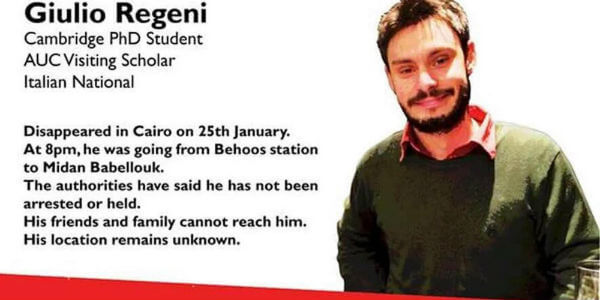
Who murdered Giulio Regeni?

GIULIO-REGENI

Alexander Stille writes: When six senior Italian detectives arrived in Cairo in early February, following the discovery of the brutally battered body of 28-year-old Italian PhD student Giulio Regeni, they faced long odds of solving the mystery of his disappearance and death. Egyptian officials had told reporters that Regeni had probably been hit by a car, but clear signs of torture on his body had raised an alarm in Rome.

The Egyptian authorities guaranteed “full cooperation”, but this was quickly revealed to be a hollow promise. The Italians were allowed to question witnesses – but only for a few minutes, after the Egyptian police had finished their own much longer interrogations, and with the Egyptian police still in the room. The Italians requested the video footage from the metro station where Regeni last used his mobile phone, but the Egyptians allowed several days to elapse, by which time the footage from the day of his disappearance had been taped over. They also refused to share the mobile phone records from the area around Regeni’s home, where he disappeared on 25 January, and the site where his body was found nine days later.

One of the Egyptian chief investigators in charge of the Regeni case, Major General Khaled Shalaby, who told the press that there were no signs of foul play, is a controversial figure. Convicted of kidnapping and torture over a decade ago, he escaped with a suspended sentence.

The Egyptians may well have hoped that the outside world, with no independent information, would have little choice but to accept their unsatisfying explanation for Regeni’s death. But in the digital age, getting away with murder has become more difficult. [Continue reading…]

Facebooktwittermail

Tension with Russia rises as U.S. halts Syria negotiations

The New York Times reports: The United States on Monday suspended talks with Russia over the protracted conflict in Syria, accusing the Kremlin of joining with the Syrian Air Force in carrying out a brutal bombing campaign against the besieged city of Aleppo.

Anticipating the end of the talks after repeated warnings from American officials, President Vladimir V. Putin of Russia responded by withdrawing from a landmark arms control agreement that calls for each side to dispose of 34 tons of plutonium, a material used in nuclear weapons.

The developments signaled the further deterioration of relations between the United States and Russia, which are now bitterly at odds over Syria, Ukraine and other issues.

“Cooperation over Syria was the Obama administration’s last and best shot for arresting the downward spiral in the bilateral relationship with Russia,” said Andrew S. Weiss, a former White House expert on Russia who is vice president for studies at the Carnegie Endowment for International Peace. “The mistrust and hostility toward the United States by the Russian leadership is real and growing. It is going to be the driving force behind Russian external behavior for many years to come.” [Continue reading…]

Facebooktwittermail

Aleppo: The capital of Western indifference

Thanassis Cambanis writes: For at least a year before the summer of 2016, civilians and fighters in rebel-held East Aleppo prepared for a siege they believed was both avoidable and inevitable. Correctly, it turns out, they calculated that the opposition’s bankrollers and arms suppliers — the United States, Turkey, Saudi Arabia, and other “friends of Syria” — cared little for the well-being of civilians in rebel-held areas. Through the spring, contacts inside Aleppo prepared for the siege, expending minimal effort on appeals to the international community, which they assumed would be futile.

For all the world-weary resignation of the opposition fighters and other residents of rebel Aleppo, they have a well-earned pride in what they’ve done. They’ve maintained their hold on half of the jewel of Syria, and under withering assault, have cobbled together an alternative to Bashar al-Assad’s rule. “From the beginning of the revolution, we held Aleppo as the role model of the liberated city, that holds free elections, has an elected city council, and elected local committees that truly represent the people,” Osama Taljo, a member of the rebel city council in East Aleppo, explained over the phone after the siege began in earnest. “We insisted to make out of Aleppo an exemplar of the free Syria that we aspire to.”

Unfortunately, Aleppo has become an exemplar of something else: Western indifference to human suffering and, perhaps more surprisingly, fecklessness in the face of a swelling strategic threat that transcends one catastrophic war. [Continue reading…]

Facebooktwittermail

Syria’s ‘White Helmets’: The life savers Putin calls terrorists

Michael Weiss writes: In one of the finer poems ever written about the twentieth century, W.H. Auden managed a careful balancing act between offering a brief, symbolized history of civilization (such as it is) and explaining the strange lure of a heavily internationalized conflict in the form of the Spanish Civil War:

Our moments of tenderness blossom
As the ambulance and the sandbag.
Our hours of friendship into a people’s army.

Here it may be worth noting that Auden originally had intended to fight on the Republican side against the Fascist forces of Francisco Franco or, at the very least, drive an ambulance to rescue those who did. (Perhaps fortunately for poetry, neither contingency came to pass, although he did turn up to broadcast anti-fascist propaganda.)

And what was “Spain,” exactly, but a revolutionary struggle against a foreign-backed dictatorship that was coopted and denatured by another murderous totalitarianism?

George Orwell, who didn’t much care for Auden’s romanticized (and slightly Communist-inflected) verses about Catalonia, knew first-hand about the firing squad and the bomb and what cynical agents of Moscow could do to a people’s army.

For these and other surface similarities, the Syria catastrophe has often been likened to the Spanish one, although no poet of distinction has yet emerged to capture the competing devastation and humanity of Aleppo (even if there are many brave Arab Orwells chronicling the catastrophe in real time).

It is also too soon to tell if revanchist imperialism, reactionary politics and waves of refugees will be able to curtain-raise an encompassing world war, although the prospect doesn’t seem as remote as it once did. For all that unpleasantness, we are not without a few moments of tenderness blossoming, as Auden would have it, among altruistic first responders.

“All lives are precious and valuable,” says Mohammed Farah, a former tailor. “A child, even if he is not my son, is like my son. I cannot explain it.”

As a matter of fact, he can, with the help his brother Khaled, a former builder, and Abu Omar, a former blacksmith. All three are volunteers with the Syria Civil Defense, more commonly known as the White Helmets, owing to the identifiable headgear all of these humanitarian rescue workers wear. [Continue reading…]

Facebooktwittermail

Battle for ISIS stronghold could trigger a new crisis: A million displaced Iraqis

The Washington Post reports: The battle for the northern city of Mosul could force a million people to flee their homes. But even before it begins, aid agencies are struggling to shelter families displaced by the conflict against the Islamic State.

The United Nations says it is nowhere near ready to deal with the fallout from the U.S.-backed offensive to retake Mosul from the militants, which could begin in less than a month.

The camps in northern Iraq are full. Debaga camp, 40 miles southeast of Mosul on the edges of the semiautonomous Kurdish region, was built a year ago for 700 families. It now houses 10 times as many people, most of whom fled fighting as Iraqi forces retook territory south of the city.

Crowds gather around reporters, hoping they are aid workers bringing humanitarian assistance. “Register me! Register me!” they shout. They complain they don’t have mattresses, medicine, milk for their children or diapers.

Many don’t have tents, with 1,100 families here waiting for shelter. They bed down in the classrooms and yard of the camp’s school and in the hall of a mosque. Some have slung tarpaulins next to walls in an attempt to shield themselves from the sun. [Continue reading…]

Facebooktwittermail

Why Egypt’s migrants risk their lives

Bel Trew writes: The smugglers forced the last 100 frightened migrants to board a listing ship at knifepoint. They were 12 kilometers (8 miles) off the Egyptian coast and the battered fishing boat was already packed. The smugglers snarled death threats at the appointed “captain” who refused to set sail for Italy because, with over 450 people on board, the vessel was dangerously overloaded.

One we’ll call Mohamed, because he is only 17, is an impoverished Egyptian tuk-tuk driver who waited on the bow of the crammed ship with a dozen of this friends as the fight erupted. It was 4:00 a.m. and nearly light but the new influx of passengers had sparked panic on deck.

The battered ribs of the ship began to groan as the shifting weight rocked the vessel violently to the side. Locked inside a fish refrigerator in the hold, dozens of people clawed at the walls to get out.

Mohamed and his 15-year-old friend, whom we’ll call Osman, were the first to jump into the churning water after failing to coax their best friend Karim, also 15, to join them. Karim, like many others on board the boat, could not swim.

“From the water I saw something snap on top and the boat suddenly flipped on its side. It was as if it was sucked under the waves,” Mohamed said days later from his impoverished hometown of Green Island, east of Alexandria.

“We watched people drowning each other to get air. The living were floating on the dead,” he added, his voice cracking.

Osman spotted Karim, 15, clutching onto a water bottle. “He was slipping. We tried to reach him. But I looked back and he was gone.”

The two boys, who swam for seven hours looking for land, were among the 163 people dragged out of the water by fishermen, who came to their rescue when the Egyptian coastguard failed to show up.

An estimated 300 people from Egypt, Sudan, Eritrea, Syria, and Somalia drowned that morning of Sept. 21, although only 202 bodies have so far been recovered. On Tuesday, 33 corpses, some unrecognizable after a week on the sea floor, were pulled out of the hull of the ship, which was finally brought to the surface and towed to shore.

Dozens of Egyptian children like Mohamed were onboard, part of an increasing number of minors leaving alone for Italy, because they cannot be repatriated under Italian law and so can stay to make money to send home.

Over 16,863 unaccompanied children have made the perilous Mediterranean crossing from North Africa to Italy so far this year, nearly double the 8,354 who traveled last year, according to an email sent to me by Save The Children. Over 2,666 of those unaccompanied minors were Egyptian, more than triple the 854 who traveled in the same period last year.

Desperation is driving families to urge their young sons to take the deadly 10-day sea trip. A crumbling economy in Egypt, fueled by five years of unrest and political oppression, means few have opportunities if they stay. [Continue reading…]

Facebooktwittermail

How Vladimir Putin feeds Europe’s rabid right

Anna Nemtsova writes: Victor Orban, the right-wing leader of Hungary, offered his people a simple formula: Come and vote in a referendum against allowing in more asylum-seekers and you will be safe from terrorism in your country.

Prime Minister Orban also promised that if people did not show up for the migration referendum on Sunday, Hungary would have wasted more than $36 million, which is what the authorities were spending to organize the vote to reject the European Union quota of 1,229 refugees. That was the price to stop terrorism, according to Orban. (According to critics, that was $30,000 per head of anti-humanitarian spending.)

As often happens in Europe these days, the results were confusing, and unsettling.

Orban had compared migrants to “poison.” Hungary would “give Europe the finger,” he said, vowing to change Hungary’s constitution so the European Union would have no right to impose any rules on the country without its parliament’s approval.

This is the same country, remember, that just a dozen years ago celebrated its membership in the EU. Now it wants to restructure the whole thing. [Continue reading…]

Facebooktwittermail

Turkey suspends thousands of police, shuts down TV station as crackdown widens

Reuters reports: Turkish authorities suspended nearly 13,000 police officers, detained dozens of air force officers and shut down a TV station on Tuesday, widening a state-ordered clampdown against perceived enemies in the wake of July’s failed coup.

The police headquarters said 12,801 officers, including 2,523 chiefs, had been suspended because of their suspected links to U.S.-based cleric Fethullah Gulen, whom Ankara accuses of orchestrating the attempt to overthrow the government.

Gulen, who lives in self-imposed exile in Pennsylvania, denies any link to the putsch which has shaken the country and led to the deaths of more than 240 people.

The suspensions came hours after deputy prime minister Numan Kurtulmus announced that the cabinet had approved a 90-day extension to a state of emergency, renewing President Tayyip Erdogan’s powers to govern by decree at least until January.

The emergency measures, if approved by parliament, mean Erdogan can take decisions without oversight of the Constitutional Court, Turkey’s highest legal body. [Continue reading…]

Facebooktwittermail

Theresa May walks into a Brexit trap

Gideon Rachman writes: Theresa May has one great advantage as a politician. She looks serious and responsible. But appearances can be deceptive. If you examine how the UK prime minister is handling Brexit, a different sort of politician emerges.

By announcing that she will start the formal negotiations for Britain to leave the EU by March 2017, the prime minister has walked into a trap. She has given away what little leverage Britain has in the negotiations — without receiving any of the assurances that she needs to achieve a successful outcome.

The announcement of the decision about when the UK will trigger Article 50 — the process by which Britain gives formal notice that it intends to leave the EU — was made in a statesmanlike fashion. But the actual content of the decision is reckless and driven by politics, rather than Britain’s national interest.

Once Mrs May triggers Article 50, she has precisely two years to negotiate a new deal with the EU. Senior civil servants have told the prime minister that it is highly unlikely that the UK will be able to negotiate both the terms of its divorce and a new trade deal with the EU within the two-year deadline. As a result, they warned the prime minister that she must have assurances on what an interim trade agreement with the EU would look like in the long period between the UK leaving the bloc and a definitive new deal being put into place.

Mrs May has chosen to ignore this advice. In doing so, she has knowingly placed Britain at a massive disadvantage in the forthcoming negotiations. [Continue reading…]

Facebooktwittermail

Former president who fought Colombia’s peace deal holds key to its future

The Wall Street Journal reports: Álvaro Uribe found the bullet-riddled body of his father at the family’s farm in 1983. Rebels from the Revolutionary Forces of Colombia, or the FARC, had killed him in a kidnapping attempt.

When he became Colombia’s president 19 years later, Mr. Uribe targeted the FARC with a military offensive. Then this weekend, more than anyone else, he helped scuttle the nationwide referendum that would have sealed a peace treaty between his successor, Juan Manuel Santos, and the Marxist rebel group.

The stunning outcome thrusts Mr. Uribe, now 64 years old and a senator, into a central role shaping what will happen next. Some Colombians see him as the only person who can renegotiate the deal in a way to convince skeptics it isn’t too lenient toward rebels who have gripped Colombia in conflict for 52 years.

Late Sunday night, Mr. Santos said all the political players — a pointed reference to Mr. Uribe, a one-time political ally — would need to “decide among us all what is the path we should take.” The rebels, speaking from Havana, said they wouldn’t return to the battlefield and want to pursue peace.

On Monday, the FARC’s leader, Rodrigo Londoño, called on the peace pact to proceed and said it couldn’t be undone despite Sunday’s vote. “Peace with dignity arrived and will remain,” he said.

Mr. Uribe also sounded magnanimous after the results were announced. He said all Colombians “want peace, no one wants violence.” He called for protection for the FARC rebels who have expressed fear of being targeted by right-wing gunmen and he said his Democratic Center party wants “to contribute to a national accord” on the question of resolving the conflict. [Continue reading…]

Facebooktwittermail

The Syrian trauma

Peter Harling writes: Arguably, all conflicts are traumatic. More than 25 years after their civil war, the lifestyle and worldview of Lebanese are still shaped by the experience, influencing how they position themselves politically, how they assess strangers and in which neighborhoods they choose to live, down to where they shop and on which roads they drive. They are also passing much of this down to their offspring, who more often than not draw the same mental map, blotting out whole swaths of their own society; even when they interact in neutral spaces, young Lebanese from different backgrounds tend to know precious little about each other. Iraqis, who arguably were subjected to greater violence still, are scarred in ways that could shape their destiny for generations to come. A new generation that grew up in cantonized communities often has only the faintest, most stereotyped understanding of their brethren across the communal wall.

Syria seems nonetheless to bring in something different, hard to pin down — an elusive truth that is precisely what we should not fail to understand. Indeed there are many layers to the Syrian trauma. First, Syrian culture, in normal times, is remarkably civil. The Syrian dialect of Arabic is ravishingly polite. Education is a source of national pride. Unlike many other parts of the Arab world, urbane mores permeated the countryside more than a rural ethos reshaped the city. Communal coexistence, edgy on occasions, was nevertheless a profession of faith.

Violence was there, no doubt, but only occasionally burst forth from beneath the surface: honor killings in the countryside, sporadic clashes between Kurds and Arabs, and failed uprisings led by the Druze or elements of the Muslim Brotherhood were among the rare exceptions. The most pervasive species of violence — the detentions, torture and executions perfected by the regime’s security apparatus — was all the more sinister for its absolute secrecy. Then, after 2011, violence became all-encompassing: swelling, escalating, engulfing and ravaging everything Syrians once believed in. All the horrible exceptions of the past were now the norm, shaking to its core the Syrian sense of self.

Second, Syrians are devastated by their own delusions. The sublime revolutionary illusion, which still drives many of them five years on, has degenerated beyond redemption. Meanwhile, on the other side, most presumed “loyalists” discern, deep down, that the regime has committed the irreparable and unforgivable, hurtling down a path from which there is no return. They know, although they can’t admit it, that what is left of a state is a fallacy and a fraud. And still, all continue to make immense sacrifices in the name of a cause however corrupted. There is, seemingly, no way back for anyone.

Third, the war has been bewildering in its sheer density and hybrid nature, borrowing from every conceivable genre of human cruelty. Organs were eaten, heads chopped off, children gassed, and whole neighborhoods starved to death. Untold numbers have disappeared in a gulag of prisons. Volunteers from around the world have joined both camps, contributing new varieties of horror (with the Islamic State keen not to be outdone). States have intervened and interfered, to make things unfailingly worse.
The Syrian war is, so to speak, the defining conflict of the era: a confusing mix of sub-dynamics that seem to have no overarching structure beyond a hodgepodge of failed agendas from the past – Western democratization, Russia reenacting the cold war, Turkey’s promotion of Islamists and containment of the Kurds, and so on. All parties seem to fight on like automatons, because they are incapable of formulating any attainable vision for the future, and hence take pride simply in exploiting their opponents’ own crimes.

Fourth, therefore, is the incredible sense of waste that comes from a conflict where no one appears to be even trying to achieve anything, other than stay the course – an unusual war where the endgame is left generally undefined. If defined at all it is through vague, aspirational goals – topple the regime, take back the country, stop the violence, defeat terror – divorced from any serious strategy. Syrians and foreigners alike are guilty of this, leaving everyone in a state of limbo that is awkward for outsiders but excruciating for the concerned. The former have other things going on in their lives. For the latter every day is a torment. And unlike the tantalizing punishments of Greek mythology, theirs is one for which there is no apparent reason.

A fifth and related source of trauma for Syrians is the horrifying spectacle of an outside world watching on as their country is pointlessly and endlessly tortured. They have learned the hard way how shallow and callous our media and politics can be. People who remember every sorrow in every detail must contend at best with generalized amnesia, at worst with conventional wisdom dismissing their life experience. Their misery is met with fatigue; their flight to safety with hysteria. They are asked a thousand times the same questions by a carrousel of journalists and officials always reinventing the wheel. And they are told to be “pragmatic” and “realistic” by outsiders who have themselves unfailingly ignored the practical realities on the ground. [Continue reading…]

Facebooktwittermail