Category Archives: Lands

Vacuum bombs in Syria: The latest chapter in a long history of atrocity from the skies

By Peter Lee, University of Portsmouth

Imagine taking a deep breath then submerging yourself in water. Then imagine having all of the oxygen forced instantaneously from your body. Try to inhale again. But instead of cold water filling your lungs, toxic, flammable particles start killing you from the inside out.

Such suffering and death is distressing and inhumane. That is what is inflicted by a thermobaric bomb, sometimes called a “vacuum bomb”. They first appeared in modern form in the 1960s and have been refined ever since. Russia, the US, China, India and many others have them.

Thermobaric bombs use different combinations of heat and pressure to produce different high explosive effects. An initial explosion produces a pressure wave powerful enough to flatten buildings or penetrate into cave or other structures. At the same time, the explosion will disperse highly flammable fuel particles around its vicinity.

These, often aluminium-based, particles ignite a fraction of a second later and burn at very high temperatures. The two blasts combine for maximum effect. They use up all the oxygen in the surrounding air, creating a vacuum – hence “vacuum bomb”. The resulting vacuum can be powerful enough to rupture the lungs and eardrums of anyone nearby.

The Syrian and Russian governments have both been accused of using thermobaric bombs against rebel forces. Compelling evidence supports the claims of devastating consequences for nearby civilians.

It is brutally clear why Vladimir Putin and his ally Bashar al Assad might use these weapons. Thermobaric bombs are highly destructive with fearsome, direct physical effects. In opposition-held areas, civilians are just as likely to be affected as combatants. The indirect effects are also desirable from Syrian and Russian government perspectives. Local communities are terrorised into submission or displaced, joining the millions of refugees seeking sanctuary elsewhere.

Continue reading

Facebooktwittermail

Strikes from Iranian air base show Russia’s expanding footprint in the Middle East

The Washington Post reports: Russian bombers flying from an Iranian air base struck rebel targets across Syria on Tuesday, Russian and Iranian officials said, dramatically underscoring the two countries’ growing military ties and highlighting Russia’s ambitions for greater influence in a turbulent Middle East.

The long-range Tu-22 bombers took off from a base near Hamadan in western Iran and launched raids in the Syrian provinces of Aleppo, Deir al-Zour and Idlib, the Russian Defense Ministry said in a statement. The ministry said the bombers were accompanied by Russian fighter jets based in Syria.

Both countries are staunch allies of Syrian President Bashar al-Assad, but the flights marked the first time Russia has launched strikes from Iranian territory.

Iran has long banned foreign militaries from establishing bases on its soil. But the raids appeared to signal a budding alliance that would expand Russia’s military footprint in the region. [Continue reading…]

Facebooktwittermail

America is complicit in the carnage in Yemen

An editorial in the New York Times says: A hospital associated with Doctors Without Borders. A school. A potato chip factory. Under international law, those facilities in Yemen are not legitimate military targets. Yet all were bombed in recent days by warplanes belonging to a coalition led by Saudi Arabia, killing more than 40 civilians.

The United States is complicit in this carnage. It has enabled the coalition in many ways, including selling arms to the Saudis to mollify them after the nuclear deal with Iran. Congress should put the arms sales on hold and President Obama should quietly inform Riyadh that the United States will withdraw crucial assistance if the Saudis do not stop targeting civilians and agree to negotiate peace.

The airstrikes are further evidence that the Saudis have escalated their bombing campaign against Houthi militias, which control the capital, Sana, since peace talks were suspended on Aug. 6, ending a cease-fire that was declared more than four months ago. They also suggest one of two unpleasant possibilities. One is that the Saudis and their coalition of mostly Sunni Arab partners have yet to learn how to identify permissible military targets. The other is that they simply do not care about killing innocent civilians. The bombing of the hospital, which alone killed 15 people, was the fourth attack on a facility supported by Doctors Without Borders in the past year even though all parties to the conflict were told exactly where the hospitals were located.

In all, the war has killed more than 6,500 people, displaced more than 2.5 million others and pushed one of the world’s poorest countries from deprivation to devastation. A recent United Nations report blamed the coalition for 60 percent of the deaths and injuries to children last year. Human rights groups and the United Nations have suggested that war crimes may have been committed. [Continue reading…]

Facebooktwittermail

Anjem Choudary was a leader. His conviction will damage terror networks

Raffaello Pantucci writes: The conviction of Anjem Choudary marks a significant moment in the history of British jihadism, but it is unclear what kind of an impact it will have. Terrorist groups and networks do suffer when they lose charismatic leaders. Their removal is unlikely to completely destroy a group, but it does change the dynamic.

Terrorist networks are, at their core, groups of people gathering around an ideology. Individuals are drawn in for various (often deeply personal) reasons, but to function as an effective unit that works to advance an ideology requires organisation and leadership. Otherwise, it is just a cluster of angry people with no particular direction.

It is here that leadership figures are key. They provide direction and can help motivate others, as well as offering some practical experience and, crucially, contacts. An individual who has risen to the top of a terrorist network after a long period of time will develop an understanding of what works. The relationships they will have developed over time are hard to replicate. [Continue reading…]

Facebooktwittermail

The never-told-before story of the meeting that led to the creation of ISIS

Harald Doornbos and Jenan Moussa write: Abu Ahmad never hesitated in his embrace of the Syrian uprising. Born in a northern Syrian city to a conservative and religious Sunni Arab family, he was a student when the revolt began in March 2011, and joined the protests against President Bashar al-Assad from day one.

“With excitement in our hearts we saw [the uprising in] Egypt happening, followed by the revolution in Libya,” he said. “We hoped the wind of change would not pass our country.”

When the uprising became a full-fledged civil war by mid-2012, Abu Ahmad decided to take up arms and fight. He joined a jihadi-leaning rebel group, whose members were mostly Syrians but also included some foreign fighters from Europe and Central Asia. The composition of the brigades was in flux then — every couple of months, Abu Ahmad’s group would either change its name or unite with other jihadi rebels. But then the groups began to consolidate: In Spring 2013, Abu Ahmad chose to side with the Islamic State of Iraq and the Levant when it officially expanded into Syria, as tensions escalated between the jihadi group and the Nusra Front. The group would go on to proclaim itself a worldwide caliphate in June 2014, assuming the name “Islamic State” to reflect its global ambitions. To this day, Abu Ahmad is a serving member in the organization, with unique insight into the group’s behavior and its history.

Over the course of our more than 15 meetings with Abu Ahmad, we questioned him intensively about his knowledge of the jihadi group and his bona fides as one of the “soldiers of the caliphate.” Over a period of 10 months, we spent more than 100 hours with him. He patiently answered our questions on everything from how he ended up with the Islamic State, how the organization is organized, and the identity of the European foreign fighters within the group. Our interviews would go on for six hours a day, in week-long stretches.

Abu Ahmad took a great personal risk in talking to us. Because he is still with the Islamic State, we had to deliberately obscure some details about his life to protect his identity.

Abu Ahmad agreed to speak to us, he explained, for several reasons. Although he is still with the Islamic State, he doesn’t agree with everything the outfit does. He is attracted to the organization because he views it as the strongest Sunni group in the region. However, he is disappointed that it “has become too extreme,” blaming it for doing such things as crucifying, burning, and drowning its opponents and those who violate its rules.

For example, Abu Ahmad objected to a punishment that the Islamic State implemented in the northern Syrian city of al-Bab, where it put a cage in the middle of the city center, known as Freedom Square, to punish Syrian civilians guilty of minor crimes, such as selling cigarettes. The group, Abu Ahmad said, imprisoned Syrians in the cage for three days at a time, hanging a sign around their neck stating the crime that they had committed.

“Now the square is known as the Punishment Square,” he said. “I think this kind of harsh punishment is bad for us. It is making ISIS more feared than liked by Sunnis, which is not good at all.”

In the past, Abu Ahmad said, he had hoped the Islamic State would become “jihadi unifiers,” capable of bringing Sunni jihadis together under one banner. He admired the foreign fighters whom he knew, mainly young men from Belgium and the Netherlands who had traveled to Syria to fight jihad. They had all lived in rich and peaceful countries, and while tens of thousands of Syrians had paid large sums of money to be smuggled to Europe to escape the war, these jihadis voluntarily traveled in the exact opposite direction.

“These foreigners left their families, their houses, their lands and traveled all the way to help us here in Syria,” Abu Ahmad said. “So to support us they are truly sacrificing everything they have.”

But Abu Ahmad would soon sour on aspects of the jihadi group. First, the Islamic State has not brought jihadis together; on the contrary, tensions have risen with other groups, and he worried that “the rise of ISIS led to the breakup with the Nusra Front and the weakening of unified jihadi forces in Syria.”

Secondly, while some of the foreign fighters were men who led truly religious lives in Europe, he discovered another group that he took to thinking of as the “crazies.” These were mostly young Belgian and Dutch criminals of Moroccan descent, unemployed and from broken homes, who lived marginal lives in marginal suburbs of marginal cities. Most of these crazies had no idea about religion, and hardly any of them ever read the Quran. To them, fighting in Syria was either an adventure or a way to repent for their “sinful lives” in Europe’s bars and discos. [Continue reading…]

Facebooktwittermail

Promises unfulfilled: How a State Department plan to stabilize Iraq broke apart

The Washington Post reports: A week before the last U.S. soldiers left his country in December 2011, Iraqi Prime Minister Nouri al-Maliki traveled to Washington to meet the team that would help shape Iraq’s future once the troops and tanks were gone.

Over dinner at the Blair House, guest quarters for elite White House visitors since the 1940s, the dour Iraqi sipped tea while Secretary of State Hillary Rodham Clinton spoke of how her department’s civilian experts could help Iraqis avoid a return to terrorism and sectarian bloodshed.

Iraq would see a “robust civilian presence,” Clinton told reporters afterward, summing up the Obama administration’s pledges to Maliki. “We are working to achieve that,” she said.

Less than three years later, the relatively calm Iraq that Maliki had led in 2011 was gone. The country’s government was in crisis, its U.S.-trained army humiliated, and a third of its territory overrun by fighters from the Islamic State. Meanwhile, State Department programs aimed at helping Iraqis prevent such an outcome had been slashed or curtailed, and some had never materialized at all.

Clinton’s political foes would later seek to blame her, together with President Obama, for the Islamic State’s stunning takeover of western Iraq, saying the State Department failed to preserve fragile security gains achieved at great cost by U.S. troops. In a speech Monday on how he would deal with terrorist threats, Republican presidential nominee Donald Trump said, “The rise of ISIS is the direct result of policy decisions made by President Obama and Secretary of State Clinton.”

But an intensive review of the record during Clinton’s tenure presents a broader picture of missteps and miscalculations by multiple actors — including her State Department as well as the Maliki government, the White House and Congress — that left Iraqi security forces weakened and vulnerable to the Islamic State’s 2014 surge. [Continue reading…]

Facebooktwittermail

Aid worker in Aleppo says joint U.S.-Russian airstrikes would be ‘diabolical’

The Intercept reports: A British aid worker based in rebel-held East Aleppo says that reported plans by the United States and Russia to conduct joint airstrikes against the city are “ludicrous and diabolical,” and, if carried out, would have a disastrous impact on civilians living there.

Tauqir Sharif, 29, speaking to The Intercept from a hospital in Aleppo, says that Russian and Syrian government airstrikes on the city are creating nightmarish conditions for ordinary people. The addition of American forces to the mix would compound the misery of civilians, while giving the impression that the United States was openly siding with the Assad government.

Last week an alliance of Syrian rebels and Islamist groups broke the longstanding government siege on the eastern half of the city. Sharif says that since then, the frequency and intensity of airstrikes has increased. “There has been an almost constant bombardment from strikes because the regime is very, very angry that a corridor has been opened into the city from the south,” Sharif says. “The siege in some ways is still in place because it is very difficult to bring aid in due to constant airstrikes on vehicles driving the routes to the city.” [Continue reading…]

Facebooktwittermail

Russia uses Iran as base to bomb Syrian militants for first time

Reuters reports: Russia used Iran as a base from which to launch air strikes against Syrian militants for the first time on Tuesday, widening its air campaign in Syria and deepening its involvement in the Middle East.

In a move underscoring Moscow’s increasingly close ties with Tehran, long-range Russian Tupolev-22M3 bombers and Sukhoi-34 fighter bombers used Iran’s Hamadan air base to strike a range of targets in Syria.

It was the first time Russia has used the territory of another nation, apart from Syria itself, to launch such strikes since the Kremlin launched a bombing campaign to support Syrian President Bashar al-Assad in September last year.

It was also thought to be the first time that Iran has allowed a foreign power to use its territory for military operations since the 1979 Islamic revolution. [Continue reading…]

Facebooktwittermail

China seeks closer military ties with Syria

Reuters reports: China wants to have closer military ties with Syria, state media on Tuesday cited a senior Chinese officer as saying during a rare visit to the war-torn Middle Eastern country.

While relying on the region for oil supplies, China tends to leave Middle Eastern diplomacy to the other permanent members of the U.N. Security Council, namely the United States, Britain, France and Russia.

But China has been trying to get more involved, including sending envoys to help push for a diplomatic resolution to the violence there and hosting Syrian government and opposition figures.

Guan Youfei, director of the Office for International Military Cooperation of China’s Central Military Commission, met Syrian Defence Minister Fahad Jassim al-Freij in Damascus, China’s Xinhua state news agency said. [Continue reading…]

Facebooktwittermail

The specter of an accidental China-U. S. war

The Wall Street Journal reports: The last time America and China went to war—in Korea in 1950—they fought each other to a standstill.

Later that decade, as the Cold War ramped up, they came close to blows again; the Eisenhower administration repeatedly threatened “Red China” with nuclear devastation as tensions bubbled over Taiwan.

Today, given the astronomical stakes at play, many assume that armed conflict between the two giants is out of the question. They are each other’s largest trading partner. Military confrontation wouldn’t only threaten these huge flows but also student exchanges, scientific collaboration, joint technical projects and the myriad other ways in which the fates and fortunes of the world’s two largest economies and their peoples are inextricably linked.

Yet, as China flexes its muscles in the South China Sea and East China Sea, the risks of an inadvertent clash on the water or in the air are growing by the day.

A new RAND Corp study says that a Sino-U. S. war as a result of such a crisis “cannot be considered implausible.”

Violence could ignite quickly, the report warns. That is because each side has deployed precision-guided munitions, as well as cyber and space technologies, able to inflict devastating damage on the other’s military assets, including Chinese land-based missile batteries and American aircraft carriers. Thus they have a strong incentive to launch massive strikes first as part of a “use it or lose it” calculation. [Continue reading…]

Facebooktwittermail

China launches quantum satellite for ‘hack-proof’ communications

The Guardian reports: China says it has launched the world’s first quantum satellite, a project Beijing hopes will enable it to build a coveted “hack-proof” communications system with potentially significant military and commercial applications.

Xinhua, Beijing’s official news service, said Micius, a 600kg satellite that is nicknamed after an ancient Chinese philosopher, “roared into the dark sky” over the Gobi desert at 1.40am local time on Tuesday, carried by a Long March-2D rocket.

“The satellite’s two-year mission will be to develop ‘hack-proof’ quantum communications, allowing users to send messages securely and at speeds faster than light,” Xinhua reported.

The Quantum Experiments at Space Scale, or Quess, satellite programme is part of an ambitious space programme that has accelerated since Xi Jinping became Communist party chief in late 2012.

“There’s been a race to produce a quantum satellite, and it is very likely that China is going to win that race,” Nicolas Gisin, a professor and quantum physicist at the University of Geneva, told the Wall Street Journal. “It shows again China’s ability to commit to large and ambitious projects and to realise them.”

The satellite will be tasked with sending secure messages between Beijing and Urumqi, the capital of Xinjiang, a sprawling region of deserts and snow-capped mountains in China’s extreme west.

Highly complex attempts to build such a “hack-proof” communications network are based on the scientific principle of entanglement. [Continue reading…]

Facebooktwittermail

Secret ledger in Ukraine lists cash for Trump’s campaign chief, Paul Manafort

The New York Times reports: On a leafy side street off Independence Square in Kiev is an office used for years by Donald J. Trump’s campaign chairman, Paul Manafort, when he consulted for Ukraine’s ruling political party. His furniture and personal items were still there as recently as May.

And Mr. Manafort’s presence remains elsewhere here in the capital, where government investigators examining secret records have found his name, as well as companies he sought business with, as they try to untangle a corrupt network they say was used to loot Ukrainian assets and influence elections during the administration of Mr. Manafort’s main client, former President Viktor F. Yanukovych.

Handwritten ledgers show $12.7 million in undisclosed cash payments designated for Mr. Manafort from Mr. Yanukovych’s pro-Russian political party from 2007 to 2012, according to Ukraine’s newly formed National Anti-Corruption Bureau. Investigators assert that the disbursements were part of an illegal off-the-books system whose recipients also included election officials.

In addition, criminal prosecutors are investigating a group of offshore shell companies that helped members of Mr. Yanukovych’s inner circle finance their lavish lifestyles, including a palatial presidential residence with a private zoo, golf course and tennis court. Among the hundreds of murky transactions these companies engaged in was an $18 million deal to sell Ukrainian cable television assets to a partnership put together by Mr. Manafort and a Russian oligarch, Oleg Deripaska, a close ally of President Vladimir V. Putin. [Continue reading…]

Facebooktwittermail

Alleged Ukrainian terror plot gives Putin excuse to pull out of upcoming meeting with Normandy group of Western nations

Owen Matthews writes: I was recently invited to appear as a guest on Channel One’s “Special Correspondent,” a news-related chat show, where I sat through two hours of increasingly wild theories linking the Olympic doping ban to a Western conspiracy to punish Russia for its “independent” stance in international affairs.

“Tell us, Owen, do you agree that the Olympic ban is payback for our having taken Crimea?” barked the quick-talking presenter Evgeny Popov. “Russia defied Washington’s hegemony and now its time for us to be punished?”

Then, on Friday, Sergei Ivanov, a former KGB officer and long-time Putin ally, was removed from his post as head of the Presidential Administration and replaced by his deputy, Andrei Vaino, a minor apparatchik who made his way up in the Kremlin protocol service.

Ivanov’s sacking is part of a pattern. Russian President Vladimir Putin has consolidated his personal rule, purging long-time political allies in favor of young, faceless, but utterly loyal bureaucrats.

Earlier this year, Putin appointed two former bodyguards as the governors of the Tula and Kalinigrad regions, and he placed his former personal bodyguard, Viktor Zolotov, in charge of the powerful National Guard, a newly-formed law enforcement organ composed of 250,000 armed men and directly answerable to the Kremlin.

“Putin is purging old friends and replacing them with servants,” Kremlin-connected analyst Stanislav Belkovsky told fontanka.ru. “These people reminded [Putin] of a time before he was a boss, let alone President … Now he needs executors, not advisers.” In other words, Putin is removing anybody capable of standing up to him. [Continue reading…]

Facebooktwittermail

The rising power of China will create new political fissures in the West

Gideon Rachman writes: Whether he wins or loses the US presidency next November, Donald Trump has already come up with one of the defining slogans of 2016 – “Make America great again”.

Trump’s vision of an America in precipitous decline is all-encompassing. At home, he points to falling living standards for many Americans and the disappearance of well-paid manufacturing jobs. Overseas, he claims the world is laughing at the US and laments that “we don’t win any more”.

Many in Europe are tempted to see Trump as an “only in America” aberration. Yet the fear of economic and geopolitical decline that Trump is capitalising upon is widely visible across the west. The coalition of frustrated working-class voters and nostalgic nationalists that the Republican has put together is uncomfortably reminiscent of the alliance that voted for Brexit in the UK. Trump’s “make America great again” mantra has an echo of the Brexit campaign’s winning slogan – “Take back control”. Nor is this is just an Anglo-American phenomenon. Across the EU, including in France, the Netherlands, Italy and Poland, protectionists and nationalists are gaining ground.

As Trump might put it: “Something’s going on.” That something is a historic shift in economic and geopolitical power that is bringing to an end a 500-year period in which western nations have dominated global affairs. This erosion of the west’s privileged position in world affairs is creating new economic, geopolitical and even psychological pressures in both the US and the EU.

The driving force of this change is the extraordinary economic development of Asia over the past 50 years. In 2014, the IMF reported that, measured in purchasing power, China is now the world’s largest economy. The US had held this title since 1871, when it displaced the UK; now China is number one. The rise of China is just part of a broader shift of economic power towards Asia. The IMF reports that three of the world’s four largest economies are now in Asia. China is first, the US is second, India third and Japan fourth. [Continue reading…]

Facebooktwittermail

The tale of two victories against Syria’s worst killers

Hassan Hassan writes: On two consecutive Fridays this month, Aleppo was the site of major victories against the Assad regime and ISIL in Syria. In southwestern Aleppo, anti-government forces broke a month-long siege enforced by the regime. In eastern Aleppo, a coalition of Arab and Kurdish forces drove out ISIL from one of its critical strongholds, Manbij.

The two developments are a blow to the country’s worst killers, and thus should be commended. The win in southwestern Aleppo saved about 300,000 civilians from a crippling siege and a slow death, while the defeat of ISIL in Manbij will further weaken the group and deprive it a crucial planning and recruitment hub.

Notwithstanding the benefits of defeating regime forces in southern Aleppo, the liberation of Manbij is in many ways a far greater victory for Syria.

The battle for breaking the siege was framed as a victory for Al Qaeda’s newly-rebranded Jabhat Fateh Al Sham (JFS), formerly Jabhat Al Nusra. A week after the JFS-led forces stormed the Artillery Academy, one of the regime’s key bastions near the city of Aleppo, a tug-of-war erupted on social media after JFS members lashed out at attempts by some rebels to take credit for the accomplishment. [Continue reading…]

Facebooktwittermail

Swiss court backs Iran in decades-old oil row with Israel, ordered to pay $1.1 billion plus interest

Reuters reports: The Swiss Federal Tribunal rejected an appeal, citing lack of due process, against an arbitration ruling last year. The verdict, dated June 27, was available on the Lausanne court’s website.

It also awarded Iran 450,000 Swiss francs ($461,302) in court costs and lawyer fees.

It remains unclear whether Israel will pay up given restrictions its “trading with the enemy” laws.

Lawyers for each side had been locked in an arbitration over the Eilat-Ashkelon Pipeline Co (EAPC), a joint venture set up in 1968, when the two nations were friendly, to transport Iranian oil to the Mediterranean.

For a decade, the pipeline successfully carried oil from the Red Sea for export to Europe. But since the Islamic revolution that brought the ayatollahs to power, Iran has been demanding its share of revenues and assets that remained in Israel.

Since the partnership collapsed, EAPC has grown into a complex of energy assets, now mostly handling oil from former Soviet states.

How much profit it has made or how much it is worth is unknown, largely because it is protected in a similar way to Israel’s intelligence agencies, including by gag orders restricting coverage of its activities. [Continue reading…]

Facebooktwittermail

The Democratic Party’s silence on Syria

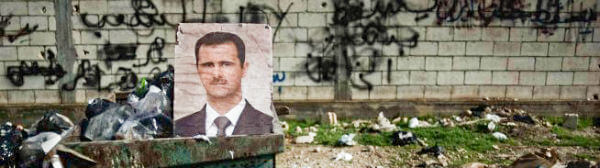
assad-dumped

Kim Ghattas writes: Syria cannot be made to fit a clear pattern of injustice, with an occupier and an occupied, like with Israel and the Palestinians, or an oppressed and an oppressor, like with South Africa’s apartheid. Any meaningful U.S. action in Syria would require more military force, a no-no for the left. And rather inconveniently, Assad belongs to the so-called axis of resistance against Israel that includes Hezbollah — and for which the American left has a tendency to voice support with little questioning, because it has the luxury of geographical distance from the consequences of life under its rule.

American political scientist and Israel critic Norman Finkelstein exemplified that attitude when he visited Lebanon in 2008 to show his support for Hezbollah, which he lauded for its courage and discipline in its 2006 war with Israel. A local interviewer pointed out that the widespread support Hezbollah enjoyed among Lebanese after it forced Israel to withdraw from southern Lebanon in 2000 had dissipated in the wake of the costly 2006 war that had wrecked much of the country’s infrastructure — a war which many Lebanese blamed on Hezbollah. “I am not telling you what to do with your lives, and if you’d rather live crawling on your feet, I could respect that,” Finkelstein replied, evoking Spanish Civil War heroine Dolores Ibárruri, who said “It is better to die on your feet than to live on your knees.”

When the interviewer pressed that support for Hezbollah should be a choice left to the Lebanese who have to live with the consequences of the group’s actions, Finkelstein’s answer was again that it was always better to resist and die with honor, adding dismissively that he doesn’t live in Lebanon, so the internal political divisions were irrelevant to him.

Such thinking is prevalent on the left when it comes to Syria, and its adherents are unwilling to vocalize any criticism of Assad’s use of force, lest it indicate support for removing him from power. Mouaz Moustafa, the executive director of the Syrian Emergency Task Force, which supports the opposition, told me Assad’s positions on the Palestinian cause means that “a large segment of the left has completely ignored Syria, and turned a blind eye to what is going on, or even subscribed to conspiracy theories” that the war was manufactured by the West to weaken Assad.

“They believe that U.S. power and military can never be used for good, and somehow they believe Russia provides a balance in the world, but they don’t realize that the Russians are much more brutal,” he said, a pertinent point as President Vladimir Putin’s influence or interference in this election cycle has become a point of debate.

Mustafa said he believed that Sanders’s silence reflected a lack of understanding of both Syria’s geopolitical complexities and the horror of a war where the overwhelming majority of civilian victims have been killed by government forces. “He should go to the Syrian border in Turkey. He should see for himself what is happening and then see if that shifts his position in the right direction,” Mustafa said. “This is our ‘never again’ moment. He needs to clarify his stance, not just keep repeating: We can’t depose dictators, we can’t use force, we can’t have no-fly zones.”

But if the left opposes military action, what about humanitarian action? Even if the United States does not impose a no-fly zone, it could still ramp up funding for overwhelmed and underfunded U.N. agencies and refugee organizations.

This is where [running mate Tim] Kaine’s views are closer to Clinton’s than even some of her own advisors, and those of President Barack Obama himself. As chairman of the Senate Foreign Relations subcommittee on the Middle East, he traveled to the region often, speaking passionately about the refugee crisis — including in March 2014, when he said that he refused to accept that “there’s nothing more we can do to end the suffering.” He spearheaded an effort to pass a Senate resolution to press the administration to beef up its humanitarian assistance.

There are two key components to Kaine’s thinking on Syria: First, he believes that the United States should push for a humanitarian zone to deliver aid. In November, he said the zone would be “principally a tool for delivering humanitarian aid pursuant to the U.N. Security Council resolution that even Russia voted for. I think, done correctly, it could also accelerate a path to a negotiated end to the Syrian Civil War.” In other words, this creates space to push back against Assad.

Secondly, Kaine believes the challenge of the Islamic State and the issue of Assad are connected, and Washington’s single-minded focus on the jihadi group means its Syria strategy is nonexistent or a mess. “These are two problems that are connected, and you can’t have a strategy that’s just about one,” he told NPR in October. [Continue reading…]

Facebooktwittermail

Watching my beloved Aleppo rip itself apart

Lina Sergie Attar writes: In June 2011, the last time I was in Aleppo, I visited my grandmother’s home every day. I obsessively photographed the apartment where my father grew up and where I spent much of my youth. I snapped shots of her wooden doors and balcony, our family’s antiques arranged in the glass vitrine, her organized kitchen cabinets and my grandfather’s proud portrait in the dining room. I took only a few sentimental pieces with me when I left to go back to my home in America. I wish I had taken everything.

My grandmother’s apartment is on a tiny street tucked between parallel one-way boulevards, one traveling southeast toward the heart of old Aleppo, and the other running northwest to the city’s expansive outlying neighborhoods. This diverse part of the city, in the west, has largely avoided the destruction of the war swirling around it — so far.

Aleppo, where I spent my adolescent years, where I went to college and became an adult before returning to the United States, where I was born, has been split in two since 2012. The west side is in the clutches of the government, and the east is held by rebel forces. Over the last four years, brutal territorial battles tore through the city, dividing neighborhoods that had been interwoven for centuries. Some two million people (including thousands of displaced Syrians) live in relative safety in the west, while over 250,000 live in the east, which has been subjected to years of indiscriminate aerial bombardment by the government’s barrel bombs and, since last year, Russian airstrikes.

Aleppo is the last major city where the rebels control significant territory, and President Bashar al-Assad thinks that capturing it could bring him close to so-called victory. In July, his forces tightened the noose around eastern Aleppo to wage yet another brutal “kneel or starve” campaign. Supplies of food and medicine were choked off; hundreds of civilians died.

At the beginning of August, the power struggle on the ground shifted unexpectedly. Activists set thousands of tires alight, creating huge clouds of black smoke, a weak attempt at a homemade no-fly zone to hide the east side from Russian airplanes. The rebel groups forged a fragile coalition and joined forces with the Levant Conquest Front, an Islamist group that recently was called the Nusra Front and was previously Al Qaeda’s affiliate in Syria. Together, they battled Mr. Assad’s troops and their Hezbollah militia allies. On Aug. 6, they broke the siege. Trucks from nearby Idlib brought the trapped civilians fresh food for the first time in weeks. Meanwhile, Russian jets struck nearby towns with incendiary bombs in retaliation. The bodies of fighters piled up in trucks like dead cattle.

As the battle unfolded, analysts on social media discussed events in real time with a zeal that comes only with detachment. Some said this battle would (again) tip the scales of the war. Others claimed that the rebels’ victory meant the bloody end was (again) near.

A favorite tool of the dispassionate Syria analyst is a map: red and green blobs showing a shifting front line, which streets are held by rebels and which by the government. These wretched maps rudely superimpose their lines over the landmarks of my life: On the east are the people I grew to love through the revolution, men, women and children who defied all odds and stood chanting in the face of one of the most ruthless regimes in history. On the west are my streets, my school, my university, my home.

I study these maps and calculate how far my home sits from the moving front line. As my neighborhood shifts sides from west to east, from red to green, will it be the next target of Mr. Assad’s barrel bombs? Or will it be left to the mercy of the rebels, who promised not to loot or destroy private property or kill civilians? Why should my home be spared when millions of others’ weren’t? This is what it feels like to watch your city rip itself apart: a constant oscillation between guilt and relief, fear and pride. [Continue reading…]

Facebooktwittermail