The Guardian reports: The bombs are falling so fast in Aleppo now that often rescuers don’t have time to reach victims between blasts. If the deadly explosions that struck on just one day last week had been evenly spaced, they would have struck every other minute around the clock.
“Sometimes there are so many airstrikes, we are just waiting and waiting at our headquarters, and the jets don’t leave the skies,” says Abdulrahman Alhassan, a 29-year-old former bank engineer from the city who coordinates “white helmet” rescue teams in the city.
“When at last we can’t see any more, we have to rush to all the sites to rescue people and evacuate them at once,” he said. On Friday, the group counted 900 airstrikes by government forces and their Russian backers, apparently throwing every weapon they have at the already devastated city.
Aid groups and people still inside the city believe the barrage is preparing the way for a blockade. The main supply line north of Aleppo has already been cut, and it will not take long before shortages bite in a ruined, desperate city.
“The Russian airstrikes are trying to completely destroy the area before they get on the ground and start the siege,” said Saad, a 35-year-old aid worker who chose to stay on and is now trapped inside the city. He says the bombing campaign was hitting both morale and food supplies. [Continue reading…]
Category Archives: Lands
ISIS’s dream is Libya’s nightmare — and the world’s too
BuzzFeed reports: A howling wind filled the air with sand, enveloping the small desert outpost. Shivering from the January cold, a skinny, bedraggled man in mismatched desert camouflage fatigues, a scarf wrapped around his face, took a deep breath and stepped forward. He tightened his grip on his AK-47 as the car pulled up to the checkpoint. Without a helmet or bulletproof vest, he warily approached, asking for identification papers, searching for weapons and checking the trunk. This time there was nothing inside, save for some rope and a few empty burlap sacks, likely to be filled with wheat or barley for the drive back. He relaxed, and waited for the next car to arrive.
Just a few years ago, the land around this outpost, 180 miles southeast of the Libyan capital of Tripoli, was a nature reserve where the deposed leader, Muammar al-Qaddafi, and his entourage would come for retreats, hunting for wild game. The spacious villas that housed them are dotted around, now empty, looted for their gaudy fixtures and fittings. Inhabitants of a nearby village have mostly fled. Once a sleepy patch of desert, Abu Grein has now become the front line against the Libyan branch of ISIS, a gathering force now threatening to demolish what’s left of the country.
The men at the checkpoints, ambling back and forth between shipping containers used as makeshift shelters, know that any one of the cars and trucks passing could be loaded to the brim with explosives, or jihadis seeking to kill them.
Mostly the militiamen come from the nearby city-state of Misrata. They knew that if ISIS gets through this front, their families and neighbors back home will be put at risk. From their stronghold in the city of Sirte about 90 minutes up the road, the list of atrocities carried out by ISIS is seemingly endless; they have dispatched suicide bombers, launched attacks on checkpoints, laid booby-trapped bombs, beheaded Christians and others, stormed the most upmarket hotel in the country, hijacked oil tankers and attacked oil facilities, kidnapped civilians, and captured fighters from the collection of dwindling militiamen that guard the front. [Continue reading…]
Another ISIS jailer who held Western hostages identified as British
BuzzFeed reports: A second member of the notorious ISIS execution cell once headed by “Jihadi John” has been unmasked as a “quiet and humble” football fan from west London, BuzzFeed News and the Washington Post can reveal.
Thirty-two-year-old Alexanda Kotey has been identified by British and American intelligence services as one of four ISIS guards, collectively known as the “Beatles”, who are responsible for beheading 27 hostages. The guards were given their nickname by hostages because of their British accents.
It can be revealed that Kotey travelled to the Middle East alongside three other known extremists on a controversial aid convoy to Gaza organised by the London mayoral candidate George Galloway in 2009 – and friends in west London have not heard from him since.
He is the second member of the cell to be identified, after “Jihadi John” was exposed as west Londoner Mohammed Emwazi, who was killed by US a drone strike in November. The other members of the cell, nicknamed “Ringo”, “George”, and “Paul”, remain among the world’s most wanted men and are being hunted by intelligence and security services on both sides of the Atlantic. [Continue reading…]
Meeting ISIS fighters: Its young men were lost souls coerced or duped into service
Sebastian Meyer writes: As a journalist based in northern Iraq for the past six years, I’ve seen the war with the Islamic State closer than I’d like. In the summer of 2014, my best friend, a man I’d come to love and respect during my time reporting here, was taken prisoner by the militants. We were more like brothers than friends, and I haven’t heard from him since.
I was filming about 180 miles away on the evening he disappeared. I drove through the night to join a group of his friends and family in a rescue effort. While the militants stormed west across Iraq, we worked exhaustively to find him. (I can’t say more about him, because doing so could put him in further danger.) We were driven by rage and desperation.
Months later, Diji Terror, a Kurdish counterterrorism unit based in Sulaymaniyah, granted my request to interview an ISIS fighter I’d heard they had captured. Finally, a small chance to press the Islamic State for answers about its tactics. A chance for some catharsis.
Ali was seized during a nighttime raid caught on film: In the footage officials showed me, Diji troops handcuffed, blindfolded and bundled him off on a helicopter. Ali had beheaded prisoners, they told me; I couldn’t help but think of my friend.
When I met him, Ali wore an orange jumpsuit and plastic sandals. [Continue reading…]
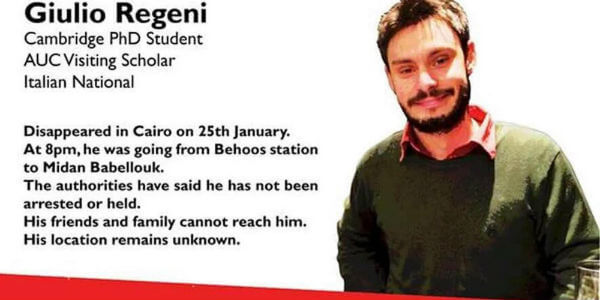
Outrage grows as Italy investigates research student’s murder in Egypt
The New York Times reports: The furor surrounding the death of an Italian student whose body was discovered Wednesday on an Egyptian roadside grew Friday as Italian investigators flew to Cairo to help find his killers, and it emerged that the young man had secretly written from Egypt for a left-wing Italian newspaper.
The newspaper, Il Manifesto, published an article on Friday that the Italian student, Giulio Regeni, 28, had written under a pseudonym weeks before he was found dead that was sharply critical of the Egyptian president, Abdel Fattah el-Sisi, while describing faltering attempts by Egyptian unions to organize.
There was no indication that Mr. Regeni’s writing led to his death, but the article contributed to the broader Italian outrage over Mr. Regeni’s injuries as news outlets pointed an accusatory finger at the Egyptian security forces. Egyptian officials said on Thursday that Mr. Regeni had been tortured extensively and probably died from a brain hemorrhage.
“Giulio, Egyptian police under accusation,” read the headline of La Stampa, a Turin-based daily newspaper.
Hoping to defuse a potentially damaging crisis with a relatively close European ally, Egyptian officials promised cooperation and vowed to find Mr. Regeni’s killers. The Italian prime minister, Matteo Renzi, spoke with Mr. Sisi by telephone and both agreed to cooperate to “unravel the mystery,” Mr. Sisi’s office said in a statement. [Continue reading…]
Russian bombing triggers civilian exodus from Aleppo
BBC News reports: Tens of thousands of Syrian refugees are moving to Turkey’s border to flee heavy fighting near the city of Aleppo, officials and activists have said.
Turkish Prime Minister Ahmet Davutoglu said up to 70,000 might be heading to the border, while a monitoring group put the number at about 40,000.
Intense Russian air strikes have helped Syria’s government troops make advances near the country’s largest city.
Meanwhile, Russia accused Turkey of preparing an invasion into Syria.
Also on Thursday, a Saudi military spokesman said the country was ready to send ground troops to Syria to fight the so-called Islamic State group. [Continue reading…]
The Independent reports: Forces loyal to Bashar al-Assad claimed to have severed the last rebel supply line to Aleppo last night in what would be a devastating blow to the Syrian opposition.
The attack, backed by Russian warplanes, was condemned by France for “torpedoing” tentative peace talks in Geneva, while the US said it was “difficult” to see how the air strikes, which the State Department said were mostly on civilian targets, would help resolve the conflict.
Pro-government media said that forces from the Syrian army and the Lebanese militia Hezbollah had reached two Shia towns north of the city that had been besieged by rebel insurgents. They claimed to have captured part of the only road that runs from Turkey to the rebel-held half of Aleppo, cutting its only supply route.
With pro-government forces close to surrounding Syria’s second city, the United Nations under-secretary general for humanitarian affairs, Stephen O’Brien, spoke yesterday of grave consequences for its beleaguered population if Aleppo was besieged by regime forces.
“What is happening in Syria is bad enough without something like that happening in Aleppo. But if the situation there gets worse we will have a large population at risk and we would need to get immediate access for road convoys to provide the necessary humanitarian assistance” he told The Independent. Aid groups also warned that a huge humanitarian crisis was looming, while people in the area were stockpiling food and supplies in anticipation of a siege. [Continue reading…]
The Guardian reports: The Russian defence ministry said on Thursday it had hit almost 900 targets in Syria in the previous three days. While Moscow’s intervention has the declared aim of battling the Islamic State terror group, military observers claim at least 70% of airstrikes have targeted opposition groups fighting to oust Assad. [Continue reading…]
As long as the linkage between authoritarian regimes and extremism is ignored, ISIS and al Qaeda will never be defeated
Joyce Karam writes: “What are you talking about, 7000…No,no. We killed 38,000”, those were the words of former Syrian General Rifaat Assad in1982 as recounted by Thomas Friedman in his book “From Beirut to Jerusalem”. Rifaat, who is now in exile, was exulting about the number of Syrians his forces killed in Hama 34 years ago, quashing a rebellion against his brother’s dictatorship and setting the stage to what has followed.
The ghosts of Hama today hover all over Syria, cementing the pillars of the Assad doctrine to rule by fear and hold on to power at any cost even if it means surrendering the country to devastation, radicalization and ultimate death. From father to uncle to son, the Assad playbook has not changed, copying the narrative of Hama to Homs, Douma, Ghouta, Idlib, Daraa and Aleppo, and in the process leaving behind more than 250 thousands dead, millions displaced, and a society in shambles.
The 3-week assault on Hama in 1982 has laid the ground for how the Assad regime reacts to any signs of rebellion later. Not coincidentally, the same horror tactics utilized in Hama in 1982 with Assad the father were replicated by the son across Syria following the 2011 uprising.
In a chilling report by Amnesty International in 2012, survivors of the Hama massacre give their account of what happened, describing images of the dead splintered in the streets, left to be eaten by dogs and as a red flag for those whose lives were spared. Snipers were on the roofs, neighborhoods were razed and one survivor recalls the the attack on Mas’oud Mosque, where “some 60 men were killed before the security forces cut off their fingers and placed them along the mosque’s walls.” She tells Amnesty “for around two years after the massacre, no one dared remove the fingers. They were so frightened.” [Continue reading…]
The worst is yet to come for Syria’s largest city, Aleppo
BuzzFeed reports: With the government of Syrian President Bashar al-Assad moving closer to encircling the rebel-held parts of the city — the most important patch of territory the opposition holds — rebels and analysts expect it to turn to the brutal tactics it has employed throughout the war. As in the past, the primary victims will be civilians.
Sending troops into rebel-held Aleppo would be a costly move for the Syrian military and its allies, said Firas Abi Ali, the head of Middle East and North Africa forecasting at IHS Country Risk in London. Instead, they are likely to attempt to starve out the rebels and civilians inside while using artillery and airstrikes to bring them to their knees. “They’re not going to dedicate the amount of resources required to capture a city of that magnitude. They’re going to go with starvation and bombardment tactics,” he said. “This is the standard military tactic developed by Assad.”
The government has spent years pounding Aleppo with airstrikes, raining chaos down on civilians. It also has notoriously employed a siege strategy in places like Madaya, near Damascus, and the central city of Homs, where starving rebels and civilians eventually agreed to surrender. Yet the potential for civilian suffering in Aleppo is far larger now. “There are still several hundred thousand people in the city and the province. The scale of the suffering here can be much greater,” Abi Ali said. “Assad can do much more damage, and he is willing to inflict enormous pain.”
Rami Jarrah, a Syrian journalist and activist who has worked extensively in Aleppo, said the government plan seemed to be “to promote as much desertion of the city as possible now in build up to performing a total siege of Aleppo. Sieges have proven to be successful in terms of draining the opposition into submission.” [Continue reading…]
The military and political significance of Aleppo
Faysal Itani and Hossam Abouzahr write: Retaking Aleppo city would be a substantial win for the regime. Militarily, it would cut off opposition forces south of the city. It would also allow the regime to further isolate opposition forces in nearby Idlib and Hama. Rebel forces in northwestern Syria receive supplies from Turkey through two border crossings: Bab al-Salama in Aleppo province and Bab al-Hawa in Idlib province. If the regime takes Aleppo city, it could then target supply lines between Idlib- and Hama-based insurgents and Turkey. The regime may opt not to take Aleppo now, however, preferring to bomb and besiege it instead. That would simply freeze the Aleppo city frontlines and allow Assad and his allies to deploy fighters and resources elsewhere, including in Idlib and Hama. Regardless, the regime’s strategy will be isolating the opposition into manageable pockets and dealing with each individually.
Crucially, progress in Aleppo will free up resources against the Islamic State (ISIS). It is true that Assad and his allies have always prioritized fighting the insurgency over ISIS. The changing international environment, however, allows for a more sophisticated regime strategy. Despite frequent accusations, the regime and ISIS are not really allies. The regime simply sees the entire conflict through the prism of ensuring its own survival by any means necessary. Throughout the war, this has meant ignoring ISIS or facilitating its war against the rebels. Now, however, the regime would benefit enormously at the international level by clearing the Aleppo area of insurgents and ISIS alike (or following the Aleppo victory with some anti-ISIS wins elsewhere, such as Palmyra). That would demonstrate to the world that it must choose between Assad and ISIS, and that ISIS and the various insurgent groups are one and the same enemy. Considering the West’s singular focus on ISIS and tolerance of the regime, this would actually be a sound strategy. [Continue reading…]
The Syrian regime is close to a victory that could turn the war
Vice News reports: Rebels north of Aleppo had already been stretched thin, attempting to balance fronts against the regime, the Islamic State, and the Kurdish People’s Protection Units (YPG) and their allies. The latest push by the regime of Bashar al-Assad – and, in particular, relentless Russian bombing from the air – proved too much to handle.
“The regime is relying primarily on the Russian air force. Its jets are in the air constantly,” said Col. Ahmed Uthman, military commander of local rebel faction Firqat al-Sultan Murad.
Locals described the nonstop aerial bombing and the shelling of the area as “scorched earth” tactics.
“There’s no parity between these Russian jets and rebel forces,” said Firas Pasa, commander of Aleppo brigade Liwa al-Mu’tasem Billah. “We need anti-aircraft weapons as soon as possible.”
In addition to Russian airpower, the regime’s Syrian Arab Army is also backed by various paramilitary forces, including Iraqi Shi’ite units. “We’re no longer facing Bashar’s army, the army of Abu Flip-flops,” said a media official with a rebel brigade in the north who requested anonymity, using a derisive nickname for the regime’s exhausted military. [Continue reading…]
Syrian refugees in Jordan: ‘If they cut the coupons, we will probably die’
The Guardian reports: Just look at how we’re living,” says Umm Majd, a Syrian who fled to Jordan. She stands in a tiny single-room apartment in Amman, the capital. It lies deep underground, next to a subterranean car park, and measures just two metres by two and a half. It is here that she, her husband and their two sons live out their exile.
“Just look,” says Umm Majd, gesturing at the room. “That’s enough to understand what’s happening to Syrians here in Jordan.”
There are between 630,000 and 1.27 million Syrian refugees in the country, depending on whose estimate you believe. Like most of them, Umm Majd’s husband does not have the right to work – so he works illegally as a carwasher for 100 Jordanian dinars a month (about £100, half the minimum wage). The family collectively receives 40 dinars in food coupons from the UN – down from 80 a year ago. Their rent is 50 dinars, leaving them just 90 each month for any other living expenses.
“Right now we’re not thinking of going to Europe,” says Umm Majd’s husband. “But if they cut our funding again then we’ll have to. If they cut the coupons we’d probably die.” [Continue reading…]
U.S. confirms involvement in Syria airfield expansion
VOA reports: At the urging of an American contingent, Syrian Kurds are expanding an airbase on farmland in northeast Syria that could be used for military purposes, according to Kurdish and U.S. officials.
Known as Abu Hajar airport, the airbase is located in the Rmelan area of northern Syria, and is controlled by the Kurdish People’s Defense Units and the Syrian Democratic Forces. Neither has an air force.
A team of Americans pitched the idea to Syrian Democratic Forces to extend the runway, a defense official told VOA on the condition of anonymity.
The official Wednesday said the airfield is being extended from 700 meters to 1,300 meters.
The extension would be long enough to allow C-130 transport planes to land on the strip and potentially supply those fighting Islamic State forces in the area. [Continue reading…]
U.S. struggling to build anti-ISIS strategy in Libya
The Associated Press reports: The Obama administration is struggling to find the right mix of military and diplomatic moves to stop the Islamic State in Libya, where the extremist group has taken advantage of the political chaos in the country to gain a foothold with worrying implications for the U.S. and Europe — particularly Italy, just 300 miles away.
U.S. officials have publicly warned of the risks of Libya becoming the next Syria, where the Islamic State flourished amid civil war and spread into Iraq.
No large-scale U.S. military action is contemplated in Libya, senior administration officials said, but Obama last week directed his national security team to bolster counterterrorism efforts there while also pursuing diplomatic possibilities for solving Libya’s political crisis and forming a government of national unity. While the Islamic State has emerged in other places, including Afghanistan, Libya is seen as its key focus outside of Syria and Iraq. [Continue reading…]
Turkey’s academics pay heavy price for resisting Erdoğan’s militarised politics
By Celal Cahit Agar, University of Exeter and Steffen Böhm, University of Exeter
While the EU and the US have turned a blind eye to the Turkish government’s brutal clampdown in Kurdish regions, Turkish academics who have spoken out about the regime’s increasingly dictatorial policies have faced punishment and even imprisonment.
A petition published in early January by the Academicians for Peace initiative, criticising the Turkish state’s political and military attacks against the Kurdish people, raised a red flag with its signatories stating: “We will not be a party to this crime.” They wrote:
The Turkish state has effectively condemned its citizens in Sur, Silvan, Nusaybin, Cizre, Silopi, and many other towns and neighborhoods in the Kurdish provinces to hunger through its use of curfews that have been ongoing for weeks. It has attacked these settlements with heavy weapons and equipment that would only be mobilized in wartime. As a result, the right to life, liberty, and security, and in particular the prohibition of torture and ill-treatment protected by the constitution and international conventions have been violated.
In response, Turkish president Recep Tayyip Erdoğan immediately demanded that all institutions in Turkey take action: “Everyone who benefits from this state but is now an enemy of the state must be punished without further delay.”
The murder of my friend Giulio Regeni is an attack on academic freedom
By Neil Pyper, Coventry University
The body of Giulio Regeni was discovered in a ditch in Cairo on February 2, showing evidence of torture, and a slow and horrific death. Giulio was studying for a PhD at the University of Cambridge, and was carrying out research on the formation of independent trade unions in post-Mubarak Egypt. There is little doubt that his work would have been extremely important in his field, and he had a career ahead of him as an important scholar of the region.
Giulio, originally from Fiumicello in north-east Italy, had a strong international background and outlook. As a teenager, he won a scholarship that allowed him to spend two formative years studying at the United World College in New Mexico. He was especially passionate about Egypt. Before beginning his doctoral research, he spent time in Cairo working for the United Nations Industrial Development Organisation (UNIDO). At the age of 28, he stood out with his big hopes and dreams, and he was committed to pursuing a career that would allow him to make an impact on the world, which is a poorer place for his passing.
Those of us who worked and spent time with him are grieving – but above all, we are furious about the manner of his death. While murder and torture are inherently of concern, Giulio’s case also has much broader implications for higher education in the UK and beyond.
Giulio Regeni’s last article on unions in Egypt, written shortly before his abduction, torture, and murder

il manifesto editors’ note: We publish posthumously this article by Giulio Regeni, an il manifesto contributor who was based in Cairo while researching his doctoral thesis. On Wednesday, his tortured body was discovered in a ditch in the city. Because independent trade unions are a contentious topic in Egypt, Regeni asked us to publish this article under a pseudonym, as we have done in the past. Today, we publish this last dispatch under the author’s real name.
Giulio Regeni wrote: President Abdel Fattah al-Sisi presides over Egyptian Parliament with the highest number of police and military personnel in the history of the country, and Egypt ranks among the worst offenders with respect to press freedom. Yet independent trade unions are refusing to give up. The Center for Trade Union and Workers’ Services (CTUWS), a beacon of independent Egyptian trade unionism, has just held a vibrant meeting.
Although the largest room at the center has 100 seats, the meeting hall could not contain the number of activists who came from all over Egypt for an assembly that was extraordinary in the current context of the country. On the agenda was a recommendation from Sisi’s ministers for close cooperation between the government and the country’s only official union, the Egyptian Trade Union Federation, with the explicit order to counter the role of independent trade unions and to further marginalize workers. [Continue reading…]
The world’s most cutting-edge renewable tech is powering rural Africa
Quartz reports: Distributed power — where electricity is generated locally, instead of delivered via complex grid infrastructure — makes lots of sense for Africa. About 600 million Africans don’t have electricity. But sunlight is a widely available resource across most of the continent, making distributed solar power one of the more sensible options for electrification.
Plenty of companies see the potential. This has made parts of Africa a testing ground for cutting-edge solar power. Some countries are developing a whole new type of infrastructure not seen elsewhere in the world: mobile-phone-led, flexible, and controlled by the user rather than big utilities and government.
“We are now seeing the first innovation where the leading technologies are actually being deployed in Africa, not being deployed in the mainstream West,” said Simon Bransfield-Garth, CEO of Azuri Technologies. Azuri is based in Cambridge, UK, and installs rent-to-buy solar systems for homes in Tanzania and several other sub-Saharan states. Power from the panels are paid for by mobile phone or scratchcard. The payments also serve as installments towards owning the system outright. After about 18 months the homeowner has typically paid off the cost of the panels, or can buy them for a very small sum (say, $5). [Continue reading…]
Diplomats say the U.S. has handed over Syria to the Russians for free

Following the suspension of UN-led peace talks, Lina Sinjab reports: Teams of diplomats representing countries supporting the opposition are pushing behind the scenes in Geneva for concessions from all parties involved in the war.
But almost everyone, whether diplomats or the opposition, says it is the US which is key to success – by using its leverage on Russia.
Russia is the only world power involved in the Syrian conflict with a military base in the country – therefore it could bring exert significant pressure on the regime of Bashar al-Assad to stop the violence.
But there is a limit to what the US is prepared to do.
A senior US Department of State official told me: “We are not ready to go to World War Three to solve this.”
The US, however, is spending billions of dollars in the battle against the self-proclaimed Islamic State (IS), which controls large parts of Syria.
Many Syrians feel the selective involvement of the US is hypocritical.
The US official was adamant that Secretary of State John Kerry wants to end the violence, and is determined to succeed.
But everyone here thinks the opposite. Almost at every corner, you hear the same thought: The US has handed over Syria to the Russians for free. [Continue reading…]