Lila MacLellan writes: In New York or L.A., it’s pretty common to learn that a yoga teacher used to be a dancer, an actor, or even a former Wall Street banker. In Bogota and Medellin, the same is true. Except that here, the teacher may also be an ex-member of a Colombian death squad.
Since 2010, a local organization called Dunna: Alternativas Creativas Para la Paz (Dunna: Creative Alternatives for Peace) has been gradually introducing the basic poses to two groups for whom yoga has been a foreign concept: the poor, mostly rural victims of Colombia’s brutal, half-century conflict, and the guerilla fighters who once terrorized them.
Hundreds of ex-militants have already taken the offered yoga courses. A dozen now plan to teach yoga to others.
To stay calm, yoga-teacher-in-training Edifrando Valderrama Holguin turns off the television whenever he sees news broadcasts about young people being recruited into terror groups like ISIL. Valderrama was 12 when he was recruited into the Revolutionary Armed Forces of Colombia (FARC). He was given a gun, basic training and a heavy dose of leftist ideology. “In the mountains, if I saw someone who was not part of our group, I had to kill him,” he says. “If I had questioned the ideology of the FARC, they would have called me an infiltrator and killed me.”
Now 28, Valderrama lives in the city of Medellin. He works afternoon shifts for a supplier to one of Colombia’s major meat companies, and practices yoga at home in the mornings. Until the program stopped last year, he attended Dunna’s yoga classes, rolling out his mat with former members of both the FARC and Autodefensas Unidas de Colombia (AUC) — a paramilitary army he once fought against. Although initially surprised that he could feel so much peace lying in corpse pose, Valderrama now hopes to become a yoga teacher, so that he can introduce the healing asanas to ex-militants in Colombia, or even overseas.
Samuel Urueña Lievano, 46, was raped and then recruited into the rival AUC by a relative when he was 15. “They used my anger and hatred to get me to join. I have so much remorse for the things I did during that period,” he tells me as he begins to cry.
Urueña, now a law student in Bogota, takes medications to manage his anxiety and still has nightmares. He calls yoga his closest friend. Practicing the poses every day for two hours has made it possible for him to handle occasional feelings of panic, impatience and frustration, he says. “It has helped me identify who I am. It has given me myself back.” [Continue reading…]
Category Archives: Lands
ISIS still on the attack, despite internal strife and heavy losses
The New York Times reports: The Islamic State is facing growing dissension among its rank-and-file fighters and struggling to govern towns and villages it has seized, but the militant Sunni group is still managing to launch attacks and expand its ideological reach outside of Iraq and Syria, senior American officials said.
In the seven months since allied warplanes in the American-led air campaign began bombing select Islamic State targets, the Sunni militancy, while marginally weaker, is holding its own, senior defense and intelligence officials said.
Pentagon officials expressed only cautious optimism on Thursday after the Islamic State lost much of the central Iraqi city of Tikrit following more than a week of fierce fighting, warning that it would be as difficult for Iraqi forces to hold the city as it was to liberate it. And even as the militants had a last stand in Tikrit, Islamic State fighters were mounting one of the fiercest assaults in months in the city of Ramadi, west of Baghdad.
But in recent months tensions have become apparent inside the Islamic State, also known as ISIS, ISIL and Daesh. The troubles stem from new military and financial pressures and from the growing pains of a largely decentralized organization trying to hold together what it views as a nascent state while integrating thousands of foreign fighters with Iraqi and Syrian militants. [Continue reading…]
In Iraq, whatever the officials say, the U.S. is providing air support for Iran
Nancy A. Youssef writes: Forces loyal to Iran are threatening to break ISIS’s grip on the key Iraqi city of Tikrit. Officially, the American military isn’t helping these Shiite militias and Iranian advisers as they team up with Iraqi forces to hit the self-proclaimed Islamic State. But U.S. officials admit that American airstrikes are a major reason Iran’s proxies are advancing on Tikrit, Saddam Hussein’s hometown.
The U.S.-led air campaign has not only crippled ISIS’s ability to move freely. It’s also providing air cover for Iraqi troops and the Iranian forces fighting alongside of them. It is a perilous, yet unspoken, military alliance between the U.S. and its top regional foe that some said could lead to an ISIS defeat in the short term and ethnic cleansing of Sunni Iraqis in the long run.
“Like it or not, right now [the U.S. and Iran] are on the same side,” said Vali Nasr, dean of Johns Hopkins School of Advanced International Studies and longtime Iranian expert.
U.S. officials have repeatedly stated their concerns about the sectarianism that could emerge even as the strategy now decisively helps one side, the Shiite, in the push to defeat ISIS.
But two U.S. officials concede that the effect of the airstrikes helps Shiite forces — while swearing that there is no strategy to help Iran. Rather, as one explained, “the goal is to provide Iraqi forces the operational space to take back territory.” [Continue reading…]
Iran’s expanding influence in Iraq
Joyce Karam writes: While the invasion in 2003 and the shortsighted policies by the U.S. disbanding the Iraqi army and propping up the sectarian rule of Nouri al-Maliki, opened the door for Iranian meddling and militia-building in Iraq, ISIS has invited a more aggressive role for Iran along the Euphrates.
“Iran has taken full advantage of the collapse of the Iraqi army in Mosul” says Phillip Smyth, a researcher at the University of Maryland and author of a policy paper on Shiite Jihad. The rise of ISIS as an existential threat to Shiites whom it considers heretics and apostates, drove many in that community to carry arms and defend themselves while the Iraqi state continued to crumble. Grand Ayatollah Ali Sistani’s Fatwa last summer “to defend the country, its people, the honor of its citizens, and its sacred places” was exploited to set the stage for the formation of the Popular Mobilization Forces, made up of disciplined Shiite recruits and a much smaller component of Sunni tribal and Kurdish forces.
Smyth sees Iranian influence in funding, training and equipping Shiite militias at an all time high. He estimates the number of Shiite militia fighters in Iraq today between 70,000 [to] 100,000, a volume that “is both astounding and strategic to the way that Iran has constructed them.” The expert sees Iran as player whose influence is only rising in Iraq, “they run ministries in Iraq today with their own security apparatus.” This new dynamic was front and center in appointing Mohammad Ghabban from the Iranian funded militia Badr as the new Iraqi interior minister. [Continue reading…]
The smugglers who take foreign would-be ISIS jihadis into Syria
The Guardian reports: On small dirt tracks, several minibuses and cars are waiting, each of them going to different points on the border, but all accessing Isis-controlled territory. Little by little, the minibus empties, and when it arrives in a nearby border town, which the Guardian is not naming to protect those quoted in this piece, only two passengers are left.
At the bus station, two teenage boys immediately approach, offering to take the remaining two passengers to the wire.
“Only 10 [Turkish] lira [£2.60],” offers Ahmed*, a boy in ill-fitting, mud-stained trousers, his bare feet barely filling his worn-out shoes.
Syrian smugglers such as Ali and his friend Ahmed take both goods and people across into Isis territory. They witness horror, routinely, and shrug it off.
“Just yesterday Isis beheaded three FSA [Free Syrian Army] fighters,” Ahmed says, laughing. He drops to his knees and bows his head, re-enacting the scene he says he witnessed, making a gesture imitating a sword coming down on his neck with one hand. “They chopped their heads off like this!”
Another Syrian Turkomen who had just crossed back into Turkey nods. “We saw a crucified man on the way to the border. You have no idea what we see in Syria every day now. Our lives are like a horror movie.”
Ali says he has helped to carry the luggage of countless foreigners crossing the border to reach the self-declared Islamic State. “There were French men who took their entire families with them to Syria,” he recalls. “Once I carried a bag full of dollar notes across. The guy I helped was going to give it to Isis.”
Hundreds of foreigners are believed to have used crossing points like this, though the most high-profile recent cases – the three British schoolgirls who absconded to Syria last month – are thought to have crossed farther east.
Business is thriving, the smugglers say. “We carry weapons and ammunition across as well,” says Ali. “The drivers [of the minibuses] get 500 lira per bag.”
Neither of them are Isis supporters. “No, I don’t like them. But what can I do?” asks Ahmed, grinning. “It’s a job, and I need the money.” [Continue reading…]
America needs its Latinos
The Economist:A satirical film in 2004, called “A Day Without a Mexican”, imagined Californians running scared after their cooks, nannies and gardeners had vanished. Set it in today’s America and it would be a more sobering drama. If 57m Hispanics were to disappear, public-school playgrounds would lose one child in four and employers from Alaska to Alabama would struggle to stay open. Imagine the scene by mid-century, when the Latino population is set to have doubled again.
Listen to some, and foreign scroungers threaten America, a soft-hearted country with a wide-open border. For almost two centuries after America was founded, more than 80% of its citizens were whites of European descent. Today, non-Hispanic whites have dropped below two-thirds of the population. They are on course to become a minority by 2044. At a recent gathering of Republicans with presidential ambitions, a former governor of Arkansas, Mike Huckabee, growled about “illegal people” rushing in “because they’ve heard that there is a bowl of food just across the border.”
Politicians are right that a demographic revolution is under way. But, as our special report this week shows, their panic about immigration and the national interest is misguided. America needs its Latinos. To prosper, it must not exclude them, but help them realise their potential.
Those who whip up border fever are wrong on the facts. The southern frontier has never been harder to cross. Recent Hispanic population growth has mostly been driven by births, not fresh immigration. Even if the borders could somehow be sealed and every unauthorised migrant deported — which would be cruel and impossible — some 48m legally resident Hispanics would remain. Latino growth will not be stopped.
They are also wrong about demography. From Europe to north-east Asia, the 21st century risks being an age of old people, slow growth and sour, timid politics. Swelling armies of the elderly will fight to defend their pensions and other public services. Between now and mid-century, Germany’s median age will rise to 52. China’s population growth will flatten and then fall; its labour force is already shrinking. Not America’s. By 2050 its median age will be a sprightly 41 and its population will still be growing. Latinos will be a big part of that story. [Continue reading…]
U.S.-trained Iraqi forces investigated for war crimes
ABC News reports: U.S.-trained and armed Iraqi military units, the key to the American strategy against ISIS, are under investigation for committing some of the same atrocities as the terror group, American and Iraqi officials told ABC News. Some Iraqi units have already been cut off from U.S. assistance over “credible” human rights violations, according to a senior military official on the Pentagon’s Joint Staff.
The investigation, being conducted by the Iraqi government, was launched after officials were confronted with numerous allegations of “war crimes,” based in part on dozens of ghastly videos and still photos that appear to show uniformed soldiers from some of Iraq’s most elite units and militia members massacring civilians, torturing and executing prisoners, and displaying severed heads.
The videos and photos are part of a trove of disturbing images that ABC News discovered has been circulating within the dark corners of Iraqi social media since last summer. In some U.S. military and Iraqi circles, the Iraqi units and militias under scrutiny are referred to as the “dirty brigades.”
“As the ISF [Iraqi Security Forces] and militias reclaim territory, their behavior must be above reproach or they risk being painted with the same brush as ISIL [ISIS] fighters,” said a statement to ABC News from the U.S. government. “If these allegations are confirmed, those found responsible must be held accountable.” [Continue reading…]
IRGC official: Iran indoctrinating Syria youth
NOW reports: A top Iranian Revolutionary Guards officer boasted about Tehran’s role in Syria and revealed that his country has been indoctrinating youths in the war-torn country to fight under the IRGC.
“The IRGC has begun to establish new religious groups in Syria called ‘Kashab’ among young Alawites, Sunnis, Christians and Ismailis,” Al-Arabiya on Tuesday cited Hussein Hamdani as saying.
These groups aim to carry out what Hamdani called “ideological education” for the “recruitment of teenagers in Syria to fight in militias under [the command] of the IRGC.”
The advisor to the Revolutionary Guards commander-general did not elaborate further on the youth groups, but did boast that Iran had formed 42 brigades and 138 battalions fighting for the Bashar al-Assad regime in Syria.
Hamdani added that the “establishment of the Basij in Syria was one of Iran’s most important achievements in recent years.” [Continue reading…]
Syrians describe the impact of four years of war
Faris Shihab, 35, former Free Syrian Army officer, now in Turkey, tells The Guardian: I was an officer in a huge FSA brigade in Damascus. I fought in the Mouadamiya district of west Ghouta for a year with more than 3,500 armed fighters. We were only three kilometres away from the presidential palace in July 2012. The regime was on the verge of collapse.
But when the planes struck the centre of Damascus, we had to flee to Daraya, south-west of the capital, where we hid among the groves, laboriously digging trenches, waiting for the soldiers to advance forward.
My friend Ahmed Nadeem was with me in the trench when he got a bullet in his head from a sniper. He died in my arms, aged 22 years old. For nine hours, I was in the trench with his body during airstrikes and tank shelling. I kept looking at him while he was dead: the same guy who had been sharing food with me a few minutes earlier. We had been together since first demo in Damascus. The last words he said to me were: “Please remember me as a Syrian man who died for his country.” Only after midnight, when the shelling eased, could we bury him near an olive tree.
Later, the Syrian people began to turn against the FSA. When Isis began decapitations, people started to curse those who had revolted against the regime. They thought we were the reason that these radical fighters had come to our country. But we wanted to freedom, not Isis.
Some people now think that life was better before the revolution – but these are people who did not lose a sibling, or whose car was not blown up, or whose house was not levelled. When my relatives and friends sit together or watch the news, they say: “What a pity, we were really having a great life. It is true that we did not have dignity but we had enough food.”
Now, should I keep the revolution going for the sake of the martyrs and allow more people to die from starvation under the regime’s bombing? Should I compound the number of the dead? Or conciliate with the regime in hope that one day a child among these people will lead another Syrian revolution, because our revolution is cursed by God. [Continue reading…]
Why a ‘bad’ deal with Iran is better than no deal at all
Jeffrey Lewis writes: I am old enough to remember when, back in 2006, I argued that the United States should let Iran keep 164 centrifuges in standby mode during talks. Do you know what people said? “164 centrifuges? Are you mad? You are giving away the store to the Iranians!” Well, now Iran has more than 15,000 centrifuges (that we know about) in at least two sites.
One of the most frustrating things about following the past decade of negotiations is watching the West make one concession after another — but only after the Iranians had moved so far forward that the concession had no value. The people arguing now for a “better” deal at some later date are the same people who in 2006 said 164 centrifuges was way too many and, that if we just held out long enough, we’d haggle the Iranians down to zero. Look what that got us.
This is a fantasy, a unicorn, the futile pursuit of which ends with a half-assed airstrike against Iran, a region in flames, and eventually an Iranian nuclear weapon. And let’s be clear: If negotiations collapse, the United States will take the blame from Europe and the sanctions regime will unravel. And here’s the best-case scenario:
Any military action against Iran will set its nuclear program back, at best, a couple of years. But the anger will last generations. [Continue reading…]
Saudi Arabia: Three more executions add to unprecedented spike in death penalty
Amnesty: Saudi Arabia is well on track to far surpass its previous annual execution records, Amnesty International warned after three more men were put to death this morning, bringing the total number of executions in the country to 44 so far this year.
That is fully four times the number of people executed in the Gulf Kingdom during the same period last year – 11. Public beheading is the most common method of execution.
“This unprecedented spike in executions constitutes a chilling race to the bottom for a country that is already among the most prolific executioners on the planet,” said Said Boumedouha, Deputy Director of Amnesty International’s Middle East and North Africa Programme.
“If this alarming execution rate continues, Saudi Arabia is well on track to surpass its previous records, putting it out of step with the vast majority of countries around the world that have now rejected the death penalty in law or practice.”
The three men executed this morning include a Saudi Arabian, a Yemeni and a Syrian national, all for drug-related offences.
“The fact that around half of the executions carried out so far this year were for drug-related offences contradicts the Saudi Arabian authorities’ claims at the United Nations Human Rights Council that the death penalty is imposed for only the most serious crimes and because it is sanctioned by Shari’a law. In the case of drug-related offences, both of these claims are far from the truth,” said Said Boumedouha. [Continue reading…]
B’Tselem’s battle to be Israel’s conscience
Eve Fairbanks writes: On 15 August last year, five weeks into the war between Israel and Hamas in Gaza, Hagai El-Ad, the director of B’Tselem, an Israeli human rights organisation, appeared on a morning radio show to discuss the conflict. Throughout the fighting, B’Tselem did what it has done for 25 years since it was founded during the first Palestinian intifada: document human rights violations by Israel in the West Bank and Gaza. It compiled film and testimony gathered by volunteer field researchers on the ground, tallied daily casualty figures that were used by the local and international press, and released names of individual Palestinians killed by the Israel Defence Forces (IDF).
B’Tselem’s founders intended it to serve a purpose unlike any other organisation in Israel’s fractious political atmosphere: to provide pure information about the Israeli military’s treatment of Palestinians, without commentary or political agenda. But by last summer, this stance had become a source of controversy. For many Israelis, identifying human-rights violations by the Israeli military, but not its enemies, was tantamount to treason. When B’Tselem tried to run radio ads listing the names and ages of 20 Palestinian children killed in Gaza, Israel’s national broadcasting authority banned them on the grounds that they constituted a political message masquerading as neutral information. A group called Mothers of Soldiers Against B’Tselem was formed; Avigdor Lieberman, Israel’s foreign minister, endorsed one of their protests.
That morning on the radio, the host, a journalist named Sharon Gal, pressed El-Ad over and over to agree that he believed Hamas is a “terrorist organisation”. El-Ad reminded Gal that B’Tselem, by its very core principles, declined to make that kind of characterisation because it believed doing so would be a political act. “We’re talking about armed Palestinian organisations; that is the professional term, and we criticise their activities when they are illegal,” he said. Gal responded that Israel was locked in a battle for its survival; at such a moment, he argued, refusing to call Hamas a terrorist group was a political – and disloyal – act. Newspaper columnists were still talking about it a month later. “Hagai El-Ad has essentially become a Hamas apologist,” one declared.
Three and a half months after the end of the Gaza war, in early December, I met El-Ad at Talbia, a wine bar beneath the Jerusalem Theatre. Forty-five years old, he looks barely over 30. He has a soft, almost hushed voice, glasses that press down on the tops of his ears, making them flop over like wings, and a frequent, mirthful smile. “Don’t sneeze,” he laughed, as a waitress propped a cork under a wobbly leg of our table, creating a fragile balance. El-Ad arrived at B’Tselem last May after spells as the director of Jerusalem Open House, Jerusalem’s premier gay-advocacy group, and the Association for Civil Rights in Israel.
B’Tselem, in Hebrew, means “in His image,” from the line in the Book of Genesis: “And God made man in His image.” El-Ad possesses a fierce belief in Israelis’ ability – and duty – to live up to their human godliness by being just and manifesting an expansive empathy. “I self-identify as a Jew who cares deeply about the Jewish future and the Jewish identity,” he told me. “To be Jewish is to treat people with dignity.” He grew up in Haifa, on the Israeli coast, and takes as the basis for his personal creed an anecdote from a visit Golda Meir paid to the city during the 1948 Israeli war for independence, when she noted that scenes of Palestinians fleeing their homes reminded her of images of Jews fleeing Poland before the second world war. “If Golda Meir could notice the similarities,” he said, smiling, “then anybody can recognise Palestinians as human beings who ought to be treated with equal rights.” [Continue reading…]
Second ex-Mossad chief joins chorus criticizing Netanyahu
Times of Israel: In a widening offensive against the six-year rule of Benjamin Netanyahu, a group of former security commanders criticized the prime minister Wednesday for allegedly ruining ties with the US, mishandling the summer’s war against Hamas, and bungling the country’s approach to the international negotiations with Iran over its nuclear program.
“You and only you turned the United States from an ally to an enemy,” former Mossad head Shabtai Shavit said of Netanyahu at a Tel Aviv press conference organized by Commanders for Israel’s Security, a group of former officers campaigning against the prime minister.
Shavit was the second former Mossad chief to express strong opposition to Netanyahu’s policies in recent days, coming close on the heels of Meir Dagan’s scathing media campaign this past week against the Likud prime minister. The pair joined a growing chorus of former defense officials who have criticized the prime minister’s policies, particularly on Iran.
Substance used to poison Litvinenko could only have come from Russia — inquiry
The Guardian reports: The rare radioactive substance used to poison Alexander Litvinenko in London could only have come from Russia, a world-leading expert has told the inquiry into the former spy’s murder.
Norman Dombey, emeritus professor of theoretical physics at the University of Sussex, said the polonium was produced at a closed nuclear facility in the city of Sarov, 450 miles south-east of Moscow. Its Soviet-era Avangard plant was the only place in the world with a polonium “production line”, he said.
“In my opinion, the Russian state, or its agents, was responsible for the poisoning,” Dombey said.
Litvinenko died after drinking a cup of tea laced with radioactive polonium-210, during a meeting in November 2006 at a Mayfair hotel. Two Russians – Andrei Lugovoi and Dmitry Kovtun – have been charged with his murder. The Kremlin has insisted that the polonium involved did not come from Russia. [Continue reading…]
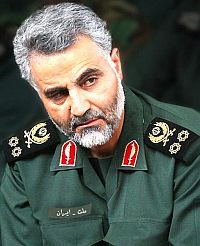
Celebrity status of General Soleimani coincides with rise in Iranian nationalism
Mahan Abedin writes: His photos are everywhere in the Iranian media and his name is mentioned on a daily basis by the national broadcaster. Major General Qasem Soleimani, the commander of the Quds force of the Islamic Revolutionary Guards Corps (IRGC), is officially a national hero.
This extreme publicity is all the more surprising in view of Soleimai’s command of the most secretive and sensitive branch of the IRGC. The Quds force is the expeditionary wing of the Revolutionary Guards and spearheads Iran’s engagement with pro-Iranian armies, militias and political factions across the region.
To the outside world, in particular to Iran’s enemies and opponents in the region and beyond, Soleimani is the potent face of Iran’s political and ideological offensive in the Middle East.
This portrait of Soleimani is being increasingly adopted at home as well, fed by a daily diet of the Quds force commander’s exploits on the Iraqi battlefield, most recently in the offensive to re-take Tirkrit from the so-called Islamic State.
Whilst Soleimani’s leading role in Iran’s counter-insurgency efforts in Iraq and Syria is undoubtedly pivotal to the Islamic Republic’s regional policy, there are huge questions marks regarding the extreme publicity that now surrounds him.
One plausible explanation is that Soleimani’s adoption as a national hero heralds a change of political culture in Iran with significant long-term ramifications for the country’s domestic and foreign policy.
Qasem Soleimani’s transformation from a secretive commander to national celebrity is unprecedented in modern Iranian culture, and his enormous popularity notwithstanding, it is not entirely without controversy. [Continue reading…]
Hardliner wins key post to influence choice of Iran’s next leader
Reuters reports: A prominent hardliner was elected on Tuesday to head the influential body that will pick Iran’s next Supreme Leader.
The surprise choice of Ayatollah Mohammad Yazdi as head of the Assembly of Experts took place at a highly sensitive time, as Iran and six world powers face a March 31 deadline to reach the outline of an agreement over Tehran’s disputed nuclear program.
Supreme Leader Ayatollah Ali Khamenei, 75, underwent prostate surgery last year and rumors have recently resurfaced about his health, although he was shown on television last Sunday meeting a group of environmental activists.
In the internal election, Yazdi, a hardline cleric who headed the judiciary through much of the 1990s, defeated former president Ayatollah Ali Akbar Hashemi Rafsanjani by 47 votes to 24, according to Fars news agency.
“This was unexpected,” said Mashallah Shamsolvaezin, an Iranian journalist and political analyst based in Tehran. “I was genuinely surprised that Yazdi won.”
The result suggested that hardliners within the Assembly had closed ranks at a sensitive time when a new Supreme Leader could soon be chosen – a decision in which the Islamic Revolutionary Guard Corps, the most powerful military force in the country, could also play a role. [Continue reading…]
Iraq’s Sunnis: Between the ISIS and a hard place
Myriam Benraad writes: More than ever, Iraq’s Sunnis remain ground zero in the struggle that is being waged against the so-called Islamic State (IS). Recent military successes by the international coalition formed by the United States last summer to counter the jihadis through the intercession of local fighters—particularly Iraqi and Syrian Kurdish militias—make it clear that the war’s outcome will in large part be determined on the battlefield. But any defeat of IS, which arose and has been fed principally by the failure of political powers to grasp the scale of the problem in time, must include a political component addressing Sunni grievances in Iraq if it is to be sustainable.
This will be complicated by Iran’s prominent role in the battle against IS. Tehran is now often presented as a stabilizing force in Iraq. However, Iran continues to play into the hands of IS, by remaining silent on the anti-Sunni exactions carried out by Iraqi Shiite militias that are funded, armed and trained by Tehran. Sunni-majority Diyala province was taken back from the jihadis in January by Iraqi security forces backed by these militias as well as Iranian troops, but at the price of more killings and forced displacement of Sunni populations. Iraq’s Shiite prime minister, Haidar al-Abadi, has also done little to rein in these militias, which he needs to compensate for the weakness of the Iraqi army. Meanwhile, the position of outside Sunni powers, Saudi Arabia and Turkey in particular, remains mutable and ambiguous in the fight against IS. Yet defeating IS will require that Sunnis across the region arrive at a coherent strategy, rather than working at cross-purposes, as is currently the case.
The challenge is first and foremost a domestic one for Iraq: How to mobilize Sunnis against IS and bring them back to institutions from which they have been excluded for a decade? From de-Baathification, which became synonymous with “de-Sunnification,” after the U.S.-led invasion of Iraq in 2003, to the 2010 parliamentary elections, in which Iyad Allawi’s largely secular Sunni-backed coalition won a narrow electoral victory but lost out to then-Prime Minister Nouri al-Maliki in the post-election wrangling, Iraq’s Sunnis had no good reason in 2014 to oppose a group that promised them liberation, revenge and political existence. It was the cooperation or non-interference of the Sunni tribes, formerly allied with the Americans against al-Qaida in Iraq between 2006 and 2008 but whose resentment toward Baghdad had since grown, that facilitated IS’ rise. The question now is whether Sunni aversion to Iraq’s political institutions can be reversed. [Continue reading…]
Sweden tears up arms agreement with Saudi Arabia over blocked speech
The Guardian reports: Sweden has torn up a decade-long arms agreement with Saudi Arabia after the Saudis blocked the Swedish foreign minister from speaking about human rights to a summit of Arab leaders.
Peter Hultqvist, Sweden’s defence minister, confirmed on Tuesday that the deal was off, removing a cause of division within the country’s left-leaning coalition but deepening a rift with business leaders who implored the government to prolong the agreement.
On Monday, foreign minister Margot Wallström complained at a meeting of the Arab League in Cairo that Saudi Arabia had objected to her planned speech on democracy and women’s rights. She had also condemned the sentencing of Saudi blogger Raef Badawi to a “medieval” punishment of 1,000 lashes.
But on Tuesday, Arab foreign ministers expressed “condemnation and astonishment” at Wallström’s remarks, which were “incompatible with the fact that the constitution of the kingdom of Saudi Arabia is based on sharia [law],” according to a statement issued at the end of their Arab League meeting and published by Gulf News.
“Sharia has guaranteed human rights and preserved people’s lives, possessions, honour and dignity. The ministers consider the comments as irresponsible and unacceptable,” the statement said.
Sweden first signed a “memorandum of understanding” with Saudi Arabia in 2005, setting out details of cooperation on intelligence, surveillance and weapons manufacture, and paving the way for the sale of Saab’s Erieye radar system to the Saudis in 2010. The agreement had to be ratified by each side every five years, and its renewal date was due in May. [Continue reading…]